How to Fail an Intellectual Health Inspection
I’ve recently taken issue with New Jersey State Senator Holly Schepisi’s claims about Delaney Hall regarding who initiated force there, but here’s a post on a different topic. On June 9th, Schepisi posted an item on her official Facebook page claiming that a May 28 inspection by the New Jersey Department of Health (NJDOH) had “proven false” migrants’ complaints about health conditions in Delaney Hall. This is her verbatim statement from the June 9 Facebook post, which she doubles-down on several times in the comments of the same post:
There have been so many conflicting comments made by NJ representatives regarding Delaney Hall but most of the claims of egregious living conditions made by Senator Andy Kim continue to be proven false. Here is the most recent example — if maggots were in food, if food was spoilt, the NJ Department of Health would not give Delaney a satisfactory health inspection.
To this end Schepisi cites a June 8 piece in Politico which links to the NJDOH report. The Politico piece summarizes the NJDOH report, and offers up some additional statements by Raynard E. Washington, New Jersey’s Commissioner of Health.
Despite the confidence with which she expresses herself, Schepisi’s claims above are false–so obviously false, and so clearly at variance with the text of the report she herself cites, that it’s impossible to avoid the conclusion that she’s deliberately misrepresenting the contents of both the NJDOH report and the Politico article simply to see whether she can get away with it. The result is the intellectual equivalent of a case of food poisoning.
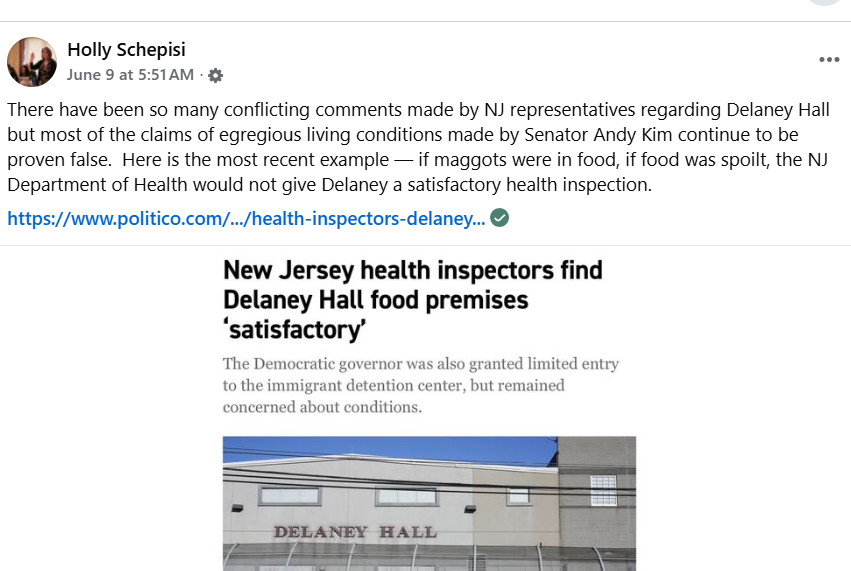
A few preliminary points are worth making. First, the complaints about maggots and spoiled food were made on or before May 22 of this year. The Health Department’s visit took place six days later, on May 28. Six days is more than ample time to cover up the most obvious of the problems mentioned in the accusations without necessarily resolving the underlying conditions: it doesn’t take seven days to throw out spoiled food containing maggots; it takes maybe fifteen minutes. So, contrary to the implications of Shepisi’s claim, a site inspection on May 28 can’t even in principle prove “false” an allegation made on or before May 22.
When you deal with someone willing to deny the obvious, you have to belabor the obvious until the point is really made. So apologies for the repetition, but here is another way of putting the obvious. The truth of the original allegation about maggots and spoiled food on or before May 22 is obviously consistent with a failure to find the maggots or spoiled food on May 28; the maggots and spoiled food might have been there on or before May 22 and might have been thrown away soon after, in which case they’d be gone by May 28.
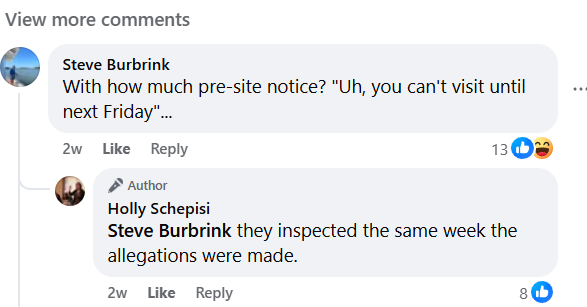
It takes a kind of self-willed stupidity–or blatant dishonesty–to wish this fact away, but that’s exactly what Schepisi does. Responding to a critic on Facebook who had made a version of the criticism I just made, Schepisi responds triumphantly that the inspection took place “the same week the allegations were made.” To be precise, since the actual presence of the maggots and spoiled food had to precede the allegations, the week the “allegations were made” doesn’t necessarily correspond to the time when the maggots and the spoiled food were physically present, but set that aside. Even if the two things had been contemporaneous, it doesn’t take a week to throw out spoiled food. It takes a couple of minutes. So the fact that the inspection took place that week is neither here nor there. Even if Schepisi wants to insist that the original accusation is unproven, she can’t legitimately say that it was “proven false.” Yet that’s the very claim she makes.
A second preliminary: the Politico article makes clear that the inspectors were unable to do a complete health inspection of the facility because they were denied access to the whole of the facility by those in charge of it. Here is a verbatim statement from the Politico report that Schepisi herself links to in her Facebook post:
In a statement to POLITICO, Department of Health Commissioner Raynard E. Washington said that “it is impossible to form an accurate assessment and make a reliable evaluation” without full access to Delaney Hall. Washington also underscored parts of the report that found that food temperatures were not appropriate.
“We were not able to fully inspect the facility because of the limited access provided to our health inspectors,” Washington said. “In terms of what we did see, we have real concerns about food cooling and reheating procedures and having a knowledgeable Person In Charge to ensure proper procedures are followed. Even more concerning is that we were not able to see the housing and medical units, where we were denied access.”
I’ll return to the “parts of the report that found food temperatures were not appropriate,” etc. The relevant point for now is that the inspectors said explicitly that “it is impossible to form an accurate assessment and make a reliable evaluation” (my emphasis) of the original accusations given the owner-operators’ refusals to give the inspectors full access. If it’s impossible to give an accurate assessment of an accusation, the same assessment can’t prove the accusation “false.” Schepisi links to the Politico article but somehow ignores this obviously relevant part of what it says. What does she make of the blatant contradiction between what the inspectors said and the words she puts in their mouths?
Here’s a further question, a third preliminary: why would the operators of Delaney Hall deny the health inspectors full access to the facility in the first place? I don’t doubt their capacity to cook up excuses, so to speak, but one obvious and relevant possibility is their desire to screen off sub-optimal conditions they weren’t able to remedy or conceal before the inspectors showed up. If you were selling your house and the house inspector showed up, what other inference would a reasonable person draw from your refusal to allow the inspector into a certain room or onto a certain floor of the house except that you had something to hide precisely there?
From the website of Schepisi’s law firm:

None of the common sense considerations about concealment I’ve just raised occurs to Schepisi, a supposed expert in land use and real estate law. It’s as though she’s never heard of the concept of an inspection (see 1, 2, 3), had never imagined that anyone ever concealed anything from inspectors, and couldn’t possibly have figured out, despite all of her extensive, much-bragged-about legal experience, that a person who denies an inspector access to something might not be fully candid. This is the person posturing to us as a courageous truth-teller about Delaney Hall. It’s enough to make a cat laugh, at least if the cat were amused by the deceptions involved.
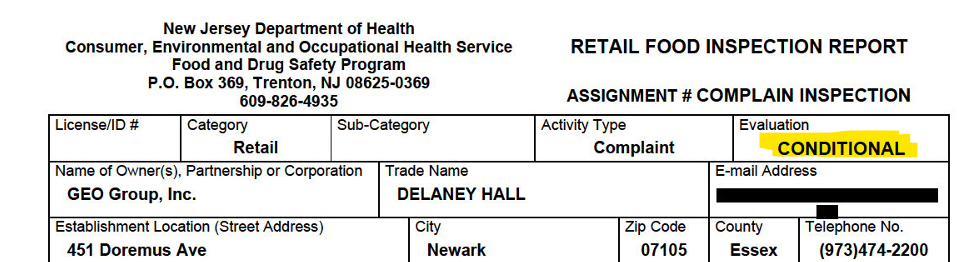
Now we get into the findings of the report itself. Both Schepisi and Politico seize on a random sentence from the Summary of Operations at the end of the report. The word “satisfactory” appears in this sentence, so they infer immediately that the report’s overall evaluation of the facility was “satisfactory.” But that’s not what the report says. The report’s overall evaluation of the facility, listed in capital letters in its first line, is: CONDITIONAL. The last full line of the report says: “The completed inspection report and NJ Department of Health Conditionally Satisfactory Rating Placard were emailed” to the relevant manager (the name is redacted).
“Satisfactory” and “Conditional” are not the same word, whether in ordinary parlance or in law. Neither are “Satisfactory” and “Conditionally Satisfactory.” They’re not interchangeable synonyms, either. They’re qualitatively different evaluations. “Satisfactory” means that conditions are close to normal or acceptable. “Conditional” (or “Conditionally Satisfactory”) means either that they are not Satisfactory but could be corrected so as to become Satisfactory, and/or that information is insufficient to make a full determination. There is no way to equate these two things except to be totally out of touch with reality, or to hope that your audience is. I’m not sure which of these two options paints a worse picture of Schepisi, but neither paints a good one.
Here, for those interested, is the legalese:

“Conditionally Satisfactory” means that the facility was out of compliance. How much clearer can it get? I’m not a lawyer; I’m just a former hospital janitor who’s prepared for, and been through, a couple of facility inspections. Is the issue here that my legal knowledge is better than Schepisi’s, or that I have an honest desire for truth that she seems to lack? Not a rhetorical question: how could Schepisi conceivably be making an honest mistake here? I don’t know, but it’s easy enough to see how she could be making a dishonest one.
Tedious as it may be, let’s go through the report, section by section. The report begins with a grid containing its overall evaluation and some basic non-health-related information about the site (Name of Owner, Trade Name, Address, etc.). As I’ve already argued, this section makes clear that the overall evaluation of the site is CONDITIONAL, not “satisfactory.”
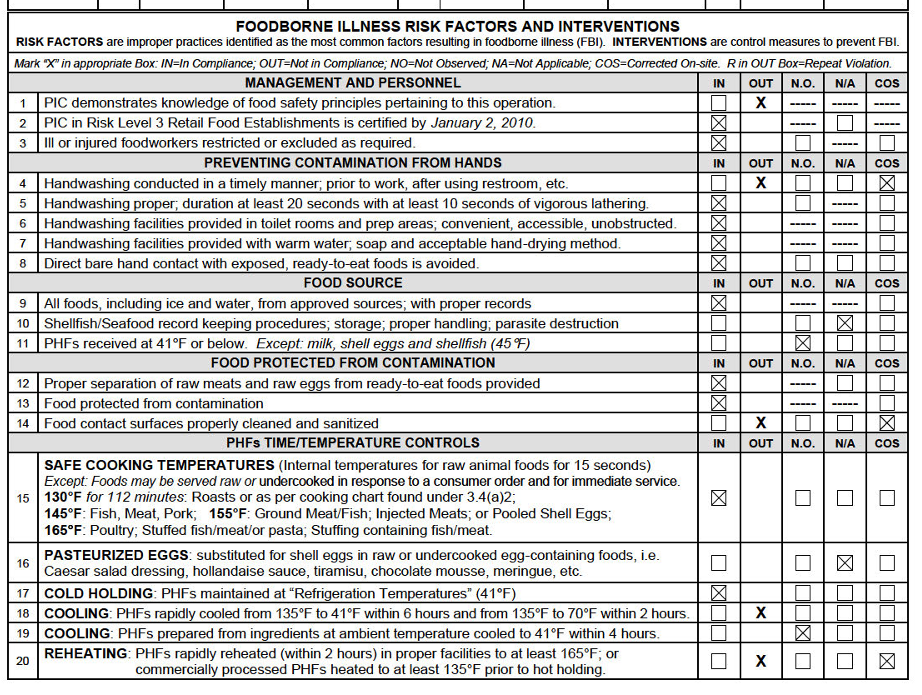
After this, we get a long checklist of “Foodborne Illness Risk Factors and Interventions” (items 1-24) followed by another one enumerating “Good Retail Practices” (items 25-52). Delaney Hall was found out of compliance on seven of these, namely (1), (4), (14), (18), (20), (27), and (39). Here is the first half.
And here is the second.
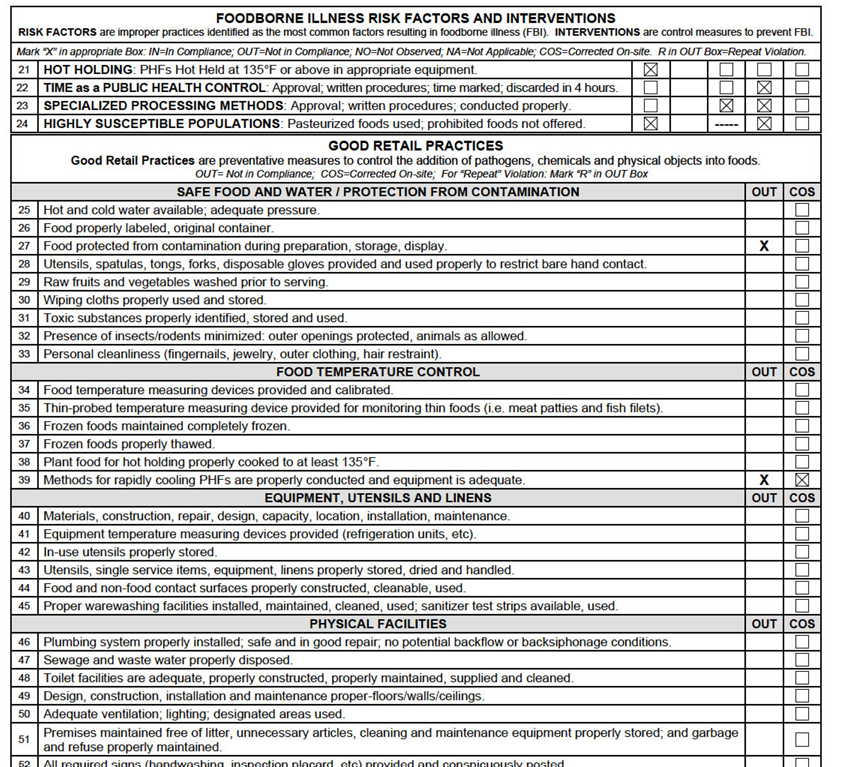
Here is the explanation in each case. Remember that each of these identifies a violation:
1. PIC (Person in Charge) demonstrates knowledge of food safety principles pertaining to this operation: out of compliance.
4. Handwashing conducted in a timely manner; prior to work, after using restroom, etc.: out of compliance.
14. Food contact surfaces properly cleaned and sanitized: out of compliance.
18. Cooling: PHFs (Processed Heated Foods) rapidly cooled from 135 F to 41 F within 6 hours and from 135 F to 70 F within two hours: out of compliance.
20. Reheating: PHFs rapidly reheated (within 2 hours) in proper facilities to at least 165 F; or commercially processed PHFs heated to at least 135 F prior to hot holding: out of compliance.
27. Food protected from contamination during preparation, storage, display: out of compliance.
39. Methods for rapidly cooling PHFs are properly conducted and equipment is adequate: out of compliance.
Items (4), (14), (20), and (39) were corrected on site during the inspection. Notice that correction of these conditions took place within the time frame of the inspection, i.e., within a few hours on a single day. In fact, they’re described in the report as happening “immediately.” This proves that correction of many violations can take place within (at most) a day, and proves, a fortiori, that six days are more than ample to conceal any overt violations.
Non-compliance on any or all of these factors is consistent with spoilage and with the presence of maggots. I refer the reader to the U.S. Department of Agriculture’s Food Safety and Inspection Service Report, “Foodborne Illness and Disease.” Look in particular at the section titled “The Danger Zone,” which makes clear that Delaney Hall was, per the Health Department’s report, precisely a danger zone of the relevant kind.
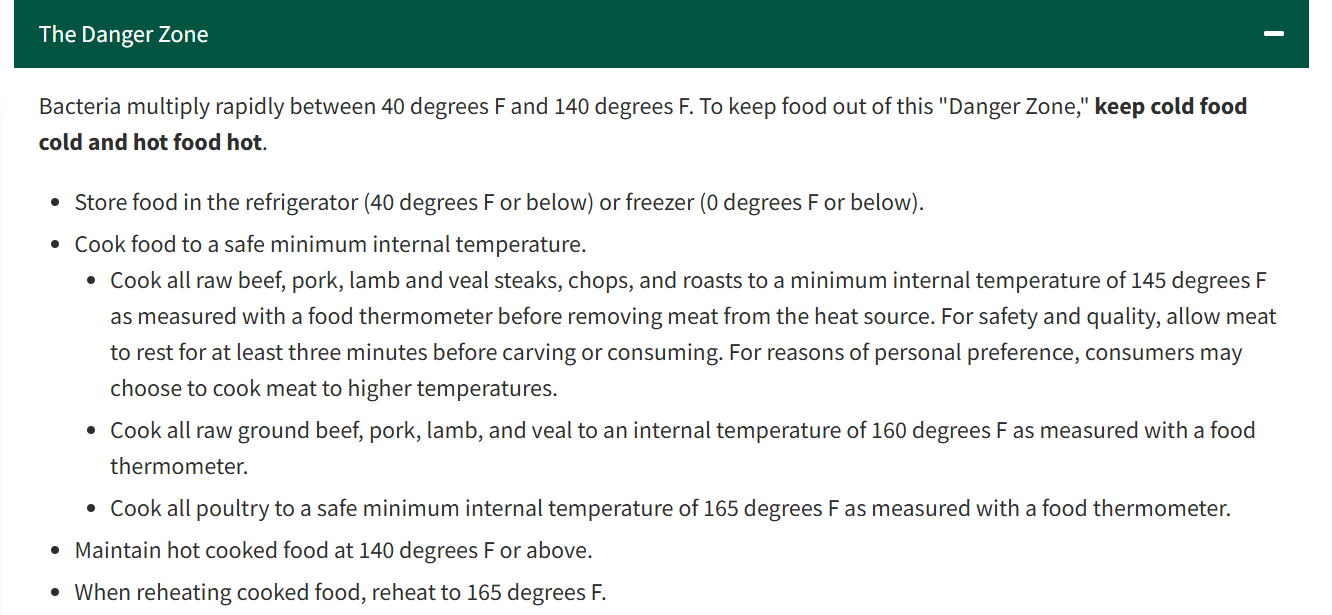
These are the exact issues on which Delaney Hall was out of compliance. From a scientific study on foodborne illness:
Foodborne illness almost always is a result of temperature abuse, and in many instances, the food vehicle has been improperly cooked meat or meat product that has been left to cook and/or cool too slowly or has undergone insufficient reheating, allowing surviving spores to germinate leading to vegetative cell proliferation. After ingestion and an incubation period of 7–30 h, symptoms typically include cramping and abdominal pain, although nausea and vomiting may also ensue, persisting for 24–48 h [7].
“Temperature abuse” was cited by NJDOH as the exact problem at Delaney Hall.

Here is a hypothesis perfectly tailored to the evidence: maggots and spoiled food were present on or before May 22, created by the very factors found out of compliance on May 28; the maggots and spoiled food themselves were not found on May 28 because they were discarded and/or concealed before the inspection, indeed potentially concealed in a place on the site off limits to the inspectors.
This hypothesis, which fits the evidence exactly, flatly contradicts Schepisi’s claim that the report proves the accusations of maggots and spoiled food “false.” It not only doesn’t prove the accusations false, but provides all the evidence one would need to make it likely that they were true. The only things missing are the maggots and spoiled food themselves. I guess arrangements should have been made by Delaney Hall’s residents to hold on to the maggots and spoiled food for six or seven days in expectation of the inspectors’ arrival. How exactly incarcerated people are to store maggots or spoiled food for that long (or where) I leave to Senator Schepisi & Co. to explain.
The two pages of checklists are then followed by seven “Remarks.” All seven of these remarks elaborate on the seven out-of-compliance conditions in the facility.
Item 1: The Person in Charge (PIC) failed to ensure food employees were properly trained and monitored regarding approved cooling procedures. As a result, food products were subjected to time/temperature abuse due to improper cooling practices, creating a potential food safety risk and demonstrating inadequate managerial control over food operations.
Item 4: Two garbage containers in the prep area were observed fully covered during food tray plating. Several staff were observed touching the garbage container openings while disposing of waste, creating a potential for hand contamination during food service. Staff were directed to wash hands immediately. *COS* (Corrected on site)
Item 18: Two covered stainless steel trays containing chicken stew were observed stacked in the walk-in cooler with a product temperature ranging from 50 to 57 F. Review of the product label and staff interview determined the product was improperly cooled after service the previous evening. *The affected food items were voluntarily discarded, and immediate onsite training was provided by NJDOH to onsite staff on proper cooling methods.* [The asterisks mean: corrected on site.]
Item 20: Individual frozen meals meatballs in the holding unit were observed with an internal product temperature of 118 F. Products were immediately reheated in the microwave to achieve product temperature above 165 F.
Item 39: The firm was found not following proper procedures for rapidly cooling potentially hazardous food items after cooking. E.g., Cooked chicken stew was not cooled in accordance with required time and temperature parameters. (Voluntarily discarded all improperly cooled trays of chicken stew) *COS*
Item 27: Storing cases of soda in same closet next to chemicals.
Item 14: Chemical sanitizer measured below proper concentration when run through the mechanical dishwasher (chemical level was full in container; a few cycles were ran through machine and concentration was tested at 200 ppm chlorine) *COS*
To summarize:
- The food was subjected to “time/temperature abuse,” creating “a food safety risk”;
- Staff touched garbage, didn’t wash their hands, then served food;
- So many mistakes were made with the chicken stew that it immediately had to be thrown out;
- The meatballs weren’t cooked hot enough to kill all relevant pathogens, so it had to be re-heated on site;
- Soda was stored next to chemicals; and
- The dishwashing liquid was too diluted to wash the dishes.
According to Schepisi, this conclusively proves that the accusations of maggots and spoiled food of six days prior were “false.” Unfortunately for her, logic, common sense, and science say otherwise.
The penultimate section of the report is a Summary of Operations. One item in this summary notes, incredibly, that “On first pass mechanical dishwasher wasn’t drawing chemical into rinse cycle, our team discussed ensuring staff know to run a few cycles and ensure chemicals are at an effective concentration to sanitize dishes.” In other words, it is not clear that the dishes at Delaney Hall were properly being washed. How does this falsify a claim of food contamination or maggots?
Immediately after the Summary of Operations there is a summary of the Discussion with Management. This more or less repeats what was said in the “Remarks.” The last line says: “The facility must ensure that food employees consistently follow approved procedures to prevent the recurrence of these violations.” The obvious implication is that the failure to follow the relevant procedures caused violations in what limited part of the facility was observed even after the operators had six days to remedy the most overt violations mentioned by the accusation.

I guess we should be comforted by the thought that the dishes were being washed with “low-temperature” water (without detergent). Most of us were taught, around the age of five, that this method of “washing” things doesn’t work, but I guess the Lords of Delaney Hall know better.
“If maggots were in food, if food was spoilt,” Schepisi tells us, “the NJ Department of Health would not give Delaney Hall a satisfactory health inspection.” This is wrong both ways around. For one thing, the New Jersey Department of Health didn’t give Delaney Hall a satisfactory health inspection. In any case, the if-then statement itself is false. A satisfactory health inspection on May 28 would have been consistent with accusations of maggots in food and spoiled food on or before May 22. If the maggots and spoiled food reported on May 22 were removed quickly enough, and the conditions remedied, then a May 28 inspection might not reveal them.
The fact remains that the actual inspection that took place in reality, as opposed to Holly Schepisi’s Facebook propaganda, revealed “violations” that might well have given rise to both spoiled food and maggots (and more). That no spoiled food or maggots were found is beside the point. Such overt violations could easily have been concealed, but conditions were present to produce maggots or spoiled food. Finally, the inspection was incomplete, rendered incomplete by Delaney Hall’s refusal to provide full access to the whole facility. Evidently, Schepisi sees nothing amiss there.
Schepisi’s failure to mention these facts constitutes a blatant, systematic misrepresentation of the contents of the report. She should be held accountable for this violation of the public trust in just the way that the operators of Delaney Hall should be held accountable for their documented violations of food safety protocol (and much else). If only there was a New Jersey Department of Intellectual Health for State Senators with mouths bigger than their sense of responsibility. Too bad there isn’t.
Thanks to Suleman Khawaja, MD for helpful comments that improved an earlier draft of this post, and to Angela Lipira for drawing my attention to NJAC 8:24, which defines “Satisfactory” and “Conditionally Satisfactory” in the present context. Neither individual is responsible for anything I say in this post; responsibility for all formulations and for any errors is mine alone.
My own limited-but-relevant experience includes work as an Assistant to the Vice President of Global Quality and Regulatory Compliance at the now-defunct American Cynamid Agricultural Research Center (which underwent periodic inspections by the USDA and FDA), and as a janitor at Overlook Hospital and in the OR at Hunterdon Medical Center (inspected by the Joint Commission and Hunterdon County Department of Health). That said, little specialized experience is needed to detect the nonsensical character of Schepisi’s post.


Pingback: Delaney Hall: Would They Lie to You? | Policy of Truth
They’re only maggots; just wash them out with brine:
https://www.youtube.com/watch?v=7UWX0oFPJak
LikeLiked by 1 person
Pingback: Getting Delaney Hall Wrong | Policy of Truth
Pingback: Holly Schepisi “Responds” | Policy of Truth
Pingback: The Delaney Hall Scandal Revisited | Policy of Truth
Pingback: DHS Is Systematically Lying to You | Policy of Truth
Pingback: “Keep New Jersey White” | Policy of Truth