Not a joke headline. It happened the other day in Pasadena, California. It almost sounds like a comedy skit intended to unmask the hypocrisy of “Western” claims that Hamas uses “civilians as human shields.” We can’t, of course, be entirely sure of the military’s intentions here. The residents might not have been human shields; they might be simulated targets, after all. But that doesn’t really improve things.
PASADENA, Calif. (KABC) — A late-night military training exercise in Pasadena startled residents as helicopters flew overhead and landed at a long-closed medical facility.
The exercise began around 8:30 p.m.Wednesday, with helicopters landing on the former St. Luke’s Medical Center building, which has been closed for more than 20 years. Residents said the noise continued into the early morning hours.
In other words, the U.S. military casually used a densely populated American city as a training base, with a hospital as its operational center. Here’s an item from KTLA TV with video for the full effect. Here’s one from Pasadena Now. And from The Los Angeles Times. The Los Angeles Times item reports that similar operations took place in Long Beach and Irvine, as well. So this wasn’t a one-off; it was part of an elaborate plan.
And not just a California plan; it’s happening in New Jersey, too. I got a Nixle alert last night for West Windsor Township alerting area residents to military exercises for chunks of June at Joint Base MDL–Joint Base McGuire Air Force Base, Fort Dix, and Lakehurst Naval Center–or “Fort Dix” for short.
Advisory: Joint Base MDL Training Noise Advisory – June 2026
Dear Irfan Khawaja, The West Windsor Police Department is advising residents of anticipated noise and vibration impacts associated with scheduled training activities at Joint Base McGuire-Dix-Lakehurst during the month of June 2026.
According to the published training calendar, higher noise levels are expected on the following dates:
• June 1 through June 7
• June 9 through June 10
• June 14
These activities may include heavy weapons training and munitions use which may produce loud noise and vibrations that can be heard or felt throughout our area.
What Residents May Experience:
• Loud booms or sustained noise
• Ground vibrations depending on weather conditions
• Intermittent activity throughout the day and evening
Pet Safety Recommendations:
Keep pets indoors during high noise days when possible
Close windows and doors to help reduce sound exposure
Use televisions, fans, radios, or white noise to mask sudden sounds
Create a quiet, secure space where pets can retreat
For pets with known anxiety, consult your veterinarian regarding calming strategies
This training remains important for military readiness and preparedness. We appreciate everyone’s patience and understanding.
For questions regarding training schedules, residents may contact Joint Base MDL at 609-754-2575.
I’ve previously argued here that defense contractors and military facilities are often in our midst, whether subtly or in covert ways (another example). Joint Base MDL is not precisely in the midst of West Windsor or Princeton; it’s just proximate enough for residents to hear the munitions and to produce anxiety in pets. But obviously, Fort Dix is in the midst of Fort Dix. Here’s a screen shot of part of Fort Dix, from Google Maps:
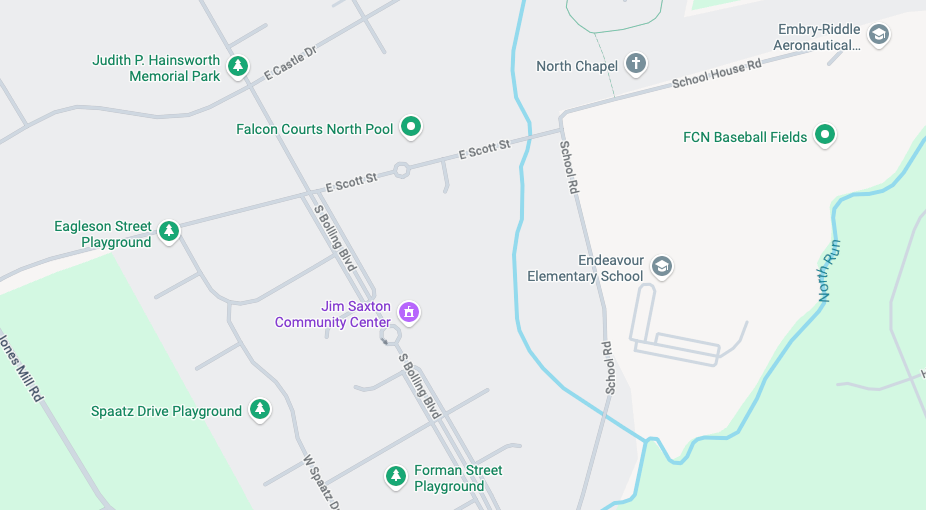
Yes, this is the kiddie part of Fort Dix: three playgrounds, a park, baseball fields, a community center, a community pool, a church, and a school. But it’s definitely on base. Army brats have to go to school, after all, and need recreational spaces in which to play. Obviously, they do that on base. Every military facility has its share of schools, parks, playgrounds, athletic fields, and community centers. It’s taken for granted as part of military life, even if it puts the kids directly in the line of fire. I guess they’re in the line of fire in a lot of non-military schools anyway.
Hospitals? Well, some military bases have their own dedicated hospitals, and some hospitals are in a sense dedicated bases; think for instance of Naval Support Activity Bethesda, home of the Walter Reed Army Medical Center, which answers to both descriptions at once. But not Fort Dix. Fort Dix has an ambulatory care facility in Wrightstown, New Jersey, but no dedicated hospital, so it transports its patients to local civilian hospitals: Virtua Hospital in Mt Holly, Jersey Shore Medical Center in Neptune, or Capital Health in Hopewell and Trenton. I would know; I work in hospital revenue management, and Capital Health is both one of my company’s clients and the hospital associated with my primary care physician, where I get medical procedures done.
In other words, were Fort Dix to come under attack, any casualties sustained there would be transported at least in part by civilian ambulances to civilian hospitals. If the presence of military personnel during active wartime makes something a target, then every ambulance, every roadway on which they traveled, every station in which they were housed, and every hospital to which they traveled, would become a target–just as they were in Gaza.
I can’t resist adding that it’s highly likely that, given its architecture, Jersey Shore Medical Center has a series of subterranean tunnels underneath it. Walkable utility tunnels or interstitial crawlspaces are standard industry practice for routing steam, water, and electric lines across multiple buildings so that maintenance crews can access them without digging up roads. What used to be called Christ Hospital in Jersey City, where my parents practiced for four decades, had a pedestrian tunnel between it and our apartment building across the street, Palisade Avenue. The point was to facilitate quick, safe passage from housing to hospital at night or in inclement weather. You don’t want your on-call cardiologist to get mugged or slip on the ice on the way to a medical emergency. Instead, she sits in her apartment until she gets the call, then runs down to the tunnel across Palisade Avenue, and into the hospital where she’s needed. My mother had to do this early in her career, and so, filled my ears with praise for these tunnels.
Though you wouldn’t know this from reading the news, tunnels are in fact a commonplace in most modern hospitals, and are often indistinguishable from “the basement.” That was certainly the case in the hospitals I’ve worked in as a janitor. You don’t typically want to store, say, janitorial equipment or waste disposal material alongside medical equipment, so it often makes sense to put that stuff at a distance from the medical part of the hospital, e.g., beneath the hospital, in a labyrinth of rooms that looks like a series of tunnels. In fact, though tunnels are standard in modern hospitals, they were a commonplace in many older hospitals, too. The motivations for them aren’t new. The hospitals of Gaza are far from unique in this respect.
Were Virtua or Capital Health or Jersey Shore to be overwhelmed by casualties (as they likely would be in any large attack on Fort Dix), the casualties would have to be shipped all over the state–Trenton, Princeton, Freehold, New Brunswick, Elizabeth, Newark, etc. Military patients would then rest side-by-side in the Emergency Departments, ICUs, ORs, Radiology Depts, etc. alongside non-combatant civilians. EMTs, doctors, nurses, technicians, and even auxiliary staff like janitors, food service workers, linen, and security would then begin to play a quasi-military role in the medical-military effort of treating these casualties.
Indeed, since all of this medical care would have to be paid for, we would all play some indirect role, including those of us, like me, tasked with bill collection and denial management. If plain old causal contribution to the war effort makes something a target, then all of these things would be targets–ambulances, ERs, nurses, physicians, janitors, revenue managers, taxpayers. If greater discrimination is required, some of them wouldn’t be, but a look at Israel’s war in Gaza, or Russia’s in Ukraine, or Ukraine’s in Russia, or the war in Congo, suggests that even if greater discrimination is required, it isn’t to be expected.
Once you know how and where to look, it becomes impossible to sustain the illusion that villains like Hamas and Hezbollah are unique in using non-combatants as human shields. If proximity to military operations is sufficient for human shieldhood, and military operations are understood functionally to include supply chains and revenue streams, then human shieldhood is a ubiquitous feature of modern life. Everyone is a human shield, and in far, far more ways than most people realize. But I have more examples, for those unimpressed with the ones I’ve so far used. Better still, the modern world gives me confidence that I’ll never run out.


The campuses of Dartmouth and Harvard, I can testify, also feature subterranean tunnels, as a means of bypassing snow, ice, and general cold. The ones I explored on the Harvard campus took me from my residence hall to neighbouring ones, and also from the dorm area to the midnight grill area; they’re also where the laundry machines were. The tunnels I explored on the Dartmouth campus took me from one computer lab to another quite distant. Cornell, which needed such tunnels at least as much as Harvard and Dartmouth, didn’t seem to have any, at least not that I found,.
LikeLiked by 1 person
It’s very sad to learn that Hamas has made such inroads into the Ivy League. You say that you were unable to find the tunnels at Cornell, which only underscores the imminent nature of the danger the institution faces. Clearly, the Cornell tunnels represent the unknown unknowns which, by double negation, are known. And being known, they must exist.
LikeLiked by 1 person
In vaguely related news, when I was in NYC in 2007 for the SDS / MDS conference, I stayed at a (now no longer extant) hotel in Greenwich Village (the Larchmont, 27 W 11th St.) across the street from the building (18 West 11th St.) where, in 1970, members of the Weather Underground accidentally blew themselves up while making a bomb intended for a dance at Fort Dix.
LikeLiked by 1 person
I had made a mental note of visiting that location sometime this summer. There’s a kind of memorial to it there which I’ll photograph and post here.
https://www.atlasobscura.com/places/the-weathermen-townhouse-explosion-new-york-new-york
LikeLike