The US-Israeli war on Iran is two weeks old, and getting worse every day. So far, the anti-war movement’s response has been salutary, but muted. A lot of astute commentators deserve credit for saying a lot of the right things, but as far as visible public outcry is concerned, we’ve fallen short.
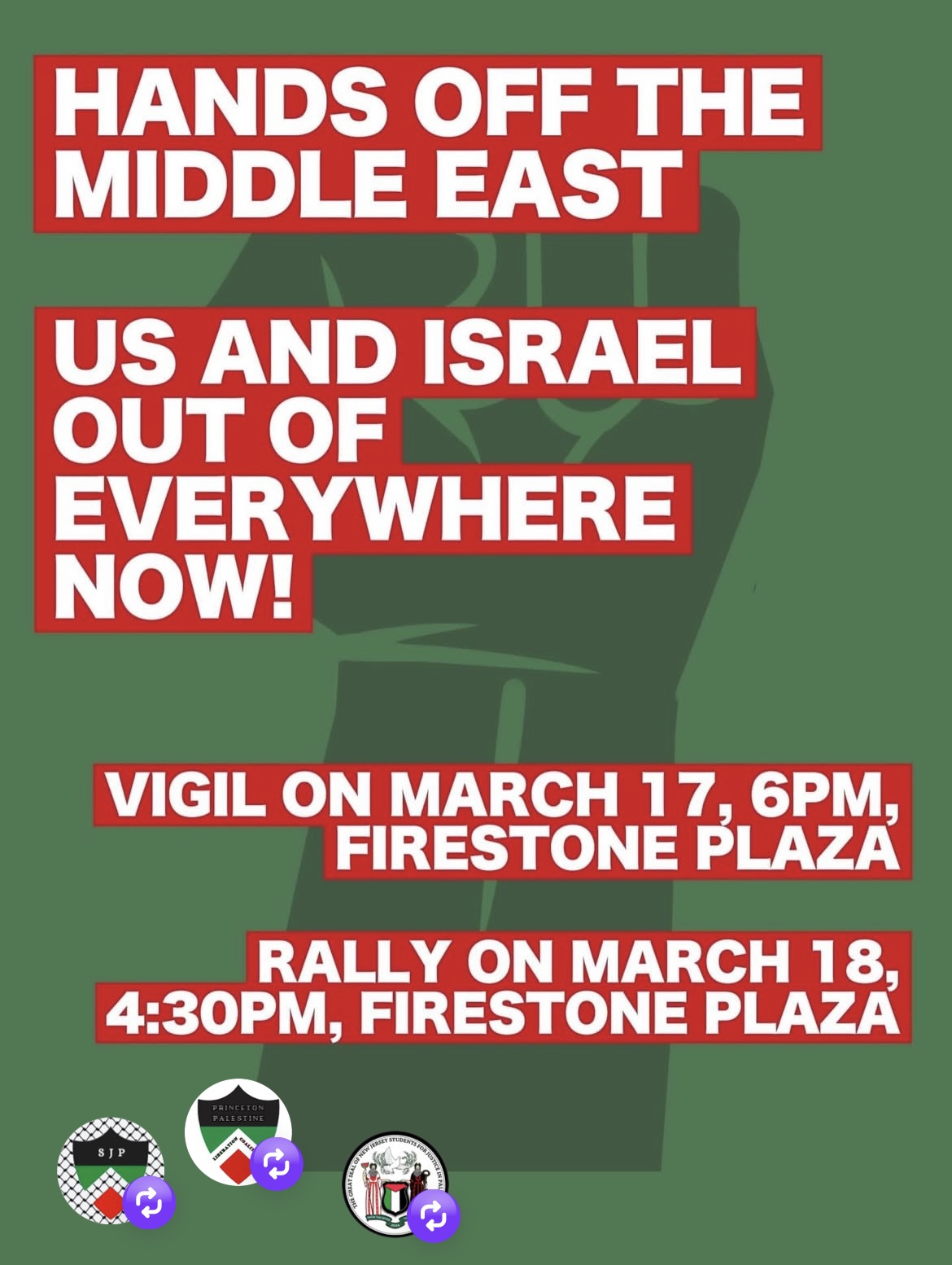
I split my time between Princeton and West Orange, New Jersey. We had a smallish anti-war rally in Princeton on the first day of the war, sponsored by the local Coalition for Peace Action and Indivisible; 180 people showed up in Hinds Plaza, and we got some modest but positive local news coverage across the following week. There was a small follow-up rally a few days later at Princeton’s War Memorial, and then some canvassing with Adam Hamaway, a local anti-war candidate for Congress. A vigil and a demonstration are scheduled for next week at the University, organized by some of the student groups there. A respectable but hardly overwhelming display.
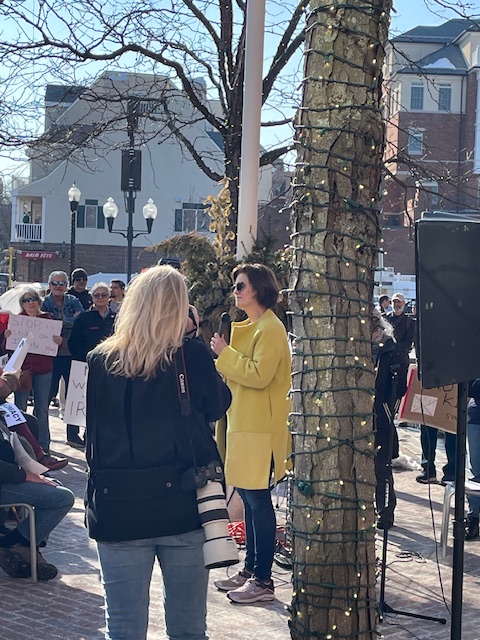
Annelise Riles speaking at Hinds Plaza, Princeton, Feb. 28, 2026
In West Orange, however, there was essentially nothing–resounding, indifferent silence. (To be fair, there were demonstrations in nearby South Orange and Montclair.) That’s pretty much the summary statewide, I suspect, and nationwide as well: very modest, low-key demonstrations in woke university towns and larger cities; near silence in the suburbs and exurbs.
I’m not blaming anyone–we’re all tired and burned out–but this level of opposition is not going to work. Iran is the Vietnam of our generation. Public protest played an instrumental role in ending the war in Vietnam, but only after it passed a threshold. The March on the Pentagon involved 100,000 people (October 1967). The Moratorium to End the War in Vietnam involved 2 million participants (October 1969). The May Day protests of 1971 shut Washington DC down and resulted in 12,000 arrests.
That’s the only kind of scale that will make a difference, and even protests on that scale took years to play out. The US role in Vietnam began in 1955 and ended in 1975. The anti-war movement only got started in earnest half-way through that involvement, and it took a good decade for it to induce LBJ and Nixon to stop the war. But they did: a standard historical view defended by a prominent consensus of historians holds that the anti-war movement accelerated the political collapse of support for the war (see, e.g., the work of Melvin Small, Lawrence Wittner, Charles DeBenedetti, Jeffrey Kimball, George Herring, and Guenter Lewy). It’s sad but instructive that we still fly those fraudulent POW-MIA flags on every other building, but have forgotten what it takes to end a war.
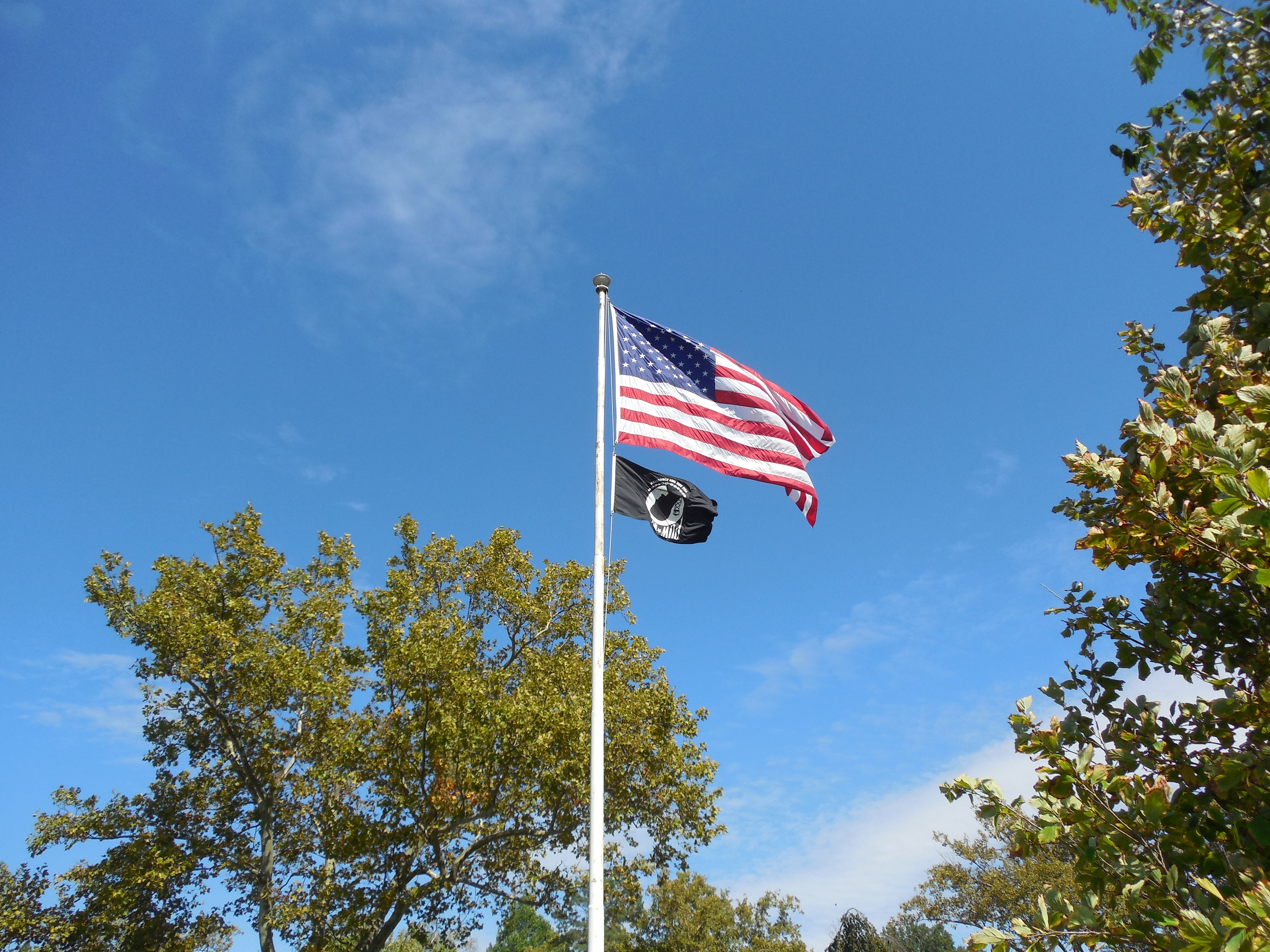
Edgemont Park, Montclair, New Jersey
The population of Princeton is about 30,000, that of West Orange, 50,000. What we need in towns of this size is not a demonstration every now and then of 150-180 people (largely retirees), but recurring, semi-ritualized demonstrations of several thousand people of all ages and descriptions. Going to a demonstration should be like going to church on Sunday. The expectation is that you show up each week. If you miss a week or two, you probably need an excuse of some kind, but if it happens, you can make it up in zeal at the next service you attend. It’s a safe bet that several thousand Princetonians go to some combination of church, synagogue, or mosque each week. Nothing stops them from showing up somewhere to protest the war.
And somewhere can be church. While many houses of worship frown on politics from the pulpit or in the pews, many don’t. So no one should balk at the idea of making their house of worship a satellite campus of the anti-war movement. We already take for granted that it’s perfectly fine to invite indicted war criminals to a Torah Study Center, or fine to conduct apartheid-promoting real estate deals at your local synagogue. Also fine to indoctrinate kids in Zionism, send them on Birthright tours, and give them all the pro-war propaganda Hashem wants them to hear. Meanwhile, conservative mosques in the US are never shy about lecturing their congregations about the evils (inter alia) of homosexuality, and the Catholic Church is even more assertive than that about the promotion of its comprehensive, explicitly hegemonic political agenda. “Politics doesn’t belong in the sanctified space of a house of worship or anywhere nearby” is obvious bullshit. No one practices it consistently, and no one really believes it. So no one should respect it.
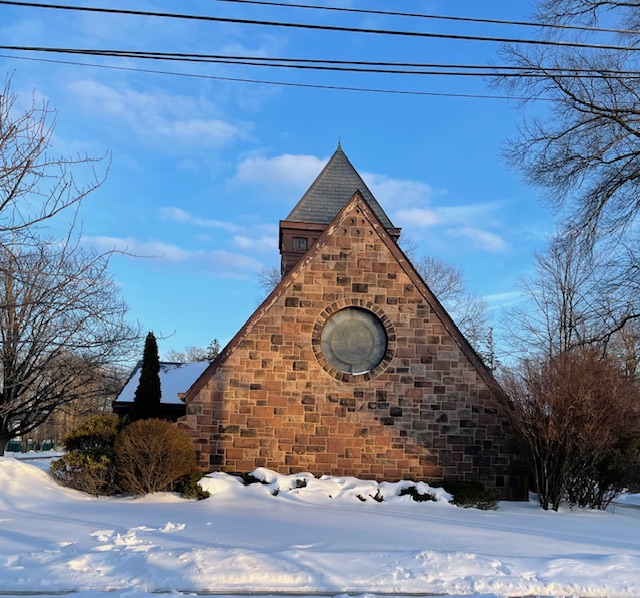
St Cloud Presbyterian Church, West Orange, New Jersey
On the other side of the ideological divide, churches have been instrumental in migrant defense work (among many other things), and of course, were central in the 1960s to the civil rights movement. Though they sometimes seem a bit tepid about it, to their credit, mainline American Protestant churches today have a robust anti-war dimension about them: think of Churches for Middle East Peace, the Evangelical Lutheran Church of America, the Quakers, or the National Council of Churches. Jews have JVP and IfNotNow; Catholics have Pax Christi; Muslims have CAIR. Some of these organizations are literally within the church (synagogue, mosque), others are adjacent lay organizations, but they’re all closely enough connected to their religious constituencies to be able to mobilize them in an anti-war movement.
Or think of prominent individual leaders. Arguably, Martin Luther King Jr’s very best speech was the broadside he delivered against the Vietnam War, “Beyond Vietnam–A Time to Break Silence,” at Riverside Church in New York City exactly a year before his assassination (April 4, 1967). And like MLK, Father Theodore Hesburgh’s career was famously transformed by his belated-but-welcome anti-war stance (not that all parts of his view were equally defensible). Among Jews, think of Abraham Heschel or Arthur Waskow; among Muslims, think of Malcolm X or Muhammad Ali. Given these examples, no one can claim that religious involvement in politics is somehow unprecedented or unsavory. We could go further: arguably, religious leaders who balk at opposing the war should be removed–canceled–in favor of those who don’t. Those swords aren’t going to beat themselves into plowshares.
The recent benchmark for a large-scale political event in Princeton is the May Day demonstration by Resistencia en Acción last year, which drew 1,000 people. (Another benchmark is Princeton University’s annual Reunions celebration, which draws several thousand.) We need to repeat that performance vis-à-vis the Iran war, and do it on a recurring basis. As a repeat performance, imagine 2,000 people, town and gown, showing up at the SPIA fountain at Washington and Prospect Streets, marching across the University from McCosh to Nassau Hall, gathering at Cannon Green (in defiance of the university’s ban on political protests there), marching past Nassau Hall down Witherspoon Street, stopping at Hinds Plaza, and ending up at Palmer Square. Now imagine they do it monthly. That’s the level of opposition that will attract the notice of the people in power.
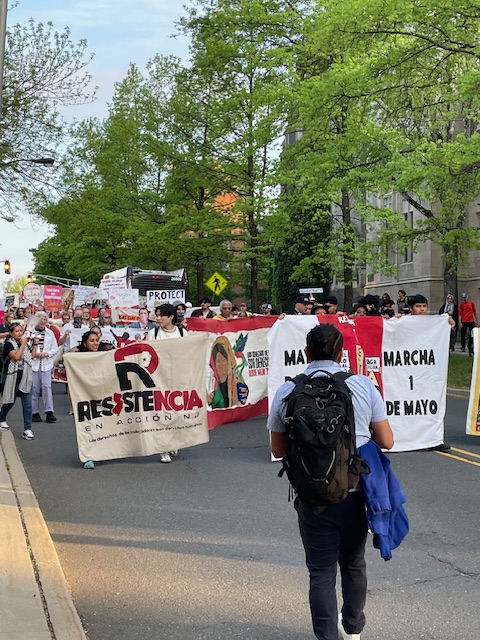
May Day Rally, 2025, Princeton, New Jersey
There’s no comparable recent benchmark in West Orange. To imagine large crowds making their way through the streets of West Orange, you’d have to think back to the days in the late 80s and 90s when the New Jersey Devils used to play practice games at South Mountain Arena, or in the early 80s, and before that, the early 70s, when famous bands used to play outdoor concerts at South Mountain Reservation (Chuck Berry, Johnny Winter, the Allman Brothers, Pat Benatar, Southside Johnny, the Doobie Brothers, Jefferson Starship). With those examples in mind, imagine 5,000 people converging each month on the current Codey Arena/South Mountain Recreation Complex demanding an end to the war. Or imagine 2,500 at the Arena and 2,500 at Stagg Field, with hundreds going back and forth between two separate but interconnected rallies.
If this seems outlandish to you, ask yourself how it is that we regularly got thousands of people to show up to Devils practice games or mid-tier rock acts decades ago when there was no social media, but throw our hands up in despair at getting anything like that at an anti-war rally when we have half a dozen social media platforms to do the job.
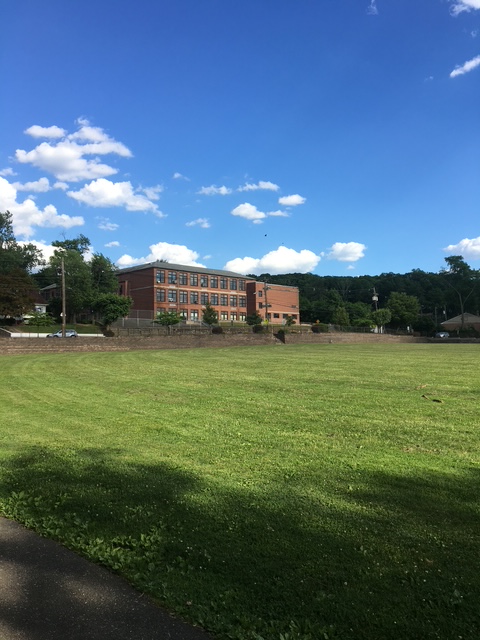
Stagg Field, West Orange, New Jersey
What seems outlandish to us is a matter of perspective. Consider what we take for granted, even during wartime. The American Dream Mall in East Rutherford gets 92,000 visitors a week–this in an age when malls are supposedly passé. I guess shopping til you drop is compatible with dropping bombs until Middle Easterners drop. Tens of thousands of people show up every few days at the Meadowlands, the Prudential Center, PNC Arts Center, and Madison Square Garden for sports events and rock concerts. The only worry people have is “security,” with little thought about why the need for such tight security arises in the first place. Even smaller, high brow local venues like the Met Opera, NJPAC, Bergen PAC, SOPAC, and McCarter Theater fill up on a weekly basis for cultural events. Here, even the security worries evaporate, too gauche to be said out loud.
On a smaller, but more recurrent scale, hundreds of people show up every night in towns across this state for high school sports events, and thousands for college sports events. On a yet smaller scale, think about Shillelagh’s Irish Pub, an Irish-themed watering hole in my neighborhood, comparable to so many like it in suburbia. Shillelagh’s is a pub and a restaurant, but also something of an Irish cultural center, which features ten Irish cultural events a month; people show up without fail for them, filling the room and filling up the parking lot. It’s forgotten, however, that back in the 80s, Shillelagh’s was less a politically neutral entertainment center than a Sinn Fein-friendly redoubt, where charged political talk and activism were as much part of the atmosphere as anything else. It also seems to be forgotten that anti-war politics is as central to Irish culture as beer, loaded fries, and the Pipe and Drum. It’s only in America that Irish culture is equated with the gastronomic and musical and emptied of political content. That happened by a slow process of deterioration, a gradual abdication of the political and a retreat into complacency. It’s not a fact of nature, and doesn’t have to be treated as one.
That said, the surest way to fill town council chambers in New Jersey is to put property values on the agenda; the second-surest way is to put ICE on the agenda. It’s just proof, if any was needed, that people will carve time out of their schedules to show up and speak out when they see something at stake.
So no one can claim that New Jersey lacks the population to populate anti-war rallies, or that it’s impossible to motivate people to come out en masse for large-scale events. They regularly do. They just lack the motivation to oppose the wars that they’ve collectively voted for, and that are waged in their names.
While you’re at it, ask yourselves how it is that we can passively allow a war to be fought in our name while permitting people to bring Iranian protesters up as the justification for the war. Thomas Friedman argues with a straight face in The New York Times that the prospects of the Iranian people are improved by their being subjected to apocalyptic violence, i.e., being killed, maimed, and displaced by systematic aerial bombardment; he remains unfazed by the difficulties even as he admits that the war may deprive the supposed beneficiaries of life, limb, housing, health care, and drinking water. How is a person’s situation improved by being blown up, rendered homeless, or dying of thirst? No one making these obscenely idiotic arguments feels the need to explain how the cost/benefit ratio works, or how anything works. Essential to them, however, is a strangely arms-length valorization of political protest abroad.
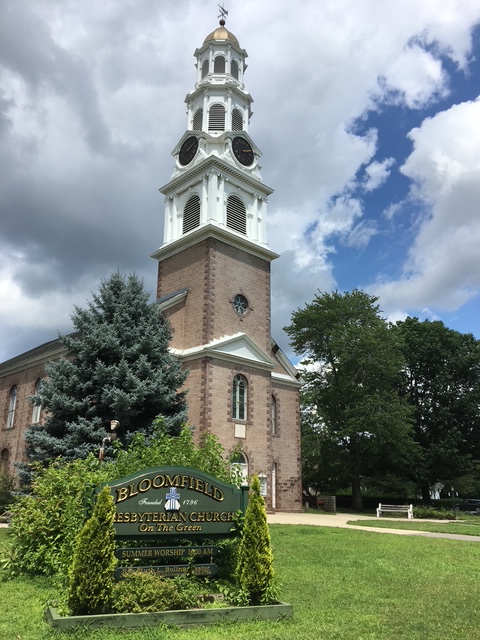
Bloomfield Green, Bloomfield, New Jersey
It’s worth asking, then: why is it the fate of Iranian protesters to take to the streets at the suggestion of our President, but somehow our job to sit on our asses as they get shot to pieces, first by their government, and then by ours? What exactly are we valorizing when we cheer protesters on to their deaths, but refuse to venture outside to do the safest conceivable version of what they were doing? To protest the war in public is to bring these questions directly into public view. What we need to reject, by word and deed, is precisely Friedman’s prescription for us: namely, that we should be applauding street protests over there, transfixed by the empty talk on our TV or computer screens, as we wait passively here for our rulers to take the next disastrous action.
People often complain that New Jersey tends to lack civic spaces, so that it’s hard to do street protest here without trespassing on private property and getting arrested for it. Though there’s truth to that, it tends to be more true of suburban space than of other spaces. There’s no shortage of civic space in Jersey’s cities or its less suburbanized towns: think Military Park in Newark, Lincoln Park in Jersey City, Eastside Park in Paterson, or “the Greens” in Morristown or Bloomfield. Even in the suburbs and exurbs, there’s no shortage of space available if we decide to use available space in political ways. There’s no reason why, say, large county, state, or municipal parks should remain apolitical spaces. As a random list, think: Verona Park, Brookdale, Branch Brook, Eagle Rock, Liberty State Park, Round Valley, Stokes, Bergen, Mercer, Middlesex, Sandy Hook, etc. Each of them can hold thousands, in some cases, tens of thousands, of people. Indeed, every little neighborhood park can become a small-scale base of operations for the anti-war movement. There’s no harm in starting small.*
Parks aside, imagine hundreds of people simultaneously picketing every New Jersey Transit rail station in the state, or tens of thousands boycotting and picketing each World Cup game at the Meadowlands. If it’s hard to imagine, why so? What’s the obstacle? If people can carve out time and spend money to go to the World Cup, why can’t they carve out time and save money to boycott it?
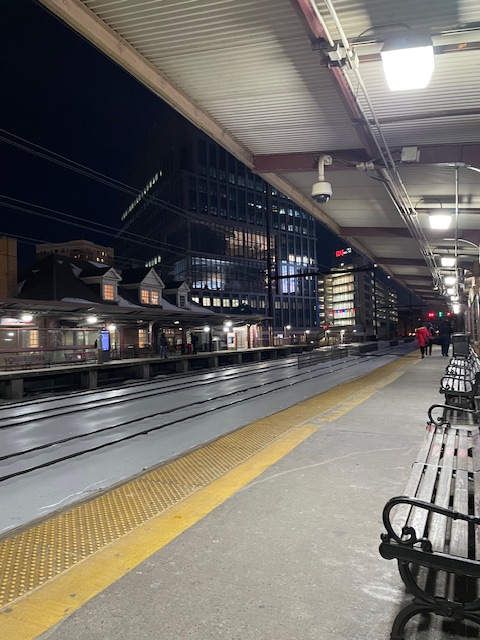
New Brunswick Rail Station, New Brunswick, New Jersey
Put it this way. This is the 250th anniversary of the American Revolution. The Revolution was largely fought in New Jersey. Every Revolutionary-era monument in this state–and there are hundreds of them–is a template for rebellion. We just have to stop treating them as the sepulchres of past heroism, and start thinking of them as how-to guides for resistance right now. If our eighteenth century forbears could figure out how to push back on imperial power, so can we.
I’ve so far been naming places where lots of people can converge. But beyond these, there are appropriate places across the state to stage demonstrations, not so much because people can easily picket them, but because being tied to the military, they richly deserve to be picketed.
The US government’s complicity in the Gaza genocide struck many people as too attenuated to be worth notice. Gaza was Israel’s war, came the refrain; how are we involved? No one can say the same about the US attack on Iran. As far as Iran is concerned, the US armed forces are directly involved in a war of aggression, a bombing campaign that has deliberately been made indiscriminate (by deliberately scaling back the vetting required for proper discrimination), and a war with zero apparent planning for any post-war outcome. Warfare can’t get less justified than that. At a minimum, this suggests the need to voice our dissociation from the military, and every identifiable part of our society associated with it or facilitating its ends.
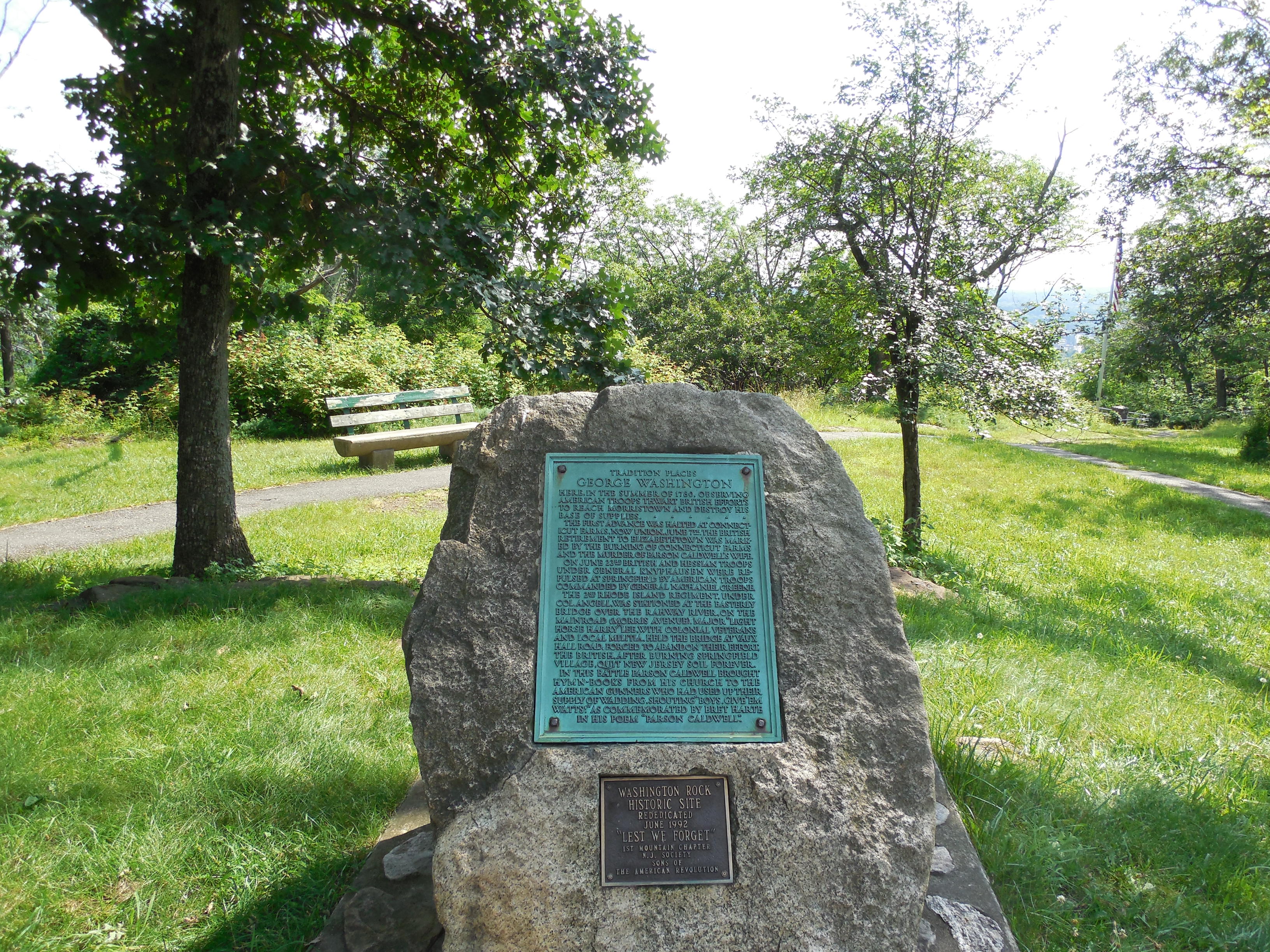
Revolutionary Battle Monument, overlooking Springfield, New Jersey
Here’s a quick list off the top of my head:
- We should picket every military installations in New Jersey, from Picatinny Arsenal to Somerville Depot to Joint Base McGuire-Dix-Lakehurst, to the Naval Weapons Station at Earle, to the 31 National Guard Armories that dot the state. It’s worth noting that all of these either contain, are adjacent to, or are located within centers of non-combatant civilian life. This is most obviously true of the National Guard Armories which are often as integrated into a given town’s life as town hall.
- We should picket all of the recruiting centers that lure kids into the military in every mall and every town that has them (there are 145 of them), or the ROTC centers at the universities that host them (primarily but not exclusively Princeton, Rutgers, Seton Hall, TCNJ, and NJIT), or the Junior ROTC branches at so many high schools (dozens, but mostly concentrated in Newark, Paterson, Trenton, Camden, Atlantic City and across South Jersey). Again, notice that these recruiting centers, like the military installations themselves, are located amidst civilian life–universities, schools, malls, downtown areas, business parks.
- We should picket all of the large corporate military contractors that dot this state: L3Harris (Clifton and Camden), Raytheon (Tinton Falls), General Dynamics (Florham Park), Peraton (Basking Ridge, Wharton, Woodbridge), Marotta (Montville), Breeze-Eastern (Hanover), McWilliams Forge (Rockaway), MAG Aerospace (Tinton Falls), Collins Aerospace (Paramus), the New Jersey Innovation Institute (Newark), the military sector of the New Jersey Manufacturing Extension Program (Cedar Knolls), ZIM (Port Elizabeth), Maersk (Jersey City), and ALL WAYS. (As I’ve argued elsewhere, there are innumerable small ones. No harm picketing some of these, either.) While you’re at it, picket the career fairs at which recruiters for the preceding companies show up, whether on campus or at government-sponsored locales (e.g., county job fairs).
- Though I’ve mentioned ZIM, Maersk, and All Ways, I’ve probably understated the role played by ports like Port Elizabeth or the ports in Jersey City in moving military hardware, or the warehouses from Secaucus to Trenton and points in between that store military hardware for shipment.
- And we shouldn’t forget the innumerable, billion dollar military contracts at all of the major universities in New Jersey, and all the military investments in their portfolios, or all of the proud collaborations here with military-forward institutions abroad.
This is just a preliminary list of obvious sites, restricted to New Jersey, the place I know best. People in other states have the local knowledge to draw up their own lists. But my list is fodder enough for a years-long Garden State anti-war movement.
Princeton University
Because that’s what it’s got to be if it’s going to get anything done. The best template we have is fifty years old, but it’s still the best we have: Vietnam. If we put it into practice, it just may work. We owe it to ourselves to try.
*The obstacles to doing many of the things in this paragraph are legal: most municipalities require permits for large demonstrations, and would be apt to deny granting them for recurring ones, particularly if the demonstrations ruffled local feathers by “bringing in outsiders” waving foreign flags (Iranian, Palestinian, whatever). If so, this is a fight we have to have in New Jersey, if only to permit large-scale movements to get off the ground. We can’t organize or demonstrate if we’re systematically prevented from assembling in public, and we can’t get an anti-war movement off the ground without large-scale assembly. Privatization poses one problem here, but so does the monopolization of public property by advocates of political self-anesthetization. The second, I suspect, should be easier to fight than the first.
 Policy of Truth