Suppose that I’m a university president at an institution that’s endorsed institutional neutrality. I’m now invited by the chair of an oversight committee in Congress or the state legislature to testify before the committee on matters that fall within the committee’s higher education oversight functions. Stipulate that the discussion of these matters can’t avoid touching on matters of public controversy, and that I won’t be permitted during the oversight hearing to pick and choose what questions I’ll answer or in what form. Those issues are exclusively within the purview of the committee chair. What should I do?
Institutional neutrality proscribes a university president’s making public statements on matters of public controversy. Stipulate that testimony to the oversight committee will be public. I’ve already stipulated that it will broach matters of public controversy. It follows that institutional neutrality is incompatible with my appearance before the committee. It therefore follows that per institutional neutrality, I should decline the invitation to testify. If subpoenaed, I should perhaps go, but invoke a Fifth Amendment right to remain silent for the duration of the questioning.
The price of taking this refusenik position, of course, is to flout the oversight function of the committee. By declining to show up or declining to speak, I’m basically saying that the committee’s oversight function doesn’t bind me. That is paradoxically a controversial thing to say or imply. It’s also an implicit abdication of institutional responsibility. It says in effect that I’m accountable to no one, not even to the legislative oversight committee on which my institution depends for its financial existence.
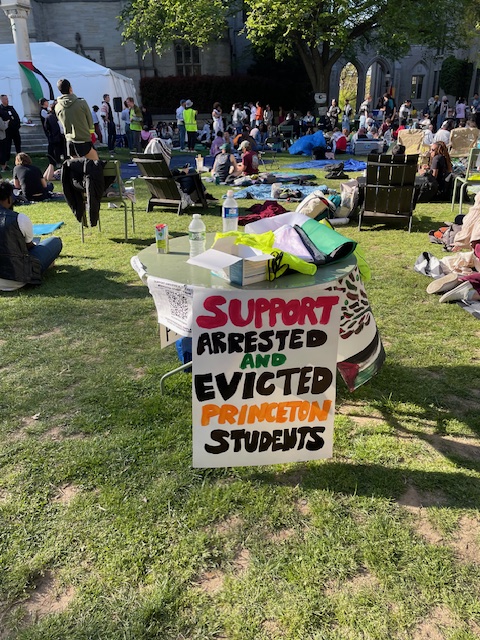
Gaza Solidarity Encampment, Princeton, April 26, 2024
Suppose that I accept the invitation and testify. If so, then the more charged the political circumstances, the less likely it is that I’ll be able to maintain adherence to institutional neutrality. Imagine, for instance, that it’s a few months after the October 7 attacks on Israel, and I’m asked whether a certain speech act qualifies as advocacy of genocide against Jews, or in a less inflammatory spirit, whether it qualifies as bias intimidation of some kind. Imagine that the speech acts include, “From the River to the Sea, Palestine will be Free,” along with, “Death to the IDF,” and “Death to ICE.” The committee chair then asks:
Do the first two statements amount to a threat of genocide? Does the last create a threatening environment? Do any of them amount to bias intimidation?
There’s no way to answer these questions in a controversy-avoiding way. It follows that there is no way to uphold institutional neutrality at such a committee meeting.
Suppose that I make some controversial statement at the committee meeting, and a controversy ensues. Now suppose that I return to my home institution and am asked by students and/or faculty about what I said before the committee. Institutional neutrality says that I’m obliged to shut down all such questions. Paradoxically, it says that the truth-seeking mission of the university demands that I decline to speak the truth on this matter. Were I to speak the truth, or what I take to be the truth, my doing so would “chill” inquiry into or assertion of the contrary of whatever I said. According to the defenders of institutional neutrality, the very faculty members or students assertive enough to ask me pointed questions about what I said to the committee would, having heard my answer, be cowed into abandoning any disagreements they had with me, and be coerced into premature agreement with me.
Granted, I’ve already violated institutional neutrality by making controversial assertions before the committee. But that’s a concession that requires minimizing any further violations. To avoid the appearance of sheer violation in the first case, I might have to carve out an ad hoc exception to institutional neutrality to the effect that, e.g., the university can make public statements on matters of public controversy when publicly asked about them by a legislative or other governmental committee in its oversight function. But being ad hoc, this ad hoc carve-out might be understood not to apply to questions on campus about what was said before the committee.
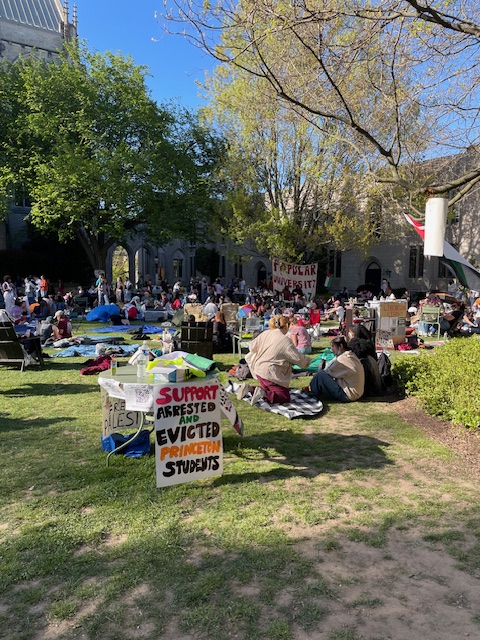
Gaza Solidarity Encampment, Princeton, April 26, 2024
A couple things are worth noting about this scenario. One is that the scenario is completely preposterous, not in the sense that it couldn’t happen, but in the sense that what institutional neutrality demands in it is so obviously silly.
A second point is that the only way to save institutional neutrality from absurdity in this case is to invent an ad hoc exception-clause to it that avoids absurdity at the price of arbitrariness. I’ve spent the last year or so lining up prima facie exceptions to institutional neutrality. The question eventually arises: how many exception clauses does it take to sink the rule altogether?
A third point is that to the best of my knowledge, the objection I’ve raised here is original to me; I so far have not encountered discussion of it anywhere in the literature on institutional neutrality. I mention this not because my originality is something to brag about, but because it isn’t. The objection I’ve raised here is obvious, so obvious that any idiot could have thought it up. But none did, or if they did, the discussion is pretty hard to find. And yet: how could anyone who followed Elise Stefanik’s grilling of Claudine Gay, Sally Kornbluth, and Liz Magill back in December 2023 fail to have seen the implications of those hearings for institutional neutrality?

Pro-Israel counter-protest, Princeton, May 3, 2024
A last point. I’ve repeatedly argued here that institutional neutrality is an instrument of administrative non-accountability, but it’s hard to think of a scenario that more vividly illustrates the point than this one. If a supposedly academic doctrine entails that a university president should decline an invitation from a legislative oversight committee precisely because something she says to the committee might prove controversial, we’ve abandoned the realm of academic values altogether for the realm of narrow legalistic self-interest. There is no plausible way to defend institutional neutrality in this context by invoking the university’s truth-seeking mission, or its commitment to academic freedom, self-governance, or viewpoint diversity. All of those things are obviously being flushed down the toilet. What we have here is just abject cowardice clothed in doctrinal verbiage, and hoping by that means for safe passage.
For decades now, academics have sat around wringing their hands about the “crisis in higher education.” Part of this crisis, they tell us, stems from “our” inability to explain what we do to the wider public. Maybe it’s time to inject a small dose of common sense into this debate. You can’t explain what higher education does without courting controversy, and you can’t court controversy if you’re straitjacketed by institutional neutrality. If you really want to justify the ways of higher education to God and man, you have to do so in a spirit of non-neutral candor. You have to stand for something, and explain what it is. If you can’t or won’t do that, then don’t expect public support for higher education. You haven’t done what it takes to earn it. Not having done so, you’re not entitled to get it. What you’ll get instead is the derision you have earned by your evasion of the issues that interest the public.

Pro-Israel counter-protest, Princeton, May 3, 2024
I don’t mean to suggest that what interests the public is necessarily a guide to truth or value. It rarely is. I just mean that you can’t sell an institution to a public if you do an end-run around what interests that public. You have to meet them where they are. But you can’t do that without being controversial, and you can’t be controversial in a spirit of neutrality. It’s sad that one has to explain such things to such eminent, well-remunerated people, but apparently one does. Unfortunately, like most dealings with university administrators, explanations are lost on those who refuse to listen. You can lead a horse to water, but you can’t make it drink. You can remonstrate with a university administrator, but you can’t expect a response. Sadder still that this is what so many academics want to defend as the apex of academic wisdom. But I guess that’s to be expected if their commitment to neutrality extends to the difference between an apex and a nadir.
 Policy of Truth