Notes on War and Complicity
There are many valuable criticisms and critiques of the Iran War out there, and at some point I hope to mention as many of them here as I can, but if you want one-stop shopping, the thing to read is Nathan Robinson’s “The Iran War Is Unfathomably Depraved” in the March 2026 issue of Current Affairs. I agree with literally everything in Robinson’s article except this one sentence:
We are all complicit.
No, we’re not.
To repeat something I’ve said elsewhere, to conceptualize complicity, we have to define the term, locate it in a broader conceptual context, and draw some necessary distinctions. Complicity is a kind of secondary injustice that consists in facilitating, enabling, or approving of some primary injustice. Put in this way, complicity has two faces: a causal face and a participatory one. A person can either promote injustice in the sense of making it happen or making its occurrence probable (causal), or they can participate in injustice, e,g., through approval of or acquiescence in it, whether or not doing so makes a causal difference to any unjust outcome (participatory).
A basic thing to keep in mind is that complicity is a secondary form of injustice, parasitic on some primary one. Put somewhat differently: complicity falls outside of some previously-defined set of primary injustices. There is, in other words, a difference between an act of aggression and complicity in aggression, or between the commission of genocide and complicity in it. This distinction is harder to draw than people realize, and one recurring mistake people make about it is to treat cases of commission as though they were cases of mere complicity, or treat cases of complicity as though they were tantamount to commission.
A politician who votes for aggression or genocide is not “complicit in” those things but committing them. A university president or trustee who knows that the university’s investment portfolio includes genocide-promoting companies is complicit in genocide, not committing it. Commission is worse than complicity, and belongs in a lower rung of Hell than it. Complicity is bad, but not quite as bad.
Contrary to Robinson, then, “we” are not all merely complicit in the Iran War. Some of us are committing the relevant offenses (not merely complicit in them), while others are merely complicit in them (not actively committing them).
Suppose we restrict ourselves to the causal side of complicity. At this point, we can distinguish between two sorts of causal contribution a person can make to an injustice: strong or weak. In other words, a person can make a crucial causal contribution to an unjust outcome (strong), or a highly attenuated one (weak). A cross-cutting distinction involves culpability. A person can make a wrongful (knowing, intentional) contribution to injustice or an excusable or innocent one (e.g., unwitting and/or involuntary). It’s one thing to know that something is wrong and voluntarily make a contribution to it despite that. It’s another thing to be roped into something, and either unwittingly or involuntary have to make a contribution through force of circumstances.
This suggests that we need terminology that distinguishes sharply between culpable contributions to injustice and non-culpable ones. I use “complicity” for the first and “entanglement” for the second. When culpable, a person is complicit; when non-culpable, a person is entangled. We can now put all of our various distinctions together. A person is most culpable for strong, knowing, willing contributions to some egregiously wrong primary injustice, and least culpable for weak, innocent, unwitting contributions to some relatively mild injustice. Obviously, there are mixed and intermediate cases between these extremes.
Contrary to Robinson, then, we’re not all complicit in the Iran War. Some of us are complicit in it, but others of us are merely entangled. And some of us may be a little both. The distinctions matter. Consider some cases.
(1) Paradigmatic complicity. Take someone who not only contributes to the war (e.g., through taxation) but avidly approves of it, publicly justifies it, and would contribute voluntarily if he weren’t already contributing through taxation. That, on my view, is a paradigm case of complicity–relatively weak, causally speaking, but fully culpable.
(2) Paradigmatic entanglement. Now take an infant just born into a military family. The infant needs care. The care she needs is paid for through the military budget, the same budget paying for the war. Imagine that the infant’s parents are actively participating in the war, and indeed, use the infant’s needs as a reason for staying employed by the military: the benefits are second to none.
In this case, the infant is entangled in the war machine, and may well be making a causal contribution to it. But while the child’s existence explains the parents’ choice to stay in the military and promote the war, the child herself is entirely innocent. I would call this a weak and entirely non-culpable contribution to a (very) unjust outcome. It’s a paradigm case of entanglement, not complicity.
(3) Another paradigm of entanglement. Case (2) is an easy one, but it suggests that we not only have to accommodate (2), but all cases relevantly like it. Here is one: Robinson himself. Nathan Robinson pays taxes, and in that sense, indirectly promotes the Iran War. But let’s stipulate that Robinson is doing everything he can to oppose the war, as his article admirably suggests. If so, he has zero culpability for the war, regardless of any involuntary causal contribution he may be making to it: given his steadfast opposition to the war, there is ex hypothesi nothing for him to be guilty of. If so, I would say that he is entangled in the war (however superficially or deeply), not complicit. It confuses things to lump him in with the actually complicit.
If you want to insist (unreasonably, in my view) that Robinson is complicit in the war because he continues to pay taxes for it (when he could in principle refuse), just imagine a hypothetical person who’s a hybrid of Nathan Robinson and the activist Rachel Cohen. Cohen has announced that she’s withholding tax payments from the federal government this year in protest of the US government’s policies on a broad range of issues, including the Iran War.
Suppose that in refusing to pay her taxes, the government garnishes Cohen’s wages to exact payment. In that case, she makes a financial-causal contribution to the war despite her refusal. But neither she nor a hypothetical Cohen-Robinson hybrid could reasonably be accused of “complicity” in the Iran War because they were making involuntary, indeed grossly unwilling, causal contributions to it. Once we subtract culpability from the case (as we must), we’re dealing with a qualitatively different sort of case requiring distinctly different terminology.
There are, in my view, plenty of conscientious objectors to the Iran War. The war is in fact pretty unpopular. Maybe some of these people should be doing more than they’re doing, but we need to draw a sharp distinction between those who approve of the war and those who oppose it. It’s the former, in my view, who are complicit, and the latter who are merely entangled.
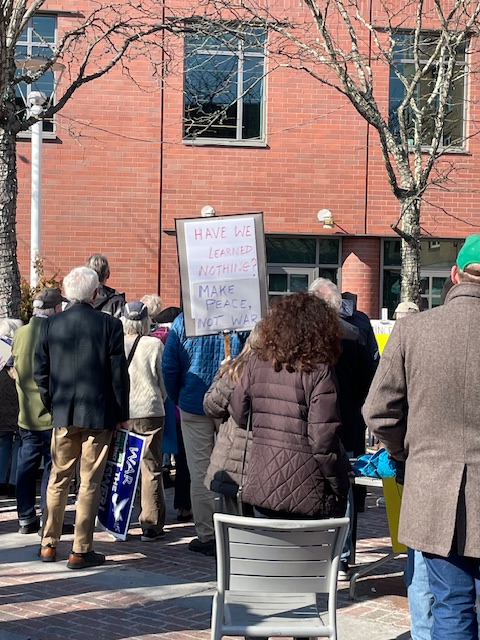
Iran War Protest, February 28, 2026, Hinds Plaza, Princeton
(4) An anomalous case of entanglement. Now consider a last case. Imagine that someone somewhere is so consumed in some non-political project that she literally has no idea what the Iran War is about or why it’s wrong. It’s easy to jump to the conclusion that such a person is culpably ignorant for not knowing about an event as prominent and significant as the Iran War, but this seems mistaken. Imagine that the explanation for the individual’s ignorance is innocent, e.g., that the person happens to be struggling with a chronic, all-consuming illness that leaves her no time to follow the news. In that case, the person might have something else to do than worry about politics, even something as big as a major war. And while she might well be making a causal contribution to the war, the contribution might still be non-culpable and unwitting. Such a person is, in my terminology, entangled, not complicit, and it’s important to distinguish her from the genuinely culpable.
So that’s my disagreement with one sentence of Robinson’s piece. The rest gets my wholehearted vote.
 Policy of Truth