Wherever you go, you’ll find imperialist wars described, particularly by their self-styled liberal opponents, as “wars of choice.” Having described a given war as a “war of choice,” the critic will then go on to criticize it as ill-conceived and ill-executed while conceding the underlying reason for going to war. The unspoken implication is that the same war, conceived and executed more competently, would have been perfectly justified. It’s just that this particular iteration is not.
In the current war with Iran, the supposed underlying reason for war is Iran’s hypothetical future possession of nuclear weapons (not Israel’s current possession of nuclear weapons, nor that of Britain, France, India, Pakistan, Russia, China, North Korea, or the United States). As The New York Times’s editorial board says, “Among [Trump’s] justifications is the elimination of Iran’s nuclear program, which is a worthy goal” (“Trump’s Attack on Iran is Reckless,” The New York Times, Feb. 28, 2026). In other words, a different war against Iran, initiated by a different president, in a different way, at a different time, would have been perfectly legitimate. There’s nothing wrong with the war on Iran, then, just with its timing or its logistics. The war isn’t so much unjust or morally unjustified as politically or otherwise inconvenient. That we have to start wars over evidentially impoverished hypothetical future contingents is a given, as long as Congress votes on it.
It’s worth asking, in this context, what the phrase “war of choice” really means, and why this rather odd neologistic phrase has become so current. An AI query on the phrase yields the following.
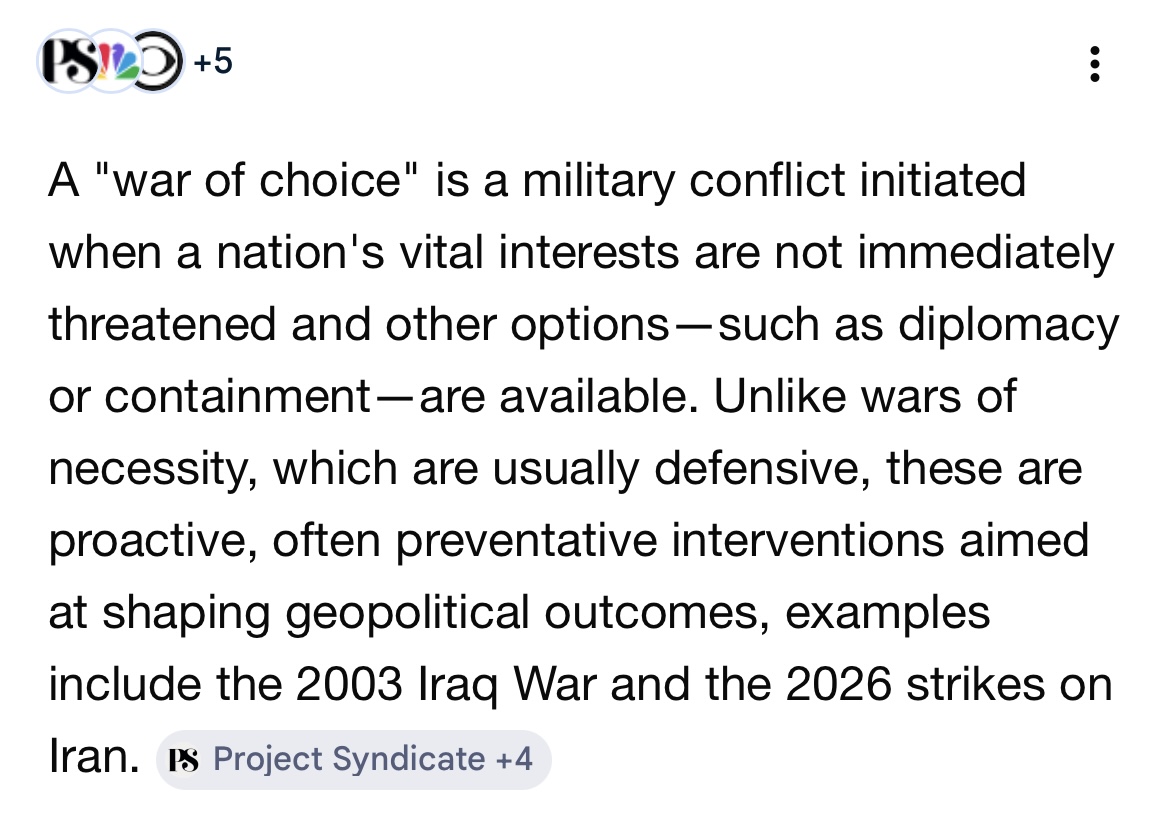
This strikes me as an accurate account of the meaning of the phrase. As with all large language models, AI has drawn from and integrated thousands, maybe hundreds of thousands, instances of the phrase over decades, and rendered the common denominator of common usage in one succint formulation.
Let me do AI one better. A “war of choice” is simply a war of aggression. And it’s not just any old war of aggression, but a frivolous war of aggression that goes out of its way to flout every ad bellum criterion of just war that’s ever been conceived or defended, invents a euphemistic neologism to cover up the offense, then invites people to focus on non-essential issues so as to divert them from the fundamental fact that stares them in the face–that the war in question is a major crime against humanity. The phrase “war of choice” simply serves to conceal this particular fact, and serves no other purpose than to do so. It’s an ideological instrument of mass deception, mass distraction, and collective self-delusion. That’s all it is.
I don’t know whether it’s amusing or sick that the advocates of aggression invoke manager-speak to give aggression the appearance of conscientiousness: few people would describe aggravated assault as “pro-active,” but when the assault involves the initiation of a regional war by imperial regimes led by decadent oligarchs, that’s what it becomes. It would widely be thought offensive to describe the Nazi invasion of Poland, or the Russian invasion of Ukraine, as “pro-active,” but change the actors and the victim, and the same usage becomes a multiply-iterated data point in a large language model.
If you want a single low-impact (but high-yield) task to perform during this war, do the following: every time you encounter the phrase “war of choice,” re-describe it to yourself as “war of aggression.” If you find this resolution tedious to carry out, what you’ll grasp in that very realization is how assiduously the powers-that-be demand your complicity in their aggression.
If it’s tedious to re-describe “war of choice” into “war of aggression,” that’s because the people using the phrase are hell bent on demanding that you use their phrase, not your own, or common sense. They’ll repeat it until it fills the Internet and the airwaves in the fervent hope that doing so will crowd out the realization of the obvious: that the United States and Israel have initiated a regional war of aggression that stands to become a world war, and whose casualties on both sides are mostly theirs to own. Every rationalization the defenders and pseudo-critics of this war offer in its defense (or in concessionary criticism) is an attempt to conceal these facts. It’s worth remembering that the attempt at rationalization only succeeds to the extent that people acquiesce in it.
If you get tired of telling yourself, that “war of choice” = “war of aggression,” start telling others. Once you find the right set of others to tell, you’ll become part of the anti-war resistance. After that, you’ll find, “next steps” become clear enough.
 Policy of Truth