Do yourself a favor. Go back and re-read the Declaration of Independence, but do it this way: skip the beginning and the end, and read the bill of particulars in the middle. It’s too long to quote here. You really just have to read it for yourself. Once you do, you’ll see that details aside, we’re living in the very world that the Declaration describes, excoriates, and uses as the basis of its declaration of war. Virtually everything in it is something that our present government is doing to us. Like the people of British North America ca. 1776, we are a people under military occupation.
Do yourself another favor. Get clear on what that means. When you’re under military occupation, you’re under the rule of force. The rule of force, as Thomas Jefferson told us, can either be met with counter-force or with abject surrender. I know how incredible this must sound to a lot of people, but take it from someone who’s actually lived under a military occupation or two: you have to choose. You can procrastinate a while. You can hope for the best. But you still have to choose a side, acknowledge the risks, and make your peace with your own mortality.
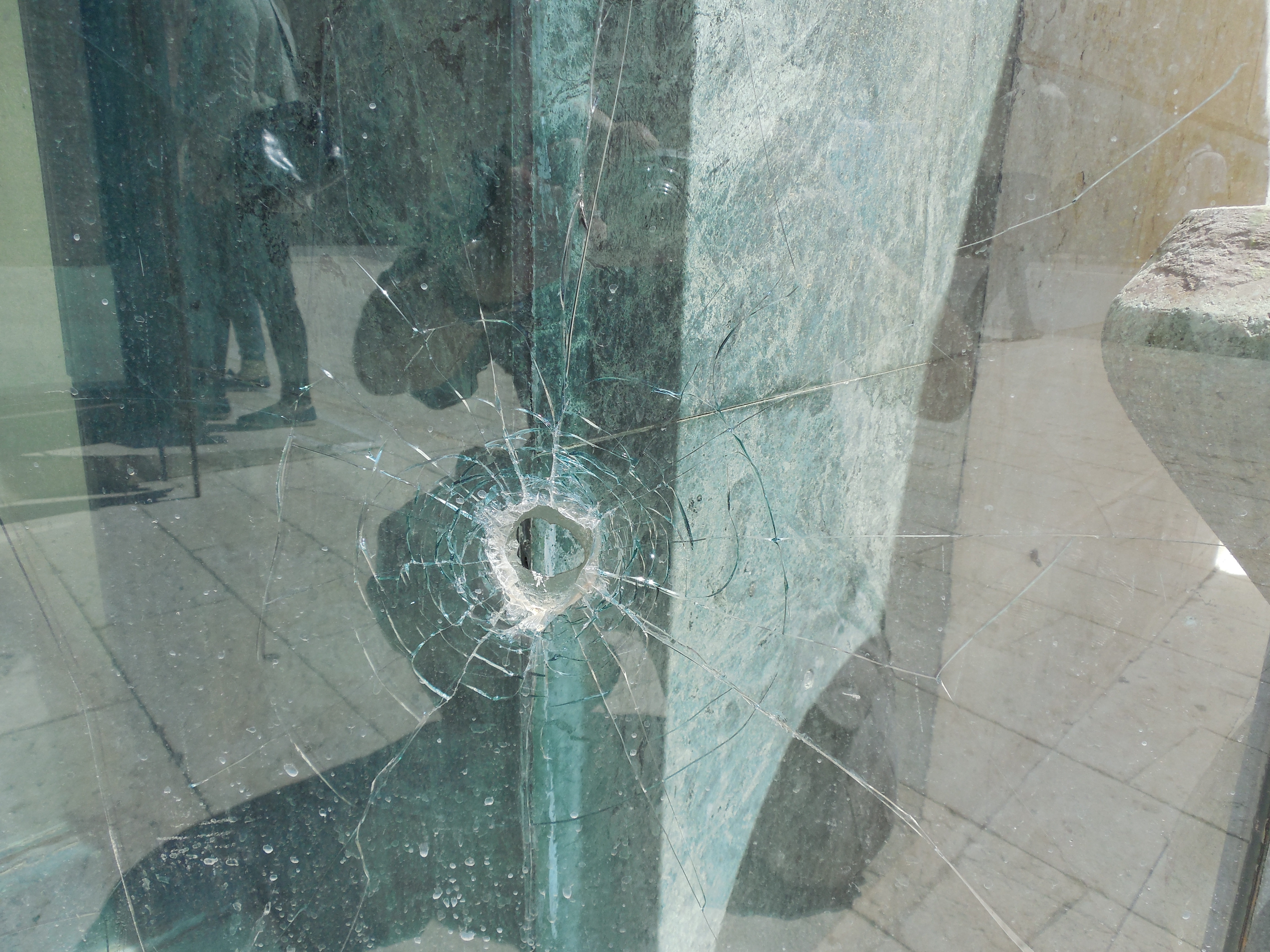
Al Quds University, Abu Dis, Palestine
If you’re honestly surprised or even disturbed by what happened today in DC, you’re more than a little late to the party. All that happened was that after nearly a year of military occupation–of provocations, brutalizations, and lies about it–someone in this country awash in firearms finally shot back. I don’t know who. I don’t know why. I haven’t bothered to study the particulars, and don’t really care about them. No, I don’t care that the shooter may be an Afghan immigrant let into the country through a refugee program, and no I’m not about to dial back my support for migrant rights because I feel bad about it. I don’t feel bad about it. All I know is that more shootings and the like will take place because that’s what happens under military occupation. If you don’t want more shootings, dial back the occupation. If you refuse to dial it back, expect more shootings, and don’t think that intensified immigration enforcement will make things better.
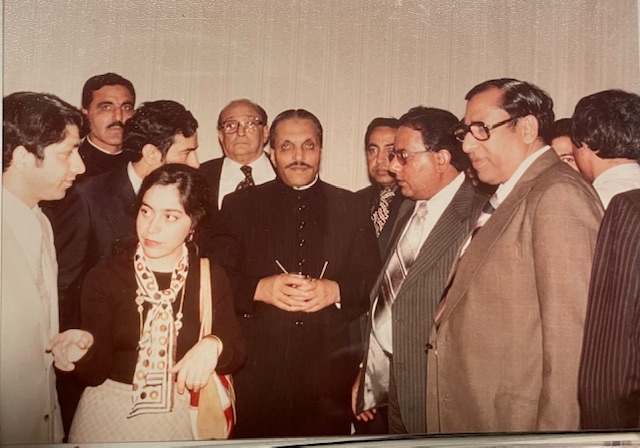
Mom and Dad, left, hobnobbing with General Zia-ul-Haq (tr: “Light of Righteousness”), Islamabad, Pakistan, 1986
Things like this don’t just happen in Gaza or the West Bank or Kashmir or Pakistan or Ukraine or Congo or Haiti or some conveniently distant place filled with weird (or non-WEIRD) people who inscrutably happen to shoot at one another for reasons beyond the ken of the civilized. It happens to people–to moral agents qua moral agents–under the rule of force. The human mind can’t function under the rule of force. Eventually, people lose patience with their tormentors and rebel. More power to them. If people could rise up against Rome, Britain, France, Germany, Belgium, Italy, Russia, the Hapsburgs, the Mughals, the Ottomans, and the Soviets, there’s no reason they can’t rise up against MAGA. Donald Trump is no more edifying a figure than Nero, George III, or Louis XIV. What happened to their regimes can happen to his. If we can applaud the one, we can applaud the other.

Wounded Knee Monument, Pine Ridge Indian Reservation, South Dakota
The people perpetuating the violence under which we live are not primarily the one-off shooters like this latest one in DC, but the unapologetic-yet-disingenuous force-wielders who put us here: the Trump Administration, its constituency, and its predecessors, along with the morally bereft people who think that it’s perfectly normal to live under a regime of military force as long as we restrict ourselves to quibbling over minutiae (if that). I’m not eager for violence, but I don’t regard shooting the perpetrators of a military occupation as a wrongful use of force. On the contrary. Sic semper tyrannis.
It’s sick, sad, and funny that the same Americans who so blithely “celebrate” Independence Day forget every year that what they’re celebrating is a war fought to free us of military occupation. In my town–the historic Revolution-era hamlet of Princeton, New Jersey–learned antiquarians sit around gushing about how “exciting” the Battle of Princeton was, dreaming up new ways to make the historic Princeton Battlefield an attractive tourist spot. So it is that the battlefield becomes an “interpretive experience”–their phrase, not mine. You’d think that warfare was something to be engaged in over Sunday brunch with tea, crumpets, and scones. Well, it is for them.

Montclair, New Jersey
Faced with a military occupation buried safely in the historical past, everyone in this country is eager for a fight against King George’s eighteenth century Redcoats. Faced with a more immediate and brutal occupation right in front of their faces, an occupation half of them voted into office, they stare balefully at their computer or TV screens and wonder helplessly how we got to this pass–by which they mean the lamentable situation of “terrorists” shooting at the poor, helpless government. Welcome to the place where the anti-historical bravado of Mel Gibson’s “Patriot” becomes the tooth-gnashing impotence of “Office Space.”
A piece of advice for anyone in the armed services who wants to avoid being shot at: don’t deploy. It was obviously a mistake for you to have enlisted in the first place, but having made the mistake, it can be rectified by doing what both prudence and courage demand: put your gun down, go home, and face the consequences. If Chelsea Manning and Reality Winner could do it, so can you. And if enough of you do it, you dilute the consequences by your numbers. Your choice. But if you don’t put the gun down, and insist on stalking us in the streets, don’t complain when someone puts a hole in your head and leaves you bleeding on the sidewalk. That’s what happens to the troops of an occupying army. And that’s what you are. If brutalizing us is part of your job description, the corresponding description will inevitably become ours.

Bloomfield, New Jersey
Americans have spent the entire history of their country normalizing one military endeavor after another. The “American Experiment” began in war, has been sustained for two centuries by war, and now inhabits a never-ending state of armed, quasi-sacral, bloodthirsty belligerence. After all of that, people have suddenly decided to wring their hands in twenty-point font over two soldiers shot in DC. Well, between fifty and sixty people are murdered every day in the United States. No one stops fifty times a day to mourn their passing. Why now? Why them? The United States has helped Israel commit genocide in Gaza for two years running, and with no end in sight. Does the modal American seem perturbed? If not, why the perturbation over two members of our homegrown Praetorian Guards, the people whose job it is to terrorize us in the name of Donald Trump and Uncle Sam? Fuck them.
In the just last few months alone, we’ve gone to war with Yemen, Iran, and Venezuela. Before that, it was Libya, Iraq, and Afghanistan. Before that, it was the proxy wars of the Cold War, too many to count, and before that, Vietnam, Cuba (twice), and Korea. War now looms with China. It goes on and on and on: look forward in time or back, but either way, we’re bounded by a horizon of warfare. How did these casualties in DC acquire the urgency missing in the millions who came before? Why should their lives loom so much larger than the lives of their victims, the people whose rights they’ve trampled on with such abandon and righteous zeal?

Metuchen, New Jersey
“If you want blood,” AC/DC sings, “you’ve got it.” People who spend their time normalizing militarization are people who, whatever their contrary professions, want blood. Their professions of surprise or chagrin in the face of actual bloodshed are either self-delusion or deceit or both. It’s time to throw back in their faces what for so long they’ve thrown in ours. You want blood? You got it. Don’t ask for or expect sympathy or tears for your dead. Their deaths are the price of your utopia, not ours. If you find the price too high to pay, maybe it’s time for a bit of buyer’s regret–while there’s still time to re-think your purchase.
 Policy of Truth
Pingback: Stirring the POT (5) | Policy of Truth