Peace and Justice in Swarthmore
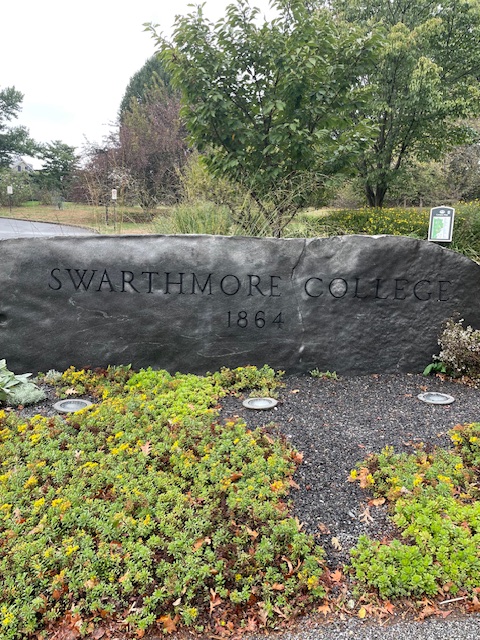
I’m at the Peace and Justice Studies Association (PJSA) conference at Swarthmore College in Pennsylvania. Having a great time. Wish you were here.
Swarthmore is practically a caricature of an old school liberal arts college, half institution of higher education, half feudal estate. It’s hard not to love, but then, I myself am half academic and half landlord–an erstwhile academic with a last name that means “landlord.” So it’s easy enough for me to fantasize having a tenure-stream job here, taking sanctuary from the world amidst the ivy, the wildflowers, the curious, well-heeled students, and the crenellated towers of stone. I didn’t see any administrators, either. Maybe there aren’t any?
Defining “violence”
PJSA is a conclave of the anti-war, anti-imperialist Left, and as with all such conclaves, I manage both to feel utterly at home and deeply alienated by the whole thing–practically the definition of “home,” I guess. My session was chaired by an old friend, Elliott Ratzman, “friend” in the academic sense of the word that’s compatible with not having spoken to someone in twenty years. Elliott and I met at a conference about Israel and Palestine at Princeton Theological Seminary back in 2005. This was the first time we’d met since then. A little frightening how quickly twenty years goes by. This time our session was on violence, non-violence, and resistance. My talk was a preliminary revisitation of the Mangione-Thompson shooting of last year, his was on Israel and Palestine. More on “Insurance Denials and the Resort to Force” in a future post.
Part of the panel discussion at the end of our session revolved around the definition of “violence.” It’s a hard concept to define, and I get the sense that there’s a little too much reliance on Johan Galtung’s definition of it in these parts (from “Violence, Peace, and Peace Research,” Journal of Peace Research 6:3, 1969):
Violence is present when human beings are being influenced so that their actual somatic and mental realizations are below their potential realizations.
I really wish that this definition didn’t have the currency it does in peace studies. For one thing, the definition implies that non-human animals can’t be violent. Worse still, it implies that humans can’t be violent to animals. So it excludes things like battery cage poultry farming and ordinary butchery. It also excludes violence involving inanimate objects: volcanic eruptions, hurricanes, earthquakes, and forest fires are all excluded despite their violence, presumably because they’re neither intentional nor agential. Same with non-terrestrial events: the implosion of a star, an interstellar collision, and the Big Bang are all excluded, despite their apparent violence, presumably for the same reason.
Even applied narrowly to human action, however, the definition is far too broad. A friend who convinces me to hang out and drop acid with him every weekend will likely influence me in a way that renders my somatic-mental realizations subpar relative to their potential realizations. That’s bad, but it’s not violent. It’s easy enough to multiply similar examples.
One of the conference participants tried to make the just-preceding point, but got more pushback than acceptance. Two examples we discussed:
- Imagine that you’re consistently denied a raise that you deserve. Is that violent?
- Imagine that you’re consistently on the receiving end of a series of micro-aggressions. Is that violent?
The answers to these questions strike me as obvious: no. There’s no violence in either case, no matter how many times you iterate the offense, and no matter how unjust the offense itself. The discussion seems to me to ignore an obvious fact: some offenses are real, in the sense of being really offensive, but not violent. Violence is not a necessary condition of injustice. In fact, there’s no proportional relationship between offensiveness and violence, either: it’s not as though the more offensive a boss’s failure to give you a raise, or the more offensive a micro-aggression, the more it approximates or exemplifies violence. None of these things approximate violence, and it’s a category mistake to think that they do. It strikes me as a debility of Left discourse that it can’t admit this as quickly or easily as it ought to. Of all the things to get stuck on when it comes to violence, this isn’t one of them.

I had intended to offer the following example, derived from the topic of my own talk, but there wasn’t time.
- Imagine that an insurance company employs AI to deny prior authorization to a million patients, each of whom is entitled to it, many of whom die as a result of the denial. Is that violent?
No. It’s harmful, not violent. I get the sense that people in the audience wanted to infer that the scope and/or intensity of the harm done implies that these denials must be violent, whereas I infer that you can produce a lot of harm without resorting to violence. Mangione’s shooting of Brian Thompson was violent but created harm of limited scope; an AI-based set of denials like (3) would create harms of far greater scope without being violent. To change the example: climate degradation could turn out to be extinction-making, but the average act of pollution–driving a car, flying a plane–is not violent. It seems an exercise in futility to insist that it is, even if cumulatively the acts in question led to extinction.
The problem of over-extending the meaning of “violent” (or of condemnatory language generally) is not unique to Left discourse, but is in my experience particularly common there. It happens like this: A certain phenomenon exists that you want to condemn–really condemn. The problem is, you lack a sufficiently condemnatory language for the job. Instead of accepting this regrettable fact, you borrow the valence of some condemnatory word, like “violence,” and then extend its meaning implausibly to cover the case at hand. So undeserved low pay and micro-aggressions end up becoming “violent,” not because they share any underlying essential similarity with paradigm cases of violence, but because it would be rhetorically or politically useful to treat them as though they did.
One problem here, it seems to me, is the Left’s reflexive allergy to the very idea of an “underlying essential similarity.” My own commitment to that idea may be the only remnant left of my erstwhile commitment to Randian Objectivism. Implausible as it may seem, I think the Left has something to learn from Rand’s Introduction to Objectivist Epistemology.
Anyway, the uncritical acceptance of Galtung’s definition of “violence” strikes me as a real mistake with real consequences. For one thing, it just distorts language and invites imprecision, which should be bad enough on its own.
It also tends to dilute the meaning of “violence.” If micro-aggressions are violent, then micro-aggressions are relevantly similar to murder, rape, and genocide. But if that’s the case, then the converse must also be true: murder, rape, and genocide are relevantly similar to micro-aggressions. Given this, it becomes hard to resist the inference that a genocide is a string of very intense micro-aggressions, or that a string of micro-aggressions is a proto-genocide. That seems to me a disastrous mistake. A genocide is a violent string of murderous events; a micro-aggression is a non-violent offense, and a string of them is the expression of a set of entrenched prejudices that leads to a string of non-violent offenses. The ascription of violence to the one and not the other preserves the categorical distinction between them much better than the ascription of violence to both.
A final problem is that the over-extension of “violence” tends to weaken the resonance or rhetorical force of all condemnatory language that doesn’t make reference to violence. To call something “unjust” nowadays–like systematic underpayment or systematic sexist discrimination, or whatever–seems insufficient in Left circles. That’s the motivation for calling it “violent.” But it’s worth asking why the term “injustice” (or “unfairness,” or “dishonesty,” or “exploitation”) lacks rhetorical or emotional resonance in the first place. Isn’t that telling? Why should we buy into a conceptual scheme that says that violence is always a big deal, but non-violent injustice never measures up? The claim is obviously false. I grew up getting into fistfights. They were violent, but they weren’t, in the long-run, such a big deal. Whereas many of the non-violent injustices I suffered left much deeper wounds. Do we have to insist that the injustices were violent in order to acknowledge the harm they did? Well, they were done to me, and I don’t make that insistence. And I doubt I’m the only one.
One expedient here is to subsume all apparently non-violent injustices under the heading of structural violence. I don’t dispute that structures exist and can play important causal roles in the production of injustice, including (perhaps) causal roles not reducible to the individuals who inhabit the structures. But I don’t think the tactic of invoking “structural X” (structural violence, structural racism, etc.) should be used as an all-purpose expedient to solve otherwise unsolved problems, as it often is.*

Take example (3) above–the AI-based denials of prior authorization. I personally don’t think any violence is involved in that example, even if it leads to a lot of unmerited death. I would ask: where is the violence in it? It begs the question to say it’s there in the very production of harm. That presupposes that harm can only be produced by violence. We just lived through a pandemic whose harms were produced by a non-violent process–a virus attacking the human immune system–so that can’t be right. If a virus can cause harm without violence, so perhaps can a bureaucratic process. There’s no reason to think that harm has one etiology rather than several.
Suppose someone responds by insisting that “structural violence” is involved in the AI/prior authorization example. I don’t see how that helps. What structure within the AI/prior auth process is violent? I see those processes at work every day. There’s nothing violent about them. They may involve an exercise of power, but the exercise of power is not, by itself, violent. In fact, that’s the salient fact about power: it can be exercised without overt violence. If someone wants to say that the violence there is latent, that’s fine (it’s true), but we still have to distinguish between active violence and an electronic process that relies in an attenuated way on the threat of violence without having to use it. So I’d just dig in my heels: insurance denials are often harmful, but rarely violent.
What then is the advantage of insisting that there is some indiscernible structural violence in the AI example, over just describing the actual structures and processes involved and saying that they lead to unmerited death? I don’t see it.
Atalia Omer’s Israeli anti-Zionism
Having said all that by way of criticism, let me now switch to praise. The Saturday afternoon keynote at PJSA was delivered by Atalia Omer, an Israeli scholar currently at Notre Dame. Omer is, to my mind, one of the most acute anti-Zionist thinkers in the United States; if you read just one paper by her, read “On Amalek, Miracles, and Turning Palestine into a Terra Nullius” (Journal of Genocide Research, May 2025). The paper traces the current Israeli genocide back to its ideological roots in the Amalek story in the Hebrew Bible, invoked by Netanyahu among many others.

The Amalek story legitimizes genocidal extermination of non-Jews by invoking a widely-accepted theological doctrine of Jewish supremacy. There’s no other plausible way to read it. God made the Jews supreme, and chose them as supreme, giving them permission to exterminate their neighbors in the quest for hegemony over the Promised Land. Feel free to fulminate all you like about the evils of Islamism–I’ll join in–but there is no comparable doctrine in Islam. Many Muslims have sung paeans to the atrocities committed by the Muslim armies engaged in the glorious task of conquering the world for Islam–Abu Tammam’s ode to the Muslim conquest of Amorium is a classic example–but there is no orthodox doctrine in Islam that describes Muslims as a Chosen People selected by God for supremacy and genocide. Brush up on your classical Arabic and look. You won’t find it. But you don’t have to look very far to find this doctrine in the Hebrew Bible. It leaps off the page and smacks the reader in the face.
You also won’t get very far before you encounter an army of hermeneutic excuse-makers for this doctrine, very eager to convince you that the doctrine says other than what your eyes and brain suggest it says. The defenders of the “Judeo-Christian tradition” can’t accept the possibility that their God is a complete psychopath, who’s saddled His followers with a bunch of psychopathic doctrines that they have to deny, minimize, mystify, or explain away so that they can continue convincing themselves and others that their tradition constitutes the apex of human civilization.
Thankfully, Omer is not one of this bunch. Unlike a lot of Israeli academics, including some putatively post-Zionist ones, Omer makes some pretty straightforward criticisms of Zionism as such and Israel as such, and at least considers the possibility of making some criticisms of Judaism as such. It really should not be all that difficult to do in this supposedly secular, post-Enlightenment, post Biblical Critical, Islamophobia-normalizing age to ask whether the worst malfeasances of Israel can be chalked up to Zionism, and whether the worst malfeasances of Zionism have their roots in Judaism. But apparently it is.
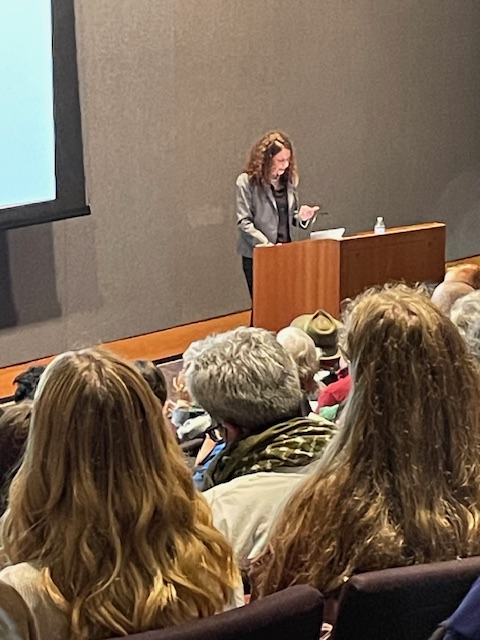
I have no idea whether Omer would agree with any of this, but suffice it to say I appreciated the plain talk and unapologetic moral outrage she expressed. “If you normalize genocide, you will have nothing left,” Omer said, quoting the Palestinian legal scholar Noura Erakat. Erakat was addressing the UN, and I think her point was that nothing is left–nothing is left of the West’s pretensions to moral supremacy over the non-Western world. Whatever its empty protestations and self-justifications, the “West” has been normalizing genocide against lesser peoples for centuries now. The Gaza genocide is just a reminder that they haven’t gotten over their malady.
Consider just the American case. The destruction of the Native Americans is a done deal in this country. Monday is still Columbus Day. Indigenous Peoples’ Day still elicits derisive snickers, not respect.
If you described the Dakota War to the average American and asked which side was in the right, most would likely compare the Santee Sioux to Hamas, liken their uprising to October 7, and conclude that the United States Army was justified in doing to them what Israel has done to Gaza. It’s telling that students aren’t typically taught the Dakota Uprising in classes on American history. I certainly didn’t learn about it in the two years of US history I took in high school, and have never encountered a student who had. It isn’t on the NAEP US History Assessment, or the AP US History Exam, or the SAT US History Subject Test. It’s not on New Jersey’s state history assessment, and not in its Student Learning Standards, either. If it’s anywhere, you’d have to look hard to find it.
The Dakota War took place in 1862. When it comes to 1862, students are taught that the Civil War was a glorious slavery-abolishing, nation-building enterprise. They’re not taught and not expected to learn that the same heroic Union Army consisted of a long list of genocidaires who besieged and starved the Santee Sioux half to death, inducing the latter, in desperation, to rise up and commit atrocities against Americans, civilian and military alike. The main events of 1862, as far as historically literate Americans are concerned, include the battles of Shiloh and Antietam, the former a name with deep Hebraic-Zionist resonances, the latter an Algonquin word whose etymology has ironically been washed out (“Antietam” means “flowing waters” in Algonquin). You’re ignorant of American history if you’ve never heard of the Battle of Shiloh, but perfectly knowledgeable if you’ve never heard of the Dakota War. A battle that matters outweighs a war that doesn’t. 
Omer’s talk raises the question, at least by implication: what if we taught things differently, with a view to disrupting the usual script? Imagine a history of the United States, taught to the young, in which the Dakota War displaced Shiloh and Antietam as a center of attention. Imagine a history whose upshot was not the triumphalist claim that we fought a civil war to overcome slavery, but that we fought a war of extermination to complete the Final Solution begun by our founders. Ideally, we want an account that integrates both things–abolition of slavery along with genocide of the native population–but you can’t integrate two things when one of them has gone completely missing.
Obviously, “the West” is more than the United States. Imagine demanding that contemporary Germans really grappled with what Germany did to the Herero, or demanding that contemporary Belgians did the same when it comes to Belgium’s role in the Congo, or that contemporary French students came to terms with what France did in Algeria, or likewise British students with respect to the English legacy in Ireland or Bengal, or Italians re Italy in Libya or Ethiopia, or Israelis regarding the hundred-year war that Zionism has waged on Palestinians. Frankly every member of “the West” could stand to be immersed in the atrocities of Rome, both Republican and Imperial, and be forced to reconcile the contemporary valorization of Rome with the genocidal horrors required to “achieve” what the Romans did. Historical pedagogy would in that case cease to be the triumphalist farce it so often is, and give students some sense of the human costs of what is so glibly termed “our civilization.”
But when whole nations invest in self-justification, one scholar’s protestations are bound to be an exercise in quixoticism. Omer relates that her efforts at Notre Dame elicited the suspicion of its Catholic administration that she was an anti-Semite engaged in an anti-Semitic enterprise. If that isn’t chutzpah, what is?
To put the point bluntly: American Catholicism is, on the whole, a morally ridiculous, mind-blowingly hypocritical enterprise. At no time in my decades-long association with Catholic higher education have I seen the slightest attempt by Catholic administrators to grapple with the Church’s role in the creation and perpetuation of anti-Semitism. How about just getting students to deal with the elementary fact that it was the Church that singlehandedly invented anti-Semitism? It’s something they’re content to ignore, conceal, or flee. Catholic students can attend literally decades of CCD, Catholic school, and Catholic university and never hear a word about it. But leave it to these Bad Faith Samaritans to parade their Zionist philo-Semitic credentials when it comes to questioning the bona fides of an Israeli Jew. The Inquisition, I guess, is the only spirituality they have.
Shopping carts and cease-fire
I get back to the hotel after a day of conferencing. There’s nothing to eat, so I go to a nearby supermarket to get something, wearing a bright red keffiyeh around my neck as I often do. I get a shopping cart when the guy who collects them comes in from the parking lot with a quizzical look on his face. “What’s that?” he says, pointing.
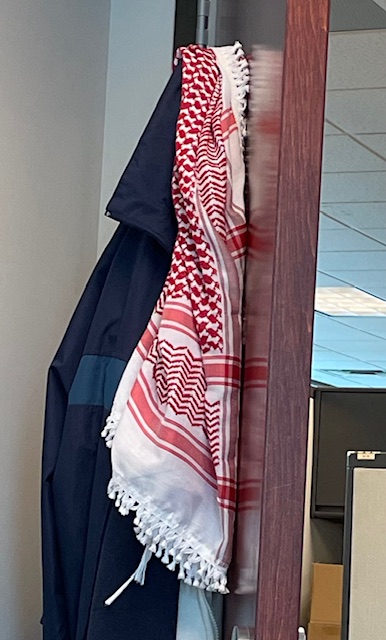
I can’t put my finger on it, or explain how I know, or even claim to know with any certainty, but my guess is that he suffers from some mild cognitive disability. He’s an adult in his thirties, but there’s something child-like about his demeanor. Or maybe this is just my sad way of saying that his sincerity is such that I can no longer imagine it in an adult of ordinary mental capacities.
“It’s a scarf,” I say, “called a keffiyeh.”
“Do you pray in it?” he asks.
“No,” I say. “It’s really a political symbol, not a religious one. It’s Palestinian. You wear it in solidarity with the people of Palestine.”
“Oh,” he says. “I confused it with something you pray in.”
It’s a common confusion. “I think you’re confusing it with a tallit, which looks similar but is used for praying.”
I don’t say what comes instantly to mind, that the tallit is worn by observant Jews, whereas the keffiyeh is worn by people reflexively deemed anti-Semitic for wearing it–a “symbol,” in one writer’s words, “of revolt, incitement, and terror.” My interlocutor lacks my world-weary cynicism and bitterness, and I prefer not to unload mine on him. One of us, at least, should enjoy the privilege of being untainted by the world.
He suddenly becomes very grave. “I’m very sorry for the shenanigans that have been happening to the Palestinians,” he says, with enormous, felt sincerity. I might ordinarily have taken offense to someone’s equating a genocide with a “shenanigan,” but this is the rare exception. I look at him and realize that I’m confronting the innocence of a child expressed with the moral gravity of a minor prophet.
He’d clearly heard the word “shenanigan,” vaguely knew that it meant something bad, and for lack of any other term, had applied it to something else he only vaguely knew, a genocide. It was a child’s diction but not a child’s knowledge, a child’s sincerity and curiosity, but not a child’s sense of concern. Genocide was clearly inconceivable to the shopping cart guy: fender benders and cart theft maybe, but no one had ever committed genocide in the parking lot at Giant Food Store. And yet in some rare way, he got it. I could tell. He’d clearly gathered the meaning of the event from random snippets gotten from random, no doubt dubious news sources. And he had somehow risen to the occasion. He insisted on bringing the “shenanigans” up, insisted on going to the place that conventionally respectable people instinctively avoid. Do you have to be “abnormal”–neuro-divergent, autistic, queer, trans, whatever–to do that? He’s doing the best he can, I think. I’m the one who’s not.
“Thank you,” I say. There should be more to say but there isn’t. I feel the need to flee. One part of me wants to stand at attention in tribute to him, the other, to collapse in a heap.
“I hope the ceasefire lasts forever and ever,” he says with great intensity. “Forever and ever,” he repeats, running off to chase his shopping carts.

I watch him sing-songing away. The last time Israel agreed to a ceasefire, I think–last December–it violated the ceasefire with impunity just a few months later. It’s promised to violate this one, too. That’s what Israel always does (see this and this). No one ever notices. No one ever cares. That’s what they count on. Apathy and buy-in to their unearned sense of civilizational supremacy.

The last time the United States and Israel jointly “guaranteed” the safety of the Palestinians, the result was the Sabra and Shatila massacre of 1982: between 2,000 and 3,000 dead over two days of rape and slaughter.** That’s what their fucking promises mean, the Israelis and the Americans. Nothing. I still remember Sabra and Shatila. I was thirteen when it happened. The corpses, I still remember, adorned the cover of Time magazine, back when corpses were allowed to do that kind of thing. It was an early lesson for me in the earthly meaning of the word “forever.” Nothing lasts forever, I want to tell the cart guy, chasing his carts. Nothing but a boot stomping on your face and mine for as long as we can stay conscious enough to feel it. Nothing but the sovereign rule of human brutality. Nothing.
“Me, too,” I hear myself responding to his wish for a “ceasefire forever.” “Me, too.”
*I’ve discussed Engels’s conception of “social murder” here.
**I was reminded of the point by a recent meme by Miko Peled, but there’s a good general account in Rashid Khalidi’s The Hundred Years’ War on Palestine, ch. 4. In order to guarantee the PLO’s expulsion from Beirut, Philip Habib, the United States envoy, “provided the Palestinians with solemn, categorical written pledges to shield the civilians in the refugee camps and neighborhoods of West Beirut. Typed on plain paper without letterhead, signatures, or identification, these memos were transmitted to the PLO by Lebanese Prime Minister Shafiq al-Wazzan and later enshrined in the records of the Lebanese government” (p. 155). One month after all parties agreed to this “document,” the Israelis facilitated the entry of their Lebanese Phalangist allies into the refugee camps, who slaughtered and raped the civilian inhabitants en masse for two days. The Israelis then fabricated a series of blatant, mind-blowingly nonsensical lies about “terrorists” in the camps–claims for which it produced zero evidence, but which went uncontested by the United States. None of this altered US policy by a decimal. Full, categorical support for Israel continued without interruption for the next four decades, with the same results–four decades of apartheid and mass slaughter interrupted occasionally by sporadic Palestinian counter-slaughter.
 Policy of Truth
a) I think you mean “terra nullius,” not “terra nullus.”
b) Re friends “in the academic sense of the word that’s compatible with not having spoken to someone in twenty years.” I have friends (not necessarily academic) that I haven’t spoken with in 20 years, for whom I would nevertheless gladly drive across the country to help them hide a body.
LikeLike
Re (a): thanks. This post was more riddled with typos than usual. I wrote it in an Uber on my phone.
Re (b): “…for whom I would nevertheless gladly drive across the country to help them hide a body…” Good to know. Hold that thought.
LikeLike
Pingback: Target Practice | Policy of Truth