In October 2024, after several years of activism (most recently spearheaded by Princeton Israeli Apartheid Divestment, or PIAD), the Council for the Princeton University Community (CPUC) invited written comments from members of the Princeton University community weighing in for and against divestment from Israel. The CPUC rejected the bid for divestment about a month ago.
What follows below is my written statement to the CPUC, which essentially speaks for itself–and likewise speaks to the title I’ve given this post. I will, in the near future, be posting some supplementary material, including screen shots from The Daily Princetonian of Meir Kahane’s two appearances at Princeton advocating ethnic cleansing and genocide (April 1984 and February 1988), the written version of my follow-up question to the CPUC about the issue of complicity, and the transparently evasive “response” to my question offered by Hilary A. Parker, Vice President and Secretary of Princeton University. I’ll also be posting a written response here to John Groves, chair of CPUC’s Resources Committee. Both Parker and Groves refused my repeated requests to offer a candid disclosure of the facts concerning the University’s investments, opting for concealment and evasion.
For now, I would just point out that Meir Kahane, one of the architects of the current genocide, met a well-deserved fate at the hands of El Sayyid Nosair, now serving a life sentence in federal prison. The same fate is to be wished upon all of its architects, including Naftali Bennett, who is scheduled to speak at Princeton on Monday. This last statement is not to be construed as practical advice to anyone, but as a statement regarding the actions that Justice, if personalized, would perform if given the ineluctable powers of fate. It goes without saying that I speak throughout only for myself, not for any organization, including any past or current employer, or place of study.
Statement in Favor of Divestment from the State of Israel and All Princeton University Investments Contributing to the Israeli Occupation of Golan, Gaza, East Jerusalem, and the West Bank
Irfan Khawaja ‘91
I write to express my support for PIAD’s proposal to divest from the State of Israel and from all Princeton University investments contributing to the Israeli occupation of Golan, Gaza, East Jerusalem, and the West Bank. I am a Princeton alum of the Class of 1991. I have a BA in Politics from Princeton, and an MA and Ph.D. in Philosophy from the University of Notre Dame. My areas of academic specialization include ethics and political philosophy; one area of competence is epistemology, or the theory of knowledge.
Between 1994 and 2020, I taught philosophy at a variety of academic institutions, including Al Quds University in Abu Dis, in the Occupied Palestinian Territories. Between 2002 and 2004, I held the rank of Lecturer in the Department of Politics at Princeton, where I taught political theory and international relations. For the last year (2023-2024), I’ve served as an alumni interviewer for high school students applying to Princeton. I’ve lived in Princeton for over a decade, and am on campus just about every day. When I didn’t live in Princeton, I made time to visit campus once a week, every week. I have followed the debate regarding divestment from Israel, at Princeton and elsewhere, for over two decades. For much of that time, I was skeptical of the need for divestment. I have recently, and decidedly, come to change my mind.
I have studied the Arab-Israeli conflict for decades, have written about it, and have experienced the Israeli occupation at first-hand. I have dozens of close friends in the region, both Israeli and Palestinian. Though raised as a Muslim, I’ve lived in a Jewish household for twelve years, i.e., as long as I’ve lived in Princeton, and was until recently a guest member of the String of Pearls synagogue in town. For the last four years, I’ve worked in health care, initially in the operating room at Hunterdon Medical Center (Flemington, NJ), and currently as a business analyst in hospital revenue cycle management for CorroHealth LLC (Iselin, NJ).
The principal obstacle to a rational discussion of the issue of divestment is the (admitted) opacity of the nature of the University’s investments themselves. The relevant point, it should be emphasized, is not whether Princeton is specifically invested in the State of Israel (e.g., in something like Israel Bonds) or in companies specifically located in Israel, or owned (or majority owned, etc.) by Israelis. The relevant point is whether a given investment, regardless of the location of the firm or the nationality of its ownership, makes a significant causal contribution to objectionable features of Israeli state policy, and whether these investments make Princeton morally complicit in those policies. A further relevant point is whether the university recognizes any such complicity to violate its interpretation of its mission.
It is often difficult conclusively to establish “where” a company is located. Since Israel lacks internationally-recognized borders, any attempt to define “company located within Israel” is a controversial matter that would itself require extensive elaboration. To narrow the focus to such matters is willfully to miss the point. I would ask that CPUC and the Board of Trustees begin by resolving not to miss the point. A necessary condition of doing so is disclosing the nature of any relevant investment.
I acknowledge that CPUC and the Board insist that any request to divest be demonstrated to violate some specific aspect of–or particular clause expressing–the University’s mission. The basic function of the University, we are told, “is to transmit and expand knowledge through teaching and scholarship.” The implication would seem to be that the University is entitled to undertake literally any action that leaves these two activities in tact, and leaves them in tact at Princeton. Taken absolutely literally, this would entail that if the University’s investments were promoting literally any evil–conquest, genocide, slavery, human trafficking, mass rape–there could be no objection to its doing so, as long as students and faculty at Princeton remained untouched by the effects of these malfeasances. Given its own idiosyncratic conception of its mission, and the self-imposed limits it places on the expression of moral considerations, the Board is just “forced” to acquiesce in world-historical evil because doing otherwise would subtract from the aim of maximizing long-term return on the university’s endowment.
If that is the standard the university has adopted, it cannot be met. But if that is the standard it has adopted, then what it has adopted is less a standard than a bad faith instrument of evasion. The relevant standard cannot require a demonstration that the university’s investments undermine the pursuit of teaching and scholarship at Princeton. The relevant moral standard must be whether the university’s investments undermine the values that undergird not just Princeton’s but any university’s mission. And demonstrable complicity in demonstrable injustice of a serious kind obviously does this.
As previously remarked, I work in hospital finance. Imagine a hospital with a Mission Statement that committed it to healing its own sick and injured patients, but which was interpreted in such a way as cheerfully to permit investment in practices elsewhere that required iatrogenesis, malpractice, and mass death on par with the Mengele experiments. Now imagine that this hospital shrugs off concern for its complicity in Mengele-like practices, simply because it declines to practice them within its own walls. “We are reluctant to consider divestment,” it piously tells its stakeholders, “because while our investments require the creation of the medical equivalent of the Fourth Reich, no one can prove that any of these experiments are taking place here. Research and teaching continue as they ever did. So our mission remains in tact! Hence investment in the Mengele experiments may continue without impediment!” This is an abdication of moral responsibility masquerading as conscientiousness. An institution that fixates on legalisms of this kind while ignoring the underlying moral issues is not acting in good faith. I assume that good faith is part of the university’s mission, whether it says so or not.
As a preliminary, then, I believe that Princeton University ought to begin by candidly disclosing which of its current investments has any tendency to contribute to the Israeli occupation. Which investments causally/financially promote the Israeli occupation of Golan, East Jerusalem, the West Bank, and Gaza? Which do so with respect to its current war effort in those occupied territories as well as Lebanon, Syria, Iran, and Iraq? At a bare minimum, the university owes the university community a candid accounting of the facts.
The failure to disclose this much flouts any reasonable interpretation of the university’s mission. Teaching and research are premised on the unbiased pursuit of truth and on good faith disclosures of fact. There is a long-standing controversy about investment and divestment from Israel, at Princeton and elsewhere. Scholars debate the issue, at Princeton and elsewhere; though I’m no longer a faculty member, I remain engaged in scholarship, and the ethics of investment/divestment is one of my topics of interest. So too is the state of higher education in Palestine, as well as what Americans have to contribute to it, whether positively or negatively. I cannot see how a refusal to disclose the facts about investment is consistent with the University’s professed interest in the values of teaching or scholarship. It directly violates them. Opacity is not an academic value.
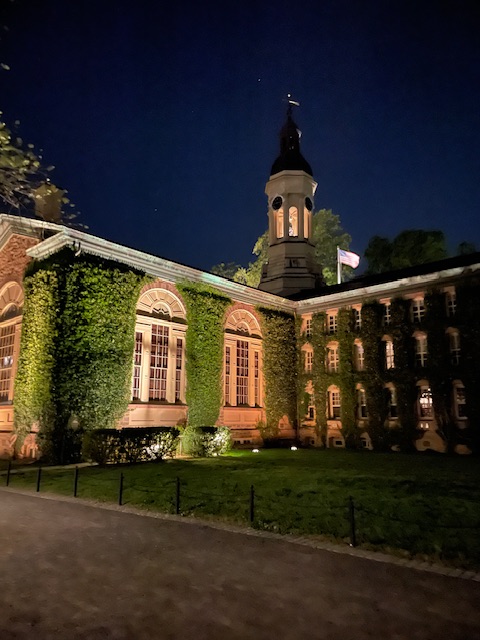
Nassau Hall, Princeton University, during Gaza Solidarity Encampment on Cannon Green, April 2024. The location from where I took this photo is now off-limits to protests. (photo: Irfan Khawaja)
Having disclosed the relevant facts, the next question is whether or not to divest. It is not possible within a statement of this length to give a comprehensive account of the reasons for divestment. As I see it, the question is whether such investments as the university has involve causal contribution to, hence complicity in, serious injustice. If the university is willing to accept its complicity in serious injustice, I think it owes the petitioners an honest, candid avowal of this fact. It should tell us, explicitly, that it accepts complicity in serious injustice as a price of growing the endowment. The obvious question, then, is how far it is willing to go in tolerating complicity.
Investment in the Israeli occupation is fundamentally and seriously unjust. The fundamental reasons reduce to these:
- The Israeli occupation of Golan, East Jerusalem, the West Bank, and Gaza are all consequences of an act of aggression on Israel’s part in the 1967 War.
- Its occupation and settlement of these territories compounds the initial injustice of aggression.
- The occupied territories have an apartheid character fully on par with apartheid in South Africa or Jim Crow in the American South.
- Israel has engaged in pervasive, repeated, systematic, egregious, and rigorously documented human rights violations in all of the occupied territories.
- There is now ample documentation to show that the current phase of Israel’s war on Palestine, begun in October 2023, exemplifies one or all of the following: genocide, ethnic cleansing, systematic state terrorism.
The literature documenting these claims is enormous and to my mind, highly persuasive. Some of the best of it has been produced by scholars associated with Princeton, e.g., Norman Finkelstein and Zachary Foster. I would highly recommend that the university explicitly seek out their advice before coming to any evaluation of Israel’s actions or policies. But I would say that any institution making a financial contribution to the Israeli occupation is, in virtue of the preceding, complict in serious injustice. It is continuing an act of aggression, continuing the occupation and settlement that themselves continue that act, promoting a system of apartheid, promoting the systematic violation of human rights, and now, arguably, promoting genocide, ethnic cleansing, and state terrorism.
Having taught in the West Bank, I can attest at first-hand to the adverse effects of the Israeli occupation on academic life. My students were regularly shot, shot at, arbitrarily detained, imprisoned, beaten, and abused every single day that I taught at Al Quds. I was shot at, arbitrarily detained, and repeatedly interrogated for reasons that fell far short of anything approximating “reasonable suspicion” or “probable cause.” Since October 2023, Israel has engaged in what has come to be called “scholasticide,” meaning the reckless or deliberate destruction of the educational system of Palestine. It seems easy enough to see how scholasticide violates the mission of a university, as long as the university in question is willing to acknowledge respect for the rights of academics at other institutions as parts of its conception of its mission. At a bare minimum, it must see the fault involved in promoting the systematic violation of the rights of academics at other institutions.
I cannot help ending with an anecdote–a Princeton anecdote that seems to have been lost in time. I attended Princeton between 1987 and 1991. In February of 1988, the Whig-Cliosophic Society invited Rabbi Meir Kahane to speak at Princeton. Kahane gave a speech in 50 McCosh Hall on or about February 11, 1988. The talk was part of a tour promoting his book They Must Go, an explicit defense of the supposed need for Israel to expel the Palestinians from “Greater Israel,” including Israel itself, the West Bank, and Gaza.
During the Q&A period, I asked Kahane, in public–before an audience of some 300 people–what would be done with those Palestinians who refused to leave when ordered. Kahane asserted without hesitation that the Israeli army would be set upon them and they would all be killed. I have confirmed my recollection of this event with Dr Sumaiya Hamdani, Associate Professor of History at George Mason University, who was also present that night. I should add that Kahane had previously spoken at Princeton in April 1984, at which occasion he explicitly advocated ethnic cleansing. Both events were reported on in The Daily Princetonian, April 27, 1984 and February 12, 1988.
To the best of my recollection, no member of the university community ever issued an official condemnation of these claims. Yet Kahane’s prescription has now posthumously been put into practice, on the ground. Regardless of the outcome of the debate over divestment, I will never forget–and never permit Princeton to forget–that Israel’s warrant for genocide was issued at Princeton before it was carried out in Gaza.
The Board may disagree with my description of Israel’s actions as a genocide, but if so, its disagreement must make sustained contact with the comprehensive literature on this topic. The Wikipedia page on “Gaza Genocide” summarizes the case, listing some 545 footnotes, and a bibliography of several dozen items. If we add other pertinent topics, we’re talking about hundreds if not thousands of pages of documentation. The Board is obliged to acquaint itself with the issues discussed in this literature. It cannot evade the issue by announcing an a priori aversion or “reluctance” to having to face the facts. The claim alleged is that Israel is committing genocide. Genocide is the crime of crimes. It is, an act of egregious moral abdication to pretend that one’s complicity in such a crime is a matter that can insouciantly be brushed away as an inconvenience unworthy of one’s time or attention. A conscientious person would, at the very least, consider the case with the care it demands. There is no statute of limitations on the pursuit of truth.
I reiterate: Princeton should divest.
Irfan Khawaja ‘91
 Policy of Truth
Pingback: Kahane at Princeton: April 1984 | Policy of Truth
Pingback: Why Princeton students disrupted Naftali Bennett | Policy of Truth