The wounded woman gets called a stereotype and sometimes she is. But sometimes she’s just true.
–Leslie Jamison, “Grand Unified Theory of Female Pain,” The Empathy Exams*
On the day before New Year’s back in 2021, I found myself riding the train to work when, one stop after mine, a vaguely familiar woman got on. Or maybe I should say, struggled on. She was, I guess, in her sixties, heavy-set, apparently in pain, though not from any obvious cause, and was struggling with a shopping cart full of possessions. At first, in a reflexive reaction to the shopping cart, I took her to be a homeless person, but that turned out not to be the case. She clearly had trouble moving, and had trouble getting the cart onto the train. I half got up to help her, but not knowing how my gallantry would be received, sat back down and watched her struggle. It was rush hour, just before 8 am.
She wasn’t well-dressed in any conventional sense of the term, but also not as ill-dressed as you might expect a homeless person to be. She sat down heavily, sighing, took out a cell phone, and began to speak. She had a loud and grating voice, which she poured into the phone in the direction of someone named David on the other end, evidently a partner or something like it.
My first reaction was annoyance. I hate noise. I hate noise on the train. I particularly hate noise on the train when I have to work the day before New Year’s. You wonder why people can’t wait to have their fucking conversations off the train rather than on it. But it was, for once, hard to feel wholehearted annoyance. I wasn’t sure why. The woman was, as I say, vaguely familiar, and I sat there a moment trying to figure out how I knew her.
The call with David didn’t go well. It started out OK, at least from the part of it I could hear. The woman told David, with a muted but sort of touching pride, how well her day was going so far. It had apparently started out several hours earlier in East Brunswick, a non-descript town nearby, where she had, with her cart and all her stuff, taken a bus to the train station at New Brunswick, a local train hub. Arriving at New Brunswick, she’d managed (I gathered) just barely to race up the stairs and catch the train to New York, where (I gathered) both she and David lived, though in different places. All in all, she’d managed rather well, hadn’t she?, she asked. Here she was, sitting on the train to Penn Station, making good time. She’d be there by 9.
I started to soften a bit at this point, my annoyance giving way to an odd sort of protectiveness. The woman’s pain briefly became real to me–accentuated I suppose, by the incongruous pride she took in her rush hour accomplishment, and the possessive care she exercised over her shopping cart. Maybe this is a special brand of commuter empathy, but for a moment, a vivid image of her came to mind, dragging the shopping cart around East Brunswick and then New Brunswick, straining against whatever pain she was suffering to make the bus and the train, precious cargo in tact. It’s no picnic lugging all that stuff around during rush hour on New Jersey Transit. Add chronic pain to the mix, and you get an ordeal. Something in me wanted, briefly, to make contact with her–touch her shoulder, offer a consoling word–but discretion suggested otherwise, so I didn’t.
The phone conversation continued. She was, the woman said, going to arrive in New York within an hour, and would be home maybe an hour after that. What did David think about the idea of her coming over to spend New Year’s together?
He clearly thought it was a shit idea, and said as much. He made plain that the woman was a burden and a bother, and made plain that he wanted her to fuck off and leave him alone. It seemed to take awhile to explain why.
I saw the woman’s face crumple, then harden, then crumple, then harden again. From hopeful expectancy, she fast-forwarded over grief and settled into rage. Why, she asked out loud, did David have to be such an asshole about everything? Was it such a crime to want to spend this supposedly celebratory night in company, rather than alone again, suffering in her apartment? Did he not understand what it was like to suffer chronic pain? Did he not see the achievement she’d managed so far that day? Did he not see that they would both be gone some day, and regret the missed opportunities for connection?
He didn’t seem to give much of a damn about any of that. The woman’s rhetorical questions continued, seemingly for an eternity, punctuated by profanity on both ends of the line. Though perched at the edge of tears, she managed somehow to stave them off, and sustain her rage for the rest of the call. Eventually, her rage exhausted, she hung up on David and called a female friend, maybe a sister, to vent. The friend was clearly more receptive to the woman’s message than David had been, allowing her to pour her anguish into the phone without interruption. I started to tune out at this point. My stop was coming up, and I needed to remember to get off and go to work. It was also starting to dawn on me why the woman seemed so familiar, and I wanted to be off the train once the realization hit.
It hit full force somewhere between the train and a nearby parking garage. I hid underneath a stairwell, crumpled into a heap, covered my head in my hands, and let it all wash over me, sobbing, until it left. The woman on the train was the ghost of my late wife. She looked like Alison, or like an older version of her. She sounded like Alison, and somehow acted like her. Same chronic pain. Same shopping cart. Same struggle with the shopping cart on mass transit. Same need to lug her life’s possessions with her everywhere she went, like a homeless person. Same insensitive asshole of a partner, tired of her, tired of life, contemptuous of the holidays, desperate to have the world fuck off for a change and leave him alone.
I don’t believe in ghosts, of course. I just mean that, dreams aside, this woman’s presence on the train was as close as one gets to seeing a ghost. The woman was Alison had she lived another five or six years. And, crumpled there under the stairwell, I couldn’t suppress the thought that this–the woman and David–is what we would have been, had there been another five or six years. The consoling fantasies evaporated in that moment, the wishful belief in the amicable friendship we might have had if only Alison had survived–a fantasy made plausible by the fact that there was no testing the hypothesis now that she was dead. Easy to forget that this is how things were when she was alive: this is the “empathy exam” I failed when passing or failing was a live option, as it no longer is.
Alison committed suicide in Toronto two years ago, after nine months’ estrangement from me. She’d suffered for almost a decade from chronic back pain produced by a failed laminectomy performed in an expensive, prestigious hospital in New York. An unsecured piece of equipment had fallen directly on her spine during the surgery, causing permanent damage. When she woke up, she was effectively crippled–unable to walk for months, unable to function for years, alone for most of her recovery, and saddled with chronic pain until the last moments of her life. She often told and re-told the story of her experiences in the hospital after the surgery: the duplicity of the surgeon; the insensitivity and neglect of the staff; the despair at the thought that she was, in the end, entirely on her own to cope with a form of torture invisible to everyone else, but unremittingly real to her. She could probably tell the story in her sleep. I knew it by heart.
It was the problem I was supposed to have solved. We’d been friends in the late 90s, but had had a falling-out around 2004. We re-connected twelve years later, and jumped headfirst, as middle-aged people do, into a torrid romance. But this was romance with a middle-aged twist: not just sex, not just fun, not just intoxication and excitement, but a sober attempt to grapple with the future, through friendship, companionship, and care. Neither of us would be alone again to deal with life’s travails. No more lonely nights of struggle and despair. The protective knight in shining armor was here, armed with Horizon Blue Cross PPO. Or so the theory went.
She was, when we re-connected after a long hiatus in 2016, still in physical therapy from the procedure, just getting to the point of something like recovery, but looking for something besides opioids to damp down the pain. She needed another surgical procedure to repair the damage done by the first one, but as the sole proprietor of a private therapy practice, couldn’t afford it on her Obamacare plan. We got married, in part, because as a salaried employee at a university, I had the kind of health insurance that would cover a dependent for such a procedure. And so, in early 2018, she got the second surgery–a Nevro HFX spinal stimulator inserted into her back, “a nondrug, FDA-approved, treatment option for long-term chronic pain relief…a small device, placed in a same-day outpatient procedure, that safely works inside your body to significantly reduce your pain and restore your quality of life.”
Except that the device didn’t quite perform the miracles it had promised to perform. And so the quest for pain relief continued for years after the surgery, each office visit necessitating yet another one to yet another specialist of some kind, each tweaking the failures of the last without ever getting us to the promised land of clinical success.
Which explains why Alison left our marriage and our home the way she did. I had, in May 2020, quit my job in protest at fraud I had discovered at my university, fraud that my Dean explicitly ordered me to cover up. What I regarded as a commitment to principle, Alison regarded as a betrayal. My “commitment to principle” had deprived her of the health insurance and access to health care that was her lifeline. In the grips of that rage, and likely in the grips of the manic phase of bipolar illness, she stole my car, stole a couple thousand dollars, abandoned all of her financial obligations (the mortgage, the HOA payments, the insurance payments, the taxes, the sewer bill…), and fled to Canada, where she had dual citizenship. She somehow managed to sweet-talk her way over the border at the height of the pandemic, without a passport, without proof of citizenship, and without a Canadian home address. “I just told them I had come home,” she said in explanation, “and they believed me because that’s how Canadians are.” I found it inexplicable, but then, I’m an American. What would I know?
She ended up totaling my car while ogling the CN Tower in traffic–”you know how much I love that building”–then trying to commit insurance fraud by collecting on the payout, ignoring the fact that it wasn’t her car, and wasn’t her policy. Geico owed her the money, she insisted, because it was undeniably her accident. It’s a miracle she didn’t get arrested. But then, it’s a miracle she got into Canada. Odd how Alison’s miracles tended to solve her problems by abetting them.
Having totaled the car and committed insurance fraud, Alison then decided to initiate a contested divorce action against me. The lawsuit led to a predictable ban on communications between us. Months of eerie silence ensued, interrupted only by intermittent violations of the ban on both sides, when one or the other of us got sick of waiting for some lawyer to do this or that trivial thing. People sometimes ask me what the “contested” part of the divorce was about, but despite having read the filing over and over, and having spent tens of thousands of dollars to resolve it, I still have no idea. Neither does my lawyer. Neither, I guess, did the judge, who eventually dismissed the case. Unfortunately, it took a year to get to dismissal, by which time she was dead, and I was nearly bankrupt–but widowed rather than divorced, if anyone’s keeping score.
But I’m getting ahead of myself. Dismissal was well in the future; it didn’t happen until late fall of 2021, months after Alison’s death. Meanwhile, back in 2020, there was more stuff to lose. Having lost the car in the fall of that year,** we ended up losing our home in late 2020, averting foreclosure by two weeks by selling the house at the very price at which we’d bought it, just breaking even, but at least getting it off our hands. I vacated the house the day Alison drove down from Toronto with the cat to collect her things. We crossed paths for five, final acrimonious minutes. The cat, disoriented at first, suddenly bounded up the stairs in long-lost recognition of me, and jumped into my lap. Alison didn’t quite follow suit. Her dismay at seeing me in the house–I was supposed to have left by then–was only too apparent. She started screaming. I screamed back. We both called our lawyers. Mine advised me to leave the house immediately, so I did. I wasn’t done packing, but no matter. I lost whatever remained.
It really didn’t matter, actually: I’d already moved everything of importance to me. Things were different for her. Her whole life was in that house–patient records, keepsakes, favorite books, private journals, screenplays never quite written, research never quite finished. She was too ill, mentally and physically, to move any of it. And no help was forthcoming, either. I was under orders to leave, and in no mood to help. The stalwart friends who were supposed to show up to help never did. So she was under pressure, and on her own. The lawyers, the real estate agent, and the buyers all demanded that she pick up the pace and clean the place out, “per the contract.” The closing was a week away, and no, it wasn’t going to be delayed. Hundreds of thousands of dollars were on the line. No one was in the mood for excuses from a sick, deranged “Karen.” People who encountered Alison that December later told me that she acted very “oddly,” screaming, crying, dropping things, forgetting things. They didn’t seem that sympathetic. They’d always found her odd. Now she’d gone over the edge. Best to keep one’s distance. No telling what she’d do.
A video I later discovered of her on Instagram from that time depicts what looks to me very much like a dress rehearsal for suicide. She stares directly at the viewer, smiling enigmatically. She positions herself carefully in bed, then lies back, slowly, seductively, closing her eyes, until she comes finally to rest, eyes closed. The video ends. Some of her newly-found Instagram friends interpreted the video as a come-on. One commenter couldn’t stop with the lurid fuck-me pleas, months after her death: “you are so pretty! I would love to be yours for you cook me with butter in your oven, and than, you will bite chew me, you will eat me slowly, heal me and eat me!!” I eventually had to tell him to stop.
My last physical memory of Alison was the day we lost the house, December 17, 2020. I had vacated a week earlier and was supposed to surrender my key at 10, so I watched surreptitiously from behind a nearby fence at 9:30 as Alison loaded the last of her things into her rental car–pointlessly, given what was about to happen–put the cat on the front seat beside her, and drove off. I can still see the scene, her grim profile rushing by fifty yards away from me as she drove away. I often wonder if she saw me. I wonder what she thought if she did.
Isolated, eventually cut off from her American health insurance, disillusioned with Canadian Medicare, with only spotty access to her pain medications, increasingly unable to communicate in a clear or cogent way, unable to keep up her therapy practice, and unable to cope with COVID, Alison fell into despair. I saw this in her Instagram posts, discovered long after her death–full of anguish, full of cryptically disturbing messages about death and violence, dotted occasionally with coded references to suicide. Though I wasn’t aware until after her death that she was on Instagram, many of the posts read as though addressed to me, as though she hoped or was somehow confident that I would see them, but could only address me by stealth and indirection. It was the behavior of someone less familiar with me than afraid of me, as though caught in a labyrinth and exchanging messages with the Minotaur in the futile hope of posthumously eliciting his empathy.
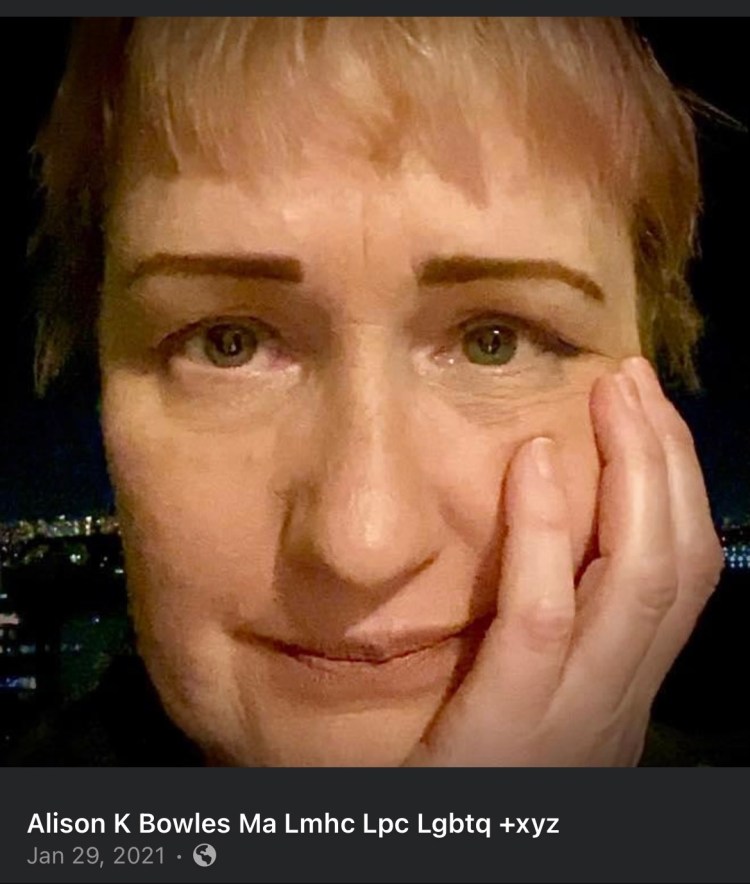
From an Instagram post of November 3, 2020:
The sun is setting on a lovely day. When the sun rose today, I regained my mind. I lost my mind over the last few days. To anybody I offended, I am deeply sorry. I have been too long in pain. I have missed my family and my friends more than I can say. I have particularly missed those I hold dear. Although there is a lot of music in the world, and stories in black-and-white and colour and in words, and our cats and dogs we love dearly, there just can’t be enough true friends, because true friends come along [only a] few times in a lifetime. And we know them when we meet them usually. There’s just that something that happens almost right away it seems. Even if you are, I am, my own best friend–and I need to be, to survive this sometimes dark, deadly world–there is no replacing those dearest to me. And I think I hurt some of those people. My profound apologies. I offer this beautiful picture I took this evening [of her neighborhood] as a way of saying what I need to say to those people. I’m so very sorry.
I wonder how much of that, if any, was meant for me.
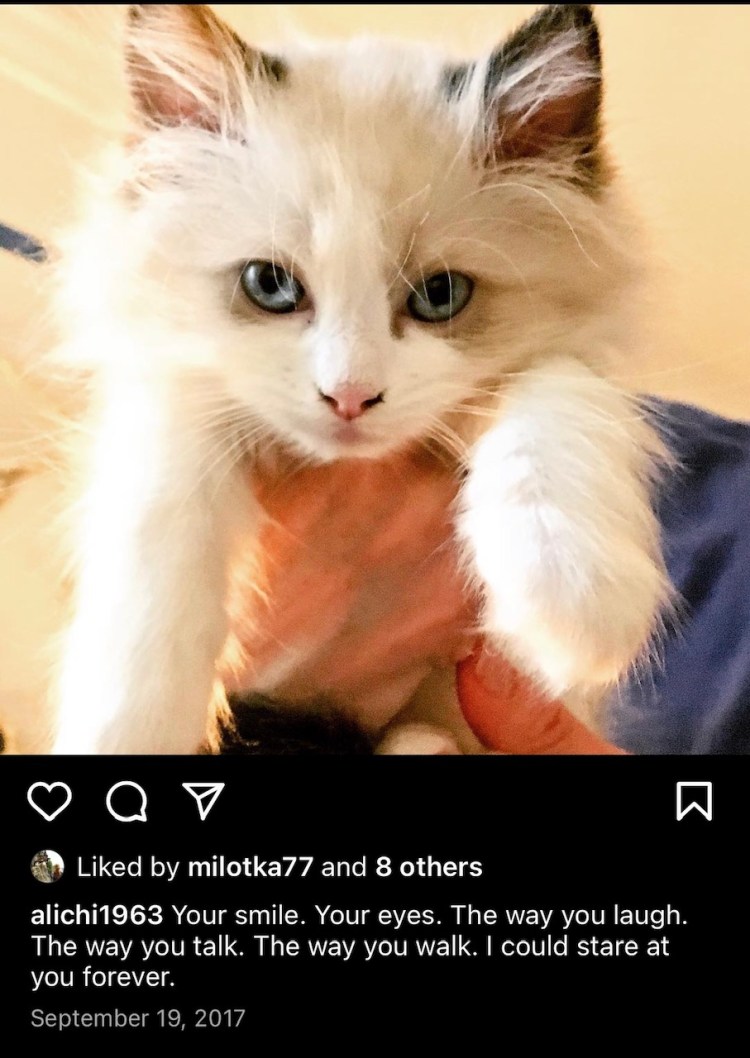
Three years earlier, however, things had been very different: we’d been best friends and in love. Months after her death, I discovered a post of hers dated September 19, 2017, underneath a photo of our then-newborn kitten Hugo. For a long while, I thought it was addressed to Hugo:
Your smile. Your eyes. The way you laugh. The way you talk. The way you walk. I could stare at you forever.
It took an effort of will to grasp that cats don’t laugh or talk, and that she was using Hugo to talk to me–in the full knowledge that I wasn’t on Instagram, that I didn’t know she was on Instagram, and that there was no guarantee I’d ever encounter the outpourings of her heart, whether before her death or after it.
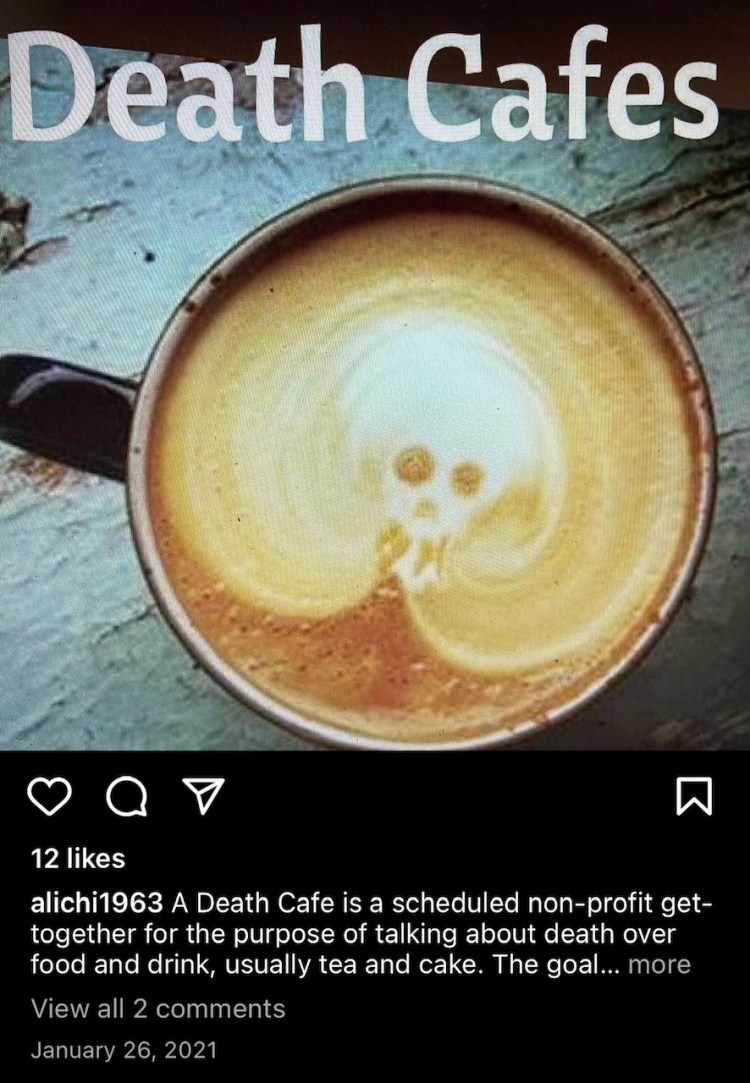
One of her last posts, a few weeks before her death, advertised her presence at a Death Café:
A Death Cafe is a scheduled non-profit get-together for the purpose of talking about death over food and drink, usually tea and cake. The goal of these nonprofit groups is to educate and help others become more familiar with the end of life.
My personal experience has been a lessening of anxiety relating to death. I think I actually need a “life cafe” to deal with my anxieties related to life!
Alison died somewhere between March 3 and 4, 2021. It was her second suicide attempt within the last few weeks of her life, and as far as I know, the third attempt she’d ever made, planned so as to coincide with a building inspection that was scheduled to take place on the 4th. She’d clearly chosen the 4th to ensure Hugo’s survival in the wake of her death, leaving a terse, hurriedly scrawled “suicide note” for whoever found her: “Please take Hugo (my cat),” with her father’s name and number underneath. Hugo, her baby, was the only one there with her at the end, the only witness to her final breaths.
I thought of Alison, even before she died, every time I set up a spinal case when I worked in the operating room at Hunterdon Medical Center, my first job after I lost my academic one. I’d go into each operating suite after we were done with a case, “making sure” in paranoid, Cartesian fashion that nothing had been left amiss. Bed locked, lowered, and level, and prepped correctly for the next procedure. Anesthesia table in proper order. Nothing on the floor. Canisters in place, attached to suction. Nothing loose or liable to fall down in the middle of the procedure. It had less to do with my official job description than with my Sisyphean quest for redemption.
I couldn’t begin to tell you what good it did, if any. It certainly didn’t do her any good. Alison died by her own hand, alone, in pain, without access to needed medications, haunted by the past, in despair about the present and future. And, Sisyphean histrionics aside, my own role in all this was hardly angelic. It wasn’t just that the woman on the train reminded me of Alison, but that David reminded me of me. Like David, I’d been consumed by my own worries–my mediocre academic career, my listless career prospects, the unapologetic corruption of my university–and had more than once acted out the role of self-absorbed asshole that David had: obsessive, insensitive, quick-tempered, verbally brutal.
Verbally brutal: my last conversation with her took place at 2 am on a weeknight, maybe three weeks before her death, and about half an hour after I’d come home from a ten hour shift in the OR, cleaning rooms full of COVID, MRSA, HIV, and C Diff. I was exhausted, as was the day’s Virtue Quota, and operating on Moral Auto-Pilot.
She called me out of the blue, violating our lawyers’ ban on communication, desperate both to come clean about what she’d done with the car, but also incapable of resisting the urge to prevaricate and demand my complicity in one last, petty fraud. The legalities were confusing, she’d lied to me too many times, the police had stopped me too many times, and I was too tired and fed up for patience or civility. I ignored her sincerity, fixated on her prevarication, and let her have it. I still remember what I said: it came so reflexively that it’s hard to forget. “I want you to stop calling me, shut the fuck up, and leave me alone,” I yelled. “I don’t want to hear what you have to say about anything. I don’t give a shit. I don’t care. Every word out of your mouth is a motherfucking lie. Everything you do is a scam. You want to communicate about the car? Have your lawyer talk to mine. End of story. Because just to be clear: when all this is over, I’m going to blot you out of my fucking life. So how about we start now?”
How about we start now. It was the last thing I ever said to her. I hung up without waiting for an answer. There was a month of silence. Then she was dead.
It’s hard to dwell on pain, especially someone else’s. Our minds don’t seem to be designed that way: we’re built to turn away from it, not to face it. You get sick of it after awhile, no matter how real it is for the other person. Their pain becomes a pain. Their life becomes a drag. So easy to overestimate your own capacity for patience or compassion until the moment comes, followed by another, and a third, and a fourth–endless cries of distress, an endless traffic jam of demands. I couldn’t help wondering whether that was the inevitable fate of the woman on the train. Another despairing soul, languishing somewhere in New York City? Another death of despair, care of the painkillers meant to make life bearable?
I once tried to assuage a friend’s moral worries about something with the thought that she had no cause for guilt or regret, because she had in the end, “done her best.” She brushed my claim aside with impatience. “How can we ever know that we’ve done our best?” she asked. Of course we could, I said. It’s self-evident. Either you did or you didn’t. Just ask yourself whether you did, and out pops the answer. No, she said, it’s not self-evident. Bestness involves a potential infinity of moral effort, a “more” beyond every “enough.” There’s always more you can give, so it’s always an open question whether there was a further quantum of effort toward bestness you could have put in that you didn’t. Far from being self-evident, it’s always an open question whether you really did your best. You can never really know.
The thought seemed preposterous to me at the time–like some weird bullshit out of Kant***–but no longer does. I wonder what my best is, whether I can ever know what it is. Did I fail the empathy exams, or did I pass? Was it a fair test, or was it rigged against me? Did I just squeak by, or did I do any better than that?
I sometimes stare awhile at Alison’s last photo and sink into it as though in expectation of an answer, but never get one. She just stares back mutely, withholding whatever it is she thinks. I see grief, resignation, exhaustion, and despair there, but surely at least a tincture of reproach. I think of it as her last cruel gift to me. She was malicious enough to know that her suicide would leave me forever in agony and doubt about the role I played in making it happen. But she loved me enough to think, sincerely, that the agony would do me some good. And I still believe in her enough to think that it will or has. Whether I did my best, I don’t know. Whether I’m doing it now, seems clearer. At times when I finally reach clarity, I come to a stop. Eventually, I think, moral effort reaches its terminus, leaving no further effort to make. That, I guess, is the best I can do. After that, there’s just the calm after the storm, the ache of loss, the will to learn from the past, and the will to move on.
*My title is an allusion to Leslie Jamison’s The Empathy Exams: Essays (Graywolf, 2014), which I highly recommend. The book’s final essay, a “Grand Unified Theory of Female Pain,” could practically have been written for Alison. Though I bought the book in 2014, I didn’t read it–late as usual–until well after Alison’s death.
**Ludicrously, I lost our other car–her car–by driving it straight into a flash flood during Hurricane Ida. But that’s a story for another day.
***As in Kant’s conception of the opacity of the human psyche: “The depths of the human heart are unfathomable,” Immanuel Kant, The Metaphysics of Morals, Doctrine of Virtue, I.1.2.2 (§22), Ak. 447. See Owen Ware, “The Duty of Self-Knowledge,” Philosophy and Phenomenological Research 49:3 (November 2009), pp. 671-698.
 Policy of Truth
Casual reader of your blog. I like your thoughtful perspectives, though often quite different from own views and experiences. I wasn’t expecting to read anything like this today. I wish you the best.
LikeLike
Thanks for reading it, and for your response. It wasn’t exactly a casual read!
LikeLike
Hi Ifran,
I think I met you once — long ago. Maybe when you were just friends with Alison. I seem to recall her raving about you. This would have been the summer of 2000, just before 9/11.
I just read your above post about Alison. It floored me. Because you captured her so well. With intense love and equal and honest dismay. I write the below to try and help you process all these feelings. Because I understand where you are coming from.
My relationship with Alison still resonates with me so many years later. She was the best and only person I’d truly call a friend in Los Angeles. We met while working at a basically ruthless large law firm in the “Die Hard” building in Century City. I was from an uptight Mormon background, continuously beating myself up about my inability to be perfect, and here was Alison bragging about some petty crime she’d committed in the past. I don’t know what it was. Simple theft. Something like that. And I loved her instantly. She was a LIGHT.
For a good long time we had a lot of fun. We were like Yin and Yang. She was all excess energy and assertiveness and I was the kind of quiet, observant one. Even though she may not have had a lot of formal education at some pretentious university, she was uber smart. Probably had the sharpest mind of anyone I’d known up ’til then.
Then we started disagreeing on things. In the beginning I was so in awe of Alison and her brilliant mind and personality that I just observed and did not speak up. But when I did start challenging some of the things she said to me, it made her very unhappy. Part of what I said was, I assume, a result of my Mormon upbringing, where everything has to be nice. It annoyed Alison to no end and I don’t blame her.
I remember making a comment about forgiving someone very close to her whom she said had caused her intense pain and suffering. She was furious that I’d ask her to try to forgive this person. I had never been in therapy at that time so didn’t know this was not the right thing to say (folks have to process their pain). That evolved into disagreements about Ayn Rand’s theories. That was also a “no no” for Alison. You do not question Ayn Rand. She just would not have it.
I remember a comment made in the law firm copy room by Alison about Ayn Rand and her theories. Something about the survival of the fittest. Basically if you can’t survive on your own then you don’t have a right to survive–or at least that’s how I heard it. When I protested that idea she stated that my need to help folks who couldn’t help themselves was more about my (Mormon?) guilt than any true want to help. That hurt. (But was probably partly true — Alison was brutal but always spoke her truth.)
After that I just started to feel exhausted whenever I was with Alison. Anything I said was challenged and vice versa. We were both guilty. Bringing our sort of damaged selves to the relationship and not willing to compromise to try to make things better. And we were both too alike (stubborn and opiniated) and too different (in our life views) to co-exist in any peaceful way.
Around this time I was going through a lot of things on my own. A break up. Deep heartbreak and had also entered therapy and so was kind of needing to lay low. I wasn’t socializing with anyone, but Alison called me out on my lack of involvement and attention to the friendship. When I tried to explain to her what I was going through, she was harsh. I think she very relevantly felt abandoned and I know it hurt her deeply. Yet, I did not have the energy to navigate Alison when I was trying to figure out my own life. (I was pretty sure I had Asperger’s or something like it, and when I said this to her, regarding my lack of social skills, there was no understanding, even though she was studying to be a therapist.)
So, yes, my relationship with Alison was, like yours, loving, crazy and complicated.
You should know she’d had chronic pain for years before I met her in or about 1989. Long before spinal surgery. And like with her later chronic pain, she had a hard time getting anyone to acknowledge her condition. She was just in constant, constant pain when I knew her.
Beyond all that, when Alison was happy it was a marvelous thing. It flowed through to everyone. She could be so stunningly gorgeous — like a young Jessica Lange — and dressed with such style and flair. She loved beautiful things and she herself was beautiful, rare being.
I loved her capacity for immense joy and I feared her wrath. She was a massive contradiction of beauty and darkness. She reminded me so much of some of my most loved poets, like Plath and Sexton. And she could write like them too.
Though her life was hard, she had a lot of joy in it too. Even though just in short spurts. Those times were the best. And that might have just been her path. Nothing anyone could do to change it or make it better. I could have been a better friend. Her parents could have been better parents. You could have been a better husband. Her therapist could have been a better therapist. The government could have been a better government. She could have had better genes that did not pass on her mental struggles. I could go on, but you get the idea.
I’m now a mother and my daughter points out to me almost every day my failings. But I will still continue to make mistakes and make her sad or angry. But I try with every fiber of my being to help her through this very difficult and magnificent world. It’s all we can do for the ones we love. And that has to be enough because there is nothing else we can do.
At some point, Alison made it impossible for you to help her. She knew that. You know that. And that was Alison’s path. Just cherish the good, nostalgic times and release the rest if you can.
I send my deep condolences for the loss of Alison and what you both went through. Your writing is so deeply meaningful to me and healing. Please keep writing.
Best wishes,
S
LikeLike
Hello, Sher–
I’m very grateful to you for having written. Apologies for the delay in responding, but I have a very tight schedule, and I always find myself falling behind. Thank you not only for the condolences, but everything you’ve written.
I don’t remember our having met. If we did meet, it would have been in New York, not California. Alison and I always planned on going to California together, but never did. We definitely had an active friendship during the summer of 2000, and I was at her place fairly often that summer. This would have been her apartment on Cabrini Blvd, the same one where she lived until we bought our house in Jersey in 2018.
Over the past few years since Alison’s death, I’ve heard from many of her friends–some people I knew, some I’d heard about, some I never knew at all. What strikes me about all of the responses is that there’s a certain common thread that runs through all of them: everyone remembers the same recognizable Alison. And yet, every perspective is also revealingly different. Despite knowing Alison for more than twenty years, and having been married to her, it becomes obvious to me that in some way, I never really knew her. No one seems to have known the whole Alison, and that seems to have been her design. She revealed intensely personal bits and pieces of herself to a wide range of people, but never revealed everything to any one person. I’m left having to piece it all together after the fact.
It sounds outlandish, but it’s hard for me to resist the thought that this is what she wanted. She desperately, desperately wanted to be known and recognized, but in life, she made it impossible to really know her in the way she herself wanted. It’s as though she left the pieces of the puzzle there for anyone willing to put them together after she was gone. It’s as though she wanted to be known, but couldn’t bear to be present for the act of knowing her for fear of the reaction.
I understand why. She was a very unique combination of light and darkness, of love and hate, of good and bad. She wanted the good to be known, but she knew the bad was there. She couldn’t disentangle the two things, and I think she couldn’t bear the thought that what people fixated on was the bad at the expense of the good. And the truth is, they often did. Many, many people were instantly turned off by Alison. Or if they weren’t, she managed to work hard to turn them off.
She wasn’t wrong to fear negative reactions, but she was wrong to think that everyone had exactly the same reaction to her–that no one was capable of recognizing or acknowledging the good. I used to think, somewhat narcissistically, that I was the only exception there, that I was the only person capable of seeing The Good Alison for the bad that everyone else attributed to her. But her friends, like you, have convinced me otherwise. All of you saw exactly what I saw, even if you knew other things I totally missed.
The tragic thing is that Alison often worked hard to wreck relationships at the very moment when intimacy had been achieved. She did that with me, and she seems to have done that with you. She did it over and over. I think this was a reflection of her deep ambivalence about being known. She desperately wanted it, but started to panic the moment she began to achieve it. Her desire to be known conflicted with the compartmentalized way she went about it. She wanted to be known, but she then set terms and conditions such that you could only know this and not that, only in this way and not that, and so on.
Your existence is an example of this. Alison frequently talked about her job as a legal secretary in LA. But not once did she mention you. Not once did she mention any friends at all from that period. In fact, the impression I got was that her life at the time was a solo act. As I think about it, I realize how vague she was about her entire life before I met her in 1997. She was detailed about life in Toronto, before she moved to LA, and I knew all about her life after 1997, when she moved to New York. But I only know selected pieces of her life in LA, and very few of the people. The period between 1989 and 1997 is a total mystery to me.
Another example is Alison’s connection to Objectivism, to Ayn Rand. In her version, she was unwillingly indoctrinated in Ayn Rand’s thought by her mother. She accepted some of Rand’s ideas, but mostly rejected them. Eventually, her mother abandoned Rand’s thought, and so for the most part did Alison. As it happens, I first met Alison at an Objectivist conference in Charlottesville in 1997, where I was giving a talk. That’s where we became friends. She was moving to New York, and I lived in New Jersey, so we saw a lot of each other in those years. Though the relationship was Platonic at the time, there was always a strong attraction, but even so, I’m surprised to hear that she raved about me to others. We had a falling out in 2004, and were out of contact between then and 2016, when we started our romantic relationship and marriage. But our return was seamless. It felt “fated.” I guess it was also ill-fated.
I wasn’t aware that she had chronic pain issues before 2013 or so. I do remember her having carpal tunnel syndrome early on, but the spinal condition seems a qualitative change from everything before. I don’t recall Alison’s really fixating on suicide in our early friendship, but suicide was an underlying theme of the second part of our relationship, and she always dated it to the aftermath of her surgery. I don’t know how accurate that was, but that’s how she put it. I will write about this some day. So far, I haven’t been able to drill down into the depths of it. Some of it is so dark and terrible that I don’t know how to deal with it.
I loved what you wrote about Alison’s looking like Jessica Lange and this:
I don’t know if you’ve seen the memorial site for her, but there are several pictures there, and one of them really does look like Jessica Lange.
https://everloved.com/life-of/alison-bowles/obituary/
I have only read a bit of Plath and nothing of Sexton, but I’m now intrigued. It’s very painful to me that all of Alison’s writing is now lost, including her screenplays. The truth is that she was never able to realize her potential as a writer, and I often think that she felt overshadowed by me in that respect. She was obsessed at the end of her life by the film “A Star Is Born,” and if you think about its plot, and substitute “writer” for “musician,” you can easily understand what I mean. (Why the writing is lost is another story that needs to be told.)
I dream more about Alison than I have dreamt of any other person I’ve ever known. I have a recurring dream where she re-appears posthumously in my life. Usually, I’m the one to know that she is dead, but she isn’t. But in some of the dreams, she knows. She is self-consciously reaching out to me from beyond the grave, trying to tie up loose ends. In the last one, maybe a week ago, she called me on the phone, and in the middle of the conversation I asked her in anguish how she could be calling me if she was dead. How was it possible? Suddenly, she went silent. After a second or so, she ignored the question and then issued a complaint against me about something unrelated. The complaint was outlandish (I forget what it was), but I felt relief that she was still there, that the silence had only been temporary. I am haunted by her. I can’t describe how real she is in these dreams. We have long conversations that I have trouble remembering when I wake up. But the person talking to me talks as though she was still alive. I wake up having to force myself to remember that she’s not.
Many people have suggested that I let go of the unpleasant parts of our relationship, but I can’t and don’t want to. Alison is only real to me as a whole. If I were to select the parts that remained real, she would become unreal. I have a fear of losing her. It’s inevitable, I guess, but the fear is there.
The war in Gaza began a week after my first visit to Alison’s gravesite. After the war began, my emotional energies were diverted from grieving Alison to the war. Much of my energy is still caught up in the war. I fear the day when Alison will become a mere image, a distant memory, when she is swallowed up by the rest of my life. Somehow, I feel, I have kept her “alive” only by keeping her whole.
Some day, I will tell her story, or our story–not through the medium of an event prompted by a stranger, or thoughts on a book I read, but directly. I’m not sure why I haven’t done it already, but I haven’t. When I do, if I succeed, people will see the whole person I knew and loved. They’ll see the good and the bad, the beautiful and the terrible, and it will fit together in a single whole. They’ll see how it all arose and how it all fell. They’ll see what was a matter of choice, and what was out of our control. They’ll see who was to blame, and for what, and what was not really a matter of blame at all. It will finally all make sense after the fact in ways it never did in real time. And I will finally do justice to her after her passing, to compensate for the ways I failed to when she was here.
LikeLike
I don’t know if you’ve seen this post, but here is a photo of Alison from early 2017, very early in our relationship. We were visiting a friend of hers in Alexandria, Virginia. She was intensely happy at the time; you can see it on her face. She’s actually writing me a love letter of some kind. But the truth is that even at this early date, I had premonitions of something terrible happening. Even when things were at their best, I had free-floating fears that it would all go wrong. That was a constant of our relationship. Maybe it was a function of her bipolar illness, but the highs were sky high, and the lows went very low.
LikeLike
You’re very honest. You weren’t always kind and in the light of what happened you wish you had been. In fact you could have been nicer in the train when the woman needed help. Maybe such situations are more complicated in the US. But… she was a difficult woman and to some extent chose her own path. You probably wouldn’t have been able to turn her from it. I sometimes think about those people who seem to attract disaster for no crime of their own. Their stories are a litany of bad luck .. first I was abused, then hit by a car, then I got cancer. It seems to me, from a novelist’s perspective, to have an inevitability about it, as if our fates are already woven. And then there are people whose traits attract misfortune. My niece is like that, she’s insanely aggressive and impulsive so she’s always losing jobs, friends, family connection. And Felix, beautiful as he was, was also like that; he had fault lines which predicted the break although better parenting could no doubt have steered him through. Maybe all one can do is just try to be a better person.
LikeLike
“And then there are people whose traits attract misfortune.”
Both Alison and I were like that, in different ways. We were both among the most misfortune-attracting members of two dysfunctional families, partly by choice. We both came from families that prized conventional success and respectability over emotional authenticity and candor. We both took the latter to an extreme, to our mutual detriment. And yet we valued those things in one another at the same time. Alison did her fair share of lying, cheating, and stealing, and engaged in her fair share of narcissism and histrionics. But in many ways, she was the most emotionally authentic and candid person I have ever known. I learned more from her than from anyone I have ever known.
I also think that, for all of our personal failings, we were failed by the institutions around us. She was failed by the American health care system (and the related “war on drugs”). I was failed by a deeply hypocritical, corrupt university that lacked tenure, also by the equally corrupt accreditation agency that so blithely accredited it, and by many aspects of the American higher education system. We were both failed by the lack of affordable housing where we live. Change those variables, and our personal failings might have been mitigated, and the outcome less extreme. Alison was less educated than most of the people in my heavily academic circle of acquaintances, but she was in many ways more insightful about the failings of our society than they were. She had lived it; most of them had not. She predicted correctly that these things would be the death of her, and they were, even if she had to fulfill her own prophecy.
LikeLiked by 1 person
Felix, like Alison, was both a difficult and extraordinary person. His most outstanding traits were his loyalty, generosity of spirit and lovingness of heart. But any memory of him comes with both good and bad…us having a beautiful time together followed by a reasonless tantrum for instance. The world was never going to change for Felix but I could have been a better, more percipient and perhaps more strategic parent.
LikeLike
“Felix, like Alison, was both a difficult and extraordinary person.”
Have you ever written anything about him, or what happened? I have only a vague idea.
Of course, you may have done so, and I may have read it. My memory has played very strange tricks with me since Alison’s death. I’m often astonished at what I remember, and what I forget.
LikeLiked by 1 person
Yes, a brief post but more about how it feels. He was depressed and anxious and started experimenting with substances he imported from China, mostly to sell. On the night he died I was staying over and he seemed very jittery, but he was often strange. He was restless and admitted to taking benzo on top of some stimulant. I said it was unwise to mix. He said pff. I ended up sleeping with him because he wanted to talk and I needed to sleep. In the small hours I woke to him making strange noises but they stopped. I thought he was snoring. I was half asleep and exhausted. Half an hour later I woke again and realised he was very still. Called the ambulance, did cpr, too late. So you can imagine the guilt and trauma. Firstly that I didn’t realise his drug use was serious enough to kill him.. actually I thought he’d given it up after a previous nasty experience. Then not intervening when he was, in fact, dying of asphyxiation in his sleep. I’ll never get over it, it’s made me look forward to death in a way that I never did before, so that I can be with him. A lot of that is expressed in Portrait. Life has its joys in the meantime though. What I mean about him being difficult is that he had a tendency to be hyper… as a kid he’d persecute his sister constantly, refuse to do as he was told and throw the most tremendous tantrums. As an adult he could be moody, irrational and extremely dogmatic about his choices. He wouldn’t be influenced. We had some really unpleasant scenes but they’d often precede or follow really joyous experiences. He used to wrap his arm around me wherever we went, he was the most loving of sons. He worried about other people close to him, his last words were concerns about his sister and his best friend. He was absolutely brilliant intellectually. He could be the soul of tact and sensitivity: actually he taught me a few things I haven’t forgotten. He hated the thought of animal or human suffering. But he just couldn’t deal with the world the way it is, he couldn’t make the compromises we need to survive or impose the discipline on himself. It’s hard for me to understand his world because I’m not an anxious person but I think in some ways it was a nightmare.
LikeLike
That’s a very disquieting story. Part of what I find disquieting about it is that it’s a mirror image of what happened with Alison.
I was totally aware of Alison’s dependency of drugs, and also of her fixation on suicide. She told me explicitly that she always carried enough in the way of substances to kill herself “in an emergency,” and virtually all of her favorite films ended with the suicide of the protagonist. She talked incessantly of suicide, and during our estrangement, took to accusing me of “killing” her over and over. She had one psychotic break in the house a day or so before she left. When she died, we’d been estranged for nine months, and was hundreds of miles away. I didn’t hear about what had happened until a week after it happened. So while it all came as a shock, one puzzle is why I was so shocked. In one sense, her suicide had an inevitability about it.
Felix’s death seems a strange reversal of all of those things. His drug use didn’t seem so serious. It doesn’t sound like he had planned or intended his death at all. I often think, “If only I had been there, it would not have happened.” But you were there, and it happened.
By the end of our marriage, Alison and had taken to sleeping in separate rooms, so it’s very possible that she might have overdosed, and I might never have heard it. Or I might have been in the same room, and never have heard it. Amazingly, I didn’t even think of those possibilities until I read your comment. I often act as though my presence is what would have done the trick, would have made the difference between life and death. But that’s probably an illusion. What’s disquieting, I think, is that before now, I never considered the possibility that my presence might not have made any difference to the outcome at all. I find that hard to process.
My father was a physician. I’ve always had a very troubled relationship to him, but when I was a child, our neighbor across the street suffered a heart attack in the middle of the night. His wife, realizing that my father could run across the street faster than an ambulance could get there, called our house begging for help. My father ran across the street, applied CPR, and saved the man’s life. I suppose that one event has structured my sense of how the world works. But it’s just one random event, not a general guide to life and death.
“But he just couldn’t deal with the world the way it is, he couldn’t make the compromises we need to survive or impose the discipline on himself.” That’s exactly how Alison was, and sort of how I am. There was just a basic mismatch between Alison and the world, and, I think, in my own case as well. I feel an instinctive sympathy for such people, but also for the normal people who have to put up with them.
I’m grateful to you for telling me this–and you didn’t just tell me. I’m now inclined to finish The Furrows tonight, so that I can start on Portrait tomorrow.
LikeLiked by 1 person
One thing I might add about Felix… I’m not sure if it’s applicable to Alison. Being there and not saving him was terrible. But not being there would have been worse. His last moments awake were a loving, if tired, conversation with me, and I know that he died in his sleep, with his mother beside him. He could easily have died far away, like Alison, and in pain, and alone. I could easily not have known the circumstances. I sometimes wonder if my not waking properly was a sort of merciful fate, in that life may have become a lot more difficult, disappointing and painful for Felix. Things were not on a hopeful trajectory and he knew it. However I can’t but wish things had been different.
LikeLike
The part of that that’s different is my situation versus yours, but Felix and Alison may well have been comparable. I don’t know. I have always looked on Alison’s suicide as a terrible mistake. I have never reconciled myself to it. I don’t know Felix’s situation, but he was so young. In Alison’s case, I have trouble coming to terms with the isolated quality of her death, also her false belief that she was unloved. I suppose I would have trouble coming to terms with accidental nature of a death like Felix’s. This is just another way of saying that I have trouble coming to terms with death, though I suppose I can’t procrastinate that one forever.
LikeLike
By the way did you end up reading Portrait, and if so what did you think?
LikeLike
I haven’t. It’s next on my fiction list after Namwali Serpell’s The Furrows, which I’ll finish this weekend.
I’m guessing you can see the theme to my fiction reading lately.
LikeLike
Pingback: Failing the Empathy Exams Yet Again, Starring Chat GPT | Policy of Truth
Pingback: Silence, Complicity, Genocide | Policy of Truth
Pingback: UHC, Denials, and Wrongful Death Revisited | Policy of Truth