Now’s the Time for “Never Again”

A piece of advice: if you see a sign like this on a telephone pole in your neighborhood, rip it down.
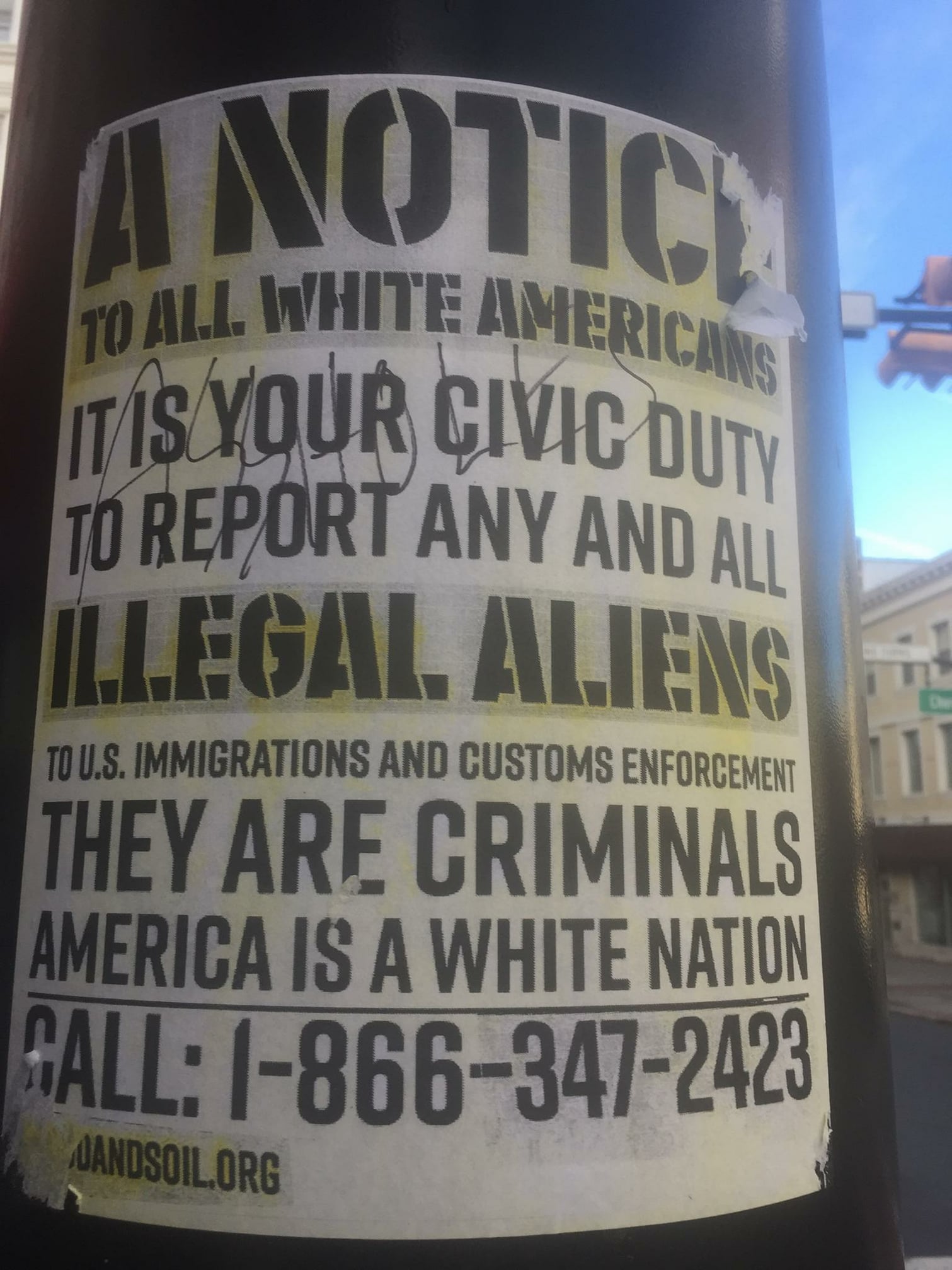
A “Blood and Soil” sign in New Brunswick, New Jersey. Photo credit: Dario Gal

Don’t just leave it up and take a picture of it, and don’t bother calling the police to investigate. No one has a right to put a sign of any kind on a telephone pole without authorization of the owner, much less a sign of this kind. You’re not violating anyone’s rights by taking it down. If you have a genuine “civic duty” as an American, it’s to express your rejection of the politics of “Blut und Boden“–Blood, Soil, and Master Race–before it takes hold more powerfully than it already has. Continue reading

One Little Victory

Most of the news we’ve recently been hearing about immigration in the United States has been bad, but every now and then a bit of good news emerges. Here’s an instance of the latter.

About a year ago, a journalist told me the story of a young Pakistani immigrant in a terrible situation, asking me to write a letter of support that might help her get out of it. I contacted the person in question, heard her out, sat down to write her a letter of support, and sent it off to her lawyer. A few weeks ago, the woman told me that her application to remain in the United States had been accepted, and the orders to deport her had been lifted. With her permission, I’ve reproduced the letter I wrote for her, one of several she used to make her case to the immigration authorities. In the interests of privacy, I’ve changed her name. 

Continue reading

A Memo to Friends and Colleagues

I wanted to take a moment to thank the many friends and colleagues, especially those at Felician University, who have expressed their support for me following my police detention of Wednesday, November 29th. I deeply appreciate the support you’ve sent my way. Indeed, my gratitude extends to the many jokes–some of them pretty funny–that have been made at my expense, my personal favorite being someone’s description of my detention as “something out a sitcom co-written by Michel Foucault and Flavor Flav.”

My brother’s idea of “moral support”

For now, suffice it to say that I was involuntarily detained on that date for several hours by the Lodi Police Department and Bergen County Prosecutor’s Office, involuntarily transported to the Lodi police station, held and questioned there, and asked to give consent to search my car and “premises.” Continue reading

Traveling in the Right Circles

From a letter to the editor of today’s New York Times:

To the Editor:

Re “The Truth About the Cost of War” (editorial, Nov. 24):

I was in a unit in Vietnam in 1969 that called in air and artillery strikes on “free fire zones” in III Corps, northwest of Saigon.

I asked an Army officer how we knew that the people we fired on were all the enemy. “By definition,” he said, “if we kill them, they are the enemy.”

Part of the truth in your editorial isn’t that civilian casualties are underreported but that their deaths in battle are seen as irrelevant.

BRUCE W. RIDER, GRAPEVINE, TEX.

God Bless the Child Who’s Got His Own Epi-Pen

I don’t like to pre-judge a legal case before it’s been adjudicated. So instead of pre-judging this case, I’m going to wonder about it out loud in as non-judgmental fashion as I can muster, playing the role of a chatty, colloquial, self-appointed investigator tasked with getting “to the bottom” of the matter, but in a sense of that broader than the narrowly legal.

Suppose that you’re a pre-school given the responsibility of caring for a child with a severe dairy allergy–severe enough to kill him if he eats the wrong thing. Death, I assume, is a serious matter, and merits being taken seriously. So I’d assume that you’d take measures to flag the child during lunch or snack, and make sure he doesn’t eat the wrong thing. If his dietary restrictions were merely a matter of finicky tastes or even religious dogma, you could afford to slip a bit. But if the restriction is a matter of life and death, you couldn’t. So I would make sure that someone was tasked with giving him a non-dairy meal. Or something like that.

But suppose that you do slip, and feed a severely allergic child a grilled cheese sandwich. The child now shows signs of going into anaphylactic shock. Preliminary question, not meant to be rhetorical: do you know what anaphylaxis is? Continue reading

“Permission to Innovate”: A response to Michael Munger

Here’s a comment I wrote in response to an article by Michael Munger, “Permissionless innovation: the fuzzy idea that rules our lives” (Learn Liberty, Sept. 19, 2017). The quoted passage at the beginning is drawn from Munger’s article, but I’d suggest reading the whole article first to get the context. (I’ve slightly edited one phrase in the version below without changing the meaning.)

There are two kinds of obstacles to permissionless innovation: requiring permission from regulators and requiring permission from competitors.

How about requiring permission from your boss, or the administrative hierarchy above you in your organization? That’s not what’s usually meant by the word “regulator,” but even apart from cases where admin functions as a proxy for external regulators, a boss is the most obvious and proximate source of regulation and of the requirement to get permission to innovate. Continue reading

“My Circuits Gleam”: A Fourth Amendment Query

A legal question for Fourth Amendment lawyers out there:

It’s settled law that if you’re in a Terry stop, you have a duty to comply with the orders of the officer who stops you. Likewise, if you receive a summons or citation from court, you’re obliged to respond. Etc.

But suppose that you (somehow) discover a listening/video device planted or inserted in or on an object that would ordinarily be protected by the Fourth Amendment, e.g, your car, your home, your computer, your phone. You surmise that the device was put there by the government in order to spy on you–but can plausibly assert (whether truthfully or not) that you don’t know for sure who put it there. Are you obliged to “comply” with government surveillance by analogy with a Terry stop? In other words, are you obliged to let government surveillance continue without interference after you’ve discovered that it’s taking place? Or can you destroy or disable an A/V device on the grounds that no officer was present to give you an order to comply with anything?

If you do destroy/disable the device, and the device was there through a procedurally correct search warrant, can you be held criminally liable for undermining the government’s attempt to surveil you? There is, after all, no way for the person under surveillance to know that the surveillance in question had the authority of a warrant.

My potentially archaic terminology of a “listening/video device” conjures up Cold War imagery of “bugs,” but I really mean: any discoverable form of electronic surveillance (e.g., a GPS device that you find attached to your car). The issue overlaps with encryption law, but encryption pre-empts surveillance before it takes place, rather than disabling surveillance that’s currently under way–and I’m thinking about the latter. The issue I have in mind strikes me as slightly more analogous to possession of a radar-detector than to the use of encryption, but that analogy breaks down pretty quickly as well.

Hence the question, as it seems a distinctive sort of case. The issue is not addressed in the very basic criminal procedure textbook I use, Matthew Lippman’s Criminal Procedure: the textbook assumption seems to be that electronic surveillance almost always goes undiscovered by the target. (I own the second edition of the book [2013], not the most recent one.)

Analogous issues may seem to arise for physical surveillance, but I don’t think they do: for the most part, if you’re under physical surveillance out in public space, you’re in plain view: you can act as you please (within the normal limits of the law), and so can the government. In that case, you have the right to go out of plain view, in which case they have the right to search or seize you if they have reasonable suspicion that you’re committing a crime. But that’s just a Terry stop, so it raises no new issues.

I’ve been surveilled twice by drone (by Israeli rather than American authorities). I’ve always wondered what would have happened, legally speaking, if I’d found a way to knock the drone out of commission, and pretend that I had no idea who had sent it. Of course, practically speaking, I kind of know what would have happened.

(Thanks to John Semel for the link to the GPS story above, and for some helpful comments on Facebook.)

I Can See Clearly Now, the Waffle Grill Is Gone

In another record, a complainant reported that an officer struck him repeatedly with a waffle grill. The investigator accepted the officer’s version of the facts despite conflicting information in his Force Report and subsequent reports. Although the officer’s report documented only that he had used “hands/fists,” he later reported that he inadvertently struck the complainant on the head with a waffle grill in self-defense. Instead of probing this inconsistency, the IA [Internal Affairs] investigator exonerated the officer and noted that the use of force was “reported and filed with complete transparency.”

Investigation of the Newark Police Department, Report of the U.S. Department of Justice Civil Rights Commission and the U.S. Attorney’s Office, District of New Jersey (July 22, 2014), p. 39.

Felician University Statement on the Repeal of DACA

Almost all readers were unimpressed with the “Statement of the Faculty of Felician University” that I posted here in January, responding to the election and inauguration of Donald Trump. I’m happy to report that Felician’s president, Anne Prisco, has released a statement that takes a much stronger and more substantive position on the repeal of the Deferred Action for Childhood Arrival (DACA) program. I’ve excerpted it below the fold. I’m grateful for it.

I can’t help remembering the “proseminars on pedagogy” I attended back in grad school, intended to prepare us for the ups and downs of college-level teaching. Oddly enough, I don’t ever remembering anyone’s covering “what to do when the federal authorities come in force to campus, invade your classroom, and seize your students as a preliminary to deportation.” But hey–the great thing about this job is that it forces you to learn new things. What I’ve learned is a twist on the old cliche that “life is a journey”: for some of us, it promises to be a journey from the classroom to a prison cell, and from there to a permanent exile from the country of one’s birth.

To be honest, if such deportations are to take place at all, I prefer that they take place on campus. Better collectively to have to bear witness to them than to have the luxury of pretending that they aren’t happening.

Continue reading

Covering Jerusalem: A response to Jacques Delacroix

I’d been thinking of writing some free-standing posts on the aftermath of the shooting two weeks ago at Al Aqsa Mosque in Jerusalem (July 14), but haven’t gotten the chance. Meanwhile, here’s a long response I wrote at Notes on Liberty to Jacques Delacroix’s post, “A short note on the riots in Jerusalem.” Scroll down for my comments.

As some of you may know, I spent most of the month of July in Jerusalem and vicinity, and spent a fair bit of time observing the events in question. It’s notable that for Americans, “what happened” can be reduced to a shooting on July 14, an Israeli decision to put metal detectors at the entrance to Al Aqsa Mosque, and rioting by Palestinians. Suffice it to say that in this as in so many matters, there is a large gap between what Americans end up hearing about Israel and Palestine and what actually happens there. But that’s a longer story than I can tell at the moment.

Postscript, August 8, 2017: The discussion continues here.