Well, spring term is winding down at Felician U., so I guess I’m (riot)-gearing up for summer term at Al Quds U. Let’s hear it for the beneficence of the Israeli “Civil Administration” (which is what the military occupation calls itself), its undying respect for “purity of arms,” and the pinpoint accuracy of its “civilian” strikes (against noncombatant civilian targets). Learning Objective 1: try not to get tear gassed, shot, or arrested.
Tag Archives: rights
“Driving While Black”: Vice News Comes to Town
No sooner do I praise my local police department, but Vice News comes to town to trash it.
Of course, this video is worth watching, as well. In the video, Bloomfield’s police chief mentions burglary, something I can speak to from first-hand experience. The question is whether the reduction in the crime rate has come at the expense of individual rights–or not.
Sexual Slavery in the Islamic World (Updated)
Probably one of the best letters to the editor of The New York Times that I’ve seen in a long time, on the subject of sexual slavery in the Islamic world. It’s a response to a March 13 article, “ISIS’ System of Rape Relies on Birth Control“: Continue reading
Problems from Locke
I can’t be the first one to have spotted this, but I’m teaching Locke tomorrow, and on my nth reading of Second Treatise chapter 5, it suddenly occurs to me that the assumption commonly attributed to Locke as the starting point of his discussion of property in the Second Treatise is much more puzzling than I had previously realized. Locke says that revelation makes clear that God gave the world “to mankind in common.” But how can that be, if God gave the Promised Land to Israel?
A Teenager Shall Lead Them
I’ve written before about the resort to force and intimidation in discussions of Palestinian-Israeli issues, but here’s an outrageous case– and one that hits close to home. From The New York Times, “Tweets About Israel Land New Jersey Student in Principal’s Office“:
A New Jersey high school student found herself in a social media storm on Wednesday after she live-tweeted and apparently secretly recorded a trip to her principal’s office.
She said administrators warned her that her comments about Israel and a fellow student on Twitter might have violated a state law against bullying.
The student, Bethany Koval, a 16-year-old Israeli Jew, said she had been reprimanded by administrators at Fair Lawn High School in Bergen County for a tweet that contained a string of expletives directed at Israel and expressed happiness that a pro-Israel classmate had unfollowed her Twitter account.
New Jersey has some of the toughest anti-bullying laws in the nation. After the suicide of a Rutgers University freshman, Tyler Clementi, in 2010, it passed the Anti-Bullying Bill of Rights, a far-reaching law with stiff penalties for educators who do not sufficiently respond to complaints of harassment or intimidation.
Read the whole thing for a fuller account of the story. Here’s a January 7 story from the Bergen Record, and here’s a January 8 story from the same place. Muftah reproduces some of the tweets involved. (Unfortunately, Koval’s Twitter feed is no longer operating in the public domain.) Fair Lawn, by the way, is just a few towns west of Lodi, where I teach.
Setting aside whatever narrowly legalistic insanities may reside within the various “anti-bullying” statutes, this is not a morally complex matter. A high school student tweets her political views about Israel. Some of what she says contains profanity. Some is sympathetic to, or appeasing of, Hamas. Some of her peers don’t like what she says. She gets some verbal flak from some of them. One “unfollows” her Twitter account. She doesn’t reveal the “unfollower’s” name in public, but reveals it to someone privately.
The Criminalization of Curiosity
Here’s another glorious contribution to the “ISIS-is-coming-so-let’s-turn-our-brains-off-in-abject-terror-and-think-of-more-rights-to-violate” literature. This one is by Eric Posner, son of Richard Posner, and evidence for the old saw that some apples fall in close proximity to the trees whence they came.
Eric Posner’s suggestion? Let’s pass a law that criminalizes the act of accessing an ISIS website, on the premise that ISIS’s propaganda has the causal powers of a cognitive virus that incapacitates people’s minds and drags them involuntarily into terrorist acts.
Consider a law that makes it a crime to access websites that glorify, express support for, or provide encouragement for ISIS or support recruitment by ISIS; to distribute links to those websites or videos, images, or text taken from those websites; or to encourage people to access such websites by supplying them with links or instructions. …
The law would provide graduated penalties. After the first violation, a person would receive a warning letter from the government; subsequent violations would result in fines or prison sentences.
But don’t worry: exceptions “could” be made
for people who can show that they have a legitimate interest in viewing ISIS websites. Press credentials, a track record of legitimate public commentary on blogs and elsewhere, academic affiliations, employment in a security agency, and the like would serve as adequate proof (my emphases).
What are the chances that “legitimate” and “the like” can be defined in a non-circular way?
And what about people without press credentials, etc.? What about people just starting out in “public commentary,” and therefore lacking a track record? Or people with a sense of curiosity, idle or otherwise, who would simply like to get a first-hand knowledge of what ISIS is about, rather than relying on “experts” picked by “the likes” of Eric Posner? Do non-credentialed people no longer have rights to free speech, or are rights reserved to a special, arbitrarily defined elite with credentials that demonstrate their worthiness to have them?
The latter, evidently. Any remaining worries can be dispatched by that old jurisprudential stand-by, “the balancing test.”
A simple balancing test would permit laws to target dangerous speech that does not advance public debate.
“A simple balancing test”–so simple that every attempt at applying such a test raises more questions than it answers, even if we arbitrarily decide that all jurisprudence must be conducted on utilitarian-consequentialist assumptions. Apparently, public debate about ISIS is not advanced by citizens’ having first-hand evidence of the nature and content of ISIS propaganda. The only permissible evidence is evidence filtered through people with “a track record of legitimate public commentary” on the subject–where “legitimacy” is presumably defined and decided by “like”-minded people with the same credentials.
Posner forgets that the legislators who are tasked with drafting his crackpot law will need access to the banned sites in order to know which sites to ban. But legislators are not on his exception list. Neither are their staffs. Neither for that matter are jurists, prosecutors, law enforcement officers, or juries. The whole idea that law involves an orderly, principled process seems not to figure in his calculations.
How his law is to be written, enforced, or judged is therefore left a mystery. One possibility is that criminal defendants will be arrested or tried by journalists, academics, or bloggers. Another, I suppose, is that the relevant legal processes will take place by telepathy. A third possibility is that “we” dispense with legal procedures and trials altogether, criminalize access to any site that fits an “ISIS-relevant algorithm,” monitor Internet access at will, arrest anyone who accesses a banned site, and treat access to a banned site as a strict liability offense so as to simplify the process of conviction. It sounds like a reductio, but with a proposal like this, a reductio is just another entailment alongside all the others.
If you think I’m reading Posner uncharitably on the grounds that his weasel phrase “and the like” was intended to cover bloggers and law enforcement officers (legislators, judges, prosecutors, juries…), ask yourself how you would feel if someone demanded to search your home on the basis of his or her affiliation with a blog or online publication, be it BHL, Notes on Liberty, Talking Points Memo, Daily Nous, Slate, or even Policy of Truth. If you asked what the hell they were doing, it wouldn’t help for them to invoke their “likeness” to law enforcement officers. But then it won’t do to invoke the “likeness” of law enforcement officers (etc.) to bloggers while claiming that a reference to the latter ought implicitly to be construed as a reference to the former.
There is, by the way, no reason why academics or bloggers should be less susceptible to seduction by ISIS than anyone else, unless you stipulate in ad hoc fashion that the academics and bloggers who will have access are restricted precisely to those least susceptible to influence-by-ISIS. In that case, you’d probably want to restrict my access before you restricted most other people’s. If ISIS targets bored and angry people of vaguely Muslim sensibilities, beware of the vaguely Muslim academic who has spent time in Palestine, Pakistan, and Saudi Arabia; has suggested that Locke’s Second Treatise can be given a Hamas-friendly reading; and who still has piles of grading to do after everyone else at the university has left for break.
Many able commentators have knocked down this or that feature of Posner’s argument on moral, constitutional, legal, and logistical grounds. I would simply point out that the argument relies on metaphors that would need to be cashed out in literal terms for the argument to get off the ground. At a minimum, we would need some empirical evidence for the claim that ISIS websites have the causal powers of a virus, that the virus in question incapacitates otherwise non-culpable minds, and that in doing so, it drags these helpless innocents into sinister terrorist or terrorist-abetting actions they couldn’t otherwise have committed. I’m afraid I don’t really believe any of that, and don’t see any reason to believe it, either.
What I find more plausible is the hypothesis that terrorism and the wars supposedly waged on it have so weakened the critical powers of our commentariat that they fear, possibly with justification, that they lack the capacity to refute what ISIS has to say. Unable to refute the propaganda, and unable to conceive its appeal to those to whom it has appeal, they feel impotent to contribute to a war effort that they have, on the basis of little more than rhetorical self-mesmerization, turned into a categorical imperative for all of us. But they feel the pressing need to do something. So day by day they produce what they like to think of as novel proposals for eliminating this or that right in the futile hope that the fewer rights we have, the more security we’ll enjoy. As for the task of offering a justification for the war “we’re in,” or the hysteria, rights violations, or state-worship it seems to necessitate, don’t hold your breath for an answer, or even an attempt at one. They’re AWOL on all that.
Eight years ago, I wrote a very critical review of Richard Posner’s book, Not a Suicide Pact: The Constitution in a Time of National Emergency. Several years later, on re-reading the review, I almost wondered whether I’d been too rude or harsh about things. I ended it with this thought:
Posner is right to say that the Constitution is not a ‘suicide pact.’ I wonder, however, whether that phrase might not accurately describe the jurisprudence he defends in his book.
I thought long and hard before I committed those sentences to print. Was I being too snide? Too clever by half? Was I exaggerating?
Re-reading the review now, however, I’m really glad I wrote what I did, how I did. Virtually every move in Eric Posner’s article is one originally made in Richard Posner’s book; the son has simply recycled the father’s adhocrocratic prescriptions and given them a contemporary twist for the current mood.
It occurs to me with a bit of middle aged weariness that this particular malady–apocalyptic rhetoric about the unprecedented danger we face from terrorism, followed by a regrettably unavoidable proposal for more rights violations–is fated to pop up at semi-predictable intervals of our public life, like outbreaks of the measles virus or the re-emergence of the cicadas. I guess that fact implies in turn that some of us are fated to respond over and over again to such proposals in what often seems to others like a histrionic way, like a pedantic version of Nietzsche’s Zarathustra engaged in a finger-wagging version of the eternal recurrence.
Well so be it. It is, I’ll admit, boring to read or even write the nth sounding of the alarm over threats to free speech. I can testify from personal experience, however, that there is one thing more boring still–life under a regime of censorship. It’s a bore to sound the alarm, but it’s more boring not to be able to. A “simple balancing test” suggests which bore is preferable to the other.
Postscript, December 29, 2015: I found Eric Posner’s arguments so ridiculous that I almost wondered whether I over-reacted in writing about them at all. No sooner do I have this thought than along comes an article in The New York Times devoted not just to Posner’s Slate piece, but to variants on the theme expressed, among others, by Cass Sunstein and Jeremy Waldron.
Sunstein’s views are laid out in this short piece at Bloomberg View. The first thing to say is that it’s not on the same topic as Posner’s. Posner wanted to criminalize access to ISIS-glorifying websites, even by people who may have no sympathy for ISIS at all. Sunstein is (much more reasonably) discussing the limits on the endorsement of potentially violent activities by those endorsing it.
In particular, he questions the “clear and present danger” test, suggesting that it’s worth asking whether the test is “ripe for reconsideration.” He ends up with this formulation:
If (and only if) people are explicitly inciting violence, perhaps their speech doesn’t deserve protection when (and only when) it produces a genuine risk to public safety, whether imminent or not.
I don’t have a strong objection to that formulation, but it’s a long way from Posner’s view, and it’s also a long way from being clear enough to be susceptible of a response. What it needs and lacks is an account of what it is for a speech act to “produce a genuine risk to public safety”–a tall order.
A speech act can in some sense “produce a genuine risk to public safety” without inciting anything. If what I say fills a large number of people with rage, you might say (misleadingly) that my assertion that p “produced” the rage that (say) led to a riot, whether or not I incited it in the sense of explicitly calling for it. But from a different perspective, the speech act didn’t “produce” anything except speech. The crowd considered the sound and acted on it, and each individual in the crowd produced the riot. In one sense, then, “produce X” means “raise the probability that X will happen.” In another sense, “produce X” means “intentionally bring X about, or try to bring it about.” It’s not clear which one Sunstein means. If he means the latter, I can agree with him, but not if he means the former.
On the latter interpretation, the suggestion I would make would be to regulate incitement by analogy with assault and/or conspiracy. If I incite violence, my act should be legally actionable just in case it credibly calls for violence against some particular victim, the victim credibly fears a threat on the basis of this call, and the threatened act would violate the criminal code (=violate rights). Celebrating a murder wouldn’t do it, even if you called in the midst of the celebration for more killing. Neither would this shit, vile as it is. (The correct way of handling something like the preceding would be for the guardians of the mosque to deny the speaker the right to speak in the it, i.e., to throw him out, not to arrest him.) I think it’s obvious that we don’t want to say that an Ayaan Hirsi Ali, Theo van Gogh, or Salman Rushdie et. al. should be held responsible for the overwrought reactions people have had to their work, even if the work in question is thought to “incite” (i.e., elicit) violence by its “inflammatory” or “incendiary” style.
In many cases, it seems to me that the dangers Sunstein mentions can be averted by assiduous enforcement of weapons laws, and also by demanding that political protest be regulated so that it’s confined to a specific place and time. If people want to gather in a park, with a permit that confines them to the park for a certain amount of time, and call for the overthrow of the U.S. government–or the mass slaughter of Jews, Muslims, or atheist philosophers–while they’re there during that time, that’s fine. But if they call for those things as they leave the park en masse with a view to enact the overthrow, that’s a different story. And a demonstration with weapons is another story as well. (It’s a tremendous irony that critics of Islam object to the face-concealing features of the hijab, but show up at armed protests against Muslims wearing masks.)
It’s also not clear from Sunstein’s account what counts as a genuine risk to public safety, or even what’s meant by “public safety” in a day and age when college students demands “safe spaces” from ordinary political speech. But that said, Sunstein’s view are light-years away from Posner’s.
Waldron’s views are more obviously objectionable than Sunstein’s (and apparently laid out in his 2012 book, The Harm in Hate Speech).
“I argued, in the adjacent area of hate speech, that the clear and present danger test is inadequate,” Mr. Waldron said in an interview. “You can poison the atmosphere without an immediate danger, but sometimes, waiting for an imminent danger is waiting too long.”
Well, you can “poison the atmosphere” simply by committing the fallacy of poisoning the well–or by committing almost any ad hominem fallacy. Would Waldron want to say that the commission of ad hominem fallacies should be illegal? I have trouble believing that the preceding quotation expresses Waldron’s considered view, but taking it at face value, as stated in the Times, I find it ridiculous. If “poisoning the atmosphere” were enough to trigger legal action, virtually the whole Republican presidential slate would have to be put under arrest, followed by whole college campuses.
I agree with Posner, Sunstein, and Waldron on one thing: legal thinking on incitement is a mess and could use some rethinking, though not I suspect in the direction they seem to want to take things.
Communication Breakdowns: Heckling, Interruptions, Screaming Matches and Other Violations*
If you doubt that, try to watch the videos embedded in this link, if you can. You can’t, because the heckling drowns out the speaker. The police, we’re told, refused to escort the hecklers out on “free speech” grounds, but the ultimate result was that Levy was unable to give his speech. It’s an understatement to call that “problematic.”
The preceding set of videos happens to involve a pro-Palestinian speaker and pro-Israeli hecklers, but the principle applies all ways around. Here’s Israeli ambassador Michael Oren being heckled during a speech he gave (or tried to give) at UC Irvine in 2010. I admire Levy and despise Oren, but I have the same view in both cases: the anti-Oren hecklers, like the anti-Levy ones, should have been removed from the hall–by force, if necessary.
Heckling may well take the form of speech, but it violates free speech by interfering with the free speech rights–disturbing and interrupting the speech–of the person who has prior claim to the floor. It can sometimes be unclear who has prior claim to the floor–which is why we have rules of order–but it usually isn’t. When it is clear, it’s equally clear what should be done with hecklers: either shut up or be thrown out and locked out. This sort of reaction is graceful and intelligent, but it still sort of misses the point and misses the mark (I’m referring to the effort at persuasion before the removal). So should senators be thrown out of the State of the Union address? Yes, senators too. For a one-word outburst? For a one-word outburst. Even if Obama was lying? Even if Obama was lying.
Feel free to demonstrate outside the hall, or to ask brutal questions during the Q&A–but speeches, like concerts, should compel absolute silence from the audience. If you’re sufficiently offended, leave. But if you decide to stay, the principle of free speech demands that you hold your peace–whoever you are, whoever the speaker is, and whatever the speaker is saying.
Postscript, October 28, 2015: This story (and video) doesn’t induce me to re-think my view on heckling, but it does induce me to offer a few caveats or qualifications. I linked to the preceding version of that story because it has the best video quality of any that I’ve seen, but (like the Huffington Post version of the story) it conveniently omits the fact that the protesters interrupted Trump’s speech by chanting at him. (The Huff Post video mentions the interruption.) I have no love for Trump, but I don’t think anyone has the right to interrupt his speech (or anyone’s speech) in this way.
As a first resort, in cases like this, the protesters should be told to stop interrupting. If they don’t agree to stop, or don’t stop, they should be removed from the premises of the talk. Ideally, they should be removed by parties designated to handle security (assuming that someone is designated). If a security detail is there, no one should be allowed to remove the hecklers but them. Obviously, if the talk is being guarded by a police detail, the task of removing hecklers is their job, not that of the audience.
If the hecklers/protesters don’t agree to leave, I still think they should be forced out. But the force used to remove them should be proportionate to the force by which they resist leaving: the less they resist, the less force is needed. Disproportionate uses of force should in this context be treated as new initiations of force–in other words, as battery. The video makes clear that the force used to remove these protesters was grossly disproportionate to what was needed to remove them. The guy in the pink shirt should absolutely have been (or be) arrested for battery.
It’s amazing that a person could be recorded on video as battering someone, and not just get away with it, but have essentially been incited into the act by a candidate for the U.S. presidency. But maybe it isn’t so amazing. Maybe it’s only as amazing as the fact that Donald Trump is the GOP front-runner for the presidency in the first place. And at this point, maybe that’s not so amazing, either.
Postscript, November 6, 2015: More of the same at the University of Minnesota, Minneapolis,this time aimed at the Israeli ethicist Moshe Halbertal. The excerpt in the link (from The Tablet) of the University’s Student Conduct Code seems to me to take the right approach to such matters.
I have to confess that I was tempted to heckle at this presentation I attended last night, at the Alanson White Institute in New York. The temptation is (nearly) overwhelming when a presenter consciously and strategically decides to bullshit the audience for 90 minutes, evading all substantive issues and abusing his critics more or less with impunity. But I decided to take my own advice–holding my tongue, leaving about twenty minutes early, and letting loose with a torrent of profanity once I was a safe distance from the hall. I’ll have to discuss the brazen dishonesty of Jeffrey Lieberman’s presentation–and the dismal intellectual standard of the entire evening–in a post of its own.
Postscript, November 9, 2015: Here’s a good summary of the Lieberman talk, minus a few things here and there in the three-way exchanges and the Q&A. I have a query out to the White Institute asking whether they’ll be making a video of the event public. I hope they will: I’m pretty sure the event was videotaped, and a wider public would benefit from watching the presentation and subjecting it to rational criticism. [Elizabeth Rodman, of the White Institute, in an email to me: “No, there is no video available for public viewing.”]
If Dr. Lieberman and his colleagues really mean what they say about rejecting the tribalism of psychiatry’s past (and that of psychoanalysis), now would be the time for a bit of transparency. Transparency, by the way, is the other side of the audience’s obligation to refrain from heckling a speaker: no one has the right the heckle, but the speaker has the obligation to come clean with his audience and allow for criticism rather than try his best to shut it down (a la Lieberman). It’s sad to have to explain all this to supposed professionals in mental health, but I guess we all profit from having to re-learn our ABCs sometime.
Postscript, November 12, 2015: Not exactly a “heckling” story, but in the same neighborhood. It seems hard to top, but then there’s always this.
Postscript, November 15, 2015: I don’t often agree with Brian Leiter, but this post on recent events at Yale seems to me exactly on target.
Postscript, November 16, 2015: Another discursive train wreck, this time at UT Austin, care of the Palestine Solidarity Committee. Don’t really see how this sort of thing promotes Palestinian rights. So if a bunch of pro-Israel protesters comes in to disrupt a defense of Palestinian rights, we’re obliged to let them disrupt the talk? Or is it that pro-Israel protesters wouldn’t have the same rights as defenders of Palestinian rights? Kind of stupid, no matter how you parse it.
Postscript, January 3, 2016: Here’s an interesting one, from a meeting in Orange County, New York involving a land-annexation dispute between the Hasidic community of Kiryas Joel and its non-Hasidic neighbors. Brooklyn assemblyman Dov Hikind shows up, and as an opening gambit insinuates (without explicitly coming out and saying so) that opposition to Kiryas Joel’s annexation bid is anti-Semitic. The crowd responds, understandably (but not in my view justifiably) with boos, jeers, and hisses. One guy in the second row stands up in protest at Hikind’s remarks and turns his back to him (Hikind himself had turned around to address the audience he was accusing). The presiding officer of the meeting asks security (in the form of uniformed officers) to usher the disruptive audience member out of the room. He refuses to leave, but promises to stay in his seat; eventually, security backs down.
Though I agree with the town council’s handling of the hecklers, Hikind’s behavior here is disgraceful. “The issue,” he thunders, “is not the annexation!” Actually, that’s exactly what the issue is, and a person who doesn’t want to discuss it has no business attending a meeting about it. Hikind doesn’t manage to say a single word about the merits of the annexation issue. He just engages in a bit of cheap demagoguery, then sits down. If Hikind has evidence of anti-Semitism, he should produce it. If not, he’s simply poisoning the well.
It’s actually unclear to me why a Brooklyn assemblyman would be asked or permitted to address an audience in Orange County (a good 90 minutes northwest of Brooklyn) on the subject of a disputed annexation there. In any case, the meeting’s presiding officer ought to have commented on the inappropriateness of Hikind’s comments. It’s not clear from this video how the officer reacted, or if he did. Contrary to the impression one gets, the jeering of the audience, though a problem, was far from the only problem in this episode. (Postscript, January 4, 2015: This critique of Hikind from a website run by Orange County locals is entirely on target.)
Soundtrack by Led Zeppelin (sort of)….
*I’ve renamed this post to better reflect the postscripts.
Rethinking rights (3): what it is for B to have a claim against A that A perform PHI?
Plausibly, patients having claims against agents comes to patients having standing to make claims (object, demand, complain, etc.). What does such “standing” come to, though? In order to understand this, perhaps we need to think of the relevant system of rules as being rules for a rule-governed social practice. In short, perhaps we need to think in terms of social practices, how they function, what their aims are.
We can invent social practices and we might start by looking at these sorts of social practices. It is intuitive to say that I might invent a game in which, when player A lands on spot X (in her way around the board, the object being to be the first player to complete the circuit around the board in accordance with the rules), player B, who is the player to the right of player A, has standing to demand that player A relinquish her next turn. Plausibly, B having this claim (standing to make the relevant claim) against A comes to: (i) B being permitted, according to the rules of the game, to demand that B relinquish her next turn when A lands on spot X and (ii) everyone else collectively, or whoever is the “master” of the game if the game works that way, being required to enforce B’s claim against A (in some particular way), should B make the claim. In this way, standings to make claims are features of deontic systems of rules that implicate obligations to enforce claims that are obligations possessed by whoever is that is in what I’ll call the compliance-enforcement role. In this way, claims are a function of the deontic rules of a practice that has agent, patient, and compliance-enforcement roles (in virtue of which one possesses obligations, permissions, etc.). This seems like a better hypothesis than my earlier idea that claims come to practice-relative reasons for the patient to make claims (demands, objections, etc.).
It is possible that things like demands, objections and complaints get to be claims, when they are, only by being related to such a social practice (and one with the requisite general enforcer role). It is possible, in other words, that a speech-act being a claim requires that it be part of a social practice characterized by the roles and role-associated obligations (or lack of obligation) as indicated. I have to think more about what (descriptive) claims are and how they are different from objections, complaints, demands, etc.
Warehouses, Theft, and Starvation
I got a chuckle out of this post at Bleeding Heart Libertarians. Jason Brennan is justifiably annoyed at the facile view expressed by this graphic:

I meant to blog this issue last year, but didn’t get the chance: As readers of PoT know, last August, I did some volunteer work in Nicaragua with a colleague of mine from Felician, along with students from his class on global capitalism. While there, we spent a day building wheelchairs at the facilities of the American Nicaragua Foundation, a charitable organization outside Managua. Words are inadequate to convey the admiration I have for the people who work there.
One of the things that impressed me while there were ANF’s gigantic warehouses filled with food and other goods, intended for distribution to the poor. I took some photos of the warehouses, but never uploaded them to the PoT site, so they’re still sitting on a Sandisk back home in New Jersey. When I get a chance, I’ll upload a shot here, but meantime, just click the ANF link, and you can see a few photos of them there. They’re big–bigger than the average American supermarket. And ANF had several of them at that location alone.
Another thing that impressed me was that ANF’s warehouses were, one and all, guarded by armed guards fully prepared to shoot anyone, rich or poor, who tried to muscle his way into the warehouses and loot their contents. In addition, ANF’s grounds were surrounded by fences with barbed wire. Sometimes, good fences really do make good neighbors, even if you have to throw some barbed wire into the mix.
It’s no secret that Nicaragua is a democratic socialist country ruled by a former Marxist junta, the Sandinista National Liberation Front (FSLN). News flash: even there, theft is illegal, stealing food is against the law, and you can let someone–maybe lots of people–starve to death while you own a warehouse full of food. You can do all of that with a clean conscience, because while generosity is a virtue, and charity is an instance of it, neither the virtue nor the activity imply that benefactors are rightless beings. After all, if benefactors were rightless, beneficiaries would be equally so, since both sets of entities are human beings. Even the Sandinistas know that (or have figured it out), despite the fact that they view ANF’s activities with some suspicion and discomfort–partly because they regard it as a front organization for the United States, and partly because its existence draws attention to the inadequacies of the regime’s own social welfare efforts.
Anyway, I hate to break the news, but the preceding–that theft is wrong, that theft of food is wrong and should be illegal, and that the poor cannot be allowed, en masse, to loot the wealthy–are not distinctively capitalist insights, and are not distinctive features of specifically capitalist political economies. People have known the preceding things for a long time, and have acted accordingly. There have always been food markets and food storage places in the world, and it’s always been a crime to steal from them. The only people who don’t seem to grasp that are the people among us who insist on arguing in images and slogans. That’s not a distinctively capitalist phenomenon, either. But for better or worse, capitalism is where the activity involved pays the most handsome wage.
Postcards from Abu Dis (10): Americans, Settlements, and Civil Rights
I’ve been away from the blog for awhile, partly because I’ve been traveling a lot, and partly because I’m at work on a presentation I’m giving this week at AQU’s Centre for Jerusalem Studies on American attitudes toward the Palestinian narrative. It’s called “Turning Up the Volume: Why Americans Have Trouble Hearing the Palestinian Narrative.”
The basic idea is this: Americans have trouble hearing the Palestinian narrative because given the way Palestinians make their case, every argument in defense of Palestinian rights can, by disputing certain factual premises, be re-cast as an argument that either proves Palestinian aggression against Jews, or proves a false Palestinian accusation of aggression by Jews.
For instance, if Jewish settlement activity is based on theft of Palestinian land, then of course, settlements are a matter of Jewish aggression against Palestinians. But if settlement activity is simply a matter of voluntary Jewish purchase of voluntarily-sold Palestinian property, then Palestinian opposition to Jewish settlement seems like a form of xenophobia, hysteria, or racism. The factual issues–theft or purchase?–often seem undecidable from several thousand miles’ distance. For that reason, some Americans simply lapse into agnosticism about the rights and wrongs of the conflict. But others insist on having a view despite the apparent inaccessibility of the relevant facts, going by what they regard as the most plausible moral hypothesis. For contingent historical reasons, Americans tend to find Zionist-Israeli claims more plausible than Palestinian ones.
The “contingent historical reasons” have to do with the rhetoric and strategies of the moderate wing of the U.S. Civil Rights Movement (i.e., the wing led by Martin Luther King, Jr.) For better or worse, American moral sensibilities about racial matters are structured by the history and moral assumptions of the King-led camp of the Civil Rights Movement. Given those sensibilities, any political argument bearing a fundamental similarity to the (moderate) camp of the Civil Rights Movement has an edge over any argument that doesn’t.
Now, the King-led camp of the Civil Rights Movement was integrationist rather than segregationist or separatist in its strategies and basic assumptions: it argued that blacks should actively strive to integrate into white society; it rejected both the white segregationist argument in favor of “separate but equal” barriers to integration, and the black separationist argument in favor of a separate nation for blacks. As it happens, Zionist-Israeli arguments tend to sound integrationist to American ears; meanwhile, the Palestinian narrative sounds either segregationist or separatist. Since Americans shy away from segregation or separatism, they opt for the Zionist-Israeli narrative.
For an example of my thesis, consider this 2009 story from The New York Times about the establishment (with conspicuous American support) of the Jewish settlement of Nof Zion within the Palestinian neighborhood of Jabl Muqabber in East Jerusalem. As it happens, I visited Jabl Muqabber/Nof Zion a few days ago; the Palestinian guide I was with took great offense at the presence of the settlers of Nof Zion, and called the settlement’s existence a “provocation.” Here’s how the Times describes it:
Nof Zion, a private Jewish project, is in Jebel Mukaber, a Palestinian Arab neighborhood of East Jerusalem, in territory Israel captured from Jordan in the 1967 war. Israel claims sovereignty over all Jerusalem; the Palestinians demand the eastern part as the capital of a future state.
Even within Israel, the idea of Jews moving into predominantly Arab neighborhoods of Jerusalem stirs heated debate. Two well-known Israeli families refused City Hall’s offer to name the street leading to Nof Zion for their deceased relatives, according to the local Jerusalem press.
But illustrating the complexity of the Jerusalem conundrum, others argue that Jews, Christians and Muslims should be able to live wherever they like. Not allowing Jews to live in certain neighborhoods of the city “is segregation,” said Mr. Hikind, a Democrat who represents several heavily Orthodox Jewish neighborhoods in Brooklyn.
With new tensions surfacing between the Obama administration and Israel over building in contested parts of Jerusalem, the city’s character and future remain central motifs in the stalled Israeli-Palestinian peace talks.
The cornerstone-laying ceremony at Nof Zion took place a day after the Israeli authorities moved ahead with plans for the expansion of Gilo, a Jewish residential district in south Jerusalem also on land captured in the 1967 war. The plans for 900 more housing units drew a sharp rebuke from the White House.
The first paragraph describes Nof Zion as a private project, then goes on to say that Israel claims sovereignty over all of Jerusalem, while Palestinians claim sovereignty over East Jerusalem. The implication seems to be that Nof Zion’s ownership status varies with the sovereignty of the political entity in control of the relevant part of Jerusalem; since the political status of the city is disputed, it follows that the ownership status of property claims within the city must likewise be disputed.
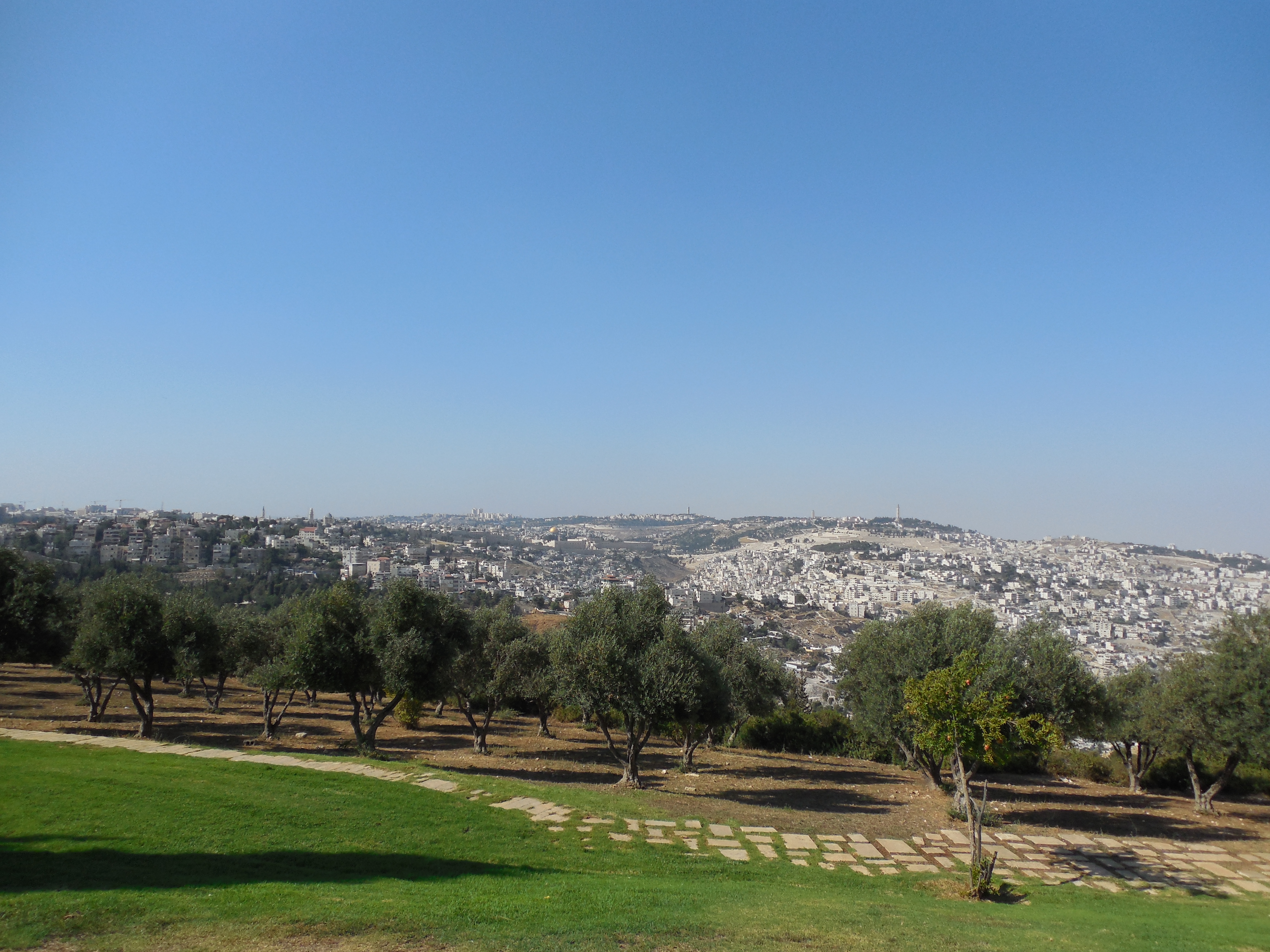
East Jerusalem viewed from the southwest (Haas Promenade)
But if Nof Zion is a genuinely private project on legitimately-bought land, what difference does it make who has sovereignty over Jerusalem? If Nof Zion is legitimately bought, then Nof Zion would seem to belong to its rightful owners–Nof Zion–regardless of who rules, runs, or governs the city. Of course, if it’s not on legitimately-bought land, it likewise makes no difference who has sovereignty over Jerusalem; in that case, morally speaking, Nof Zion doesn’t belong to Nof Zion at all, and ought to be given back to its rightful owners, whoever they happen to be, and whoever is in charge of the city.
In other words, sovereignty is a distraction from the relevant issue. The relevant issue is ownership, and specifically, what Robert Nozick calls “justice in transfer of holdings” (Anarchy, State, and Utopia, pp. 150-51). If the transfer of ownership to Nof Zion is morally illegitimate, then regardless of its specifically legal status, it ought to revert to its rightful owners. This would be a clear case of applying what Nozick calls “rectification of injustice in holdings” (p. 152). It seems to me that the literature on Nozick ignores cases like this, intermediate between ordinary cases of reparation for ordinary theft, and massive expropriations in the distant past.
The second paragraph tells us that the idea of Jews moving into predominantly Arab neighborhoods stirs heated debate. Why? Is it because Arabs simply don’t like Jews, or is it because Arabs fear that the apparently innocuous act of moving into the neighborhood betokens something more sinister, like a coercive take-over? While we’re at it, does the converse hold? In other words, does the idea of Arabs moving into Jewish neighborhoods stir debate? If so, what’s the upshot?
In my experience, settlers insist that Arab opposition to Jewish in-migration is simply a matter of xenophobia or racism. Meanwhile, Palestinians don’t explicitly or effectively argue that Jewish in-migration is a Trojan Horse for house demolitions or coercive territorial capture; they focus instead on the supposed “provocation” of a Jewish presence in an Arab neighborhood as such. But this appeal to “provocation” is a very weak argument, and one almost designed to offend American ears: it simply assumes without further explanation that a Jewish presence in an Arab neighborhood is a provocation, qua Jewish, without explaining what’s provocative about such a presence. It’s as though someone were to describe white peoples’ (or immigrants’) moving into a predominantly black neighborhood as a “provocation” simply because they were the “wrong” race.
In fairness to Palestinians, arguments of the “Trojan Horse” form tend to be dismissed by American audiences a priori as paranoid or anti-Semitic conspiracy theorizing, even when there is good evidence for them, and even when Americans themselves use such arguments in other contexts. So it becomes easy to see why Palestinians tend to be vague at the crucial argumentative moment. But the fact remains: the vagueness drastically weakens their argument.

Demolished Palestinian home, Ras al Amud, East Jerusalem
As for the third paragraph, is Hikind right to think that not allowing Jews to live in Jabl Muqabber is “segregation”? If so, would it then follow that not allowing Palestinians–whether of Israeli citizenship, Jerusalem residence, or West Bank/Gaza residence–to live in Jewish settlements is also segregation? He doesn’t get around to that issue here, and I doubt he ever has. If I had the money, I wouldn’t mind buying an apartment in Ma’ale Adumim. But could I? And invite my Palestinian friends over to hang out and swim in the community pool? Rest assured that there’s no community pool here in Abu Dis or in any nearby Palestinian town.
While I’m on the topic of water, I guess it’s worth adding that the aquifer under Abu Dis is under Israeli, not Palestinian control: “An estimated four-fifths of the water [in the West Bank aquifers] is used by Israel, much of it is piped back to West Bank settlements. Many West Bank Palestinians, however, must rely on wells” (Charles D. Smith, Palestine and the Arab-Israeli Conflict: A History with Documents, 8th ed., p. 511, Map 11.4.) Does that pattern of water use involve segregation or discrimination? I think so.
Anyway, back to land: In my experience, those who defend the settlement enterprise are very reluctant to consider the possibility of Arab residence in Jewish settlements–even when they complain that Arab reluctance to allow Jewish settlements in Arab neighborhoods is “segregation.” Meanwhile, Palestinians regard the idea of applying for residence in a Jewish settlement as either a quixotic waste of time or as something akin to treason, the ethno-nationalist equivalent of a scab’s working for management during a strike. The pro-settlement claim strikes me as hypocritical; the Palestinian nationalist claim strikes me as self-defeating.*
In any case, the general point should be clear: American interpretations of the Israeli settlement enterprise are, for better or worse, steeped in assumptions drawn from the theory and practice of the U.S. Civil Rights Movement. But neither side’s views map easily onto the integrationist template formulated by that movement. My point is that, rhetorically, Zionist-Israeli arguments sound–and are made to sound–as though they do. That fact accounts for why Americans find Zionist-Israeli arguments more plausible than their Palestinian counter-parts, especially when the facts that would decide a controversy are complex or difficult to access.*
A query for PoT readers, especially American ones: Just off the top of your head, do you regard the Jewish settlement enterprise as fundamentally just or as fundamentally unjust? If unjust, what’s wrong with it? If just, why is it mistakenly thought to be wrong?
Postscript: As it happens, Nof Zion is clearly visible from my side of the separation wall in Abu Dis. I’d take a photo and upload it here, but my camera lacks a telephoto lens, so I’m not sure the relevant details will come out.
*For clarity’s sake, I added a few sentences to each of these paragraphs after the initial posting.
 Policy of Truth