I meant to blog this issue last year, but didn’t get the chance: As readers of PoT know, last August, I did some volunteer work in Nicaragua with a colleague of mine from Felician, along with students from his class on global capitalism. While there, we spent a day building wheelchairs at the facilities of the American Nicaragua Foundation, a charitable organization outside Managua. Words are inadequate to convey the admiration I have for the people who work there.
One of the things that impressed me while there were ANF’s gigantic warehouses filled with food and other goods, intended for distribution to the poor. I took some photos of the warehouses, but never uploaded them to the PoT site, so they’re still sitting on a Sandisk back home in New Jersey. When I get a chance, I’ll upload a shot here, but meantime, just click the ANF link, and you can see a few photos of them there. They’re big–bigger than the average American supermarket. And ANF had several of them at that location alone.
Another thing that impressed me was that ANF’s warehouses were, one and all, guarded by armed guards fully prepared to shoot anyone, rich or poor, who tried to muscle his way into the warehouses and loot their contents. In addition, ANF’s grounds were surrounded by fences with barbed wire. Sometimes, good fences really do make good neighbors, even if you have to throw some barbed wire into the mix.
It’s no secret that Nicaragua is a democratic socialist country ruled by a former Marxist junta, the Sandinista National Liberation Front (FSLN). News flash: even there, theft is illegal, stealing food is against the law, and you can let someone–maybe lots of people–starve to death while you own a warehouse full of food. You can do all of that with a clean conscience, because while generosity is a virtue, and charity is an instance of it, neither the virtue nor the activity imply that benefactors are rightless beings. After all, if benefactors were rightless, beneficiaries would be equally so, since both sets of entities are human beings. Even the Sandinistas know that (or have figured it out), despite the fact that they view ANF’s activities with some suspicion and discomfort–partly because they regard it as a front organization for the United States, and partly because its existence draws attention to the inadequacies of the regime’s own social welfare efforts.
Anyway, I hate to break the news, but the preceding–that theft is wrong, that theft of food is wrong and should be illegal, and that the poor cannot be allowed, en masse, to loot the wealthy–are not distinctively capitalist insights, and are not distinctive features of specifically capitalist political economies. People have known the preceding things for a long time, and have acted accordingly. There have always been food markets and food storage places in the world, and it’s always been a crime to steal from them. The only people who don’t seem to grasp that are the people among us who insist on arguing in images and slogans. That’s not a distinctively capitalist phenomenon, either. But for better or worse, capitalism is where the activity involved pays the most handsome wage.
I’ve been away from the blog for awhile, partly because I’ve been traveling a lot, and partly because I’m at work on a presentation I’m giving this week at AQU’s Centre for Jerusalem Studies on American attitudes toward the Palestinian narrative. It’s called “Turning Up the Volume: Why Americans Have Trouble Hearing the Palestinian Narrative.”
The basic idea is this: Americans have trouble hearing the Palestinian narrative because given the way Palestinians make their case, every argument in defense of Palestinian rights can, by disputing certain factual premises, be re-cast as an argument that either proves Palestinian aggression against Jews, or proves a false Palestinian accusation of aggression by Jews.
For instance, if Jewish settlement activity is based on theft of Palestinian land, then of course, settlements are a matter of Jewish aggression against Palestinians. But if settlement activity is simply a matter of voluntary Jewish purchase of voluntarily-sold Palestinian property, then Palestinian opposition to Jewish settlement seems like a form of xenophobia, hysteria, or racism. The factual issues–theft or purchase?–often seem undecidable from several thousand miles’ distance. For that reason, some Americans simply lapse into agnosticism about the rights and wrongs of the conflict. But others insist on having a view despite the apparent inaccessibility of the relevant facts, going by what they regard as the most plausible moral hypothesis. For contingent historical reasons, Americans tend to find Zionist-Israeli claims more plausible than Palestinian ones.
The “contingent historical reasons” have to do with the rhetoric and strategies of the moderate wing of the U.S. Civil Rights Movement (i.e., the wing led by Martin Luther King, Jr.) For better or worse, American moral sensibilities about racial matters are structured by the history and moral assumptions of the King-led camp of the Civil Rights Movement. Given those sensibilities, any political argument bearing a fundamental similarity to the (moderate) camp of the Civil Rights Movement has an edge over any argument that doesn’t.
Now, the King-led camp of the Civil Rights Movement was integrationist rather than segregationist or separatist in its strategies and basic assumptions: it argued that blacks should actively strive to integrate into white society; it rejected both the white segregationist argument in favor of “separate but equal” barriers to integration, and the black separationist argument in favor of a separate nation for blacks. As it happens, Zionist-Israeli arguments tend to sound integrationist to American ears; meanwhile, the Palestinian narrative sounds either segregationist or separatist. Since Americans shy away from segregation or separatism, they opt for the Zionist-Israeli narrative.
For an example of my thesis, consider this 2009 story from The New York Timesabout the establishment (with conspicuous American support) of the Jewish settlement of Nof Zion within the Palestinian neighborhood of Jabl Muqabber in East Jerusalem. As it happens, I visited Jabl Muqabber/Nof Zion a few days ago; the Palestinian guide I was with took great offense at the presence of the settlers of Nof Zion, and called the settlement’s existence a “provocation.” Here’s how the Times describes it:
Nof Zion, a private Jewish project, is in Jebel Mukaber, a Palestinian Arab neighborhood of East Jerusalem, in territory Israel captured from Jordan in the 1967 war. Israel claims sovereignty over all Jerusalem; the Palestinians demand the eastern part as the capital of a future state.
Even within Israel, the idea of Jews moving into predominantly Arab neighborhoods of Jerusalem stirs heated debate. Two well-known Israeli families refused City Hall’s offer to name the street leading to Nof Zion for their deceased relatives, according to the local Jerusalem press.
But illustrating the complexity of the Jerusalem conundrum, others argue that Jews, Christians and Muslims should be able to live wherever they like. Not allowing Jews to live in certain neighborhoods of the city “is segregation,” said Mr. Hikind, a Democrat who represents several heavily Orthodox Jewish neighborhoods in Brooklyn.
With new tensions surfacing between the Obama administration and Israel over building in contested parts of Jerusalem, the city’s character and future remain central motifs in the stalled Israeli-Palestinian peace talks.
The cornerstone-laying ceremony at Nof Zion took place a day after the Israeli authorities moved ahead with plans for the expansion of Gilo, a Jewish residential district in south Jerusalem also on land captured in the 1967 war. The plans for 900 more housing units drew a sharp rebuke from the White House.
The first paragraph describes Nof Zion as a private project, then goes on to say that Israel claims sovereignty over all of Jerusalem, while Palestinians claim sovereignty over East Jerusalem. The implication seems to be that Nof Zion’s ownership status varies with the sovereignty of the political entity in control of the relevant part of Jerusalem; since the political status of the city is disputed, it follows that the ownership status of property claims within the city must likewise be disputed.
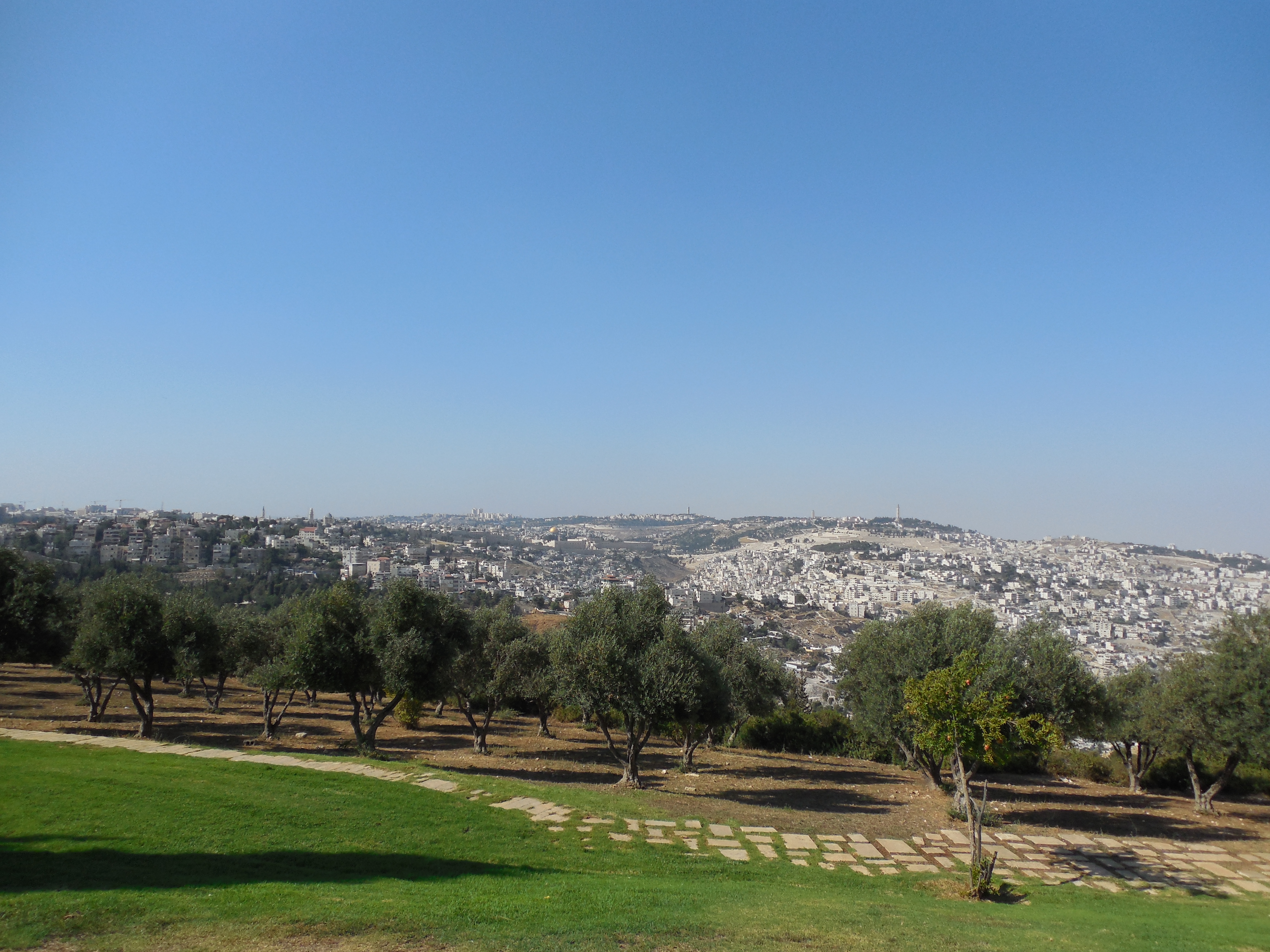
East Jerusalem viewed from the southwest (Haas Promenade)
But if Nof Zion is a genuinely private project on legitimately-bought land, what difference does it make who has sovereignty over Jerusalem? If Nof Zion is legitimately bought, then Nof Zion would seem to belong to its rightful owners–Nof Zion–regardless of who rules, runs, or governs the city. Of course, if it’s not on legitimately-bought land, it likewise makes no difference who has sovereignty over Jerusalem; in that case, morally speaking, Nof Zion doesn’t belong to Nof Zion at all, and ought to be given back to its rightful owners, whoever they happen to be, and whoever is in charge of the city.
In other words, sovereignty is a distraction from the relevant issue. The relevant issue is ownership, and specifically, what Robert Nozick calls “justice in transfer of holdings” (Anarchy, State, and Utopia, pp. 150-51). If the transfer of ownership to Nof Zion is morally illegitimate, then regardless of its specifically legal status, it ought to revert to its rightful owners. This would be a clear case of applying what Nozick calls “rectification of injustice in holdings” (p. 152). It seems to me that the literature on Nozick ignores cases like this, intermediate between ordinary cases of reparation for ordinary theft, and massive expropriations in the distant past.
The second paragraph tells us that the idea of Jews moving into predominantly Arab neighborhoods stirs heated debate. Why? Is it because Arabs simply don’t like Jews, or is it because Arabs fear that the apparently innocuous act of moving into the neighborhood betokens something more sinister, like a coercive take-over? While we’re at it, does the converse hold? In other words, does the idea of Arabs moving into Jewish neighborhoods stir debate? If so, what’s the upshot?
In my experience, settlers insist that Arab opposition to Jewish in-migration is simply a matter of xenophobia or racism. Meanwhile, Palestinians don’t explicitly or effectively argue that Jewish in-migration is a Trojan Horse for house demolitions or coercive territorial capture; they focus instead on the supposed “provocation” of a Jewish presence in an Arab neighborhood as such. But this appeal to “provocation” is a very weak argument, and one almost designed to offend American ears: it simply assumes without further explanation that a Jewish presence in an Arab neighborhood is a provocation, qua Jewish, without explaining what’s provocative about such a presence. It’s as though someone were to describe white peoples’ (or immigrants’) moving into a predominantly black neighborhood as a “provocation” simply because they were the “wrong” race.
In fairness to Palestinians, arguments of the “Trojan Horse” form tend to be dismissed by American audiences a priori as paranoid or anti-Semitic conspiracy theorizing, even when there is good evidence for them, and even when Americans themselves use such arguments in other contexts. So it becomes easy to see why Palestinians tend to be vague at the crucial argumentative moment. But the fact remains: the vagueness drastically weakens their argument.
Demolished Palestinian home, Ras al Amud, East Jerusalem
As for the third paragraph, is Hikind right to think that not allowing Jews to live in Jabl Muqabber is “segregation”? If so, would it then follow that not allowing Palestinians–whether of Israeli citizenship, Jerusalem residence, or West Bank/Gaza residence–to live in Jewish settlements is also segregation? He doesn’t get around to that issue here, and I doubt he ever has. If I had the money, I wouldn’t mind buying an apartment in Ma’ale Adumim. But could I? And invite my Palestinian friends over to hang out and swim in the community pool? Rest assured that there’s no community pool here in Abu Dis or in any nearby Palestinian town.
While I’m on the topic of water, I guess it’s worth adding that the aquifer under Abu Dis is under Israeli, not Palestinian control: “An estimated four-fifths of the water [in the West Bank aquifers] is used by Israel, much of it is piped back to West Bank settlements. Many West Bank Palestinians, however, must rely on wells” (Charles D. Smith, Palestine and the Arab-Israeli Conflict: A History with Documents, 8th ed., p. 511, Map 11.4.) Does that pattern of water use involve segregation or discrimination? I think so.
Anyway, back to land: In my experience, those who defend the settlement enterprise are very reluctant to consider the possibility of Arab residence in Jewish settlements–even when they complain that Arab reluctance to allow Jewish settlements in Arab neighborhoods is “segregation.” Meanwhile, Palestinians regard the idea of applying for residence in a Jewish settlement as either a quixotic waste of time or as something akin to treason, the ethno-nationalist equivalent of a scab’s working for management during a strike. The pro-settlement claim strikes me as hypocritical; the Palestinian nationalist claim strikes me as self-defeating.*
In any case, the general point should be clear: American interpretations of the Israeli settlement enterprise are, for better or worse, steeped in assumptions drawn from the theory and practice of the U.S. Civil Rights Movement. But neither side’s views map easily onto the integrationist template formulated by that movement. My point is that, rhetorically, Zionist-Israeli arguments sound–and are made to sound–as though they do. That fact accounts for why Americans find Zionist-Israeli arguments more plausible than their Palestinian counter-parts, especially when the facts that would decide a controversy are complex or difficult to access.*
A query for PoT readers, especially American ones: Just off the top of your head, do you regard the Jewish settlement enterprise as fundamentally just or as fundamentally unjust? If unjust, what’s wrong with it? If just, why is it mistakenly thought to be wrong?
Postscript: As it happens, Nof Zion is clearly visible from my side of the separation wall in Abu Dis. I’d take a photo and upload it here, but my camera lacks a telephoto lens, so I’m not sure the relevant details will come out.
*For clarity’s sake, I added a few sentences to each of these paragraphs after the initial posting.
My thoughts on the subject of property and planning are somewhat in flux, as I try to process the implications of some planning- and property-relevant phenomena I’ve seen while traveling–in Pakistan in 2012, in Nicaragua last year, and most intensely of all, here in Israel and Palestine, where I am right now. I’m also trying to anticipate and think through issues I expect to encounter on an upcoming trip to Pine Ridge Indian Reservation in South Dakota this fall.
It’s an enormously complex task to get straight on all of that, especially if one approaches it from the direction of the libertarian literature on property rights. On the one hand, there’s a mismatch between that literature and the facts I’m trying to conceptualize. On the other hand, theorists more directly interested in places like Managua, the West Bank, or Pine Ridge make assumptions about property that I don’t share. So my brain is on overdrive, and hasn’t reached the terminus of the inquiry.
I suspect that I subscribe to a weaker, or at least less expansive conception of property rights than most libertarians do; what I’m working on is how exactly to distinguish the view I hold from pragmatic/progressivist conceptions of property and planning on the liberal left. I think there’s a distinction to be drawn, but I haven’t worked through all of the relevant complexity. I’ll comment when I’ve worked more of it out than I so far have. I’m grateful to Taylor for giving me the incentive to clarify my thoughts.
Postscript: I guess it’s a bit misleading to say that I’ll “respond” to Taylor when I get a chance, since Taylor and I are basically agreeing. What I meant was that I’ll offer some substantive reflections in response when I get a chance.
The only comment I’d make right now, based on a small handful of early comments at BHL, is that Taylor’s critics (and by implication mine) are begging the question against both of us by making tacit but wide-ranging assumptions about the nature of property rights. I won’t speak for Taylor, but I don’t see any intrinsic reason why the existence of planning boards must violate property rights. Property rights could, after all, themselves be sensitive to the need for (government) planning. Libertarians could insist on strong (probably deontic) conceptions of property rights that function as bulwarks against any and all forms of government “interference” (aka “regulation”), but I’m not aware of a successful defense of such a conception of property rights, and don’t find the idea plausible (or even coherent).
Postscript, June 27, 2015: This lecture by Rick Porter of Georgia Tech’s School of Building Construction is a nice primer on zoning and planning in the U.S. from a generally Objectivist/libertarian perspective, from the 2013 Atlas Society Conference; it helpfully reveals both the strengths and weaknesses of that (type of) position.
The lecture starts out well enough, discussing the legitimate basis of zoning in the need for rights-based protections (first 25 minutes or so), but then gets side-tracked in that favorite Randian pastime, the accumulation of ideological horror stories (25-35 minutes). I don’t disagree with what he says there, but it’s a missed opportunity for discussing the real underlying issues in a sustained way.
He ends, unfortunately, with a descent into Randian-libertarian utopianism, suggesting that if we privatize all infrastructure and convert zoning restrictions into private deed restrictions, our problems are resolved. But what goes undiscussed, despite the quick reference to Locke, is the fine-grained content of private property rights: what is it that you own when you own something, like a piece of real estate? Is your ownership right so strong that it precludes zoning laws that prevent your imposing boundary-crossing externalities on others? He’s essentially asked that question around 54:00, but either concedes the legitimacy of zoning in his answer, or appeals to “the market” in a way that doesn’t really answer the question asked (his answer swings between those two claims).
Porter objects to zoning law as “pre-emptive,” but so are the laws of assault and self-defense against assault in the criminal code: an assault is a threat of imminent harm that doesn’t require physical contact, and a right of self-defense gives the victim the right to retaliate before contact is made (and physical harm inflicted), precisely so as to avoid the harms in question. I think the analogy carries over to rights-violative externalities and zoning. The end of the lecture seems to concede that zoning has a legitimate purpose, if properly conceived, but the claim isn’t really developed in the lecture.
That said, I think the lecture is well worth watching, if only for making explicit the facts that need to be dealt with as a preface to a sustained inquiry into the topic.
Postscript, June 28, 2015: Last postscript for now: It belatedly occurs to me that Ronald Coase’s “The Problem of Social Cost,” Journal of Law and Economics III (October 1960) is the classic discussion of this topic, and well worth reading (or re-reading). Here’s a summary.
That said, I reject virtually every major assumption Coase makes in the article, even when I incidentally end up agreeing with this or that claim in it. Coase’s thesis (it’s not really a “theorem”) is often regarded as a critique of the legitimacy of rights-based planning, zoning, and regulation, but I don’t think it succeeds as one, and don’t think Coase thought it did, either. Robert Nozick’s discussion of “Prohibition, Compensation, and Risk” (chapter 4 of Anarchy, State, and Utopia) is in effect a philosopher’s attempt to improve on Coase, but I don’t think it succeeds, either. Nor, as I say in a different post, do I find Hayek’s arguments against “planning” coherent.
Given that, I’ve never quite understood the intensity and scope of the libertarian-Objectivist animus for “regulation.” The animus seems to stand or fall with the idea that all government regulation violates a ban on first-uses of force, but even apart from the conspicuous lack of an argument for the ban, along with the absence of an argument for its application to all government regulation, the principle needs more explication than it’s ever gotten: in order to grasp what the principle says, we need to know what counts as a first use of force, and the principle itself doesn’t tell us.
In any case, it’s not at all obvious to me that regulations designed to thwart (what their architects regard as) first-uses of force must themselves always be first-uses of force. They could be just what their architects say they are: non-rights-violative regulations designed to thwart rights violations. The examples Coase cites in his paper make clear that there is no shortage of potential candidates for regulation in the name of rights. If you reject his analysis, as I do, at least some of those potential candidates become actual ones, and ought to be regulated.
(The preceding comments may well have re-invented the wheel. See Matt Zwolinski’s excellent discussion of the same issues in “Libertarianism and Pollution,” in the Routledge Companion to Environmental Ethics. Differences of detail aside, I basically agree with the approach he takes.)
I’ve decided to start what I envision as an ongoing series of posts here at PoT, called “Rethinking Rights.” A couple of posts have already implicitly discussed the topic: Though I focused on the “traffic ethics” angle at the time, part of the point of last summer’s series on honking at a dangerous intersection was to re-think how the concept of rights applies to noise-based nuisances. Rethinking rights is also related to Gordon Barnes’s post on the freedom fetish, and to my posts on self-defense and local government, among others. Though I meant it as a joke, my recent post on noisy neighbors was arguably on the same topic. There are probably some others as well. Since rights and freedom/liberty are on some accounts closely related concepts, feel free to regard the series as in principle extending to the topic of freedom/liberty as well. (I just happen to know a PoT reader chomping at the bit to become a PoT blogger and write on that topic.)
While any authorized PoT blogger can contribute to the series (and any approved commentator can comment on it), my own personal motivation for rethinking rights is that I find the issue overridingly important, but find myself dissatisfied by the conceptions of rights I’ve encountered in the philosophical literature and in ordinary discourse. The Objectivist conception of rights strikes me as either too narrow or ultimately indeterminate. The libertarian conception is on some accounts even narrower, but also problematically deontic. (Yes, I regard a commitment to deontology as a problem.) The standard left-liberal conception, which (on some accounts) includes a strong version of positive rights, and (on others) includes “collective” rights to ethno-national self-determination, strikes me as too broad, and problematically collectivist. (Yes, “collectivism” is a problem, too.) More radical conceptions of rights, which confer rights on embryos, fetuses, non-human animals, and non-living things, strike me as much too broad. Conceptions of rights drawn in positivist fashion directly from blackletter law strike me as arbitrary and insufficiently focused on moral essentials.
And yet I don’t want to let go of rights-talk, either: I don’t, for instance, buy the Benthamite, Burkean, Marxist, or MacIntyrean rejections of the concept of rights. I don’t even buy communitarian claims about the supposed excesses of rights talk. I’m convinced that there’s an account of rights “out there” that avoids the pitfalls of the existing accounts while bypassing the objections of rights-skeptics. It just needs to be worked out in an explicit way. (On PoT.)
My aim in the series (which need not be the aim of any other contributor) is to (begin to) work out a conception of rights that’s broader and more determinate than the Objectivist/libertarian conception, narrower than the left-liberal conception, and more focused on specifically moral essentials than the sort of account you’d get by perusing a standard textbook of criminal, tort, or business law. A further constraint on the theory is that it has to cohere with a recognizably Aristotelian conception of human flourishing and moral virtue. An aspiration of the series is to think about topics, or spheres of life, that go relatively (or completely) undiscussed in the Anglo-American analytic literature.
I don’t imagine that I can work out a theory of rights in a series of blog posts, even a few years’ worth of them. My aim is a bit more modest: to rebut some defective ideas; to sketch some promising new lines of thought; to uncover previously hidden areas of inquiry worth probing; and so on.
I have a first post in mind, which I’ll post sometime this weekend–most likely after I announce the publication of the new issue of Reason Papers (Spring 2015, volume 37.1).
An Egyptian court has sentenced a prominent pro-democracy activist to five years in prison for violating a law banning unauthorised protests in what rights groups describe as an ongoing clampdown on dissent.
Alaa Abd El Fattah – a software engineer, blogger and activist – was one of the public faces of the 2011 revolution that removed Hosni Mubarak from power.
The verdict came in a retrial of 25 defendants who had previously been sentenced to 15 years over a demonstration against military trials of civilians in 2013. The remaining defendants in the case received three-year sentences on Monday, while 15-year sentences were upheld for others tried in absentia.
Before the hearing, Abd El Fattah and other prisoners were brought into the courtroom but confined to a metal and glass cage, unable to speak to their families, other activists, and journalists.
As the judge read out the sentences, the courtroom at Tora prison in Cairo erupted in outrage. The activists’ supporters scrambled on to the wooden benches, raising their fists and chanting: “Down with military rule!”
Answer: The Egypt bilateral foreign assistance budget for FY2014 is approximately $1.5 billion and includes $1.3 billion in Foreign Military Financing (FMF) – $200 million in Economic Support Funds; and over $7 million for other security assistance programs, including International Military Education and Training, International Narcotics Control and Law Enforcement, and Nonproliferation, Antiterrorism, Demining and Related Programs. The $650 million from FY2014 FMF will be the first of this funding to move forward, pending Congressional notification and approval.
Here’s the text of Milton’s Areopagitica—in case you need to wash the bad taste of it all out of your mouth and mind.
If you lack the time to slog through Milton right now, perhaps the words of President John Tyler will suffice:
The body may be oppressed and manacled and yet survive; but if the mind of man be fettered, its energies and faculties perish, and what remains is of the earth, earthly. Mind should be free as the light or as the air.
Postscript, February 25, 2015: There’s an apocryphal story to the effect that the Caliph Umar, upon entering Egypt, burned down the Library of Alexandria on the premise that its contents either contradicted Islam or were consistent with it; in the first case they were heretical and in the latter, they were pointless–flammable in either case. Head a few hundred miles to the northeast, and it turns out that the apocryphal tale has now effectively been realized: ISIS has burned 8,000 rare books from the library of Mosul (Iraq). It reminds me a bit of the destruction of the Library of Alexandria in the film, “Agora.” People have complained about the film’s lack of historicity, but at this point, I wouldn’t worry about it: substitute twenty-first century Muslims for fourth century Christians, and “Allahu Akbar” for “Hallelujah,” and the rest is close enough. (ht: Walter Donway)
Postscript 2, February 26, 2015: Though it doesn’t rise to Egyptian or ISIS-levels of repression, I’m perennially startled by the degree of European authoritarianism with respect to free speech. Here’s an example from Austria:
Parliament on Wednesday passed a law that seeks to regulate how Islam is administered, singling out Austria’s Muslim minority for treatment not applied to any other religious group. The law bans foreign funding for Islamic organizations and requires any group claiming to represent Austrian Muslims to use a standardized German translation of the Quran.
Any nation that has an official religious establishment faces the problem of “standardizing” the religion to satisfy the demands of the establishment. Note that the law doesn’t outright ban competing translations of the Qur’an, but gives the official imprimatur of the Austrian government to an approved translation. It doesn’t seem to have occurred to Austrians to distinguish the rights-protecting and religious-establishment-establishing functions of the state, and to dump the latter over the side. But I suspect it hasn’t occurred to the Austrian Parliament because it hasn’t quite occurred to Austrian Muslims, either. There are perks to be had if you accept government sponsorship of your religion: once you’re enticed by them, it becomes hard not to do a deal with the Devil to keep them in place. I don’t know about the standardized German translation, but my translation of the Qur’an suggests that seduction is the Devil’s AOS.


 Policy of Truth