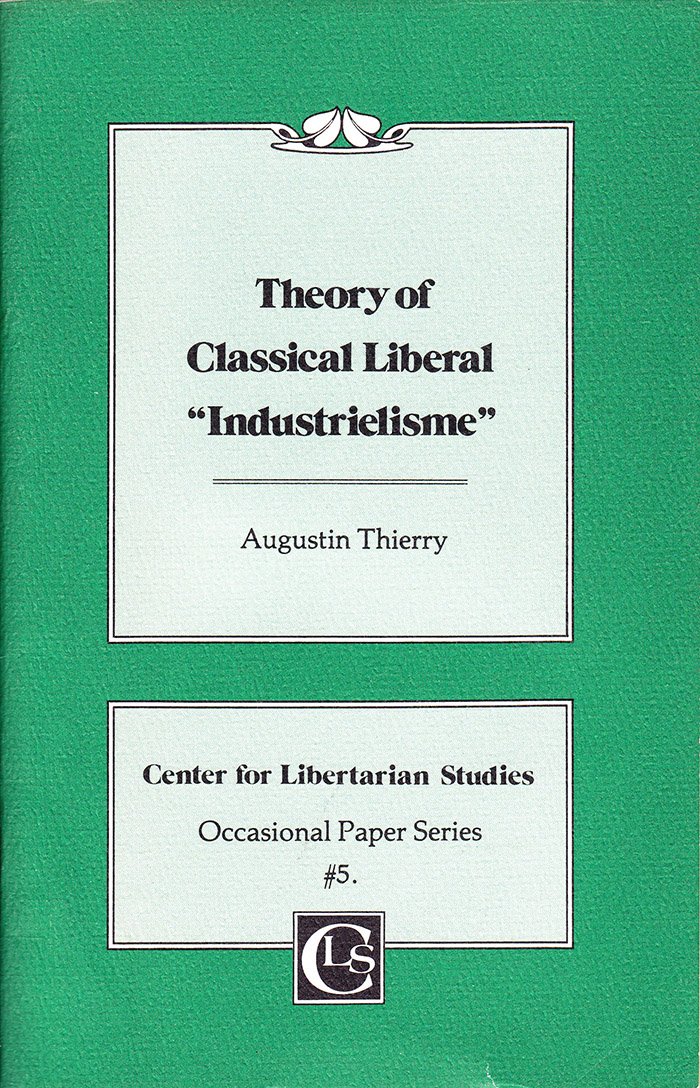
Thierry Rides Again

With Mark Weinburg’s kind permission, I have posted on the Molinari site his hard-to-find 1977-78 translation of Augustin Thierry’s 1818 review of Destutt de Tracy’s 1806 commentary on Montesquieu’s 1748 Spirit of the Laws

Tracy was a philosopher and free-market economist, and a friend of Thomas Jefferson (who translated and published several of Tracy’s writings, including the one Thierry is discussing here).  Thierry, primarily a historian, was one of the radical liberal triumvirate who (along with Charles Comte and Charles Dunoyer) developed an important version of liberal class theory in their journal Le Censeur Européen; Karl Marx would later refer to Thierry as “the father of the ‘class struggle’ in French historiography.”  Montesquieu was a massively influential social and legal theorist, broadly liberal but not quite radical enough for Tracy and Thierry.  Like many of Thierry’s book reviews, this one is in large part a springboard for Thierry to talk (particularly in the second half – which Weinburg makes the first half) about his own developing views in ways that don’t necessarily have all that much to do with either Tracy or Montesquieu.

This piece is especially famous for Thierry’s inspiring (but, in the event, unduly optimistic) prediction of what the coming century would bring:

“Federations will replace states.  The despotism of men and of the law will be replaced by the loose but indissoluble bonds of interest.  The inclination towards government, the first passion of the human race, will yield to the free community, the real need of civilized men.  The era of empires has ended.  The era of association is beginning.”

I am working on my own translation of Thierry’s article (as part of an exciting larger project about which you will learn more later), but in the meantime, enjoy!

Molinari East and West

Lo, I have information about both the Eastern and Pacific meetings of the Molinari Society for 2025.  (Irfan has already previously posted some info about his presentation at the Eastern.)

Eastern meeting, NYC, January 2025:

The Molinari Society will be holding its mostly-annual Eastern Symposium in conjunction with the Eastern Division of the American Philosophical Association in New York City, 8-11 January 2025.

Here’s the schedule info:

Molinari Society symposium:  False Alternatives in the Politics of Knowledge

G3A. Wednesday, 8 December, 4:00-5:50 p.m., Sheraton Times Square, 811 7th Ave. & W. 53rd St., New York NY  10019, room TBA.

chair:
Roderick T. Long (Auburn University)

speakers:
Irfan Khawaja (Independent Scholar), “Pedagogy Under Occupation: Between Indoctrination and False Neutrality”
Cory Massimino (Center for a Stateless Society), “Between Convergence and Conspiracy”

commentator:
Roderick T. Long (Auburn University)

Frequent Molinari panelist Jason Lee Byas will also be presenting elsewhere on the program on “The Vocabulary of Society: Feasibility and Fit in Expressive Arguments” (10G, Friday 10 December, 9:00-10:50 a.m.).

Pacific meeting, SF, April 2025:

The Molinari Society will be holding its mostly-annual Pacific Symposium in conjunction with the Pacific Division of the American Philosophical Association in San Francisco, 16-20 April 2025.

Here’s the schedule info:

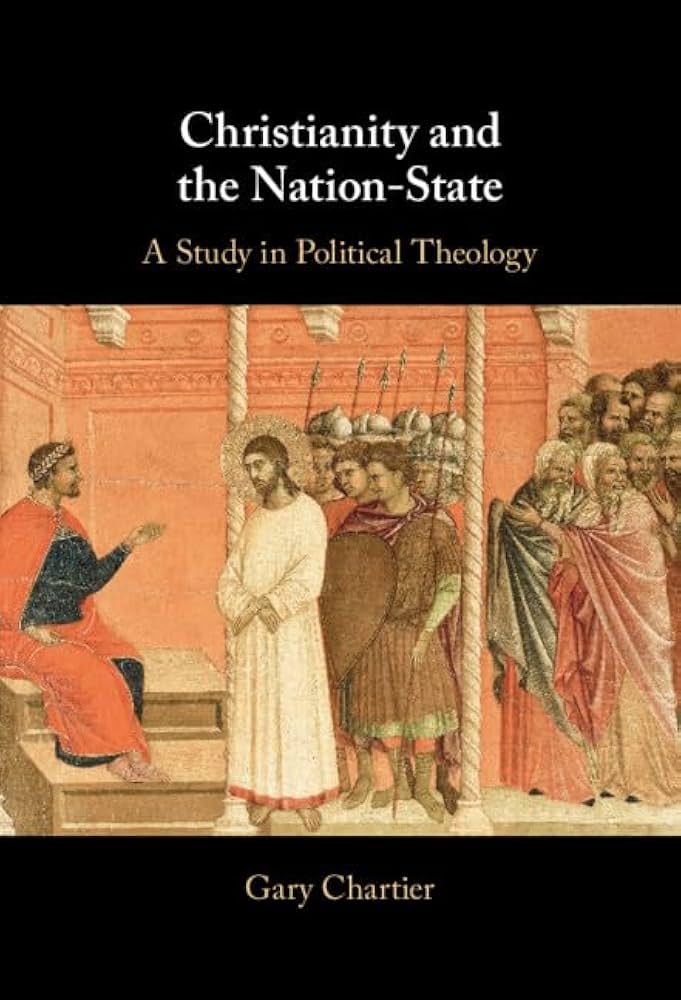
Molinari Society symposium: Author Meets Critics: Gary Chartier, Christianity and the Nation-State: A Study in Political Theology

G1H.  Wednesday, 16 April 2025, 6:00-8:00 p.m., Westin St. Francis Hotel, 335 Powell St. [unless a labour dispute forces a change of venue], San Francisco CA  94102, room TBA.

chair:
Roderick T. Long (Auburn University)

author:
Gary Chartier (La Sierra University)

critics:
David VanDrunen (Westminster Seminary California)
Mary Doak (University of San Diego)
Irfan Khawaja (Independent Scholar)

Be there or B2!

“Pedagogy Under Occupation”: Slides and Key Formulations

Here is the plain text version of the PowerPoint slides (or Google Slides slides) for my July 11 presentation, “Between Indoctrination and Neutralism: Pedagogy Under Occupation,” to be given at the NASSP Conference at Creighton University.

Here is an unstructured list of some of the key formulations from the paper. Continue reading

Understanding Rightwing vs. Leftwing

I have spent my whole adult life as a libertarian or classical liberal of one kind or another. And throughout this long period—for I am not young—I have been puzzled as to whether I should think of myself as leftwing or rightwing or centrist, or whether I should, like many libertarians, reject the conventional left–right political spectrum altogether. So now, herewith I propose to try to sort this out.

Continue reading

Michael Sugrue (1957-2024), RIP

I was pained to read of the untimely death of philosopher Michael Sugrue, most recently of Ave Maria University, but for twelve years a lecturer in political philosophy at Princeton. He was 66. 

I met Sugrue sometime in 2002 when I was living in Princeton and trying, with conspicuously little success, to make ends meet and get my dissertation done. I applied in late 2001 for an adjunct job at Princeton, and got a position as teaching assistant for Sugrue’s POL 307, “The Just Society,” a standard survey course in political philosophy–the first half devoted to classic works, the second to contemporary ones. Continue reading

“Pedagogy Under Occupation”

Just a quick announcement–for anyone in the vicinity of Omaha, Nebraska this July–that I’ll be giving a paper at the 41st annual conference of the North American Society for Social Philosophy (NASSP), Thursday morning (11:15 am), July 11th, at Creighton University. The paper, “Pedagogy Under Occupation: Between Indoctrination and Neutrality,” is a much revised version of a blog post by the same title that I posted here back in 2015. The paper is scheduled for a session called “Hostile Environments,” with Monika Rydzewski (Queens College) and Joseph Tanke (University of Hawaii). As the blog post suggests, the paper is something of an exercise in standpoint epistemology, or more precisely, I suppose, standpoint pedagogy. Continue reading

First Thoughts on Pettit’s Republicanism

I want to get some basic thoughts on Philip Pettit’s book, Republicanism: A Theory of Freedom and Government, on the record. Pettit’s ideas have the virtue of being not so far out in left field (from my own perspective) as to be hopeless, yet strange enough to be difficult to grapple with. What follows really are just some first thoughts, not very elegantly expressed, and not very certain.

Continue reading

Nationalism and Liberalism: ‘Policy of Truth’ at the APA

Just a quick announcement that there will be something of a PoT presence at the American Philosophical Association’s Eastern Division meeting this January in New York (to be held at the opulent, hence utterly unaffordable Sheraton New York Times Square). Roderick Long has, through the Molinari Society, arranged a two-part session for Tuesday afternoon, January 16th: “Nation-States, Nationalism, and Oppression” in the 2-3:50 pm slot (Session G7C, listed at APA Draft Program, p. 33), and “Topics in Radical Liberalism” in the 4-5:50 pm slot (Session G8C, listed at APA Draft Program, p. 37). I’ll be presenting some version of my PoT blog post, “Teaching Machiavelli in Palestine” in the first of the two sessions. Continue reading

How to Fix the United States

How to Fix the United States: Amendments and a Constitutional Convention

At this point, it must be obvious to everyone paying attention that the United States is a nation in deep trouble. Over the last two decades, both the effectiveness and democratic credentials of the US federal government have gone into decline, which has helped to drive increasing political polarization and public frustration that steepens the decline. More of the public turn to extremist politicians promising to eviscerate their political enemies, which makes the compromises needed in the American federal system totally impossible. Even the basics cannot get done: a single senator holds up over 300 military officer promotions for many months; a group of six radical House members out of 435 cause a government shutdown by holding up funding bills. Continue reading

Local Optima and Abolitionist Ideals

In The Tyranny of the Ideal, Gerald Gaus draws attention to a trade-off faced by anyone pursuing an ideal conception of justice. What he says here seems almost trivially obvious (at least once he puts it down on paper), and seems to have obvious implications (at least once one sees it set out in print), but I still find it insightful. He calls it The Choice:

The Choice: In cases where there is a clear optimum within our neighborhood that requires movement away from our understanding of the ideal, we often must choose between relatively certain (perhaps large) local improvements in justice and pursuit of a considerably less certain ideal, which would yield optimal justice (Tyranny, p. 82).

Continue reading