Thierry Rides Again

With Mark Weinburg’s kind permission, I have posted on the Molinari site his hard-to-find 1977-78 translation of Augustin Thierry’s 1818 review of Destutt de Tracy’s 1806 commentary on Montesquieu’s 1748 Spirit of the Laws

Tracy was a philosopher and free-market economist, and a friend of Thomas Jefferson (who translated and published several of Tracy’s writings, including the one Thierry is discussing here).  Thierry, primarily a historian, was one of the radical liberal triumvirate who (along with Charles Comte and Charles Dunoyer) developed an important version of liberal class theory in their journal Le Censeur Européen; Karl Marx would later refer to Thierry as “the father of the ‘class struggle’ in French historiography.”  Montesquieu was a massively influential social and legal theorist, broadly liberal but not quite radical enough for Tracy and Thierry.  Like many of Thierry’s book reviews, this one is in large part a springboard for Thierry to talk (particularly in the second half – which Weinburg makes the first half) about his own developing views in ways that don’t necessarily have all that much to do with either Tracy or Montesquieu.

This piece is especially famous for Thierry’s inspiring (but, in the event, unduly optimistic) prediction of what the coming century would bring:

“Federations will replace states.  The despotism of men and of the law will be replaced by the loose but indissoluble bonds of interest.  The inclination towards government, the first passion of the human race, will yield to the free community, the real need of civilized men.  The era of empires has ended.  The era of association is beginning.”

I am working on my own translation of Thierry’s article (as part of an exciting larger project about which you will learn more later), but in the meantime, enjoy!
Epistolary Sprouts in Brussels

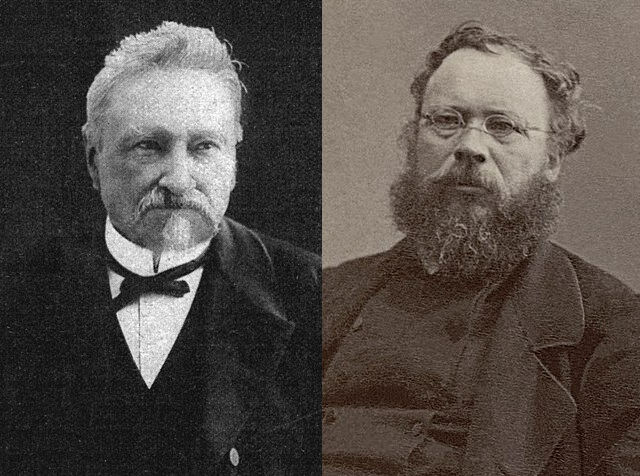
The glorious ongoing Institut Coppet online collection of Gustave de Molinari’s Complete Works has brought to light some correspondence between Molinari and Proudhon from their years of Brussels exile during Napoléon III’s regime in France.  The letters are few in number and are not ideologically substantive, but they are nonetheless interesting.  So I’ve translated them.  Enjoy! 

Understanding Rightwing vs. Leftwing

I have spent my whole adult life as a libertarian or classical liberal of one kind or another. And throughout this long period—for I am not young—I have been puzzled as to whether I should think of myself as leftwing or rightwing or centrist, or whether I should, like many libertarians, reject the conventional left–right political spectrum altogether. So now, herewith I propose to try to sort this out.

Continue reading

Sunstein versus Hayek on the Rule of Law

We’ve been doing some philosophy of law in the PoT reading group lately, and a recent piece came up by Cass Sunstein on “The Rule of Law.” The abstract claims that “this [Sunstein’s] account of the rule of law conflicts with those offered by (among many others) Friedrich Hayek and Morton Horwitz, who conflate the idea with other, quite different ideas and practices.” This statement caught my attention because Sunstein’s account of the rule of law seems very sensible. It is in fact quite similar to the account given by our current reading group book author Lon Fuller (that’s how Sunstein’s piece came up), which also seems sensible. At the same time, I am a strong admirer of Hayek. So, if the sensible Sunstein/Fuller account of the rule of law conflicts with Hayek’s, what’s the conflict? What “different ideas and practices” does Hayek “conflate” the rule of law with? Essentially none, it turns out. Sunstein’s, Fuller’s, and Hayek’s conceptions of the rule of law are largely the same. Sunstein misunderstands Hayek’s argument that the rule of law requires economic freedom. At least, so I will argue in what follows.

Continue reading

Three Passings, Three Losses

Sometimes people you come to know in passing leave a more-than-passing memory. Three such people have recently passed away in quick succession, and I wanted to mark their passings. 

Many readers of this blog may know, or know of, Chris Sciabarra, The Famous Dialectical Libertarian of Brooklyn, but far fewer have had the privilege, as I have, of meeting his late sister Elizabeth (1952-2022). To the best of my memory, I met her only twice; it may in fact only have been once, but she was the kind of person who would have left a double impression from a single encounter. Continue reading

“Sovereignties, World Orders, and the Federalist Option”

I wanted to draw attention, however belatedly, to Sovereignties, World Orders, and the Federalist Option: Reviving Libertarian Foreign Policy, an issue of Cosmos and Taxis, Studies in Emergent Order and Organization (10:9-12) edited by my friend Brandon Christensen. Brandon is editor of the blog “Notes on Liberty” (now at a new location on Substack), and a long-time friend of PoT. The issue looks great, and I’m happy to see libertarians thinking in innovative ways about this much-neglected set of topics. Contents below the fold, with clickable hyperlinks. Continue reading

Western Civilization or Universal Culture or WEIRD Culture?

It is common to think of Western Civilization as rooted in classical antiquity, the Catholic and Protestant forms of Christianity, and the languages, history, and cultural attainments of Western Europe. It is also common to think of Western Civ as particularly favorable, and maybe even essential, to modernization as exemplified by the industrial revolution and the modern market economy. An example of both these ways of thinking is Huntington (1996). But this view is open to challenge, and in this post, I want to examine two such challenges: Scott Alexander’s “universal culture” and Joseph Henrich’s “WEIRD culture.”

In a Slate Star Codex post, How the West Was Won, Scott Alexander argues that what people often call Western culture is really universal culture, the omnivorous culture of “what works.” For example, “Western medicine” is really just whatever has been found to be the most effective at curing disease, maintaining health, etc. It is driven fundamentally by empirical standards, and in that sense is nonideological, and so the contrast with “natural” or “traditional” or “Eastern” medicine is bogus, in at least two ways. First, despite claims of its opponents in these other camps that “Western” medicine is forcing a certain conception of health or science or efficacy onto people, the truth is that it is the opponents who are playing that game, not “Western” medicine, which will adopt indiscriminately whatever can be shown empirically to get the job done. Second, there is nothing geographically Western about “Western” medicine, except insofar as the “what works” approach to medicine first began making spectacular progress in the West in the nineteenth century, and Western Europe and the Anglosphere nations have maintained a lead ever since. But it is not peculiarly “Western.” For one thing, it will take new ideas from anywhere, indiscriminately; the criterion is efficacy, not region of origin. For another, it can be adopted anywhere—and it is. Its essence is a rational standard of acceptance, as opposed to any ties to tradition, culture, region, or ideology. It is an accident of history that “Western” medicine was developed in the West.

Alexander gives some other examples of what he claims is the same phenomenon: Coca-Cola succeeded because it is “refreshment that works,” egalitarian gender norms “work,” sushi “works.” And note that sushi, of course, was not invented in the West. That’s the point.

Continue reading

Natural Law Libertarianism in Two Flavours

My two latest Agoric Café videos:

In the first one, I chat with philosopher Eric Mack about walking out on Ayn Rand, clashing with Nazi Sikhs in Seneca Falls, libertarian rights theory, Kantian vs. Aristotelean approaches to fixing Randian ethics, Nozickian polymathy, the unselfishness of Samuel Johnson, the ethics of COVID lockdowns, physical distancing in Durango, the CIA as an argument against anarchism, shoving someone in front of a bus as a form of restitution, and the edibility of matter.

In the second video, I chat with philosopher Gary Chartier about Robin Hood, left-wing market anarchism, natural law, free speech and employer power, libertarian secularism, Seventh-day Adventism, religious epistemology, long-arc television, urban fantasy, Lawrence Durrell, Iris Murdoch, Whit Stillman, the evils of giving extra credit and taking attendance, and the attractions of being emperor.