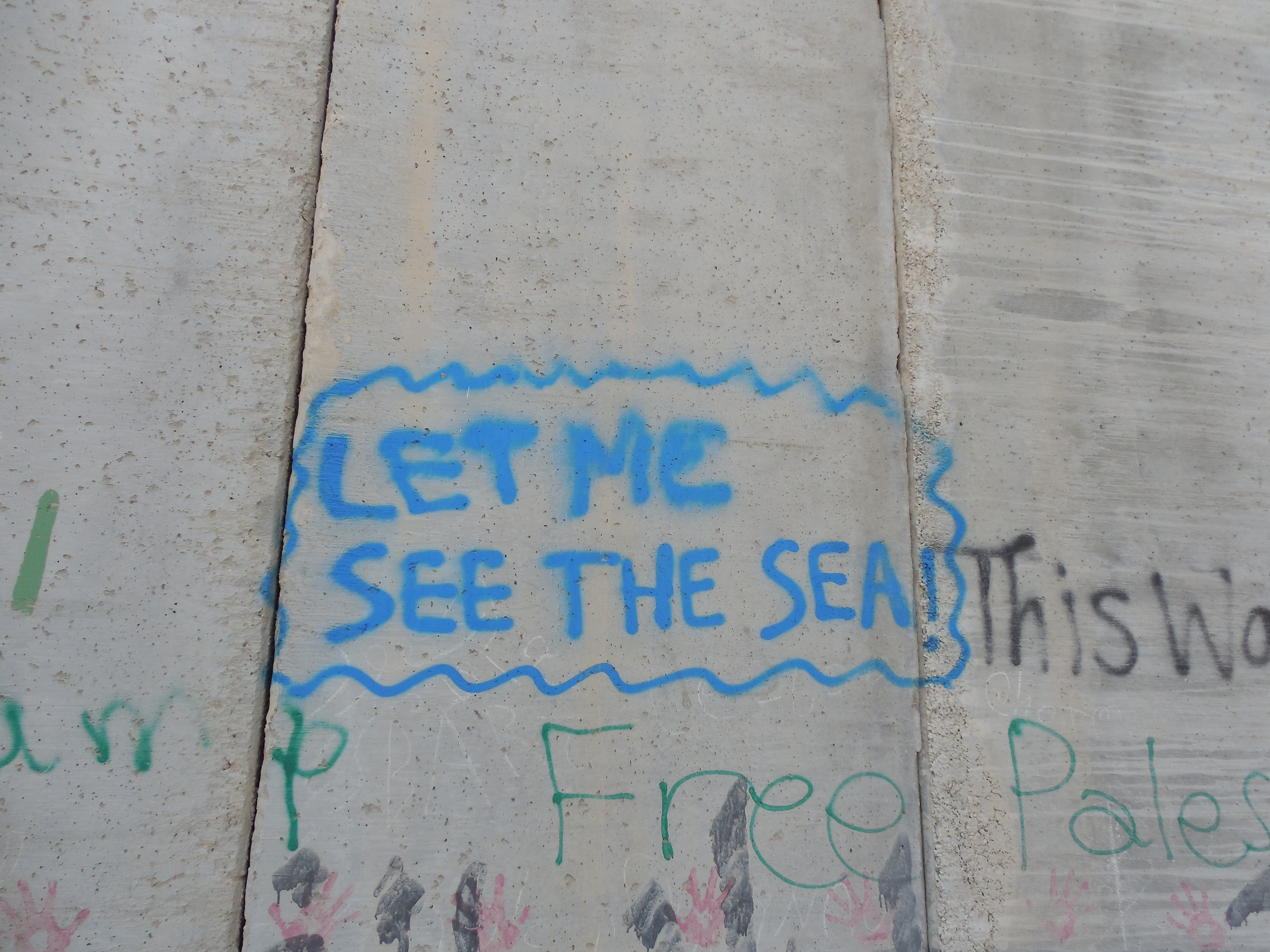
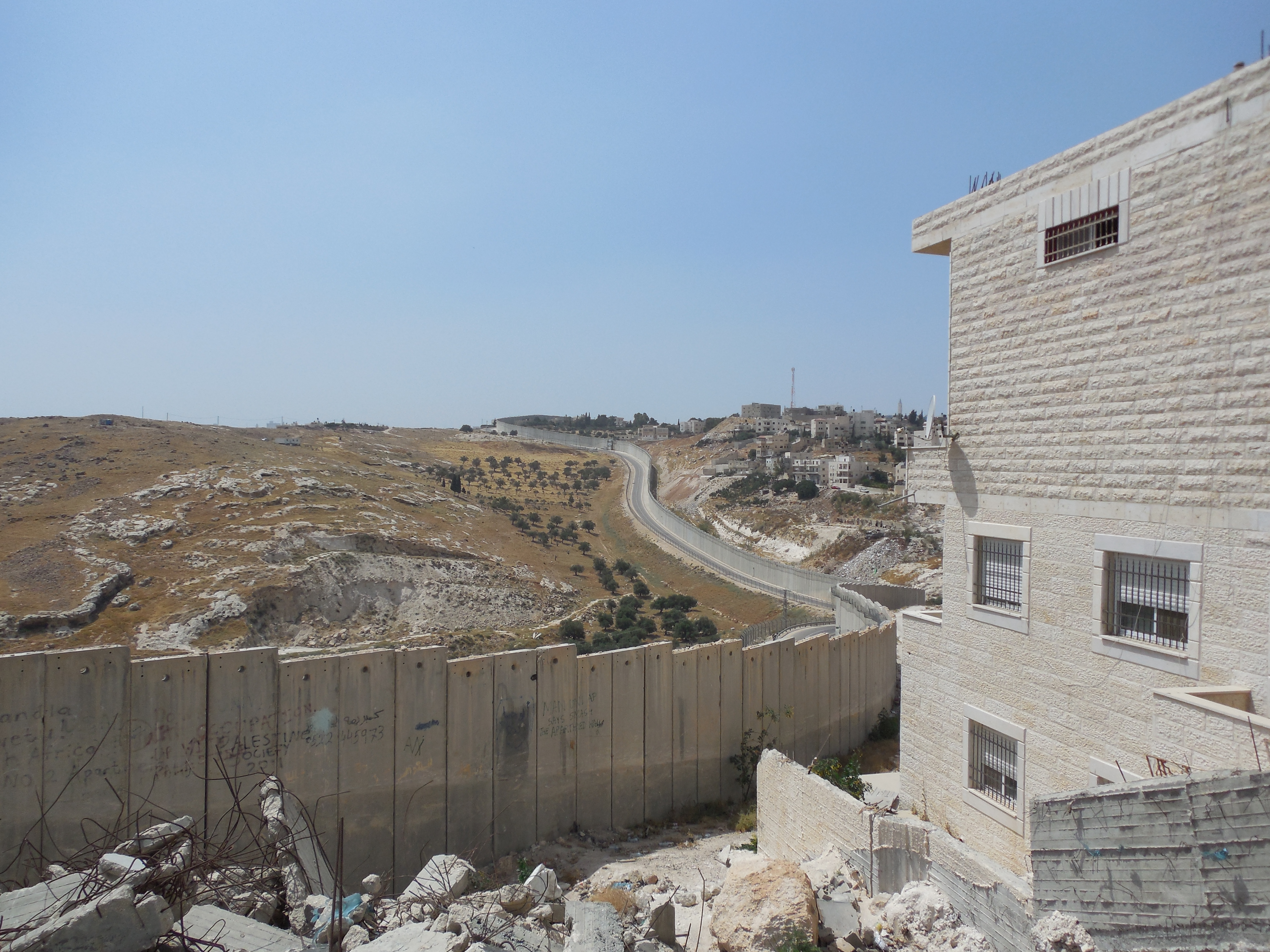
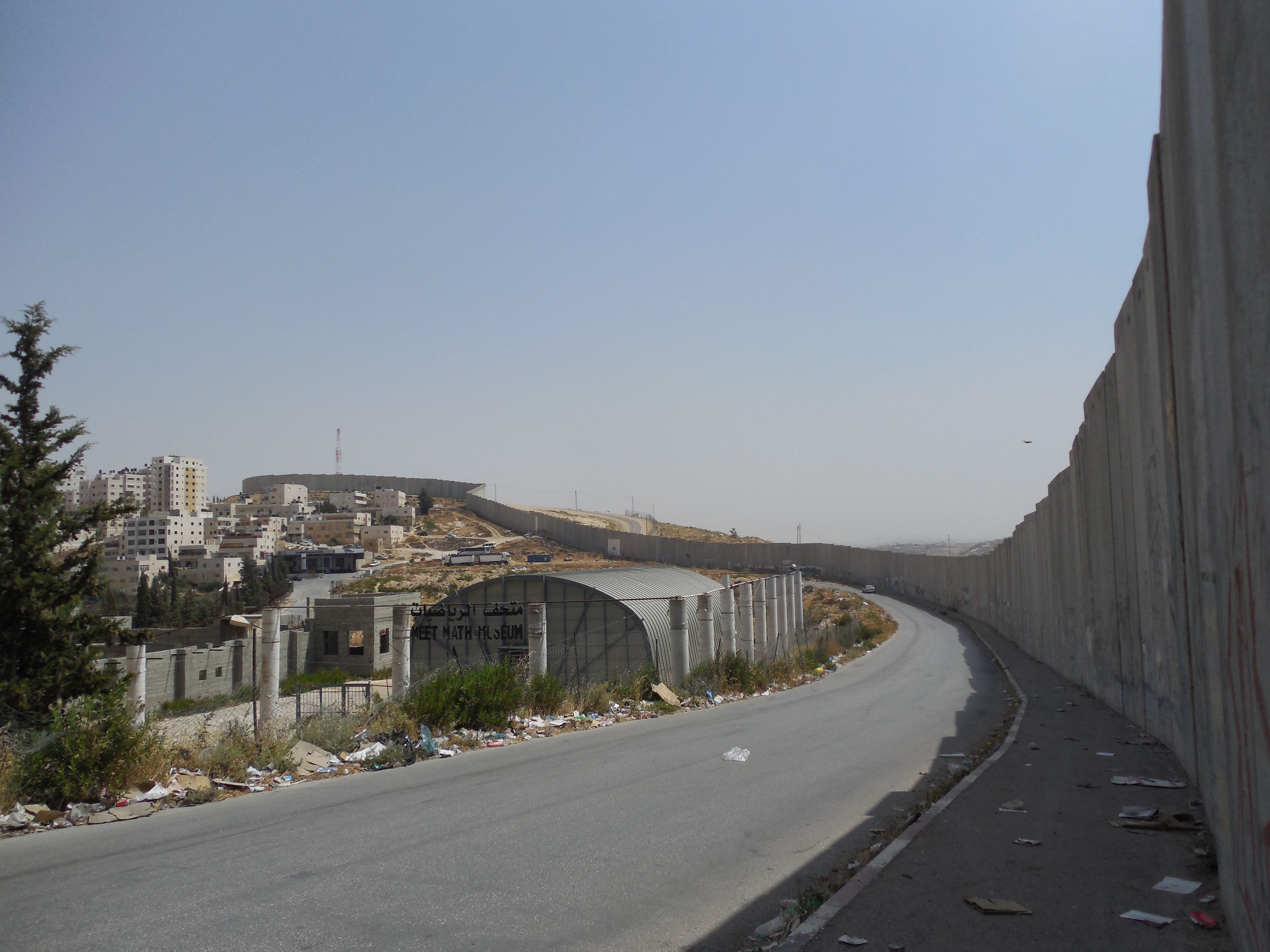
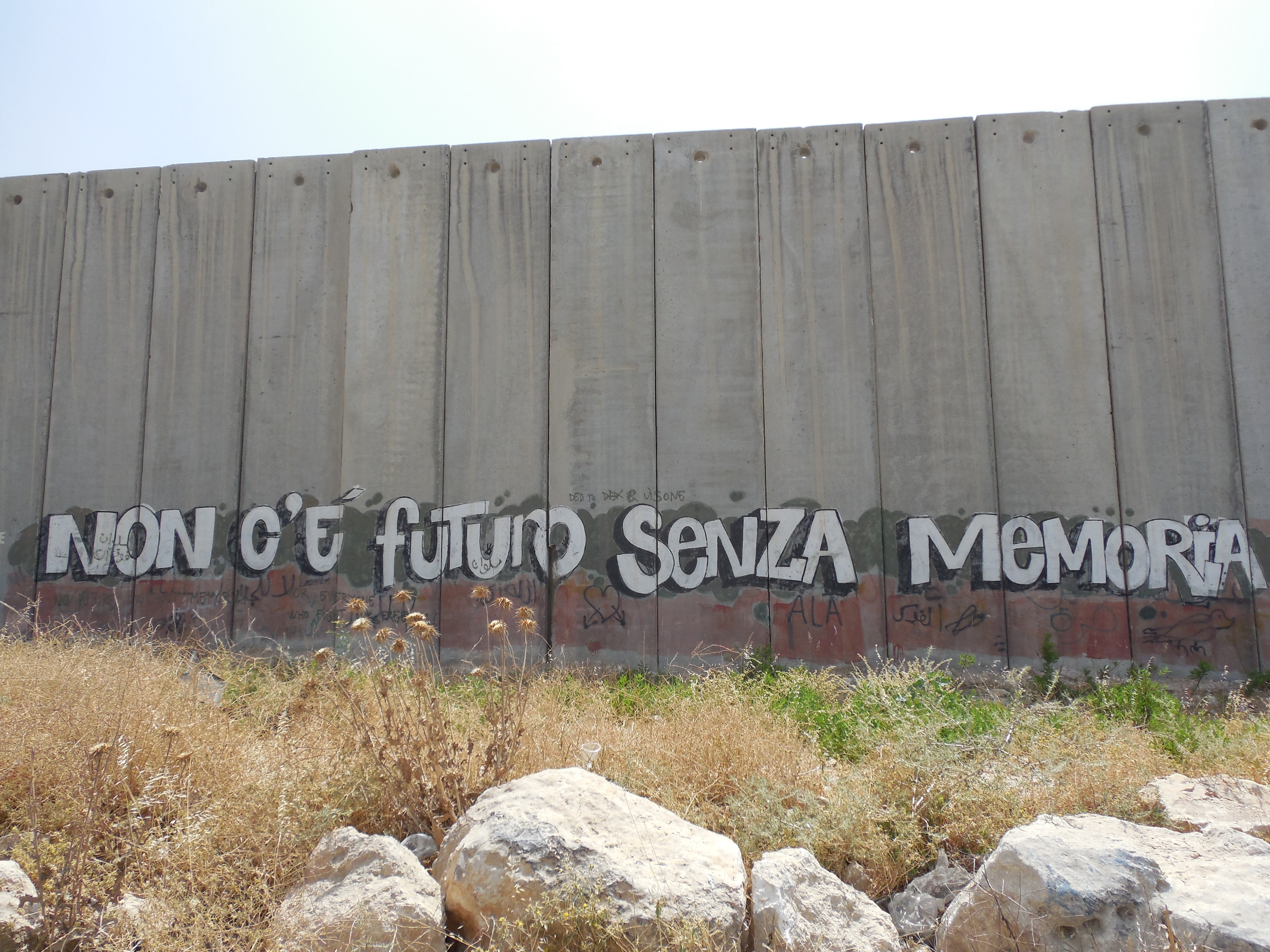
Postcards from Abu Dis (7): Museum on the Seam, Jerusalem

I went to Jerusalem’s semi-famous Museum on the Seam the other day (“MotS”). A couple of friends have asked for a report on what I saw there and how I liked it, so I thought I’d blog it.

Here’s the Museum’s self-description, from its website:

The Museum on the Seam is a socio-political contemporary art museum located in Jerusalem. The Museum in its unique way, presents art as a language with no boundaries in order to raise controversial social issues for public discussion. At the center of the changing exhibitions in the Museum stand the national, ethnic and economic seam lines in their local and universal contexts.

The Museum is committed to examining the social reality within our regional conflict, to advancing dialogue in the face of discord and to encouraging social responsibility that is based on what we all have in common rather than what keeps us apart.

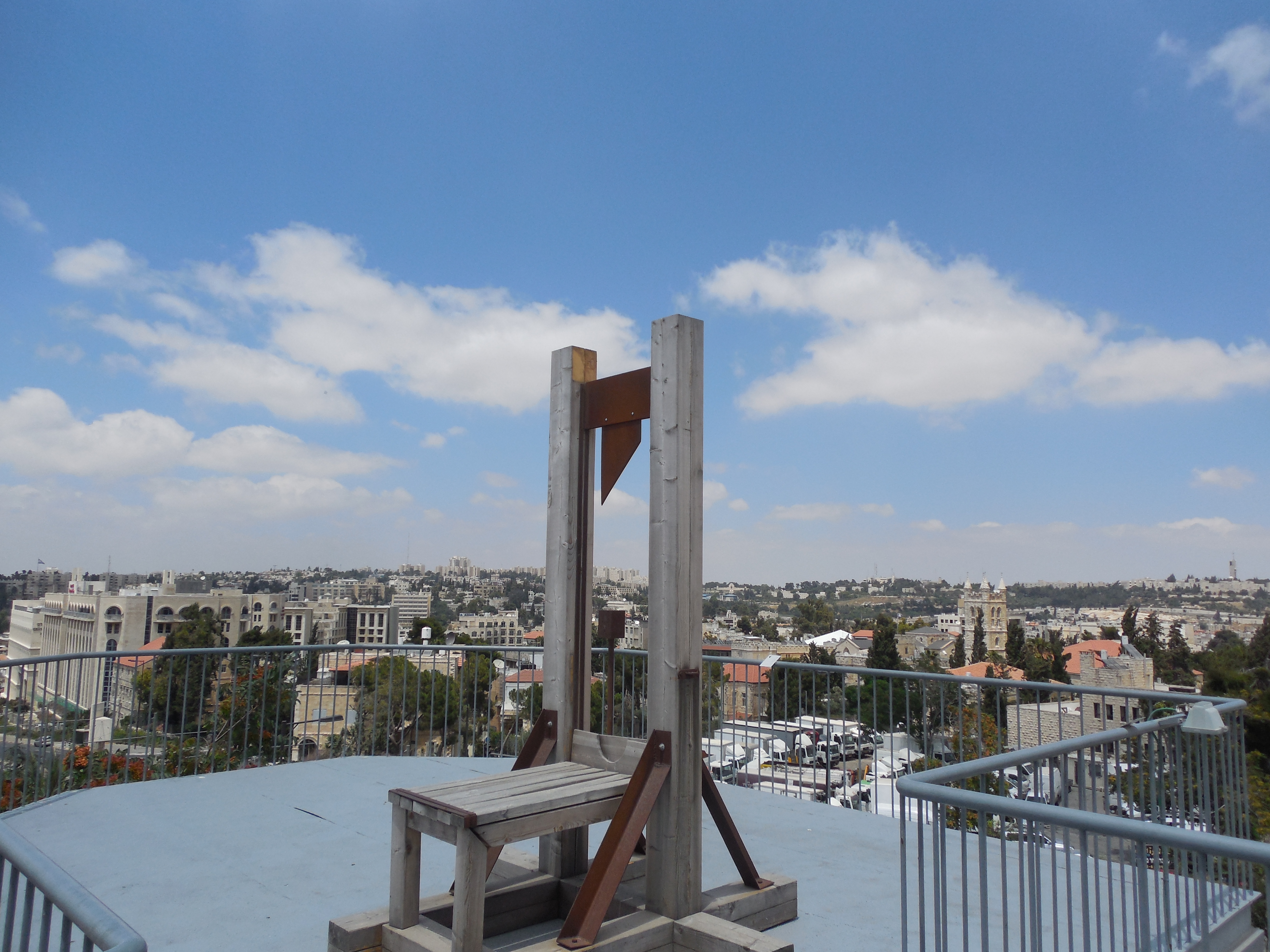
It’s a relatively small place, three floors of museum plus a guillotine-equipped observation deck, housed in a building that played an important role in the 1948 and 1967 Arab-Israeli wars. The wartime damage to the facade of the building is still visible, and constitutes part of MotS’s aesthetic-political appeal. The owners are obviously proud of the fact that the place manages to look both chic and bombed-out, and though the comparison isn’t exact, the vibe is a little bit like Manhattan after 9/11.
mots1

The Museum gets its name from its physical location–on the seam or borderline between largely Arab East Jerusalem and largely Jewish West Jerusalem, two halves of an “eternally undivided” city divided by one war, and fused together by another. Strictly speaking, MotS is located in West Jerusalem, but that’s only because it’s on the west side of Hel Handasa, the street that divides the city. So it’s at the eastern edge of West Jerusalem, across the street from the Arab neighborhood of Sheikh Jarrah in East Jerusalem, and next to the ultra-Orthodox Jewish neighborhood of Mea She’arim.

Though the Museum is obviously well-named, I’m inclined to wonder whether anyone from either Sheikh Jarrah or Mea She’arim ever visits the place. As it happens, the only people in the Museum during my visit there were American tourists like me. There’s a kind of symbolism in that: East doesn’t seem to meet West in Jerusalem; the two keep their distance from one another, leaving Americans to fill the gap. I get the sense that for the most part, Americans visiting “Israel” tend to go as far East as is compatible with staying firmly in the West. In other words, they stay in Israel, and visit the West Bank, if only for Bethlehem. My visit to MotS reinforced that sense.

MotS is controversial by design, and there are at least two rival perspectives on it. Partisans of Israel sing its praises as a daring exercise in contemporary guerilla art. Partisans of the Palestinian cause regard it as an overhyped pseudo-radical exercise in Zionist apologetics and imperialist bullshit artistry. My own sensitive and deeply nuanced view sits somewhere in between those unsubtle extremes. In other words, I thoroughly enjoyed my visit to MotS, but ultimately sympathize with the Palestinian take on it. It shouldn’t surprise you that, as an American, I feel entitled to have it all.

I particularly liked four of the exhibits I saw, and through the wonders of the Internet, I can show you two and a half of them right here.

The first was this film, “Los Encargados,” by the Spanish artists Jorge Galindo and Santiago Sierra, which depicts a motorized protest up the Gran Via in Madrid, Spain in August 2012. It’s set to an old socialist worker’s anthem, and for me, that really did the trick (not because I’m a socialist, but because I liked the anthem).

The message is not exactly subtle–Spain’s leaders have betrayed the country’s working class–but aesthetically, it works, so I liked it. (Trigger warning: I’m really not that sophisticated or articulate about art, so this is the level of commentary you should expect for the rest of this post.)

This second film is a lot longer than the first (37 minutes), but frankly I think it’s a masterpiece, and I was riveted by it from beginning to end–despite knowing absolutely nothing about the issue it engages with, and having no idea how to pronounce the artist’s name. It’s Chto Delat’s “The Tower: A Songspiel,” in Russian, and it’s about a controversy concerning the (pardon me) erection of the Gazprom Tower in St. Petersburg. If you don’t have 37 minutes to spare, just watch the first two minutes. I don’t know about you, but I found it hilarious.

The depiction of the short-haired elite woman struck me, somewhat vaguely, as a parody of Ayn Rand–not so much a political parody (the woman’s views are not particularly Randian) as an aesthetic one. To be precise, it seems like the kind of parody you’d expect of someone who had heard of Rand but never read her (there’s no shortage of such people). But I still liked it.

I can’t show you the third film, William Kentridge’s 3-minute “Monument,” but here’s a description of it:

Monument is Kentridge’s second film in the series and explores his feelings of ambivalence about the privileges and comforts of the white South African society into which he was born. It was made from a basis of eleven drawings and is accompanied by music composed by Edward Jordan. Soho Eckstein, wealthy real estate developer, here assumes the guise of civic benefactor and erects a monument to the black South African work force, from whose labour his wealth is derived. The monument is a huge statue of an anonymous African workman. During the ceremony of unveiling the monument, in the first half of the film, the statue comes to life. Slowed by the enormous burden on his shoulders, he makes his way across the outskirts of the city, before disappearing into the distant landscape.

There’s a vague Rand connection here, too: the film managed to remind me of Rand’s essay “The Monument Builders” in The Virtue of Selfishness, and the film’s protagonist bears an obvious similarity to John Galt from Rand’s Atlas Shrugged. That said, I somehow doubt that Kentridge has ever heard of Rand, or that the average Randian has ever heard of him; same symbolism, different messages.

A fourth piece I liked was a bitter sculpture of Israeli Prime Minister Menachem Begin by the Israeli artist Uri Lifshitz. Unfortunately, I haven’t been able to find a version online. Since you really have to see it to appreciate its power–and it was powerful–I’ll leave my “commentary” on it at that.

I should add that the Museum’s staff was excruciatingly nice to me in that disarmingly earnest, half-apologetic way that I associate with a certain brand of Israeli leftist. Maybe it’s my American imagination on overdrive, but I felt as though the staff was saying, “We realize that the occupation is in its 48th year–and we apologize for that–but we hope you’ll like the Museum anyway.” Which I did (thanks). I  guess I should also mention that MotS is responsible for the “CoExist” meme you’ve probably seen, which combines symbols from the world’s religions to form an icon spelling that word. If the Museum had a slogan, it might be the one associated with Rodney King (of Los Angeles riots fame): “Can we all just get along?”

So that’s what I liked about MotS. But there were some things I didn’t like–really, one big thing with a variety of different aspects. In a way, this complaint is a response to the somewhat facile nature of the whole “CoExist” idea associated with MotS. There are reasons why coexistence is not as easy as putting a clever bumper sticker on your car.

To approach that problem, consider some of the hype in favor of MotS. The authors of Lonely Planet’s Israel and the Palestinian Territories are typical in their accolades for the place:

Conflict, prejudice, racism (and occasionally coexistence) are on display at the Museum on the Seam, a socio-political/contemporary art museum that pulls no punches. …

Do not mistake it for a museum about the Israeli-Palestinian conflict; the issues here are broad and far-reaching and the Middle East conflict is just one small piece of a larger puzzle. (2010 edition, pp. 130-31)

Well, that’s one–rather euphemistic–way of putting things. I think it’d be more accurate to say that the Museum does its best to avoid the Arab-Israeli conflict, and in so doing, pulls a lot of punches. You couldn’t guess, by walking through it, that MotS is on the seam of the Arab-Israeli conflict. In fact, you couldn’t guess that the Museum is in Jerusalem, much less that it advertises its proximity to Arab East Jerusalem. Going by its contents, MotS could just as well be located in New York or Chicago as anywhere in Israel.

None of the artists featured in MotS are Palestinians. Neither are any members of the Museum’s administrative staff. With one exception, none of the exhibits had anything to do with the Arab-Israeli conflict. The exception is the Uri Lifshitz sculpture I mentioned, but even there, Lifshitz depicts things entirely from an Israeli perspective. His approach reminds me of Ari Folman’s in the 2008 film Waltz with Bashir: the theme is the anguish, from an Israeli perspective, of Israel’s having fought the 1982 Lebanon War, not the anguish of being on the Palestinian or Lebanese receiving end of the Israeli invasion. I don’t begrudge Lifshitz his perspective on things (he was a paratrooper in the IDF), but the fact remains that the closest that MotS comes to engaging Palestinians is the artwork of an Israeli paratrooper lamenting the fact that he had to kill some.

Mariam Shahin, author of Palestine: A Guide, is harshly dismissive of MotS:

Israelis established the Museum of [sic] the Seam in the confiscated home of the Baramki family. The theme of the displays is the development of Jerusalem since 1948. Although the curators say the museum is designed to bring Arabs and Jews together from both sides of Jerusalem, the signs are only in Hebrew and English. (p. 337)

Though I sometimes find Shahin’s nationalist polemics wearing, and would dispute the accuracy of the second sentence, the first and third sentences of this excerpt are very much on point. Nowhere is MotS candid with the visitor about the complex and problematic history by which it claimed ownership of the building it calls its own (more on that below). And for a Museum that prides itself on bridging East and West Jerusalem, Shahin is right to suggest that it’s not exactly an Arab-friendly place. Shahin was writing in 2007, but things don’t seem to have changed that much since then: though a small handful of the signs are in Hebrew, English, and Arabic, the vast majority are only in Hebrew and English. You can see why the residents of Sheikh Jarrah are not exactly lining up to get in: even if you could cough up the 30 shekel entrance fee, you’d have no idea what was going on around you. No surprise that the only Arab in the whole place was the guy serving coffee in the café.

But all of that really pales in comparison with the property-rights issue, bitterly summarized by the Arab Israeli politician Awatef Sheikh in a 2011 piece in Washington Report on Middle East Affairs, “Jerusalem’s Museum on the Seam: Artful Dodging.” Reading the first paragraph, I was inclined to think that Sheikh was overdoing the polemics, but having worked my way to the end, I had to admit that he was painfully right.

The building which today houses the Museum on the Seam is, in fact, owned by the Baramki family. It was designed by Andoni Baramki, then a young Palestinian architect who designed many of Jerusalem’s houses. In 1934 he built it and rented it to two Palestinian families who were forcibly expelled from the house in 1948. The Baramki family lived in a rented house nearby and, like hundreds of thousands of Palestinians, were forced to flee their homes in search of temporary safety during the violent spring of 1948. Denied return to their home, the Baramki family lived as refugees in Gaza before moving to the village of Birzeit, north of Ramallah, in 1953. Following Israel’s occupation of the West Bank in 1967, all members of the Baramki family with the exception of son Gabi—his parents, brother and sister- managed to obtain Jerusalem ID cards and live in East Jerusalem. The Washington Report on Middle East Affairs, contacted Dr. Gabi Baramki, who was 18 when his family fled Jerusalem in 1948. A former vice president of Birzeit University, he lives in Ramallah.

After 1967, when the family was able to cross over to the west side of the city, Gabi’s father, Andoni, fought for his right to his house. He went to the Israeli Custodian of Absentee Property, presented the deeds to his house and his identification documents. According to Gabi, “My father, a 6’4″ tall man, stood in front of the Custodian and told him: ‘I’m Andoni Baramki and I want to return to my house.’ The Custodian looked back at him and replied: ‘you are absent.'” The family then turned to the court but received no justice there, either. “You will get your house when there is peace,” the judge told Gabi’s father. People often told Gabi that his father, a very well-known figure in Jerusalem, “stood in front of the house for hours looking at it the way Romeo used to look at Juliet.” Andoni Baramki was never allowed to set foot inside his house again. He died in 1972.

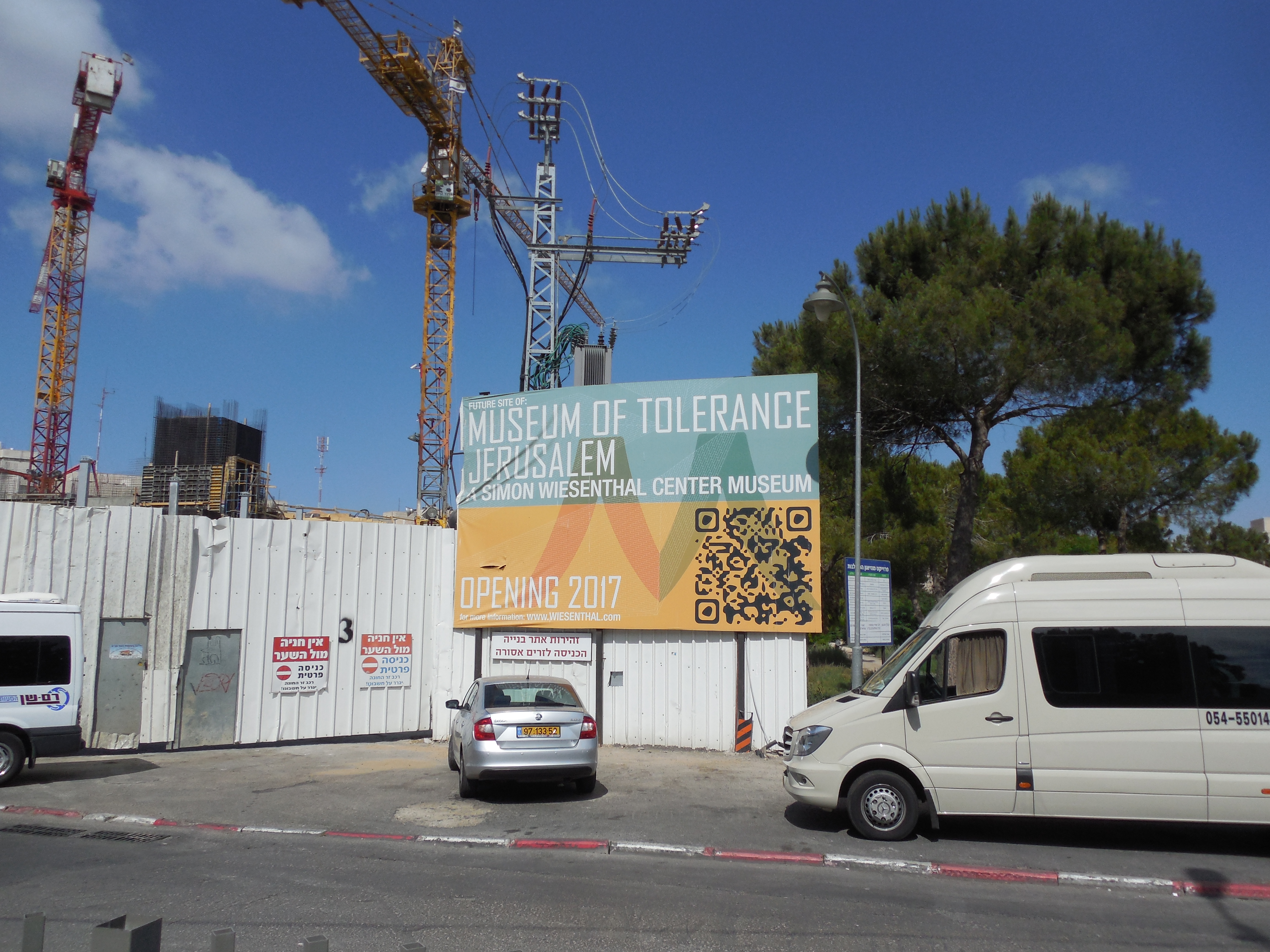
There seems to be a pattern here: just as MotS is the expropriated home of a “present absentee” Palestinian, so the forthcoming Simon Wiesenthal Museum of Tolerance is currently being built on top of the Mamilla Muslim Cemetary in violation of the property rights of the Palestinians whose family members are buried there. (For more on the Mamilla issue, see this article from Columbia Journalism Review, featuring my friend, Rawan Dajani.) The ethos seems to be: Injustice must be done so that good may come of it (and feed the insatiable desire for uplift characteristic of bien pensant American tourists).
tolerance

Given betrayals of this nature, it becomes hard to take Israeli liberals’ claims about the need for mutual understanding and tolerance at face value, and tempting to regard their brand of liberalism as a self-deceived charade. When they tell you that “art lacks boundaries,” I guess they really mean it: boundary violations, you might say, are part of the picture.

I hate to end on that downer note, but unfortunately, that’s the way Jerusalem is, at least in my limited experience. Every time you find something to feel good about, you find something bigger to feel bad about. And that was my ambivalent experience of MotS as well: the premise of the place seemed to be protest of injustices located at a safe remove built on injustice perpetrated nearby.

For me, the lesson is to disavow the smiley-faced, faith-based interpretations of this place one so often hears back home, of which Birthright Israel is perhaps the most nauseatingly delusional exemplification. In fact, Jerusalem is the scene of deep tragedy, worthy of a Sophocles or a Shakespeare, and built on tragic flaws that seem to reproduce themselves with every passing day. And while MotS was interesting and enjoyable–I’m glad I went–it wasn’t a catharsis. I’ll tell you if and when I have one. But don’t hold your breath.

Postscript, August 21, 2015: Here’s an interestingly if indirectly relevant item from The New York Times: Holland Cotter’s “What I Learned from a Disgraced Art Show on Harlem,” discussing the “Harlem on My Mind” art show at the Met in 1969, from the Times’s “Virgin Eyes” series.

Postcards from Abu Dis (6): Lost and Found in Translation

My political philosophy class is now deep into Book I of Aristotle’s Politics. Aristotle is tough going in any language, but he’s a linguistic obstacle course if you’re going from Attic Greek to English to Arabic and back again. Every technical word in the Aristotelian lexicon requires a special explanation that threatens to run aground on the reefs of some linguistic-conceptual-cultural misunderstanding.

Just consider the first passage of the text:

Since we see that every city (polis) is some some sort of partnership (koinonia), and that every partnership is constituted for the sake of some good (for everyone does everything for the sake of what is held to be good), it is clear that all partnerships aim at some good, and that the partnership that is most authoritative (kurios) of all and embraces all the others does so particularly, and aims at the most authoritative good of all. This is what is called the city or the political partnership. (1252a1-5, tr. Carnes Lord)

Since every what is some sort of what, and is what for the sake of some good, what is it that’s supposed to be clear?

Mission Nearly Impossible: Try explaining this, one clause at a time, in English via Arabic translation to 30 hungry, dehydrated, and nicotine/caffeine-deprived students fasting for Ramadan. Then listen to the Arabic translation via your weak, misremembered college Arabic of thirty years ago in search of any red flags in the translation, and hope you can catch them without losing your place or pushing your translators over the edge.

So: Is our students learning? Na’am, inshallah (“yes, if God wills it”)

I have two translators in the room, Sinan and Hadi, each of whom helps the other when one of them has trouble. They’ve have used the Arabic medina for “polis/city,” jamia for “koinonia/partnership,” and the adjectival form of “hukm” for “kurios/authoritative.” To add to the complexity, I prefer “association” to Carnes Lord’s use of “partnership.”

Sahih? (“Got that?”)

We spent most of the class explicating the Aristotelian idea of the polis/city, which had to be distinguished from “nation” (dawla), “country” (balad), “state” (also dawla), and “empire” (imbira’turia, obviously just an Arabization of “empire”). To avoid confusion, I decided to avoid “city-state” (medinat ad-daula) for polis, and decided to stick with “city,” adding a special explanation to the effect that an Aristotelian “city” isn’t a city in the modern sense–or even a city in the Palestinian sense. Medinat ad-daula is an intelligible phrase in Arabic, but I’m inclined to think that it would sound to students’ ears like an unintelligible paradox, prompting the predictable question:

Professor, how can a city be a state?

Well, it can’t, but “city-state” is not meant to suggest that a polis is a species of state; “city-state” is a term of art, and we already have too many of those floating around.

There is no easy way (that I know of) for distinguishing nations from states in Arabic (the same word translates both words), so it’s easy on purely linguistic grounds for Arabic speakers to think that every nation either is or requires a state, and vice versa.

Interestingly, I have a hunch that the average educated American–who has a working knowledge of American history but lacks a working knowledge of non-American nationalisms–might also have trouble seeing the distinction between “nation” and “state.” But I think that the latter difficulty arises from totally different sources than the Arabic-speakers’ difficulty. Both Arabs and Americans identify “nation” with “state,” but each has different conceptions of both concepts. In other words, they agree in identifying them, but disagree about what they’re identifying.

For Arabs, I think a “nation” is an ethnicity, and every ethnicity requires (or has the right to) a state. For Americans, by contrast, “nation” is to be identified with “state,” simply because the two words are synonyms; neither “nation” nor “state” is to be identified with any given ethnicity. Despite Woodrow Wilson’s inclusion of self-determination in the Fourteen Points, Americans have trouble grasping, much less sympathizing with, the idea of ethno-national self-determination. It sounds unAmerican. (Strictly speaking, the phrase “self-determination” doesn’t appear in the Fourteen Points, but a commitment to national self-determination is implicit in the second paragraph of the document.)

After giving what I think is the standard account of the nature of the polis in Aristotle, we talked about its possible exemplifications or approximations in the modern world.

To focus the conversation, I described the U.S. today as a counter-exemplification of the Aristotelian polis: in other words, I suggested that the U.S. provides a good (democratic) contrast to what Aristotle took the polis to be. In the U.S., we prize the freedom to do as we please with lives that we regard as essentially our own; we resent the idea that the nation has, or can dictate a single purpose to us, and have a very thin conception of “the common good” in the form of “the public interest,” which is sometimes (but pretty rarely) invoked to justify this or that policy, and plays little role in everyday political thought, discourse, or practice. Is that a controversial thing to say? Maybe, but it seems fairly obvious to me.

There didn’t turn out to be any literal exemplifications of the polis in the modern world. Among the closer approximations I came up with–and I know this is controversial–were Israel and Pakistan. Granted, both Israel and Pakistan are states, and as I’ve already said, the polis is not a state at all but a city. Further, being states, both Israel and Pakistan are much bigger than the political unit that Aristotle had in mind in his account of the polis. Given all of that, both Israel and Pakistan are obliged to rely on the use of force in a way that I don’t think is characteristic of an Aristotelian polis; put another way, each achieves an approximation (or illusion?) of being an Aristotelian koinonia by using the instrument of law to enforce a common conception of virtue in the service of a common good. Those are, I realize, large differences that distinguish both Israel and Pakistan from the Aristotelian polis.

But I still think that there’s something to the comparison. My point was that Israel and Pakistan each self-consciously conceives of itself as a political koinonia–a political association–with a common end, and a substantive conception of the common good. Citizenship in both countries is defined by allegiance to this robust conception (or supposedly robust conception) of the common good–the conception being supplied in the Israeli case by the idea of a Jewish State, and in the Pakistani case by the idea of an Islamic one. Each regime has a conception of virtue and the common good that it tries to inculcate through a public system of education, with the aim of getting citizens to identify their good with the state by identifying with its conception of virtue. And each is unapologetic about relying on the state to do so.

I have a feeling that my students were a little perturbed at hearing Aristotle compared with Israeli Zionism in one breath, and Israeli Zionism compared with Pakistani nationalism in the next. When I taught in Pakistan in 2012, students there were equally perturbed when I compared Pakistan with Israel. I guess all that’s left is to teach the same material in Israel, and I’ll have covered all of the relevant national bases.

Anyway, that’s when I decided to drop the real bomb. Neither Israel nor Pakistan is a good approximation of a polis, I suggested; they’re both too big and diverse to fit the bill. And both face the problem of how to deal with minority populations–a problem with no analogue in the case of an Aristotelian polis.

If you really want a good approximation of this polis, I suggested, you need to think smaller, and think of something closer by. I asked them if they could figure out what I meant. “Palestine?” someone asked. “No,” I said. “Just think of an Orthodox Israeli settlement.”

For a second, the class looked at me in blank incomprehension. But then, I think, they got it. I won’t elaborate, but I actually think that that comparison really does work: at some level, Israeli settlements really are like Aristotelian poleis. The biggest problem with the comparison is that the West Bank settlements are tied to Israel, which is a nation-state, and Israel is itself supported by the United States, which is a nation-state verging on an empire. But if you abstract the normative ideal of a Jewish settlement from its practical or logistical ties to Israel and the U.S., I’d say that settlements–which have a municipal governing structure–are a contemporary approximation of the Aristotelian polis. 

Incidentally, when I was a graduate student at Notre Dame, Alasdair MacIntyre used to use the example of the New England Town System as a “modern” approximation to the polis, but I no longer remember whether he was making a historical point about the structure of that system in colonial times, or making reference to the version of the system that exists today.

An unexpected linguistic stumbling block: At one point, I made passing reference to the “conceptual connection” between one thing and another, and both translators were momentarily stumped. It belatedly occurred to me that “conceptual connection” is a metaphor–possibly a dead metaphor, but still, idiomatically speaking a metaphor for purposes of translation. If you put the English word “connection” into Google’s translation device, you get 17 possibilities in Arabic, ranging over personal connections, computer-related connections, connections involving transportation hubs, and so on. If you put in “conceptual connection,” you get ittisal al maffahimi.

It sounds pretty impressive, but is it the right translation? Allah hu’ alim. God only knows. Let’s hope God’s Arabic is better than mine.

Postscript: An interesting paper I happened to encounter on this topic, Marco Allegra, “Citizenship in Palestine: A Fractured Geography,” Citizenship Studies 13:6 (2009).

On a more polemical note, consider Amos Oz’s claims, as described in a piece by Zachary Lockman:

Oz, in his wartime article for the New York Times, goes on at length about the romantic, idealistic and humanitarian character of the early Zionist settlers. They were pragmatic, politically aware, supremely self-analytical and egalitarian all at once, these men and women who by day drained the swamps of Palestine (to cite a popular Zionist image) and by night argued about social, political and ethical issues. The pre-state Jewish yishuv was not entirely idyllic, to be sure; there were some conflicts between the Labor Zionist leadership and the right-wing dissidents led by Begin. Despite this, Oz asserts, in many respects Israel was by 1948 “on its way to becoming a twentieth-century version of an Aristotelian Greek polis, characterized by the highest degree of individual involvement in public affairs.”

The Oz piece is Amos Oz, “Has Israel Altered Its Visions,” New York Times Magazine, July 11, 1982. For some reason, I haven’t been able to locate it in the Times’s archive.

Postcards from Abu Dis (5): More Miracles in the Holy Land?

Ramadan just started a couple of days ago, and I’m already wiped out from fasting. The fast is just too long. It starts at 3:54 am and doesn’t end until 7:48 pm: no food, no drink, no coffee. No coffee….

Fasting used to be easier when I was a kid. Somehow, back then, I had the capacity to fast and then play basketball or go to track practice. When did I become such a soft and pathetic wimp?

The thing is, I had planned to go to Jerusalem today, but canceled those plans at the last minute, because, due to fasting-fatigue, I hadn’t gotten any work done over the last few days. So I stayed home today and finished some of that work instead, fighting the ravages of my confused metabolic system.

Originally, I’d planned to go Bab al Amoud (Damascus Gate) in the Old City. In fact, I was planning to take a bus that stops right there just around the time that this happened:

An Israeli border policeman was critically wounded in a stabbing attack at the Damascus Gate in Jerusalem Sunday morning. The officer was stabbed in the neck, but managed to shoot the attacker before collapsing.

“When we arrived, we found a young man around 20 lying unconscious with a number of stab wounds to his upper body,” Magen David Adom paramedic Aharon Adler told Haaretz.”

“We immediately provided life-saving treatment and evacuated him to Shaare Zedek hospital in very serious condition.” The officer’s condition stabilized after undergoing surgery, the hospital said Sunday afternoon.

According to an Israel Police spokesperson, the perpetrator was an 18-year-old Palestinian who lives in the West Bank. He was evacuated to Hadasah, Ein Kerem hospital in critical condition.

Following the incident, security forces began combing the area with police helicopters.

As a friend of mine laconically put it: “It wasn’t a good day to go to Jerusalem.”

Mere coincidence? Or yet another survival-conducive miracle?

Well, survival-conducive for me, at any rate. Otherwise, too few miracles to go around.

Thinking about BDS (2): The Rhetoric of the Race Card

Anti-Semitism is a real, sometimes insidious, and always vicious thing. I’ve argued now for more than a decade that it finds problematic (probably disproportionate) expression among Arabs and Muslims, and also among Israel’s more militant and dogmatic secular critics.* In the United States at least, things seem to have improved since I first started writing on the subject, but still, I see nothing to retract from the criticisms I’ve made over the years. Whatever the malfeasances of Israel’s defenders (and of Israel itself), Arabs, Muslims, and anti-Zionists have a fair bit of housecleaning to do as far as anti-Semitism is concerned. As one prominent Palestinian intellectual put it to me, it doesn’t help Palestinians for Europe to be re-infected by anti-Semitism, so that Jews once again feel the need to leave the Left Bank of the Seine for the West Bank of the Jordan.

The anti-BDS movement, however, has gone well beyond such claims. Their view is not merely that anti-Semitism is on the rise, that it is a bad thing, and that it finds problematic expression among Israel’s critics. That would just put anti-Semitism on par with anti-Arab racism or anti-Muslim bigotry, which is also real, insidious, and vicious, and finds problematic and disproportionate expression among militantly pro-Israeli Jews. On their view, BDS is an anti-Semitic movement as such, in “effect” if not in “intention.” To be associated with it is presumptively to be associated with anti-Semitism. To sympathize with it is to sympathize with anti-Semitism. To participate in it is to participate in anti-Semitism. To lead it just is “classic” anti-Semitism.

The ultimate goal here is to reverse the presumption of innocence that usually obtains when you deal with someone you don’t know very well: other things being equal, you assume that a stranger is morally innocent, even if their views are false, until (or unless) you discover clear evidence of culpability. What the anti-BDS movement wants is a state of affairs in which, without having to address the merits or demerits of BDS, it can play the race card against anyone associated with BDS. Doing so saves time, and purchases more bang for the buck: with a mere six syllables at your disposal, you obviate the need for argument, and wipe your opponents’ reputations permanently in the mud.

The arguments for views of this sort are scattered across the vehicles of the movement, and repeated ad nauseam, but in this post, I want to discuss not the arguments but the rhetoric of the anti-Semitism accusation as made by critics of BDS. (I’ll discuss the arguments in a later post.) There is a distinctive method and style to this rhetoric, and something to be learned from analyzing it.

As I’ve mentioned before, one version of this form of discourse is what might be called safe-space self-infantilization. It might with equal merit be called the appeal to post-non-traumatic-stress disorder, or self-dramatic-stress-disorder. The claim here is that hurt Jewish feelings, especially in college-age students, just entails the existence of real anti-Semitism, on the assumption that the effect could not possibly have arisen through any other cause. As a general principle: If people feel bad, their feeling bad underwrites whatever they believe about why they do. The same principle put in the first person singular: If you make me feel bad, and I come to believe that you’ve done so through racist intentions, then, if I can demonstrate that I feel really bad, you really are a racist. The worse I claim to feel, the more confirmation I have of any accusations I make of you.

What’s worth learning here is how a general discursive culture of sensitivity and caring can be exploited for sinister ends–and how difficult it can be to challenge its assumptions without being branded insensitive, uncaring, or worse. At a deeper epistemic level, what’s worth learning here is what happens when you erase the distinction between cognition and emotion so as to lose any sense of the difference between them. If there is no difference between cognition and emotion, or between appeals to cognition versus appeals to emotion, then there is no difference in principle between inferring your way to a conclusion and feeling your way to one. But in that case, it seems to me, there is no difference between persuading someone of  a conclusion via inference, and manipulating them into a conclusion via appeals to pity, guilt trips, ad hominem arguments, ad bacculum arguments, and the like.

What would such a caring, sensitive, but emotionally manipulative discourse look like? To get a sense of it, consider some passages from this May 9 report in The New York Times on BDS and the response to it by students who oppose BDS in defense of Israel.

LOS ANGELES — The debates can stretch from dusk to dawn, punctuated by tearful speeches and forceful shouting matches, with accusations of racism, colonialism and anti-Semitism. At dozens of college campuses across the country, student government councils are embracing resolutions calling on their administrations to divest from companies that enable what they see as Israel’s mistreatment of Palestinians. …

As the debates spill from undergraduate council to dorm room, students and college officials are grappling with where to draw the line between opposition to Israel’s policies in the West Bank and Gaza — a position shared by many Jews — and hostility toward Jews. Opponents of divestment sometimes allude to the Holocaust.

“What bothers me is the shocking amnesia of people who look at the situation of American Jews right now and say, ‘You’re privileged, you don’t have a right to complain about discrimination,’ ” said Rachel Roberts, a freshman at Stanford who is on the board of the Jewish Student Association there. “To turn a blind eye to the sensitivities of someone’s cultural identity is to pretend that history didn’t happen.”

Actually, opponents of divestment don’t “sometimes” allude to the Holocaust. They allude to it a lot. Consider Cary Nelson and Gabriel Noah Brahm’s Case Against Academic Boycotts of Israel in this respect. The book’s index has twenty-five entries for “Holocaust (see also Shoah),” including four multi-page references. Naturally, there is an index entry for “Shoah (see also Holocaust),” as well. The index entry for “anti-Semitism” is four lines long, as is the coincidentally just-following entry for “anti-Zionism.” The rhetorical purpose of these allusions is clear: vaguely insinuate that BDS, being anti-Zionist, is “by definition” anti-Semitic (p. 77); then suggest that its version of anti-Semitism has something in common with the Nazi version, so that BDS either has something in common with Nazism or at least with Holocaust denial.

Here’s a logician’s summary of the fallacy involved (he’s making reference to an example from a different context, but the same principle applies):

This tactic is sometimes called “poisoning the well,” and it is obviously fallacious. The fact that someone might have a nonrational motive for supporting a position does not mean the position is false, and it certainly does not mean we can decide ahead of time that all his arguments for the position can be dismissed.

Well, none of this is obvious to the anti-BDS movement, which has come to rely on well-poisoning as a discursive way of life.

“Holocaust,” “Nazism,” and “anti-Semitism” are the nuclear weapons of moral discourse in the academy. Those with the power to deploy those terms and make them stick to other people’s reputations are the nuclear powers of the academic set. Unlike the actual nuclear powers of the military world, however, they’re not shy about pushing the button, and face little in the way of deterrence, so that every successful weapons launch encourages them to engage in another. The toxic consequence of their efforts–in many cases the intended consequence–is the empowerment of ignorant, opportunistic college students like Rachel Roberts who seem think that if you’re insensitive to someone’s presumed cultural identity you are denying history itself. The assumption seems to be that no aspect of history as it actually happened could conceivably involve an affront to anyone’s cultural identity.

Reading between the lines of Rachel Roberts’s assertion (“pretend that history never happened”), one hears the echoes of the most propagandistic features of contemporary Holocaust education: “never forget,” the Holocaust ed mantra asserts, without telling anyone what exactly to remember–except that the Holocaust was morally and metaphysically unique, and so too, presumably, was the solution to it in the form of the creation of the State of Israel. Predictably, the Rachel Roberts of the world infer that if they feel bad about whatever you’re saying about Israel, you’ve forgotten the Holocaust and are, by your words, letting (or making) it happen all over again.

It’s as though someone were to say:

Your defense of BDS makes me feel really bad. Really, really bad. In fact, I feel so bad right now that I kinda feel as though…you’re a Holocaust denier on par with David Irving. Only a Holocaust denier could make me feel this bad, so you must be one.

Well, if I were on the receiving end of that accusation, I would feel really bad, and I’d be tempted to respond in kind. Many do. But what seems obvious is that this “feeling-to-ascription” manuever is a desperate attempt to change the subject and shut down the conversation. The hypothetical person I’ve just quoted is not someone who wants to discuss BDS, the merits and demerits of Zionism, Israeli policy in Area C, or what practical measures to take to end the occupation. This is a person who realizes that the best bet for evasion is a conversation about the presumed dirty secrets of his or her interlocutor, secrets that can only be exposed–or manufactured–by enacting a pseudo-therapeutic drama in which the focus turns to the drama itself. As a matter of logic, an interlocutor who does that sort of thing cannot be reasoned with until he or she ceases and desists from doing it. There is no logical way to respond to an insinuation of racism based on someone’s feelings except to dismiss it and get back on topic.

To continue:

“There’s more poison in the rhetoric than we’ve ever felt before,” said Rabbi Chaim Seidler-Feller, the executive director of Hillel at the University of California, Los Angeles, who has worked on college campuses for more than four decades. “There are so many students who now see Israel as part of the establishment they’re against. What’s alarming is this gets deeply embedded and there’s no longer room for real discussion.”

The word “felt” obviates the need to find a genuinely empirical way to test the generalization implicit in Seidler-Feller’s supposed observation. By contrast, it’s well-established that support for Israel practically defines the American foreign policy establishment today. How it’s poison to regard the Establishment as established is unclear to me.

Seidler-Feller’s claim is particularly bizarre coming from a person who has somehow managed to regard BDS as “deeply embedded.” The “embedding” metaphor is pretty unclear, but if it means anything at all, it has to mean that BDS is starting to become an establishment of some sort: to say that a view has become “deeply embedded” is to say that it’s become well-established in a given population. Put aside the empirical absurdity of the claim and suppose that it was true. If it was true, why would it leave no room for discussion? At any given time, it’s reasonable to expect that someone constitutes the Establishment. How does the sheer existence of an Establishment leave no room for real discussion? And why is it that when BDS regards the Israel lobby as the Establishment, that is anti-Semitic, but when critics of BDS regard BDS as subverting real discussion by “embedment,” no issue of bigotry arises at all, even by implication?

I may be pressing too hard on claims that were never supposed to make sense in the first place, but it’s hard to avoid the conclusion that Seidler-Feller’s claims here are just a desperate defense of the status quo. If his views are part of the Establishment, it’s poison to oppose them, but if contrary views get “embedded” somewhere, well then, we’re all in discursive prison. I’m left wondering what Seidler-Feller thinks about the room for discussion that’s left to us after people throw around gratuitous insinuations of anti-Semitism in people one disagrees with, as he just has: in addition to the preceding claim about “poison,” Seidler-Feller has accused Omar Barghouti, the presumptive founder/leader of the BDS movement, of being a “classic anti-Semite.” Presumably, calling someone a “classic anti-Semite” gives us all the room for a “real discussion”–a discussion, at any rate, of who’s next on Seidler-Feller’s McCarthyite blacklist.

But let’s continue:

Sometimes, the specific aims of campus divestment campaigns can get lost in broader debates about the Israeli-Palestinian conflict. At Barnard College, which is one-third Jewish, a group called Students for Justice in Palestine put up a banner last year saying, “Stand for Justice, Stand for Palestine,” showing a map of the area with no internal border demarcating Israel. The banner was taken down the next morning after Jewish students complained that it made them feel threatened.

What I find interesting about this passage is that the complaining students didn’t complain that the map implied a falsehood, or was inaccurate, but that it “made them feel threatened.”  The claim seems to be that display of the map itself constitutes a threat.

This approach to things parallels the views of those in France who claim, with the authority of law, that the sight of a full niqab worn in public constitutes a threat by those who are “forced” to see it, which is why it must be banned, at least in public. The claim here is literally this: if Aisha is wearing a full niqab, and you see her wearing it, she might as well have come up to you and threatened you; the sight of the niqab is a threat on par with what Anglo-Saxon common law regards as assault: creating the apprehension of imminent harmful or offensive contact with a person (itself a remarkably broad formulation).

Accept the reasoning for a moment. In that case, shouldn’t any defender of the Palestinians cower in fear–or even call the policeevery time defenders of Israel (or just ordinary folks) conflate the West Bank with Israel as, with “frightening” frequency, they do? How about a book that calls for the annexation by Israel of the West Bank? Should the display of such a book in, say, a bookstore window be regarded as a threat and legitimize a demand that it be taken down? What difference in traumatic intensity is there between displaying a map that treats Israel and Palestine as a single political entity, and displaying a book that prescribes treating Israel and Palestine as a single political entity? I don’t see any, but somehow, in the United States, the first is construed as an attack, while the second is construed as a polite topic for conversation.

This reminds me of an incident during my undergraduate days at Princeton. One day, someone invited Rabbi Meir Kahane to speak on campus, and Kahane made the case not just for the forcible transfer of the Arabs from Eretz Israel (which for him included the West Bank), but their mass slaughter if they didn’t accept second-class citizenship or leave voluntarily. (For a discussion of how Kahane came to be invited to Princeton, see Robert Friedman’s Zealots for Zion.)  That was regarded as a polite topic for conversation at Princeton in the late 1980s. Most of the audience laughed at Kahane’s jokes, applauded what he said, and was offended when Kahane was sharply taken to task in the Q&A. There were no cell phones in those days, but just try to imagine the absurdity of calling 911 from inside of McCosh Lecture Hall 50 and trying to assert to the police dispatcher that Kahane’s racist and anti-Arab diatribe was an act of assault under the criminal code requiring the immediate dispatch of police units, followed by his arrest, and his prosecution. What is more likely to happen–that the police would arrive and arrest him, or that they would arrive and arrest you for false report?

Anyway, let’s keep going.

At U.C.L.A. last month, hundreds of Jewish students waving Israeli flags and wearing shirts emblazoned with “We, the Zionists” gathered on the campus quad to celebrate Israel’s Independence Day. Some said that while they had never hidden that they were Jewish, they felt uncomfortable voicing their support for Israel and often chose to stay out of debates around other current political issues. When the student government considered a divestment resolution, Jewish student leaders encouraged their peers to stay away from the meeting, saying their presence would offer legitimacy to a process they deemed inherently wrong.

“When there were marches about Ferguson, I went, but I stayed on the sidelines,” said Natalie Charney, a U.C.L.A. senior and the president of the Hillel Student Board, who had been made uneasy by the chants of “From Ferguson to Palestine,” which she saw as totally unrelated. “I wanted to be there, but part of what they are hating is central to who I am and what I stand for.”

The “discomfort” voiced here seems to me indistinguishable from group think, as is the encouragement to stay away from the debate. The failure to see any connections between Ferguson and Palestine betrays a failure of integration and imagination: how difficult is it to see the similarity between the systematic and racialized abuse of force by law enforcement officers in one place, and the same thing happening in another?** Never mind that this criticism comes from people who habitually criticize BDS for “singling out” Israel. So if critics of Israel focus on Israel, that’s “singling Israel out.” But if they link criticism of Israel to other political causes, they’re muddying the waters by bringing up “totally unrelated” topics. As for “part of what they are hating is central to who I am and what I stand for,” the claim raises an obvious question for Ms. Charney: what part of what they are protesting is central to what you “stand for,” and whatever it is, why is it that you’re going out of your way not to stand up for it?

Continuing:

At U.C.L.A. this year, a Jewish student, Rachel Beyda, was questioned about her loyalties while she sought a position on the student Judicial Board. At Stanford, another Jewish student, Molly Horwitz, described a similar situation when she sought the endorsement of the Students of Color Coalition, which favors divestment, but disputed the claim that it had asked about her Jewish identity. Before declaring her candidacy, Ms. Horwitz felt compelled to remove pro-Israel references from her Facebook page before she ran for the student senate.

What happened in the Stanford case is (as the passage itself says) highly disputed, but if Israel really is what its defenders “stand for,” why the need to airbrush one’s support out of existence when one thinks that an election requires it?***  The deletion of one’s “stand” is not exactly a case of standing up for it.

More:

“Jewish students and their parents are intensely apprehensive and insecure about this movement,” said Mark Yudof, a former president of the University of California system. “I hear it all the time: Where can I send my kids that will be safe for them as Jews?”

I wonder if a former president of the University of California system can be counted on to know what an “equivocation” is. How “safe” is a university system in the hands of a man with mental processes of this caliber?

In general, this is the rhetorical space within which the supposed “arguments” against BDS operate in the United States. Those arguments would have no traction in a climate of opinion where rhetoric of this kind was regarded as unacceptable. They get traction in a climate of opinion in which well-poisoning and appeals to pity are generally taken for granted, up for grabs for those who best know how to exploit them.

It’s worth noting that while many of the people quoted in this article are students, not all of them are. They’re adults in positions of academic or quasi-academic authority. When people like that approach politics like this, they have to expect push-back–forceful push-back–from people on the other side. In particular, they have to be put on notice that fraudulent insinuations of anti-Semitism, like the ones discussed here, have to be treated as the fraud they are. In other words, if critics of BDS want to play the race card, they have to be put on notice that those of us on the receiving end intend to respond, not quite “in kind,” but in a manner that exposes the fraud, and puts responsibility for the discursive pollution involved on the people who created it. We have no obligation to sit back and accept their threats and attacks with equanimity–which is what they seem to expect of Palestinians in the occupied territories, and what they expect of the rest of us, as we survey the wreckage of a 48-year-old military occupation made with our support, in our name.

But “self-infantilization” is just one variation on a theme that has dozens of variations and dozens of exponents. There are–trust me–many, many more. So unfortunately, this post is just the first of what will have to be a sustained effort at criticism. Stay tuned.

*My writing on this subject is scattered all over the Internet and in somewhat obscure places. When I get back to the States, I’ll try to consolidate it all on this site for easy reference. Meanwhile, I’ve endorsed this book, and some of my comments on the subject are mentioned within it.

**In referring to “Ferguson,” I’m referring (as my links suggest) to the Justice Department’s exposure of systematically discriminatory practices engaged in by law enforcement and other agencies in the area, not to the details of the encounter between Michael Brown and Darren Wilson.

***A sincere question for experts in the ethics of voting: is it consistent with “the ethics of voting” to edit your Facebook page in the described way simply in order to win an election? Doesn’t doing so represent a defect of character that precludes voting for a candidate, even if it doesn’t have clear policy implications for the future?

Postscript, June 21, 2015: One doesn’t have to wait long for reality to provide confirmatory postscripts to a post like this. From an article in The New York Times, “Two Israeli Men Are Attacked, and One Killed, Near Settlement in the West Bank“:

Israeli leaders condemned the attack. “We will not accept a situation in which a young hiker has his life taken from him in the land of Israel because he is Jewish,” President Reuven Rivlin said in comments on his Facebook page. “The murderous attack that occurred today is another step in the quiet and serious escalation in acts of terrorism we have witnessed in recent months.”

So Dolev–between Bir Zeit and Ramallah, miles from the Israeli border–is in “the land of Israel”? How did that happen? In other words, how does a shooting allow the President of Israel to bypass final status negotiations and decide the fate of the West Bank?

But this is how the settlers, their supporters–and in certain moods, Israelis as such–habitually speak. If we should feel “threatened” by the advocacy of one-state solutions, then the shooter in this case had the right idea: he shot the people from whom he “felt” a threat. It’s not as though the presence of the settlers is like a map he can ask to have taken down by some care-bear administrator.

Continuing:

Israel’s education minister, Naftali Bennett, of the hawkish Jewish Home party, accused Palestinian society of promoting “murder and terror.”

“At a time when the world is busy boycotting Jews, the Palestinians are busy killing them,” he said in a statement.

You wonder why there is anti-Semitism among Palestinians? If a boycott of Israel (whatever its merits or demerits) is axiomatically equated with a boycott of Jews by the country’s “education minister,” unsophisticated people will naturally infer that the policies of the State of Israel, the Jewish State “in the land of Israel,” are themselves the policies of “the Jews.” If the victims of those policies hate the policies–because, often enough, they’re enforced at the point of a gun that’s pointed at the victims’ faces–there’s the lurking danger of hating the people who put the policies in place. If the architects and supporters of those policies insist on describing the policies as the policies of “the Jews,” they can’t really complain when the victims of those policies end up hating “the Jews.” They’re practically inviting that response.

I don’t dispute that the victims are mistaken, that they’re indulging in misinference, and that that misinference is in many cases culpable. Nor do I dispute  that Palestinians who equate the occupation with “the doings of the Jews” are enacting a logic that leads ultimately to war, death, and misery. What I insist on is this: If people like Bennett had any sincere interest in reducing anti-Semitism, they would stop cynically identifying “Israel” with “the Jews.” But it’s obvious that they have no such interest. What they have instead is a perceived interest in demagoguery, in the percolation of ethnic hatred, and in the imposition of the mailed fist as a response to the hatreds they themselves have stoked. They are morally complicitous in the phenomenon they claim to condemn. We need a discourse about Israel and Palestine in the United States that holds them accountable for it, not one that throws accusations of “anti-Semitism” around whenever the mood strikes.

Postcards from Abu Dis (4): A Land of Miracles

So I decided today, in defiance of common sense, to walk from Abu Dis to Jerusalem. I mean, I can see the Mount of Olives from my kitchen window, so how hard could it be to get there? Seeing is believing. Kind friends showed me the way there en route to a nearby restaurant a few days ago, albeit from the comfort of their car. It all seemed simple enough. You take the short cut from Abu Dis to Eizariyah, take Route 417 down to the Khatib Bakery shop, take the road after it, and walk up the road to Har Hazeitim* Checkpoint and into Jerusalem. Easy!

You forget that the holy land is not just holy, but hilly. Yes, Jesus preached the Sermon on the Mount, but we tend to remember the sermon at the expense of the mount. And now I get why Jesus didn’t walk to Jerusalem on Palm Sunday. I really get it: one mile of walking up a 45 degree slope in 80-something degree heat from Abu Dis to Eizariyah, and I begin to think that this whole “walk to Jerusalem” thing is a really bad idea. (I could at this point too easily resort to an “ass” joke, but I’ll spare you.)

So I get to the town of Eizariyah, and the time comes to put those directions to use. You know, the directions my friends gave me while driving through this town? So here I am on Route 417. Now, I seem to remember them saying that the turn-off to Har Hazeitim Checkpoint is after Khatib Sweets and Bakery on this road. Khatib Sweets. And Bakery. After it. It seemed so clear at the time.

I get to Khatib Sweets and Bakery, and wouldn’t you know it, there are two roads after it. Two roads diverged in Eizariyah after Khatib Bakery, and I–I cannot figure out what “after” means in this context. Right after? Somewhat after? Which has the better claim?

Whatever “after” means, I get it wrong: right direction, wrong turn-off, wrong destination. I end up at a checkpoint, all right. But it’s closed. And it’s not called “Har Hazeitim” (or, for that matter, Herzliyah).* I don’t know what it’s called, but it’s ugly as sin, covered with trash, and totally abandoned.

I keep walking a few miles up and down the hills of Eizariyah, feeling like death itself.  “Jesus,” I think. “Get me out of this.”

Lazarus_Bethany.JPG (2048×1536)

I look up. It’s the Tomb of Lazarus. I take a random left turn. Hey, there’s the bus stop. I pay the fare. It’s eight shekels. I have exact change. I get to Jerusalem.

Hallelujah.

*Postscript, June 17, 2015: Not only did a screw up my friends’ directions, but I got the name of the checkpoint wrong in the original post (I had originally written “Herzliyah Checkpoint”). I’ve fixed it now. Of course, for purposes of the post, this piece of revisionist history erases the fact that I not only misremembered my friends’ directions, but misremembered the name of the checkpoint that was central to the directions.

My friend Awad Mansour informs me that the abandoned “checkpoint” I describe in the post is actually a large gate that (years ago) used to be opened at times to allow schoolchildren back home from school in Jerusalem. Apparently, it’s been the scene of clashes with the Israeli army–including some particularly intense ones this past fall.

Incidentally, I’m glad I didn’t head toward the “Herzliyah checkpoint” (or more precisely the “Herzliyah Marina Checkpoint“), because unsurprisingly, it turns out to be in…well, Herzliyah, on the Mediterranean coast, on the other side of the country. I’m not sure what miracle would have helped me there–except, perhaps, the one that gave the scarecrow a brain in “The Wizard of Oz.”

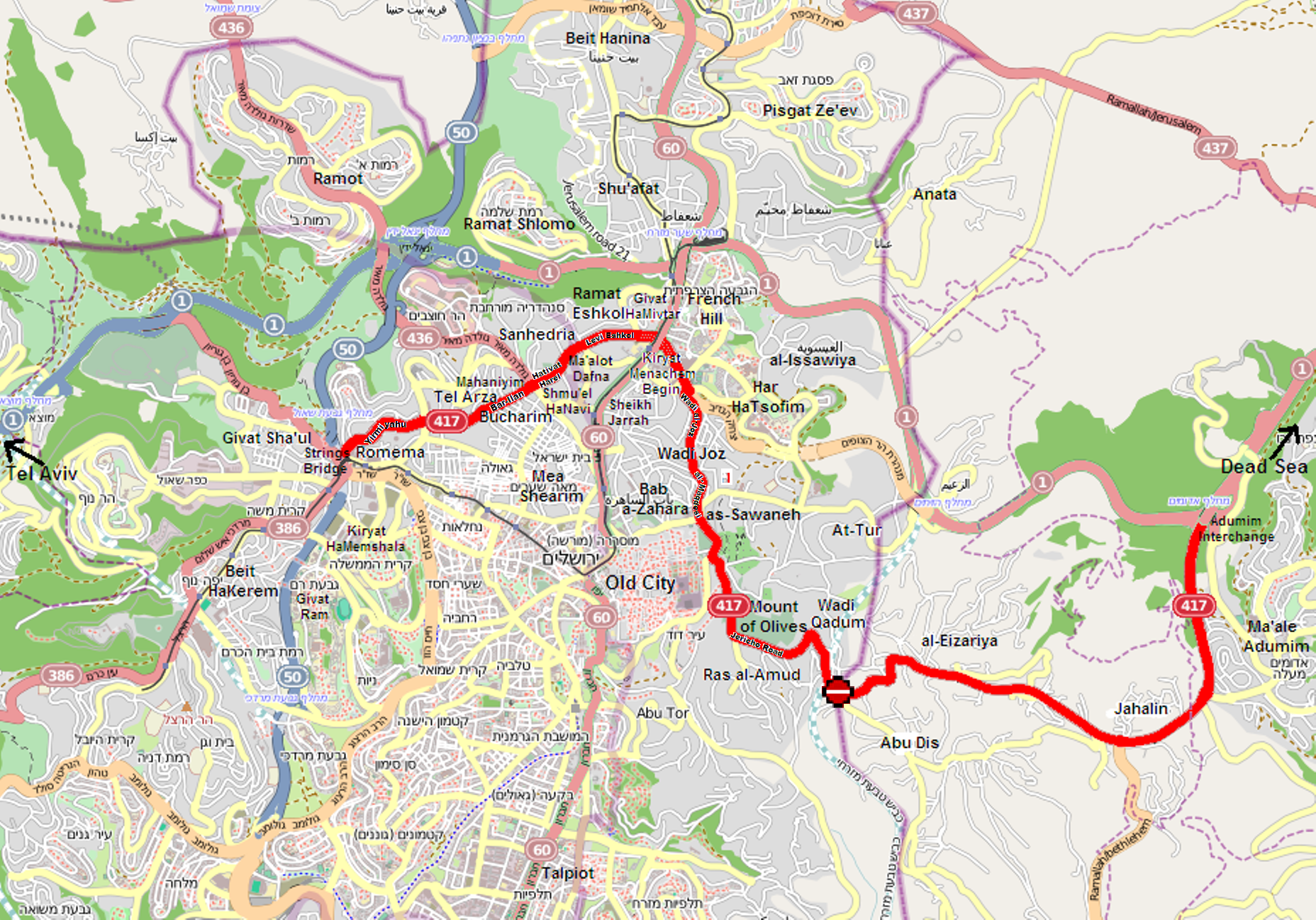
Postscript, June 24, 2015: With the help of Wikipedia, a bit of OCD, and some help from my friends, I’ve figured out what I did wrong. See the yellow road that stretches somewhat horizonally across the page underneath the words “Abu Dis”? That’s not the road I took. But if you look at the “s” of “Abu Dis,” you’ll see a sort of vertical white road that heads to Eizariyah. That’s the “short cut” I mention in the post. If you take it to Route 417, there’s a roundabout there, probably not visible on this map. I got lost in those squiggly white lines (roads) and kept knocking into the purple thing (the wall). But see how only one of those roads crosses over the blue and white line into the city? That was the road not taken.

You can’t see Lazarus’s Tomb, but I walked down from it to Route 417 and walked over to the red sign with the horizontal white stripe through it. That’s the bus stop at the wall (in purple). The bus then takes 417 in the opposite direction, through Eizariyah, Jahalin, Ma’ale Adumim, to Route 1, and into the city via the checkpoint at Adumim Interchange (where we were ordered to stop and our documents were inspected). Whether the further route continued via Sawaneh, Wadi Joz, or Sheikh Jarrah, I don’t remember (will pay closer attention next time I go). But whichever it is, it’s a pretty circuitous route, and would obviously be much shorter if it went through the Mount of Olives via 417 heading northwest.

ILroute-417.png (1856×1298)

Pakistan’s Occupied Territories: The Country Itself

I thought I’d interrupt the “All Israel/Palestine, all the time” posts with a classic from the “Pakistan embarrasses itself yet again in front of the whole world” genre. From a headline as accurate as it is designed to provoke laughter: “Pakistan Warns Aid Groups to Follow Unspecified Rules.”

ISLAMABAD, Pakistan — After the police shut down the offices of a major Western aid group, Pakistan’s interior minister warned Friday that other foreign organizations operating in Pakistan faced greater scrutiny and the possibility of expulsion if they failed to adhere to unspecified rules and laws.

“We do not want to impose a ban on any N.G.O., but they will have to respect the code of conduct,” said the minister, Chaudhry Nisar Ali Khan, referring to nongovernmental organizations.

A day earlier, Pakistani officials abruptly sealed the Islamabad offices of the Save the Children, which has operated in Pakistan for 35 years, for what were described as “anti-Pakistan” activities. The group was given 15 days to wind down its operations.

Speaking to reporters, Mr. Khan said Pakistan’s intelligence agencies had reported “irregularities” among other aid groups working in Pakistan, although he did not name them or the laws they had broken.

If you read the rest of the article, the “unspecified rules” become clear, and end up reducing to one rule: using one’s brain, for purposes of one’s own, without government permission.

Same story from Karachi’s Dawn. An even better story with a particularly revealing headline: “Pakistan Will Not Allow NGOs Working Against the National Interest.” The video embedded in the preceding article (in Urdu), features a press conference with the Federal Interior Minister, and makes plain how the Government of Pakistan conceives of “the national interest”: if you’re an NGO, it dictates where you’re allowed to work as a condition of your being allowed to operate at all, and if it finds you working in a different party of the country, you’ve violated the “national interest” regardless of what you’re doing or why you’re there, simply because the government panics at the very idea that NGOs might have freedom to act independently of the “agenda” of the government.

Time to haul out the red herrings:

The interior minister named the United States, Israel and India as countries supporting the illegal activities of NGOs in Pakistan.

Putting aside the total implausibility of the claim, the proper question should be: so what? We haven’t been told what the NGOs have been doing that’s so harmful to Pakistan in the first place. So what if the U.S, Israel, and India are supporting those activities? If they’re such enemies of Pakistan, you’d expect them to be doing something more harmful than generating the civil society that the government itself has failed to provide or facilitate. If this is how Pakistan’s enemies treat Pakistan, maybe the time has come to turn the country over to them. It might be an improvement.

Doesn’t this story just prove that all of Pakistan is a set of “occupied territories”? Despite my objections to the Israeli occupation, it bothers me that Association for Asian American Studies wants to boycott Israel but not Pakistan. Maybe the argument is that a wholesale boycott of Pakistan would be unproductive. It probably would be. But if a wholesale boycott is inappropriate for Pakistan, why is it appropriate for Israel? If a partial boycott of Israel is justifiable, why not select a package of targets to boycott in Pakistan?

Meanwhile, the provision of safe water is Pakistan’s newest challenge.  Recall, however, that water flows downhill. Let’s hope it’s legal to follow the stream where it leads.

Postcards from Abu Dis (3): Where is the “there” in Jerusalem?

A letter published in yesterday’s New York Times makes a bitter complaint about the U.S. Supreme Court’s recent decision regarding the location of Jerusalem:

To the Editor:

Re “Justices Reject Passport Law on Jerusalem” (front page, June 9):

Jerusalem is where the Knesset, Israel’s legislative body, is. Jerusalem is where Israel’s prime minister, cabinet and president have their offices and meet. Whatever some governments, world organizations or politicians might say, these are facts.

Ignoring these facts harms the prospects for peace in an increasingly violent, destabilized Middle East. Israel’s ancient capital, Jerusalem, is not a negotiating pawn to be offered up by the American president or the State Department as they may see fit.

To treat Jerusalem as other than Israel’s capital throws gasoline on the fires already raging across the Middle East.

JULIA LUTCH

Davis, Calif.

Here’s a prior question: Where is Jerusalem? What are its city limits?

To answer that question, take a look at this map of Jerusalem and environs, from Google Maps. Intuitively, where should the eastern boundary of “Jerusalem, Israel” lie?

Intuitively, it ought to lie on the 1949 Armistice Line, indicated on the map. But it doesn’t. Israel has unilaterally annexed swatches of land to the east of that line in an incremental fashion so that it’s simply unclear where Israeli Jerusalem is supposed to end on its eastern side.

So “Jerusalem” now includes the Old City (Church of the Holy Sepulchre, Western Wall, Al Aqsa Mosque), the Mount of Olives, Silwan, Ma’alot Ir David Street, the uninhabited portions of Nahal Kidron, etc. right up to the separation wall at Abu Dis and Eizariyah, miles into the West Bank, and miles away from what any naive American would have regarded as the eastern border of Jerusalem. (It doesn’t matter what naive Americans think; we don’t think. We just brainlessly foot the bill for others’ sectarian-nationalist projects.) The total arbitrariness of these boundaries doesn’t bother the Israeli government. Nor is it bothered by the fact that its de facto boundary is miles into the territory of the would-be state that it claims to regard as a partner in the so-called “two state solution.” We Americans haven’t quite come to grips with the fact that our favorite ally in the Middle East is a country whose demands are more determinate than its borders.

A look at the map should also reveal how an opportunistic Israeli city planner might decide to take things further still. To the east of the Mount of Olives, south of Hebrew University, and west of the settlement of Ma’ale Adumim lies a planning zone enumerated “E1.” Here is how the Israeli human rights organization B’Tselem described the master plan for E1 in 2009. I’ve italicized the key sentence (be sure to click the link to watch the video embedded in it):

Ma’ale Adummim is the largest Israeli settlement in its jurisdictional area (some 4,800 hectares) and the third largest in population size, after the ultra-Orthodox settlements of Beitar Illit and Modi’in Illit. Its city limits, which include the city’s neighborhoods and the Mishor Adummim Industrial Zone, encompass a vast swath of land deep in the West Bank. Many Israelis consider Ma’ale Adummim an Israeli city that will remain under Israeli control in any final-status agreement reached with the Palestinians.

In accordance with this conception, Israeli governments have taken measures in recent years to strengthen the spatial and functional ties between Ma’ale Adummim and Jerusalem. The planning authorities have approved an outline plan for residential neighborhoods in E1, an area that lies within Ma’ale Adummim’s city limits and borders Jerusalem’s jurisdictional boundary. Due to objections made by the US Administration, the neighborhoods have not yet been built. However, despite the American opposition to construction in E1, Israel moved the Samaria and Judea Police District headquarters there. While constructing the police headquarters, Israel paved roads and built infrastructure to serve hundreds of housing units planned to be erected nearby.

The route approved by the government for the Separation Barrier in the area will leave more than 6,000 hectares on its “Israeli” side, including not only Ma’ale Adummim’s built-up area (400 hectares), but also extensive swaths of land for future expansion of the settlement. Although construction of the Barrier has stopped – officially due to budgetary constraints – the plans to complete it along the designated route, thus annexing extensive areas of land to Israel, remain in place.

I am not sure what the exact status of E1 is right now. But supposing it’s built according to plan, will the developed areas lie  “in Jerusalem”? Is E1 “in” Jerusalem? Well, strictly speaking, E1 is within the municipal boundary of Ma’ale Adumim. But much of the zone is closer to Jerusalem than it is to Ma’ale Adumim. So it’s part of “Greater Jerusalem,” which is defined (or described) as follows by a pro-Israeli source:

The area known as “Greater” Jerusalem usually refers to an approximately 100 square mile space surrounding the Old City of Jerusalem. This area includes both West and East Jerusalem, including the adjacent neighborhoods outside of the municipal boundaries of the city.

Greater Jerusalem usually refers to an approximately 100 square mile space not limited to east Jerusalem but including unspecified adjacent neighborhoods outside of the municipal boundaries of the city. So don’t assume that if someone says, “Jerusalem ends here,” it ends there. It ends wherever Israel wants it to end, when it wants it to end, whenever that is. Meanwhile, its supporters insist that anyone born “in it” is born in Israel.

Here’s “Greater Jerusalem” circa 2003, getting “greater” with every passing year. (There’s a more recent map online, but I couldn’t get it to reproduce very well. What else would you expect of a CIA map?)

Metropolitan Jerusalem - 1.jpg (1600×1153)

I’ve seen other maps that simply incorporate Ma’ale Adumim into Jerusalem, but they’re hard to reproduce here.

Jerusalem, the letter writer has the audacity to tell us, is not a “negotiating pawn.” No, it’s a moving target conceived in such a way that the Israelis can keep annexing land to its east, putting “facts on the ground,” and subverting the purpose of negotiations altogether. The Palestinians have insisted on a settlement freeze (which wouldn’t really touch any of the above), but that’s been brusquely dismissed. The U.S. was given the opportunity to vote on settlements at the UN in 2011, but cryptically vetoed a draft resolution condemning settlements despite the consistency of the resolution with official U.S. policy.

Given that, I think we should be able to grasp the U.S. State Department’s very mild objection to describing “Jerusalem” as being “in” Israel. Jerusalem is only “in” Israel in the sense that its roving eastern border is “in” the fantasies of Israel’s land-use planning authorities. The status of the city is disputed, and has to be resolved in final status negotiations. (Of course, it’d be nice for State Department spokespersons to be able to explain what the policy is. And though it’s easy to find pro forma references to our Jerusalem policy, I had some trouble finding a formal statement of it via either the State Department’s website, or that of the US Embassy in Israel.)

I’m writing this from the town of Abu Dis in the West Bank, about half a mile from the separation barrier that constitutes what the Israelis regard as the eastern border of “Jerusalem.” Jerusalem, you might say, is a stone’s throw from my daily walk to the university. This so-called “Jerusalem” right next to Abu Dis is an uninhabited waste ground of rocky hills and escarpments. (It’s depicted in one of the header photos I’ve put up.) In other words, it’s not Jerusalem at all, except in the minds of opportunistic city planners and irredentist fanatics. But it’s considered Jerusalem all the same.

The irony, however, is that, according to Google, to get to “Jerusalem”–meaning the actual city of Jerusalem, the place where you find buildings, streets, and people, including the Knesset, and the offices of the cabinet and president–you have to spend 100 minutes on a bus that takes a gigantic U-turn to Maale Adumim and then into “Jerusalem.”* Incidentally, if it weren’t for the wall, this would be a 20 minute ride traversing about two miles, but the wall makes that impossible. As it happens, there’s a road just on the “Jerusalem” side of the wall, but West Bank Palestinians are not permitted to access it, even though it’s in the West Bank. So close and yet so far away! They don’t call it an “apartheid wall” for nothing.

The outrage back home about the Supreme Court decision on Jerusalem is a classic case of wanting to have things all ways at once: When Israel’s defenders want to insist that Jerusalem is “in Israel,” they talk about the part of Jerusalem that is obviously in Israel, the western part. When they want to defend Israel’s expanding Jerusalem to the east, they ignore the fact that that “Jerusalem” is not in Israel–or only “in it” by Israel’s fiat. The point seems to be that our government should equate Israeli fiat with reality, and write it into our laws, our policies, and our passports.

As it happens, the Supreme Court’s decision is only the tiniest gesture in the reverse direction, toward reality. But just as you can lead a horse to drink without making it drink, you can gesture toward reality without making anyone perceive it. The reality is that Israel is encroaching on land that is often private Palestinian property, and was supposed to be part of a Palestinian state. It’s putting up a concrete barrier to make Israeli planning and development easier and Palestinian planning and development impossible, cutting neighborhoods in two, and cutting them off from one another. It’s about time that Americans took the effort to see what’s really going on here.

Gertrude Stein supposedly said of Oakland, California: “There’s no ‘there’ there.” The comment more obviously applies, though in a sense different from the one Stein had in mind, to Jerusalem. There’s no there there because there’s no where for the there to be. It sounds convoluted because it is: it’s a convoluted place ruled by a government which thrives on convolutions. But when you apply a policy of convolution to boundaries, what you get is a recipe for systematic boundary crossings. Welcome to “Jerusalem…Israel.” Or wherever it is.

——————————

*A friend tells me that there are faster ways of getting to Jerusalem from here by bus; I’m just repeating the information I found via Google. Even so, the relevant point stands: the existence of the wall changes the route one takes, and the time it takes, to get to Jerusalem from here.

PS, June 16, 2015: Having taken the bus now, it’s obvious that Google was wrong: it takes about 30-40 minutes to get from Eizariah (just north of Abu Dis) to Jerusalem. But the wall substantially adds to the time it takes to get there, and makes it prohibitively difficult to get there by foot, as I discovered today from hard experience. I can see the Mount of Olives from my kitchen window (the edge of Jerusalem proper), and if the wall weren’t there, it’d be a fifteen minute walk, but there’s no way to walk it without hitting the wall.

Postcards from Abu Dis (2): Pedagogy Under Occupation

My political philosophy class here at Al Quds University has met either once or twice so far, depending on how you count. I’m told that 19 students are enrolled, but only one showed up on the first day, so I didn’t really teach that much. Four students showed up for class two, so we had a full class. I’m told that this pattern of attendance (or non-attendance) is a bit of a tradition in this neck of the woods: things start slowly at first, and then, little by little, build to a pedagogical crescendo. It’s the reverse of the pattern I’m used to at Felician, where everyone on the roster shows up on the first day of class, but fewer and fewer show up as the term wears on, so that by the last day, you’re lucky if anyone shows up–and at some level, they’re lucky if you do.

There’s a sense in which what I’m doing here at Al Quds is pedagogically controversial and a departure from my usual approach to teaching. Without literally engaging in advocacy in the classroom, I’m taking an overtly political approach to how I’m framing the class. I am, in effect, unapologetically teaching not political philosophy per se, but “Political Philosophy (and the Occupation).” Though it’s not what I would do in the average American classroom, I’d like to think that it could bear scrutiny by observers from back home. So I thought I’d say a bit about it, and invite some scrutiny.

There’s no way to teach political philosophy from a literally neutral perspective. You can’t successfully teach, say, Plato’s Republic or Hobbes’s Leviathan simply by showing up in the classroom, knowing nothing about the interests or psychology of your students, and “covering the material.” That’s a recipe for pedagogical failure. It may work in other disciplines, but it can’t work in philosophy. The problem with it is that philosophical “material” is too open-ended and protean to be approached in this way. There’s no single, standardized “right way” to teach a philosophical text. There are too many choices to be made–regarding translation, selections, questions to be pursued and not pursued–and too many legitimate ways of making them. Choices of that kind are dictated in part by the audience you want to reach, and what you want to achieve with them.

thesea

Suppose you decided to teach Plato’s Republic, and “simply” wanted to “cover the arguments,” whether in the sense of merely summarizing them, or summarizing them, laying them out in deductive fashion, and testing each of them sequentially for validity and soundness. I suppose you could do that, and at some level, anyone would have to do a bit of it. But you couldn’t leave things there. The “material” you’d ideally want to cover is not reducible to a summary of the arguments in “the” text, or even reducible to a summary plus a sequential set of tests of the soundness of each argument (assuming that that’s even possible, and waiving questions about how to individuate the arguments in the text). At a minimum, what you’d need in addition to all of that is analysis of the contested concepts of each of the premises of every major argument–and not just a straight “conceptual analysis” as analytic philosophers often use that phrase, but a sort of dialectical and rhetorical analysis that takes stock of what those concepts mean to your students both cognitively and emotionally.

Putting things slightly differently: if you want the material to sink in—in any sense of “sink in”—you have to ask how it connects with the beliefs, desires, habits, practices, preoccupations, etc. (call it the ‘context’) that the students bring to the text. How do they conceptualize “justice,” “friendship,” “harm,” “advantage,” “promises,” “debt,” and so on? If you ignore that personal context, the class will backfire: the text becomes a series of alien and alienating abstractions without connection to the students’ experiences. That’s what makes teaching both challenging and enjoyable, and somewhat analogous to psychotherapy. Whether you’re teaching philosophy or engaging in therapy, you can’t waltz in, hit your “audience” with a Power Point presentation and waltz out. You have to interact with themgoing back and forth between the text and the context they bring to it, until each thing manages actively to illuminate the other. (By the way, this is why online teaching will never become a literal substitute for on-the-ground teaching in philosophy.)

wall1

The issue becomes particularly acute when you’re teaching a dialogue like the Republic: dialogues are stories, and readers either relate or don’t relate to a story.There is no successful way to teach “the arguments” of Plato’s Republic while ignoring how students relate to Socrates, Glaucon, Polemarchus, and Thrasymachus as characters. You might as well read The Brothers Karamazov “for the arguments” while ignoring the brothers.

In fact, the dialogue form is what makes Plato’s Republic such a hard but great text to teach. What would make Aristotle, Machiavelli, Hobbes, Locke, and Mill easier to teach would be some way of presenting them in dialogue form. But that, of course, is what a class on such texts has to become. What Socrates says to those characters in the Republic is informed by his knowledge of their personalities, and the same thing has to be true of a successful instructor teaching Aristotle and the rest. Absurd and presumptuous as it may sound, once you teach Plato’s Republic, and move on to the rest of the class, you the instructor have to play Socrates to the Glaucons, Adeimantuses, Polemarchuses, and Thrasymachuses in your classroom–but on Aristotelian, Machiavellian, Hobbesian (etc.) material. The classroom has to become an extended dialogue.

wall2

As an American, 99.99% of the teaching I’ve ever done has been done in the United States. Even there, regional and institutional differences have always necessitated adjustments to my pedagogical methods. I saw this with blinding clarity one semester when I happened simultaneously to be adjuncting at Princeton University, The College of New Jersey, and Mercer County Community College—three institutions within a few miles of each other, but that may as well have been located in different galaxies. Princeton is an Ivy League university, TCNJ is a small state college, and MCCC is a two-year county college devoted to remedial work.

I’ll admit that I had a few Stand-and-Deliver-type fantasies about teaching my MCCC students by exactly the same standards and methods as my Princeton students, but mercifully, those plans didn’t get past the fantasy stage. The differences between Princeton and MCCC students, learning philosophy within five miles of one another on different sides of Route 1, are a blog post in themselves, but suffice it to say that they demanded drastically different pedagogical treatment. I didn’t happen to teach the same class at both places, but if I had, they’d have to be taught in radically different sorts of ways. And what applies to two or three different schools in Mercer County a fortiori applies to a school thousands of miles away in the Jerusalem Governorate. It makes no sense to teach Palestinians philosophy the way I teach it to Americans.

wall4

In general, the American students I’ve taught—twenty-one years’ worth of students at seven institutions in three states—are politically disengaged. They’re preoccupied with personal concerns and personal pleasures that push political concerns to the side: clubbing, drinking, drugs, sex, sports, shopping, and parties on the frivolous end; friends, family, romantic relationships, career choices, money, logistical worries (e.g., transportation, child care, etc.), and medical-mental health issues at the more serious end. Military veterans aside, the political world doesn’t interest them, and to put the point somewhat uncharitably, they rarely have anything of interest to say about it, either. The political issues that concern them are hyperlocal issues of direct consequence to them, e.g., the rules and regulations governing student loans. (It seems to me characteristically New Jersey-esque to think that defaulting on one’s college loans is a significant form of political protest. But I’ve complained about this attitude too recently to spend time on it now.)

The sort of issue that consistently makes its way to the front page of The New York Times strikes most of my students as distant, abstract, and ultimately meaningless. Take the headlines above the fold in today’s edition of the Times (meaning the June 9 edition): “Justices Reject Passport Law on Jerusalem”; “A Raid on ISIS Yields a Trove of Intelligence”; “Evangelicals Open Door to Debate on Gay Rights”; “A Rare Gambit Seeking Justice for a Shot Boy.” I can just hear my students asking:  What does any of that have to do with my life?

It’s tempting to respond that while the details of these stories aren’t directly related to their lives, surely justice, rights, intelligence and passports/constitutionalism are relevant. Isn’t that enough to get students engaged with politics? The answer is “no.” The response presupposes a concern with principle and a degree of empathy for others that isn’t always there (=usually isn’t there), and can’t easily be taught, if it can be taught at all, at least in a classroom (cf. Plato’s Meno).

In my experience, not even crime and race relations are an exception to the general rule of political disengagement, at least not in suburban New Jersey. The events of the last year–Ferguson, Cleveland, etc.–haven’t really changed anything. After all, race relations on campus (my campus) are generally good, and a black guy is president: that tends to be good enough to preserve the equilibrium of complacency. As far as my students are concerned, Ferguson, Cleveland, and even Staten Island may as well be foreign countries. So the pedagogical task in the American context is to find a way to make the political personal–to make it matter to students in a personal way.

Here in Palestine, the situation is just the reverse: the political is already personal; the (merely) personal is relatively unimportant. More specifically, for the Palestinian students I’ve met, occupation is their preoccupation. Like anyone, they may well be preoccupied, more remotely, with personal concerns and pleasures (hookahs, cigarettes, coffee, hanging out in cafes), but the burning issue that concerns them is life under Israeli military occupation. What they need (as I see it) is a means of standing back and taking a broader perspective on things than the daily grinding outrage they feel about the situation they’re in. That said, one can’t expect them simply to ditch the outrage and theorize in the abstract.

There’s a balance to be struck here, and it’s a hard balance to find. From experience, I’ve decided this time to push things in the politically engaged direction after having made the mistake last time I was here of pitching things in an overly abstract way. When I lectured here two years ago on Locke, I’d intended to give a relatively uncontroversial overview of themes in Locke’s political philosophy, along with a sketch of Locke’s relevance, at a very high level of abstraction, to the Israel-Palestine dispute. That first lecture (of three) didn’t go well, and its failure was a valuable learning experience for me. (I learned quickly enough to make the second and third lectures more successful, but they were on different topics anyway.) I still don’t think I said anything false, but much of what I said was irrelevant to the audience I was facing. And it’s not that I knew nothing about my audience’s concerns; I knew that they were living under a military occupation and resented it. But I had misjudged the degree and intensity of that resentment. I also knew less than I thought I did about the occupation itself.

Psychologically, I came to realize, my Palestinian audience simply could not focus on Locke qua Locke, abstracting entirely from Locke’s relevance to the occupation. My Locke lecture was, for them, like an outlandish two-hour thought-experiment offered for reflection to people in prison. “You keep talking about rights,” I remember one guy saying. “But we don’t have any of these rights.” And not having them became an insuperable barrier to hearing what I had to say about Locke. It wasn’t, strictly speaking, an objection to anything I had said. I hadn’t after all said that they had the rights Locke says we have. The objection was that in jumping straight into Lockean theory, I had made demands of them that flouted their experience.

wall5

Pedagogically, one has to make a choice here that one doesn’t, I think, have to make back home. If I’m going to get students here to open up psychological space for theorizing, I can either motivate that theorizing as a good thing in general, or as a good thing as a form of resistance to the occupation. And I’ve decided to go with the latter. I don’t see the point in pretending that I’m neutral on that subject, or even that the purpose of the class is neutral with respect to it. I’m not neutral, and neither is the class. The occupation is unjust. The class is a form of resistance to it. Enough divides me from these students as it is, even in the context of that agreement, to justify using the agreement to forge a common bond, and letting it promote classroom rapport. I’m teaching here to help them think their way out of the occupation, insofar as that can be done.

I’m teaching Plato tomorrow, but I think the point can more easily be conveyed by thinking about Locke. In teaching Locke here last time, I realized that one can’t teach Locke in Palestine by putting the text of the Second Treatise at the forefront and keeping the occupation on the backburner. One has to bring Locke to the occupation, and vice versa. To give a sense of what I mean, imagine a hypothetical class or set of classes on the first five chapters of Locke’s Second Treatise, as follows.

The class begins with Locke’s account and definition of “political power” in ST I.3. The definition seems straightforward enough; I don’t recall any of my teachers or interlocutors spending much time on it. But the details of the definition have a certain subtle significance in a Palestinian context, as applied to the Oslo definitions of Areas A, B, and C in the West Bank. Who (it’s worth asking) has Lockean “political power” in each place under that arrangement–Israel or the Palestinian Authority? That way of asking the question turns out to be both illuminating and disorienting. On a conventional view, the Palestinians rule Area A, there’s joint rule in Area B, and the Israelis rule Area C.* But that’s not the question. The question is: Who has Lockean political power over the West Bank? And the answer is that the Israelis do. That’s why the tripartite division of the West Bank doesn’t change the fact that the West Bank remains as occupied as it ever was: it remains occupied by Israeli political power in the specifically Lockean sense, not the conventional one, something worth bearing in mind when one faces someone who insists that the West Bank is “no longer occupied.”

Move to book II of the ST, which discusses Locke’s conception of the State of Nature. Most of PoT’s readers can probably recite some version of an undergraduate lecture on this topic: “A Lockean State of Nature is a hypothetical state of affairs in which persons exist with rights of freedom and equality, but without a common political power.” The sticking point is “hypothetical.” Yes, that’s what the words say, but what is a State of Nature really like? Nozick is somewhat helpful in clarifying this a bit:

To understand precisely what civil government remedies, we must do more than repeat Locke’s list of the inconveniencies of the state of nature. We also must consider what arrangements might be made within a state of nature to deal with these inconveniences…Only after the full resources of the state of nature are brought into play…will we be in a position to see how serious are the inconveniences that yet remain to be remedied by the state, and to estimate whether the remedy is worse than the disease. (Anarchy, State, and Utopia, pp. 10-11).

At this point, however, Nozick offers a very abstract (some would say implausible, fantastic, and rationalistic) account of protective associations, dominant protective associations, invisible hand explanations, and the task of backing into the state. It’s intended as a just-so story, but it sort of seems like a fairy story.

But there’s another way, a more concrete way, to see how serious are the inconveniences of life without a state. Go to a place that doesn’t have a state and take a look around. For instance, go to Area B in the West Bank and ask: is Area B a Lockean State of Nature? What inconveniences arise from the absence of a state here? What improvements, if any, would be made if a state could be brought into existence? What kind of state would improve things, and how? Your answers may not generalize to every State of Nature, but they may tell you something that you won’t get by reflecting from your armchair (a la Nozick) on Proudhon, Schelling, Rothbard, and Boulding. (Incidentally, go back and re-read p. 4 of Anarchy on this very under-remarked issue–how exactly do we conceptualize the State of Nature–and the question turns out to be both central to Nozick’s conception of political philosophy, and totally unresolved. But that’s a topic for a different post.)

Move now to book III of the Second Treatise, on the State of War. It might be valuable to apply a similar approach to this topic as to the last one. We can all read Locke’s definition of the State of War without any trouble, but how does it apply to particular cases? For instance: is the Palestinian Authority in a (Lockean) State of War vis-à-vis Hamas and/or Israel right now? Can the Palestinians be in a State of War vis-à-vis the Israelis if Abu Mazen (Mahmoud Abbas) has sworn off “armed struggle” as a means of dealing with the occupation? Can a State of War obtain between two parties, like the PA and Hamas, that have formed an alliance with one another, albeit in a state of nature? Questions like that give Locke a poignancy in the Palestinian context he wouldn’t otherwise have had.

Book IV of the Second Treatise discusses slavery: some sensitive topics come up here. On Locke’s view, slavery is “the State of War continued, between a lawful conqueror and a captive” (ST IV.24.16ff). Does that mean that the Israeli occupation is a form of slavery in Locke’s sense? Arguably, it does. Though Locke is famous for the view that suicide is morally impermissible (since we’re all God’s property, ST II.6.19), he leaves the door open for suicide under slavery (ST, II.23.13) while “resisting the will of [one’s] master.” But if you can commit suicide under slavery as a form of resistance to your master, can you kill your master while you’re at it? If the occupation turns out to be a form of Lockean slavery, that gives Locke a closer kinship to Hamas and Islamic Jihad than anyone might have expected, a thought that seems to have escaped most academic interpreters of Locke I’ve read.

Finally, consider Locke on property, with an explicit view to the implications of his views on property disputes in Israel and the West Bank (ST V). Here’s a short laundry list of questions that occur within the first few paragraphs of Locke’s discussion:

  • If, as Locke tells us, we’re to rely on reason and revelation for our account of property (ST V.25.5), does that mean that Islamic sharia is a legitimate source of norms regarding property rights? Sectarian prejudices aside, why wouldn’t it be?
  • While we’re on the topic: Is Locke pro-Palestinian or pro-Zionist or neither? Is Locke’s labor-based conception of property an implicit defense of the Palestinians’ natural right to stay on the land in defiance of legal processes that evict them, or is just a set of anachronistic apologetics for Labor Zionism?
  • According to Locke, initial appropriation of land proscribes wasting it, demands its improvement, and requires leaving ‘enough and as good’ for others (ST V.31-33). The model Locke seems to have in mind is agriculture—even more specifically, the English enclosure movement. But how does that relate, if at all, to nomadic Arab Bedouins in Israel/Palestine?
  • According to Locke, God gave the use of the land to “the industrious and rational” (ST V.34.5). Do Bedouins qualify as “industrious and rational” in the relevant sense? Or is Israel right to think that they’re neither: that nomadism wastes land, environmentally degrades it, and uses too much space, so that there’s a justification for expropriating Bedouins by force and putting them in settled and civilized housing projects?

That’s just a hypothetical set of classes on Locke. I doubt even the most proficient instructor could do more than scratch the surface of the issues I’ve mentioned in an actual class. But what’s true of Locke ends up being true across the board. To teach Plato, Aristotle, Machiavelli (etc.) in Palestine, you have to ‘Palestinianize’ those texts. I don’t mean, of course, that you read them for things that aren’t in them. I mean that you have read them for what’s in them in relation to the context that surrounds you, where the context picks out features of the text or approaches to the text you might not otherwise have focused on.

The irony is that doing so makes these texts both easier and more difficult to teach at the same time, but in different respects. Easier because it gives them a concentrated focus that they would otherwise lack. More difficult because one rarely reads them in this way back home, and the task of integrating theory and practice is a difficult one where an outsider like me is forced to do a fair share of groping in the dark.

I told my students the other day that life under occupation gave them an advantage that few people have, and that as students of political philosophy, they ought to be grateful for it.

That got their attention. One of them asked me (with all due respect) what the hell I was talking about. I told her (them) that the advantage in question was epistemic: few people in the world live under military occupation, from which it follows that few people know what it’s like to live under one. Arguably, that goes for most philosophers, including most (though not all of) the philosophers we’re about to read in the course. Plato, Aristotle, Hobbes, and Mill didn’t (as far as I know) live under occupation-like conditions, though arguably, Machiavelli, Locke, and Marx did.

Since (I suggested) Palestinians can’t wish the occupation away, they might as well capitalize on whatever features of it can be put to their advantage. Political philosophy gives its devotees a perspective on their immediate political situation that facilitates a comprehension that they might not otherwise have had. But it works the other way around as well: ‘naïve’ readers may well have something to teach the giants of philosophy what they would never have thought of on their own.

That, at any rate, is my bet. I’m curious to see if I win it.

*Thanks to Kate Herrick for spotting a typo in the original version of this sentence.

Thinking about BDS (1): Infantilization, ‘Safe Spaces’, and Threats to Discourse

An angry discussion has broken out about the self-infantilizing character of American university life (and beyond). The basic argument is that contemporary American universities have, in the name of an infantilizing form of pseudo-therapeutic psychobabble, come to stigmatize the very idea of discourse or debate that hurts anyone’s feelings. The criticism comes mostly from the political-academic right (in some sense, however vague) and targets the political-academic left (in the same vague sense). Here’s a piece on the subject in Intercollegiate Review. Here’s an overview from Inside Higher Ed from last year, and a much-discussed one from The New York Times this past March. Here’s a critical commentary from Salon inspired by the Times article. Here’s a more aggressive take on the same from Reason magazine. Here’s the take at the Breitbart site. Here’s the most recent take from BHL.

I basically agree with “the right” on this one, at least in a qualified sort of way. I agree that discourse at American universities is, across the board, irrationally constrained by pseudo-therapeutic rather than truth- or justice-guided norms. We care far too much about how people will feel than how they think, or how they should be thinking. We also care too much about how people will feel than we do about how good our arguments are, how much evidence supports them, or for that matter how rhetorically persuasive they would be to a person of psychologically normal sensibilities.

I don’t mean to suggest that we should be insensitive to people’s feelings or special sensitivities, or to go out of our way to offend them. There’s a balance to be struck between candor and tact. But the balance cannot involve the outright sacrifice of alethic to therapeutic concerns: “sensitivity” can’t dictate that nothing be said out loud that might be construed as insensitive or “triggering” for some person or audience.

I reached the absolute limits of my patience with the “sensitivity” phenomenon when I was obliged last year (along with the rest of the faculty and staff at my institution) to take “sensitivity training” designed to ensure compliance with federal anti-discrimination laws, as follows:

As a Catholic/Franciscan institution of higher education, Felician College unconditionally rejects all forms of discrimination and acknowledges our obligation to safeguard and enhance the dignity of every member of our College community. As part of our commitment  to create and to maintain an environment free of discrimination, intimidation, humiliation and harassment of any kind, and in compliance with both federal and state recommendations, all members of the Felician College faculty and staff are required to complete training on identifying and preventing harassment and discrimination in the workplace. …

It is a legal requirement that we provide harassment training annually.  Since it is very difficult to get everyone together for a lecture format, we have contracted with  Workplace Answers to provide online training for Felician College.  The basic module for faculty/staff should take no more than 40 minutes, the supervisory module (if required) about 20 minutes.  The FSI Corporate Compliance module is self-paced.

Feel free , incidentally, to take a look at the website of Workplace Answers to try to figure out what they’re all about. At best I think you’ll learn that online harassment training is a big and lucrative business involving the marketing of a lot of vacuous cliches.

It sounds innocuous, doesn’t it? It isn’t. If you actually endure the training, you’ll discover that the entire “compliance module” is a systematic assault on the norms of inquiry, discourse, and academic life. Here’s an actual example taken verbatim from the module: it is (we are told) unlawful harassment for a professor to hang a poster inside his office of the word “War” with a red slash through it, because the extremist anti-war message involved could be construed as “threatening” to, “discriminatory” against, or “harassing” of military veterans. (I can’t reproduce the actual graphic, because it’s protected by copyright.) The tacit reasoning seems to be: opposition to a political policy can be construed as “threatening” to those who (presumptively and stereotypically) may be thought to support the policy (e.g., veterans can be presumed to support war); meanwhile, passive acquiescence in the status quo, however unjust, is legally obligatory and “professionally appropriate” behavior.

One implication here seems to be that while combat veterans can handle combat on the battlefield, they cannot be expected to handle ideas like war in a university. Presumably, all returning military veterans suffer from a form of PTSD so intense that they will collapse into a dysfunctional heap at the mere mention of the word “war”–from which it follows that the word must never be spoken in their presence (except, I suppose, to praise it).* A second and more general implication seems to be that  “professionalism” in the “corporate” (=academic) context requires us to avoid discussing anything that might offend anyone’s sensitivities, even if doing so is central to the academic enterprise.

As I said before, most of the criticism of “academic infantilization” has targeted the left from the right, but one group, essentially located on the right, seems to me to have taken the infantilization of academic discourse to a generally undiscussed extreme. The group in question is the anti-BDS movement (or more pedantically, the anti-BDS counter-movement, since it opposes BDS, which precedes it).** In saying this, I don’t mean to be pronouncing on the correctness or incorrectness of BDS as a strategy for dealing with the Israeli occupation. That’s a complicated topic on which I reserve judgment, and which I’d like to think through here over the next few months. What’s clear, however, is that whether BDS is right or wrong–even if it’s entirely wrong–its critics and the movement they represent are a threat to the academy and to political discourse as such.

Two tactics are essential to the anti-BDS repertoire and particularly subversive of rational discourse: (1) gratuitous recourse to the race card, in the form of reflexive accusations of anti-Semitism as a means of discouraging debate; (2) resort to the (literal) use of force through “lawfare” in order to put BDS out of commission by force of law, and thereby put an end to debate that way. Many groups (especially ethno-religious groups) employ one or the other or both of these tactics, but few have done a “better” job of combining them in a single integrated assault on the norms of discourse. In doing so, the anti-BDS movement has, on American university campuses, become the discursive equivalent of the “price tag” movement in Israel: they’re among the vandals of our intellectual life. I find it instructive that right-wing critics of infantilized/trigger-warning discourse have almost nothing to say about this brazenly obvious example of the phenomenon they deplore. But they don’t.

One task on my agenda here in Palestine is to clarify my own views on BDS: I’ve been asking everyone I meet here in Palestine (and will ask anyone I meet in Israel) what they think about BDS. Personally, I’m in favor of divestment on the Princeton model, agnostic about sanctions, skeptical about boycotts, and generally opposed to academic boycotts. I realize that that sentence by itself will cost me friendships across the entire political spectrum. But that’s where I stand, at least for now.

In favor of BDS: I worry about anti-Semitism and about double standards within BDS, but I’m also uncompromisingly opposed to the Israeli occupation/settlement enterprise, and frankly have lost patience with views of a sort that permit opposition to the occupation but proscribe doing anything about it. That’s led to nothing but five decades of occupation, subsidized and supported by the American taxpayer. In a sense, it’s led to something worse: our acquiescence in the idea that it’s our fate or role to support the morally insupportable by insisting that it’s somehow a moral imperative to do so. We’ve become mere means to the end of the Israelis’ making the Palestinians mere means to their ends. And that has to end. BDS looks like the only viable option for hastening the end, or at least doing what’s in our power to hasten the end. So in principle, sign me up.

Skepticism about B and S: Though divestment seems relatively uncontroversial to me, non-targeted boycotts and sanctions potentially seem indiscriminate in their punitive features, and counter-productive in the sense of attacking the very parts of the Israeli public most sympathetic to Palestinian rights. So I can’t sign on the dotted line to the whole package, but am not willing to dismiss BDS out of hand, either. (I can, however, think of both American and Israeli companies and institutions that deserve to be boycotted.)

That said, one can’t even begin to think clearly about any of that in the atmosphere of hysterics generated by the anti-BDS movement. Hence the need for an initial blog-based “ground clearing” operation. In the next part of this series, I’ll talk a bit about the anti-Semitic “race card,” and its effects on discourse about Israel. In a third part, I’ll talk about the attempt to deal with BDS through “lawfare.” I don’t mean either discussion to be comprehensive; it’s a complicated topic, and I’m sure I’ll be returning to it periodically after this initial series is over (uncharitable interpretation: “Khawaja has an unhealthy obsession with that topic”). So there will be indefinitely many parts to this series as a whole.

More soon.

 *I teach at a “veteran friendly” institution, and have taught and taken classes with former combat veterans for years. They certainly do have special needs and sensitivities, but they also tend to be among the most mature and engaged students in a given classroom. I find Workplace Answers’s depiction of them frankly stupid, and I suspect that the veterans I know would, too.

**For vehicles of the movement, see The AMCHA Initiative, the BDS section of the Anti-Defamation League’s website, BDS Cookbook, Buycott Israel, Divest This, Divestment Watch, Engage, Israel Action Network, Israel On Campus Coalition, The Israel Project, and Scholars for Peace in the Middle East. See also Cary Nelson and Gabriel Noah Brahm’s The Case Against Academic Boycotts of Israel (2015). The title of the Nelson-Brahm book is a classic case of falsity in advertising: despite the title, the book is a wholesale critique of BDS as such, not just of academic boycotts. Despite the protests of a single author (Michael Berube), seven authors in the book go out of their way to argue that the BDS movement as a whole is anti-Semitic–a view clearly shared by the editors.

Postcards from Abu Dis (1)*

So here I am, blogging “live” from Abu Dis. I’ve settled in a bit, the jet lag is starting to wear off, and I’m getting ready for my first class tomorrow, which I’m hoping will be a case of found rather than lost in translation: I’m speaking in English, and a translator is translating into Arabic for the students, and then back into English for me (and so on). We’re working on acquiring and distributing serviceable Arabic translations of Plato’s Republic, Aristotle’s Politics, Machiavelli’s Prince, Hobbes’s Leviathan, Locke’s Second Treatise, Mill’s “On Liberty,” Marx’s Communist Manifesto, and just maybe, Marx’s “British Rule in India.” With the possible exception of the very last reading, I’m pretty confident that translations are out there and can be found–though I suppose that  you’d want more than a vote of “pretty confident” from a professor whose class starts tomorrow morning.

That said, I do wish I had paid more attention in Arabic 101 (as well as Arabic 102 and Arabic 103) in college, but I clearly didn’t learn enough to understand or carry on an ordinary conversation, much less teach a political philosophy seminar. Let that be a lesson for all students everywhere who ask that ridiculous question, “But when will I ever use this stuff that I’m learning?” How about: “What will you do when the unforeseeable occasion arises that demands knowledge you were supposed to have gotten but didn’t?” You’ll plead ignorance, that’s what you’ll do. And you’ll look and feel like a blithering idiot. How’s that for an answer?

How this translation thing will work is anybody’s guess, but I’m game, and I hope the students are, too. I met three of my students the other day–we exchanged enthusiastic smiles at one another for lack of being able to engage in mutually comprehensible discourse–and I’m told that I’ll have a total of between 12 and 15 students in the class. (A colleague at Felician tells me that they’re running summer classes with enrollments as low as 5. Ha!) We’re scheduled for a nice seminar room with a long rectangular table. A few cups of the Arabic coffee I’ve been having lately, and I think I’ll be ready for anything.

I don’t mean to be minimizing the hardships of life under military occupation–at least for people without an American passport like mine–but you could hardly have dreamt up better conditions for philosophical contemplation than the ones I’m currently in. I’m living in a spare but comfortable dorm room on the eighth floor of a four-tower housing complex. I’m the only human occupant of any of the four buildings: it’s like living in a non-scary version of “The Shining” (if that makes any sense). The other occupants include an unending series of pigeons whom the building manager allows to roost where they will–because “they’re guests, too.” Those bloodthirsty Palestinians!

The weather has been clear everyday, with temperatures hovering in the upper 70s and low 80s during the day, and upper 60s at night. A Mediterranean breeze riffles through my open window, and my ears are caressed by the twittering of birds, and the melody of children at play (never thought you’d see me write that, did you). I’ve had nowhere to go today, and apart from a quick trip into town, nothing to do but read, write, and look idly out of my eighth-floor window. It’s like a single person’s version of that old Belinda Carlisle song (if that makes any sense).

I’ve had a whirlwind few days. Last night, Rawan Dajani, one of the many hard-working people who work at AQU’s PR office, took me–of all places–to a reception at the U.S. Consulate in West Jerusalem, where I hobnobbed with the movers and shakers of Jerusalem. The food was good (grape leaves, sushi, hors d’ouevres, Jerusalem-style pizza, Palestinian pastries), but the music was even better (a jazz group from Nazareth), and the company was better than either. We got there too late to hear the departing Consul General’s speech–all I heard was the word “terrorists” as I went through security–but here it is.

After a few unsuccessful attempts, I even managed to have a conversation with the Consul General, Michael Ratney. Mr. Ratney and I discussed the complexities of the political situation. It was a productive conversation, and we agreed to re-convene in the near future for further talks. In a highly positive development, he told me–and here I quote directly–that he was “very pleased to meet” me. So I’m happy to report that progress is being made on all fronts, and look forward to continuing conversations with him on matters of mutual concern.

After the reception, Rawan and I visited the controversial Mamilla Cemetary, the opulent Mamilla Mall, and the hard-to-characterize Festival of Light in the Old City of Jerusalem, but I’ll have to save serious discussion of all of that for another post.

Well, except for one thing: I gather from a report on CBS News that there was a protest and some police action in response to the Festival a few days ago, but the only disturbance I managed to encounter that night was sleep disturbance due to jet lag. Incidentally, I find the line of questioning by the interviewer in the CBS video I just linked to rather silly: “Things have been calm in Jerusalem ‘lately,’ so was there anything that precipitated these protests?” The assumption seems to be that protesters are stimulus-response machines who won’t protest unless some proximate event precipitates it. But tensions have been “simmering” here for years, and the underlying problems have gone unresolved, so there’s nothing surprising about protest in East Jerusalem when it does arise.

Anyway, as I said, I’ll save discussion of the politics (and in the case of the Festival, the aesthetics) for later posts. For now, I’ll just say that Rawan and I were there for about an hour last night; it was packed with throngs of Israelis, Arabs, and foreign tourists, but I perceived no tension at all.

So what’s it like here in the West Bank?  I’ve put a photo of my immediate surroundings in the header photos (and I’ll putting more in as I take some), so you’ll see that come round the photo carousel every now and then. I’ve already told you about the weather, and I haven’t had enough meals to tell you about the food, so about sound? What does it sound like in the West Bank?
Here, from a few days’ experience, is what the average evening sounds like in Abu Dis:
7:30 pm: preliminary call to maghrib (evening) prayer followed by call to prayer followed by prayer (VERY LOUD)
8:30 pm: celebratory machine gun fire and fireworks** followed by loud amplified music (yes, every night)
9-10 pm: dog fights and miscellaneous dog howling that echoes throughout the valley
10 pm: night time (isha) call to prayer
11 pm: eerie, reverential silence…until….
12 midnight: roosters crow midnight for half an hour
1 am: cat fights
2 am: dead silence punctuated by random horn blowing and trucks in low gear straining to get up the hill
3 am: cats, roosters, pigeons, donkeys, and occasional dog engage in high volume interspecies call-and-response communication, the cats being the loudest and sounding weirdly human
4 am: morning call to prayer (fajr)
5 am: in direct contradiction of all rooster stereotypes, roosters fail to crow for sunrise
9 am: someone operates a pneumatic drill for an hour
The strangest thing is that I actually slept rather well, and feel totally refreshed.
It’s a rather paradoxical place, this Palestine. More soon.
*I was originally going to call this series “Live from Abu Dis,” but dropped it for two reasons: (a) The blog currently has more Palestinian than American readers, and I’m not sure Palestinian readers would understand the (not all-that-funny) allusion to “Saturday Night Live”; (b) every blog post from anywhere is live, so “Live from Abu Dis” ultimately makes no sense. I almost called it “Postposts from Abu Dis,” but I think you can figure out why I didn’t. So “Postcards” it is. Wish you were here!
**I had originally written “celebratory machine gun fire,” but I discovered last night that they were fireworks. Less dramatic, I realize (June 14).
August 3, 2015: I later discovered that machine gun fire was interspersed with the fireworks (and vice versa).