To the best of my recollection, I haven’t voted since 2004. I’d been a reliable LP voter since 1988, but the LP’s nomination of Bob Barr and Wayne Allyn Root in 2008 soured me on the LP; and though the LP has had better candidates since (particularly in 2020 with Jo Jorgensen), by the time those campaigns came around I was no longer enamoured of electoral politics and was committed to non-electoral strategies for political and social change. (I even have a video on my YouTube channel from 2020 that blathers on for a mind-numbing 45 minutes about my non-voting policy; I’m not sure why I needed more than ten.) I expect I’ll most likely continue to be a non-voter in future elections. But I’m planning to vote in this one – though perhaps not for the reasons you may imagine.
Tag Archives: Donald Trump
A Vote for Harris is a Vote for Genocide
For the last year, Kamala Harris’s more aggressive defenders have wielded a particular rhetorical weapon against Jill Stein voters like me: A vote for Stein is a vote for Trump. I’m a little late to the party in saying this, but there’s an obvious retort to them worth repeating ad nauseam: A vote for Harris is a vote for genocide. Call it Stein’s Maxim.
Stein’s Maxim retort has two advantages over theirs. For one, it hits a lot harder. For another, unlike theirs, it’s true.
Taken at face value, “A vote for Stein is a vote for Trump” is flat-out nonsense. A vote for X is a vote for X, not for someone else on the ballot. If I vote for X, and you accuse me of voting for Y, the obvious objection arises: if I had wanted Y to win, I could have voted directly for Y, yet I didn’t. So how could my voting for X be a vote for Y? It obviously can’t be an intended vote for Y. The only intended vote for Y is an actual vote for Y. Continue reading
Blue Line Excuses for the Insurrection
If John Catanzara’s views are representative of sentiment within American law enforcement, that institution is gradually pushing us into an American equivalent of the Third Reich.
The president of Chicago’s largest police union defended the actions of a mob of Pro-Trump rioters who stormed the U.S. Capitol—an incident that resulted in four deaths on Wednesday.
John Catanzara, president of the Fraternal Order of Police Lodge 7 and a Trump supporter, defended the rioters in an interview Wednesday by saying “there was very little destruction of property.”
“There was no arson, there was no burning of anything, there was no looting, there was very little destruction of property,” Catanzara told the radio station WBEZ in a Wednesday evening phone interview. “It was a bunch of pissed-off people that feel an election was stolen, somehow, some way.”
Those claims are the twenty-first century American equivalent of excuse-making for the Beer Hall Putsch, and from pretty high up within the law enforcement establishment. It’s hard to know how representative or widespread Catanzara’s view is, but this Newsweek article is not the first time I’ve encountered it. It’s making the rounds within law enforcement circles. Continue reading
It Just Happened Here
For thirty years, I’ve heard conservatives lecture everyone else about the supposed “lessons” of Munich, Neville Chamberlain, and appeasement, all in order to rationalize endless warfare against “threats” abroad. Every time they want to start a war, they roll out their canned lectures on Chamberlain’s appeasement of Hitler at Munich, the one-size-fits-all analogy that justifies any brutality from the Gulf of Tonkin to the Persian Gulf. In fact, all they’ve managed to accomplish is perpetual war abroad, and fascist sedition at home. (Paul Krugman’s columns on this topic have been both prescient and explanatory.)
Hanging Up on Donald Trump
I am enormously proud of my friend Alice Roberts for this interview she did on CNN, along with the longer one she did on MSNBC, both follow-ups to the Op-Ed she wrote earlier in the week for the Newark Star-Ledger.
Dominance and Submission
From the classic discussion of the psychology of interruption in discourse: a power-oriented interruption is an attempt to establish dominance over an interlocutor by non-rational, semi-coercive means. In a televised debate, the television audience is a sort of interlocutor, so interruptions can be interpreted as attempts to establish dominance over the audience.
In this context, the relevant question is not who won the debate, but whether the audience acquiesces in domination or resists. The outcome of the “debate” was irrelevant because it wasn’t one. The whole event was simply a bid for domination, full stop, and its success or failure as an attempt depends on how the audience responds to the bid. Does the audience play along with the bid, take its aims for granted, and make excuses for it? Or does it push back in wholehearted rejection? There’s not much room here for neutrality or agnosticism.
Each one of us knows the answer to that question in our own case, and has the power to figure out what it is, partly by bringing it about. Voting may not give you much power or control over the powerful. But that one act does.
“No More”? Like the Last Four Years?
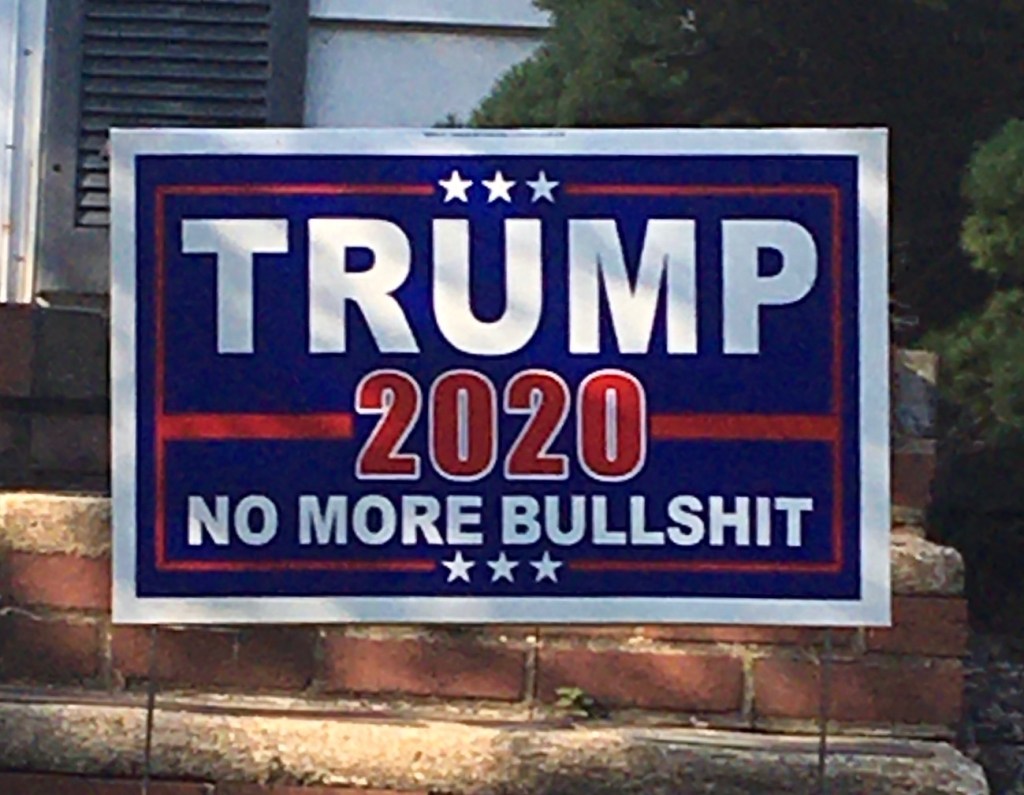
Whitehouse Ave., Whitehouse Station, New Jersey
Coronavirus Diary (20): “It’s Going to Be Just Fine.”
From a list of Donald Trump’s statements on the COVID-19 crisis:
Jan. 22: “We have it totally under control. It’s one person coming in from China. We have it under control. It’s going to be just fine.” — Trump in a CNBC interview.
Imagine All the People
When Hillary Clinton lost the 2016 presidential election, there were people out there who were absolutely certain that the explanation was sexism: the American people couldn’t (they insisted) handle the idea of a female president, and voted accordingly. You couldn’t get such people to consider the possibility that maybe Hillary Clinton lost the election because she was a complacent, uninspiring candidate. Continue reading
Giving the Devil His Due: Donald Trump and the Afghan War
I’m not a Satanist, but I do believe in fairness, so I don’t mind giving the Devil his due. The Devil in this case is Donald Trump, and his achievement is getting us out of Afghanistan. Or, well: signing a deal that if adhered-to, and if all goes well, will someday get us out of Afghanistan. I ended my 2008 review of Sarah Chayes’s The Punishment of Virtue: Inside Afghanistan After the Taliban like this:
To ‘keep trying’ to occupy and rebuild Afghanistan is to sacrifice lives and money on an ill-defined, increasingly pointless, and probably Sisyphean venture. A thousand lives and billions of dollars into that quest, we’re no closer to its completion than we were when we first started. That is as much a ‘punishment of virtue’ as anything Chayes describes. We’re entitled to ask when it will end.
We now have a better sense than we did a few days ago of “when it will end.” The answer is: some day. To paraphrase Metallica, the good news is that the light at the end of the tunnel may not be a freight train coming our way. Continue reading
 Policy of Truth