Complicity, Neutrality, Atrocity (4/5)

Rectificatory Justice and/vs. Business-as-Usual

This is part 4 of a five part series. For part 1, go here. For part 2, go here. For part 3, go here.

In part 2 of my post, “Complicity, Neutrality, Atrocity,” I discussed the common objection that activist demands for rectificatory justice like divestment are objectionable because they disrupt business-as-usual. As I say there, I don’t think disrupting business-as-usual is necessarily objectionable. If business-as-usual is sufficiently unjust, then a continuation of business-as-usual is just a perpetuation of some terrible injustice. We can reasonably argue about the threshold that must be crossed before it’s reasonable for an injustice to disrupt business as usual, or argue about the kind of causal contribution that a given institution has to make before it can be regarded as complicit in injustice. But absent such a discussion, pleas to continue business-as-usual should not strike anyone as persuasive. They should be regarded as rationalizations for moral complacency, and dismissed as such. Continue reading

Complicity, Neutrality, Atrocity (3/5)

Complicity, Exposure, and Activism

This is part 3 of a five part series. For part 1, go here. For part 2, go here.

At this point, the Stakeholders have criticized, the Institution has half-responded, and the Stakeholders have rebutted that half-response. What’s most likely to happen next is that because the Institution controls the terms of the debate, it will insist on a purely procedural discussion. The substantive issues are to be set aside as “too complex and controversial.” The issue of complicity is quickly to be submerged in a broth of procedural acids and left to corrode. The Institution, it will be repeated, must be governed in an orderly fashion—a fashion that just happens to give a systematic, unyielding presumption to stasis and the status quo, that places a nearly impossible burden of proof on anyone who seeks to change it, and that then describes doing so as a binding norm. Continue reading

Let Them Eat Each Other

A couple of weeks ago, I wrote a post here called “Academic Hiring and Genocide,” in which I argued that genocidaires should, at the very least, be excluded from academic life, but ideally should be excluded from gainful employment itself. Whatever anyone thought of the argument, readers might have wondered about its practical relevance. “So Khawaja’s calling for the on-campus cancellation of ‘genocidaires’. Interesting vendetta, but how many genocidaires are there, anyway? And how many are actively seeking employment right now, including academic employment?” The New York Times reports that the “Defense Department [Is] to Cut Over 5,000” workers due to the Musk-Trump rampage against the “Deep State.” Could I possibly have meant them? Take a wild guess. Continue reading

Complicity, Neutrality, Atrocity (2/5)

Stakeholders, Politicization, and Standing to Complain

This is part 2 of a five part series. For part 1, go here.

Background context: an institution accused of complicity in injustice counter-accuses its accusers of politicization and lack of standing.

Start with the politicization objection. The Stakeholders have two separate responses here. 

Responding to the politicization objection. First, they point out that it’s not clear that the politicization of a previously apolitical scene is necessarily objectionable. Productiveness, order, and justice are three separate values whose relative value is far from self-evident. Given this, it’s obviously not the case that the value of productiveness and order so outweigh justice as to trump it altogether. Continue reading

Complicity, Neutrality, Atrocity (1/5)

Complicity and the Strategy of Evasion

Imagine that an institution (“the Institution”) maintains a set of investments in various enterprises that make a clear and demonstrable contribution to some indisputable injustice. Now suppose that a set of stakeholders (“the Stakeholders”) objects to these investments, calling on the Institution to divulge the facts in a fuller way, and demanding divestment from the clearly objectionable investments.  Continue reading

Learn the Language

A friend of mine was unceremoniously fired from Felician University in 2023–one of sixteen people fired on a single day–after 23 unrelenting years as an English comp instructor to students with an average SAT verbal score well below 500. I described her in a letter of recommendation, without exaggeration, as “the most dedicated college instructor I had ever encountered” in two+ decades in the profession. Her office was across the hall from mine, and every now and then I’d eavesdrop on her efforts. I couldn’t imagine putting even half the effort into teaching that she did. Continue reading

Divestment at Yale

Well, they say it’s kinda frightenin’
How this younger generation swings
You know it’s more than just some new sensation
Well, the kid is into losin’ sleep
And he don’t come home for half the week
You know it’s more than just an aggravation

–Van Halen, “And the Cradle Will Rock…”

Yale Daily News, December 8:

Yale students overwhelmingly pass divestment referendum

The Yale College Council announced today that the student body has passed the divestment referendum by a large margin.

Continue reading

Divestment at Princeton

Princeton’s Silence Is Our Weapon

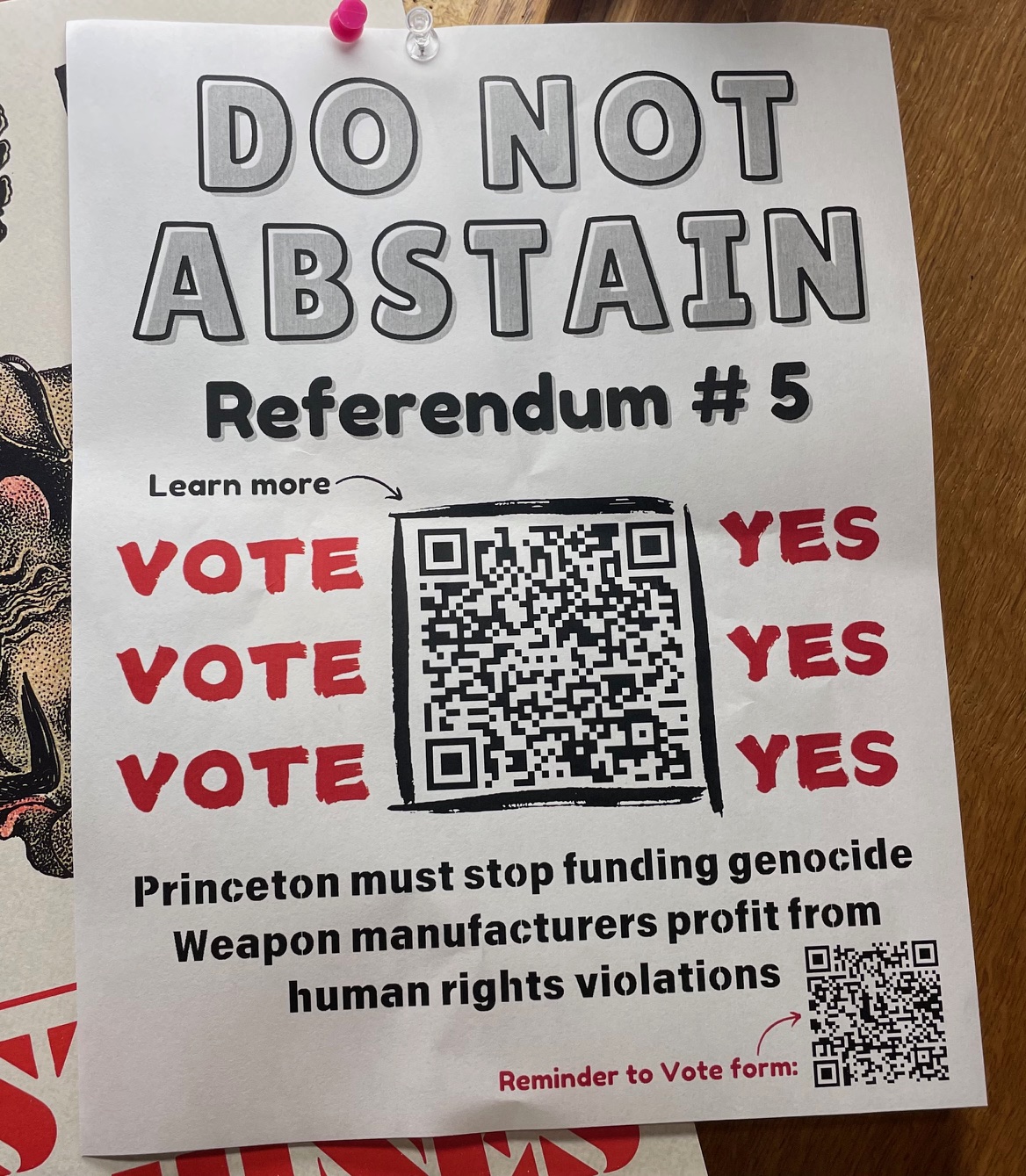
I’m happy to report that Princeton University’s undergraduate student Referendum #5 has passed by a margin of 68% to 32%. A referendum has to win at least 65% of the vote to pass, so this one did. The referendum calls on the University to disclose and divest all direct and indirect holdings in companies involved in weapons development, manufacturing, or trade, giving first priority to disclosing and divesting direct holdings in Boeing, Lockheed Martin, Northrop Grumman, RTX (formerly Raytheon), and General Dynamics, weapons manufacturers with documented ties to human rights violations. It also calls on the university to increase communication and accountability on socially responsible investments with the student body and campus community. Continue reading

Princeton University USG Referendum Question #5: Divest

Referendum Question #5 of Princeton University’s forthcoming Undergraduate Student Government elections. Scroll down (you may have to click “download”) for a PDF with the wording of the referendum. Kudos to these students for the work they’ve done on this. If only I could vote on it, but I’m 33 years too late.

donotabstain

Continue reading