
Quote of the Day

One of the tragic aspects of the emancipation of the serfs in Russia in 1861 was that while the serfs gained their personal freedom, the land – their means of production and of life, their land was retained under the ownership of their feudal masters. The land should have gone to the serfs themselves, for under the homestead principle they had tilled the land and deserved its title. Furthermore, the serfs were entitled to a host of reparations from their masters for the centuries of oppression and exploitation. The fact that the land remained in the hands of the lords paved the way inexorably for the Bolshevik Revolution, since the revolution that had freed the serfs remained unfinished.
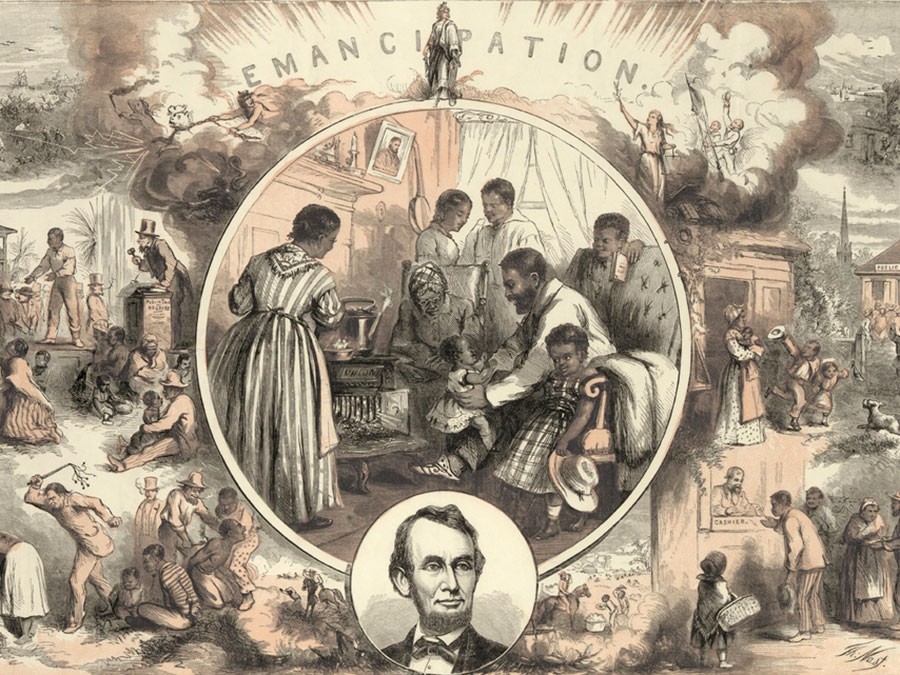
The same is true of the abolition of slavery in the United States. The slaves gained their freedom, it is true, but the land, the plantations that they had tilled and therefore deserved to own under the homestead principle, remained in the hands of their former masters. Furthermore, no reparations were granted the slaves for their oppression out of the hides of their masters. Hence the abolition of slavery remained unfinished, and the seeds of a new revolt have remained to intensify to the present day. Hence, the great importance of the shift in Negro demands from greater welfare handouts to “reparations”, reparations for the years of slavery and exploitation and for the failure to grant the Negroes their land, the failure to heed the Radical abolitionist’s call for “40 acres and a mule” to the former slaves. In many cases, moreover, the old plantations and the heirs and descendants of the former slaves can be identified, and the reparations can become highly specific indeed.
Anarchy in Philadelphia

The Molinari Society will be holding its mostly-annual Eastern Symposium in conjunction with the Eastern Division of the American Philosophical Association in Philadelphia, 8-11 January 2020. Here’s the schedule info:
Molinari Society symposium:
New Work in Libertarian and Anarchist Thought
G5E. Thursday, 9 January 2020, 9:00 a.m.-12:00 noon, Philadelphia 201 Hotel, 201 N. 17th St., Philadelphia PA 19103, room TBA.
chair:
Roderick T. Long (Auburn University)
presenters:
Zachary Woodman (Western Michigan University), “The Implications of Philosophical Anarchism for National Identity”
Jason Lee Byas (University of Michigan), “What Is Violence?”
William Nava (New York University), “The Causal Case Against Contributing to Public Goods”
Roderick T. Long (Auburn University), “Ayn Rand’s ‘New’ (Posthumous) Critique of Anarchism: A Counter-Critique”
Just Say Yes: Tulsi Gabbard on Impeachment
Well, my fan-boy crusade for Tulsi Gabbard’s presidential campaign has come to grief on the shoals of her abstention on impeachment last night. Her decision to abstain strikes me as a serious mistake: it had no clear legal or constitutional justification, and simply managed to alienate the base that’s supported her so far. I get the rationale, but it seems a bridge too far to a political right that’s essentially lost its way and lost its mind. I still have great respect and admiration for Gabbard, and still intend to post the fourth installment of my series on “Tulsi Gabbard vs. Liberal McCarthyism” (haven’t changed my mind on that, and don’t agree with the accusations of “cowardice” that have been leveled against her for this decision),* but the fan-boy crush, alas, has ended. Continue reading
He Could Do No Other
In case you hadn’t figured this out, I’m grading final papers–tonight’s harvest being applied ethics. After spending the day making fun of my applied ethics students on Facebook, I turn at last to the final paper of the evening, a dense, single-spaced essay written by a transfer student. The author starts by telling me that while he found my course very interesting, applied ethics just isn’t his thing–and then proceeds to write a sophisticated, cogent, but totally off-topic paper on the problem of evil, written from “a Protestant Christian worldview.”

Now what?
I Get Ink
A good thing just arrived by mail – a first edition of Francis Dashwood Tandy’s 1896 free-market anarchist classic Voluntary Socialism, autographed by the author. And for only $25! Usually those go for over $400, even if not autographed. I’ve grossly exploited some online bookseller, and I’m fine with that.
That Zola Commercial
Here it is:
As you’ve probably gathered, the Hallmark Channel pulled this ad because the couple’s kissing–at their own wedding–supposedly violated Hallmark’s “policies on PDA.” Apart from the obvious hypocrisy and disingenuousness involved in invoking this excuse–what channel runs an ad that violates its own policies?–surely the question has to arise: why would any company adopt so idiotic a policy in the first place? Are articulable reasons involved, or just inarticulate fears? Continue reading
Notes on the Jersey City Shooting
I’ve held off on commenting on the recent anti-Semitic shooting in Jersey City, partly because I’m too overloaded with grading to comment intelligently, and partly because the facts are too sparse for comment. But confusions have already crept into mainstream reporting on the subject. Here is The New York Times. Continue reading
We Lit
Student arrives twenty minutes late to final exam. Khawaja looks up expectantly.
Khawaja (apologetically, as though the default procedure was to wait twenty minutes to start an exam): We already got started. You ready for this?
Student: I’m ready to bommmb this [laughs]. I didn’t study at all. At. All.
Khawaja: Did you at least get a good night’s sleep? It’s more important than studying.
Student: No.
Khawaja: Hmm.
Student: Yo, I met a rapper last night at a concert. It was lit.
Khawaja: You went to a concert last night?
Student: It was lit.
Khawaja (with forced cheer and strained smile): Hmmm.
Student: A’ight. You know, I don’t think I really want to go to law school any more [laughs uproariously].
Khawaja: Right, so here’s the test.
Another pedagogical win–aka, Socratic voyage of self-discovery–fall semester 2019, Felician University.
Distance from Khe Sanh to Kandahar: 0
Proof that people would rather die than ask simple questions of their so-called “superiors.” Theirs was not to reason why–and evidently still isn’t.
My view on Afghanistan, circa 2008, from a review of Sarah Chayes’s much-praised book, The Punishment of Virtue: Inside Afghanistan After the Taliban (2006).
A government policy cannot rest on an illogical, inarticulate sense of commitment, and cannot be premised on the quixotic thought that good intentions trump feasibility. But that is effectively what our Afghan policy rests on today. To ‘keep trying’ to occupy and rebuild Afghanistan is to sacrifice lives and money on an ill-defined, increasingly pointless, and probably Sisyphean venture. A thousand lives and billions of dollars into that quest, we’re no closer to its completion than when we were when we first started. That is as much a ‘punishment of virtue’ as anything Chayes describes. We’re entitled to ask when it will end.
 Policy of Truth