Colleagues, Tramps, and Thieves

A colleague of mine went to India over Christmas break, and gifted me a box of Indian sweets–laddu, barfi, and the like. I gluttonously consumed two-thirds of the box a few minutes after receiving the gift. I then put the box in the fridge of our faculty lounge, thinking I’d eat the rest the next day. I open the fridge just now, and it’s gone. And no, it can’t be a mistake. So yeah, it was stolen–as in theft, larceny, crime. It was in a distinctive gift box, and was virtually the only thing in the fridge. And it had to have been stolen by a faculty member, because the door to the lounge has a combination lock known (or presumably known) only to faculty. I guess Maintenance has access as well, but I simply don’t believe Maintenance would do something like this.

What manner of depravity is this? What kind of colleagues would steal a gift out of the faculty lounge–at a Franciscan school? Is nothing sacred?

The Girl Who Did Her Cause No Favors

I almost feel guilty saying this, but as yet, I have no strong view on climate change. I more or less defer to expert opinion on the subject, which as I understand it holds that the planet is on fire, that it’s our fault, and in consequence that we should shop less and recycle more. At least half of that message is music to my ears: I find shopping a bore, and often think the planet deserves to be burned down. The other half I find unobjectionable: it wouldn’t surprise me if the planet’s demise were our fault (given my estimation of the people who inhabit it), and at this point, I’ve been married often enough to have internalized recycling. So I’m down with the whole climate change agenda.

I’m less down with Greta Thunberg, whom I find problematic. Or rather, not with Greta the person, but Greta the media phenomenon. Unlike many of Greta’s critics (and yes, I’m going to call her that), I don’t dislike Greta the person. I like her. Not only do I like her, but I like the very things about her that her critics so intensely dislike. She’s a hectoring, fanatical, self-righteous prig. A kindred spirit, in short. Continue reading

War with Iran (14): When Proxy Wars Attack

In an earlier post, I insisted that “our” war with Iran was not yet over. And it isn’t. You may have forgotten all about the war we started with them. But rest assured, they haven’t.

Exhibit A: Saturday’s missile attack on a government military base in Yemen. The New York Times, a bit behind the times in this case, lists the casualties as rising “to at least 76.” That was yesterday. Seven hours ago, it was 111. I’m guessing it’ll go up. Continue reading

My Crime Family Connections

I just got back from Brunswick GA for a Liberty Fund conference on Frank Knight. I’d never read much of Knight before beyond the risk vs. uncertainty stuff, but his methodological, ethical, and (though he wouldn’t have used the term) praxeological writings turn out to connect nicely with a number of my areas of concern: Plato and Aristotle, Frege and Wittgenstein, Collingwood and Winch, Mises and Hayek.

The conference was at the Jekyll Island Club on Old Plantation Road. It’s like a fusion of the sins of the Hamiltonian and Jeffersonian factions! (And given that Knight taught at Chicago, it seems appropriate that there’s a connection between Jekyll Island and Hyde Park.)

For photos of the venue, see my Facebook page.

Speaking of Jekyll Island: my grandfather Charles Roderick McKay (1873-1954), although he wasn’t at the famous Jekyll Island meeting, was one of the people involved in setting up the Federal Reserve; he worked with Paul Warburg et al.
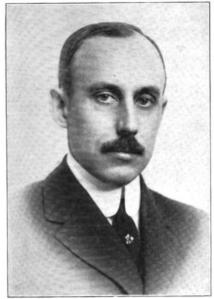
From a poverty-stricken childhood in Prince Edward Island, he became a runner for a bank while visiting Chicago relatives with his mother, and eventually worked his way up to the position of Transit Manager for the First National Bank of Chicago, in which position he developed the numerical check-clearing ABA system which would be adopted by the Fed. Once the Fed was established he became Deputy Governor of the Federal Reserve Bank of Chicago, though he was really more of a co-governor; when the various Fed Governors went to DC to meet with FDR, the Chicago gov was the only one who brought his deputy with him.

By way of partial mitigation of his role in the Fed, I note that when the central Fed began artificially lowering interest rates, which on the Austrian analysis was a major cause of the Great Depression, it was in large part thanks to my grandfather that the Chicago branch resisted the policy until finally overridden by the central; and in later retirement he felt betrayed by the direction the Fed had taken. (My grandfather’s economic and political views were broadly speaking “Old Right.” I never met him; he died a decade before I was born.)

I found his photo online in this periodical. From my mother’s stories I gather he was as much fun as he looks.
MLK: “Believe Women,” Rape, and the Worst-Case Scenario

Yesterday, I wrote a post arguing that the supposedly woke slogan “Believe Women” has some odd implications for the recent Sanders-Warren controversy. It implies that we should believe Elizabeth Warren’s accusation that Sanders is a sexist, or at least presume his guilt until he can conclusively prove his innocence. Because I take this consequence to be a reductio, I take “Believe Women” to be an absurdity. Put charitably, the original, unqualified version of the slogan has to be modified. Put uncharitably, it has to be rejected. To split the difference, it requires a bit of both. Continue reading

“Believe Women Except When…”

So whatever happened to the “Believe Women” mantra, brought to us care of #MeToo? Yesterday’s unqualified axiom seems to have been washed away by today’s intra-progressive controversy. The reasoning here seems to be: Elizabeth Warren accused Bernie Sanders of sexism. But Bernie is more progressive than Liz. So the accusation can’t possibly be true, because if it were true, its truth would ruin the most progressive mainstream candidate’s shot at the presidency. Hence the accusation must be false, and Elizabeth Warren is a bit of a bitch for making it. From which it follows that the “Believe Women” axiom must also be false, though we’re not to say so out loud.

Gee, that was easy. Who knew that moralized axioms could so lightly be adopted, and so lightly be cast aside?  Continue reading

Logistical Nightmare

It’s 4 am. I just woke up from the weirdest dream.

Dreamt that I’d wanted to go to Baghdad, so I’d booked a cheap flight via Dar-es-Salam, Tanzania, thinking to drive the rest of the way. But I’d somehow forgotten to book a rental, had underestimated the distance, and had forgotten about the problems posed by the existence of international borders and the Red Sea. As I belatedly made this realization, the cab showed up to take me to the airport–but I’d forgotten my flight information. So I went to my computer to refresh my memory, but inexplicably found myself in a public Internet cafe in Manhattan, able to remember but unable to type my password. When the guy next to me asked what was wrong, I explained the problem to him by bursting into tears, and then spelled my password out to everyone within hearing. Continue reading

Goodbye, Neil Peart

[A guest post by my younger brother, Suleman Khawaja.]

I can still remember being six years old, sitting on the asphalt basketball court behind St. Joseph’s church, tagging along with my older brother and the other neighborhood 12-year olds, trying hard not to be so conspicuously small. A hushed anticipation fell over the churchyard. I can still hear the ephemeral bumps and clicks as the tape unspooled in the little boom box, the sonic artifacts of fingers pressing Record and Play on someone’s Dad’s hi-fi, the click of the needle touching down on vinyl. “This is it, man!” The LP-to-cassette knock-off of Moving Pictures cued to launch the opening burst of “Tom Sawyer” into the air of North Jersey suburbia.

1981. West Orange, New Jersey. That’s the first time I heard Rush. The first time I ever heard of Neil Peart. One story among so many others. But mine.

Continue reading

War with Iran (12): Imminent Threats and Moral Blackmail

This abstract presents a slightly more formal, structured version of the argument I gave in the second installment in this series. Comments welcome.]

The Iran War of January 2020 (hereafter, “the War”) was widely justified by way of the following morally loaded question, addressed primarily to an American audience:

(Q1) If you had certain intelligence of an imminent threat to American lives, would you use military force to stop the person responsible for that threat?

Typically, an interlocutor hoping to defend the War would pose Q1, demand an unqualified “yes or no” answer to it, and take the “yes or no” to be an exclusive disjunction. Continue reading