Woke Conspiracies and Zionist Ones

People on the American Right sincerely seem to believe that “woke” ideology is so terrible and pervasive a phenomenon that it can be compared to a conspiratorial form of totalitarianism sweeping the country.

David Brooks, in The New York Times:

My friend Rod Dreher recently had a blog post for The American Conservative called “Why Are Conservatives in Despair?” He explained that conservatives are in despair because a hostile ideology — wokeness or social justice or critical race theory — is sweeping across America the way Bolshevism swept across the Russian Empire before the October Revolution in 1917.

Continue reading

A Welcome Tension: AOC, the Democrats, and Palestine

So it looks like decades of activism are finally, very gradually, starting to pay off in the form of polarization within the Democratic Party over Israel and Palestine. This didn’t happen by activists’ genuflecting before the prevarications and dogmatism of the mindlessly pro-Israel wing of the party, including Joe Biden. It happened through open, unapologetic confrontation.

Continue reading

Tomfoolery in the Overhead Compartment

The Agoric Cafe is serving once again!

In my latest video, I chat with globetrotting, gunslinging, contraband-smuggling libertarian scholar Tom G. Palmer on the legitimacy of self-defense; the militarisation of police; prison abolitionism; the wars on drugs, guns, and gays; the economics and ethics of bounty hunting; the French liberal demystification of the state; lawlessness vs. anarchy; the perversities of the FDA and CDC; Afghan libertarianism; hatred as a treacherous muse; how to sneak a photocopy machine into the Soviet bloc; and the height of the sky.

GoFundMe Request: Tanya O’Malley

I wanted to share this GoFundMe request, a fundraiser for the equivalent of a scholarship for a young woman named Tanya O’Malley.

I met Tanya on a flight home from Rome back in 2016, after I’d spent the summer in Palestine, and she’d spent hers in Italy. We were total strangers to one another, mere seatmates on a nine-hour flight.

Instead of ignoring each other, or sleeping through the flight, we had an intense nine hour conversation…about education! And she initiated it, not me. She was at the time a 17-year-old high school student, and I was a 47-year-old college professor, but our thirty-year age difference melted away in nine hours (sooner, really). We became friends, and remain friends five years later.

Continue reading

Character-Based Voting Revisited Yet Again

Readers of this blog know of my obsession with the topic of character-based voting. Suppose that we accept some workable distinction between matters of character and matters of policy with respect to politicians and political candidates, each a potential consideration for or against their continued stay in office or their candidacy.* What role should judgments of character play? Is it ever justifiable to vote for or against a candidate (or support or remove a sitting candidate) on grounds of character abstracted from considerations of policy? Clearest version of the question: can a person’s moral character ever be bad enough to disqualify him or her from office independently of anything we know about their views on policy, or even in defiance of the knowledge that they have the “right” views on policy?

Continue reading

The Life She Saved

I was cleaning out some computer files when I came across the folder from my old Felician University office laptop containing all (or most) of my student letters of recommendation. On a lark, I decided to look some of my former students up. Some might call this “stalking”; I call it Pedagogical Outcomes Analysis.

Here’s one of them, an RN-to-BSN student for whom I wrote a letter back in 2010, when she was applying for a position as a school nurse. I’m pleased to say that she got that position, and then some:

Continue reading

The Ontology of Everyday Life (1)

Well, “everyday” for me. Yes, believe it or not, this is the first installment in yet another one of my series that never quite sees completion. I have no idea how, or if, this one ends, but it was inspired (or counter-inspired) by a footnote on the definition of “table” in Michael Huemer’s Ethical Intutionism (p. 280, footnote 6, keyed to text in chapter 8, around p. 201). Huemer is not responsible for my wholesale rejection of his views on this matter. But I’ll get to that disagreement in a future installment. This post is mere philosophical groundclearing for the construction of that forthcoming “promenade among the grandeurs of the mind.”*

Continue reading

Those Riots in Jerusalem, Tho

It’s that time of year again: warm weather is back, so it’s time for rioting in Jerusalem–also time for American journalists to write the usual uninformative stuff designed to mislead their audiences without coming out and writing literal falsehoods. This piece in The New York Times about recent riots in Jerusalem is a case in point, as informative for what it doesn’t say, and for the questions it fails to ask, as for any information it conveys.

My aim here is not to pick it apart. I’m in Jersey rather than Jerusalem right now, so there’s no way for me literally to contest the claims it makes. Nor is there any particular reason to do so. But having watched American correspondents misrepresent the Al Aqsa riots of 2017 while I was there, and then misrepresent the January 2019 anti-Orban demonstrations in Budapest when I was there, I’ve at least come to develop a sense of what questions to ask of any American news item purporting to describe such an event.

Continue reading

The ABC’s of Occupation Redux

Casually-asserted aside in an article on Israel’s vaccination program and its effect on the Palestinians:

The Palestine Authority governs the semiautonomous West Bank…

This is PBS, no less–Flat Earth political geography of a kind that makes no pretense of accuracy or even minimal coherence. How can a “semiautonomous” territory be governed at all? What does “semiautonomous” even mean? Is it a legitimate synonym for “under (military) occupation,” which is how the United Nations and most human rights organizations characterize the West Bank and Gaza? Doesn’t seem like it could be. No, what we’re dealing with is outright nonsense, doublespeak worth of Orwell’s 1984, but presented to the American public as uncontroversial fact, and as the basis of PBS’s reporting on the subject.

Continue reading

Why They Wrote Such Good Books

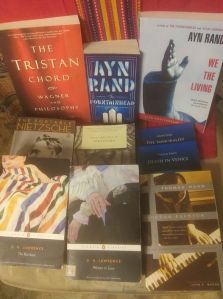
I’ve just finished up my seminar (the teaching portion, not the grading portion – oh, not remotely the grading portion!) on Nietzsche and Modern Literature, where along with various readings from Nietzsche we also read works by Thomas Mann, André Gide, D. H. Lawrence, and Ayn Rand. I created an “audiovisual companion” website for the course to illustrate the various people, places, and works of art and music that are discussed by all five authors; and I’m posting the link to it here in case my broader readership is also interested.

As many of my readers are likely to have a particular interest in Rand, I’ll note that the pages where I discuss Rand are Weeks 9-14. See the four “horse tamer” statues that Rand describes at the beginning of Part II of We the Living! Hear the “John Gray” song (misidentified by Michael Berliner) that pervaded the streets of Kira’s Petrograd! See the theatres that Kira attended with Andrei, and the restaurant where they ate! Hear clips from the Kálmán operetta that inspired her, and the swingtime version of Wagner’s “Evening Star” that Gail Wynand suffered through during his late-night walk through the streets of New York! See the real-life models for Leo Kovalensky, Essie Twomey, Ellsworth Toohey, Lois Cook, Lancelot Clokey, Dominique Francon, Henry Cameron, Ralston Holcombe, and Austen Heller – as well as the real-life models for the buildings of Roark and Cameron, the coffee shop where Peter says goodbye to Katie, and much much more!

And check out similar sights and sounds for the works of Mann (Weeks 1-4), Gide (Weeks 4-5), Lawrence (Weeks 5-9), and of course Nietzsche (passim).