The Schwartz Theory of Basic Values and Some Implications for Political Philosophy

The study of basic human values by psychologists is not new. Probably the best-known theory of basic values in psychology is Abraham Maslow’s “hierarchy of needs,” which dates from the early 1940s. But the psychological study of values has been growing, in both volume and empirical quality of research, and philosophers interested in ethics ought to know something about it.

Unfortunately, growing though it may be, the psychological study of values is nevertheless not in a particularly advanced state of development. Accordingly, there are multiple, conflicting theories of human values (and corresponding virtues) in the psychological literature. A sampling that I spent just a few minutes pulling together is: Braithwaite and Law (1985), Cawley, Martin, and Johnson (2000), Crosby, Bitner, and Gill (1990), Feather and Peay (1975), Hofstede (1980), Maloney and Katz (1976), Peterson and Seligman (2004), Rokeach (1973), Schwartz (1994, 2012), and Wicker et al. (1984). My impression is that on the one hand there is considerable loose agreement in the results of these studies, but on the other hand the agreement is indeed loose, and there are significant differences between theories, especially when it comes to the conceptualization of the results.

I myself am not well enough acquainted with this research to comment on these differences. What I want to do in this post is just describe the one of these theories that seems to me to be the most serious, ambitious, well-developed, and well-supported, namely the “Schwartz theory of basic values,” due to Shalom Schwartz (1994, 2012). At the end I will briefly discuss some implications of Schwartz’s theory for political philosophy.

By “values” we refer to beliefs concerning what situations and actions are desirable. However, values for Schwartz are not attitudes toward particular situations or actions, like having a chicken dinner right now or having $20K in my bank account. He restricts the term “value” to broad motivational goals. Schwartz sees values as stable standards by which we evaluate everything else, including the appropriateness of any norms, attitudes, traits, or virtues that may be suggested to us. It is also characteristic of values that some are more important than others. Multiple values are normally implicated in any proposed action, for better or worse, and the all-things-considered evaluation of an action will depend on the relative importance of the competing values it implicates.

Schwartz reasoned that since values are motivational goals, basic human values might be derived by considering the most basic needs of human beings, which he divides into three fundamental categories: our biological needs as individuals, our need to coordinate our actions with others, and the need of groups to survive and flourish. By considering these needs more or less a priori, Schwartz derived the following set of ten basic values. Each basic value is described in terms of its motivational goal. A set of more specific values that express the basic value is given in parentheses after each description.

  1. Benevolence: Preservation and enhancement of the people with whom one is in frequent personal contact [meaning especially family]. (helpful, honest, forgiving, responsible, true friendship, mature love)
  2. Universalism: Understanding, appreciation, tolerance, and protection for the welfare of all people and for nature. (broadminded, social justice, equality, world at peace, world of beauty, unity with nature, wisdom, protecting the environment)
  3. Self-Direction: Independent thought and action—choosing, creating, exploring. (creativity, freedom, choosing own goals, curious, independent)
  4. Security: Safety, harmony, and stability of society, of relationships, and of self. (social order, family security, national security, clean, reciprocation of favors, healthy, sense of belonging)
  5. Conformity: Restraint of actions, inclinations, and impulses likely to upset or harm others and violate expectations or norms. (obedient, self-discipline, politeness, honoring parents and elders)
  6. Hedonism: Pleasure or sensuous gratification for oneself. (pleasure, enjoying life, self-indulgent)
  7. Achievement: Personal success through demonstrating competence according to social standards. (ambitious, successful, capable, influential)
  8. Tradition: Respect, commitment, and acceptance of the customs and ideas that one’s culture or religion provides. (respect for tradition, humble, devout, accepting my portion in life)
  9. Stimulation: Excitement, novelty, and challenge in life. (a varied life, an exciting life, daring)
  10. Power: Social status and prestige, control or dominance over people and resources. (authority, wealth, social power, social recognition, preserving my public image)

Some of the more specific values may seem a little odd (why is reciprocation of favors an expression of security?), but they have been empirically confirmed to express the basic values they were postulated to express. The sort of empirical testing that Schwartz’s theory has undergone is illustrated by the figure below, which shows the result of a type of multidimensional scaling analysis called Simple Space Analysis.

Schwartz values map big 2

The figure was created as follows. A questionnaire was prepared that asked participants to rate the importance to themselves of each of the specific values in the figure on a 9-point scale ranging from 7 to –1, where 7 indicates supreme importance, 0 indicates no importance, and –1 indicates that the participant regards the item as opposed to his own values. The questionnaire was administered to thousands of participants worldwide. For instance, the study reported in Schwartz (1994) included 97 samples in 44 countries from every inhabited continent, for a total of 25,863 participants. Most of the participants in Schwartz (1994) were evenly split between public school teachers and university students, but about 15% were occupationally heterogeneous adults (or, in the case of two samples, teenagers). The ratings were averaged across all participants and then intercorrelated. A Simple Space Analysis then arranged the average ratings in a 2-dimensional space in the way that best represents their intercorrelations as distances, so that points close together in the space are highly positively correlated and points far from each other are highly negatively correlated. The resulting space was then examined to see if the specific values clustered together in groups corresponding to the 10 basic values. Since they did indeed cluster in the predicted way, partition lines were drawn through the space to mark the basic values.

The fit between theory and data observed in the diagram is impressive. This type of study has been replicated many times in the years since Schwartz first presented his theory. The (1994) study is itself a replication and extension of work first presented in 1992. Other instruments have been used to measure basic values besides direct ratings, and specific values than those presented here have been tested. The spaces produced by Simple Space Analysis have been examined by independent raters looking for clusters that might imply basic values other than Schwartz’s ten. But alternative basic values have failed to emerge.

Note that Schwartz’s strategy of postulating a structure of values derived from basic human motivational goals and then testing it empirically differs from other strategies that have been used, such as the lexical strategy of gathering all the value terms to be found in the dictionary and eliminating redundancies and the cross-classification strategy of gathering lists of basic values from multiple traditions and cultures and looking for commonalities. Cawley et al. (2000) used the lexical strategy, which is also the basis of nearly all work in personality psychology. Peterson and Seligman (2004) exemplify the cross-classification strategy. Each strategy has certain merits, obviously, but the Schwartz approach seems to me to have an advantage in being grounded in the functional role of values as motivational goals rather than in the way people (lexical strategy) or intellectuals (cross-classification strategy) happen to talk. The randomness of the lexical strategy in particular seems unfortunate and may have something to do with why it took so many decades for a dominant theory of personality to finally emerge.

Schwartz originally postulated an 11th basic value, spirituality, encompassing specific values such as a spiritual life, meaning in life, inner harmony, and detachment, but it was dropped from the system due to failure to find cross-cultural validation for it. In other words, it didn’t pass empirical muster as a basic, universal human value. Schwartz (1994) speculates that this may be because spirituality is not clearly related to any of the three fundamental categories of basic human needs identified above. Those categories all depend on human functional needs. It may be that spirituality values are not functionally driven.

Notice that happiness is not represented on Schwartz’s list, either of basic or specific values. This is deliberate. Schwartz sees happiness as the result of attaining one’s values.

Notice also that there are specific values on the chart, such as self-respect and moderation, that are not listed along with any basic value in the basic values list. This is because they are associated with more than one basic value (self-respect with both self-direction and achievement, moderation with both tradition and security). They satisfy elements of the motivational goals of more than one basic value. They therefore tend to sit on the borderline between basic values and to be associated more or less closely with their basic values in different empirical studies.

This brings us to another important part of the Schwartz theory, which is that the basic values do not form a loose and unrelated collection but are systematically connected. The connections are expected and predicted by the theory. They have two sources. First, they result from overlap between motivational goals. For example, in an obvious way both power and achievement involve social superiority and esteem. Achievement and hedonism both involve self-centered satisfaction. Hedonism and stimulation both involve desire for affectively pleasant arousal. And so on. I won’t go through all the pie slices in Schwartz’s diagram, since most of the connections are pretty obvious. (The two papers I’ve cited give all the details for anyone who wants them.) Note that conformity and tradition were originally predicted by the theory to be ordinary adjacent pie slices like the others. But that is not the way things worked out empirically, hence their configuration as a split slice.

Second, the basic human motivational goals represent different and sometimes competing or conflicting interests. Thus, the pursuit of one basic value may often conflict with the pursuit of another. For example, the pursuit of personal power or achievement will conflict with the pursuit of universalist values like equality. People who value both must prioritize and often find separate activities by which to pursue each.

Thus, Schwartz’s ten basic values form a continuous, closed circle. Basic values that are adjacent in the circle have overlapping motivational goals and are mutually supporting, whereas basic values on opposite sides of the circle have competing goals and are mutually opposed. Moreover, the circle has a 2-dimensional opponent structure. One dimension contrasts basic values of self-enhancement (achievement and power) with basic values of self-transcendence (universalism and benevolence). The other contrasts basic values of openness to change (self-direction and stimulation) with basic values of conservation (conformity, tradition, and security). Note that hedonism is positively associated with both self-enhancement and openness to change. The diagram below is a schematic version of the one above that makes explicit the two opponent dimensions and the circular structure of adjacency between the basic values.

Schwartz circular model of basic values color

The 2-dimensional opponent structure of the circle is yet another prediction of the theory. So it is additional confirmation of the theory that the predicted dimensions show up in the diagram produced by the Simple Space Analysis and that a 2-dimensional SSA does the best job of modeling the data. (At least, I assume Schwartz tried SSA models with more than two dimensions. He does not explicitly say.)

Note that openness to change and self-enhancement both focus on the personal side of life, while conservation and self-transcendence focus the interests of others and one’s relation to society. So the left side of the diagram represents values with a personal focus and the right side represents values with a social focus. Again, conservation and self-enhancement both express anxiety-driven motivations, to secure oneself against loss, gain power to overcome threats, maintain the current order, and so on. By contrast, openness to change and self-transcendence both express anxiety-free motivations of growth and expansion. So the top of the diagram represents anxiety-free values, and the bottom represents anxiety-based values.

There is one final aspect of the theory that should be mentioned. Although values obviously differ widely in importance between individuals, Schwartz found, remarkably, that when individual ratings of basic values are averaged over all the members of a society, the priority order that results is more or less the same in all societies. The basic values were listed above in their order of cross-cultural priority (highest listed first): benevolence, universalism, self-direction, security, conformity, hedonism, achievement, tradition, stimulation, and power. That is, in most societies benevolence is the most prized basic value, and power is the least. The ranking is curious, and I would be inclined to pay it little attention if it weren’t strongly supported empirically. It is striking that only one personal value (self-direction) is in the top half of the order. This may reflect a universal tendency for socialization processes to emphasize pro-social values. Schwartz (2012) spends some time speculating about why the values are ranked the way they are. For instance, he takes the primacy of benevolence to reflect the central role of the family in a person’s cooperative relations, social connections, and development of all further values. Recall that in Schwartz’s system, benevolence is based on local, personal relationships—this is the key point of difference between benevolence and universality. Thus benevolence ranks highest, and is higher than universality despite universality’s plausible claim to be the pro-social value par excellence, because local and family relations are fundamental and generally trump relations with strangers and out-group members.

To summarize, the Schwartz theory of basic values seeks to identify a core set of basic human values grounded in the motivational goals inherent in (1) our individual, biological needs, (2) our need for smooth coordination and cooperation with others, and (3) the need of groups of people to survive and grow as groups. The system of 10 basic values derived from these goals forms a continuum arranged in a closed circle as in the above diagrams. The space within the circle contains specific values that express various aspects of the basic values that subsume them. Proximity in the space indicates closeness of values in terms of their motivational goals. Proximity to the perimeter indicates strength of commitment to the relevant basic value. Moreover, the basic values themselves are subsumed by four master values arranged on two opponent dimensions: self-enhancement vs. self-transcendence and openness to change vs. conservation. Because of the opponent structure of the dimensions, values on opposite sides of the center of the space will tend to compete with each other for priority. The theory claims that the set of ten basic values and their structural relations are universal. That is, although individuals may differ in their particular value priorities, the basic values and their structural relations are common coin among all humanity in all cultures. The theory has not only intuitive and theoretical plausibility but a very impressive record of empirical support gathered in dozens of studies using multiple measures and employing tens of thousands of participants worldwide.

I promised to conclude by saying something about the implications of all this for political philosophy. Political philosophy commonly arranges political views along a dimension with endpoints designated “left” and “right,” where the defining feature of this dimension is an opponent contrast between equality on the left and hierarchy on the right. If you read a thinker like Allan Bloom, for example, you will get this stark opposition repeatedly (see for instance Bloom 1987). And this dimension admittedly does a powerful job of organizing diverse political positions and explaining many of their similarities and differences. It illuminates many of the differences between American liberals and conservatives, for example, as well as the many social movements in favor of democracy, income equality, racial equality, sexual equality, etc. that became ascendant in the West in the later 18th century and have intensified and spread across the world ever since. But it is irksome to libertarians, who are inclined to think that it treats as primary an issue—equality vs. hierarchy—that does not deserve that status. Libertarians would prefer to focus on an alternative issue, which might be captured by a dimension with endpoints designated “freedom” and “slavery,” or perhaps “individualism” and “collectivism.”

I suggest that the Schwartz theory of basic values can help us to understand this conflict between the libertarian way of analyzing political systems and the standard one. The suggestion, of course, is that the two political dimensions, equality vs. hierarchy and freedom vs. slavery, correspond to the Schwartz dimensions of self-transcendence vs. self-enhancement and openness to change vs. conservation. Concerning the dimension favored by standard political philosophy, equality is the nonpareil specific value of universalism (this is indicated by its position in the first diagram above), and in general the specific values that are grouped under universalism and benevolence (social justice, protect environment, world peace, forgiveness, broadminded, helpful) are suggestive of equalitarian politics. On the other side, the values of power and achievement, which cannot be equal (that is the point of valuing them) suggest a politics of rank. As for the dimension beloved of libertarians, freedom and independence are the premier specific values of self-direction, a basic value whose congruence with a politics of individual liberty couldn’t be more obvious. Other specific values grouped under self-direction and stimulation are among the most celebrated by libertarians: creativity, curious, choosing own goals, varied life, daring, exciting life. At the other end of this dimension, the conservation values of tradition, conformity, and security embody just the sort comfortable obedience and passivity that aligns with a politics that preaches the supremacy of group interests. The person who is at home in this region of the value space values obedience, the sense of belonging, health, social order, humility, self-discipline, moderation, security, and—most strongly, to judge from its position in the diagram—“accepting my portion in life.” Clearly, these are values that encourage political positions that promise safety and good order in the bosom of the group and maintenance of traditions.

Some implications of this analysis are the following. First, libertarians are right to complain that the freedom vs. slavery political dimension is at least as important as the equality vs. hierarchy dimension and that the freedom vs. slavery dimension has been wrongly neglected or ignored by standard political philosophy.

Second, it would be a good idea for partisans of either dimension to drop the habit of reductionism with regard to the other. That is, recognize the other dimension. Both dimensions are real and both are about equally important and illuminating, so do not treat your favored dimension as the only one that really matters.  Furthermore, stop trying to paint all your opponents with a single brush dipped in the color of the opposite end to yours of your favored dimension. The other dimension may be at least as great a source of disagreement. For example, just because someone does not place the same value on freedom that you do does not necessarily mean that his main political impulses are collectivistic. Those who emphasize equality, for example, often do so in part because they see it as essential to individual autonomy. (I believe this was Jean-Jacques Rousseau’s motivation.) They see any sort of draconian collectivistic consequences of the push for equality as incidental and avoidable. Whereas I think a typical libertarian view is to see emphasis on equality as mere cover for a deeper, collectivistic impulse. But that is quite wrong in many cases, if the present analysis is correct.

Third, no political philosophy that wants to have a chance of adequacy can afford to embrace one side of either dimension to the complete exclusion of the other. Equalitarians must make room for the inescapable values of self-enhancement (for details, see “Harrison Bergeron”), and libertarians must make room for the equally inescapable values of security and social order. (And don’t anybody comment to tell me about “spontaneous order.” I know all about it. The point is that not all desirable social order is spontaneous.)

Fourth and last, we should expect there to be no such thing as a pure libertarian or equalitarian (or conservative). Libertarianism stakes out a position on only one dimension. Every libertarian must be expected to have some orientation with respect to the other dimension as well, and so be either a “conservatarian” or “liberaltarian.”And of course, notoriously, this is exactly what we find. The same will be true of liberals and conservatives. Some should really care about freedom, others not. Since the two dimensions seem to be largely orthogonal, extreme devotion to one end of either dimension, freedom vs. slavery, equality vs. hierarchy, should be no help whatever in predicting what a person’s position will be with respect to the other dimension. We must take both dimensions with equal seriousness.


WORKS CITED

  • Bloom, Allan. 1987. The Closing of the American Mind. Simon and Schuster.
  • Braithwaite, V. A. and H. G. Law. 1985. “Structure of Human Values: Testing the Adequacy of the Rokeach Value Survey.” Journal of Personality and Social Psychology, 49: 250–263.
  • Cawley, M. J., J. E. Martin, and J. A. Johnson. 2000. “A Virtues Approach to Personality.” Personality and Individual Differences, 28: 997–1013.
  • Crosby, L. A., M. J. Bitner, and J. D. Gill. 1990. Organizational Structure of Values. Journal of Business Research, 20: 123–134.
  • Feather, N. T. and E. R. Peay. 1975. The Structure of Terminal and Instrumental Values: Dimensions and Clusters. Australian Journal of Psychology, 27: 151–164.
  • Hofstede, G. 1980. Culture’s Consequences: International Differences in Work-Related Values. Sage.
  • Maloney, J. and G. M. Katz. 1976. “Value Structures and Orientations to Social Institutions.” Journal of Psychology, 93: 203–211.
  • Peterson, Christopher, and Martin E. P. Seligman. 2004. Character Strengths and Virtues: A Handbook and Classification. Oxford University Press.
  • Rokeach, M. 1973. The Nature of Human Values. Free Press.
  • Schwartz, Shalom H. 1994. “Are There Universal Aspects in the Structure and Contents of Human Values?” Journal of Social Issues, 50: 19–45.
  • ———. 2012. “An Overview of the Schwartz Theory of Basic Values.” Online Readings in Psychology and Culture, 2(1). http://dx.doi.org/10.9707/2307-0919.1116
  • Wicker, F. W., F. B. Lambert, F. C. Richardson, and J. Kahler. 1984. “Categorical Goal Hierarchies and Classification of Human Motives.” Journal of Personality, 53: 285-305.

Postcards from the ER: “Safe Travels” from the Mideast to the Midwest and Beyond

I spent the last two months in the Occupied Palestinian Territories diligently looking for trouble. Strangely, despite my best efforts, I didn’t manage to find any.

I spent every Friday during Ramadan in the vicinity of Haram Sharif in the Old City, poised and ready for rock throwing and riots. There was some rock throwing and rioting at that very location, but I was never there when it happened. The one day they really decided to have a riot, I was home in Abu Dis, grading final exams for my political philosophy class.

Another tense Friday evening at Jaffa Gate.

Another tense Friday evening at Jaffa Gate.

According to the pro-Israeli blogger Elder of Ziyon, the Jerusalem light rail system is pelted with rocks by Palestinian youth “every single day.” I was in Jerusalem in the vicinity of the light rail twenty of the sixty or so days I was in the area, and didn’t see it get pelted even once. Didn’t hear of it being pelted once, either–and I had a friend in Shu’afat (the neighborhood, not the refugee camp) who rode it without incident every day for a month. Didn’t see any broken windows, any terrified commuters, or experience any anxiety while hanging around the rail stops at Jaffa Road and near Damascus Gate.  Just saw the light rail making its way from Mt. Herzl to Pisgat Zeev and back, over and over without incident.

As I’ve mentioned before, there was a stabbing at Damascus Gate one morning. I had planned to be at Damascus Gate that very morning, but got sidetracked by some paperwork that needed to get done, and never made it there. The stabbing took place without me.

On my way back from a visit to Hebron, my guide and I drove by clashes-that-were-about-to-take-place at this highly contested location near Al Arroub Refugee Camp. As we drove by, the Israeli soldiers were loading their weapons and the protesters were getting ready to engage. “I don’t think we should stop,” my guide said. So we didn’t.

I went through about thirty checkpoints. It was often a tedious and demoralizing experience, but it was mostly uneventful. No rock throwing, no terrorist attacks, no beatings. Only one arrest. That’s not to say that there were no checkpoint incidents while I was there. I just didn’t happen to be around for any. I went out to dinner with friends in Azariah immediately after the Duma attack. One friend floated the idea of driving to Jericho for dinner. “Maybe some other time,” said the other friend. Unsurprisingly, all hell broke loose that night across the West Bank. But things were calm enough in Azariah. We had a nice chicken dinner.

While in Abu Dis, I made contact with Daniel Luria of Ateret Cohanim, who invited me to tour the “Temple Mount” (Haram Sharif) with his group (Luria: “We don’t often get inquiries from Abu Dis”). Ateret Cohanim is a settler organization, and settlers who visit the Temple Mount/Haram Sharif are usually subject to harassment by Muslims who object to their presence there. I was all set to go, but had to cancel at the last minute because of a scheduling problem (once again, believe it or not, my plans to visit the holy site were trumped by the holier imperative of grading).

On my last day in Abu Dis, there were violent clashes between locals and the Israel Defense Forces. I heard the clashes from my window and decided to go out into the city to find them. Following my nose (tear gas) and ears (stun grenades) I set out in (what I took to be) the direction of the clashes. I spent an hour looking for trouble, but didn’t really manage to find it. When I finally got to the relevant location, all I found was an abandoned street where clashes had taken place, the residue of tear gas in the air, and a couple of still-burning fires.

Last time I went to Israel, I was detained for five hours on entry at Ben Gurion Airport, and for four hours on exit. This time, I was only detained for about two hours on entry, and for about half an hour on exit. In an attempt to be polite, the lady who gave me my exit permit gave it to me and tried to say, “You’re free to go.” What she actually ended up saying was, “Please go.” I didn’t know how to respond, so I said, “OK,” and left without incident.

Zipper_ride_at_night.jpg (3554×2395)

Terror from the Midwestern skies. 

So I got home to New Jersey, rested a day, and flew to Michigan to spend some time with Kate Herrick. On Thursday, Kate and I decided to go to the Ingham County Fair for some good, wholesome Midwestern fun. After eating some really unwholesome county fair food (“jalapeno poppers“), we decided to ride “The Zipper,” a vicious amusement park ride characteristic of Midwestern county fairs. Though strapped in at the waist, I didn’t realize that I was supposed to keep my arms outstretched in front of me to keep my head from being bashed against the steel sides of the car. Predictably, my head got bashed against the steel sides of the car, and I ended up in the ER with a concussion.

Aside from some headaches, cranial pressure, drowsiness, and mild loss of memory and cognitive function, I’m OK.

For months, people have asked me whether travel to the Mideast is “safe.”  I rest my case. If you want danger, try the Midwest.

Tomorrow, I’m off to Pine Ridge Indian Reservation for a kind of domestic follow-up to my trip to Palestine. As a friend of mine put it, “If Palestine is the Third World, get ready for the Fourth World.”

Yeah, yeah, I know: “safe travels.” Spare me.

Postscript: As Rod Stewart once put it, some guys have all the luck. Some guys do nothing but complain.

Postcards from Abu Dis (12): Boundaries, Borders, and Walls

Roderick Long and I have been having an extended conversation about boundaries, borders, and walls. Feel free to check it out and add your own two cents, whether here or there.

Abu Dis from Jerusalem, divided by separation wall

Abu Dis from Jerusalem, divided by separation wall

While you’re at it, check out Roderick’s series on the ancient Greeks and their legacy for libertarianism (unrelated to the preceding), which starts with a post on Homer’s treatment of Achilles and militarism.

Dome of the Rock and Western Wall from the Jewish Quarter

Dome of the Rock and Western Wall from the Jewish Quarter

This will be the last of my postcards from Abu Dis (though not, of course, the last post on what I learned while in Abu Dis). I’ll be traveling a lot over the next week or so, and will probably have to neglect the blog a bit, but within a week or so, I’m hoping to blog from Pine Ridge Indian Reservation in southern South Dakota (“Postcards from Pine Ridge”), where I’ll be following up on (analogues of) some of the issues I pursued in Israel/Palestine. Background on Pine Ridge here and here.

deheishe

Deheishe Refugee Camp, outside Bethlehem

Postcards from Abu Dis (11): Transcendental Questions, West Bank Edition

When you live in the West Bank, you get hyper-sensitive about license plates: yellow plates are Israeli, green plates are Palestinian; yellow plates can go anywhere in Israel or the West Bank (except, in theory, to parts of Area A); green plates are confined to designated parts of the West Bank (e.g., places reserved for the military or Israeli settlers).

I just saw a car on the main street of Eizariyah here in the West Bank (Area B) with Virginia license plates.

How is that possible? And for legal purposes, would it count as a yellow or a green plate?

I have no idea how to answer the first question, but here’s a guess at the second: if license plates follow passports, I’m guessing a Virginia license plate counts as yellow. As an American passport holder with a valid visa, I can go places in the West Bank that Palestinians can’t, including Israeli settlements and militarized zones designated off-limits to Palestinians (e.g., H2 in Hebron). If Virginia plates are treated as equivalent to an American passport (plus visa), the same would be true of them.

My speculation here rests, of course, on the debatable assumption that the presence of the car with the Virginia license plate is legal–an assumption confounded by the fact that the town of Eizariyah is effectively a Lockean State of Nature without laws or law enforcement of any discernible sort. The only “exception” to that rule is the presence of an Israeli military base on the outskirts of town, between Eizariyah and the settlement of Ma’ale Adumim. But it’s not really an exception at all: the Israeli military presence serves as militarized backdrop to life here; it isn’t here for purposes of everyday policing, much less to deal with traffic violations. It’s mostly here to intimidate Eizariyah and environs, and protect Ma’ale Adumim.

That said, unless someone bought a car here and just randomly stuck a Virginia license plate on it (odd but possible), to get it here, the owner would have to ship the car from Virginia to a border crossing controlled by the State of Israel. I can see why someone might want to do that; what I can’t see is why the State of Israel would allow it.

51094186.jpg (594×315)

That’s not the sort of Virginia plate I saw, but it does raise the question: if you can drive a car with Virginia plates in the West Bank, how about one with a plate like that? Granted, the State of Virginia has ordered that car owners with Stars and Bars license plates trade them in within about three months (120 days since the original ruling). But that still leaves time to ship one’s car here and drive it around for a few months as a test case. I’d love to see how that works, if only I could be around for it.

Aristotelian Egoism and the Ergon Argument

A few days ago, the latest issue of The Philosophical Review arrived (yes, I actually subscribe to the print edition), and I saw Anthony Skelton’s review of the third volume of Terence Irwin’s gargantuan The Development of Ethics. (The three volumes, published between 2007–2009, amount to some 2500 pages!) Although I was aware of the existence of these books, I knew nothing specific about their content. I was gratified to learn from Skelton’s review that one of Irwin’s major aims in these books is to make a historical exploration and defense of what he calls “Aristotelian naturalism,” the teleological, eudaimonist, realist view which “identifies virtue and happiness in a life that fulfills the nature and capacities of rational human nature” (Irwin 2007, 4). The Development of Ethics traces the fortunes of Aristotelian naturalism from its first articulation by Aristotle through 2300 years of philosophical dialectic. Since I would count myself as an Aristotelian naturalist, this makes Irwin’s project interesting to me (though where I would find the time to read a 2500 page work of philosophy I have no idea). I was struck by Skelton’s casual description of Aristotelian naturalism as a form of egoism (2015, 280). I would agree that it is, but I think of this assessment as being at least somewhat controversial. Bernard Williams in Ethics and the Limits of Philosophy, for example, insists that Aristotle is no egoist. I don’t find Williams’s comments persuasive, but the point is that the question is arguable. All this started me thinking about Aristotelian egoism and its rationale, and led me ultimately to a startling problem for Aristotelian egoism. The problem is startling, to me anyway, because I had thought that Aristotle’s fundamental argument for his conception of the human good is essentially egoistic and could not be otherwise. I have also long thought that no system of ethics can be anything but egoistic if it is to have a ghost of a chance of being true. To see such longstanding views seriously undermined is startling, but it is also refreshing and rewarding to clarify and deepen one’s understanding of one’s views. Let us see in what way Aristotle is an egoist, what his argument is for his view of the human good, and where I now see a problem for his egoistic conclusion. Egoism is the view that the only reason to do anything ultimately is to confer some benefit on the agent. This rules out, as reasons for action, such things as that God said, that your mother said, that it’s the law, that it’s just the right thing to do, and that it’s required by social norms or intuitions. That is, these are ruled out as ultimate reasons. The mere fact that your mother said you should do something is not a reason to do it, according to egoism. Of course, if you want to please your mother or if you want to avoid being punished by her or if you think she has good judgment and has your best interests at heart, then her say-so can become a reason indirectly. But then her say-so is not your ultimate reason for acting. By this standard, Aristotle is an egoist. Along with every other Greek philosopher so far as I can see, he simply takes for granted that one should act to promote one’s own good and has no other reason for acting. This shows up in his eudaimonism. After arguing in Book I of the Nicomachean Ethics that reasons for action are structured teleologically and all aim at a grand, final end, he declares that it is uncontroversial that the final end is happiness. It is clear that he means the personal happiness of each agent. The difficulty, he says, is to know precisely in what happiness consists, and he proceeds in the remainder of Book I—and really in the remainder of the NE—to develop his eudaimonistic conception of happiness. Of course, Aristotle is not one of those bad egoists like Epicurus who have trouble explaining why you shouldn’t lie, cheat, and steal. Again along with every other Greek philosopher—except Epicurus this time—Aristotle is a good egoist, the kind who doesn’t have this problem. He and they avoid it by including virtuous action as a constitutive element in happiness. You can’t be happy by lying, cheating, and stealing, because to do these things is already to wreck your happiness. What distinguishes Epicurus and his numerous modern successors is that they identify the human good with something other than virtue, something like pleasure or long life or physical well-being or desire satisfaction. Thus they make virtue only instrumentally good. Since the human good (the final end) is, say, pleasure, everything else is good only to the extent that it is useful for obtaining pleasure. As a result they have a problem explaining why one should still be virtuous even in circumstances where one could get more pleasure by being vicious. I believe it is because Aristotle is a good egoist that Williams doesn’t want to allow that he is an egoist at all. If so, I think this is misguided. Egoism should be defined in terms of what is fundamental to it—the primacy of self-interest—not by whether one has trouble explaining why we shouldn’t lie, cheat, and steal when we can do so to our advantage. How does Aristotle link virtue with personal benefit? How does he derive his conception of the human good? He does so by the famous ergon argument of Book I, chapter 7. Basically the argument is that whatever has a function (in Greek, ergon) thereby has standards of its good built in to the function. The function of a flute player is to play the flute; a good flute player is one who plays well. The function of the eye is to see; a good eye sees well. Now, if a human being per se also has a function, then we can similarly derive standards of what makes a good human being. Aristotle decides that the distinctive function of the human being is reason (since it is what most fundamentally distinguishes us from all other creatures) and accordingly that the human good lies in the excellent active employment of the rational faculty. This is all pretty abstract. As Aristotle proceeds, it develops that what he is recommending is that one live one’s life through the constant, excellent, active employment of reason, letting it penetrate all areas of conduct, not just overtly intellectual areas like learning and reasoning and deliberating, but areas having to do with the passions and emotions as well. Passions and emotions cannot easily be controlled directly, of course, but we can train ourselves by repetition and exercise to develop habitually appropriate emotional responses. This is the core idea of his theory of the character virtues, such as courage, moderation, liberality, and even temper. When a person has and exercises these character virtues as well as the intellectual virtues, he has everything: appropriate action comes naturally; it feels good to do the right things; right action leads as a rule to material success, health, and well-being, but even when it doesn’t the happy person is content with the path of decency that reason dictates; he is both admired by others and comfortable in his own skin; in a word, he flourishes. The details of Aristotle’s conception of the human good are less important than the structure of his basic argument for it: The good of a thing that has a function consists in its performing that function well; biological organisms are functionally organized; so their good is to function well. We ought in principle to be able to identify the good functioning of an organism empirically, by analyzing its functional organization and operation. At a gross level, the analysis is intuitive. We know pretty well without training how to spot a thriving flower or tree in the garden. Likewise in the case of our bodies, the concept of health is precisely of this functional, empirical sort. For Aristotelian naturalism, the flourishing of a good person is like the health of a good body. Obviously there are many objections that can be made to all this and many matters of detail to address. I am just outlining the basic ideas here, so I can get on with my problem. This is a blog. I don’t imagine I’m writing a treatise on Aristotelian naturalism. Though if anyone has a particular bone or two to pick with any of this, that could make for good discussion. But there is one issue I do need to mention, concerning the status of functions. They need to be real. For the good of a thing to be derivable from its function, there needs to be a function that it has. This is controversial. Since the work of Larry Wright and Rob Cummins in the mid-1970s, it has become legitimate to take functions with ontological seriousness, especially in biology. According to this view, when biologists say that the heart is for pumping the blood, the eye is for seeing, the wing is for flying, they and we can take it literally. There are scoffers. John Searle comes to mind. On the other hand, both Ruth Millikan’s and Fred Dretske’s theories of cognitive semantics are rooted in this idea, and they have not exactly been laughed off the stage. I propose not to worry too much about this. Whatever the exact ontological status of functions, our empirical investigation of them has substantial objective constraints; that is probably enough reality for the purposes of Aristotelian naturalism. One very helpful constraint in the case of biological functions comes from the Darwinian theory of natural selection. And here at last we come to the problem I see for Aristotle’s egoism. If a trait evolved because it brings about a certain result in the life of an organism, a result which would not exist without that trait, that is evidence that the trait has the function of bringing about the result. If the eye evolved—came to exist—because of the information about the distal environment it supplied to organisms, which they would not otherwise have had, that is evidence that the eye is for supplying information about the distal environment. Wright actually makes this criterial for something having a function. Cummins does not. Either way, it is at least evidence of functionality. Most traits evolve by enhancing the fitness of individual organisms. Of two primeval flatworms, the one with the proto-eye will on average survive and reproduce more than the one without. This is individual or within-group selection. Since the 1960s, it has been firmly believed to be the only kind. If you read Richard Dawkins, that is what he will tell you. But Darwin didn’t think so, and contemporary opinion is no longer so uniformly against it as it was in the 1970s and 1980s. In particular, it is beginning to be recognized that natural selection also operates at the level of groups. For this to happen, it is necessary that groups compete as groups. But this does happen. In the human case, for example, two tribes may fight over the same foraging territory. Which tribe will be more likely to win this fight, the tribe whose members exhibit solidarity and discipline or the tribe whose members are looking out for number one? Clearly when tribes are at war, it is better to be a member of the tribe whose members exhibit solidarity and discipline. To be a member of the other tribe is to be doomed to destruction no matter how personally big and strong and brave one is. Thus where group selection pressure is significant, traits like solidarity and discipline will spread through the population. The counterargument is that although it is better to belong to the group whose members exhibit solidarity and discipline than to belong to the group whose members don’t, what is still better is to be a free rider in the former group; that is, best of all is to be surrounded by tribe members who exhibit solidarity and discipline but not to exhibit these traits oneself. To be a member of a tribe full of heroes but to be careful to let one’s other fellow members be the heroes. But this isn’t really a counterargument. It is only a statement of an opposing selective force. Group selection pressure, such as tribal warfare, selects for pro-group traits like solidarity and discipline; individual selection pressure selects for selfish traits like abandoning one’s fellows when the going gets dangerous. Both are always operating, and each tends to drive out the other. If there are never any wars, then selfish traits will inexorably spread through the population by individual selection pressure in the way just described. But if wars are frequent, they will tend to be won by the group with the most robust pro-group membership, and pro-group traits will spread through the population at the expense of the selfish ones. Which process will predominate, group selection or individual selection, depends on conditions and can change with conditions. That’s all I will say about this interesting topic. To find out more, and for a thorough and convincing argument for the reality of group selection in case you’ve read Dawkins lately and don’t believe it, see two papers by David Sloan Wilson and Edward O. Wilson, “Rethinking the Theoretical Foundations of Sociobiology” (2007) and “Evolution ‘for the Good of the Group’” (2008). Henceforth let us accept for the sake of argument that group selection operated (and operates) in human evolution and that we have pro-group traits of some kind. It doesn’t really matter for my purposes what they are exactly. I suggested “solidarity” and “discipline” without defining them. Whatever the traits are, they will be ones that economists tell us are irrational, like tipping in restaurants and voting in political elections and punishing wrongdoers. (Need to be reminded why punishment is irrational? Suppose you have been assaulted by some random person you are unlikely ever to meet again. Then the harm is done and will not be undone by having the malefactor spend time in jail. True, if he commits assault and gets away with it, he’ll be encouraged to do it again. But almost certainly not to you, so you have no interest in discouraging him. The rational thing is to save your time and effort: forget it and let his next act of aggression be someone else’s problem.) I hope the problem with Aristotelian egoism is now coming clear. The ergon argument says the good consists in functioning well. This means that our functions as human beings, whatever they are, set the terms of what makes us good human beings. This argument is safe as long as its conclusion is restricted to what makes us good. This is simply the logic that says if the function of a flute player is to play the flute, a good flute player is one who plays the flute well. The trouble is that, as the argument is employed, it goes further. It draws conclusions about what makes us happy. About what makes for our well-being. About what is good for us. From the putative fact that we have the function of reasoning, it is concluded that a good human being reasons well. That is the safe part. But it is also concluded that it is good for a human being to reason well. This assumes that what makes us good instances of our kind is also good for us. But for creatures with pro-group traits, this is not necessarily true. The honey bee that stings an invader and thereby kills itself is being a good honey bee. (“Do be a do-bee.” Sorry, I couldn’t help it.) But its action is not good for it! It costs it its life. That is the nature of pro-group traits; they are good for the group, not the individual. Aristotelian naturalism takes for granted an individualistic metaphysics of human beings that group selection theory implies is false. If it were true, then we could indeed conclude from the fact that something makes one a good human being that it is good for one. This is the implicit premise of eudaimonism: that to be a good human being is to thrive, to flourish, to be happy, to function well as an individual. But with pro-group traits, this is not necessarily any truer of human beings than it is of honey bees. Time to wrap up. As should be clear, I don’t see the ergon argument as the problem. I believe it is sound. The problem is that an unstated assumption of metaphysical individualism—the assumption that all our human traits are pro-individual—led to the (as it turns out) unwarranted conclusion that the ergon argument supports eudaimonism. Well, largely it does, of course. We aren’t honey bees and don’t have particularly many pro-group traits. But I believe we have some, and they are important. To the extent we do, eudaimonism is false. More amazingly, egoism is false. We actually have a reason, in the ergon argument, to do something that does not benefit us. What I would say in all earnestness to a honey bee, if it could deliberate about its actions, is that the most important thing in life is to be a good honey bee. To be a scurrilous honey bee who lets some other worker sting the invader is to live a bad life as a honey bee. I hope there is something intuitive about this. To run away from the fight to save itself is to be a bad bee. I think that is objectively true. To the extent that we have pro-group traits, it turns out, to my astonishment, that it is true (in a much more limited way, of course) for us too. WORKS CITED

  • Cummins, Robert. 1975. “Functional Analysis.” Journal of Philosophy, 72: 741-764.
  • Irwin, Terence. 2007. The Development of Ethics: A Historical and Critical Study, Vol. 1, From Socrates to the Reformation. Oxford University Press.
  • Skelton, Anthony. 2015. “Review of Terence Irwin, The Development of Ethics: A Historical and Critical Study, Vol. 3, From Kant to Rawls, Oxford University Press, 2009.” The Philosophical Review, 124: 279–286.
  • Williams, Bernard. 1985. Ethic and the Limits of Philosophy. Harvard University Press.
  • Wilson, David Sloan and Edward O. Wilson. 2007. “Rethinking the Theoretical Foundations of Sociobiology.” The Quarterly Review of Biology, 82: 327–348.
  • ———. 2008. “Evolution ‘for the Good of the Group’.” American Scientist, 96: 380–389.
  • Wright, Larry. 1976. Teleological Explanations. University of California Press.

Warehouses, Theft, and Starvation

I got a chuckle out of this post at Bleeding Heart Libertarians. Jason Brennan is justifiably annoyed at the facile view expressed by this graphic:

1374238_784568528277580_3220370305162781028_n.jpg (627×405)

I meant to blog this issue last year, but didn’t get the chance: As readers of PoT know, last August, I did some volunteer work in Nicaragua with a colleague of mine from Felician, along with students from his class on global capitalism. While there, we spent a day building wheelchairs at the facilities of the American Nicaragua Foundation, a charitable organization outside Managua. Words are inadequate to convey the admiration I have for the people who work there.

One of the things that impressed me while there were ANF’s gigantic warehouses filled with food and other goods, intended for distribution to the poor. I took some photos of the warehouses, but never uploaded them to the PoT site, so they’re still sitting on a Sandisk back home in New Jersey. When I get a chance, I’ll upload a shot here, but meantime, just click the ANF link, and you can see a few photos of them there. They’re big–bigger than the average American supermarket. And ANF had several of them at that location alone.

Another thing that impressed me was that ANF’s warehouses were, one and all, guarded by armed guards fully prepared to shoot anyone, rich or poor, who tried to muscle his way into the warehouses and loot their contents. In addition, ANF’s grounds were surrounded by fences with barbed wire. Sometimes, good fences really do make good neighbors, even if you have to throw some barbed wire into the mix.

It’s no secret that Nicaragua is a democratic socialist country ruled by a former Marxist junta, the Sandinista National Liberation Front (FSLN). News flash: even there, theft is illegal, stealing food is against the law, and you can let someone–maybe lots of people–starve to death while you own a warehouse full of food. You can do all of that with a clean conscience, because while generosity is a virtue, and charity is an instance of it, neither the virtue nor the activity imply that benefactors are rightless beings. After all, if benefactors were rightless, beneficiaries would be equally so, since both sets of entities are human beings. Even the Sandinistas know that (or have figured it out), despite the fact that they view ANF’s activities with some suspicion and discomfort–partly because they regard it as a front organization for the United States, and partly because its existence draws attention to the inadequacies of the regime’s own social welfare efforts.

Anyway, I hate to break the news, but the preceding–that theft is wrong, that theft of food is wrong and should be illegal, and that the poor cannot be allowed, en masse, to loot the wealthy–are not distinctively capitalist insights, and are not distinctive features of specifically capitalist political economies. People have known the preceding things for a long time, and have acted accordingly. There have always been food markets and food storage places in the world, and it’s always been a crime to steal from them. The only people who don’t seem to grasp that are the people among us who insist on arguing in images and slogans. That’s not a distinctively capitalist phenomenon, either. But for better or worse, capitalism is where the activity involved pays the most handsome wage.

Postcards from Abu Dis (10): Americans, Settlements, and Civil Rights

I’ve been away from the blog for awhile, partly because I’ve been traveling a lot, and partly because I’m at work on a presentation I’m giving this week at AQU’s Centre for Jerusalem Studies on American attitudes toward the Palestinian narrative. It’s called “Turning Up the Volume: Why Americans Have Trouble Hearing the Palestinian Narrative.”

The basic idea is this: Americans have trouble hearing the Palestinian narrative because given the way Palestinians make their case, every argument in defense of Palestinian rights can, by disputing certain factual premises, be re-cast as an argument that either proves Palestinian aggression against Jews, or proves a false Palestinian accusation of aggression by Jews.

For instance, if Jewish settlement activity is based on theft of Palestinian land, then of course, settlements are a matter of Jewish aggression against Palestinians. But if settlement activity is simply a matter of voluntary Jewish purchase of voluntarily-sold Palestinian property, then Palestinian opposition to Jewish settlement seems like a form of xenophobia, hysteria, or racism. The factual issues–theft or purchase?–often seem undecidable from several thousand miles’ distance. For that reason, some Americans simply lapse into agnosticism about the rights and wrongs of the conflict. But others insist on having a view despite the apparent inaccessibility of the relevant facts, going by what they regard as the most plausible moral hypothesis. For contingent historical reasons, Americans tend to find Zionist-Israeli claims more plausible than Palestinian ones.

The “contingent historical reasons” have to do with the rhetoric and strategies of the moderate wing of the U.S. Civil Rights Movement (i.e., the wing led by Martin Luther King, Jr.) For better or worse, American moral sensibilities about racial matters are structured by the history and moral assumptions of the King-led camp of the Civil Rights Movement. Given those sensibilities, any political argument bearing a fundamental similarity to the (moderate) camp of the Civil Rights Movement has an edge over any argument that doesn’t.

Now, the King-led camp of the Civil Rights Movement was integrationist rather than segregationist or separatist in its strategies and basic assumptions: it argued that blacks should actively strive to integrate into white society; it rejected both the white segregationist argument in favor of “separate but equal” barriers to integration, and the black separationist argument in favor of a separate nation for blacks. As it happens, Zionist-Israeli arguments tend to sound integrationist to American ears; meanwhile, the Palestinian narrative sounds either segregationist or separatist. Since Americans shy away from segregation or separatism, they opt for the Zionist-Israeli narrative.

For an example of my thesis, consider this 2009 story from The New York Times about the establishment (with conspicuous American support) of the Jewish settlement of Nof Zion within the Palestinian neighborhood of Jabl Muqabber in East Jerusalem. As it happens, I visited Jabl Muqabber/Nof Zion a few days ago; the Palestinian guide I was with took great offense at the presence of the settlers of Nof Zion, and called the settlement’s existence a “provocation.”  Here’s how the Times describes it:

Nof Zion, a private Jewish project, is in Jebel Mukaber, a Palestinian Arab neighborhood of East Jerusalem, in territory Israel captured from Jordan in the 1967 war. Israel claims sovereignty over all Jerusalem; the Palestinians demand the eastern part as the capital of a future state.

Even within Israel, the idea of Jews moving into predominantly Arab neighborhoods of Jerusalem stirs heated debate. Two well-known Israeli families refused City Hall’s offer to name the street leading to Nof Zion for their deceased relatives, according to the local Jerusalem press.

But illustrating the complexity of the Jerusalem conundrum, others argue that Jews, Christians and Muslims should be able to live wherever they like. Not allowing Jews to live in certain neighborhoods of the city “is segregation,” said Mr. Hikind, a Democrat who represents several heavily Orthodox Jewish neighborhoods in Brooklyn.

With new tensions surfacing between the Obama administration and Israel over building in contested parts of Jerusalem, the city’s character and future remain central motifs in the stalled Israeli-Palestinian peace talks.

The cornerstone-laying ceremony at Nof Zion took place a day after the Israeli authorities moved ahead with plans for the expansion of Gilo, a Jewish residential district in south Jerusalem also on land captured in the 1967 war. The plans for 900 more housing units drew a sharp rebuke from the White House.

The first paragraph describes Nof Zion as a private project, then goes on to say that Israel claims sovereignty over all of Jerusalem, while Palestinians claim sovereignty over East Jerusalem. The implication seems to be that Nof Zion’s ownership status varies with the sovereignty of the political entity in control of the relevant part of Jerusalem; since the political status of the city is disputed, it follows that the ownership status of property claims within the city must likewise be disputed.

ejfromsouth

East Jerusalem viewed from the southwest (Haas Promenade)

But if Nof Zion is a genuinely private project on legitimately-bought land, what difference does it make who has sovereignty over Jerusalem? If Nof Zion is legitimately bought, then Nof Zion would seem to belong to its rightful owners–Nof Zion–regardless of who rules, runs, or governs the city. Of course, if it’s not on legitimately-bought land, it likewise makes no difference who has sovereignty over Jerusalem; in that case, morally speaking, Nof Zion doesn’t belong to Nof Zion at all, and ought to be given back to its rightful owners, whoever they happen to be, and whoever is in charge of the city.

In other words, sovereignty is a distraction from the relevant issue. The relevant issue is ownership, and specifically, what Robert Nozick calls “justice in transfer of holdings” (Anarchy, State, and Utopia, pp. 150-51). If the transfer of ownership to Nof Zion is morally illegitimate, then regardless of its specifically legal status, it ought to revert to its rightful owners. This would be a clear case of applying what Nozick calls “rectification of injustice in holdings” (p. 152). It seems to me that the literature on Nozick ignores cases like this, intermediate between ordinary cases of reparation for ordinary theft, and massive expropriations in the distant past.

The second paragraph tells us that the idea of Jews moving into predominantly Arab neighborhoods stirs heated debate. Why? Is it because Arabs simply don’t like Jews, or is it because Arabs fear that the apparently innocuous act of moving into the neighborhood betokens something more sinister, like a coercive take-over? While we’re at it, does the converse hold? In other words, does the idea of Arabs moving into Jewish neighborhoods stir debate? If so, what’s the upshot?

In my experience, settlers insist that Arab opposition to Jewish in-migration is simply a matter of xenophobia or racism. Meanwhile, Palestinians don’t explicitly or effectively argue that Jewish in-migration is a Trojan Horse for house demolitions or coercive territorial capture; they focus instead on the supposed “provocation” of a Jewish presence in an Arab neighborhood as such. But this appeal to “provocation” is a very weak argument, and one almost designed to offend American ears: it simply assumes without further explanation that a Jewish presence in an Arab neighborhood is a provocation, qua Jewish, without explaining what’s provocative about such a presence. It’s as though someone were to describe white peoples’ (or immigrants’) moving into a predominantly black neighborhood as a “provocation” simply because they were the “wrong” race.

In fairness to Palestinians, arguments of the “Trojan Horse” form tend to be dismissed by American audiences a priori as paranoid or anti-Semitic conspiracy theorizing, even when there is good evidence for them, and even when Americans themselves use such arguments in other contexts. So it becomes easy to see why Palestinians tend to be vague at the crucial argumentative moment. But the fact remains: the vagueness drastically weakens their argument.

demohouse

Demolished Palestinian home, Ras al Amud, East Jerusalem

As for the third paragraph, is Hikind right to think that not allowing Jews to live in Jabl Muqabber is “segregation”? If so, would it then follow that not allowing Palestinians–whether of Israeli citizenship, Jerusalem residence, or West Bank/Gaza residence–to live in Jewish settlements is also segregation? He doesn’t get around to that issue here, and I doubt he ever has. If I had the money, I wouldn’t mind buying an apartment in Ma’ale Adumim. But could I? And invite my Palestinian friends over to hang out and swim in the community pool? Rest assured that there’s no community pool here in Abu Dis or in any nearby Palestinian town.

While I’m on the topic of water, I guess it’s worth adding that the aquifer under Abu Dis is under Israeli, not Palestinian control: “An estimated four-fifths of the water [in the West Bank aquifers] is used by Israel, much of it is piped back to West Bank settlements. Many West Bank Palestinians, however, must rely on wells” (Charles D. Smith, Palestine and the Arab-Israeli Conflict: A History with Documents, 8th ed., p. 511, Map 11.4.) Does that pattern of water use involve segregation or discrimination? I think so.

Anyway, back to land: In my experience, those who defend the settlement enterprise are very reluctant to consider the possibility of Arab residence in Jewish settlements–even when they complain that Arab reluctance to allow Jewish settlements in Arab neighborhoods is “segregation.” Meanwhile, Palestinians regard the idea of applying for residence in a Jewish settlement as either a quixotic waste of time or as something akin to treason, the ethno-nationalist equivalent of a scab’s working for management during a strike. The pro-settlement claim strikes me as hypocritical; the Palestinian nationalist claim strikes me as self-defeating.*

In any case, the general point should be clear: American interpretations of the Israeli settlement enterprise are, for better or worse, steeped in assumptions drawn from the theory and practice of the U.S. Civil Rights Movement. But neither side’s views map easily onto the integrationist template formulated by that movement. My point is that, rhetorically, Zionist-Israeli arguments sound–and are made to sound–as though they do. That fact accounts for why Americans find Zionist-Israeli arguments more plausible than their Palestinian counter-parts, especially when the facts that would decide a controversy are complex or difficult to access.*

A query for PoT readers, especially American ones: Just off the top of your head, do you regard the Jewish settlement enterprise as fundamentally just or as fundamentally unjust? If unjust, what’s wrong with it? If just, why is it mistakenly thought to be wrong?

Postscript: As it happens, Nof Zion is clearly visible from my side of the separation wall in Abu Dis. I’d take a photo and upload it here, but my camera lacks a telephoto lens, so I’m not sure the relevant details will come out.

*For clarity’s sake, I added a few sentences to each of these paragraphs after the initial posting.

Postcards from Abu Dis (9): Checking Out the Checkpoints

I had my first run-in at an Israeli checkpoint yesterday, only the second pedestrian checkpoint I’ve gone through in the last six weeks.

Prior to this, most of the checkpoints I’d gone through were vehicular, and little of note had happened at them. I was held for two hours at the airport, which was an improvement on my last visit here, when I was held for five. I encountered one “flying checkpoint” on my first night here on the road between Ma’ale Adumim and Al Eizariyah, but after a ten minute wait, we were waved through. My seatmate on the 263 bus to Jerusalem was detained one morning at the Ma’ale Adumim checkpoint, but hey, I wasn’t, so the trip was basically uneventful. I was briefly accosted and questioned by a security guard for standing too long in front of the Jerusalem District Courthouse (where the Abu Khdeir trial is taking place), but after convincing him that I was harmless, he walked away, whereupon I decided to confirm his opinion by walking away myself. In an irritating sequence of events, I was falsely told one night by a police officer in the Old City that a certain walkway was closed when it wasn’t; he forced me to take a left turn that I didn’t want to take, after which I managed to get lost. But on reflection, I decided he’d done me a favor, because the hour was late, and I didn’t need to be in the Old City at that hour anyway.

And that was it. All was well even if it hadn’t quite ended well.

Yesterday, I finally had occasion to go through the Har Hazeitim checkpoint I mentioned a few weeks ago. Honestly, the only way to describe my experience there is to say that the people staffing that checkpoint around 7:30 pm on Sunday night were the most consummate assholes I’ve dealt with in a long time—and by far the biggest assholes I’ve met in Israel or Palestine in the last six weeks. If Palestinians routinely get treated at these checkpoints the way I was treated last night at Har Hazeitim, it really is no wonder that they lash out as often as they do. Anybody would, especially if they got the sense that the mistreatment would persist into the indefinite future, and that it seemed to be getting progressively worse. I’m morbidly curious what happens to one’s psyche if one goes through checkpoints like that on a regular basis, so in a spirit of inductive inquiry modeled on Mill’s Methods, I’ve decided to go through that checkpoint as often as I can over the next few weeks that I’m here, just to see what happens to me. I’ll be sure to tell you.

For now, I guess I’d describe the experience as roughly what would happen if you put a bunch of college-aged kids safely behind bomb-proof glass, then gave them the power to run a version of the Milgram Experiment every day, thousands of times a day, and then crossed the Milgram Experiment with a game of Donkey Kong in which instead of Donkey Kong, the protagonist of the game was a human being, typically a Palestinian. A real barrel of laughs. I guess it was for them, because they spent the duration of my visit to the checkpoint laughing at me.

I’ve noticed that Israeli Border Police have a certain hand gesture that I think of as the “mosquito gesture.” When they don’t want to deal with you, they wave you away with this contemptuous wave of the hand–what you or I would do to swat away a mosquito. The sign language says: “go away,” or more expansively, “go away, you piece of shit.” The next time I get that gesture, I intend to do it back. If questioned, I intend to describe it as an act of assimilation into Israeli society: I’ve seen the gesture so often that I thought I’d blend in and imitate it. Judging from the frequency with which it’s used, it must mean something like “mazel tov.” What could be nicer?

Seriously, I’m curious to see what happens. Stay tuned.

Postscript, July 16, 2015: I just discovered this great website and organization, Women Against the Occupation and for Human Rights, with individualized reports on each of the checkpoints. So many checkpoints, so little time!

Here’s the report on the Mount of Olives checkpoint described in the post above.

Here’s Anata/Shu’afat checkpoint; the report includes a few others, like Az-Zaim, which I’ve gone through about a dozen times on this trip. It looks different nowadays than it does in the photos here.*

Here’s Abu Dis, where I’m currently living; unfortunately, the photos of the place are somewhat dated. Perhaps I should donate some of my own? I’m a little baffled by the references to Cliff Hotel from this website; I’ve heard it mentioned by locals as well.

It’s always painful to see this gem of Jerusalem architecture in its present state — smashed windows, broken walls, filth everywhere, and now surrounded by a fence.  Nobody came to stop us when we crossed the gate into the settlement area.  There was someone in the booth, but he didn’t bother.  The signs proclaimed “forbidden, forbidden” — and “dangerous”.

I’ve lived here for six weeks, and despite looking for it, I can’t find it. The report above is from February 2014; is the hotel gone?

This report from Bethlehem took place about an hour before I happened to visit the same exact checkpoint (I visited July 10 around 9:30 am). Things were hectic but not violent while I was there, but I was only there for about fifteen or twenty minutes. I was also farther away from the checkpoint itself than those writing the report. I don’t know how they managed to get as close as they did.

Here’s reporting from Hebron, a hell-hole I’ll describe in a forthcoming post, having recently visited there (I’ve uploaded some photos of Hebron to the header).

Container Checkpoint at Wadi Nar is fast becoming my favorite checkpoint in the whole Occupied Territories. I was going to try walking through (it’s walking distance from where I live) but a friend told me that doing so was a good way to get shot, so I decided against it. It’s also a good way to get bitten, as the soldiers at that checkpoint have befriended some aggressive stray dogs, feeding them, but taking no responsibility for their (the dogs’) behavior –a good deterrent against overly curious American tourists out for a stroll. WOHR describes Container Checkpoint as “a god-forsaken checkpoint rarely visited by our shifts.” Yes and no: it’s actually about 200 yards from the rather pleasant village of Sawahirya, so it’s not that out of the way. As for “rarely visited,” it’s a hell of a walk from where I live, but I don’t mind making the trip.

*Correction, July 18, 2015: I corrected a mistake in the original version of this sentence: having now gone through the (various) Shufaat/Anata and Az Zaim checkpoints, I now realize that there are at least three different checkpoints involved here. By “Az Zaim” checkpoint,” I mean the one on Route 1 directly after Ma’ale Adumim and before the Mount Scopus campus of Hebrew University.

On My Way to the Promised Land (Hebron Edition)

I’ve been traveling these last few days, and I’m off to Hebron now, so I’ll be away from the blog for a bit. Commenting and comment approvals will be slow. Hope to blog a bit on it at some point when I get back. Patience is advised.

Meanwhile, here’s some background material on Hebron from a variety of perspectives. They’re intended as background; I don’t necessarily endorse what any particular author or speaker says here.

Print resources:

I’ll be taking my camera with me, but I can’t hope to capture Hebron on film the way Jackie Hadel captures it on her travel photo blog, Tokidoki. Highly recommended.

The official Israeli perspective on Hebron, care of the Israel Defense Forces:

Palestinian resistance to the Israeli occupation, as experienced and described by a Palestinian:

A longer video from a left-dissident Israeli perspective:

Interesting perspective from Vice:

And, of course, the soundtrack:

By the way, in Arabic, “Hebron” is “Al Khalil,” making Hebron, roughly, the City of Friendship. Cue up irony.

Postcards from Abu Dis (8): From Settlements to Unsettlement

So I’ve been here for about a month now, and have another month or so to spend in the country (or these countries, or this country and a half). As I reflect on what I’ve seen and done so far, however, I can’t help feeling a sense of dissatisfaction at myself: I really need to get out more.

In the month that I’ve been here, I’ve mostly stayed in and around Abu Dis. I’ve walked all around Abu Dis and Eizariyah, and gotten a fairly good sense of the place; I’ve also taken a foray into the nearby desert between Abu Dis and Ma’ale Adumim, strolling among the Bedouin encampments in the notorious E1 zone–until I was accosted by a xenophobic sheepdog who decided that I lacked the credentials to cross his canine checkpoint. (So far, I’ve had better luck at human checkpoints.)

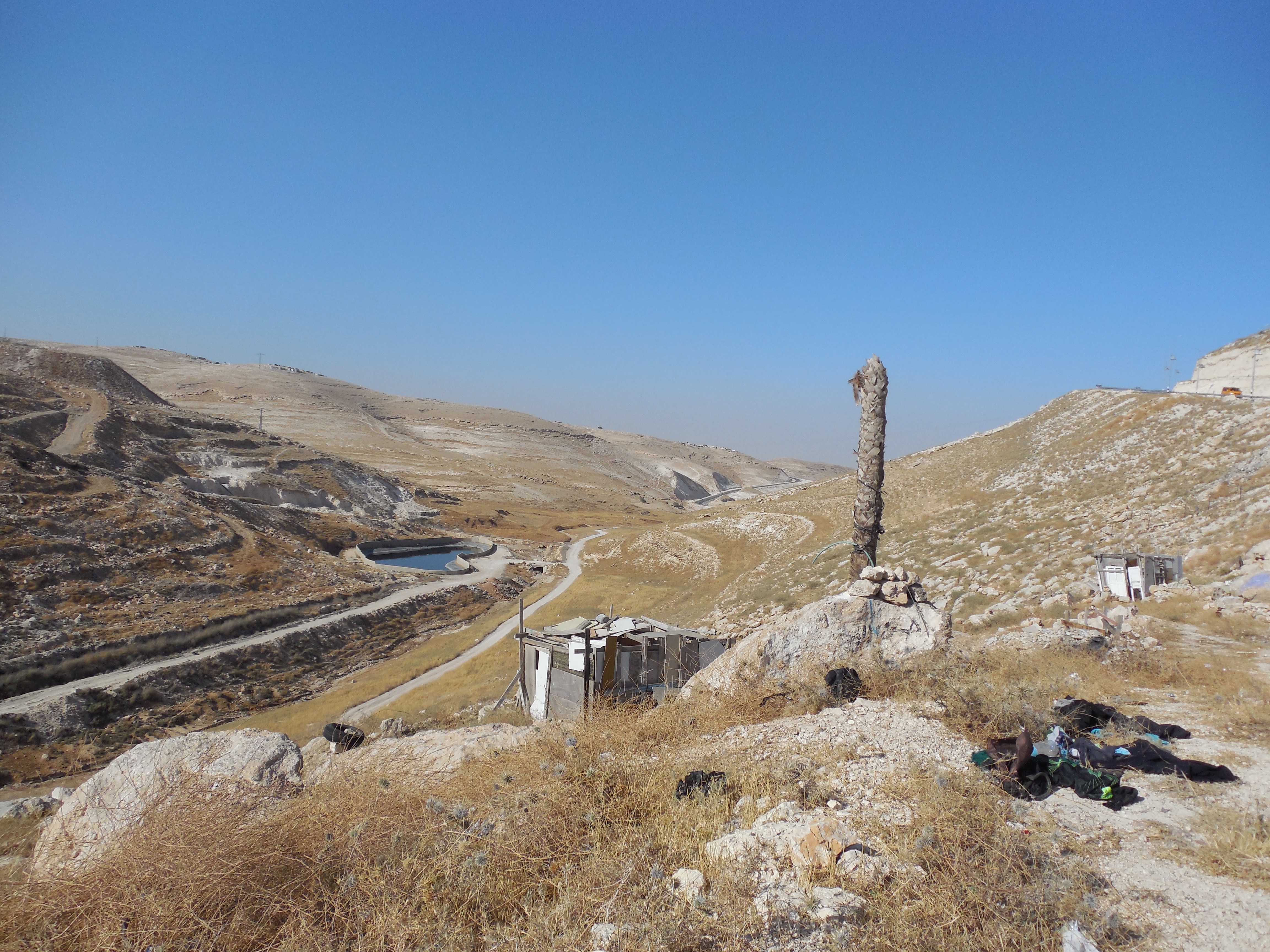
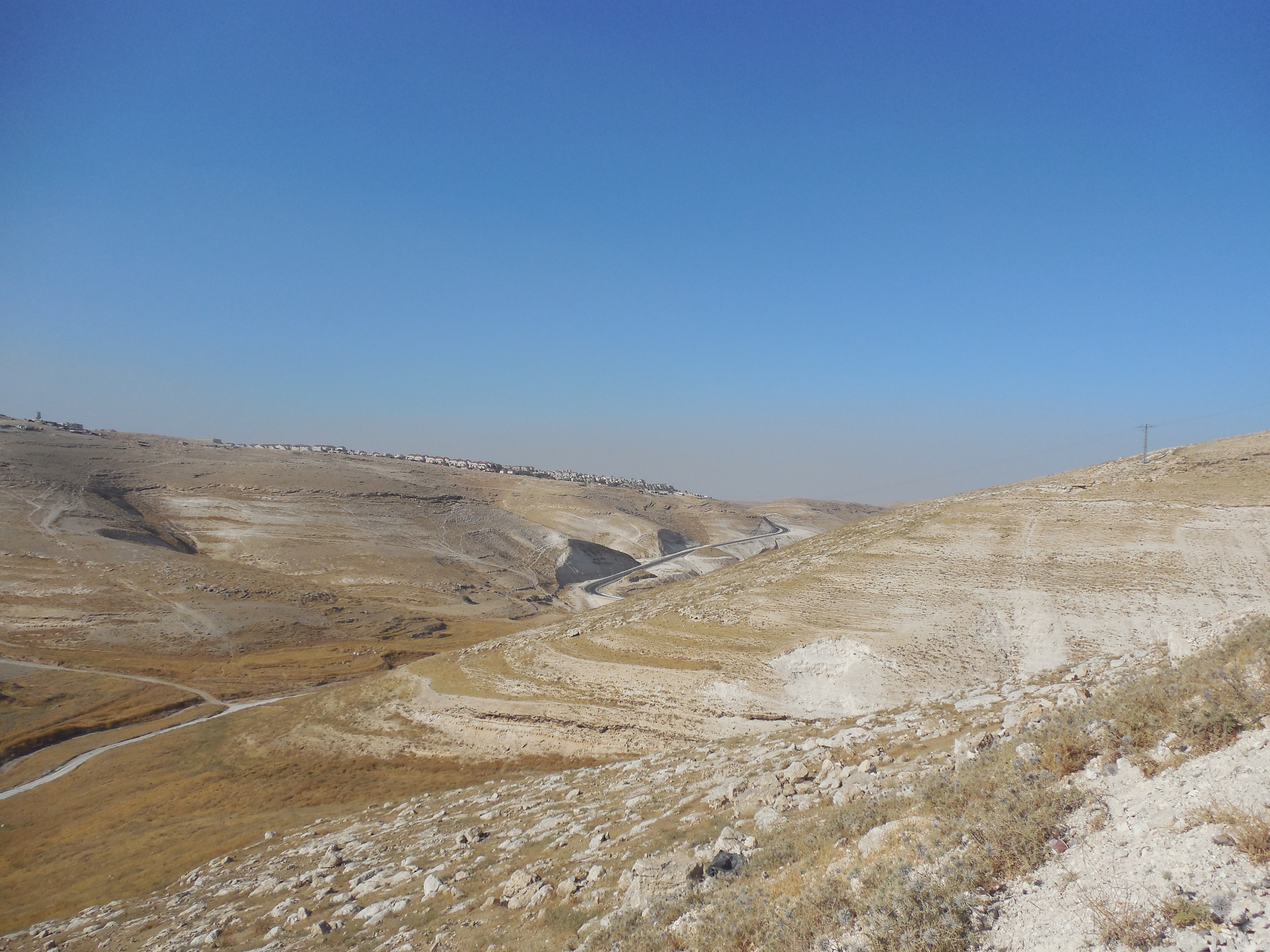
As I was saying, the jaunt I took was in E1–the so-called “Judean Wilderness.” When you first walk into the “desert” there, it seems uninhabited–so obviously uninhabited that you could be forgiven for thinking that you’ve come upon a land without a people. But then you look more closely, and you see the first signs of habitation, followed by the second, and the third–so that after an hour or so, you realize that what had previously seemed “uninhabited” is not just inhabited, but in some sense entirely appropriated. In fact, one of the first things I ran into when I got to the desert was…a fence preventing me from going any further into the desert, or rather, requiring me to go around it if I wanted to go anywhere at all.

Here’s one of the earliest indications of habitation. I’d been walking for a bit when I came on these shepherd’s shanties by the side of the road.

desert1

I take it that they’re just temporary shelters to keep the shepherds out of the sun (obviously, there’s no shade for miles). They own those, right? It’d be trespassing to use them without the owner’s consent, and something like theft to destroy or bulldoze them without the owner’s consent. Maybe morally, but not by law. Legally, none of this property has any valid status; it’s all illegal.

If you look to the left, there’s a big valley with a sort of shantytown nestled within and a village on the mountaintop.

desert3

The mountaintop is (just barely) on the electric grid, but the shantytown is not. So what do these people own? The clothes on their back? That plus the shanties over their heads? The mountain? That plus the valley? Does that include the roads you see and the reservoir as well? Could they legitimately say that they own all that the eye can survey? And whose eyes would those be–Israeli, PA, or Bedouin? These people are living “illegally,” as well; in fact, their whole existence is illegal.

How to conceptualize property claims of this kind is a major undertaking for which I so far lack the conceptual apparatus, the relevant information, and any fine-grained answers. The Israeli government regards these Bedouins as living “illegally” on state land in Area C (under full Israeli control), and intends to move them elsewhere to build Jewish settlements here (whether the Bedouin like it or not). The Israeli government is offering the Bedouins compensation, and has suggested (as a justification for expropriation) that the structures the Bedouins have built aren’t up to code. How you think about that turns on how you think about natural rights of property, initial appropriation and its limits, the status of a nomadic lifestyle in a modern state, the moral status of “state land,” the imperatives of economic development, and paternalistic regulation. (For defenses of the Israel point of view, see this and this, both PDFs. For the Bedouins’ own perspective, see this. Here’s more from Architects and Planners for Justice in Palestine. Here’s a small portion of B’Tselem’s reporting.)

It’s a lot to think about, and part of the reason I find it hard to leave my immediate environs is that I find that those environs by themslves give me more than enough to think about–more, in fact, than I can handle. I sympathize with the plight of these Bedouins, but the status of their claims is not clear to me. After all, it’s not clear to me that if a bunch of Bedouins showed up in north Jersey, they’d be able to appropriate whole mountains and valleys of this size for their own use, exclusive of the development needs of neighboring towns or any other claims. What would happen to them if they tried is anyone’s guess (try to imagine it happening in Sussex County or in the Pine Barrens)–though a hard look at the remote origins of our Indian reservations suggests one possible answer. That’s not a moral judgment; it’s just an observation in need of a moral judgment by a mind better stocked with answers than mine.

Here’s a shot looking into the distance at the northeastern horizon.

desert4What you see in the distance is Ma’ale Adumim, a Jewish settlement about the size of my hometown of West Orange, New Jersey (and which actually looks a lot like West Orange). The road that snakes through the picture goes to Ma’ale Adumim and by a roundabout route to Jerusalem.

So what do they own? As it happens, Ma’ale Adumim is often described as having been built on expropriated Arab land. If the settlement’s development needs encroach on this valley, whose claims, morally speaking, have prior or overriding consideration? If the Jerusalem Municipality’s Master Plan calls for the incorporation of all this “unused land” into an integrated plan for a Greater Jerusalem, what basis, moral or legal, would these stateless quasi-nomads have for disputing the claims of modern, metropolitan citizens of a functioning state? Whatever the answer, I haven’t encountered anything in the philosophical literature that deals with it in a way that does justice either to the complexity of the issues involved or the urgency of what’s at stake here. (If anyone has bibliographical recommendations, I’d love to hear them.)

We take “civilized” life for granted, and usually take for granted that the displacements it required took place in some distant and morally irrelevant past. But a look at E1 and similar places here suggests that that isn’t so. The displacements are happening now, and happening in the name of the imperatives of civilized life. One of the (many) things that gives the Arab-Israeli dispute its urgency for Americans is the way in which it re-enacts the worst (and most tragically forgotten) aspects of our own history, when we were the Israelis, and our adversaries were the Palestinians. The displacement of the Bedouins in E1 sounds uncomfortably like a 21st century version of the Trail of Tears. It sounds that way, but is it? A complex question in need of an answer that I don’t have.

Cherokee_Heritage_Center_-_Trail_of_Tears_Schild_1.jpg (2560×1920)

Don’t worry; this happened a long time ago.* 

Anyway, I started out by saying that I need to get out more, and I do. I’ve gotten a great deal out of teaching my political philosophy class–we’re currently finishing up Machiavelli’s Prince–and I was right to think that my Occupation-based approach to the classic texts of European political philosophy would pay the hermeneutical dividends I anticipated. I’ve also gotten a fairly good sense of the rhythms and details of life in my immediate vicinity, and made a couple of trips to Jerusalem and Ramallah.

But my activities all seem distressingly parochial. I’m uncomfortably reminded of a passage from Mill’s On Liberty:

In the case of any person whose judgment is really deserving of confidence, how has it become so? …Because he has felt that the only way in which a human being can approach to knowing the whole of a subject is by hearing what can be said about it by persons of every variety of opinion, and studying all modes in which it can be looked at by every character of mind.

I haven’t really done that. I’m ensconced here among Palestinians in a cocoon of Palestinian political and religious opinion. Everyone here is opposed to the occupation and to the settlements–in a fundamental way, to Israel itself.

So the time has come, I think, to hang out with some Israeli settlers. To that end, I’ve made arrangements over the next few weeks to meet one set of settlers through this tour; another through this one; and to visit Ma’ale Adumim through this program. (Here’s a description from 2010; here’s one from a few days ago focusing on East Jerusalem rather than Ma’ale Adumim.) The second of these tours will enable me to visit the Temple Mount/Haram Sharif in the company of Jewish settlers, something I never imagined myself doing before, and which fills me with a peculiar mixture of apprehension and amusement.

I’ll be visiting Hebron through this tour, and spending time in a Bedouin village in the Negev on this one; though the description of the Hebron tour doesn’t say much about interacting with settlers there, I’d like to see how far I can get in the direction of interaction with them. Though I’m not totally sure I can schedule it, I’m hoping to spend a couple days re-visiting the village of Beit Umar through this program; I had an “interesting” exchange with an Israeli military patrol last time I was there, and I’m hoping that I can meet my old “comrades” in that unit once again and re-start the argument where we left it two years ago.

I’m curious what PoT readers are curious about. Any questions you think I ought to be asking, or things I ought to be looking for? Tell me.

————————————————————————————

*”The Treaty of New Echota was ratified by a single vote…” Recall the old axiom, care of Anthony Downs, that a single vote almost never alters the outcome of an election in a politically significant way. “In a large election, the probability that an individual vote might change the election outcome is vanishingly small.” Almost, vanishingly small: sometimes the odds get even.

Postscript, July 19, 2015. Here’s a useful map depicting the places described in this post. (It’s a PDF; unfortunately, I can’t copy and paste it.) I took the long road that starts from the “b” in Abu Dis, and took it past Sawahrah as-Sharqiyah, bypassing Container Checkpoint, and doing a half-perimeter of what’s marked “the alternate site” in E1. The map indicates that all of the land I photographed, though physically inhabited by Bedouins, is within the municipal boundaries or Regional Council jurisdictional area of the surrounding Jewish settlements (either Ma’ale Adumim or Qedar). The realization of the E1 plan would require the expropriation of all of the Bedouin encampments located within the blue space on the map.

It’s an interesting question what moral justification anyone could have for doing this. Even if you argue that Bedouin appropriation of land has to be limited by some version of a Lockean Proviso, it’s unclear how the surrounding settlements could be entitled on the same grounds not only to what they currently have but to everything that the Bedouin have–despite the fact that the Bedouin are on the land, and the settlers are not.  Though I haven’t read as much of it as I should, I get the impression that libertarian discussions of property are, in their current form, ill-equipped to adjudicate disputes of this sort. Likewise Lockean discussions. It’s unclear to me whether Lockean/libertarian accounts can be developed into adjudication-worthy theories, or whether they have to be junked in favor of something different, and more adequate to the task.

Postscript, July 20, 2015: This article from Reuters is exceptionally informative on the plight of the Bedouin in E1.

Postscript, July 24, 2015: Another informative article, this one on the hamlet of Susiya in the southern West Bank.