The Missing Piece of the Story
I was happy to see some modest coverage of Princeton’s having passed an ICE-Free resolution: the story was covered by The Daily Princetonian and Princeton Patch. But I have a bone to pick with both of these articles. In both cases, the passage of the resolution is described as though the initiative for it began with the Council. That’s not true. It began because I privately raised the issue back in June; the Mayor and Council agreed to pursue it, and kept me apprised of their progress. I then raised it publicly in August, and the resolution passed near the end of September.
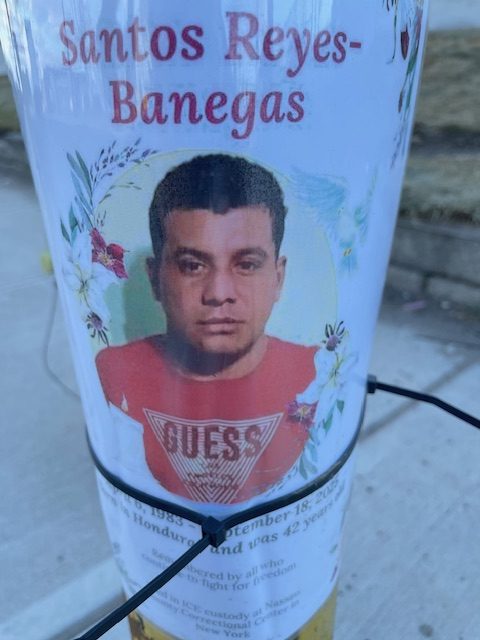
Santos Reyes Banegas (1983-2025), a victim of ICE’s systemic medical neglect, from a poster at Delaney Hall
I mention this not because I demand credit for my heroic efforts (they weren’t heroic), but because these stories get the chronology and causality of the event wrong. The Council did not unilaterally decide, on its own, to pursue this issue. It was asked. The same thing was true last year of the Immigrant Trust resolution. The latter resolution passed in August after the Council was dragged kicking and screaming to passage, which came after a full summer of agitation by Resistencia en Accion. In fact, the correct sequence of both events is that Resistencia convinced the Council last year that migrant defense legislation was necessary; I leveraged that win this year to take things one step further. Factor Resistencia’s activism out of the picture, and you don’t get an Immigrant Trust resolution. Factor my reliance on their activism out of the picture, and you don’t get an ICE-Free Resolution.
What’s missing from these articles is any sense of the specifically activist dimension behind the ICE Free legislation. Both give the impression that local governments think spontaneously of migrant rights, and then spontaneously decide to pass migrant defense legislation. That’s not what happened here, or what happened last year, and it’s not how things generally work. Local politics gravitates naturally to things of interest to the upper middle class: property values, tax rates, zoning, traffic, and the provision of amenities. If activists don’t bring up migrant defense issues, they don’t come up on their own. This is why Town Topics, TapInto Princeton, and Princeton Packet haven’t covered the ICE Free legislation: they’ve discussed topics drawn from the same Council meeting of greater interest to their upper middle class readership than how to keep ICE at bay. That’s the norm.
It’s easy to believe that activists are dispensable: just re-write history so as to excise their contributions. Factor in the relevant history, and you get a different result. Since most journalism today is stenography rather than reporting, you can only “factor in the relevant history” if you already know what it is. If you don’t, you’re reading someone’s PR. Which is the norm.

