Postcards from Abu Dis (10): Americans, Settlements, and Civil Rights

I’ve been away from the blog for awhile, partly because I’ve been traveling a lot, and partly because I’m at work on a presentation I’m giving this week at AQU’s Centre for Jerusalem Studies on American attitudes toward the Palestinian narrative. It’s called “Turning Up the Volume: Why Americans Have Trouble Hearing the Palestinian Narrative.”

The basic idea is this: Americans have trouble hearing the Palestinian narrative because given the way Palestinians make their case, every argument in defense of Palestinian rights can, by disputing certain factual premises, be re-cast as an argument that either proves Palestinian aggression against Jews, or proves a false Palestinian accusation of aggression by Jews.

For instance, if Jewish settlement activity is based on theft of Palestinian land, then of course, settlements are a matter of Jewish aggression against Palestinians. But if settlement activity is simply a matter of voluntary Jewish purchase of voluntarily-sold Palestinian property, then Palestinian opposition to Jewish settlement seems like a form of xenophobia, hysteria, or racism. The factual issues–theft or purchase?–often seem undecidable from several thousand miles’ distance. For that reason, some Americans simply lapse into agnosticism about the rights and wrongs of the conflict. But others insist on having a view despite the apparent inaccessibility of the relevant facts, going by what they regard as the most plausible moral hypothesis. For contingent historical reasons, Americans tend to find Zionist-Israeli claims more plausible than Palestinian ones.

The “contingent historical reasons” have to do with the rhetoric and strategies of the moderate wing of the U.S. Civil Rights Movement (i.e., the wing led by Martin Luther King, Jr.) For better or worse, American moral sensibilities about racial matters are structured by the history and moral assumptions of the King-led camp of the Civil Rights Movement. Given those sensibilities, any political argument bearing a fundamental similarity to the (moderate) camp of the Civil Rights Movement has an edge over any argument that doesn’t.

Now, the King-led camp of the Civil Rights Movement was integrationist rather than segregationist or separatist in its strategies and basic assumptions: it argued that blacks should actively strive to integrate into white society; it rejected both the white segregationist argument in favor of “separate but equal” barriers to integration, and the black separationist argument in favor of a separate nation for blacks. As it happens, Zionist-Israeli arguments tend to sound integrationist to American ears; meanwhile, the Palestinian narrative sounds either segregationist or separatist. Since Americans shy away from segregation or separatism, they opt for the Zionist-Israeli narrative.

For an example of my thesis, consider this 2009 story from The New York Times about the establishment (with conspicuous American support) of the Jewish settlement of Nof Zion within the Palestinian neighborhood of Jabl Muqabber in East Jerusalem. As it happens, I visited Jabl Muqabber/Nof Zion a few days ago; the Palestinian guide I was with took great offense at the presence of the settlers of Nof Zion, and called the settlement’s existence a “provocation.”  Here’s how the Times describes it:

Nof Zion, a private Jewish project, is in Jebel Mukaber, a Palestinian Arab neighborhood of East Jerusalem, in territory Israel captured from Jordan in the 1967 war. Israel claims sovereignty over all Jerusalem; the Palestinians demand the eastern part as the capital of a future state.

Even within Israel, the idea of Jews moving into predominantly Arab neighborhoods of Jerusalem stirs heated debate. Two well-known Israeli families refused City Hall’s offer to name the street leading to Nof Zion for their deceased relatives, according to the local Jerusalem press.

But illustrating the complexity of the Jerusalem conundrum, others argue that Jews, Christians and Muslims should be able to live wherever they like. Not allowing Jews to live in certain neighborhoods of the city “is segregation,” said Mr. Hikind, a Democrat who represents several heavily Orthodox Jewish neighborhoods in Brooklyn.

With new tensions surfacing between the Obama administration and Israel over building in contested parts of Jerusalem, the city’s character and future remain central motifs in the stalled Israeli-Palestinian peace talks.

The cornerstone-laying ceremony at Nof Zion took place a day after the Israeli authorities moved ahead with plans for the expansion of Gilo, a Jewish residential district in south Jerusalem also on land captured in the 1967 war. The plans for 900 more housing units drew a sharp rebuke from the White House.

The first paragraph describes Nof Zion as a private project, then goes on to say that Israel claims sovereignty over all of Jerusalem, while Palestinians claim sovereignty over East Jerusalem. The implication seems to be that Nof Zion’s ownership status varies with the sovereignty of the political entity in control of the relevant part of Jerusalem; since the political status of the city is disputed, it follows that the ownership status of property claims within the city must likewise be disputed.

ejfromsouth

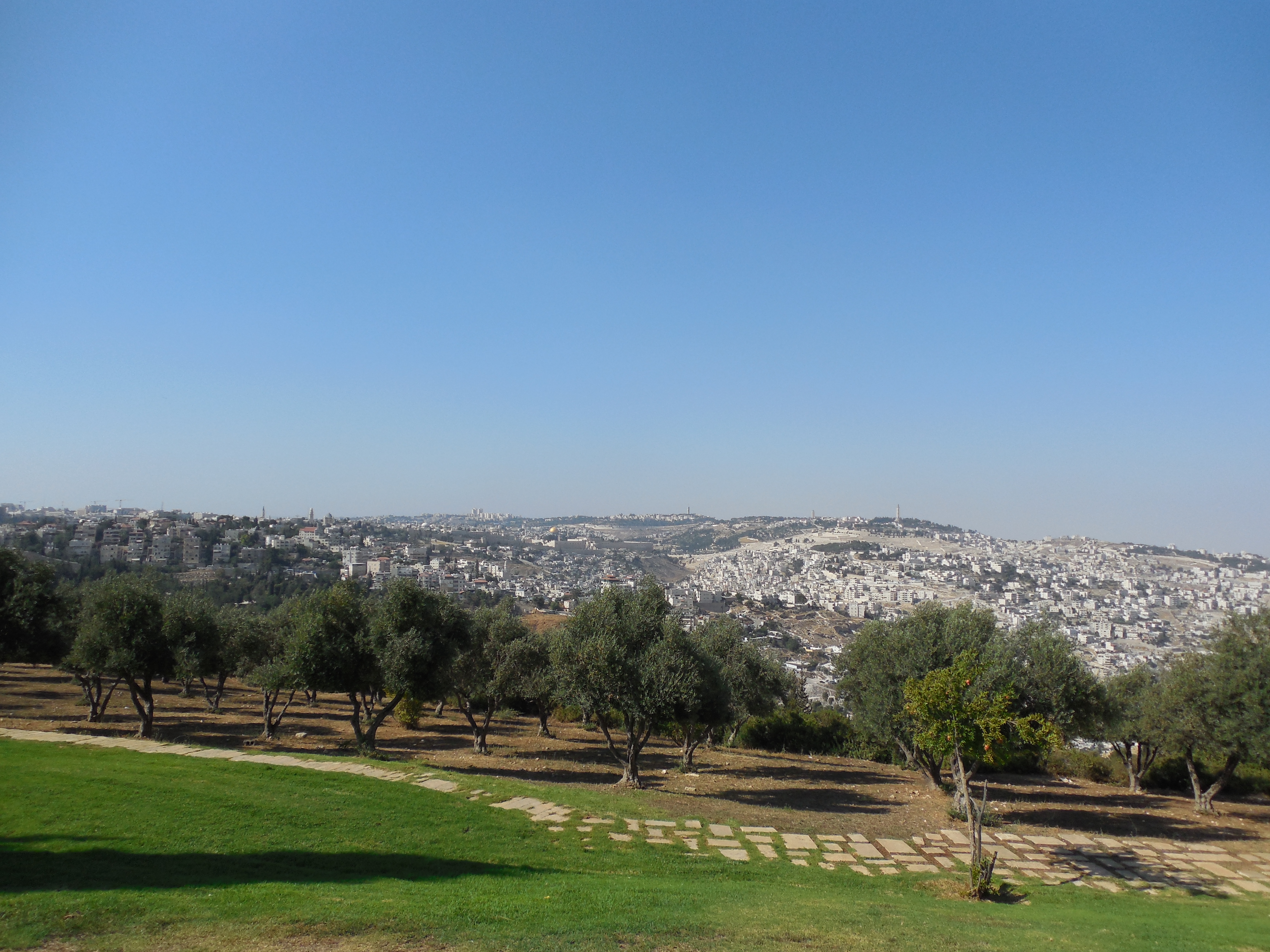
East Jerusalem viewed from the southwest (Haas Promenade)

But if Nof Zion is a genuinely private project on legitimately-bought land, what difference does it make who has sovereignty over Jerusalem? If Nof Zion is legitimately bought, then Nof Zion would seem to belong to its rightful owners–Nof Zion–regardless of who rules, runs, or governs the city. Of course, if it’s not on legitimately-bought land, it likewise makes no difference who has sovereignty over Jerusalem; in that case, morally speaking, Nof Zion doesn’t belong to Nof Zion at all, and ought to be given back to its rightful owners, whoever they happen to be, and whoever is in charge of the city.

In other words, sovereignty is a distraction from the relevant issue. The relevant issue is ownership, and specifically, what Robert Nozick calls “justice in transfer of holdings” (Anarchy, State, and Utopia, pp. 150-51). If the transfer of ownership to Nof Zion is morally illegitimate, then regardless of its specifically legal status, it ought to revert to its rightful owners. This would be a clear case of applying what Nozick calls “rectification of injustice in holdings” (p. 152). It seems to me that the literature on Nozick ignores cases like this, intermediate between ordinary cases of reparation for ordinary theft, and massive expropriations in the distant past.

The second paragraph tells us that the idea of Jews moving into predominantly Arab neighborhoods stirs heated debate. Why? Is it because Arabs simply don’t like Jews, or is it because Arabs fear that the apparently innocuous act of moving into the neighborhood betokens something more sinister, like a coercive take-over? While we’re at it, does the converse hold? In other words, does the idea of Arabs moving into Jewish neighborhoods stir debate? If so, what’s the upshot?

In my experience, settlers insist that Arab opposition to Jewish in-migration is simply a matter of xenophobia or racism. Meanwhile, Palestinians don’t explicitly or effectively argue that Jewish in-migration is a Trojan Horse for house demolitions or coercive territorial capture; they focus instead on the supposed “provocation” of a Jewish presence in an Arab neighborhood as such. But this appeal to “provocation” is a very weak argument, and one almost designed to offend American ears: it simply assumes without further explanation that a Jewish presence in an Arab neighborhood is a provocation, qua Jewish, without explaining what’s provocative about such a presence. It’s as though someone were to describe white peoples’ (or immigrants’) moving into a predominantly black neighborhood as a “provocation” simply because they were the “wrong” race.

In fairness to Palestinians, arguments of the “Trojan Horse” form tend to be dismissed by American audiences a priori as paranoid or anti-Semitic conspiracy theorizing, even when there is good evidence for them, and even when Americans themselves use such arguments in other contexts. So it becomes easy to see why Palestinians tend to be vague at the crucial argumentative moment. But the fact remains: the vagueness drastically weakens their argument.

demohouse

Demolished Palestinian home, Ras al Amud, East Jerusalem

As for the third paragraph, is Hikind right to think that not allowing Jews to live in Jabl Muqabber is “segregation”? If so, would it then follow that not allowing Palestinians–whether of Israeli citizenship, Jerusalem residence, or West Bank/Gaza residence–to live in Jewish settlements is also segregation? He doesn’t get around to that issue here, and I doubt he ever has. If I had the money, I wouldn’t mind buying an apartment in Ma’ale Adumim. But could I? And invite my Palestinian friends over to hang out and swim in the community pool? Rest assured that there’s no community pool here in Abu Dis or in any nearby Palestinian town.

While I’m on the topic of water, I guess it’s worth adding that the aquifer under Abu Dis is under Israeli, not Palestinian control: “An estimated four-fifths of the water [in the West Bank aquifers] is used by Israel, much of it is piped back to West Bank settlements. Many West Bank Palestinians, however, must rely on wells” (Charles D. Smith, Palestine and the Arab-Israeli Conflict: A History with Documents, 8th ed., p. 511, Map 11.4.) Does that pattern of water use involve segregation or discrimination? I think so.

Anyway, back to land: In my experience, those who defend the settlement enterprise are very reluctant to consider the possibility of Arab residence in Jewish settlements–even when they complain that Arab reluctance to allow Jewish settlements in Arab neighborhoods is “segregation.” Meanwhile, Palestinians regard the idea of applying for residence in a Jewish settlement as either a quixotic waste of time or as something akin to treason, the ethno-nationalist equivalent of a scab’s working for management during a strike. The pro-settlement claim strikes me as hypocritical; the Palestinian nationalist claim strikes me as self-defeating.*

In any case, the general point should be clear: American interpretations of the Israeli settlement enterprise are, for better or worse, steeped in assumptions drawn from the theory and practice of the U.S. Civil Rights Movement. But neither side’s views map easily onto the integrationist template formulated by that movement. My point is that, rhetorically, Zionist-Israeli arguments sound–and are made to sound–as though they do. That fact accounts for why Americans find Zionist-Israeli arguments more plausible than their Palestinian counter-parts, especially when the facts that would decide a controversy are complex or difficult to access.*

A query for PoT readers, especially American ones: Just off the top of your head, do you regard the Jewish settlement enterprise as fundamentally just or as fundamentally unjust? If unjust, what’s wrong with it? If just, why is it mistakenly thought to be wrong?

Postscript: As it happens, Nof Zion is clearly visible from my side of the separation wall in Abu Dis. I’d take a photo and upload it here, but my camera lacks a telephoto lens, so I’m not sure the relevant details will come out.

*For clarity’s sake, I added a few sentences to each of these paragraphs after the initial posting.

Postcards from Abu Dis (9): Checking Out the Checkpoints

I had my first run-in at an Israeli checkpoint yesterday, only the second pedestrian checkpoint I’ve gone through in the last six weeks.

Prior to this, most of the checkpoints I’d gone through were vehicular, and little of note had happened at them. I was held for two hours at the airport, which was an improvement on my last visit here, when I was held for five. I encountered one “flying checkpoint” on my first night here on the road between Ma’ale Adumim and Al Eizariyah, but after a ten minute wait, we were waved through. My seatmate on the 263 bus to Jerusalem was detained one morning at the Ma’ale Adumim checkpoint, but hey, I wasn’t, so the trip was basically uneventful. I was briefly accosted and questioned by a security guard for standing too long in front of the Jerusalem District Courthouse (where the Abu Khdeir trial is taking place), but after convincing him that I was harmless, he walked away, whereupon I decided to confirm his opinion by walking away myself. In an irritating sequence of events, I was falsely told one night by a police officer in the Old City that a certain walkway was closed when it wasn’t; he forced me to take a left turn that I didn’t want to take, after which I managed to get lost. But on reflection, I decided he’d done me a favor, because the hour was late, and I didn’t need to be in the Old City at that hour anyway.

And that was it. All was well even if it hadn’t quite ended well.

Yesterday, I finally had occasion to go through the Har Hazeitim checkpoint I mentioned a few weeks ago. Honestly, the only way to describe my experience there is to say that the people staffing that checkpoint around 7:30 pm on Sunday night were the most consummate assholes I’ve dealt with in a long time—and by far the biggest assholes I’ve met in Israel or Palestine in the last six weeks. If Palestinians routinely get treated at these checkpoints the way I was treated last night at Har Hazeitim, it really is no wonder that they lash out as often as they do. Anybody would, especially if they got the sense that the mistreatment would persist into the indefinite future, and that it seemed to be getting progressively worse. I’m morbidly curious what happens to one’s psyche if one goes through checkpoints like that on a regular basis, so in a spirit of inductive inquiry modeled on Mill’s Methods, I’ve decided to go through that checkpoint as often as I can over the next few weeks that I’m here, just to see what happens to me. I’ll be sure to tell you.

For now, I guess I’d describe the experience as roughly what would happen if you put a bunch of college-aged kids safely behind bomb-proof glass, then gave them the power to run a version of the Milgram Experiment every day, thousands of times a day, and then crossed the Milgram Experiment with a game of Donkey Kong in which instead of Donkey Kong, the protagonist of the game was a human being, typically a Palestinian. A real barrel of laughs. I guess it was for them, because they spent the duration of my visit to the checkpoint laughing at me.

I’ve noticed that Israeli Border Police have a certain hand gesture that I think of as the “mosquito gesture.” When they don’t want to deal with you, they wave you away with this contemptuous wave of the hand–what you or I would do to swat away a mosquito. The sign language says: “go away,” or more expansively, “go away, you piece of shit.” The next time I get that gesture, I intend to do it back. If questioned, I intend to describe it as an act of assimilation into Israeli society: I’ve seen the gesture so often that I thought I’d blend in and imitate it. Judging from the frequency with which it’s used, it must mean something like “mazel tov.” What could be nicer?

Seriously, I’m curious to see what happens. Stay tuned.

Postscript, July 16, 2015: I just discovered this great website and organization, Women Against the Occupation and for Human Rights, with individualized reports on each of the checkpoints. So many checkpoints, so little time!

Here’s the report on the Mount of Olives checkpoint described in the post above.

Here’s Anata/Shu’afat checkpoint; the report includes a few others, like Az-Zaim, which I’ve gone through about a dozen times on this trip. It looks different nowadays than it does in the photos here.*

Here’s Abu Dis, where I’m currently living; unfortunately, the photos of the place are somewhat dated. Perhaps I should donate some of my own? I’m a little baffled by the references to Cliff Hotel from this website; I’ve heard it mentioned by locals as well.

It’s always painful to see this gem of Jerusalem architecture in its present state — smashed windows, broken walls, filth everywhere, and now surrounded by a fence.  Nobody came to stop us when we crossed the gate into the settlement area.  There was someone in the booth, but he didn’t bother.  The signs proclaimed “forbidden, forbidden” — and “dangerous”.

I’ve lived here for six weeks, and despite looking for it, I can’t find it. The report above is from February 2014; is the hotel gone?

This report from Bethlehem took place about an hour before I happened to visit the same exact checkpoint (I visited July 10 around 9:30 am). Things were hectic but not violent while I was there, but I was only there for about fifteen or twenty minutes. I was also farther away from the checkpoint itself than those writing the report. I don’t know how they managed to get as close as they did.

Here’s reporting from Hebron, a hell-hole I’ll describe in a forthcoming post, having recently visited there (I’ve uploaded some photos of Hebron to the header).

Container Checkpoint at Wadi Nar is fast becoming my favorite checkpoint in the whole Occupied Territories. I was going to try walking through (it’s walking distance from where I live) but a friend told me that doing so was a good way to get shot, so I decided against it. It’s also a good way to get bitten, as the soldiers at that checkpoint have befriended some aggressive stray dogs, feeding them, but taking no responsibility for their (the dogs’) behavior –a good deterrent against overly curious American tourists out for a stroll. WOHR describes Container Checkpoint as “a god-forsaken checkpoint rarely visited by our shifts.” Yes and no: it’s actually about 200 yards from the rather pleasant village of Sawahirya, so it’s not that out of the way. As for “rarely visited,” it’s a hell of a walk from where I live, but I don’t mind making the trip.

*Correction, July 18, 2015: I corrected a mistake in the original version of this sentence: having now gone through the (various) Shufaat/Anata and Az Zaim checkpoints, I now realize that there are at least three different checkpoints involved here. By “Az Zaim” checkpoint,” I mean the one on Route 1 directly after Ma’ale Adumim and before the Mount Scopus campus of Hebrew University.

On My Way to the Promised Land (Hebron Edition)

I’ve been traveling these last few days, and I’m off to Hebron now, so I’ll be away from the blog for a bit. Commenting and comment approvals will be slow. Hope to blog a bit on it at some point when I get back. Patience is advised.

Meanwhile, here’s some background material on Hebron from a variety of perspectives. They’re intended as background; I don’t necessarily endorse what any particular author or speaker says here.

Print resources:

I’ll be taking my camera with me, but I can’t hope to capture Hebron on film the way Jackie Hadel captures it on her travel photo blog, Tokidoki. Highly recommended.

The official Israeli perspective on Hebron, care of the Israel Defense Forces:

Palestinian resistance to the Israeli occupation, as experienced and described by a Palestinian:

A longer video from a left-dissident Israeli perspective:

Interesting perspective from Vice:

And, of course, the soundtrack:

By the way, in Arabic, “Hebron” is “Al Khalil,” making Hebron, roughly, the City of Friendship. Cue up irony.

Postcards from Abu Dis (8): From Settlements to Unsettlement

So I’ve been here for about a month now, and have another month or so to spend in the country (or these countries, or this country and a half). As I reflect on what I’ve seen and done so far, however, I can’t help feeling a sense of dissatisfaction at myself: I really need to get out more.

In the month that I’ve been here, I’ve mostly stayed in and around Abu Dis. I’ve walked all around Abu Dis and Eizariyah, and gotten a fairly good sense of the place; I’ve also taken a foray into the nearby desert between Abu Dis and Ma’ale Adumim, strolling among the Bedouin encampments in the notorious E1 zone–until I was accosted by a xenophobic sheepdog who decided that I lacked the credentials to cross his canine checkpoint. (So far, I’ve had better luck at human checkpoints.)

As I was saying, the jaunt I took was in E1–the so-called “Judean Wilderness.” When you first walk into the “desert” there, it seems uninhabited–so obviously uninhabited that you could be forgiven for thinking that you’ve come upon a land without a people. But then you look more closely, and you see the first signs of habitation, followed by the second, and the third–so that after an hour or so, you realize that what had previously seemed “uninhabited” is not just inhabited, but in some sense entirely appropriated. In fact, one of the first things I ran into when I got to the desert was…a fence preventing me from going any further into the desert, or rather, requiring me to go around it if I wanted to go anywhere at all.

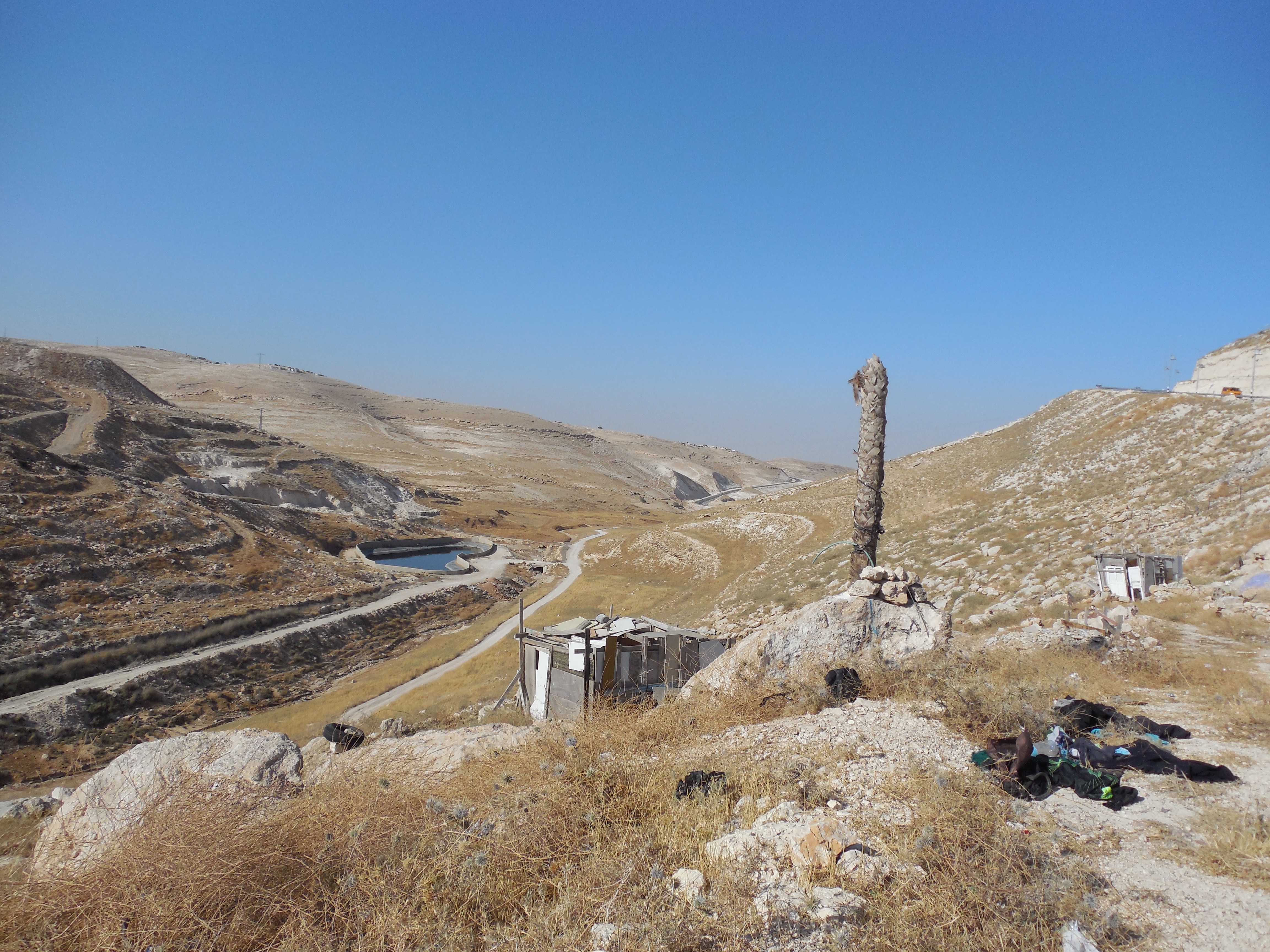
Here’s one of the earliest indications of habitation. I’d been walking for a bit when I came on these shepherd’s shanties by the side of the road.

desert1

I take it that they’re just temporary shelters to keep the shepherds out of the sun (obviously, there’s no shade for miles). They own those, right? It’d be trespassing to use them without the owner’s consent, and something like theft to destroy or bulldoze them without the owner’s consent. Maybe morally, but not by law. Legally, none of this property has any valid status; it’s all illegal.

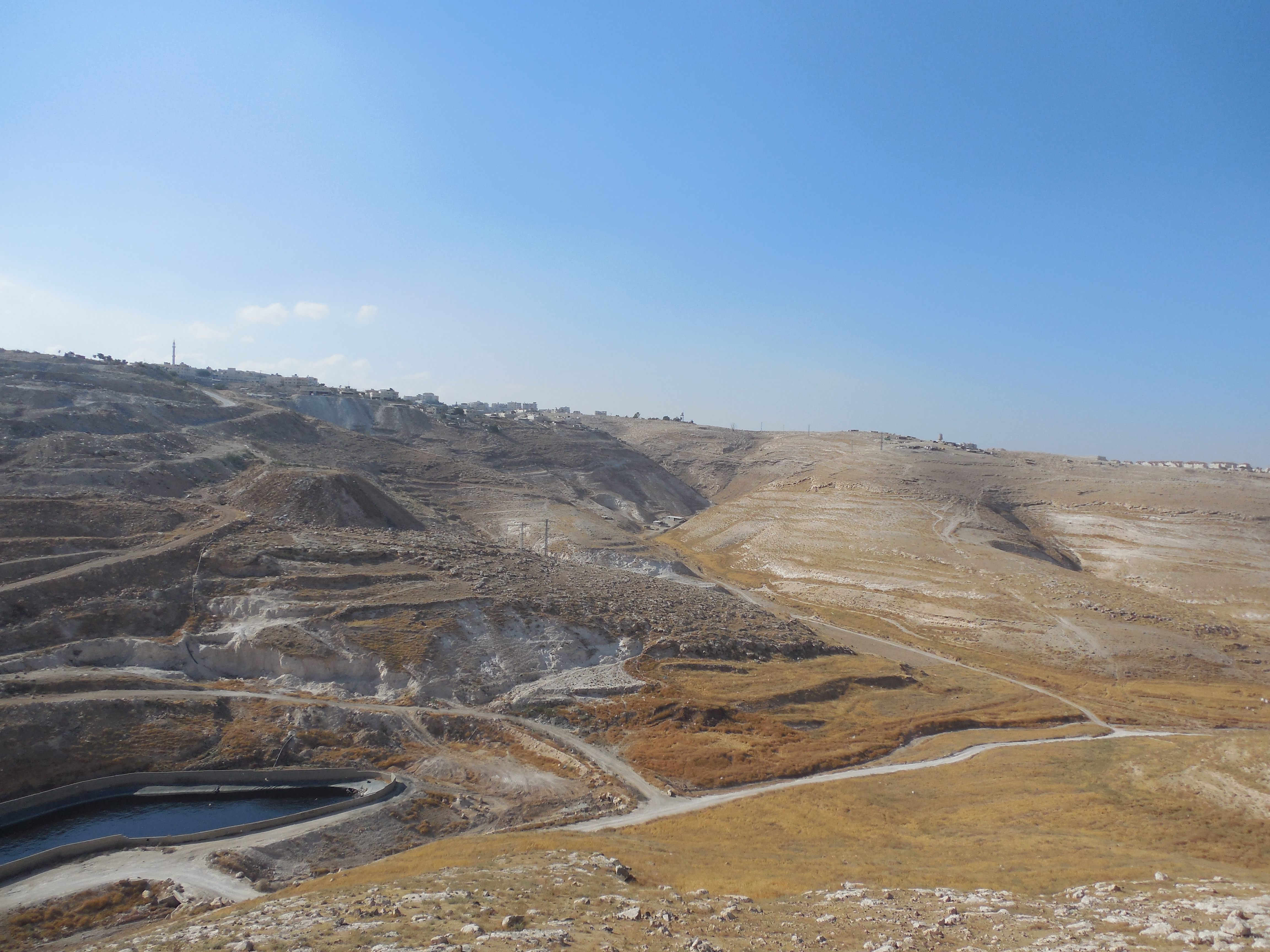
If you look to the left, there’s a big valley with a sort of shantytown nestled within and a village on the mountaintop.

desert3

The mountaintop is (just barely) on the electric grid, but the shantytown is not. So what do these people own? The clothes on their back? That plus the shanties over their heads? The mountain? That plus the valley? Does that include the roads you see and the reservoir as well? Could they legitimately say that they own all that the eye can survey? And whose eyes would those be–Israeli, PA, or Bedouin? These people are living “illegally,” as well; in fact, their whole existence is illegal.

How to conceptualize property claims of this kind is a major undertaking for which I so far lack the conceptual apparatus, the relevant information, and any fine-grained answers. The Israeli government regards these Bedouins as living “illegally” on state land in Area C (under full Israeli control), and intends to move them elsewhere to build Jewish settlements here (whether the Bedouin like it or not). The Israeli government is offering the Bedouins compensation, and has suggested (as a justification for expropriation) that the structures the Bedouins have built aren’t up to code. How you think about that turns on how you think about natural rights of property, initial appropriation and its limits, the status of a nomadic lifestyle in a modern state, the moral status of “state land,” the imperatives of economic development, and paternalistic regulation. (For defenses of the Israel point of view, see this and this, both PDFs. For the Bedouins’ own perspective, see this. Here’s more from Architects and Planners for Justice in Palestine. Here’s a small portion of B’Tselem’s reporting.)

It’s a lot to think about, and part of the reason I find it hard to leave my immediate environs is that I find that those environs by themslves give me more than enough to think about–more, in fact, than I can handle. I sympathize with the plight of these Bedouins, but the status of their claims is not clear to me. After all, it’s not clear to me that if a bunch of Bedouins showed up in north Jersey, they’d be able to appropriate whole mountains and valleys of this size for their own use, exclusive of the development needs of neighboring towns or any other claims. What would happen to them if they tried is anyone’s guess (try to imagine it happening in Sussex County or in the Pine Barrens)–though a hard look at the remote origins of our Indian reservations suggests one possible answer. That’s not a moral judgment; it’s just an observation in need of a moral judgment by a mind better stocked with answers than mine.

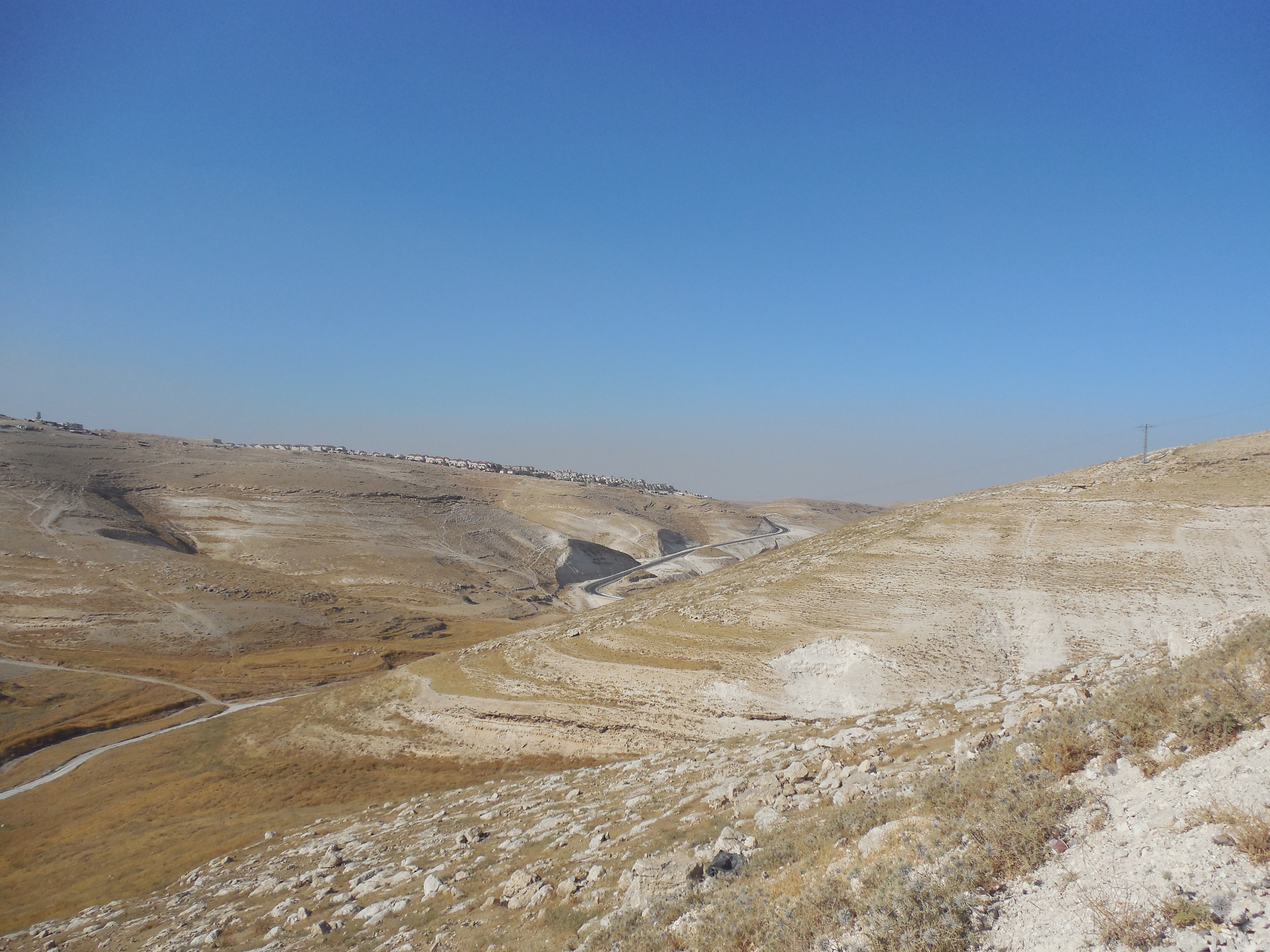
Here’s a shot looking into the distance at the northeastern horizon.

desert4What you see in the distance is Ma’ale Adumim, a Jewish settlement about the size of my hometown of West Orange, New Jersey (and which actually looks a lot like West Orange). The road that snakes through the picture goes to Ma’ale Adumim and by a roundabout route to Jerusalem.

So what do they own? As it happens, Ma’ale Adumim is often described as having been built on expropriated Arab land. If the settlement’s development needs encroach on this valley, whose claims, morally speaking, have prior or overriding consideration? If the Jerusalem Municipality’s Master Plan calls for the incorporation of all this “unused land” into an integrated plan for a Greater Jerusalem, what basis, moral or legal, would these stateless quasi-nomads have for disputing the claims of modern, metropolitan citizens of a functioning state? Whatever the answer, I haven’t encountered anything in the philosophical literature that deals with it in a way that does justice either to the complexity of the issues involved or the urgency of what’s at stake here. (If anyone has bibliographical recommendations, I’d love to hear them.)

We take “civilized” life for granted, and usually take for granted that the displacements it required took place in some distant and morally irrelevant past. But a look at E1 and similar places here suggests that that isn’t so. The displacements are happening now, and happening in the name of the imperatives of civilized life. One of the (many) things that gives the Arab-Israeli dispute its urgency for Americans is the way in which it re-enacts the worst (and most tragically forgotten) aspects of our own history, when we were the Israelis, and our adversaries were the Palestinians. The displacement of the Bedouins in E1 sounds uncomfortably like a 21st century version of the Trail of Tears. It sounds that way, but is it? A complex question in need of an answer that I don’t have.

Cherokee_Heritage_Center_-_Trail_of_Tears_Schild_1.jpg (2560×1920)

Don’t worry; this happened a long time ago.* 

Anyway, I started out by saying that I need to get out more, and I do. I’ve gotten a great deal out of teaching my political philosophy class–we’re currently finishing up Machiavelli’s Prince–and I was right to think that my Occupation-based approach to the classic texts of European political philosophy would pay the hermeneutical dividends I anticipated. I’ve also gotten a fairly good sense of the rhythms and details of life in my immediate vicinity, and made a couple of trips to Jerusalem and Ramallah.

But my activities all seem distressingly parochial. I’m uncomfortably reminded of a passage from Mill’s On Liberty:

In the case of any person whose judgment is really deserving of confidence, how has it become so? …Because he has felt that the only way in which a human being can approach to knowing the whole of a subject is by hearing what can be said about it by persons of every variety of opinion, and studying all modes in which it can be looked at by every character of mind.

I haven’t really done that. I’m ensconced here among Palestinians in a cocoon of Palestinian political and religious opinion. Everyone here is opposed to the occupation and to the settlements–in a fundamental way, to Israel itself.

So the time has come, I think, to hang out with some Israeli settlers. To that end, I’ve made arrangements over the next few weeks to meet one set of settlers through this tour; another through this one; and to visit Ma’ale Adumim through this program. (Here’s a description from 2010; here’s one from a few days ago focusing on East Jerusalem rather than Ma’ale Adumim.) The second of these tours will enable me to visit the Temple Mount/Haram Sharif in the company of Jewish settlers, something I never imagined myself doing before, and which fills me with a peculiar mixture of apprehension and amusement.

I’ll be visiting Hebron through this tour, and spending time in a Bedouin village in the Negev on this one; though the description of the Hebron tour doesn’t say much about interacting with settlers there, I’d like to see how far I can get in the direction of interaction with them. Though I’m not totally sure I can schedule it, I’m hoping to spend a couple days re-visiting the village of Beit Umar through this program; I had an “interesting” exchange with an Israeli military patrol last time I was there, and I’m hoping that I can meet my old “comrades” in that unit once again and re-start the argument where we left it two years ago.

I’m curious what PoT readers are curious about. Any questions you think I ought to be asking, or things I ought to be looking for? Tell me.

————————————————————————————

*”The Treaty of New Echota was ratified by a single vote…” Recall the old axiom, care of Anthony Downs, that a single vote almost never alters the outcome of an election in a politically significant way. “In a large election, the probability that an individual vote might change the election outcome is vanishingly small.” Almost, vanishingly small: sometimes the odds get even.

Postscript, July 19, 2015. Here’s a useful map depicting the places described in this post. (It’s a PDF; unfortunately, I can’t copy and paste it.) I took the long road that starts from the “b” in Abu Dis, and took it past Sawahrah as-Sharqiyah, bypassing Container Checkpoint, and doing a half-perimeter of what’s marked “the alternate site” in E1. The map indicates that all of the land I photographed, though physically inhabited by Bedouins, is within the municipal boundaries or Regional Council jurisdictional area of the surrounding Jewish settlements (either Ma’ale Adumim or Qedar). The realization of the E1 plan would require the expropriation of all of the Bedouin encampments located within the blue space on the map.

It’s an interesting question what moral justification anyone could have for doing this. Even if you argue that Bedouin appropriation of land has to be limited by some version of a Lockean Proviso, it’s unclear how the surrounding settlements could be entitled on the same grounds not only to what they currently have but to everything that the Bedouin have–despite the fact that the Bedouin are on the land, and the settlers are not.  Though I haven’t read as much of it as I should, I get the impression that libertarian discussions of property are, in their current form, ill-equipped to adjudicate disputes of this sort. Likewise Lockean discussions. It’s unclear to me whether Lockean/libertarian accounts can be developed into adjudication-worthy theories, or whether they have to be junked in favor of something different, and more adequate to the task.

Postscript, July 20, 2015: This article from Reuters is exceptionally informative on the plight of the Bedouin in E1.

Postscript, July 24, 2015: Another informative article, this one on the hamlet of Susiya in the southern West Bank.

Thinking about BDS (3): Borne on the Fourth of July

On this day in history in the year 1776 AD, fifty-six American political leaders declared war against the “coercive,” “intolerable” military occupation (about two years in length) that had been imposed on them by Great Britain. They felt pushed to the expedient of war after the failure of the boycott campaign they had initiated against their imperial overlords.

In their words:

We hold these truths to be self-evident, that all men are created equal, that they are endowed by their Creator with certain unalienable Rights, that among these are Life, Liberty and the pursuit of Happiness.

–That to secure these rights, Governments are instituted among Men, deriving their just powers from the consent of the governed, –That whenever any Form of Government becomes destructive of these ends, it is the Right of the People to alter or to abolish it, and to institute new Government, laying its foundation on such principles and organizing its powers in such form, as to them shall seem most likely to effect their Safety and Happiness.

Prudence, indeed, will dictate that Governments long established should not be changed for light and transient causes; and accordingly all experience hath shewn, that mankind are more disposed to suffer, while evils are sufferable, than to right themselves by abolishing the forms to which they are accustomed. But when a long train of abuses and usurpations, pursuing invariably the same Object evinces a design to reduce them under absolute Despotism, it is their right, it is their duty, to throw off such Government, and to provide new Guards for their future security.

–Such has been the patient sufferance of these Colonies; and such is now the necessity which constrains them to alter their former Systems of Government. The history of the present King of Great Britain is a history of repeated injuries and usurpations, all having in direct object the establishment of an absolute Tyranny over these States. To prove this, let Facts be submitted to a candid world.

They’re venerated to this day for the war they started, and the (slave-owning) country they created in its wake.

Feel free to read the bill of particulars over which they started that war. Then compare that bill of particulars to the ever-lengthening one documented (among other places) at B’Tselem, The Israeli Information Center for Human Rights in the Occupied Territories.

Then ask yourself: does it make sense to celebrate a war fought over the bill of particulars in the U.S. Declaration of Independence while criticizing BDS as an anti-Semitic attempt to “de-legitimize” Israel? Is it really wrong to “de-legitimize” a military occupation that has lasted 48 years, that Americans are obliged to support, that the American government refuses (unlike, say, Pakistan) to sanction, and that not only shows no sign of ending, but seems to be intensifying? If we can celebrate an eight-year war begun in response to a two-year occupation, why the vilification of those non-violently resisting an occupation almost a half century in length?

Something to think about tonight under the fireworks, courtesy of an American malcontent in Palestine.

Don’t get me wrong: though British rule over the American colonies was certainly unjust, I don’t mean to suggest that I regard the Revolutionary War as justified. I don’t think it was, so I don’t think the Fourth of July ought to be a matter of celebration.

According to David Bernstein, however, my views on this subject make me “abnormal” (scroll down to the bottom of the comments in the preceding link for the whole thread).

How is celebrating the conquest of East Jerusalem=celbrating the deaths of Arabs? When you celebrate July 4th, does that mean you are celebrating the death of the British. That’s pretty much the dumbest thing you’ve said on this thread. And I’m sorry you’re not troubled by the fact that the news sources you rely on make shit up. …

I think *normal* people distinguish between celebrating a military victory, especially one when your side was attacked in a war of annihilation, and celebrating the death of innocent civilians in terrorist attacks. When you celebrate a military victory, your celebrating that your side one, not that they killed lots of kids. And Jerusalem Day celebrates Jewish control of Jerusalem, not a military victory per se.

I suppose we ought to celebrate “Jewish control of the West Bank” while we’re at it. It’s not a military occupation “per se.”

I guess that’s why, as you pass the Jewish settlement of Ma’ale Adumim and enter the Arab town of Al Azariya, the trees are festooned with Stars of David and the number “67.” The IDF wants to celebrate the fact that in 1967, they established “Jewish control” over everything you see around you, while abstracting from the fact that the control is enforced by means of tanks and machine guns “per se.” If you’d like to be the kind of moron that David Bernstein thinks you are and wants you to be, feel free to indulge in that act of amnesiac evasion. But don’t do it while celebrating the Revolutionary War.

Ask yourself instead whether war was justified in the one case, and prolonged military occupation is justified in the other. As an American, you’ve likely internalized a lifetime of propaganda intended to convince you that you owe moral allegiance to the ideals of the American Revolution, and owe a blank check to the imperatives of the Israeli Occupation. This Independence Day, do something different for a change. Consider the possibility that you don’t.

Prior installments in this series:

Thinking About BDS (1): Infantilization, ‘Safe Spaces’ and Threats to Discourse

Thinking About BDS (2): The Rhetoric of the Race Card

Were Rousseau’s Children Victims of His Moral Theory?

Yes, it’s true: Jean-Jacques Rousseau, philosopher of compassion, fierce defender of the weak against the strong, the man who never tired of talking about equality and justice and virtue, who wrote a long book (Emile) about just the right way to raise children, sent all his own children to the Paris Foundling Hospital immediately upon birth.  He never knew or even saw them.  Rousseau’s admirers sometimes write as if there might be some doubt about this (e.g., Riley 2001, 6).  But not usually.  More commonly the fact is accepted without question (e.g., Cohen, 1953, 13; Bertram, 2012, 4; Edmonds and Eidinow, 2006; Kelly, 2001, 315).  Indeed it’s hard to see what doubt there could be when Rousseau refers repeatedly to it in his Confessions (1953, 320–22, 332–35, 387, 437, 515–16, 549, and possibly 583–84).  As Cohen (1953, 13) points out, several of the people Rousseau claims to have confessed the secret to were still alive when the Confessions were published, and if it weren’t true, some of them surely would have said so.

Now, being no fan of Rousseau’s brand of social thought, I admit that I am not sorry to find evidence of his hypocrisy.  I’m inclined to smile along with Deirdre McCloskey: “A house ‘filled with domestic cares and the noise of children’ would make a poor place for discoursing on social justice and the raising of children.  Thus on five occasions did Jean-Jacques Rousseau act, that great pre-Romantic teacher of good behavior in love and education” (2006, 114).  But being also at present the teacher of a class on Critical Thinking, my conscience is pricked with the thought that this is ad hominem.  Rousseau’s hypocrisy does not make his social and moral theories false.

My own thought when I learned of this episode in Rousseau’s life was, “if Rousseau had spent less time cultivating his conscience and more time cultivating his character, maybe he wouldn’t have done that!”  That is, it struck me that Rousseau’s actions in this case illustrate a fundamental problem with his conscience-centered morality and thus are philosophically relevant after all.

To judge from the statements of the Savoyard Vicar, which are confirmed repeatedly by statements made in Rousseau’s own voice in the Confessions, conscience is the lone pillar of Rousseau’s moral view.  Rousseau espouses a form of moral sense theory that makes conscience the sole and infallible oracle of right and wrong.  Rousseau’s moral view can be summarized in eight points.  (a) “All the morality of our acts is in the judgment that we ourselves pass on them” (1975, 259).  This seems to be a statement of subjectivism, though how far to take it is questionable.  The same Savoyard Vicar who makes this statement also believes that God rewards the virtuous and punishes the wicked after the death of the body.  Still, if there is any other basis of right and wrong, Rousseau gives no hint of it.  (b) The “judgment” in question is a matter of feeling, not reason or cognition.  “[W]e feel before we know, and just as we do not learn to will our own good and avoid what is harmful to us, but receive that will from nature, love of good and hatred of evil are as natural to us as self-love” (1975, 262–3).  (c) Our moral feelings are the product of an innate faculty called conscience.  It is the inner voice of right and wrong.  It not only allows us to recognize the good, it motivates us to love and pursue it.  It is to the soul what passions and instincts are to the body (1975, 258–9).  (d) Conscience is infallible (1975, 264).  (e) The judgments of conscience are universal; that is, essentially the same across persons and cultures (1975, 261–2).  (f) Although infallible, conscience can be misled by false information or sophistical reasoning.  The Savoyard Vicar doesn’t discuss this point, but it is clear and important in the Confessions (see for example 1953, 190–1, 218–9).  The same point is made concerning the general will in The Social Contract: the general will is infallibly good but not necessarily very wise (II.iii, vii).  It can be misled.  For Rousseau, the general will is to the body politic what the conscience is to the individual.  (g) The voice of conscience can be ignored or denied (1975, 264).  Indeed this happens all too often, usually from personal interest.  When we are disinterested in a case, the voice of conscience is typically clear and easy to discern; when our personal interests are engaged, our passions compete with conscience and frequently overwhelm it.  (h) A person whose conscience is misled is not morally culpable.  It is not a moral requirement that one be wise or smart.  But it is morally wrong to deny or ignore one’s conscience.  Moral goodness consists in listening to and following the voice of one’s conscience.  This is a matter of degree.  One can be more or less guilty, depending on the degree of temptation, the seriousness of the moral issue, one’s level of strength and personal development, and so forth.  Again the Vicar doesn’t go into these details, but the many moral judgments passed in the Confessions make this clear.

The Savoyard Vicar summarizes the view:

Conscience!  Conscience!  Divine instinct, immortal and celestial voice!  You are the sure guide of a being who is ignorant and limited, but intelligent and free.  You are the infallible judge of good and evil; it is through you that man resembles God; it is to you that he owes the excellence of his nature and the morality of his acts.  Aside from you, I feel nothing in me that raises me above the level of the beasts, except the sad privilege of wandering from error to error by means of understanding without rules and reason without principles. (1975, 264)

We can see also how this moral view supports Rousseau’s famous thesis that we are born good and corrupted by society.  Conscience, the guide and motive force of our inmost soul, is inborn.  Unfortunately it is “timid” (1975, 264) and retires in the face of the raging passions stirred up by our personal concerns and the competitive pressures we are subject to in the world of affairs.  When we allow this to happen, it is due to our own weakness.  Nevertheless, that we allow it to happen is the rule, not the exception.

Now, what’s wrong with all this?  I believe there are several things wrong with it, but here I want to emphasize one in particular, which is that it is largely content free.  What does the voice of conscience say?  How do we know when we are hearing the voice of conscience and when we are hearing the voice of passion, prejudice, tradition, etc.?  Rousseau provides no criterion or even any discussion.  He seems to think it’s just obvious.  But of course it is not.  It is not even obvious—not to mention plausible—that a Rousseauan innate faculty of conscience exists in the first place.  Note the difference between Rousseau and the Scottish moral sense theories of David Hume and Adam Smith.  Hume and Smith, each in his own way, provide a specific psychological mechanism by which moral feelings (and hence judgments) arise from other, relatively uncontroversial, nonmoral feelings.  Thus they give us both a reason to believe that the sort of moral feelings they describe really exist and a guide to the content of those feelings.  Rousseau gives us neither.

He does supply some examples to give us an idea of what conscience dictates (1975, 258–60).  Conscience approves of compassion, kind acts, friendship, clemency, magnanimity, and Cato the Younger.  It disapproves of seeking our own good at the expense of others, malicious acts, insensitivity, violence, suffering, and Caesar.  But for the most part he describes the deliverances of conscience in terms that are already moral: conscience approves of goodness, virtue, heroic deeds, sweetness, the noble, justice, etc., and disapproves of wickedness, crimes, injustice, viciousness, depravity, etc.  Unless we already know good from bad, this hardly helps.

But of course, he thinks we do already know!  That’s the theory of conscience.  Perhaps, anticipating G. E. Moore, Rousseau would say that the good, right, etc.—in general, moral approval—is sui generis and irreducible.  We know it when we see it, or rather when we feel it, thanks to our innate faculty of conscience.  There is nothing more to be said.  We cannot identify the good in any other terms (such as flourishing, desire satisfaction, living in accordance with nature, etc.) or supply any standard by which to assess it.  If we would know the good, we must cultivate our “exquisite feelings” (1975, 259) and “tender emotions” (1975, 260), not deny or suppress them.

Moral development on this view is a matter of uncovering and encouraging these exquisite and tender feelings, and this in turn is primarily a matter of ceasing to deny and suppress them.  The feelings are natural; they are there.  But they are “timid” and driven underground by the passions, corruptions, artificialities, and concerns whipped up by society and its pressures.  To recover our innate goodness and cultivate our conscience depends on returning to nature and its simplicity.  This is quite different from a traditional view of moral development as requiring that one master some set of substantive principles and acquire the habit—the strengths of character—of following them.

If Rousseau’s basic moral precept and advice is to cultivate one’s tender and exquisite feelings, then no one can say he didn’t practice what he preached.  The Confessions consists almost entirely of the history of Rousseau’s feelings.  Every episode is described principally in terms of how Rousseau felt about it, the feelings that motivated his own actions and the feelings that resulted.  The feelings are often intense, sometimes all-consuming.  Rousseau’s thoughts on the other hand take a decided second place.  And if one approaches the Confessions expecting something like an intellectual autobiography, one will be disappointed.

The point of the Confessions is not exactly to justify Rousseau and defend his reputation—well, not before Book IX anyway—but it is to reveal Rousseau’s soul to the reader in such a way as to make clear that Rousseau is a good man.  Notwithstanding a few bad moments, Rousseau believed that “I am on the whole the best of men” (1953, 479), and he proposed to demonstrate this by presenting an account of his life that would be as complete and truthful as he could make it, with respect to both his actions and their motivations.  It is evident that a key component of this project of displaying the goodness of his soul is to tell the history of his exquisite and tender feelings.  By showing what “tender feelings” underlay his every action, his actions are rendered, if not always quite good, at least not viciously motivated.

We see the exculpatory power of tender feelings repeatedly in the Confessions, not just in Rousseau’s own case but in the cases of other people he loves and is determined to think well of.  His father, whom he refuses to criticize, effectively abandoned him at the age of ten and never supported him thereafter, although he could have done so.  Indeed, Rousseau effectively supported his father through an inheritance from his mother (who died of puerperal fever nine days after he was born), money that belonged to Jean-Jacques but which was at the disposal of his father as long Jean-Jacques wasn’t around to collect it.  Hence, according to Rousseau (1953, 61), his father’s neglect.  But his father wasn’t bad.  On the contrary, he was good, affectionate, and “a man of scrupulous integrity, and possessed of that strength of mind that makes for true virtue.”  How does this evaluation square with his father’s actual behavior?  Evidently the idea is that his father meant well—his tender feelings never wavered—but unconsciously (“obscurely without his being conscious of it”) his self-interest in the money influenced his behavior.  Thus he could remain good in his heart even though his actions were not what they should have been.

Another person Rousseau loved and was determined to think good was Madame de Warens, whom he met shortly after running away from home at the age of 16 and with whom he lived during most of his twenties.  His senior by about fourteen years, she was a mother figure to Rousseau (he called her “Mamma”) and remained so even after she became his lover.  She was surely the most important person in his entire life.  He insists throughout the Confessions that her character was one of angelic purity and goodness.  Her M.O., at least during the period of her life that Rousseau describes, was to attach men who could do things for her to herself by sleeping with them, for as long as the arrangement was useful and no matter what other men were simultaneously in her life.  To this reader, it seems evident that Rousseau’s own relationship with her was not exceptional in this regard.  She informed Rousseau that they would have sex at about the time it became apparent that he might otherwise be seduced by other women.  Later, when he became sickly and incapable of doing much, she replaced him with another man.  Or perhaps “supplemented” would be more apt, since, although the other man took the primary position, she did not propose to withdraw her favors from Rousseau.  (He however declined to accept them anymore and soon moved away permanently to Paris.)  Rousseau himself does not regard her sexual behavior as morally appropriate.  How does he reconcile it with her goodness?  She had mistaken ideas.  “All her faults, I repeat, came from her lack of judgment, never from her passions” (1953, 190).  To be specific, she was led astray by her philosophy teacher!  In an attempt to seduce her, which succeeded, he plied her with sophistries and convinced her that sexual intercourse is intrinsically unimportant and that marital fidelity need be kept up only in appearance, not in reality.  Thus hers was a case of a misled conscience: innocent and good although mistaken.

These two cases set the pattern: wrongdoing can be compatible with goodness of heart if the wrongdoing can be put down to weakness, such as unconscious corruption in the case of Rousseau’s father and weakness of understanding in the case of Mme. de Warens.  This is the strategy Rousseau applies to himself as well.  He has, he says, every virtue but strength of character (1953, 261).  I do not mean that he completely lets himself off the hook for every wrongdoing.  He clearly blames himself (in a mild way) for certain acts, though not many.

To return at last to les enfants, what does Rousseau say about his actions in this regard?  He insists that at the time of the decision, he was morally untroubled (1953, 322).  The only reason he did not boast openly of his actions was to save the feelings of his mistress (the mother), who did not agree with the decision (1953, 333).  He claims he got the idea that abandoning one’s children at the Foundling Hospital was “the custom of the country” (1953, 322) from the ribald stories told by the “fundamentally decent” men at the dining establishment he frequented.  He regarded children as a considerable inconvenience, abandoning them was a socially acceptable way to relieve oneself of it, problem solved.  So like Mamma, his heart was good but he was misled.  He asks himself whether he might have been callous or lacking in humanity in abandoning his children, and answers: “No, I feel, and boldly declare—it is impossible.  Never for a moment in his life could Jean-Jacques have been a man without feelings or compassion, an unnatural father.  I may be been mistaken, but I could never be callous” (1953, 333).  He then alludes, in all seriousness, to reasons that persuaded him to abandon his children that were so powerful that they cannot be revealed, lest they corrupt other young men!  Some other reasons he does give in this passage include imagining himself as a guardian in Plato’s Republic who must turn over his children to the state and never know their identities, and the reflection that it would be better for them to be brought up “as honest people” (at the hands of an 18th century state orphanage) than with money, as would have happened if one of Rousseau’s aristocratic patrons had taken them in, as some offered to do.  A final reason was that he wanted to keep his children away from the influence of his mistress’s bad family (1953, 334, 387).  Whatever Rousseau’s all-powerful hidden reasons may have been, one has to agree that he could safely reveal these others.

Rousseau eventually developed a considerably bad conscience about the way he had disposed of his children.  He considered making a public confession of the fact at the start of Emile, but thought better of it.  (He does make a veiled allusion to it in that book, 1979, 49.)  Nevertheless, in spite of his later bad conscience, he insists that the action was innocently done at the time and with a good heart.  I believe this raises a serious existential challenge to Rousseau’s whole conscience-based moral view.  A baby at the Paris Foundling Hospital in these years had only a two thirds chance of surviving its first year and only a five percent chance of reaching maturity.  These are facts which Rousseau could have determined without much difficulty if he had felt motivated to bother (Johnson 1988, 21).  One can imagine the Dickensian conditions that must have prevailed in the place.  What is the use of a moral view that can’t tell a modern European he shouldn’t treat his kids that way, like so much garbage?  Less rhetorically, can it be true that we possess an innate, infallible oracle of right and wrong if Rousseau could not hear that oracle telling him it is wrong to dispose of his children in the way he did?  Rousseau, after all, was “the best of men” and “never for a moment in his life… without feelings or compassion.”  He must have been fully attuned to the voice of his conscience if anyone ever was.  Even without any explicit moral theory or moral code, his conscience would be there, according to his view, and he as a man of tender and exquisite feeling should have been in a position to hear it.  But by his own account, he didn’t.

His own account is that he honestly thought he was doing the very best for his kids, better than raising them himself and better than letting one of his aristocratic patrons take them in and better than any other avenue he might have pursued but didn’t.  But can conscience be supposed really to be so utterly detached from cognition as to accept without a murmur the idea that it is better for a child to be in an orphanage than in the home of his parents or on an aristocrat’s estate?  Can conscience really be so passive and accepting of what cognition says as not to at least raise concerns and push for a clear examination of conditions at the Foundling Hospital?  Conscience is supposed to at least be able warn against suffering and seeking one’s own interest at the expense of others.  Can it not be expected to recognize when these conditions are liable to be going on or at least to motivate cognition to make proper inquiries?  If it can, then Rousseau’s account of the case of his children is inadequate and we must suppose his conscience failed him.  In which case, we must be skeptical about the existence of such a thing as a Rousseauan conscience.  If it can’t, there is a serious theoretical problem of how conscience is supposed to provide the guidance it is supposed to provide.  If conscience cannot tell you the suffering of your children is morally important, what can it tell you?

Of course, really the best account of Rousseau’s actions in disposing of his children at the Foundling Hospital is that he callously eliminated them from his life because they interfered with the way he wanted to live it.  He doesn’t want to admit this, no doubt even to himself, and the story of his being misled is his form of denial.  In which case Rousseau might not after all have been the best of men, but at least his moral view might be saved.  His conscience did speak, but only timidly and was drowned out by the passions of self-interest.  But this solution will not do for reasons similar to the ones that scuttled the solution in terms of his being misled.  We can’t just say Rousseau was depraved so naturally he didn’t listen to his conscience.  He may not have been the best of men, but he was hardly depraved.  Surely he was a basically decent man and as full of tender feelings as he describes.  (No one could make that stuff up, or would want to, who wasn’t really of that character.)  He was in as good a position as anyone could reasonably be to hear and heed the voice of his conscience.  But he didn’t.  Although not depraved, and motivated by tender feelings, it seems he was morally somewhat rudderless.  So if we are still to believe in the existence of conscience in the Rousseauan sense, then as before we will have to radically reduce its supposed efficacy.  There seem to be two choices: either the voice of conscience speaks so softly as to be barely audible even on such questions as the fate of one’s children, or its content is so vague as to provide no real guidance, again even on such a question as Rousseau was facing.  Either choice seems hardly distinguishable from the skepticism they are being proposed to avoid.

We are driven to the conclusion that Rousseau’s own case raises serious doubts about the existence of an infallible, innate faculty of conscience that operates in something like the way Rousseau describes.  Rousseau would have done better, both in his moral philosophy and in his life, to cultivate substantive moral principles and the character to go with them than to wallow in exquisite and tender feelings with the idea that they are a sufficient guide to life.

There is one further point.  Rousseau’s theory of conscience is a poor source of moral guidance, but it is a rich source of excuses for moral failings.  Consistently in the Confessions, we see Rousseau excuse his own bad behavior and that of the people he loves on the claims that they were misled or at worst a bit weak.  Not coincidentally, his theory makes this easy to do.  Since the theory articulates no substantive principles a person is expected to follow or character they are expected to exhibit, and since a good heart is unobservable, it can always be claimed that a good heart is really present but let down by bad advice or weakness, and this is sufficient to make a person good according to the theory.  So the people Rousseau loves, like Rousseau’s father and Mme. de Warens, can be claimed to be pure and good despite their bad behavior, while the people Rousseau is on the outs with, like Denis Diderot and Friedrich Melchior Grimm, can be base and wicked.

It is tempting for a variety of reasons to believe that we just know by an innate faculty what is good.  But it is false.  The effect of holding that we have such a faculty in Rousseau’s case, and probably in any other, is to leave him with no standard of moral evaluation either in theory or in his own life.  It is thus to leave him without moral guidance.  It is tantamount to no moral view at all.

WORKS CITED

  • Bertram, Christopher.  2012.  “Jean-Jacques Rousseau.”  Stanford Encyclopedia of Philoosphy.
  • Cohen, J. M.  1953.  “Introduction.”  In Jean-Jacques Rousseau, The Confessions, J. M. Cohen, translator, Penguin, pp. 7–14.
  • Edmonds, David, and John Eidinow.  2006.  “Enlightened Enemies.”  The Guardian, 28 April.
  • Johnson, Paul.  1988.  Intellectuals.  Harper & Row.
  • Kelly, Christopher.  2001.  “Rousseau’s Confessions.”  In Patrick Riley (ed.), The Cambridge Companion to Rousseau, Cambridge U. P., pp. 302–328.
  • McCloskey, Deirdre N.  2006.  The Bourgeois Virtues.  University of Chicago Press.
  • Riley, Patrick.  2001.  “Introduction: Life and Works of Jean-Jacques Rousseau.”  In Patrick Riley (ed.), The Cambridge Companion to Rousseau, Cambridge U. P., pp. 1–7.
  • Rousseau, Jean-Jacques.  1979.  Emile, or On Education, Allan Bloom, translator, Basic Books.
  • ———.  1975.  The Creed of a Savoyard Priest, Lowell Bair, translator.  In Jean-Jacques Rousseau, The Essential Rousseau, New American Library.
  • ———.  1953.  The Confessions, J. M. Cohen, translator, Penguin.
New Bloggers at Policy of Truth

I’m happy to announce that I’ll be adding two new bloggers to Policy of Truth. Both are old friends of mine, and both have made cameo appearances here in the recent past.

David Potts teaches philosophy at the City College of San Francisco. He has a Ph.D. in philosophy and a Ph.D. in cognitive psychology from the University of Illinois-Chicago, where, on the philosophy side, he worked with David Hilbert. Though his “official” areas of specialization are epistemology and philosophy of mind, his first post here will be on Rousseau (which should be posted in a day or two). He’s guest-posted here previously on the so-called Dunning-Kruger effect. Note: Readers are strictly advised to avoid puns involving David’s last name and the acronym for this blog. (I’m probably the only person here who was ever tempted to flout that advice in the first place.)

Michael Young has taught philosophy at Bridgewater State University in Massachusetts, and has done graduate work in philosophy at Brown University. Though he’s “officially” interested in issues in meta-ethics and moral psychology, his first post here will be a contribution to the “Rethinking Rights” series I mentioned awhile back (that post should go up mid-week, a few days after David’s). Incidentally, our Michael Young, who blogs from Providence, Rhode Island, should be distinguished from the other Michael Young, who blogs from Beirut.  They turn out to be as different as Rhode Island is from Lebanon.

Welcome aboard, both of you–looking forward to your posting and comments.

Postcards from Abu Dis (7): Museum on the Seam, Jerusalem

I went to Jerusalem’s semi-famous Museum on the Seam the other day (“MotS”). A couple of friends have asked for a report on what I saw there and how I liked it, so I thought I’d blog it.

Here’s the Museum’s self-description, from its website:

The Museum on the Seam is a socio-political contemporary art museum located in Jerusalem. The Museum in its unique way, presents art as a language with no boundaries in order to raise controversial social issues for public discussion. At the center of the changing exhibitions in the Museum stand the national, ethnic and economic seam lines in their local and universal contexts.

The Museum is committed to examining the social reality within our regional conflict, to advancing dialogue in the face of discord and to encouraging social responsibility that is based on what we all have in common rather than what keeps us apart.

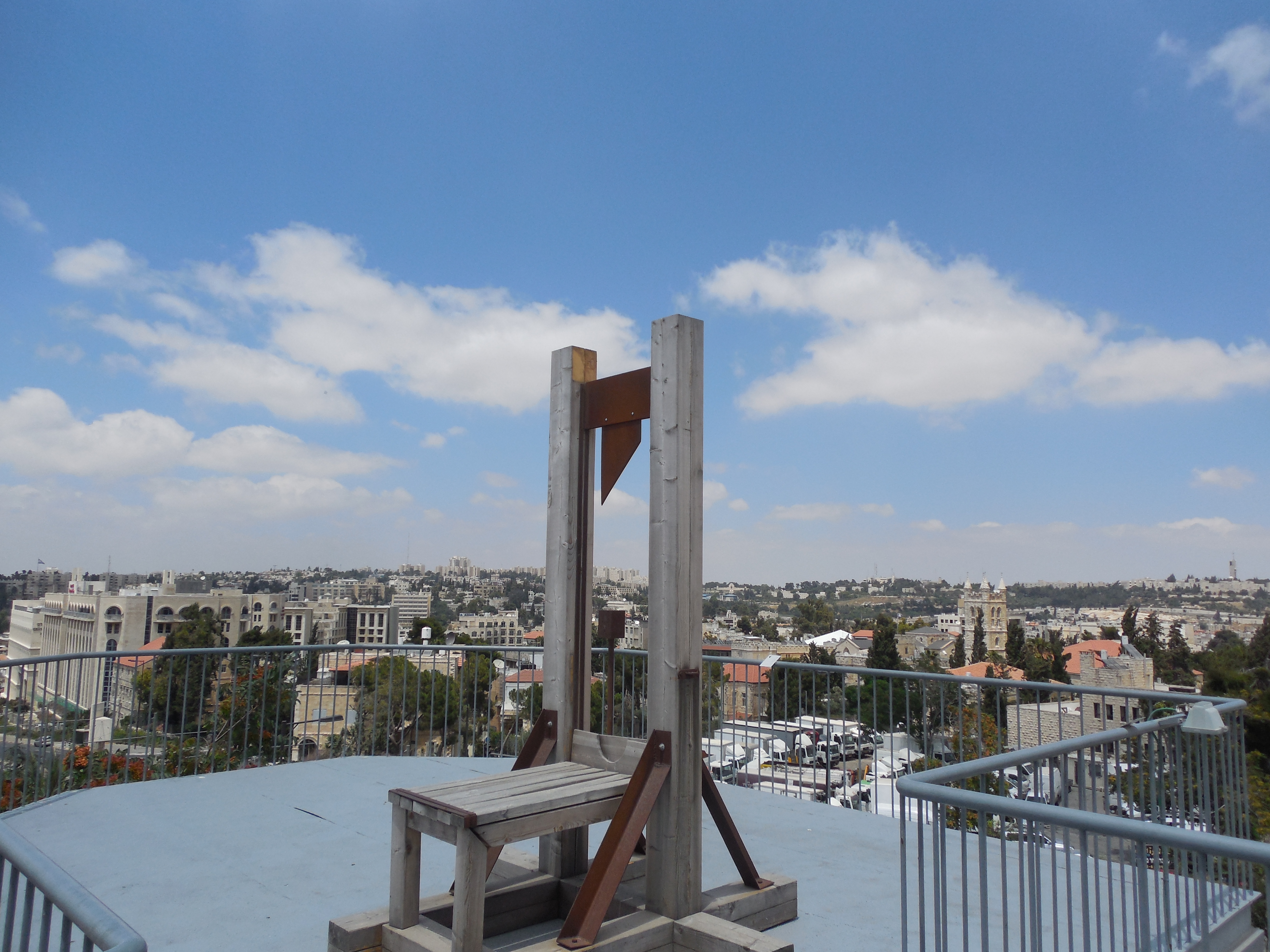
It’s a relatively small place, three floors of museum plus a guillotine-equipped observation deck, housed in a building that played an important role in the 1948 and 1967 Arab-Israeli wars. The wartime damage to the facade of the building is still visible, and constitutes part of MotS’s aesthetic-political appeal. The owners are obviously proud of the fact that the place manages to look both chic and bombed-out, and though the comparison isn’t exact, the vibe is a little bit like Manhattan after 9/11.

mots1

The Museum gets its name from its physical location–on the seam or borderline between largely Arab East Jerusalem and largely Jewish West Jerusalem, two halves of an “eternally undivided” city divided by one war, and fused together by another. Strictly speaking, MotS is located in West Jerusalem, but that’s only because it’s on the west side of Hel Handasa, the street that divides the city. So it’s at the eastern edge of West Jerusalem, across the street from the Arab neighborhood of Sheikh Jarrah in East Jerusalem, and next to the ultra-Orthodox Jewish neighborhood of Mea She’arim.

Though the Museum is obviously well-named, I’m inclined to wonder whether anyone from either Sheikh Jarrah or Mea She’arim ever visits the place. As it happens, the only people in the Museum during my visit there were American tourists like me. There’s a kind of symbolism in that: East doesn’t seem to meet West in Jerusalem; the two keep their distance from one another, leaving Americans to fill the gap. I get the sense that for the most part, Americans visiting “Israel” tend to go as far East as is compatible with staying firmly in the West. In other words, they stay in Israel, and visit the West Bank, if only for Bethlehem. My visit to MotS reinforced that sense.

MotS is controversial by design, and there are at least two rival perspectives on it. Partisans of Israel sing its praises as a daring exercise in contemporary guerilla art. Partisans of the Palestinian cause regard it as an overhyped pseudo-radical exercise in Zionist apologetics and imperialist bullshit artistry. My own sensitive and deeply nuanced view sits somewhere in between those unsubtle extremes. In other words, I thoroughly enjoyed my visit to MotS, but ultimately sympathize with the Palestinian take on it. It shouldn’t surprise you that, as an American, I feel entitled to have it all.

I particularly liked four of the exhibits I saw, and through the wonders of the Internet, I can show you two and a half of them right here.

The first was this film, “Los Encargados,” by the Spanish artists Jorge Galindo and Santiago Sierra, which depicts a motorized protest up the Gran Via in Madrid, Spain in August 2012. It’s set to an old socialist worker’s anthem, and for me, that really did the trick (not because I’m a socialist, but because I liked the anthem).

The message is not exactly subtle–Spain’s leaders have betrayed the country’s working class–but aesthetically, it works, so I liked it. (Trigger warning: I’m really not that sophisticated or articulate about art, so this is the level of commentary you should expect for the rest of this post.)

This second film is a lot longer than the first (37 minutes), but frankly I think it’s a masterpiece, and I was riveted by it from beginning to end–despite knowing absolutely nothing about the issue it engages with, and having no idea how to pronounce the artist’s name. It’s Chto Delat’s “The Tower: A Songspiel,” in Russian, and it’s about a controversy concerning the (pardon me) erection of the Gazprom Tower in St. Petersburg. If you don’t have 37 minutes to spare, just watch the first two minutes. I don’t know about you, but I found it hilarious.

The depiction of the short-haired elite woman struck me, somewhat vaguely, as a parody of Ayn Rand–not so much a political parody (the woman’s views are not particularly Randian) as an aesthetic one. To be precise, it seems like the kind of parody you’d expect of someone who had heard of Rand but never read her (there’s no shortage of such people). But I still liked it.

I can’t show you the third film, William Kentridge’s 3-minute “Monument,” but here’s a description of it:

Monument is Kentridge’s second film in the series and explores his feelings of ambivalence about the privileges and comforts of the white South African society into which he was born. It was made from a basis of eleven drawings and is accompanied by music composed by Edward Jordan. Soho Eckstein, wealthy real estate developer, here assumes the guise of civic benefactor and erects a monument to the black South African work force, from whose labour his wealth is derived. The monument is a huge statue of an anonymous African workman. During the ceremony of unveiling the monument, in the first half of the film, the statue comes to life. Slowed by the enormous burden on his shoulders, he makes his way across the outskirts of the city, before disappearing into the distant landscape.

There’s a vague Rand connection here, too: the film managed to remind me of Rand’s essay “The Monument Builders” in The Virtue of Selfishness, and the film’s protagonist bears an obvious similarity to John Galt from Rand’s Atlas Shrugged. That said, I somehow doubt that Kentridge has ever heard of Rand, or that the average Randian has ever heard of him; same symbolism, different messages.

A fourth piece I liked was a bitter sculpture of Israeli Prime Minister Menachem Begin by the Israeli artist Uri Lifshitz. Unfortunately, I haven’t been able to find a version online. Since you really have to see it to appreciate its power–and it was powerful–I’ll leave my “commentary” on it at that.

I should add that the Museum’s staff was excruciatingly nice to me in that disarmingly earnest, half-apologetic way that I associate with a certain brand of Israeli leftist. Maybe it’s my American imagination on overdrive, but I felt as though the staff was saying, “We realize that the occupation is in its 48th year–and we apologize for that–but we hope you’ll like the Museum anyway.” Which I did (thanks). I  guess I should also mention that MotS is responsible for the “CoExist” meme you’ve probably seen, which combines symbols from the world’s religions to form an icon spelling that word. If the Museum had a slogan, it might be the one associated with Rodney King (of Los Angeles riots fame): “Can we all just get along?”

So that’s what I liked about MotS. But there were some things I didn’t like–really, one big thing with a variety of different aspects. In a way, this complaint is a response to the somewhat facile nature of the whole “CoExist” idea associated with MotS. There are reasons why coexistence is not as easy as putting a clever bumper sticker on your car.

To approach that problem, consider some of the hype in favor of MotS. The authors of Lonely Planet’s Israel and the Palestinian Territories are typical in their accolades for the place:

Conflict, prejudice, racism (and occasionally coexistence) are on display at the Museum on the Seam, a socio-political/contemporary art museum that pulls no punches. …

Do not mistake it for a museum about the Israeli-Palestinian conflict; the issues here are broad and far-reaching and the Middle East conflict is just one small piece of a larger puzzle. (2010 edition, pp. 130-31)

Well, that’s one–rather euphemistic–way of putting things. I think it’d be more accurate to say that the Museum does its best to avoid the Arab-Israeli conflict, and in so doing, pulls a lot of punches. You couldn’t guess, by walking through it, that MotS is on the seam of the Arab-Israeli conflict. In fact, you couldn’t guess that the Museum is in Jerusalem, much less that it advertises its proximity to Arab East Jerusalem. Going by its contents, MotS could just as well be located in New York or Chicago as anywhere in Israel.

None of the artists featured in MotS are Palestinians. Neither are any members of the Museum’s administrative staff. With one exception, none of the exhibits had anything to do with the Arab-Israeli conflict. The exception is the Uri Lifshitz sculpture I mentioned, but even there, Lifshitz depicts things entirely from an Israeli perspective. His approach reminds me of Ari Folman’s in the 2008 film Waltz with Bashir: the theme is the anguish, from an Israeli perspective, of Israel’s having fought the 1982 Lebanon War, not the anguish of being on the Palestinian or Lebanese receiving end of the Israeli invasion. I don’t begrudge Lifshitz his perspective on things (he was a paratrooper in the IDF), but the fact remains that the closest that MotS comes to engaging Palestinians is the artwork of an Israeli paratrooper lamenting the fact that he had to kill some.

Mariam Shahin, author of Palestine: A Guide, is harshly dismissive of MotS:

Israelis established the Museum of [sic] the Seam in the confiscated home of the Baramki family. The theme of the displays is the development of Jerusalem since 1948. Although the curators say the museum is designed to bring Arabs and Jews together from both sides of Jerusalem, the signs are only in Hebrew and English. (p. 337)

Though I sometimes find Shahin’s nationalist polemics wearing, and would dispute the accuracy of the second sentence, the first and third sentences of this excerpt are very much on point. Nowhere is MotS candid with the visitor about the complex and problematic history by which it claimed ownership of the building it calls its own (more on that below). And for a Museum that prides itself on bridging East and West Jerusalem, Shahin is right to suggest that it’s not exactly an Arab-friendly place. Shahin was writing in 2007, but things don’t seem to have changed that much since then: though a small handful of the signs are in Hebrew, English, and Arabic, the vast majority are only in Hebrew and English. You can see why the residents of Sheikh Jarrah are not exactly lining up to get in: even if you could cough up the 30 shekel entrance fee, you’d have no idea what was going on around you. No surprise that the only Arab in the whole place was the guy serving coffee in the café.

But all of that really pales in comparison with the property-rights issue, bitterly summarized by the Arab Israeli politician Awatef Sheikh in a 2011 piece in Washington Report on Middle East Affairs, “Jerusalem’s Museum on the Seam: Artful Dodging.” Reading the first paragraph, I was inclined to think that Sheikh was overdoing the polemics, but having worked my way to the end, I had to admit that he was painfully right.

The building which today houses the Museum on the Seam is, in fact, owned by the Baramki family. It was designed by Andoni Baramki, then a young Palestinian architect who designed many of Jerusalem’s houses. In 1934 he built it and rented it to two Palestinian families who were forcibly expelled from the house in 1948. The Baramki family lived in a rented house nearby and, like hundreds of thousands of Palestinians, were forced to flee their homes in search of temporary safety during the violent spring of 1948. Denied return to their home, the Baramki family lived as refugees in Gaza before moving to the village of Birzeit, north of Ramallah, in 1953. Following Israel’s occupation of the West Bank in 1967, all members of the Baramki family with the exception of son Gabi—his parents, brother and sister- managed to obtain Jerusalem ID cards and live in East Jerusalem. The Washington Report on Middle East Affairs, contacted Dr. Gabi Baramki, who was 18 when his family fled Jerusalem in 1948. A former vice president of Birzeit University, he lives in Ramallah.

After 1967, when the family was able to cross over to the west side of the city, Gabi’s father, Andoni, fought for his right to his house. He went to the Israeli Custodian of Absentee Property, presented the deeds to his house and his identification documents. According to Gabi, “My father, a 6’4″ tall man, stood in front of the Custodian and told him: ‘I’m Andoni Baramki and I want to return to my house.’ The Custodian looked back at him and replied: ‘you are absent.'” The family then turned to the court but received no justice there, either. “You will get your house when there is peace,” the judge told Gabi’s father. People often told Gabi that his father, a very well-known figure in Jerusalem, “stood in front of the house for hours looking at it the way Romeo used to look at Juliet.” Andoni Baramki was never allowed to set foot inside his house again. He died in 1972.

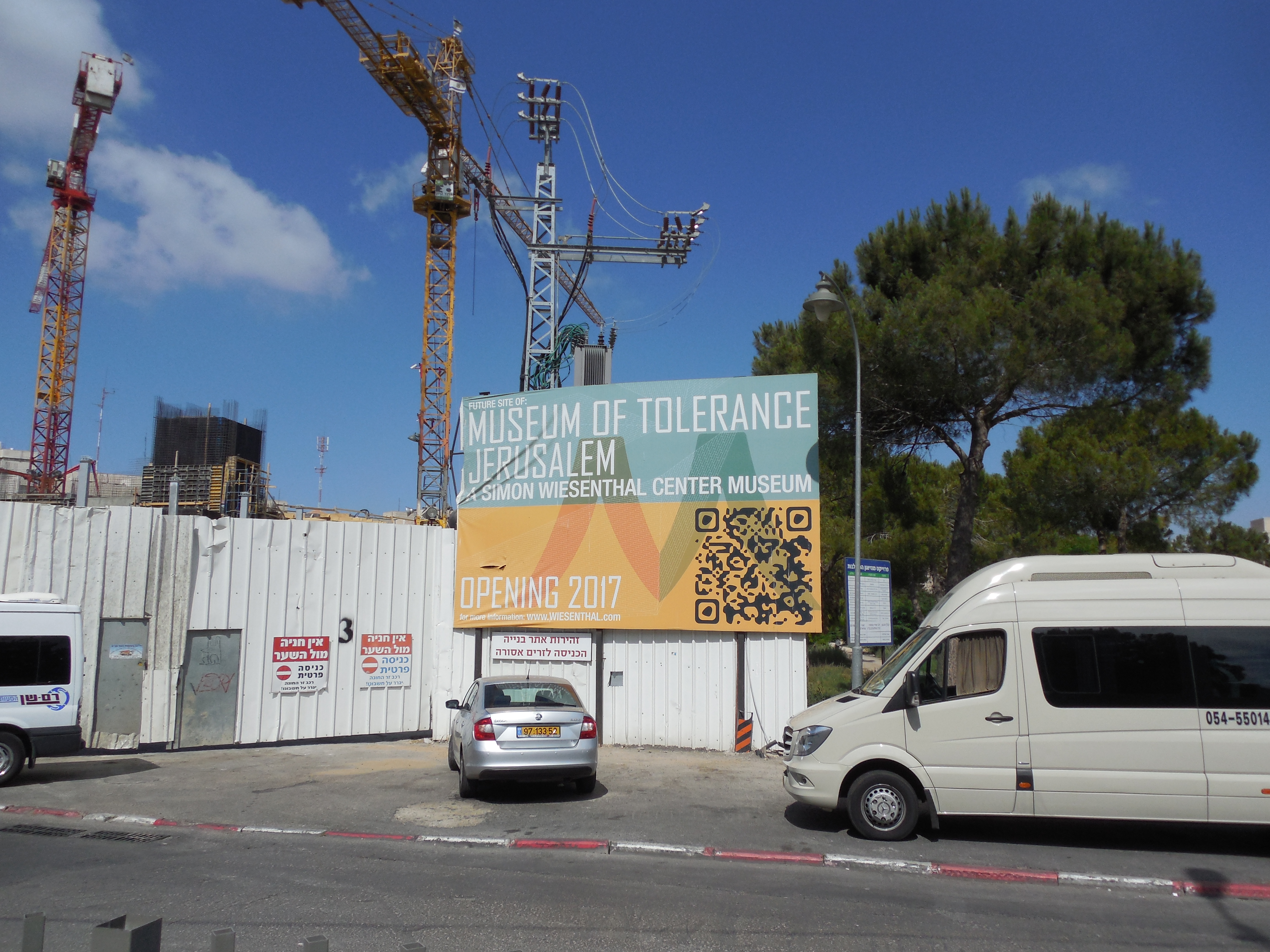
There seems to be a pattern here: just as MotS is the expropriated home of a “present absentee” Palestinian, so the forthcoming Simon Wiesenthal Museum of Tolerance is currently being built on top of the Mamilla Muslim Cemetary in violation of the property rights of the Palestinians whose family members are buried there. (For more on the Mamilla issue, see this article from Columbia Journalism Review, featuring my friend, Rawan Dajani.) The ethos seems to be: Injustice must be done so that good may come of it (and feed the insatiable desire for uplift characteristic of bien pensant American tourists).

tolerance

Given betrayals of this nature, it becomes hard to take Israeli liberals’ claims about the need for mutual understanding and tolerance at face value, and tempting to regard their brand of liberalism as a self-deceived charade. When they tell you that “art lacks boundaries,” I guess they really mean it: boundary violations, you might say, are part of the picture.

I hate to end on that downer note, but unfortunately, that’s the way Jerusalem is, at least in my limited experience. Every time you find something to feel good about, you find something bigger to feel bad about. And that was my ambivalent experience of MotS as well: the premise of the place seemed to be protest of injustices located at a safe remove built on injustice perpetrated nearby.

For me, the lesson is to disavow the smiley-faced, faith-based interpretations of this place one so often hears back home, of which Birthright Israel is perhaps the most nauseatingly delusional exemplification. In fact, Jerusalem is the scene of deep tragedy, worthy of a Sophocles or a Shakespeare, and built on tragic flaws that seem to reproduce themselves with every passing day. And while MotS was interesting and enjoyable–I’m glad I went–it wasn’t a catharsis. I’ll tell you if and when I have one. But don’t hold your breath.

Postscript, August 21, 2015: Here’s an interestingly if indirectly relevant item from The New York Times: Holland Cotter’s “What I Learned from a Disgraced Art Show on Harlem,” discussing the “Harlem on My Mind” art show at the Met in 1969, from the Times’s “Virgin Eyes” series.

(More) Unintended Lessons from Pakistan: Water, Theocracy, and Planning

This is a brilliant piece on the Ramadan-related deaths in Karachi, now numbering around 1,000.

Karachi is known for killing its residents, but weather had never been its weapon of choice.

Besides illuminating the politics of water, Hanif manages to clarify two further issues: the lethal irrationality of the idea of an Islamic State empowered to dictate what people can eat and drink and when, and the unintended consequences of the absence of centralized urban planning in a rapidly-developing “Third World” city.

The first point ought to be an object lesson to those who think that an Islamic State was or is needed on the Indian subcontinent to keep the Muslims of the subcontinent safe from a “Hindu Raj”: there’s no Hindu Raj in Pakistan and yet Muslims are dying by the droves in Karachi, but not in Delhi, Agra, or Lucknow. Faisal Devji’s discussion of the logic of Pakistani nationalism (and the comparison back to Zionism) is brilliant:

The second point ought to be an object lesson to those under Hayek’s spell and in the grips of the belief that centralized government planning is a discredited socialist idea that “we” can easily dispense with:

The peculiar character of the problem of a rational economic order is determined precisely by the fact that the knowledge of the circumstances of which we must make use never exists in concentrated or integrated form but solely as the dispersed bits of incomplete and frequently contradictory knowledge which all the separate individuals possess.

How does Hayek know that? The claim is an instance of the very knowledge whose existence he denies: it’s a generalization involving a series of integrated claims, offered about rational economic orders and their epistemic determinants as such, not a series of dispersed bits of “frequently contradictory” claims possessed by separate individuals. In any case, Hayek never considers the possibility that there are times when an agent or entity needs to integrate the dispersed bits of knowledge that others possess, since knowledge in its integrated form sometimes has greater practical value than knowledge in dispersed and disintegrated form. What if riparian law is one of them?

Without government protection of the water supply, there’s not a natural drop of water to drink, and without government “planning,” there’s no government protection of the water supply. Even if you wanted to privatize all the water in Pakistan, you’d need to do it under the rule of law, ensuring at a minimum that the privatized water was safe to drink. And that would require reliance on the dreaded activity, “planning.” In addition, Pakistan has water disputes with India, disputes that require bilateral negotiations for their resolution–which requires yet more government planning.

I suppose you could wish this all away by invoking the hopes and dreams of “ideal theory,” but ideal theory has to make some contact with actually-existing reality in order to make a claim on our credence. As it stands, a great deal of it does neither.

James Stacey Taylor on Planning Boards and Property Rights

James Stacey Taylor has a short, thoughtful response at BHL to an earlier post of mine here at PoT,which was itself a response to something he had written at BHL. I’ll respond here at PoT when I get the chance.

My thoughts on the subject of property and planning are somewhat in flux, as I try to process the implications of some planning- and property-relevant phenomena I’ve seen while traveling–in Pakistan in 2012, in Nicaragua last year, and most intensely of all, here in Israel and Palestine, where I am right now. I’m also trying to anticipate and think through issues I expect to encounter on an upcoming trip to Pine Ridge Indian Reservation in South Dakota this fall.

It’s an enormously complex task to get straight on all of that, especially if one approaches it from the direction of the libertarian literature on property rights. On the one hand, there’s a mismatch between that literature and the facts I’m trying to conceptualize. On the other hand, theorists more directly interested in places like Managua, the West Bank, or Pine Ridge make assumptions about property that I don’t share. So my brain is on overdrive, and hasn’t reached the terminus of the inquiry.

I suspect that I subscribe to a weaker, or at least less expansive conception of property rights than most libertarians do; what I’m working on is how exactly to distinguish the view I hold from pragmatic/progressivist conceptions of property and planning on the liberal left. I think there’s a distinction to be drawn, but I haven’t worked through all of the relevant complexity. I’ll comment when I’ve worked more of it out than I so far have. I’m grateful to Taylor for giving me the incentive to clarify my thoughts.

Postscript: I guess it’s a bit misleading to say that I’ll “respond” to Taylor when I get a chance, since Taylor and I are basically agreeing. What I meant was that I’ll offer some substantive reflections in response when I get a chance.

The only comment I’d make right now, based on a small handful of early comments at BHL, is that Taylor’s critics (and by implication mine) are begging the question against both of us by making tacit but wide-ranging assumptions about the nature of property rights. I won’t speak for Taylor, but I don’t see any intrinsic reason why the existence of planning boards must violate property rights. Property rights could, after all, themselves be sensitive to the need for (government) planning. Libertarians could insist on strong (probably deontic) conceptions of property rights that function as bulwarks against any and all forms of government “interference” (aka “regulation”), but I’m not aware of a successful defense of such a conception of property rights, and don’t find the idea plausible (or even coherent).

Postscript, June 27, 2015: This lecture by Rick Porter of Georgia Tech’s School of Building Construction is a nice primer on zoning and planning in the U.S. from a generally Objectivist/libertarian perspective, from the 2013 Atlas Society Conference; it helpfully reveals both the strengths and weaknesses of that (type of) position.

The lecture starts out well enough, discussing the legitimate basis of zoning in the need for rights-based protections (first 25 minutes or so), but then gets side-tracked in that favorite Randian pastime, the accumulation of ideological horror stories (25-35 minutes). I don’t disagree with what he says there, but it’s a missed opportunity for discussing the real underlying issues in a sustained way.

He ends, unfortunately, with a descent into Randian-libertarian utopianism, suggesting that if we privatize all infrastructure and convert zoning restrictions into private deed restrictions, our problems are resolved. But what goes undiscussed, despite the quick reference to Locke, is the fine-grained content of private property rights: what is it that you own when you own something, like a piece of real estate? Is your ownership right so strong that it precludes zoning laws that prevent your imposing boundary-crossing externalities on others? He’s essentially asked that question around 54:00, but either concedes the legitimacy of zoning in his answer, or appeals to “the market” in a way that doesn’t really answer the question asked (his answer swings between those two claims).

Porter objects to zoning law as “pre-emptive,” but so are the laws of assault and self-defense against assault in the criminal code: an assault is a threat of imminent harm that doesn’t require physical contact, and a right of self-defense gives the victim the right to retaliate before contact is made (and physical harm inflicted), precisely so as to avoid the harms in question. I think the analogy carries over to rights-violative externalities and zoning. The end of the lecture seems to concede that zoning has a legitimate purpose, if properly conceived, but the claim isn’t really developed in the lecture.

That said, I think the lecture is well worth watching, if only for making explicit the facts that need to be dealt with as a preface to a sustained inquiry into the topic.

Here’s the 2014 follow up lecture. I’m “bookmarking” it here for relevance; I haven’t watched it yet.

Postscript, June 28, 2015: Last postscript for now: It belatedly occurs to me that Ronald Coase’s “The Problem of Social Cost,” Journal of Law and Economics III (October 1960) is the classic discussion of this topic, and well worth reading (or re-reading). Here’s a summary.

That said, I reject virtually every major assumption Coase makes in the article, even when I incidentally end up agreeing with this or that claim in it. Coase’s thesis (it’s not really a “theorem”) is often regarded as a critique of the legitimacy of rights-based planning, zoning, and regulation, but I don’t think it succeeds as one, and don’t think Coase thought it did, either. Robert Nozick’s discussion of “Prohibition, Compensation, and Risk” (chapter 4 of Anarchy, State, and Utopia) is in effect a philosopher’s attempt to improve on Coase, but I don’t think it succeeds, either. Nor, as I say in a different post, do I find Hayek’s arguments against “planning” coherent.

Given that, I’ve never quite understood the intensity and scope of the libertarian-Objectivist animus for “regulation.” The animus seems to stand or fall with the idea that all government regulation violates a ban on first-uses of force, but even apart from the conspicuous lack of an argument for the ban, along with the absence of an argument for its application to all government regulation, the principle needs more explication than it’s ever gotten: in order to grasp what the principle says, we need to know what counts as a first use of force, and the principle itself doesn’t tell us.

In any case, it’s not at all obvious to me that regulations designed to thwart (what their architects regard as) first-uses of force must themselves always be first-uses of force. They could be just what their architects say they are: non-rights-violative regulations designed to thwart rights violations. The examples Coase cites in his paper make clear that there is no shortage of potential candidates for regulation in the name of rights. If you reject his analysis, as I do, at least some of those potential candidates become actual ones, and ought to be regulated.

(The preceding comments may well have re-invented the wheel. See Matt Zwolinski’s excellent discussion of the same issues in “Libertarianism and Pollution,” in the Routledge Companion to Environmental Ethics. Differences of detail aside, I basically agree with the approach he takes.)