From the Molinari Vaults

To my surprise I discover that I never uploaded the PDFs to the articles in the 2nd issue (2019!) of the Molinari Review. I’d intended to have an interval between print publication and web publication in order to incentivise people to buy the print edition, but I hadn’t intended to have a five-year interval. I thought I remembered posting the PDFs a while ago, but apparently my memory befoozled me. (Well, the past few years have been … complicated.)
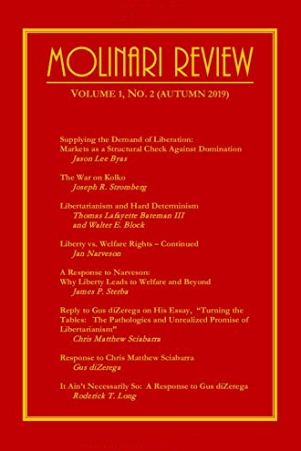
mr-f19-coverOkay, so I’ve uploaded them now. Thus if you’re one of those penurious souls who never purchased the hard copy, you can now read the articles for free! Check out Jason Lee Byas defending market anarchism vis-à-vis communist anarchism; Joseph R. Stromberg defending Gabriel Kolko’s account of the role of big business in setting up the regulatory state; Thomas Lafayette Bateman III and Walter E. Block on the political implications of the free will debate; an exchange between Jan Narveson and James P. Sterba over whether a commitment to welfare rights follows from libertarian premises; and an exchange among Gus diZerega, Chris Matthew Sciabarra, and your humble correspondent on the merits and demerits of libertarianism in general and Ayn Rand in particular.

All this Molinari goodness is available via this link.

By the way, the 3rd issue (which will feature, inter alia, a reply to Stromberg from Robert Bradley Jr. and Roger Donway, along with Stromberg’s counter-reply) has been nearly ready to go for a while now; I just haven’t found the time to put the damn thing together. Maybe this summer? (It’d be nice if the 3rd installment of the Molinari Review could appear before the still-longer-awaited 3rd volume of Harlan Ellison’s Dangerous Visions anthology, due out this fall. People have been waiting for that sucker since 1973.)

Where Ignorant Armies

I was once parodied on a YouTube video (by whom I don’t recall) as holding that “people who are right and people who are wrong are basically saying the same thing.”  While I obviously wouldn’t endorse the claim in the form stated, the line does insightfully capture something about my approach – a suspicion of stark oppositions.   Suspicion, not invariable rejection: sometimes one side of an opposition is just completely and uninterestingly wrong.  But I’m regularly finding my way to angles from which supposedly stark oppositions can be seen as complicated or subverted by unexpected affinities – which is why, e.g., I was never fully satisfied, even at the height of my Randian period, with the cops-and-robbers approach to intellectual history that prevails in Randian (and not only Randian) circles, consigning all of e.g. Plato’s or Augustine’s or Hume’s or Kant’s or Hegel’s or Marx’s or Heidegger’s or Rawls’s writings to the Dustbin of Total and Irredeemable Worthlessness, rather than approaching them with the expectation that they might have something valuable to teach.

Hence my tendency to question such oppositions as libertarianism versus social justice, analytic versus continental, social anarchism versus anarcho-capitalism, deontology versus teleology, eastern versus western thought, theism versus atheism, Hayekianism versus Rothbardianism, and most recently, Randian discipline versus Kerouacian spontaneity.  (And no, it’s not a rejection of the law of non-contradiction to question whether positions presented as mutually contradictory really are so.)

One of the most important pieces of advice I would give to young scholars beginning their intellectual journeys is not to structure their conceptual landscape so as to close themselves off from the opportunity to learn from both sides of supposedly unbridgeable gaps.

Reason Papers 43:1, JARS 23: Bromance, Romance, Scholarship

I’m very happy to announce the publication of Reason Papers 43:1 (Spring 2023), and the final, double issue of the Journal of Ayn Rand Studies (JARS) 23:1-2. There are a bunch of interconnections between these two journals, and connections back to PoT. Being the gossip hag that I am, I’m going to give you the juicy back story (romance, bromance, and all), so hold on to your hat.

The main piece of backstory here is that both journals bear a connection to Ayn Rand and the (American) Objectivist movement. (The preceding links go to Wikipedia, which was founded by Jimmy Wales, who was also a member of the Objectivist movement. You can’t make this shit up.) Reason Papers was founded in 1974 by Tibor Machan, a fervent Randian; JARS was founded in 1999 by Chris Sciabarra, a fervent Rand scholar. Many of the people associated with Policy of Truth were once Randians, associated in some way with one or both journals and/or the Objectivist movement. Whatever our proximity to or distance from Rand and Objectivism at this point, many of us still a bear a close relation to one another, and so, still find ourselves arguing about Rand and related topics (Aristotelianism, libertarianism, aesthetic Romanticism, etc.), whether as impartial scholars, as Rand-sympathizers, or as critics or even antagonists of Objectivism. Continue reading

Nor Custom Stale Her Infinite Variety

Every time (or nearly every) that a new artistic style or movement emerges (in literature, think e.g. of romanticism or naturalism or modernism; in painting, think of impressionism or cubism or abstraction), it’s accompanied by two narratives.

monet-impress-sun

One narrative comes from defenders of the Older Art. The burden of this narrative is that the Newer Art is not merely inferior, but pernicious – that it represents a betrayal of the very principles of art itself. Think of the hostile reviews of the first Impressionist Exhibition in Paris (such as “Wallpaper in its early stages is much more finished than that”); or the singers who refused to learn Wagner’s operas because they were “unsingable”; or the Vienna Musikverein’s initially rejecting Schönberg’s Verklärte Nacht because it used “nonexistent” chords; or the literal violence that broke out in the theatre at the first production of Victor Hugo’s play Hernani for its violation of the rules of classicism.

Continue reading

Why They Wrote Such Good Books

I’ve just finished up my seminar (the teaching portion, not the grading portion – oh, not remotely the grading portion!) on Nietzsche and Modern Literature, where along with various readings from Nietzsche we also read works by Thomas Mann, André Gide, D. H. Lawrence, and Ayn Rand. I created an “audiovisual companion” website for the course to illustrate the various people, places, and works of art and music that are discussed by all five authors; and I’m posting the link to it here in case my broader readership is also interested.

As many of my readers are likely to have a particular interest in Rand, I’ll note that the pages where I discuss Rand are Weeks 9-14. See the four “horse tamer” statues that Rand describes at the beginning of Part II of We the Living! Hear the “John Gray” song (misidentified by Michael Berliner) that pervaded the streets of Kira’s Petrograd! See the theatres that Kira attended with Andrei, and the restaurant where they ate! Hear clips from the Kálmán operetta that inspired her, and the swingtime version of Wagner’s “Evening Star” that Gail Wynand suffered through during his late-night walk through the streets of New York! See the real-life models for Leo Kovalensky, Essie Twomey, Ellsworth Toohey, Lois Cook, Lancelot Clokey, Dominique Francon, Henry Cameron, Ralston Holcombe, and Austen Heller – as well as the real-life models for the buildings of Roark and Cameron, the coffee shop where Peter says goodbye to Katie, and much much more!

And check out similar sights and sounds for the works of Mann (Weeks 1-4), Gide (Weeks 4-5), Lawrence (Weeks 5-9), and of course Nietzsche (passim).

The Strastnoy of Ayn Rand

Ayn Rand’s Red Pawn, written in the 1930s, takes place on the imaginary Strastnoy (“Passion,” in the Christian theological sense) Island, in “the Arctic waters off the Siberian coast,” where a Christian monastery has been converted into a Soviet prison camp.

In real life there actually was, during the 1920s and 30s, a Christian monastery that had been converted into a Soviet prison camp, on a remote island in Arctic waters – though on the western side of Russia, not the eastern, Siberian side – namely Solovki Prison on Solovetzky Island, which was actually the nucleus of the entire Gulag system. (Appropriately enough, the Gulag Archipelago began on a literal archipelago.)

Solovki Prison is not as forbidding-looking as the one described in Rand’s story (Rand’s version has a bit more the flavour of the Château d’If), but I still suspect it influenced the tale. (During World War II, Solovki became a military base. Today it is a monastery again.) (There was also a Strastnoy monastery in Moscow that was demolished by the Soviets, and might have influenced Rand’s choice of name.)

Would Rand have been aware of Solovki Prison? I think likely yes, since two books had been published on it in the west during the 1920s, by former inmates – S. A. Malsagoff’s An Island Hell: A Soviet Prison in the Far North, and Youri Bezsonov’s Mes vingt-six prisons et mon évasion de Solovki.

Who Is Sheldon Richman, and Why Does He Hate the Constitution and American Greatness? and Why Does He Love Jihadis, French Communism, Godless Atheism, and Weird-Ass Epistemology?

In Part 1 of this 2-part interview, I chat with Sheldon Richman about his youthful enthusiasm for the Swamp Fox and his guerilla fighters; the Constitution as a betrayal of the American Revolution and the Articles of Confederation; defying YAF with Karl Hess at the March to the Arch; the positive externalities achievable by sitting next to Dave Barry; using Koch money to fight big business; Robert Bidinotto’s dark anarchist past; the perils of publishing Kevin Carson; going crazy for Thomas Szasz; the identity of Filthy Pierre; how to smoke like Gandalf; an atheist’s favourite Bishop; and which prominent Austrian economist experimented on Sheldon’s newborn infant.

In Part 2, we chat about the Israeli occupation of Palestine; u.s. intervention in the Middle East; the meaning of Jewish identity; the relation between libertarian individualism and social cooperation; the communistic theories of Frédéric Bastiat; the theologico-political merits of Spinoza; Nathaniel Branden and George H. Smith on atheism; Thomas Paine and Lysander Spooner on deism; the philosophical failings of the New Atheists; rehabilitating the cost-of-production theory of value; the uses of coherentist epistemology for both theists and atheists; reading Wittgenstein for relaxation; the advantages and disadvantages of Randian approaches to knowledge and concepts; the sordid truth behind the special effects in Roderick’s videos (and in particular, what the deal is with Roderick’s hair); Sheldon’s case against open Borders; and the shocking misuse of libertarian think tank resources to photocopy body parts (but who did it, Sheldon or Roderick? and which body parts? watch and learn!).