Here’s a parlor game anyone can play. Familiarize yourself with the controversy about the “ICE manger” at St Susanna’s Church in Dedham, Massachusetts. Then get into an argument about it with any specifically Christian critic of the parish and/or apologist for ICE. Then count how many minutes it takes before they sacrifice both Baby Jesus and the Holy Family to Herod, Caesar, and the Roman Empire. In my experience, it takes about two.
Continue readingCategory Archives: Palestine
Those “Drowned Out” Zionists
Joshua Leifer’s “Conflictedly Connected” Liberal Zionist Center
The well-regarded left Zionist writer Joshua Leifer has a much fawned-over piece in Ha’aretz that’s been adopted in some quarters as the expression of profound wisdom. In it he argues that there’s a “conflictedly connected” Zionist quasi-left “majority” that’s been “drowned out” by the extremist voices of the “ultra-hawkish right” and the “anti-Zionist left.” If only this “conflictedly connected” majority could be liberated from the shackles placed on it by these twin extremists, the Golden Mean would prevail, and virtue would flourish on the topic of Israel and Palestine. Continue reading
If You Want Blood
Do yourself a favor. Go back and re-read the Declaration of Independence, but do it this way: skip the beginning and the end, and read the bill of particulars in the middle. It’s too long to quote here. You really just have to read it for yourself. Once you do, you’ll see that details aside, we’re living in the very world that the Declaration describes, excoriates, and uses as the basis of its declaration of war. Virtually everything in it is something that our present government is doing to us. Like the people of British North America ca. 1776, we are a people under military occupation. Continue reading
Zionism as Incest
“Do not perform the practices of the land of Egypt in which you dwelled, and do not perform the practice of the land of Canaan to which I bring you, and do not follow their traditions.” –Leviticus 18:3
Many people will by now have seen Sarah Hurwitz’s jeremiad at the General Assembly of the Jewish Federations of North America, complaining about Israel’s having lost the narrative war on social media. Hurwitz is a former Obama speechwriter, and the epitome of Democratic centrism. Her comments are notable, not for any great insight they contain or wisdom they impart, but for demonstrating just how illogical and uninformed you can be while conveying the reverse impression for decades, and while making a fabulous career for yourself in American life. They’re also an object lesson in the double standards of Zionist ideology, and what happens when a double standard collapses, as it must, into incoherent hysteria. Continue reading
The Immigrant Trust Tour: Clifton Redux
Chris D’Amato, Migrant Rights, and the Exploitation of Anti-Semitism
I mentioned the campaign for an Immigrant Trust Resolution in Clifton a few weeks ago. Unfortunately, I had a scheduling conflict and had to miss the follow-up meeting yesterday. Below the fold is a depressing report from my friend Jeff Hoey, a Clifton resident who’s been leading the campaign. It’s a perfect example of the cynicism that masquerades as philo-Semitism nowadays–and also the right-wing virtue-signaling that passes itself off as “anti-woke.” I encountered a similar phenomenon when I spoke last week in West Orange, which I’ll describe here in the near future. It’s obviously a trend. Continue reading
“The Cost of Borders from Palestine to Mexico”
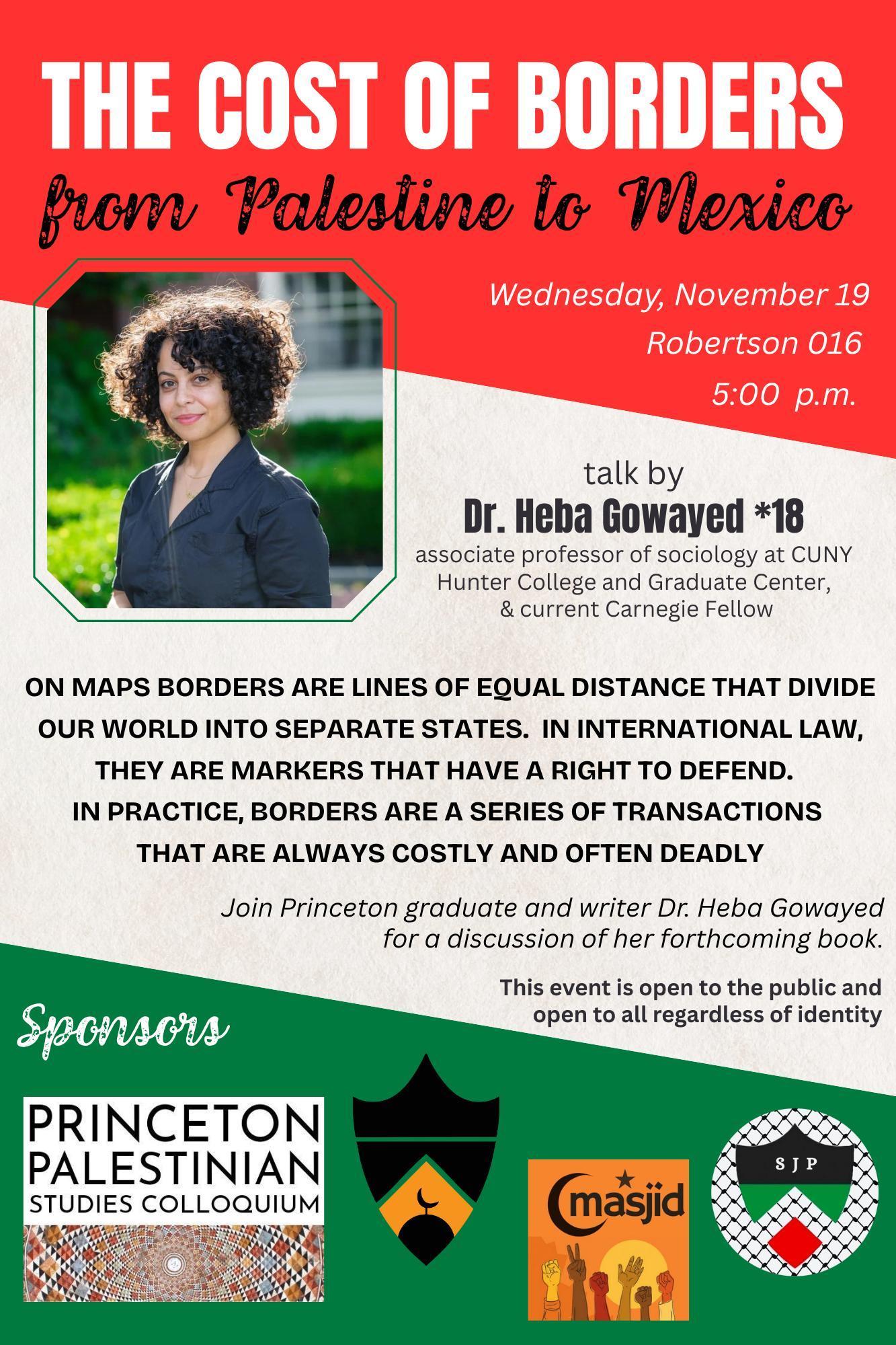
Wednesday, November 19, 5 pm, in Robertson 016 (the basement of the old “Woodrow Wilson School,” at the corner of Prospect and Washington), on the Princeton University campus, Princeton, New Jersey.
The Immigrant Trust Tour: October Update
To the best of my knowledge, the municipal-level campaign to persuade the New Jersey state legislature to pass the Immigrant Trust Act started last December in Madison, New Jersey, an affluent college town in a relatively conservative part of the state. By March, about a dozen municipalities had followed suit.
Things quieted down in the months after that, but with the impetus of a constant drumbeat of ICE raids, things started up again in June with the campaign for a resolution in Princeton, which eventually passed in August. Whether it’s correlation or causality or both, the movement has heated up since then and gone statewide. About twenty municipalities and two counties have at this point passed pro-ITA resolutions, and plenty of county commissions and town councils across the state are facing demands to pass more. Continue reading
How You Gonna Win if You Ain’t Right Within?
Just an FYI to the “No Kings” Democrats: you don’t get to blather to us about “No Kings” while calling for the disarmament of a population under military occupation. The people running these demonstrations seem too historically illiterate to remember that the American Revolution was a war, and that it got rid of the King by killing his troops. Continue reading
Disarming Candor
Donald Trump, on the disarmament of Hamas:
They’re going to disarm because they said they were going to disarm. If they don’t disarm, we will disarm them.
Asked how he will do that, Trump responded:
I don’t have to explain that to you. And I spoke to Hamas, and they said, “Yes, sir, we’re going to disarm.”
Against Palestinian Disarmament
I’m not one to give anyone specifically military advice, and I have neither the time nor the inclination to comment on the fraud of Trump’s Gaza peace plan. Only one thing really needs to be said, and said at top volume: under no circumstances should any Palestinian militant group disarm for anyone or anything. That goes for Hamas, Islamic Jihad, the PFLP, the Lion’s Den, and anyone else with a weapon and the will to use it. Do not disarm. Do NOT disarm. To disarm is to commit mass suicide by placing yourself in the hands of confirmed liars and psychopaths. Things are bad, but nothing could be worse than that.
Continue reading Policy of Truth