Imagine a society in the grips of civil war. On one side stand the partisans of theocracy; on the other, the partisans of secularism. As they fight over their country, a larger imperial power decides to invade, citing as justification the apparent approval of (a faction of) the secular side, along with the inherent evils of theocracy. Taking advantage of the smaller country’s internal division and weakness, the imperial power then tears the country to pieces that neither side will ever be able to govern. Besieging, starving, and massacring the people it claims to be liberating, the imperialists eventually conquer the place, lording it over the defeated population. They then spend the next several centuries singing their own praises–until they, too, are defeated by a rival power and swept away. Continue reading
Category Archives: Palestine
We’re Going to Need a Bigger Movement
The US-Israeli war on Iran is two weeks old, and getting worse every day. So far, the anti-war movement’s response has been salutary, but muted. A lot of astute commentators deserve credit for saying a lot of the right things, but as far as visible public outcry is concerned, we’ve fallen short.
I split my time between Princeton and West Orange, New Jersey. We had a smallish anti-war rally in Princeton on the first day of the war, sponsored by the local Coalition for Peace Action and Indivisible; 180 people showed up in Hinds Plaza, and we got some modest but positive local news coverage across the following week. There was a small follow-up rally a few days later at Princeton’s War Memorial, and then some canvassing with Adam Hamaway, a local anti-war candidate for Congress. A vigil and a demonstration are scheduled for next week at the University, organized by some of the student groups there. A respectable but hardly overwhelming display. Continue reading
Institutional Neutrality and Legislative Oversight
Suppose that I’m a university president at an institution that’s endorsed institutional neutrality. I’m now invited by the chair of an oversight committee in Congress or the state legislature to testify before the committee on matters that fall within the committee’s higher education oversight functions. Stipulate that the discussion of these matters can’t avoid touching on matters of public controversy, and that I won’t be permitted during the oversight hearing to pick and choose what questions I’ll answer or in what form. Those issues are exclusively within the purview of the committee chair. What should I do? Continue reading
Anatole Lieven on “The Woke Left”
Consider a lapse (or two) into senselessness in a generally sensible piece by a generally sensible author, Anatole Lieven. The thesis:
By their shameful, spineless stance on the U.S. and Israeli war against Iran, European leaders have doomed whatever remained of their global influence and their pretensions to promote a “rules-based international order.”
They are also helping to dig the graves of their own political parties, and quite possibly of European democracy.
Fair enough. Now for the first lapse: Continue reading
The Carlson-Huckabee Interview (1)
There are many things to be said about Tucker Carlson’s remarkable interview with Mike Huckabee, too many to say all at once. So I’m going to take my time to say them, and say them in bite-sized portions.
There’s a distinction in ancient Greek philosophy that’s useful here, between virtue and skill. A virtue is a specifically moral disposition to thought and action, like honesty or justice. A skill is a pragmatically useful but morally neutral sort of know-how, like knowing how to play the guitar or ride a bike or swim. The possession of a skill is not the possession of virtue, and virtues in turn aren’t reducible to the possession of a skill or sets of skills. They’re just categorially different things. That said, both virtues and skills are objects of praise, just not the same kind of praise. They’re both achievements, just achievements of different kinds. Continue reading
From Diversity to Neutrality: Rebutting the “Key Move”
This is the précis of a paper I’ll be giving at the virtual/online component of the 2026 conference of the Association of Practical and Professional Ethics. The conference takes place April 10; the paper is called, “From Diversity to Neutrality: Rebutting the ‘Key Move’ of the Kalven Committee Report.” Last year I gave a different paper at the on-ground version of the conference, discussing institutional neutrality’s failure to deal with complicity in injustice.
Institutional neutrality is the doctrine that institutions like universities should refrain from taking public positions on matters of public controversy. The locus classicus of the doctrine is the so-called Kalven Committee Report (KCR) issued at the University of Chicago in 1967. According to the KCR, the core mission of the ideal university is the “discovery, improvement, and dissemination of knowledge” in the service of teaching and research. This mission, we’re told, requires the maximization of intellectual diversity, which in turn requires or entails institutional neutrality. I call this “the key move” of the KCR’s argument. Continue reading
The West Orange Anti-Semitism Task Force (2)
Second Statement to West Orange Town Council on its Proposed Anti-Semitism Task Force
66 Main St
West Orange, New Jersey
February 10, 2026
Last time I was here, I criticized a proposal for an anti-Semitism task force. In response, some speakers suggested that I was being insensitive to the dangers faced by Jews in West Orange. I don’t agree, so I’m going to respond. Continue reading
You Say You Want a Revolution
The local papers around Princeton are gushing over an event that took place in town this morning:
In 1776, the New Jersey Legislature convened for the first time in Nassau Hall, the ivy-covered building that is now the centerpiece of Princeton University’s campus.
It was wartime, but the new legislators kept busy: within months, they had adopted the state’s first constitution, elected the state’s first governor, and kick-started preparations to help the Continental Army fight British redcoats. The British eventually seized the building, before being kicked out again by George Washington’s army in the Battle of Princeton, but by then the legislators had moved on.
Two-hundred-fifty years later, as the United States prepares to celebrate the 250th anniversary of its independence, the New Jersey Assembly returned to Nassau Hall to celebrate its role in New Jersey’s revolutionary history.
“Today isn’t simply a change in venue for us,” Assembly Speaker Craig Coughlin said. “It’s a return home, a return to our beginnings, to the place where our Legislature first met in 1776 at the dawn of a new and uncertain democracy.”
The Assembly approved a series of ceremonial resolutions honoring New Jersey’s role in the American Revolution, Princeton University’s 280th anniversary, the New Jersey National Guard, and battleships named for New Jersey, among others.
The celebrants included Lt. Gov. Dale Caldwell, Princeton University President Christopher Eisgruber, and British Consul General to New York Oliver Christian.
Free Speech in Montgomery
Statement to Montgomery Township Committee
100 Community Dr
Skillman, New Jersey
February 5, 2026
Revised for presentation (to better fit the 3-minute time limit), February 5, 2026
On January 7th, Sadaf Jaffer, the former mayor of Montgomery and former head of its Democratic Organization, made public something that this Committee has known for a year. About a year ago, she said, Mayor Neena Singh and Deputy Mayor Vince Barragan demanded her resignation from the Democratic Organization because Montgomery Township was being denied state and county funds in retaliation for, her, Jaffer’s, criticisms of US and Israeli policy in Palestine. I have an audio file of Mr Barragan’s making this demand.
Continue reading
Political Speech Threatened

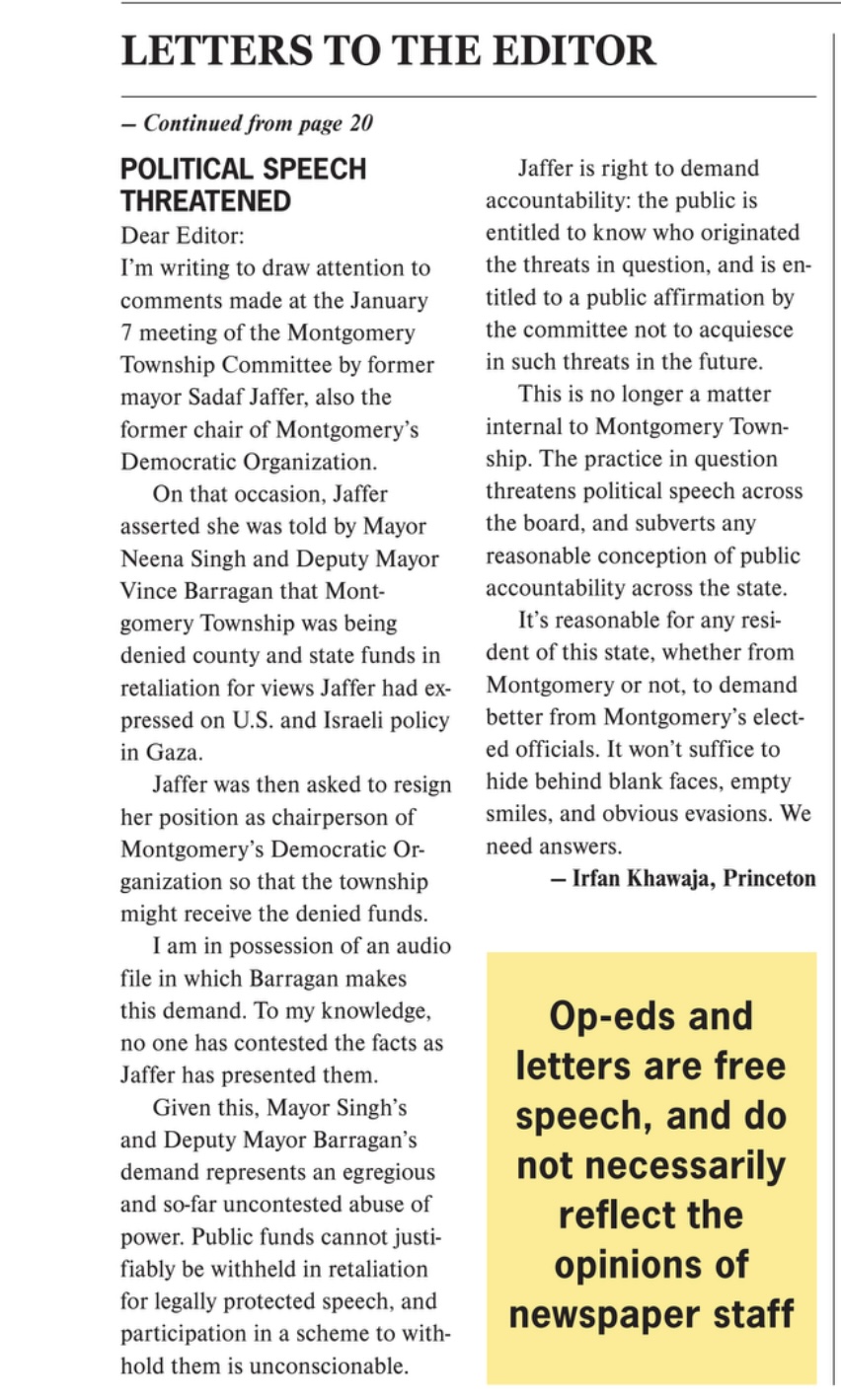
From the February edition. Click the right side thumbnail to enlarge it.
 Policy of Truth