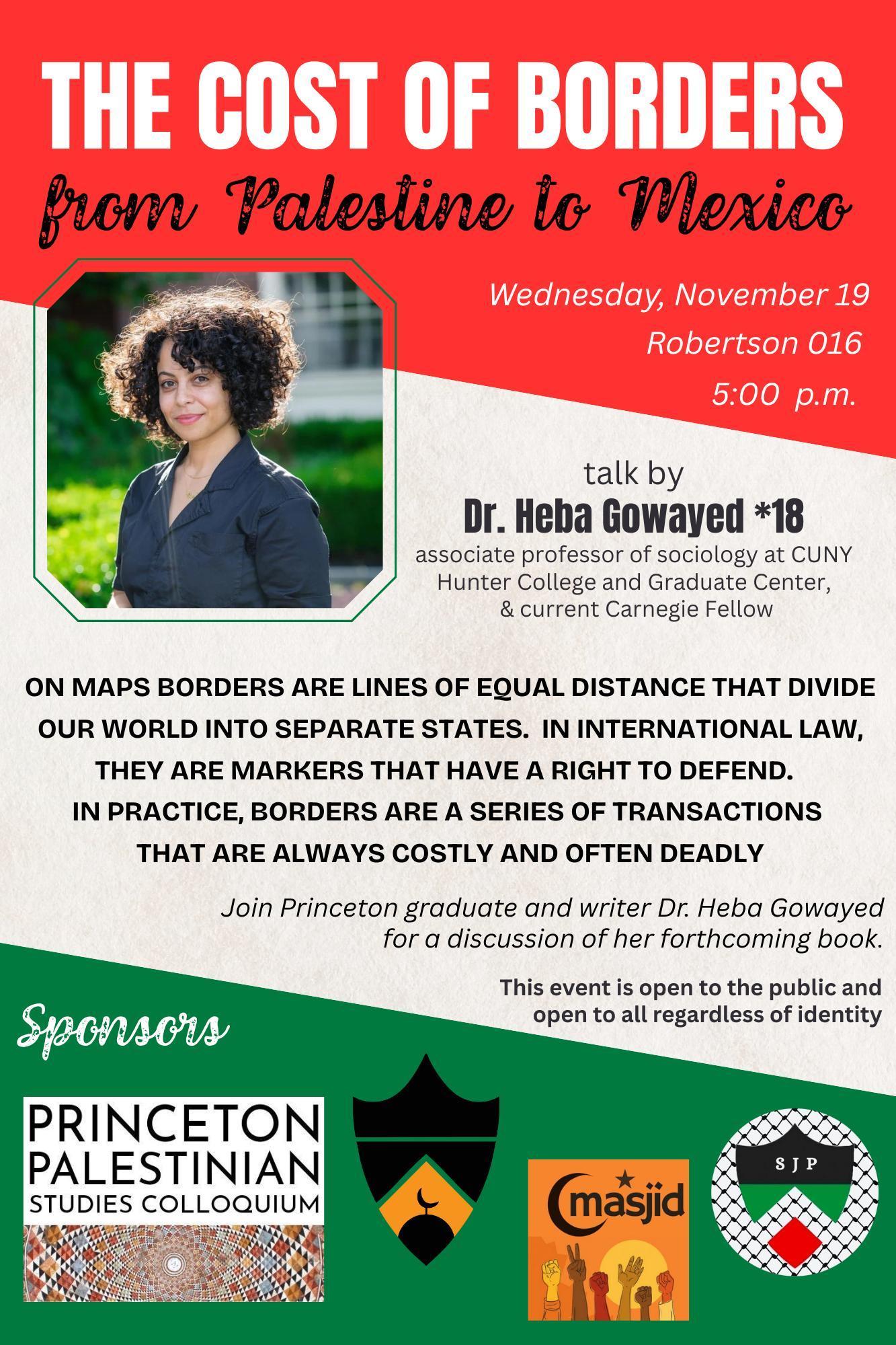
Wednesday, November 19, 5 pm, in Robertson 016 (the basement of the old “Woodrow Wilson School,” at the corner of Prospect and Washington), on the Princeton University campus, Princeton, New Jersey.
Wednesday, November 19, 5 pm, in Robertson 016 (the basement of the old “Woodrow Wilson School,” at the corner of Prospect and Washington), on the Princeton University campus, Princeton, New Jersey.
To the best of my knowledge, the municipal-level campaign to persuade the New Jersey state legislature to pass the Immigrant Trust Act started last December in Madison, New Jersey, an affluent college town in a relatively conservative part of the state. By March, about a dozen municipalities had followed suit.
Things quieted down in the months after that, but with the impetus of a constant drumbeat of ICE raids, things started up again in June with the campaign for a resolution in Princeton, which eventually passed in August. Whether it’s correlation or causality or both, the movement has heated up since then and gone statewide. About twenty municipalities and two counties have at this point passed pro-ITA resolutions, and plenty of county commissions and town councils across the state are facing demands to pass more. Continue reading
Donald Trump, on the disarmament of Hamas:
They’re going to disarm because they said they were going to disarm. If they don’t disarm, we will disarm them.
Asked how he will do that, Trump responded:
I don’t have to explain that to you. And I spoke to Hamas, and they said, “Yes, sir, we’re going to disarm.”
“Divestment and the Boundaries of Conscience”
As regular readers of this blog know, I’ve been involved since 2024 in the campaign to induce Princeton University to divest its holdings, not just from Israel, but from arms manufacture and military affairs as such.
It was about a year ago that I got it into my head to get Robert K. Massie IV involved in our efforts. Massie is one of the architects and chroniclers of the decades-long campaign to divest from apartheid South Africa; I’d first encountered his book Loosing the Bonds twenty years ago, and been impressed by the rigor of his argument, as well as by the wealth of detail and moral passion he brought to the subject. Continue reading
I woke up this morning to find an email from one of my best friends in Palestine, someone who lives in a small village in the South Hebron Hills. I’ve excerpted it below, deleting personal names, and omitting place names and other particulars, and corrected the grammar of one sentence for clarity. It’s in English, but I’ve provided a tl; dr translation just after the block quote. The word “football” refers throughout to soccer. Continue reading
A controversy has recently broken out in the New Jersey gubernatorial campaign. Mikie Sherrill, who has long touted her experience as a helicopter pilot for the Navy, is now facing the somewhat exaggerated charge that she “cheated her way” through the Naval Academy (to quote hearsay from the Internet).
The backstory is this: Nicholas DeGregorio, a supporter of Sherrill’s opponent in the race, made a records request re Sherrill, including her Naval Academy record, to the National Personnel Center of the National Archives. Continue reading
After helping Israel destroy Palestine and commit genocide there, Australia, Britain, and Canada are “recognizing” a “State of Palestine”—a “state” under military occupation, in the process of annexation, without borders, without a government, and without a military—while continuing to arm and support the regime destroying it.
If this is recognition, what would repudiation be?
I’ve recently given a handful of talks critical of the Kalven Committee Report’s (KCR) conception of institutional neutrality–three or four, depending on how you count, with one or two more to come, depending on what the referees say. My argument is pretty straightforward: it’s an adequacy-condition on any account of academic norms that the account deal with the problem of institutional complicity in wrongdoing. The KCR defense of institutional neutrality doesn’t just fail to deal with this issue; it offers complicit institutions a blueprint for evading accusations of complicity even when those accusations are recognized as true, well-documented, and incriminating. Continue reading
Fifty or sixty years from now, this is how they’ll be rehabilitating the reputations of the assholes running our current genocide in Gaza. Oh, the private doubts they had! The anguish they suffered! Poor, poor things! Judge not, lest it be discovered that you figured out on Day 1 what these “experts” were too cowardly to admit or act on for the duration.
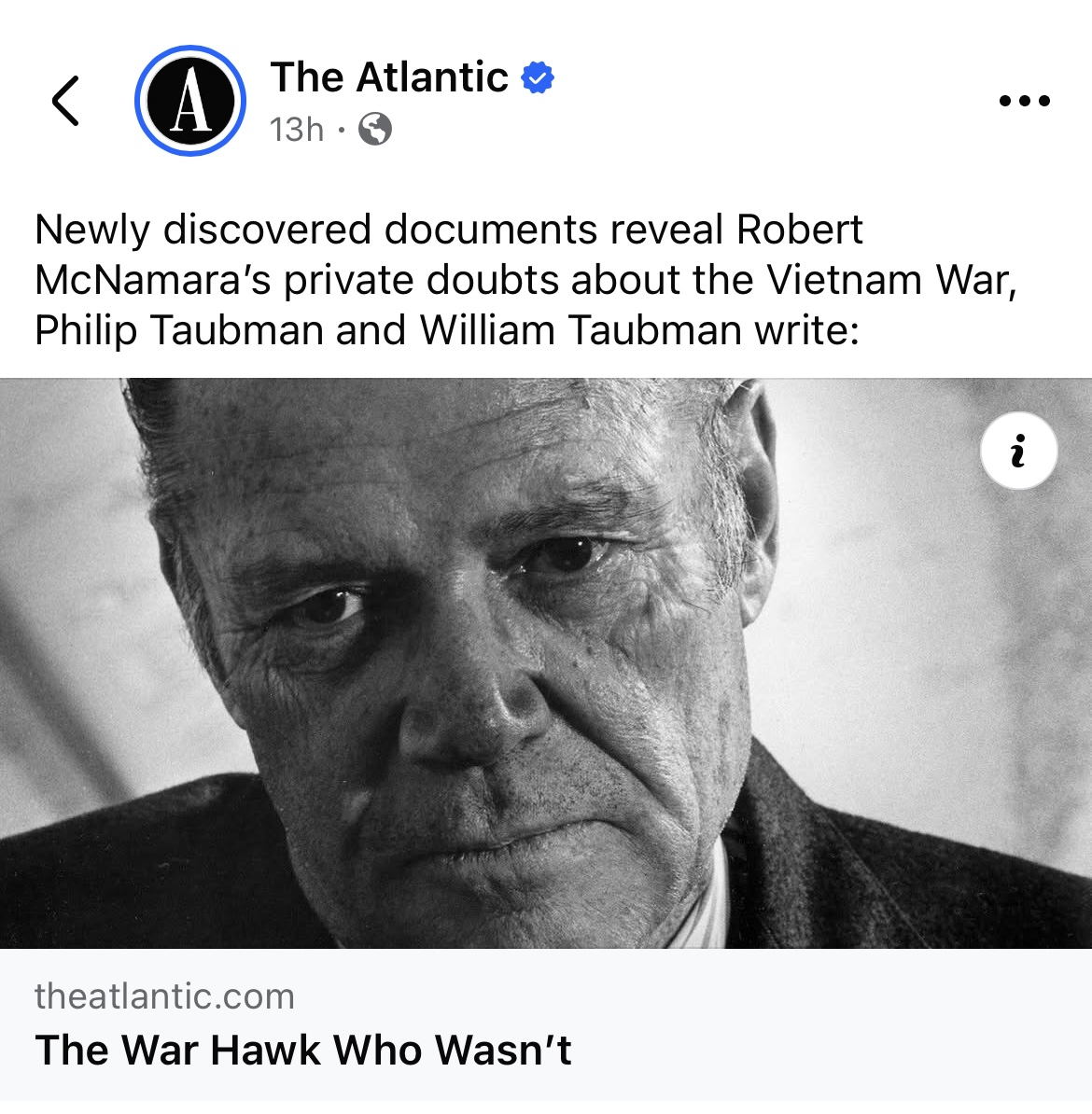
The “war hawk who wasn’t,” except that he was.
Most years, on 9/11, I’ve brought this post back up to the top and re-posted it. I want to do something different this time. I want to give a brief (or semi-brief) answer to one of the most pressing questions that arises on 9/11: why do Americans not learn from history? Or to narrow it a bit: why do Americans learn nothing from the military history of their own country? Continue reading
 Policy of Truth