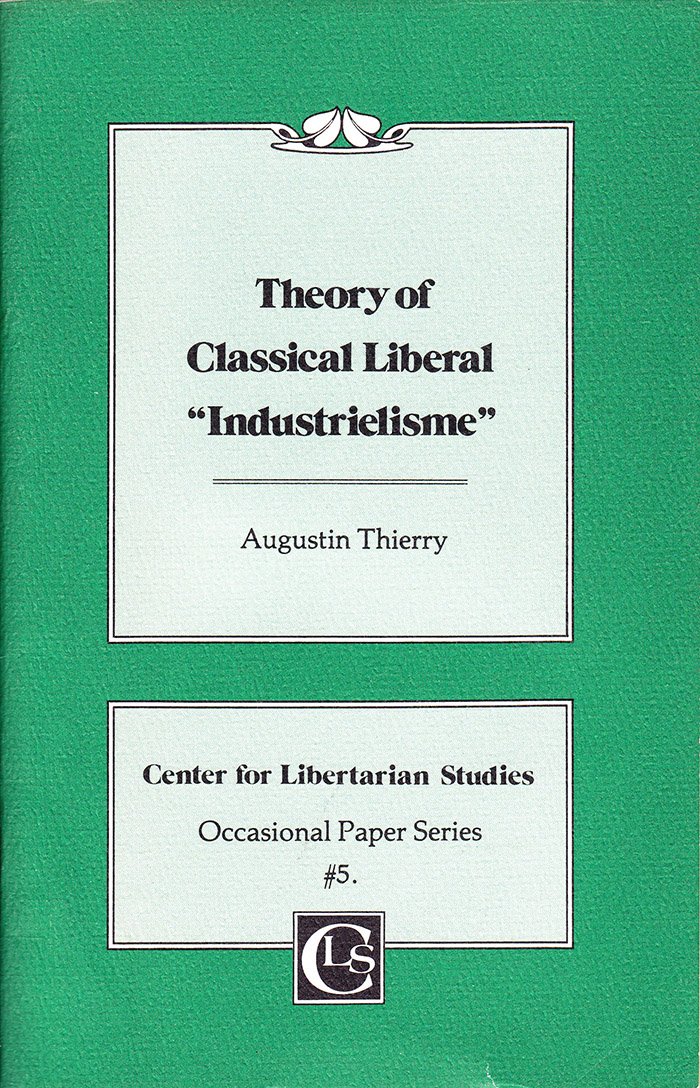
Thierry Rides Again

With Mark Weinburg’s kind permission, I have posted on the Molinari site his hard-to-find 1977-78 translation of Augustin Thierry’s 1818 review of Destutt de Tracy’s 1806 commentary on Montesquieu’s 1748 Spirit of the Laws

Tracy was a philosopher and free-market economist, and a friend of Thomas Jefferson (who translated and published several of Tracy’s writings, including the one Thierry is discussing here).  Thierry, primarily a historian, was one of the radical liberal triumvirate who (along with Charles Comte and Charles Dunoyer) developed an important version of liberal class theory in their journal Le Censeur Européen; Karl Marx would later refer to Thierry as “the father of the ‘class struggle’ in French historiography.”  Montesquieu was a massively influential social and legal theorist, broadly liberal but not quite radical enough for Tracy and Thierry.  Like many of Thierry’s book reviews, this one is in large part a springboard for Thierry to talk (particularly in the second half – which Weinburg makes the first half) about his own developing views in ways that don’t necessarily have all that much to do with either Tracy or Montesquieu.

This piece is especially famous for Thierry’s inspiring (but, in the event, unduly optimistic) prediction of what the coming century would bring:

“Federations will replace states.  The despotism of men and of the law will be replaced by the loose but indissoluble bonds of interest.  The inclination towards government, the first passion of the human race, will yield to the free community, the real need of civilized men.  The era of empires has ended.  The era of association is beginning.”

I am working on my own translation of Thierry’s article (as part of an exciting larger project about which you will learn more later), but in the meantime, enjoy!
Days of Future Past:  Another One from the Vaults

A few years ago I posted my 1992 Ph.D. dissertation on my website; but I was recently asked to post my 1985 undergraduate thesis as well.  Happily, this document was one I knew the location of and could easily access and scan (unlike so much of my stuff packed away in boxes). 

So here’s a blast from the past about the status of the future – and a glimpse of your humble correspondent at age 21.  (I vaguely recall seeing an interview with later Billy Joel looking at footage of early Billy Joel and chuckling, “that young punk!”  Yeah, feels kinda like that.)

“WITH PARTICULARS THAT ARE GOING TO BE IT IS DIFFERENT”:
Aristotle and the Problem of Future Contingents

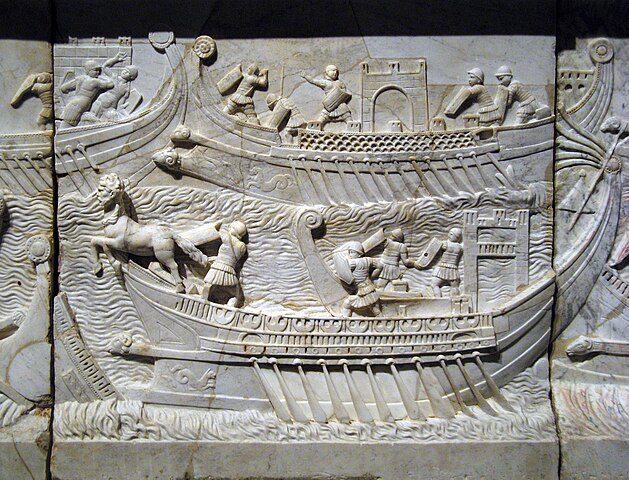
Incidentally, I remember vividly the moment when I was first introduced to the so-called “sea battle problem.”  I was already interested in theories of time generally, and Aristotle’s theory of time in particular, but my exploration of the latter had been confined mainly to the Physics and Metaphysics; I hadn’t yet found my way to On Interpretation 9.  Well, one day during a school break I was parked at the dock in Hull MA, waiting to pick up my mother from the commuter ferry (we were living in Hull, but she was working in downtown Boston), and while I was waiting for the boat I was reading a green and white paperback anthology titled Problems of Space and Time, edited by J. J. C. Smart, which I’d picked up in some used bookstore in Cambridge.  (Alas, there were many more of them then.)  The chapter I read on that occasion was Elizabeth Anscombe’s article “Aristotle and the Sea Battle.”  I wasn’t convinced by Anscombe’s solution, but I became obsessed with the problem (along with her delightful line “I won’t say,” which has become a perhaps dubious part of my vocabulary).   And so here we are.  (But those who are hip to the relevant signs and stigmata will also recognise traces of Randian influence throughout.)

I’ve now reread the thesis enough to get a serious nostalgia wave from it, but not enough to judge how far I would still agree with all of it.  Bear in mind that this thesis, unlike my later dissertation, was written when I had not yet studied Greek in anything more than the most minimal way; so all my arguments about the details of Aristotle’s wording in various passages would need to be revisited while consulting the Greek texts.  Which, ha, not today, mate.

I notice that in the Introduction I describe my method as having “a somewhat dialectical character, weighing reciprocal determinations.”  I certainly was starting as I meant to go on!  (But y’know, if you’d asked me recently when it was that I first got into the whole reciprocal-determination thing, I would have said the mid-1990s.  Obviously not.)

“Justice by Means of Democracy”

Modesty is supposed to be a virtue. Freeriding is an expression of vice. So how could modesty lead to freeriding? Well, suppose you have bloggers so modest that they refuse to advertise their own publications. Then it’s left to me to do it for them.

With that preface: PoT blogger and freerider John Davenport has a review in Notre Dame Philosophical Reviews of Danielle Allen’s Justice by Means of Democracy. First paragraph: Continue reading

Anarchy, Democracy, and Privacy

A trio of announcements on, yes, anarchy, democracy, and privacy:   

(1) PoT’s Roderick Long has a review in Reason of Jesse Spafford’s new book, Social Anarchism and the Rejection of Moral Tyranny (Cambridge, 2023). Despite his reservations with some of Spafford’s arguments, Roderick says, 

…this is an intelligently argued book that deserves careful reading and discussion—particularly among market libertarians, since it offers ingenious and powerful arguments, from premises many libertarians will find appealing, to conclusions that most libertarians will be eager to avoid. That’s the sort of challenge that libertarians need to take seriously.

Judging from the review, I’m inclined to think that Spafford’s discussion of the Lockean Proviso is worth further discussion. I’m hoping we can have some of that here, possibly with Spafford’s input. Continue reading

How to Fix the United States

How to Fix the United States: Amendments and a Constitutional Convention

At this point, it must be obvious to everyone paying attention that the United States is a nation in deep trouble. Over the last two decades, both the effectiveness and democratic credentials of the US federal government have gone into decline, which has helped to drive increasing political polarization and public frustration that steepens the decline. More of the public turn to extremist politicians promising to eviscerate their political enemies, which makes the compromises needed in the American federal system totally impossible. Even the basics cannot get done: a single senator holds up over 300 military officer promotions for many months; a group of six radical House members out of 435 cause a government shutdown by holding up funding bills. Continue reading

John Davenport’s “The Democracy Amendments”

I’m very pleased to announce the publication, about two weeks ago, of PoT blogger John Davenport’s newest book, The Democracy Amendments: Constitutional Reforms to Save the United States (Anthem Press, 2023). I read and commented on the book in manuscript form, and thought it was spot-on. I agreed with virtually every one of John’s diagnoses and reforms; I only wonder how many of them will be taken seriously enough to be put in place, or even to find a place in public discussion. The book’s subtitle may seem hyperbolic, but isn’t: the United States really is a sinking ship, and it’s not an exaggeration to say that reforms like John’s are needed to keep it afloat. We probably need a lot more than that, but John’s reforms would be a good starting point.

Continue reading

Aristotle on Free Will: One From the Vaults

Today I found that my 1992 Ph.D. dissertation, Free Choice and Indeterminism in Aristotle and Later Antiquity, is a free (to those with institutional access) download from UMI, so I decided to make it a free download for everybody.

Reducing and optimising the hell out of it only got it down from around 25 MB to around 18 MB, so I split it into four parts in order to get around the 5 MB maximum upload limit.

I haven’t OCR’d it because UMI has inserted renderable text on every page, which bizarrely blocks Acrobat’s OCR function, and getting around that is more hassle than it’s worth to me right now.

I still agree with what I say here in broad outlines, but not with every detail, and indeed I have a book manuscript, Aristotle on Fate and Freedom, that revises, updates, and supersedes the Aristotle portion of this. (It leaves out the sections on later antiquity.) That is better than this. But that’s not published, and this is, so here ya go.

The main thing I would want to retract today is the snarky remark about Los Angeles in the autobiographical sketch. L.A. is the bee’s knees, man! Not sure what my glitch was. (Of course it was inspired by a similar remark in Isaac Asimov’s bio, but that hardly justifies it.)

Molinari Review I.2: What Lies Within?

The long-awaited second issue of the Molinari Review (the Molinari Institute’s interdisciplinary, open-access, libertarian academic journal) is here! Nearly twice the length of the first issue!

You can order a paper copy from Amazon US, Amazon Canada, Amazon UK, or, I believe, any of the other regional incarnations of Amazon.

(A Kindle copy should be available later this month. In the meantime, the previous issue is available as a free PDF download here.)

So what’s in the new issue? Here’s a rundown: Continue reading

Molinari Review I.1 Now Free Online, Molinari Review I.2 Heading to Print

In celebration of the 17th anniversary of the Molinari Institute, we’re happy to announce:

a) The long-awaited second issue of the Molinari Review will be published later this month. More details soon!

b) In the meantime, the entire first issue is now available for free online on the journal’s archive page. You can download either individual articles or the whole thing. Contents include:

  • “The Right to Privacy Is Tocquevillean, Not Lockean: Why It Matters” by Julio Rodman
  • “Libertarianism and Privilege” by Billy Christmas
  • “Capitalism, Free Enterprise, and Progress: Partners or Adversaries?” by Darian Nayfeld Worden
  • “Turning the Tables: The Pathologies and Unrealized Promise of Libertarianism” by Gus diZerega
  • Review of C. B. Daring, J. Rogue, Deric Shannon, and Abbey Volcano’s Queering Anarchism: Addressing and Undressing Power and Desire by Nathan Goodman

Enjoy!