The (Further) Implosion of Donald Trump’s 9/11 Celebration Story

MTV has finally released the notorious video that constitutes the only videographic “basis” for the 9/11 celebration rumor about Paterson, New Jersey. I’ve had “eyewitnesses” of this video swear to me over the years that they not only watched the video, but that the video itself depicted a celebration taking place in front of the public library in the 900 block of South Main Street in Paterson. It’s the video that I describe in my Jewish Standard interview as the one that I went “crazy” looking for. Incidentally, my own repeated inquiries to MTV in 2001 and 2002 went unacknowledged.

Ladies and gentlemen, behold Exhibit A in Donald Trump’s supposed case for “thousands and thousands” of Arab-Muslim celebrants of 9/11 in the streets of Jersey City, New Jersey:

I never spoke with Emily Acevedo during my research, but the story she tells is identical to the most credible story I’ve heard over the years. It’s also identical to the story that Curtis Sliwa told me in a long phone conversation I had with him back in 2001 or 2002.

Note that Acevedo points out that the disturbance was celebration-like, but that it was not clearly a celebration of 9/11. It could well have been a case of a bunch of high school kids making a disturbance simply because they’d been let out of school early.

As far as Paterson is concerned, I would essentially call this “case closed.” But I certainly have more to say, and though I have hundreds of pages of grading to do over Thanksgiving break, I’ll try to find time to offer a coda (or two) to the controversy.

HT: Glenn Kessler.

Postscript, 6:30 pm: As you may have heard, Trump is now under fire for seeming to mock Serge Kovaleski, the reporter whose September 18, 2001 Washington Post story (written with Frederick Kunkle) is the only (pathetic) basis for Trump’s claim about “thousands and thousands” of post-9/11 celebrants in Jersey City.  I’ve addressed the Kovaleski-Kunkle article–and my inadvertent role in facilitating Trump’s exploitation of a sentence in it–in the comments section of a previous post. (Here’s a CNN article where Kovaleski elaborates a bit on the story.)

As a substantive matter, a single obvious fact is worth making, or really, re-iterating for the nth time: as stated, the Kovaleski-Kunkle article doesn’t give credence to Trump’s claims as he originally stated them.  The Kovaleski-Kunkle article refers to alleged celebrations (the phrase used is “allegedly seen”), but as I’ve said in the comments I just mentioned, the alleged celebrations were never verified (reports of the celebrations were verified, not the celebrations themselves); Trump mentioned thousands of celebrants, but no such number is mentioned in the article; Trump claims to have seen the celebration on video, but no “video” is mentioned, and none has surfaced. Further: no location is mentioned for the alleged celebrations, no time is mentioned, no detainees are mentioned by name, and as far as I know, no members of the Jersey City Police Department who were involved in the detention have discussed the matter for the record.

At a minimum, if we’re going to take any claims about Jersey City celebrations seriously, we need to see documentation of who was detained, for what reason, what questions were asked of these people, and what was said in the questioning. Precisely none of that has surfaced, despite the fact that the 2001 report definitely asserts that detentions were made and questioning took place, but only asserts that celebrations were allegedly seen. So far, no publicly available evidence has emerged regarding detention, questioning, or celebrations. And though only an idiot would assume that an otherwise unconfirmed allegation of a celebration was by itself evidence of a celebration, evidently plenty of such idiots exist and insist that any allegation of a celebration is proof that one happened.

The current controversy concerns Trump’s apparently mocking Kovaleski’s physical condition (see the first link in this postscript for details). Apparently, Kovaleski has a medical condition called arthrogryposis, a congenital condition that attacks the joints. Here’s a juxtaposition of images of Kovaleski and of Trump making his speech. (Be sure to watch the video embedded in the very first link of this postscript.)

If anyone but Trump were involved, I might be inclined to accept Trump’s defense as deserving of the benefit of the doubt (the link goes to a statement Trump has released on the matter, tweeted at the site of CBS reporter David Goodman). Ordinarily, we might think that the apparent similarity between Kovaleski’s condition and Trump’s mimicking a flustered reporter was a coincidence. But given Trump’s proven history of mendacity, and his history of making fun of people’s appearance (e.g., Carly Fiorina), I think he’s forfeited the right to be believed. I’m inclined to believe that he’s dishonest enough, and malicious enough, to be lying even about something like this.

Though Trump claims not to remember Kovaleski, and therefore claims not to know what Kovaleski looks like, Kovaleski disputes that claim. Kovaleski claims, plausibly enough, to have met Trump on several occasions while covering his (Trump’s) exploits for The Daily News. Though we all know that Trump’s claims to have “the world’s greatest memory” (now demoted to “one of the all-time great memories”) was practically intended to be bullshit, it’s also an indication that Donald Trump is the sort of person who will spout any rubbish that occurs to him without regard for truth or consequences, and it’s entirely plausible to think that such a person would stoop to mocking a person with a physical disability. Hard to believe that political discourse in the United States has descended to this level, and that the person leading the charge is the Republican front-runner for the presidency.

Here’s an editorial from the New York Times calling for journalists to play a harder form of hard ball with Trump. (I actually think the Trump-Wallace comparison is somewhat unfair to George Wallace, who, to his credit dramatically changed his views late in life, and asked his victims for forgiveness.)

Paul Waldman puts things very well in a blog post at The Washington Post:

Trump represents one face of today’s racism (though not by any means the only face). It simultaneously insists that Muslims can be good Americans, and accuses them of hating America and says their places of worship ought to be kept under government surveillance. It says that some Mexican-Americans are good people, and says most of them are rapists and drug dealers. It says “I think I’ll win the African-American vote” and then tries to convince voters that black people are murdering white people everywhere. In every case, Trump proclaims that he’s no racist while tapping into longstanding racist stereotypes and narratives of the alleged threat posed by minorities to white people.

Since I can’t read minds, I don’t know whether Donald Trump is a racist deep in his heart. But he is without question making himself into the racist’s candidate for president. And that’s a subject the media needs to explore in more depth.

Critics will no doubt claim that there’s an inconsistency between the requirements of journalistic objectivity on the one hand, and the ascription to a public figure of a normatively charged term like “racism” on the other. The moral realist philosophers among us ought to be quick to see the false dichotomy there. And we shouldn’t hesitate to descend back into the Cave to say so.

Postscript, November 27, 2015: This New York Times piece adds some useful information on the Trump-Kovaleski controversy, including Kovaleski’s recollections of having met Trump in person:

In an interview on Thursday, Mr. Kovaleski said that he met with Mr. Trump repeatedly when he was a reporter for The Daily News covering the developer’s business career in the late 1980s, before joining The Post. “Donald and I were on a first-name basis for years,” Mr. Kovaleski said. “I’ve interviewed him in his office,” he added. “I’ve talked to him at press conferences. All in all, I would say around a dozen times, I’ve interacted with him as a reporter while I was at The Daily News.”

In other words, Trump expects us to believe that despite his world-class memory, he doesn’t remember the appearance of a person with a distinctive physical handicap who interacted with him a dozen times over several years, including in his office–but he definitely remembers seeing thousands and thousands of celebrants of the 9/11 attacks in a video clip that no one has been able to recover in fourteen years. He also doesn’t seem to be able to remember that the article he keeps referencing asserts that people were detained and questioned for allegedly celebrating the attack while not offering a particle of confirmation that anyone was in fact detained or questioned, much less found to be celebrating.

In some of his remarks, Trump seems to be implying that he saw the celebrations with his own eyes, not on video. So far, no one has been able to ask him where he was, what he saw, and where exactly the event he saw was taking place. He claims on 9/11 to have been in an apartment with a view of the World Trade Center, which allowed him to see people jumping from the towers. Does the same apartment provide a view of Jersey City that allows the viewer with the naked eye to discriminate a celebration there? If he’s serious, he should show us.

If he was in Trump Towers, we’re being asked to believe that he saw people jumping out of the WTC towers from four miles’ distance and saw a celebration in Jersey City from an apartment on Fifth Avenue in midtown Manhattan. If that’s not so, either he was elsewhere (where?), or his whole story turns on the phantom video tape. Since he insists so heavily on the Kovaleski-Kunkle article, he should be able to request the police reports of the detention and questioning, find the exact location of the alleged celebration, as well as the names of the people detained and questioned, and take it from there. I realize it’s an exercise in futility to expect people indifferent to truth to go through the motions of making a serious inquiry to discover it, but that’s what a serious inquiry would require.

It’s not clear to me that Trump “intended” to mock Kovaleski in the sense of self-consciously hatching a plan to do so and then enacting it. He might have done that (I wouldn’t close the door on the possibility), but I think it’s more likely that since mockery is second-nature to him, he reflexively mocked Kovaleski in the speech without thinking about it, then defaulted (without thinking about that) to the cheapest and easiest form of mockery, mockery of someone’s appearance. So it’s immaterial whether he “intended” to mock Kovaleski or not. More likely than not, what we saw was the ultimate Freudian slip–habituated mockery aimed at what Trump regards as another’s weakness. A bizarre irony: having defamed the people of Jersey City with his reckless disregard for truth, Trump is now insisting that his critics adhere to the truth when it comes to claims adverse to his reputation.

Sad but true: The Republicans are now desperately trying to dislodge Trump, but as Josh Marshall correctly points out at Talking Points Memo, the Trump phenomenon has been a long time in the making, and will be a long time in the undoing. Meanwhile, the spectacle involved manages simultaneously to be addictive and unbearable to watch.

Yes, Trump is Lying

A reporter just asked for my comment on Donald Trump’s recent claim about “thousands and thousands” of New Jersey Muslims celebrating 9/11. Here’s what I said.

The quotation from my co-authored piece with Gary Fine is my bottom line on the subject (quoted near the bottom). I did the interviews for the book chapter linked in the WaPo piece, and have interviewed Patersonians in the years since. No evidence has surfaced of any celebrations over and above the formulation of ours quoted in the WaPo from our book chapter. A small handful of people I’ve interviewed over the years claim to have seen something celebration-like in the mid morning of 9/11 around the 900 block of South Main Street (and claim to have been there in real time). I regard some of them as credible, and some of them as not credible. By all accounts, the “celebration” in question consisted of maybe a dozen or half dozen teenagers jumping around and yelling. It dispersed relatively quickly (i.e., within a few minutes). The police were patrolling the area and claim to have seen nothing. Reporters from the Herald News and Star Ledger were in the area; I interviewed as many reporters as I could find, and not one said that they had seen anything celebration-like. The only journalist who has ever defended the idea of a celebration has been Curtis Sliwa, who conducted a series of interviews in the area just after 9/11. I’ve spoken with Sliwa as well. To the best of my knowledge, his view coheres with mine–he regards it as likely that there was a mini-celebration consisting of 6-12 teenagers or young men, and that it dispersed relatively quickly.

To state the obvious: I don’t regard equivocal testimonial evidence of a bunch of teenagers jumping around and yelling as consistent with or supportive of Trump’s claims.

Also to state the obvious: Trump is the one who’s making the current claims. He bears the burden of proof for the claims he’s making. It seems to me he should be the one asked to bear it.

Irfan Khawaja

PS. Just to be clear: in case you saw my Jewish Standard interview from 2002, I do still stand by what I said there, as long as you take the interview as a whole with the July 2004 postscript. The 2004 postscript corrects a minor factual error in the original interview.

Bottom line: no matter how you slice it, Trump is lying.

Thanks to Michael Young, Joseph DeFilippo, and Susan Bernarducci for alerting to me to the story.

Postscript, 1:16 pm: Just to head off any misunderstandings, in the Jewish Standard interview, I make reference to a celebration “said to have” taken place at the Islamic Cultural Center in Paterson, New Jersey at 5 pm. I end my speculation about that anecdote by pointing out that I found the story implausible, intended to look into it, but never did look into it. What I recorded at the time was my hunch that the story sounded implausible. But precisely because I never actually looked into it, I don’t regard the story or my hunches as evidence of any substantive claim.

Postscript, November 24, 2015: I was gratified to see this piece by Benjamin Wittes in Lawfare. I’ve long admired Wittes’s work (have taught some of it, in fact), and this piece is no exception to the general rule. Here’s a small excerpt, but read the whole thing:

Let’s be blunt about this: They are either lying or they are delusional. And assuming they are not suffering both from the same hallucination, they are lying in a fashion calculated to instill anger and hatred against a minority population at a time when nerves are raw, fears are high, and tempers are short. There are a lot of names for this. None of them is nice.

The “they” is a reference to Ben Carson, who (briefly) joined Trump in what Wittes aptly (though qualifiedly) calls a “blood libel.” (Carson’s now backed off of the claim.)

Postscript, November 25, 2015: Here are some useful links on Trump and the celebration rumors: I’ve linked to Glenn Kessler’s Washington Post column above, but be sure to keep checking back, as he’s updated it several times. This item from the Bergen Record is practically a re-run of the sorts of items that regularly ran in the north Jersey papers in the fall of 2001.  The Record story mentions John Chadwick, who played an important role in the early reporting on this issue; here’s a link to some of Chadwick’s reporting from 2001. (Also important is the reporting of Hilary Burke, then of the Herald News. Unfortunately, Burke’s reporting isn’t easily available online, but I’ll try to remedy that if I can.) This piece from Talking Points Memo offers a useful summary of the issues, and a useful reminder of the other celebration rumor that circulated in the wake of 9/11–the “Dancing Israelis” rumor. Here’s a classic Snopes take-down of the celebration rumors.

Today’s New York Times has three interesting items on Trump’s mendacity and related matters. A front page item details yet another Trump fib, followed by a fairly cavalier expression of indifference to it from Newt Gingrich, who doubles in his post-political life as a historian. This piece provides a nice summary of Trump’s recent deceptions. And this column lays out John J. Farmer Jr.’s case against Trump. Farmer was attorney general of New Jersey in September 2001, and was stationed in Jersey City on 9/11. He’s currently the Dean of the Law School at Rutgers-Newark. According to Glenn Kessler of The Washington Post, Farmer’s claims have been disputed by Walter Zalisko, a former Jersey City police officer.

But Walter Zalisko, a former police officer in Jersey City, contacted The Fact Checker to say Farmer was wrong. He says he heard on the radio dispatch at the time that officers had found Middle Easterners “clapping and laughing” on a number of rooftops, even in one case knocking down a cardboard version of the Twin Towers. But he does not think a police report was filed. “It was at most a hundred people doing this,” he said, saying Trump’s description of “thousands and thousands” was an exaggeration. As for Farmer’s account, Zalisko said “John was holed up in his office and he didn’t know what was going on.”

Lots of things are said over the police radio, not all of them true. How does Mr. Zalisko know that these claims were true? How was the ethnicity of the people involved determined? Where and when did the event take place? He mentions “officers.” Who are they? And where are they? If he himself didn’t see the events in question, how is he better off than Mr. Farmer? If he did see the events in question, that would be worth knowing, but the passage seems to suggest that he didn’t see them. How does he know that the people in question were clapping and laughing at the attacks? The night that the space shuttle Columbia disintegrated on re-entry to Earth (February 1, 2003), I went for a walk in my neighborhood in Princeton, New Jersey and saw lots of people in bars and on the streets, clapping and laughing. Were the people of Princeton celebrating the crash?

Here’s a piece by The Weekly Standard, with a link back to this post, recording one of Chris Christie’s better moments. The author dutifully lines up the Kovaleski-Kunkle piece from The Washington Post and my claims about Paterson to put the best face on the idea that celebrations might have taken place. But he ignores something more obvious: surely the more obvious fact to consider is how many people lied and spread rumors about celebrations that clearly hadn’t taken place. Why mention the unverifiable possibilities but not the fully verified fact? (See my response to Derrick Abdul-Hakim on this issue in the combox below, responding to Powerline’s misuse of my research.)

In a repeat of the events of 2001-2002, my phone has started to ring once again with “eyewitness reports” of the Paterson celebrations. “Hi, my name is ___, I live in Paterson, and I was there on 9/11. Are you still doing research on the Paterson celebrations?” Somehow, I have a feeling I’ll always be doing research on the Paterson celebrations. It’s the gift that keeps on giving. Or do I mean taking. Anyway, I guess I’m back in business again.

Here’s an interview I just did with Kelly Heyboer of the Newark Star Ledger.

Blasphemy in Pakistan: If You Listen to Fools…

Breaking news of a series of arson attacks on Ahmadi Muslims in the city of Jhelum, Pakistan on grounds of “blasphemy.” From Pakistan’s Dawn:

JHELUM: An enraged mob set a Ahmadi place of worship on fire in Punjab’s Jhelum district on Saturday, following Friday night’s arson attack on a factory.

The place of worship was located in the Kala Gujran area of Jhelum, which was under guard of local police forces.

The mob managed to break through the police cordon which was established to safeguard the Ahmadi places of worship, following Friday night’s unrest.


Police had to resort to baton charging and tear gassing the protesters in order to bring the situation under control, but were unable to do so. The mob resorted to pelting stones at the police personnel.

The incidents were a result of rumours circulated earlier in Jhelum district which levelled blasphemy allegations on the owner and workers of the factory.

According to Pakistan’s Express News (in Urdu), Jhelum is now under control, but it sure took awhile. If you want to see what anarchic mob violence looks like up close–a micro-level picture of the descent from Locke’s State of Nature to the State of War–have a look at this video.

No cops anywhere. No firefighters en route. Just an unbridled mob drunk on theological liquor, screaming their minds out in coarse Punjabi. I understand the language but most of what they’re saying is unintelligible, and even when I can make out the words, I have no idea what they’re talking about until 1:00, when they sound the “takbir,” the equivalent of a hallelujah. Almost two minutes into the video, and they’re still doggedly at it, committing arson in a leisurely fashion, with no fear whatsoever that anyone will stop them. They were right not to feel fear: no one did stop them. As the Dawn story makes clear, when the police came, they arrested the victims.

Last time I was in Pakistan, on my last night there, a bunch of us Khawajas had dinner at the home of a cousin of mine who’s a well known politician in Pakistan, and a qualified defender of Pakistan’s blasphemy law. It was a wonderful send-off for me, but we ended up having a riotous argument about the blasphemy law over biryani and shami kebabs, most of us arguing against the in-principle legitimacy of such a law, but a minority at the table defending it.  My politician cousin (and gracious host) agreed that the law had been tragically abused, but insisted that some such law had to be retained in Pakistan, albeit enforced in a narrower and more impartial way. The rest of us argued that the reformist gambit was a lost and pointless cause. I wonder if this event will induce Pakistanis (including Pakistani politicians, and particularly including the ones related to me) to rethink their naive, dogmatic attachment to that cause. Maybe it’s time for some push-back from Pakistan’s American sponsors as well. (While we’re on this subject, how about a little pressure on Pakistan to lift its legalized anathematization of Ahmadis?)

That said, the issue here isn’t just a matter of the blasphemy law but of the rule of law. As far as I’m concerned, the video above is a perfectly accurate depiction of a state of anarchy. I know that anarchists will object to that characterization, but though I’m familiar with the objections, I don’t accept them. The Jhelum attacks are a paradigmatic instance of life under a state that is too weak to uphold the rule of law. The remedy seems obvious: retain the state, but strengthen its commitment to the rule of law. The remedy is not to ratchet back the state and aim (or hope or pray) for some “market-based” solution, whatever that’s supposed to mean. Part of the problem is that it’s not clear what it means, much less how it’s supposed to work.

To complete the thought in the title…

Postscript. Just to give PoT readers a taste of the mentality involved, here’s an exchange in Urdu on YouTube between commentators discussing the YouTube video I inserted above.

Kabhi Quran parha hai ? Pata hai usme Kia likha hai
The first writer, Kamz Khan, writes: “What was done here is absolutely right; they should have burned the infidel owner in the very same flames.”
The second writer, Hasan Ahmad, responds: “Have you ever read the Qur’an? Do you have any idea what’s in it?”
Postscript, November 22, 2015: This is a useful backgrounder on the Pakistan Supreme Court’s position on the blasphemy law, taking roughly the sort of position I ascribed to my cousin in the original post (call it “theocratic reformism” or “theocratic constitutionalism”). The article was written a few weeks before the Jhelum incident. The Qur’anic verses cited in the article are 2.83, 2.94 (Surah Nisa’a), and 49.6 (Surah Hujuraat). Note the frightening ambiguity of this passage:
Thirdly, “any call for reform of the law regarding the offence of blasphemy ought not to be understood as a call for doing away with that law and it ought to be understood as a call for introducing adequate safeguards against malicious application or misuse of that law”, is the Supreme Court’s clear answer to the flawed argument that criticising the manmade blasphemy law is blasphemy.
Contrary to the author’s apparent re-assurances, the claim he makes here at least leaves open the possibility that root and branch rejection of the blasphemy law is itself blasphemy. I find it unfortunate that a Visiting Fellow in Political Science at LSE could write such stuff. Shouldn’t it be legally actionable “blasphemy” to defend such a position in a secular-liberal country like Great Britain? Mercifully, it isn’t–not yet, anyway. (Here’s the Wikipedia entry on “Blasphemy Law in Pakistan.”)
It’s worth noting, incidentally, that Pakistani newspapers are (legally) obliged to refer to Ahmadi mosques as “places of worship” rather than as mosques or masjids. Since Ahmadis have been declared “non-Muslim” by Pakistani law, it’s against the law to refer to their “places of worship” in a manner that implies that those “places of worship” are Muslim places of worship. (Read the text in the preceding hyperlink to get a sense of the surreal, totalitarian character of the law, Ordinance XX.) I was gratified to see The New York Times refer to the place in question straightforwardly as a mosque.
Postscript, December 17, 2015: More useful background, care of The Friday Times blog (Lahore).

Atlas Shrugged: The Rematch

This is old news, but apparently, Al Ruddy, the producer of “The Godfather,” is planning to make a Netflix-type miniseries of Ayn Rand’s Atlas Shrugged. This is what he has in mind:

Mr. Ruddy, who is working up an outline for a writer or writers yet to be named, sees his rendition as a love story, built squarely around its commanding female protagonist, Dagny Taggart. (Angelina Jolie was in line for an earlier, never-made version.)

The main thing, Mr. Ruddy said, is to honor Ms. Rand’s insistence on making a film for the future. That means redrawing its capitalists and creators, who go on strike against creeping collectivism, as figures more familiar than the railroad heiress and industrial titans who figured in a book that was first published in 1957.

“When you look at guys like Jeff Bezos, he’s not only doing Amazon, he wants to colonize Mars,” Mr. Ruddy said. He spoke by telephone last week of his plan for a mini-series in which an Internet blackout led by Bezos-like figures might shut down cellphones, banks and almost everything else.

As for concerns about faithful Rand fans objecting to any liberties he might take with the book, Mr. Ruddy said he had none.

“If you can reimagine the Old Testament and the New Testament,” he said, “why can’t I reimagine Ayn Rand?”

Yeah, that sounds really great–Jeff Bezos meets Angelina Jolie on Mars after the Internet goes down. Can’t wait.

I’ve already given my two cents on this topic: if you want to do Rand, aim for low but solid ground; forget Atlas Shrugged for now and make an updated film version of We the Living. Not that I expect any of these media moguls to take my advice.

Meanwhile, I think Inspector Wang captures my essential reaction to the “re-imagining” of Atlas Shrugged that Al Ruddy has in mind.

Apologies for the “cultural appropriation.”

Supererogatory Bluffing

You know you’re in trouble when you encounter a sentence like this in a paper for an ethics class:

After reading both Powell’s and Zwolinski’s articles, there are definitely pros and cons of sweatshops.

The hyper-conscientiousness of having read “both articles” is laudable. Trouble is, Powell and Zwolinski are the co-authors of a single article.

P.S. Harry Frankfurt’s “On Bullshit” is the last reading of the course.

Help Unwanted

The Republicans want an absolute guarantee that not a single Syrian refugee entering the United States is a terrorist-in-the-making. Meanwhile, psychiatrists are complaining that they’re being held legally liable for failing to identify criminals-in-the-making; that’s unfair, they argue, because such predictions are impossible. While we’re on the subject: advocates of gun control think that mental illness is a proxy for predictions about gun violence, but critics of gun control think that no such predictions are possible.

It almost makes you wish that there was a discipline that helped us think about–integrate, make coherent sense of–such complex, far-flung claims.

I suppose we could ask the economists, but if we did, I think we’d still be left wondering why a Hayekian like Paul Ryan insists that centralized government planning works when it comes to vetting an influx of refugees, but not when it comes to anything else.

By the way, Marco Rubio thinks it’s important for the next generation of Americans to know how to connect one piece of metal to another, but not how to connect one piece of information to another.

I’d expatiate at further length on this topic, but I have to go teach Critical Thinking to a classroom full of students who persistently ask, out loud, why they have to take a course in a topic as obviously irrelevant to life as philosophy.

Postscript, November 20, 2015: It’s not philosophy, but this take on the Syrian refugee issue strikes me as just right. For a discussion of the refugee issue at PoT that precedes the Paris attacks, read the comments on this post. For my skepticism on the anarchist-literalist version of “Open Borders,” read this post and the comments on this one.

Just Answer the Question, Dammit

If you’ve been wondering where I’ve been lately, aside from teaching and grading I’ve been immersed in a series of mandatory Title IX online training courses at my University. Each module–there are four* of them–consists of a couple of dozen questions plus explanatory gloss. You’re obliged to give an answer to each question in order to proceed to the next question; you’re obliged to reach the end of the training module in order to be remain employed at the University; and having done so, you’re explicitly obliged to indicate your assent to the contents of each module as well.

Here’s one of the questions, under the heading “Constant Consent.” It’s a yes/no question. This is the sum total of the question-prompt.

Allie was kissing her date at the end of their evening together. If Allie chose to make out with him, did his having sex with her count as rape?

Now, there’s a paradigm of a well-constructed test question.
The answer turns out to be: YES, i.e., he raped her. Here is the official explanation.
Consent can be revoked at any time, and when Allie told him to stop she was explicitly ending her consent. Having sex with someone when you do not have their consent is rape, and her rapist could be expelled from his school and convicted in a court of law.

She told him to stop? I didn’t catch that. Evidently, much of the drama here seems to be happening off-stage.

So let’s take this step by step: Allie was kissing her date. From kissing, they consensually went to “making out” (ex hypothesi, there’s a subtle distinction). Then, without further elaboration, we’re told that they ended up having sex. Nothing is said in the initial prompt about whether or not the sex was consensual. The omission is then construed in the answer (which is not visible until after you’ve answered the question) to mean that Allie explicitly told the date to stop, and that he didn’t stop. Evidently, “constant consent” not only means that Allie has to indicate consent at each step of the sexual encounter, but that questions about sexual encounters can be written in such a way that if consent isn’t mentioned one way or another, we’re to infer that consent was explicitly denied and flouted.

The question is whether I can revoke my consent to take this online training.

The answer is: NO. Here is the explanation.

Consent cannot be revoked at any time. Once you’re employed, you’ve consented to everything that your employer wants to impose on you, no matter how ridiculous. Failure to take the compulsory training module will result in termination of employment.

In other words, revocation of consent would be a kiss of death for my further employment prospects. Pretty sexy.

*Correction, November 15, 2015: I had originally written “three,” but there are four. [Correction, March 24, 2016: Felician admin recently scolded me for missing the fifth.]

Postscript, November 16, 2015: As promised, an item from the harassment module of my training:

Watch your language: Tolerance does not mean you need to compromise your ethics. You may disagree with choices others make, but express your opinion respectfully. Don’t post critical comments on social media sites, spread rumors or call people names.

As we all know, critical comments are the equivalent of rumors or insults. For this reason, and with all due respect, no more critical comments will be allowed at Policy of Truth, especially if they are critical of me, Irfan “the Oppressed” Khawaja. Anyone who criticizes me will be asked to apologize, grovel, abase themselves, resign from any position they hold anywhere, and be reminded of the PTSD I suffer from my past-life Jungian experiences as a result of the Partition of India and Pakistan (in 1947, two decades before I was born). And then they’ll be asked to send me a check to cover my therapy co-pays for the rest of my life (ht: Jason Brennan at BHL).

That goes double for white, male cis-gendered (etc.) readers of this blog (yes, including contributors). I’ve had it with your privilege! Had it! Be quiet! Who the fuck hired you? This blog is my home! It’s not about creating an intellectual space. Do you understand that? Is this what Policy of Truth is? You’re disgusting

Just kidding! Ha ha.

If the preceding doesn’t meet your subversion-of-the-norms-of-discourse quota, try this post.

Postscript, March 24, 2016: I have mixed feelings about the AAUP–and particularly mixed feelings about the accuracy of their reporting–but unless there are any major boo-boos in it, this seems like a worthwhile use of their resources (PDF).

Adventures in Campus Diversity

We’re covering issues at the intersection of race and criminal justice in my Phil 250 class (“Making Moral Decisions”) via Michelle Alexander’s 2013 TED talk, “The Future of Race in America,” and Heather Mac Donald’s 2008 City Journal article, “Is the Criminal Justice System Racist?”

Two representative vignettes from class:

Section A: A black student tells the story of how he was accosted by the police this summer on Felician’s Rutherford campus. Why? He was walking down the street while looking intently at his phone; the officer who stopped him worried out loud that he was taking pictures of buildings on campus–a worry made salient (the officer said) by the possibility that he might be affiliated with ISIS. The officer then asked to see the student’s ID, and demanded his name, address, and phone number on the grounds that it would be beneficial for the Rutherford Police to have this information in case the student ever lost his wallet in town.

Section B: On watching the Alexander video–which asserts that the American criminal justice system has come to replicate a twenty-first century form of Jim Crow–a white student asks, in exasperated bewilderment: “What the fuck is ‘Jim Crow'”?

I swear to God I’m not making any of this up.

Happy Halloween 2015

I’m reblogging this post I did last year, slightly modified.

Halloween has, for as long as I can remember, been the only holiday I’ve ever been able to take seriously or wholeheartedly to celebrate. As an ex-Muslim, I have a certain affection for Ramadan, but Ramadan isn’t really a holiday, and unfortunately, none of the Muslim holidays (the Eids) are seasonal, seasonality being an essential property of a real holiday. In fact, generally speaking, Muslims have trouble figuring out when exactly their holidays are supposed to take place–another liability of being a member of that faith.

Having spent a decade in a Jewish household, I have some affection for some of the Jewish holidays–Yom Kippur and Passover, though not Hannukah or Purim–but always with the mild alienation that accompanies the knowledge that a holiday is not one’s own: it’s hard to be inducted into a holiday tradition in your late 20s, as I was.

I like the general ambience of Christmastime, at least in the NY/NJ Metro Area, but unfortunately, once you take the Christ out of Christmas, you take much of the meaning out of it as well–Christmas without Midnight Mass being an anemic affair, and Midnight Mass without Christ being close to a contradiction in terms. Not being a Christian, I find it hard to put Christ back into Christmas, mostly because he’s not mine to put anywhere in the first place. (Same with Easter.)

The secular holidays are, I’m afraid, a sorry set of excuses for holidays. I’ve trashed Columbus Day on this blog (more than once), Independence Day on another, and I endorse Christopher Hitchens’s description of New Year’s Eve as the “worst night of the year” (and U2’s description of the Day as essentially unremarkable). Thanksgiving is too damn complicated, given its connection to family, and the political holidays (Presidents’ Day, MLK Day, Memorial Day, Veterans’ Day) are either too political, too contrived, and/or too somber to count as real holidays. Labor Day is a day off, not a holiday. It’s not the same thing.

danse-macabre-966x1024.jpg (966×1024)

So what’s left? The purest, most innocent, most seasonally appropriate, most nostalgic, and most celebratory of all holidays, Halloween.

I’ll concede this much: El dia de los muertos, All Saints’ Day, and All Souls’ Day are perfectly respectable cousin-holidays to Halloween and fit for post-Halloween celebrations, but their value supervenes on that of Halloween; in and of themselves, they don’t quite cut it, at least for me. (Scary thought: only a philosopher could manage to use the words “supervene” and “Halloween” in the same sentence.) What all four holidays have in common is a properly autumnal and properly macabre preoccupation with mortality, which is the only point of having a holiday in the first place. The point of a holiday is to celebrate life  in the shadow of death, in the full knowledge that it’s there, lurking in the shadows and crevices of life–and in the full knowledge that though it’s there, it doesn’t matter.

inness_early_autumn.jpg (923×613)

It’s a near tragic fact that Halloween itself almost went extinct. I have nostalgic memories of Halloween from childhood, but sometime in the mid-80s, Halloween’s luster was dimmed by a series of candy poisonings, razor-bladed apples, and other scares (or so we were led to believe); I distinctly remember when Halloween was cancelled–abolished, outlawed–in my town in the mid-80s. It took a long time for the holiday to recover from its de jure abolition, and  just as it seemed to have been doing so, it was cancelled two years in a row in the Metro Area for climatological reasons–for the freak snowstorm of 2011, and then for Hurricane Sandy in 2012. It made a comeback these past few years, and I’m hoping it makes a bigger one this year. All systems appear to be “go” for a comeback: Halloween falls on a Saturday this year; the weather is supposed to be perfect; and judging from the neighborhoods I’ve seen across north Jersey, everyone–infants, adults, and everyone in-between–is more than ready to celebrate.

Main+Street+Halloween-a.jpg (1432×1050)

Every holiday has an aesthetic, and needs artwork to match. In recent times, I’d nominate Tim Burton as the Master Artist of Halloween. Going further back in time, I might award that title to Bram Stoker, Mary Shelley, or Washington Irving.

Anyway, over the years I’ve been surprised to discover how many people–or at least, how many Americans between the ages of 20 and 50–have childhood  memories of listening to some version of Camille Saint-Saens’s little piece, “Danse Macabre,” around Halloween-time. I myself remember listening to a version of it playing over an animated “filmstrip” (remember those?) of dancing skeletons, care of my grade-school music teacher, Mrs. Davidson–to whom I’m eternally grateful. Unfortunately, I haven’t been able to find a video version of the filmstrip anywhere. That said, there are lots of versions of “Danse Macabre” online; I couldn’t quite find the perfect one, but this one had the right quirkiness about it.

For a more musically satisfying version of “Danse Macabre,” check out Clara Cernat and Thierry Huillet’s version for violin and piano.

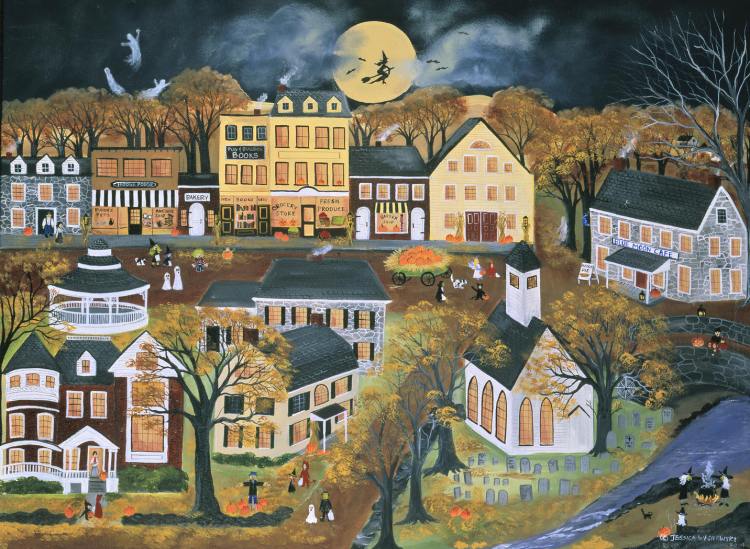
This year’s Halloween art exhibit comes from Melissa Macalpin’s “Getting Ready for Halloween.” (I can’t seem to insert the artwork directly into the post. According to Melissa (sort of), “copyright is old-fashioned,” so if I could, I would.)

This year’s metal soundtrack is King Diamond’s Abigail.

I don’t know what’s scarier–the music, or that I’m linking to it on what’s supposed to be a semi-serious, occasionally quasi-academic blog. Anyway, thanks to Vik Kapila for the suggestion.

By the way, don’t forget to vote in this crucial electoral race. Vote early and vote often, since the rules explicitly allow for it. Naturally, I cast several votes for AC/DC. I suggest you do the same. Or else.

Postscript, November 1, 2015: Well, another successful Halloween gone by. Conditions for it probably couldn’t have been better–Halloween on a bright October Saturday that turns gloomy as the day goes by, followed by an overcast All Saints’ Day falling on the Sunday when Daylight Savings Time ends.

My impressions of Halloween aren’t much changed from what they were last year: fairly large throngs of trick-or-treaters, but concentrated in very specific parts of town officially designated for the official purpose of Municipal Celebration of Halloween. Lots more adult involvement than when I was a kid; lots more adult supervision and regulation; more police involvement; strictly circumscribed hours. There’s a bit of anti-climax here: Halloween has now become six weeks of build-up toward a holiday that’s mandated to take place between the hours of 5 and 8 pm on a single evening.

Anyway, part of what makes Halloween an attractive holiday, at least in the suburbs, is the contrast it offers to the usual pathetic patterns of suburban life. Sad but true: Halloween is virtually the only night of the year when people leave the electronified comfort of their oversized homes to go out on the streets and interact with their neighbors for a few hours.

Watching the scene here in north Jersey, I couldn’t help thinking about the stark contrast with Abu Dis in Palestine, where I spent the summer: in suburban New Jersey, nightfall induces kids to retreat to the fortress-like compounds of their homes; in Palestinian towns and cities, by contrast, kids are up at all hours, playing in the streets. Both sets of kids are up, mind you; it’s just that suburban American kids are inside, in front of TV sets and video games, whereas the Palestinian kids are out and about. Meanwhile, suburban American parents treat their antiseptic neighborhoods as though they were chronically populated by witches, goblins, and werewolves. At the other extreme, Palestinian parents seem unfazed by permitting their children to play in streets riven by tear gas and gunfire.

Another unspoken but attractive secret of Halloween: In many neighborhoods, Halloween is one of the few nights on which  the de facto (and implicitly de jure) racial segregation that rules suburban life is temporarily allowed to lapse. Where I live, black kids from surrounding urban areas migrate en masse to the safety and affluence of the white suburbs, in search of better candy prospects than might be possible back home. For one night, then, crowds of black people converge on white neighborhoods without anyone’s regarding it as a threat–i.e., as a prelude to rioting or looting. In other words, #BlackLivesMatter temporarily becomes #CandyMatters. Since the two messages are in principle logically compatible with each other, everyone agrees for a night to focus on the latter, and a great time is had by all. Maybe they should introduce Halloween to Jerusalem and Hebron?

Speaking of Jerusalem and Hebron, there’s a big “debate” out there about political correctness in costumes, and the (supposed) dangers of “cultural appropriation” in costume-wearing. I’m going to save that one for next year. On a related topic, however, I couldn’t help being amused at how Islam is slowly but surely finding its way into Halloween culture. I tagged behind a group of kids last night dressed as terrorists: instead of “trick or treat,” they went door to door shouting “Allahu akbar!”  (Guilty confession: I found that pretty funny.) I also find it interesting that the newer film versions of Dracula–Bram Stoker’s Dracula (1992), Dracula Untold (2014)–now go out of their way to depict Dracula’s turn to vampirism as a response to Ottoman Islamism, an interesting inversion of the usual grievance-based explanations for Islamic terrorism.

The Dracula-as-anti-Islamist theme is a deliberate departure from, almost an inversion of, the depiction of Dracula in Bram Stoker’s novel. Though Dracula’s historical precursor Vlad the Impaler fought the Ottomans, anti-Islamism plays almost no role whatsoever in Stoker’s Dracula: Stoker’s Dracula equates the “Turk” with white invaders (Wallachian, Saxon, Austro-Hungarian); meanwhile Stoker “Orientalizes” Dracula himself despite his (Dracula’s) past life (lives?) as an anti-Ottoman freedom fighter. Transylvania, Dracula tells Jonathan Harper, “was the ground fought over for centuries by the Wallachian, the Saxon, and the Turk.”

Why, there is hardly a foot of soil in all this region that has not been enriched by the blood of men, patriots or invaders. In old days there were stirring times, when the Austrian and the Hungarian came up in hordes–men and women, the aged and children too–and waited their coming on the rocks above the passes, that they might sweep destruction on them with their artificial avalanches. When the invader was triumphant he found but little, for whatever there was had been sheltered in the friendly soil. (Bram Stoker, Dracula, p. 22).

In other words, Dracula was a rock-throwing Transylvanian nationalist ready to fight any invader who dared set foot in his lands.

Which is why Stoker gives him the physiognomic treatment reserved for Oriental nationalists:

The mouth, so far as I could see it under the heavy moustache, was fixed and rather cruel-looking, with peculiarly sharp white teeth; these protruded over the lips, whose remarkable ruddiness showed astonishing vitality in a man of his years (p. 18).

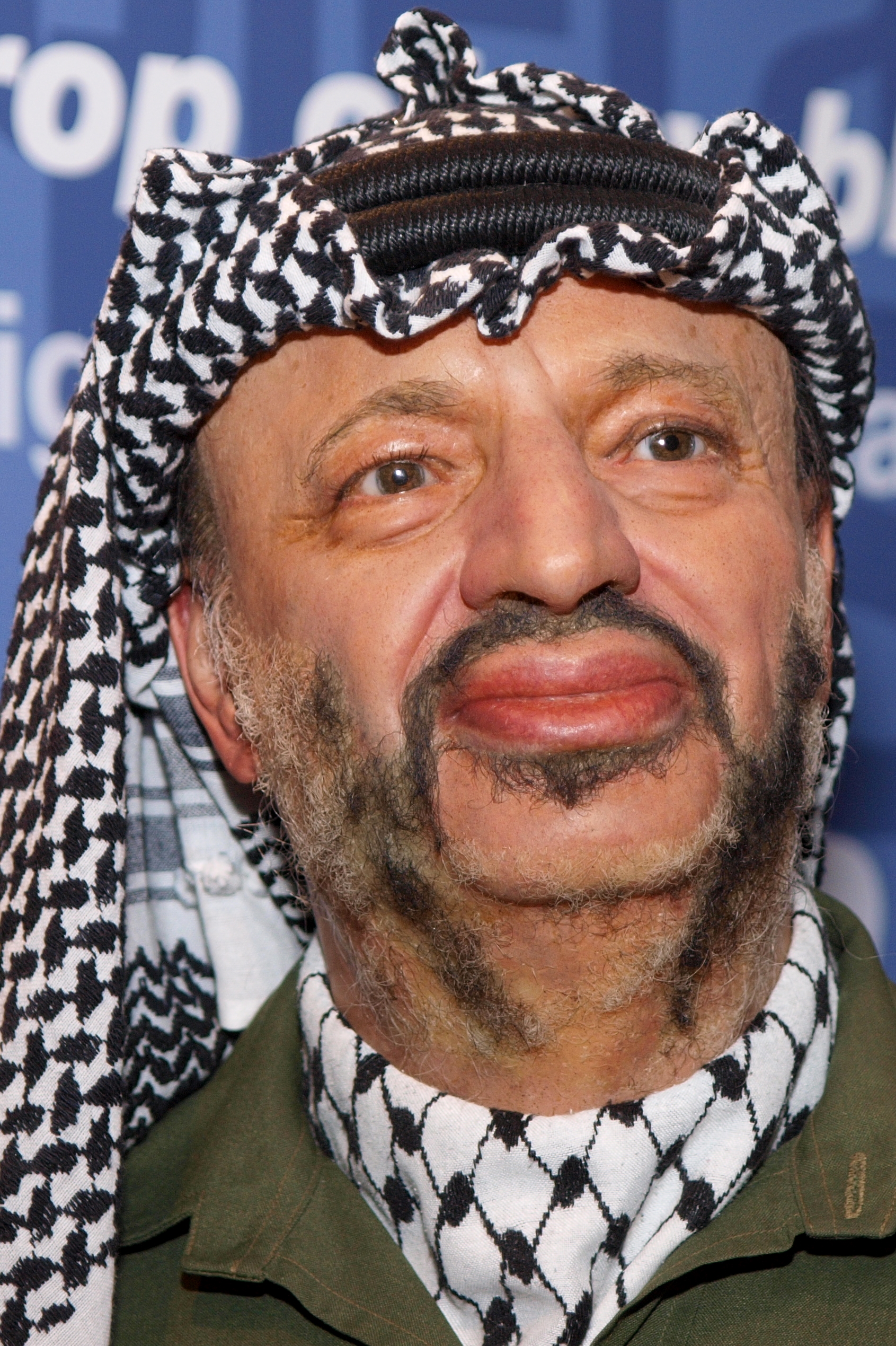
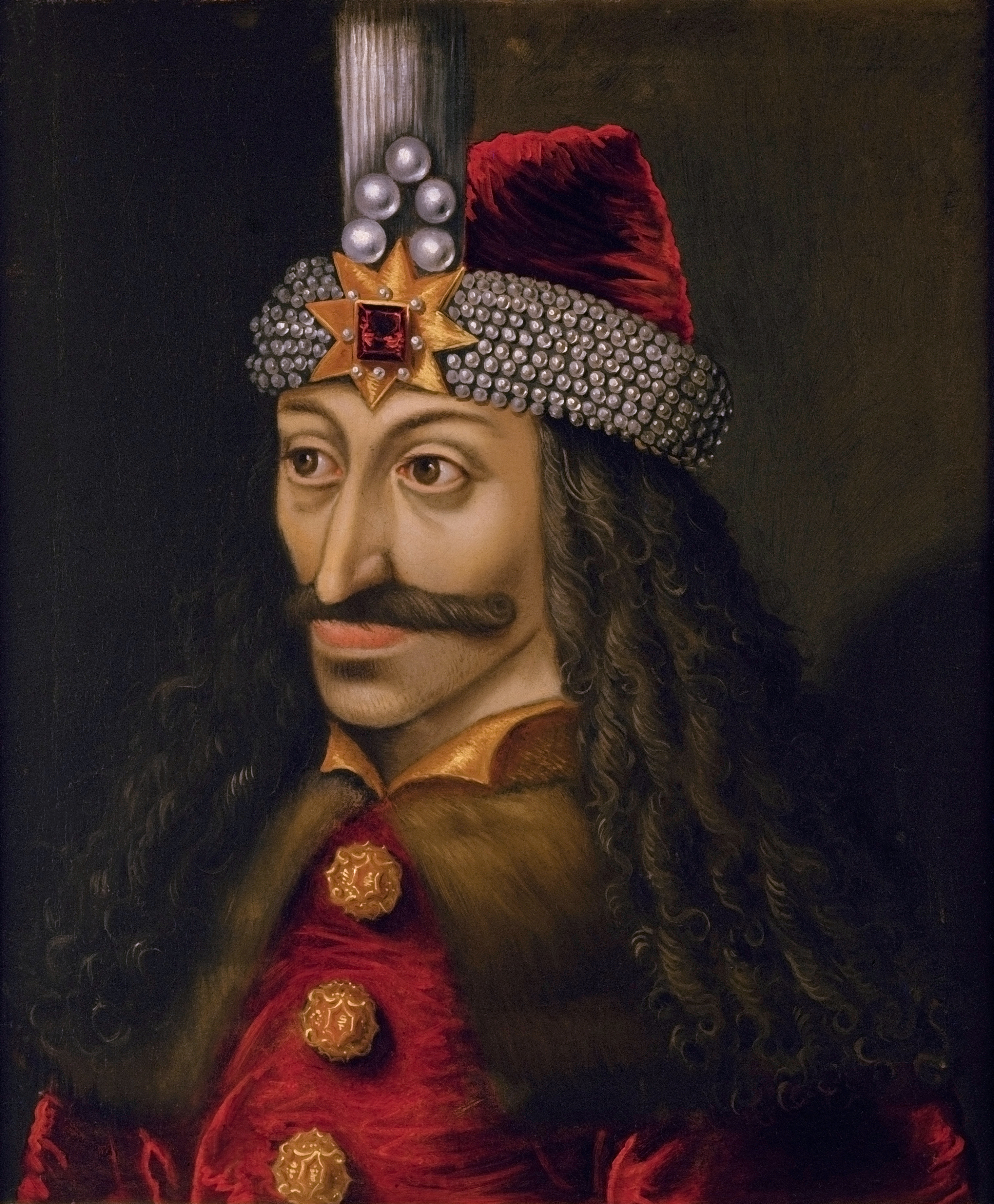
Interestingly, Stoker gives a much longer description of Dracula’s physical appearance but pointedly (so to speak) omits a description of the Evil One’s eyes. All in all, Stoker’s Dracula sounds like the spitting image of Yasir Arafat. Right?

Yasser_Arafat.jpg (1691×2539)

Vlad_Tepes_002.jpg (392×483)

Photo credits: Wikipedia

Right. Obviously, they’re not going to give the game away by opening their mouths.

Clearly, there are dissertations waiting to be written here: Dracula and the Ottoman OtherStok(er)ing Orientalism, (Jonathan) Ha(n)k(er)ing After British Imperialism, and so on, and my only regret is that I can’t write any of them. But obviously, some have, and more power to them. Read them, the tenure-seekers of the night. What music they make!

All right, enough: off to really scary things. Like paying the rent.

New Blogger: Stephen Boydstun

I’m happy to announce that Policy of Truth is getting yet another blogger, Stephen Boydstun. I don’t exactly remember where Stephen and I met, but I think it was either at Marsha Enright’s justifiably famous New Intellectual Forum “salon” in Chicago in the early 1990s, or at one of the Institute for Objectivist Studies summer seminars around the same time. Anyway, we met a long time ago, and we’ve been talking philosophy ever since. The last time we did that (in person, anyway) was 2013, at the epistemology seminar that Carrie-Ann and I did in Glen Ridge.

Here’s a bio of Stephen I found online:

My academic backgrounds are in physics, philosophy, and engineering. My engineering work was building locomotives, then I switched to nuclear power electrical generation. Engineering rounded out the understanding of the physical world I had from physics. Now all those backgrounds, and long study of philosophy, too, are put into my project of writing my own philosophy.

I created, financed, and edited Objectivity, a hardcopy “journal of metaphysics, epistemology, and theory of value informed by modern science” (1990-98). All issues of Objectivity are now freely available online for readers and researchers.

On the romantic side, my partner’s name is Walter. We have been together nineteen years. He has two sons and one grandson, now age fourteen. It is wonderful to have a family.

The last sentence of the first paragraph refers to a book that Stephen is currently working on, parts of which I believe he’ll be trying out on us. (Here’s another bio of Stephen I found, by the way.)

And here’s a bit about the book in question (written in December 2014):

I have been writing a book of philosophy since last January [2014]. It is my first. Throughout the preceding thirty years, I had written essays. Writing essays had to be stopped while I write this book. Into my book, as into all my previous essays, there goes a lot of study. My writings in philosophy are informed by the history of philosophy and contemporary philosophy and informed by mathematics and by modern physical science, engineering, biology, neuroscience, and psychology. …

I cannot share the title of my book at this time. It deals with metaphysics, epistemology, and theory of moral value. I shall not be treating esthetics. Theory of individual rights will be entered, but beyond that, I shall not undertake political philosophy.

So it looks like some of us are actually going to have to learn some science if we’re to understand what Stephen is talking about–something I haven’t bothered to do since the introductory Geology/Biology course I took in my sophomore year of college (roughly: “Rocks and Cells for Idiots 101”).

Like all PoT bloggers Stephen will be blogging whenever he wants. I have no idea when that will be, but until then, a warm welcome from the rest of the PoT crew….

And now back to our regularly scheduled programming of bad jokes and overheated polemics from yours truly.

Postscript, November 5, 2015: Stephen will be blogging under the online moniker “guyau.”