We’re about a month into the Iran War at this point. The war is, as predicted, a disaster getting worse by the day. As I’ve argued here before, we desperately need a large-scale anti-war movement, but the movement is, alas, in a low-energy state right now. Not that it’s entirely dead: there are direct actions taking place, some very brave ones, along with some ordinary demonstrations. And there’s no shortage of astute commentary out there as well.
But the movement has a problem in need of solution, and while No Kings seems at first to provide the solution, that appearance quickly evaporates on contact with it. The anti-war movement has a clear goal, ending the war, but lacks the means or numbers to accomplish it. No Kings has the numbers, but seems uninterested in ending the war (or any war), and uninterested even in broaching the topic. So it’s worth discussing the relationship, or anti-relationship, between these things.
My discussion here has admittedly severe experiential limits. I work long hours, have a long commute, spend a fair bit of time reading and writing rather than agitating, am an introvert, and have a strong aversion to being arrested or fired. So I’m a sunshine activist at best, a dilettante rather than a disciplined social justice warrior of any kind. Over the last month, I attended five demonstrations in two towns–four anti-war demonstrations and one No Kings rally. Two of the anti-war demonstrations were student-organized events at Princeton University; the other two were organized by off-campus anti-war groups, one by the Coalition for Peace Action in Princeton, the other by New Jersey Peace Action in Montclair. On Saturday morning I went to the No Kings rally at Monument Park in Princeton, the first No Kings event (I think) that I’ve so far attended.
Five demos in two towns is admittedly a small sample from which to generalize, but though small, I’m inclined to think that the sample is basically representative of the problem the anti-war movement faces. In other words, I’m assuming, defeasibly, that my experiences represent the central tendency. There may be alternatives to it, but my (defeasible) assumption is that those are non-representative outliers.*
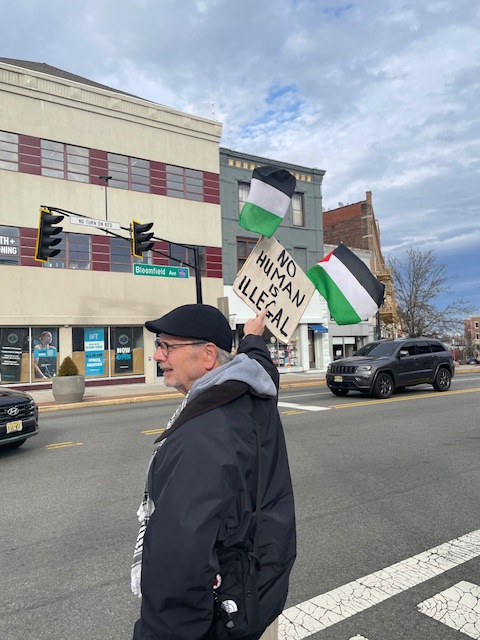
Jeff Hoey, Church Plaza, Montclair, New Jersey
If we set No Kings aside for the moment, I would say that anti-war activist groups of the kind I’ve just mentioned tend to have the same mix of assets and liabilities. On the plus side, they’re run by knowledgeable, experienced, and intensely dedicated activists who’ve been protesting war and imperialism for decades. These activists know what they’re doing and why they’re doing it. In the present case, they want to end the war, and want to induce others to help end it.
And though it’s not much noticed, anti-war activists have a tenacity that exceeds any power of merely verbal description. The anti-war activists I know (or know of) in New Jersey have been at it for decades, undaunted by the indifference, derision, and hostility of the surrounding community and of professional politicians and civil servants. Unlike me, they’re either retired or willing to sacrifice career entirely to activism; they spend time in the streets rather than curled up with books; whatever their psychological propensities, they force themselves to engage with people rather than avoid them; and many of them are only too happy to be arrested. In other words, these are people engaged in a lonely, thankless, ill-understood, and ill-appreciated enterprise.
Without them, there would be no traffic jams at all along the various highways to hell that the rest of us take for granted. When they succeed or are proved right, as in Vietnam, Afghanistan, Iraq, and Libya, we take their achievements for granted. Along the way, we either ignore or laugh at them, and watch with equanimity as their reputations are trashed and their futures destroyed. The asset to which I’m drawing attention is their imperturbability. Do what you like or don’t, they keep going. Appreciate them or not; it doesn’t matter. What matters is stopping the juggernaut, and there’s no rest until it does, assuming it ever does.
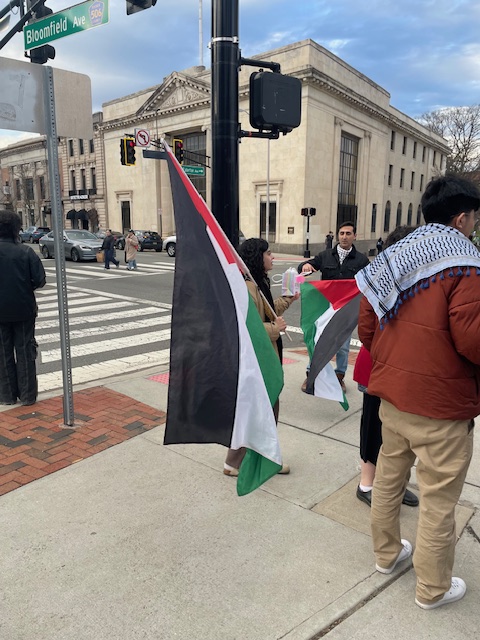
Church Plaza, Montclair
On the negative side, however, whatever their knowledge, sincerity, and dedication, anti-war activist groups are too small to have any real impact on public consciousness, much less public policy. About two hundred people showed up at Hinds Plaza in Princeton on the first day of the war. We got some nice media coverage, but made barely a dent in anyone’s thoughts. The University events were sparsely attended and poorly covered. The Daily Princetonian garbled the one quotation from me that they ran from my statement at Firestone Plaza the other day to ban ROTC from Princeton University. I wrote a letter to them correcting some pretty straightforward errors, which they’ve so far (in a week’s time) declined to print. These are undergraduate journalist-amateurs getting on their high horse about having to amend their own journalistic errors. A movement that can’t even get that much movement out of people in that position has essentially no power at all.
We got several dozen commendatory honks from passing cars at Church Plaza in Montclair the other night, but there were at best a dozen or so of us protesting at any given time. As far as pedestrians were concerned, we got maybe two or three hecklers, and a dozen half-hearted expressions of interest from passing pedestrians, but were mostly met with polite indifference. It was Friday evening, and people were out and about to have a good time downtown. The war was further from most peoples’ minds than dinner or dessert, so no one on Bloomfield Avenue was about to be detained by a bunch of activists waving anti-war signs or Palestinian flags.
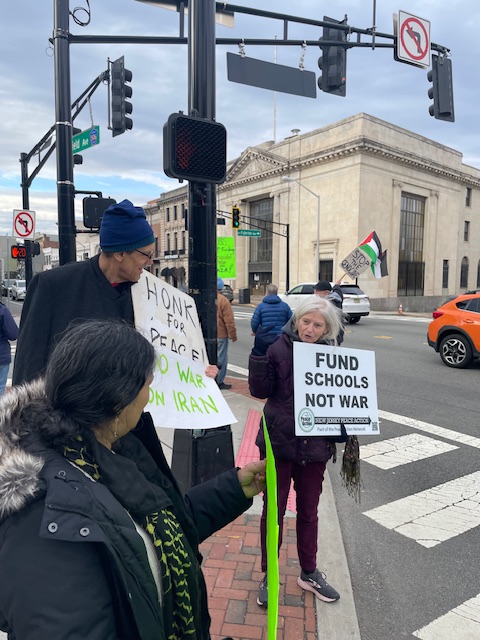
John Lawrence and others, Church Plaza, Montclair
At a higher level of intensity, there are activists doing direct actions at ports and dockyards on both coasts–Port Newark in New Jersey, Port Oakland in California, and the Port of Seattle in Washington State. These are people putting their bodies on the line to stop maritime shipments of military hardware to Israel via shipping companies like ZIM and Maersk.
It’s very unlikely you’ve heard a word about the activists or their actions, however–who is doing them, when, where, how, why, or with what consequence. It’s not just that the numbers aren’t there in terms of activists themselves, but that they aren’t there in terms of attention to what the activists are doing. The activists are willing martyrs to a noble cause, but have the misfortune of inhabiting a milieu that takes pride in treating noble causes are quixotic, inconsequential fanaticism. No matter that the judgment comes from people who have brought us (or are complicit in) an endless string of imperial disasters, and who can only be counted on to bring us more.
So that’s the anti-war activist scene. What about No Kings? Following my own advice, I went to the No Kings rally at Monument Park in Princeton on Saturday. I had previously said this about No Kings:
I understand that people have ideological reservations about No Kings, many of them perfectly valid. And I grant that not all of No Kings’s energies this weekend will be devoted specifically to the anti-war cause.
That was an understatement. Mea culpa. The hard truth is that No Kings really sucked–managed dissent and manufactured consent at its worst. The rally was about 90 minutes long, and attracted about 1,000 people. A small (but visible) minority carried anti-war signs and banners, but most were interested in other things. The organizers– Indivisible Princeton and the ACLU of New Jersey, presided over by the local Democratic establishment–seemed to have gone out of their way to avoid mention of the war, and also tried their best to ensure that no one else mentioned it. Of maybe ten invited speakers, not one focused on the Iran War, or any war, or any foreign policy issue. And if you think this was purely accidental, I have a Persian Gulf strait to sell you.
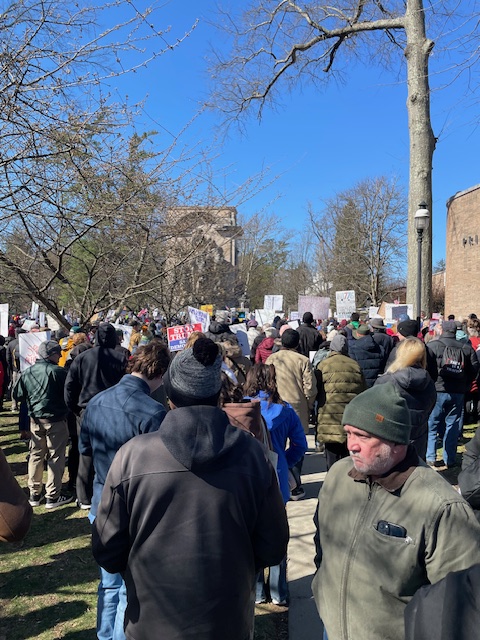
No Kings, Monument Park, Princeton, New Jersey
The main advice we got was to vote, the implication being that we should vote for the Democrats. No Kings is in short a canvassing exercise for the Democratic Party. Its primary aim is to cement the Democrats’ confidence in the popular support they enjoy in safely blue districts. Its secondary aim is to bring business into town on the premise that any thousand-person upper-middle class event is bound to attract its share of high-end shoppers and Kamala-inspired brunchers. Its tertiary and perhaps most pathetic aim is to give local Democratic politicians (think Mark Freda, Jon Durbin) the sense that they have a leadership role to play in the illusory “resistance” they’ve put up to the Trump regime.
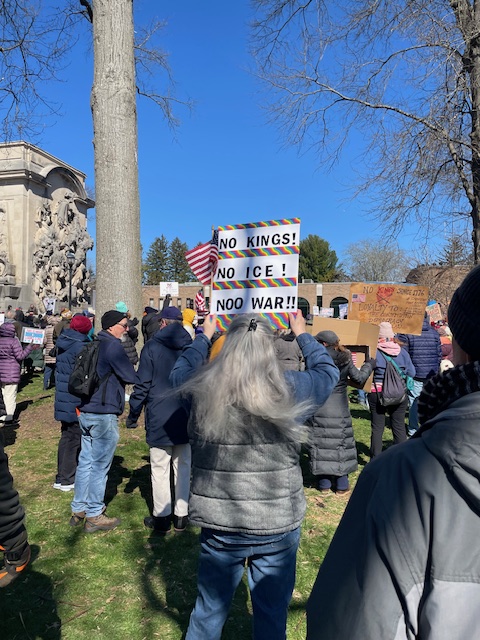
No Kings, Princeton.
Most of the No Kings rally was an insipid cocktail of clichés and manufactured outrage presided over by establishment Democrats with nothing to say. The one exception was Ana Paola Pazmiño of Resistencia en Acción, who delivered a strong pro-migrant message, and offered the one and only anti-war line of the morning. Otherwise, the speakers labored to pretend that the only thing we had to fear was Trump himself–not war, not war crimes, not atrocities, not mass displacement, not genocide, not even war-generated economic dislocation, and certainly nothing as abstract as the possibility of world war or nuclear war. Listening to them, you’d have no way of knowing that we were at war. The emcee, ACLU attorney Ezra Rosenberg, rambled on in a state of insular obliviousness, careful to avoid mention of the war, but unable to rouse the crowd by mention of what he did bring up. Leave it to a bunch of fucking lawyers to narrow the focus, kill the buzz, and destroy the momentum.
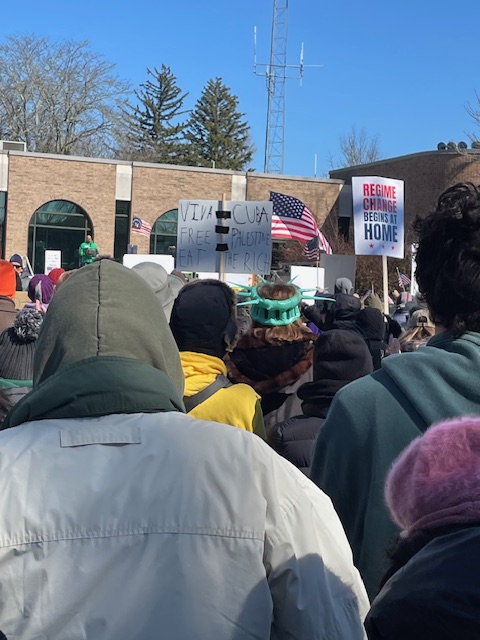
The only sign I saw that mentioned Cuba or Palestine by name
It’s been remarkable to watch a movement that claims to be so anti-Trump fail to target Trump for the one policy that’s so distinctively a liability for him as the Iran war–so exclusively his, so totally unprecedented in its incompetence and conceptual confusion, so painfully unpopular, so clearly disastrous, so breathtakingly dangerous, and so obviously immoral.
Faced with a crystal-clear example of a lethal political liability for Donald Trump, one that fractures his own Republican base, No Kings managed to avert its eyes, flee the moral scene, and yet farcically enough to invoke the idea of Revolution (!)–the Revolution of 1776, of course, apparently unresolved since Yorktown. Hard to avoid the thought that they’ve declined to criticize the war because they secretly support it. Also hard to avoid the related thought they’re hedging their bets about what to say about the war because they know Israel supports it. That Americans might die in droves for Israel is somehow not a relevant consideration for them. If we voted for them, and the war was still on when they won, what could we expect them to do about it? Disengage? Escalate? Defer to Bibi? Or just go to brunch with Kamala? Given their silence, it’s anybody’s guess.
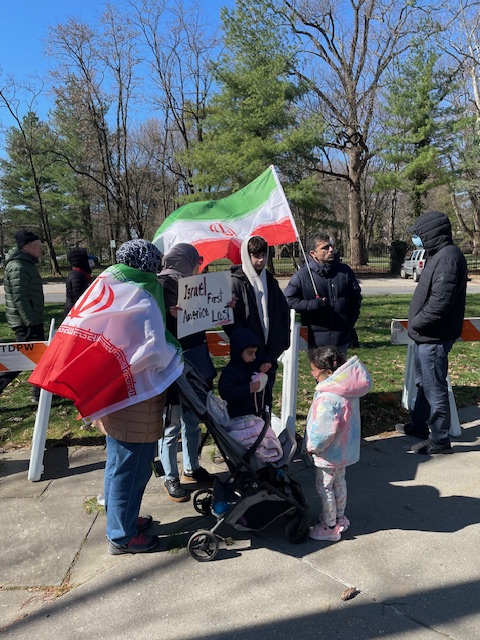
I assumed that they were against the war, but neglected to stop and ask
It all makes you wonder whether they’re really as stupid as they seem, or just plain evil, or some cowardly mixture of the two. I sincerely invite anyone to produce a better explanation for the level of blank, wholesale, cosmic evasion involved.
Here they are, two years into a genocide, or if you refuse to use that term, into a years-long string of atrocities in the service of ethnic cleansing and colonial expropriation. That’s not bad enough, so we manage to fund and arm Israel’s multi-front wars with its “neighbors.” That’s not bad enough, so we ourselves go on an unhinged series of attacks against a variety of sovereign nations, bombing Iran, kidnapping Maduro, blockading Cuba. That’s not enough, so we decide to initiate a full scale war against Iran, which predictably retaliates by closing the Strait of Hormuz, trapping us in an escalation trap, and threatening to tank the world economy.
Tens of thousands of people are dead, millions are displaced, and there’s more death and displacement to come. There is credible talk of invasion, of escalation, of wholesale massacre, of nuclear war. Every day brings news, now normalized, of the latest civilian infrastructure we’ve bombed–apartment buildings, hospitals, schools–with the exultant coda that we’re free to hit what we want because we have “air superiority” over them. None of it registers. None of it penetrates the veil of ignorance. None of it is allowed to disturb the serenity of the perpetualized ethos of brunch, of pseudo-revolutionary fantasy, of falsified historical nostalgia, or of sporadic electoral “resistance.” If the Democratic establishment wants to play make-believe, then we too are obliged to play it with them. If they want to play hide-and-seek minus the seeking, then we have to do the same. It’s either Democratic make-believe, after all, or MAGA. What choice does a bien pensant have?
The Democrats are quick to complain about Trump’s lies, but their own dishonesty is really no different than Trump’s, differing only its lack of brazenness or transparent incoherence. Trump lies; they conceal. Trump is incoherent; they’re evasive. But at the end of the day, it’s the similarity that’s more striking than the differences: Trump is addicted to and inured to militaristic brutality, but then, so are they.
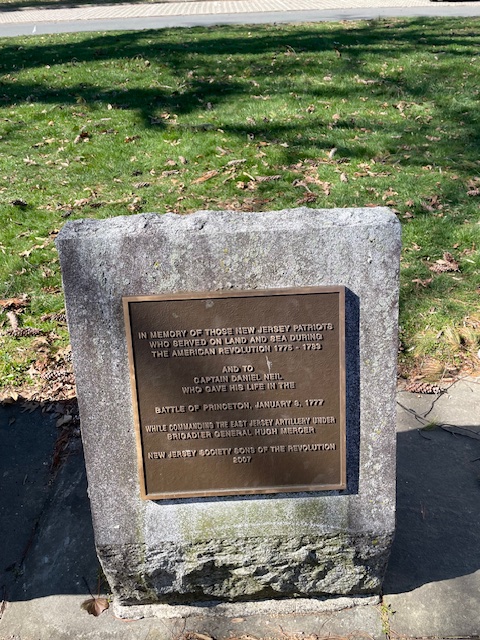
The Battle of Princeton was actually fought about a mile from this marker. I’m not sure it’s over
There was a lot of empty valorization among the No Kings crowd of the American Revolution and its displacement of King George III. This in some ways is the key to the essential bullshit artistry of the entire No Kings movement. The American Revolution is for them a fixed Archimidean Point of moral deliberation: if something re-enacts the Revolution, it can’t be that bad. But precisely that needs to be called into question. Was the Revolution really such a great thing? Is it the fixed point they seem to believe it is?
Consider first the most obvious facts. The American Revolution was a war. Do the Democrats want to fight a comparable war here at home? If so, where is it? The war targeted the Establishment. But the Democrats are the Establishment! The American Revolution was an anti-imperial enterprise. Is the Democratic Party an anti-imperial enterprise? If so, why does it have such trouble opposing obviously imperial wars?
Now consider some subtler facts. It’s a commonplace of contemporary historiography that the American Revolution was both an anti-imperial and an imperial war. It was an anti-imperial war against Britain, but it was fought in part to reverse Britain’s Proclamation of 1763, preventing settlement of the continent beyond the Appalachians. That was an imperial aim because settlement in the service of sovereignty threatened war against and displacement of the Native American tribes west of the Appalachians.
The Revolution was fought in part to erase or reverse the Proclamation so as to settle, conquer, and impose sovereignty over the West. So just as the Revolution required the political displacement of the British, it required the physical displacement and destruction of the native inhabitants of the continent, whose presence was deemed a threat to the nascent American nation. You can’t build a nation until you cleanse it of those who don’t belong in it, and a rival nation obviously doesn’t. This is, incidentally, not exactly revisionist history. It’s ordinary American history at the advanced introductory college level as taught in 200- or maybe 300-level history courses. If No Kings is unfamiliar with it, maybe it’s time to go back to school.
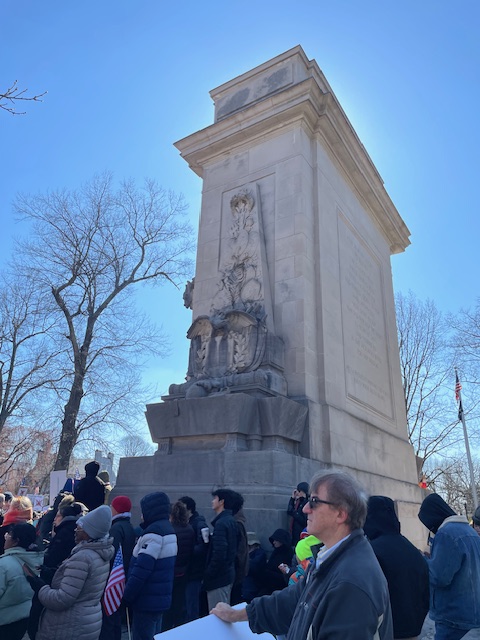
Princeton Battle Monument
This blind spot about the nature of the Revolution haunts the entire No Kings enterprise. The principals of No Kings are content to take for granted the version of American history they half-learned in tenth grade, but seem disinclined to take things any further. They’re capable at some level of imagining themselves as eighteenth century British Americans put upon by King George III. But they’re not capable at any level of imagining themselves the Native American victims of the Revolution, whether during the Revolution itself, or for the next century thereafter, up to and including Wounded Knee.
It’s not surprising that people incapable of empathizing with the eighteenth century victims of their Revolution are likewise incapable of empathizing with the contemporary victims of its centuries-long Thermidorean Reaction–the Palestinians, Lebanese, Syrians, Iraqis, Yemenis, and Iranians whose lives and countries we’re currently destroying. It’s an axiom of the centuries-old moral ontology we inherit from Washington, Jefferson, Madison, Hamilton, et al that some people are meant to rule, while others in consequence are meant to die.
Americans tend to forget that No Kings is perfectly compatible with “natural aristocracy” (explicitly defended by Thomas Jefferson, John Adams, and Alexander Hamilton), understood as rule by the best. And while rule by the best requires the deposition of incompetent monarchs, it also means the destruction of those deemed incompetent humans. That’s the price of civilization, paid for by the uncivilized. That is the ethos Americans have practiced since Day 1, and continue to practice until this day. No Kings won’t contest it because they can’t. It’s their ethos as much as it is Donald Trump’s or Pete Hegseth’s. That’s why they refuse to bring it up. Where would that lead, but an actual revolution?
People stuck at this level of moral development are content to mouth “Lenni Lenapi land acknowledgements” without grasping that their own country is violating, say, the Lebanese in unspeakable ways even as the mandated land acknowledgements are recited in various sanitized settings. If the ethnic cleansings of the past have been reduced to a series of empty verbal rituals, the ones of the present have even less presence than that. No one mentioned “Lebanon” at No Kings, much less the million people displaced by the US-Israeli war on that country. Like the Cherokee, it’s assumed, the Lebanese will eventually find their way to some version of Oklahoma. How they get there is no one’s problem but their own, and certainly not something to be discussed in polite company, like a No Kings rally.

Wounded Knee, Pine Ridge Indian Reservation, South Dakota
That said, my advice remains the same. We really have no choice. We need a mass anti-war movement of the kind I’ve previously described here, but we don’t have one unless we recruit it from No Kings. Two things are worth bearing in mind about that.
One is that it’s instructive to note that the organizers of No Kings were forced to invite the likes of Resistencia’s Pazmiño, despite their knowledge that she really isn’t one of them, and isn’t really on board with their agenda. To their credit, Resistencia marches to the beat of its own non-establishment drummer. Once upon a time, mainstream Democrats marginalized and ignored Resistencia, but now they know better. After the events of 2025, mainstream Democrats have grasped that they ignore Resistencia at their peril: any attempt to marginalize Resistencia will meet a painful response.
Princeton’s Town Council still has nightmares about the full court press that Resistencia mounted last summer in defense of the Immigrant Trust Act resolution, and knows that if provoked, Resistencia can repeat the performance more or less at will. Resistencia’s presence on the No Kings program proves that you can get an anti-establishment message into establishment platforming if you work hard enough at it, and work hard to deny the establishment’s attempts at marginalizing you. In that respect, Resistencia offers an example for emulation, but is also a hard act to follow.

Resistencia at Union County Administrative Center, Elizabeth, New Jersey (March 2025)
The other thing worth noting is that while the No Kings organizers ignored the war, the crowd did not. There was as I’ve said a small but visible anti-war minority in the No Kings crowd. You can see some of that in the photos I’ve posted nearby. After the event, when I approached this guy below and rather sardonically jeered that no one had even mentioned the war he was protesting, he murmured “yes” with quiet, dignified resignation and seemed on the verge of tears. I feel pain at having pushed him to that reaction (which belatedly makes me want to cry), but also a somewhat guilty sense of vindication. What I should have done was recruit him, except that I had nothing to recruit him into. That’s a snapshot of our problem.
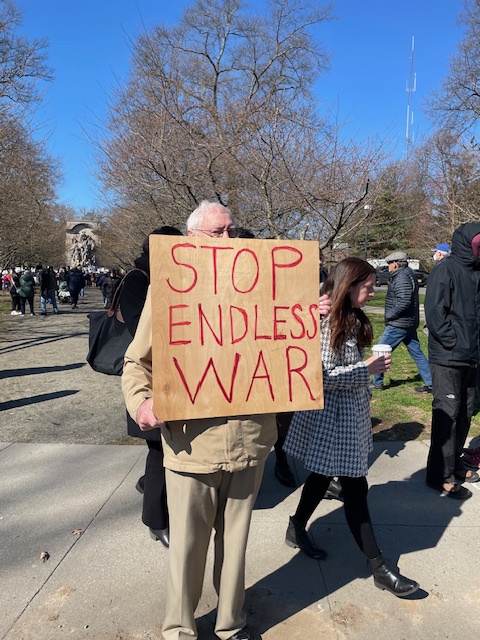
I regret that I didn’t stop to have a more civilized conversation with this man.
For a variety of reasons, I don’t think we can directly emulate Resistencia, e.g., by persuading the No Kings powers-that-be to platform our anti-war anti-imperialist message. Even if we can, the costs will be exorbitantly high. So while I don’t shut the door on it, it’s not my preferred strategy. What we can do, and should do, is show up at No Kings events and actively recruit the disaffected. We feel your pain, we should tell them. We see that you’ve come here to oppose the war, and come to realize that nobody at the top of the No Kings hierarchy gives a flying fuck about your concerns. That’s what happens when an aristocracy decides to go after the king. The hierarchy changes, but the goals remain the same. And if the baseline was constant imperial warfare, that will remain the same, so that there’s nothing for you here.
There has to be something for them somewhere else. We need to get these people into our movement, and get them to show up at Church Plaza, or Teaneck Armory, or Founders Park, or Brookdale Park, or Morristown Green, or Newport Green, or Military Park, or Hinds Plaza, or whatever. We can’t just go through the motions of showing up at those places on our own. We need an influx to us that’s an exodus away from political business as usual. It’s been done before. It can be done again. But it has to be done soon.
*Though I can’t say I’ve done a comprehensive literature search (whatever that would mean), I have read up on No Kings well beyond Princeton or New Jersey, and see little evidence that No Kings organizers have integrated anti-war themes into their messaging. Current reporting suggests either that anti-war protesters showed up at No Kings rallies (as I argue they should), or suggests that critics think anti-war motivations are in fact driving people to show up at No Kings (as I expect is the case). But that doesn’t address my criticism. I take this piece by Robert Kuttner to sum up the consensus: anti-war messaging is not part of the package. This piece from LA Progressive coheres with my own take; so from a slightly different angle does this one by Jeet Heer in The Nation.
This PR piece from Common Dreams claimed before the fact that anti-war messaging will be part of the rallies, but when I looked for actual confirmation of follow-through, I found essentially nothing. My point is that No Kings as a movement is not in general an anti-war movement, and specifically that No Kings in Princeton went out of its way to ignore the war. I take No Kings Princeton to be representative of No Kings in New Jersey.
Thanks to Hilary Persky for ongoing conversation on this topic. Thanks also to Susan Gordon, whose insights inform just about anything I write on activism; to Kate Herrick, who endures my perpetual rambling; to Alexis Morin, who checks my old-man tendencies; to Jeff Hoey; to Robert Massie; and to Suzanne Schneider, whose criticisms of the anti-war movement (and commentary on the nationalist Right) I’ve mulled over and taken to heart. None of them are responsible for anything I say here.
 Policy of Truth