If you’ve been following the news about the Iranian girls’ school that was hit by an American missile, you may have noticed that the very news stories that indict the US quietly provide a bit of exoneration for the US as well. The school, we’re told, was right next to a military installation. Clearly, the installation was the intended target of the strike. If so, perhaps there is a story to be told about how the US was trying to hit the military installation but accidentally hit the school (twice). Which doesn’t make it so bad. It was an accident! Not our fault! Why would the Revolutionary Guards put a military installation next to a school? How can we be blamed for killing a bunch of schoolgirls if they do? You can see the position of the school relative to the base in this screen shot below from The New York Times.
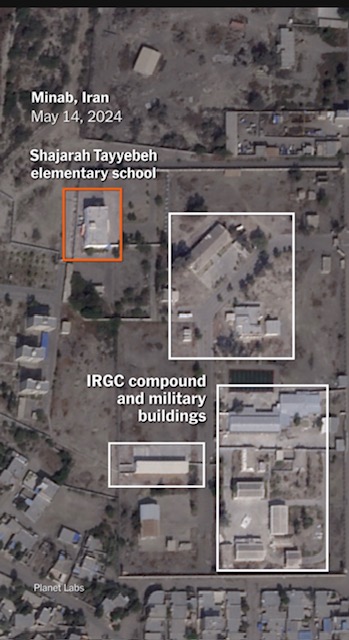
Consider a related question, though. Look at this screen shot below, from the Carnegie Center in West Windsor, New Jersey. I know the layout well because I used to work there.
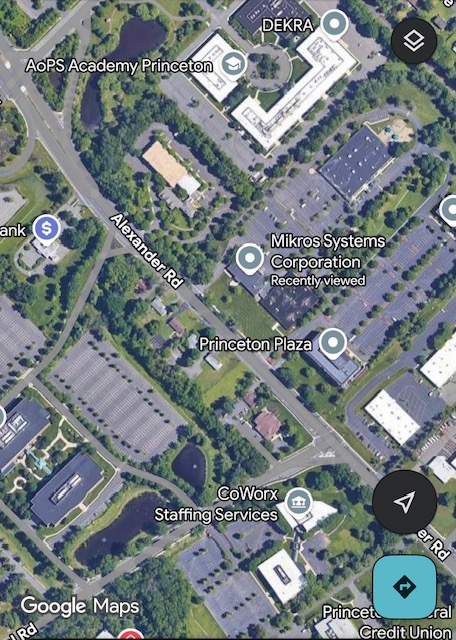
Mikros Systems Corporation is a defense electronics maintenance and logistics support company that has contracts with the US Navy and other “defense”–aka, military, aka aggression–agencies (see here). Princeton Plaza is a medical office building. DEKRA is a civilian process safety laboratory. AoPS Academy is an enrichment academy for kids, grades 1-12. CoWorx Staffing Services is a nearby temp agency. The Princeton Federal Credit Union is self-evident. Also adjacent are assorted streets, parking lots, walking paths, and sitting areas, all of an apparently civilian nature. They’re quite pleasant, actually. I should know. I used to spend my lunch breaks there back in the day.
Mikros is as “adjacent” to these civilian sites as the IRGC facility is to the girls’ school. If so, surely the question to ask is not why the Iranians put their schools so close to military installations, but why modern societies do. Put less decorously: why do these psychopaths insist on embedding military entities within civilian infrastructure, but then insist that the “enemy” is the one that does it (not us), and thus deserves to have its kids killed (not ours) because they embed their military infrastructure amidst civilian life–which we never do?
Except that we do, all the time. One reason is that it’s cheaper to do so than otherwise. Military facilities need ordinary economic supply lines. Military families need schools and enrichment programs. It’s cheaper and more convenient to be closer to such things than farther away from them. That single fact by itself explains why defense contractors can be found in ordinary office parks. Where else would they go? Consider the alternatives.
The nearest full-scale military base is Joint Base McGuire Dix Lakehurst in Jackson, New Jersey, a woebegone town an hour south of Princeton–in the middle of nowhere, from a Zillow perspective, with mediocre public schools to boot. What self-respecting defense contractor would want to live there?
Imagine that you’re a well-educated, high-end defense contractor. With a war raging in Iran, business is good, your job is secure, the kids are in good Princeton-area schools (bound, let’s hope, for the Ivy League or at least Swarthmore), and your Mercer County property values are climbing.
Here’s your average day: you design lethal aerospace targeting systems in the Carnegie Center by day, get a babysitter for the evening, hop the New Jersey Transit at nearby Princeton Junction rail station, and end up at Madison Square Garden within an hour for happy hour. Who could beat that? Who gives a shit that your office is adjacent to a bunch of civilian targets, and that you’ve turned them all into human shields? Who would target them, anyway–a bunch of religion-intoxicated Shiite fanatics? What do Iranian Shiites know about missiles or targeting systems, anyway? And what sense would it make to move onto a military base in the middle of nowhere just to avoid the implications of a few armchair ethical dilemmas?
Bear in mind that the companies in question tend to have diversified product lines. They don’t think of themselves as exclusively defense-serving. Since they typically have ordinary civilian clients in addition to, say, the US Navy, it makes no sense for them to be located in places that their civilian clients find inconvenient. You may regard this consideration as obviated by Teams, Zoom, Slack, and the like, but the offices in question were built in the days before those technologies were adopted (essentially, before COVID, before 2020).
And most employers insist on some on-site presence, if only to justify leasing on-site facilities. Whether anyone works there on a daily basis or not, the physical site, after all, is where the most sensitive company material (data, servers, documents, etc.) will be stored, and where the most important in-house or client meetings will take place. I may be an anomaly, but I commute to an on-site facility every day, five days a week. So do a few colleagues. And we have hybrid colleagues, as well, who show up at the office three or four times a week. So the physical site can’t just be waved away as an anachronism.
If you really follow the hybrid logic, though–defense contractors don’t need offices because they have Teams, which they have in their home office–we end up with defense contractors wherever the contractors can get WiFi. And since 5G is basically everywhere, that means anywhere, like right next door. It’s a sobering thought. If your next door neighbor designs aerospace targeting systems for a living, does that make your block a military target? I don’t see why not. Something to bring up with the HOA or the zoning board.
If the Iranians had missiles that could reach us, and they were picking targets, Mikros would be an obvious, perfectly legitimate target. I mean, if we can hit their oil refineries with hellish results, they can hit our defense contractors with milder (though still lethal) results. Like their refineries, Mikros is surrounded by civilian infrastructure and civilians themselves. If you target Mikros and miss (or don’t hit it precisely), you end up hitting medical patients, school children, office workers, and other assorted passersby.
At that point, you have your choice of accusations and excuses. You could either blame Mikros for being so close to these civilian concerns, or blame the missile targeter for missing Mikros and hitting everything else. You could also, however, side-step the whole issue by blaming the people who gratuitously start wars and generate pointless questions of this nature–which in this case would be the US and Israel.
Mikros is not an anomaly. It’s an example I picked out of a hat because I happen to know the defense contractor/office park environment in Princeton, having worked and lived here over the course of decades. Mikros is one of several defense contractors in the Carnegie Center office park alone. Here’s the list–I mean the part of it that’s in the public domain: 133 contractors, 2,445 contracts, and $1.5 billion in defense contracts in the Princeton area alone.
Though I didn’t happen to do military work there, I used to work for Raytheon in the very same office plaza back in the 1990s. Raytheon moved to Princeton in the mid 1990s, after the first World Trade Center (WTC) bombing of February 1993, which is how I landed a job with them. They’d initially been housed in the WTC, but decided after the 1993 bombing that they didn’t feel safe there. Good choice! So they moved to Princeton/West Windsor on the premise that no one would think to bomb them there. And no one did.
You might, incidentally, have been led to believe that the WTC was a purely civilian office building. Well, in that case you’d be wrong. Raytheon wasn’t and isn’t a purely civilian company. It’s a defense contractor, and it was housed at the WTC with the full knowledge and acquiescence of the management of the WTC, which happily took leasing revenues from Raytheon and made a killing off of it (if you’ll pardon the pun). If Raytheon was a defense contractor, the WTC was at least in part a defense facility. But if “defense” is really a euphemism for “imperialist,” you get a different outcome altogether.
Right now, Raytheon is, in an entrepreneurial spirit, advertising their anti-drone business on their website on the correct assumption that anti-drone technologies will be in demand in the near future. Does it really make sense to think that the office buildings and office parks that house Raytheon are purely civilian entities? Can we call something “civilian” if it just happens to house anti-drone production lines intended for the military? If not, every office park housing Raytheon looks like a legitimate military target, even if it’s surrounded (as so many of them are) by civilian infrastructure.
Contrary to common belief, the WTC wasn’t a purely civilian office building, any more than the Pentagon was or is. It was home to a bunch of federal agencies (US Customs Enforcement, the Secret Service, the SEC, the Defense Dept), a bunch of security consultancies (Kroll, Marsh & McLennan, Aon, Pinkerton), and not one but several large defense contractors (Raytheon, Lockheed-Martin, L3, SAIC). In short, things there weren’t as innocent as the “innocent civilian” mythology about the WTC suggests. If we look at the 1993 WTC bombing the way we look at our own bombings, it just looks like an ordinary military bombing with a set of political-military targets plus some collateral damage.
In short, neither Mikros nor the Carnegie Center is an anomaly. They’re a lot like the WTC, which was a lot like a lot of apparently innocuous office buildings. Defense contractors dot the landscape all over the Princeton area, so what I’ve said about Mikros, the Carnegie Center, and the WTC applies across all defense contractors in this area. Here’s that two page list again. There are 133 sites on it.
Princeton/West Windsor isn’t an anomaly, either. I work in Metropark, some twenty miles north of Princeton, and the private equity behind my company is the Carlyle Group. The company I work for does health care revenue management, but our revenue stream feeds Carlyle’s defense line, “Aerospace, Defense, and Government.” So the money we make from health care gets plowed back into mass death. It’s fair to say that we are human shields, or human-financial shields, for Carlyle. Our two-billion dollar denial management business feeds into their $400 billion military machine. Put cynically, we collect money for hospitals here so that they can invest in the machinery that destroys hospitals abroad.
And even Carlyle is just the tip of the iceberg. All of Northeast Jersey between Secaucus and Trenton is an entrepot for military production. Here is a listing of defense contractors in Middlesex County alone–608 contractors, 34,000 contracts, $6 billion of contracts. And this doesn’t include indirect relationships like the one between my company and Carlyle. Nor does it include the transport industries that get the products from one place to the next, or the storage facilities that keep them safe, or the security agencies that keep things in the dark. 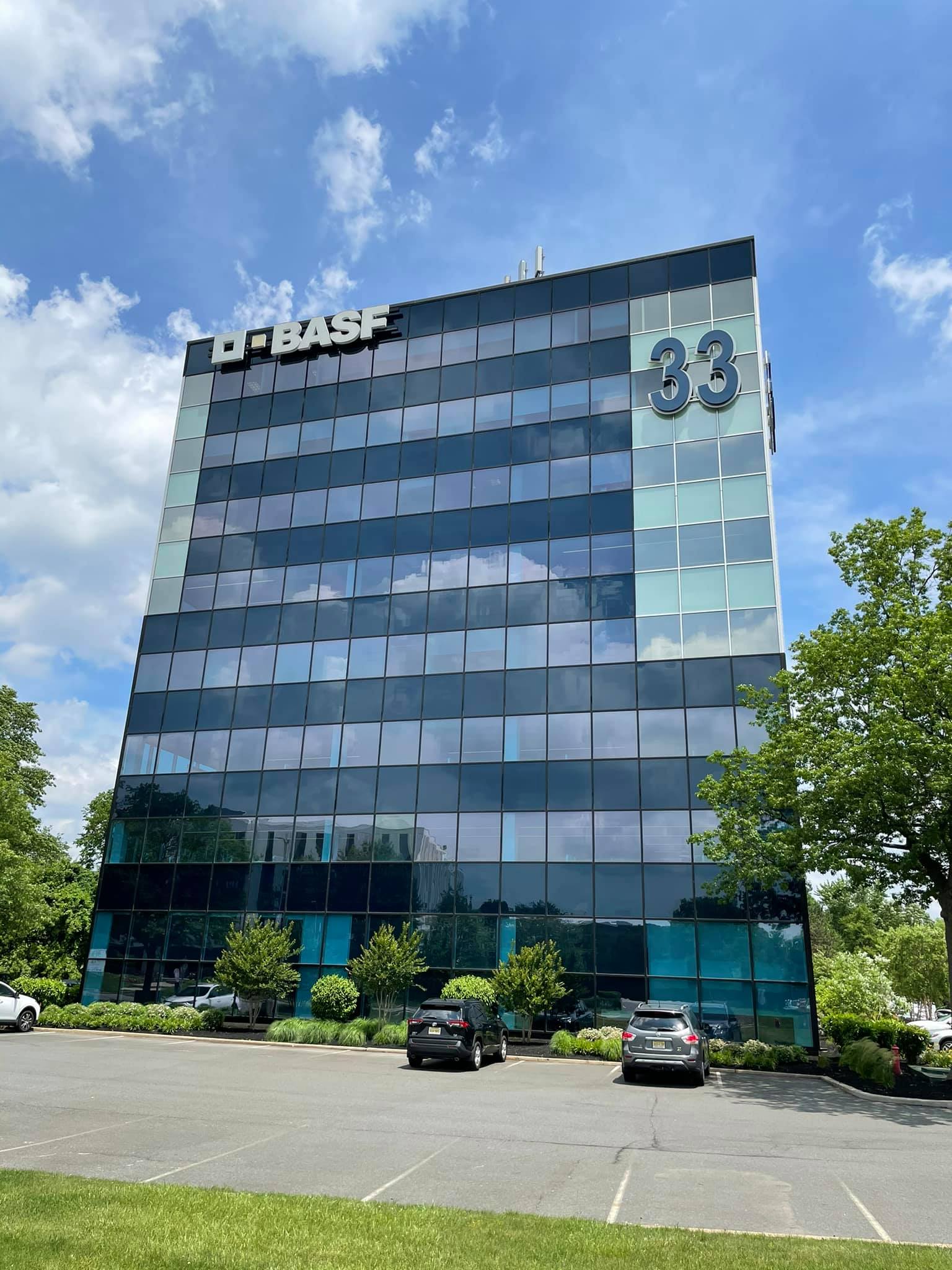
Rules of engagement: please avoid aiming for the office above the second “3”
I hate to break the news, but Central Jersey isn’t an anomaly, either. Neither is New Jersey as such. Neither is the Northeast Corridor. Neither is the East Coast. Neither is the West Coast. Neither is anything in between. Recall the proud lessons FDR taught us about the “arsenal of democracy,” during the World Wars. “Powerful enemies must be out-fought and out-produced.”
We defeated our enemies, on this view, by marshaling our awe-inspiring capitalist productive capacities so as to produce our way to victory. According to certain pro-American apologists, even the Red Army owed its victories in World War II to the assistance we gave it through Lend-Lease, etc. But Uncle Sam’s productive capacities weren’t all located in the Carnegie Center, or Princeton/West Windsor or Metropark or Central Jersey, or even New Jersey. They were spread across our great nation as such. They were everywhere. We were fighting a total war, and that, after all, is what total war is. Everybody is involved in the war effort. And that means that everybody’s a target.
Here’s another example, also from Princeton.
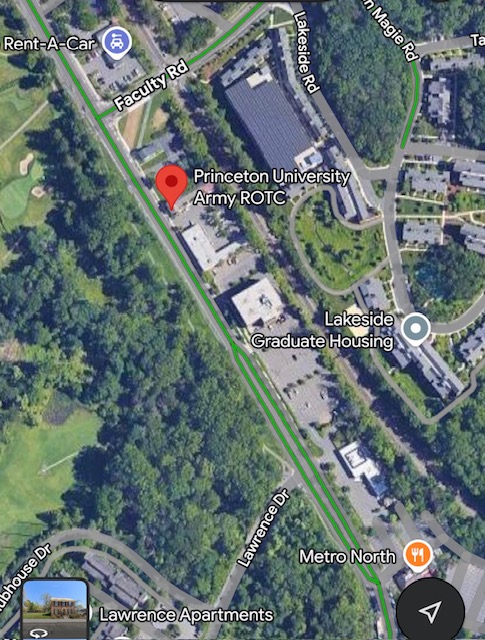
In the middle of the screenshot is Princeton University’s Army ROTC center. Every morning, I see the young ROTC cadets marching out of this building in camouflage, as though to launch a frontal assault on campus. They look as serious and determined and brainless as they did when I was a student.
Princeton University Army ROTC is adjacent to Lakeside Graduate housing, a civilian housing complex, also adjacent to a parking garage and an ordinary office building, not far from Metro North, a restaurant, not very far from Lawrence Apartments, and adjacent both to the New Jersey Transit railroad tracks (a gray line behind the building), and Alexander Road (a green line in front of it). Just a few hundred yards away is Enterprise Rent a Car. Princeton University, by the way, is host to many other area institutions that lack the resources to host the university equivalent of a military base (TCNJ, Rider, Rowan, Rutgers, and Stockton). In its magnanimity, Princeton allows these second-tier students to train alongside its home-grown elite for war. All of them, of course, are about to fed to the war machine in Iran–and are no doubt being indoctrinated for that purpose as I write. People complain about the expense of a college degree. These ones were purchased at a higher price than most–mass death.
Imagine, then, that an Iranian targeter were to put Princeton University Army ROTC in his sights. And why wouldn’t he? These ROTC kids are the future leaders of the United States Armed Forces. If Anakin Skywalker could kill the Jedi younglings in “Revenge of the Sith,” why couldn’t the Iranians do the same with ours? Anyway, if the Iranians targeted Princeton Army ROTC, and missed, they might also hit a bunch of kids (e.g., in the nearby apartments), a bunch of grad students (same), a bunch of commuters (in the garage), a bunch of office workers (self-evident), and/or a bunch of people trying to rent a car (at Enterprise). That would be fair game, wouldn’t it? If anything adjacent to anything military is fair game, so is this whole block. So are a lot of things.
You might at this point think that I’m suggesting that the military should put its installations in distant, fully segregated, well-marked locations. But I know how silly and unrealistic that is, so I’m not suggesting they do that. But if it’s silly and unrealistic for us, it’s just as silly and unrealistic an expectation to foist on Hamas, Hezbollah, the Lion’s Den, the Houthis, or the Iranians. That’s not how life works.
If people want war, they have to accept the resort to stealth and concealment. They have to accept that all of us everywhere are human shields. They have to accept the prospect of their kids blown into little pieces. They have to accept raging fires burning through “civilian” locations–homes, businesses, places of worship–and hospitals overwhelmed with trauma cases they can’t possibly treat. It’s too far downstream to complain that war harms civilians. Of course it does. It makes no sense to accept the legitimacy of psychopathic wars but flail against their psychopathic consequences.
We need to stop kidding ourselves about our own holy innocence and the evils of our enemies. Once you know where to look, and have the audacity to say what you know, you can find the military embedded everywhere in American civilian life. We are their human shields. The only thing that protects us is that so far no one has had the capacity or desire to point a missile at us and pull the trigger. Just wait, though. We’ve given them ample motive. Eventually they will get the means and opportunity. Once they do, our towns and cities will look like theirs do now and arguably, look like swatches of Tel Aviv, Dubai, Bahrain, and Kuwait do now. It’s just a matter of target practice. Expect them to be as careful with our lives as we are with theirs.
How careful? Well, look at Gaza or Jenin or South Lebanon or Tehran today. Read about Hiroshima and Nagasaki in years past, or the firebombings of Tokyo, Dresden, and Cologne, or the British pacification of Iraq under Churchill. Read about Operation Rolling Thunder in Vietnam, or the potential consequences of the Cuban Missile Crisis, or the inevitable consequences of the doctrine of mutually assured destruction. If that’s how careful we’ve been, that’s about how careful they’ll be. We’re all in the cross-hairs now, and it’s a matter of time and chance what gets hit. Should we be worried? Ask the guy who led us into war. “I guess,” he said. It’s as good a guess as any.
 Policy of Truth