This is the statement I gave tonight on the issue of the kiosks at Princeton Council:
I’m here to speak about the replacement of the kiosks on Nassau St with electronic versions. I should say that I was unconvinced by the Council’s arguments for replacing the kiosks, and remain unconvinced, but my comment tonight is more query than statement.
In the debate over the kiosks back in 2024, Councilwoman Sacks was quoted in The Princeton Patch as saying:
“I am sort of a free speech absolutist,” but if we “go to an electronic option, the government is in charge of who can express a particular idea, and that is what concerns me.”
Likewise, former Councilwoman Eve Niedergang is quoted in the same place as saying:
“I’d love to move to a digital display…The digital display is then under our control, and it ceases to be a place for the public to interact.”
My understanding is that the new kiosks may have a sort of hybrid design: partly electronic, and partly tack-on. But I’m curious to know how the Municipality intends to regulate the content of the flyers on the kiosks in either form.
So here are five examples of controversial messages I’ve recently encountered around town.
- “Fuck ICE”
- “Free Gaza”
- “Death to the IDF”
- “From the River to the Sea, Palestine will be free”
- “Naftali Bennett is a war criminal”
Question: How would the Municipality handle requests to put these messages up on the new kiosks?
You can watch me give the statement (the wording may be slightly different than what’s above) and see the Council’s response. The discussion starts at 28:40 in this video, and goes to essentially the end of the meeting.
As I see it, the Council faces the following dilemma. If it regulates the content of speech on the new kiosks, it risks both complaints and litigation on First Amendment grounds. It’s banning constitutionally protected speech.
If it permits speech like my five examples (particularly cases [3], [4], and [5]), it risks both complaints and litigation on grounds of permitting speech that its own police department is investigating as “bias intimidation.”
If it adopts a hybrid design wherein the Council controls the electronic part of the kiosk but treats the lo-fi part as a commons, it invites three criticisms at once: that it’s artificially induced scarcity when it comes to the part of the kiosk where free expression is permitted; that it’s commandeered the rest of the kiosks for its own purposes; and that it has now taken active ownership of kiosks where people can still engage in speech that, as far as its own police department is concerned, amounts to “bias intimidation.”
The irony is that the Council decided to replace the kiosks to avoid the supposed “eyesore” that they represented, but now seems to have replaced the eyesore with a bunch of headaches. If only they’d left well enough alone.
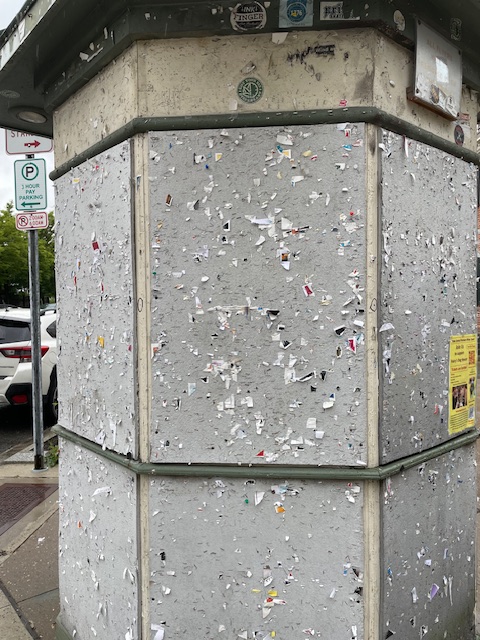
The kiosks stripped clean just prior to Princeton University reunions, well before the posted “1st of the month” date
The apparent conflict between Councilwoman Pirone Lambros and Councilwoman Sacks in responding to me is diagnostic. Ms Pirone Lambros hears my examples, thinks reflexively of “hate speech,” tells us that hate speech will be excluded from the kiosks, but declines to comment on my actual examples. Ms Sacks steps in to offer a note of caution, mostly from a lawyerly instinct to induce Ms Pirone Lambros to stop talking. She, too, avoids commenting on my examples. Clearly these people want to keep their options open: they’re careful not to rule out the possibility that my examples above are hate speech. I guess they’re forced into that posture by their own police department: either they endorse the actions of their police department, or repudiate them. Repudiation seems unlikely, but outright endorsement is too risky. So they hedge their bets. They can afford to. Their speech isn’t on the line.
I’m not sure I believe Ms Sacks’s re-assurance that the Council has no intentions of regulating the content of the flyers posted on the lo-fi, tack-on part of the kiosks. As I pointed out here, last May, during Princeton University’s Reunions, that’s exactly what it did. The stated rule says that flyers are removed on the first of the month. In fact, the kiosks were stripped bare just before Reunions this past May, well before the first of the month. Hard to believe that the reasons were “aesthetic.” Take a look at the photo above: I wouldn’t call the result “pretty.” The more likely explanation is content regulation: the Municipality didn’t want to upset the poor, delicate Princeton alumni with politically discomfiting messages. So they ripped them all down.
Given the nebulousness of the concept of “hate speech,” and the refusal to describe my examples as protected, and the police department’s treating some of them as “bias intimidation,” and the concession that most of the planning lies in the future, I think a reasonable person has grounds to worry about the Council’s censorship regarding the kiosks. In a sense, that’s what the Council’s artificial creation of scarcity amounts to, anyway. Having commandeered public space for itself, it’s left scraps for everyone else to fight over. Who do they think is going to win a fight like that? The people asserting things that the police department regards as “bias intimidation”?
Richard Rein of TapInto Princeton points out that the desire to appropriate and re-shape the kiosks began decades ago, in the 1990s: a long train of usurpations by different but related parties, all pursuing invariably the same object, namely monopolistic control of public space. Well, I guess the partisans of monopolistic control have “won.” The kiosks are now under their control, and will mostly cease to be a place where the public interacts. Sad that this is what counts as victory for them, but clearly it is.
 Policy of Truth
Pingback: Institutional Neutrality and Legislative Oversight | Policy of Truth