Back in March, I wrote a post here called “I Think They Call This Fascism,” meant to be a preliminary inquiry into how to define “fascism” and apply it to present circumstances. I laid out seven methodological issues that arise in defining “fascism,” the second of which was how the concept of “fascism” applies to totalitarianism and authoritarianism. At the time, I was conceptualizing totalitarianism as revolutionary and all-encompassing, and conceptualizing authoritarianism as traditional and more limited in scope. Though I still think that totalitarianism vs authoritarianism is an essential issue, it now occurs to me that the preceding conceptualization, somewhat uncritically adopted from Jeane Kirkpatrick’s account, is misleading or wrong.
A recent column by Chris Hedges suggests a better, clearer distinction. Consider the distinction between:
- A regime that adheres to the rule of law–has, at minimum, clear, well-defined, predictable laws– but whose laws are systematically rights-violating, and
- A regime that flouts the rule of law altogether, so that it is, by design, impossible to know what the law says or how to follow it.
The first sort of regime, we might say, is authoritarian; the second tends toward totalitarian. It seems plausible to me to say that fascist regimes cross-cut both categories. The worst authoritarian regimes (the most invasive) can be described as fascist even if they adhere to some conception of the rule of law, but left unchecked, fascist regimes tend to develop in a totalitarian direction so as to subvert the rule of law altogether.
The transition from authoritarianism to totalitarianism is difficult to detect because it involves incremental changes to a large-scale phenomenon under conditions intentionally malconducive to inquiry. It’s difficult to gauge the extent to which, say, the last five changes to the law have undermined “the rule of law.” For one thing, it’s difficult by itself to enumerate the last five changes to the law. For another, it’s difficult to articulate a workable criterion for systemic change to a complex legal system. Put the two things together, and it becomes yet more difficult to measure the impact of x changes of the law on a whole political system. Now introduce legal changes that adversely affect inquiry as such via systemic deception, coercion, and corruption. It would be a miracle if you figured anything out under such conditions.

But try. Read Hedges’ column with Trump’s memo in hand. Then go on Instagram, making an account if you have to, and watch Rachel Cohen’s first-hand account of events at the Broadview, Illinois ICE facility over two days. Then consider that what took place in Broadview (and Chicago generally) is a re-play of what is taking place right now in Portland, Oregon, and in different ways, Los Angeles, Newark, New Jersey, and many other places. Remember that the aim of Trump’s deportation machine is the (impossible, mind-boggling) attempt to deport ten million people from the United States, something it hasn’t even begun to approximate. Put all of that in the larger context of the deportation crusade as described by, say, Blitzer and Kocher.
My reading: a wholesale assault on the American people has begun, taking the most vulnerable population as the starting point, pre-emptively shutting down dissent and resistance in just the way Hedges describes.
On top of that, the Secretary of War has now summoned his military brass to urge them to adopt a non-woke warrior ethos, has valorized the perpetrators of a historic massacre, and presides over a military that has just initiated two wars out of the blue without encountering any appreciable opposition (Iran and Venezuela), while committing genocide in Gaza, and announcing an explicit, phantasmagorial intention to ethnically cleanse the entire population of Gaza so as to make room for a new Atlantic City on the Mediterranean.
Meanwhile, the war in Ukraine, which was supposed to have been wrapped up in January, has mostly continued without much notice, and is now escalating. The regional war in the Middle East that everyone claimed to fear has been here for a year without provoking all that much notice. The implosion of Haiti likewise continues without notice, after a string of massacres across at least a year that has, well, mostly gone unnoticed (outside Haiti). War looms on the horizon with China, provoking little more than incomprehension or at best, yawns. We’re now so inured to war that we treat it as the ASMR of our civic existence.
This is the soothing, whispery background for the War Secretary’s announcement of the target of our most imminent war: the people of the United States.
On Sept. 30, 2025, at Marine Corps Base Quantico, President Donald Trump told hundreds of military officials that American cities should serve as “training grounds” for U.S. troops, a proposal that would test longstanding civil-military boundaries and would likely face immediate legal challenges.
“I told Pete, we should use some of these dangerous cities as training grounds for our military,” Trump said, referring to War Secretary Pete Hegseth. “We’re going into Chicago very soon.”
Trump’s remarks came during a hastily convened meeting at Marine Corps Base Quantico, where the White House flew in hundreds of generals and admirals. The meeting itself was unprecedented. Trump cast crime and immigration as internal threats that require a domestic military response.
Trump made clear which cities he had in mind. “Inner cities are a big part of war,” he said, before singling out Los Angeles, Portland, Seattle, and Washington. “I will never hesitate to protect our people from the horrible plague that is taking place from within.”
The president has repeatedly targeted Democratic-led cities in his rhetoric, and aides have hinted the concept could expand to Baltimore, Chicago, New York City, and Atlanta.
Read this passage until its meaning really sinks in. The United States has declared war on the United States. It’s not a joke. It’s not a metaphor. It’s not an exaggeration. It’s a Declaration of Subjugation intended to replace whatever residual meaning the Declaration of Independence is still supposed to have. It describes large swatches of the American population as carriers of communicable diseases requiring wholesale extermination. Urban problems are to be solved by targeting the source of the problem, urbanites. Once dead, they cease to be a problem because they cease to be. The story doesn’t come from some left-wing rag. It comes from Military News, a publication meant for members of the armed forces.
I can’t pack into one paragraph, or one post, or one piece of any kind of writing, all of the things that suggest a devolution into fascism. But if this is not fascism, I think it’s worth asking what would count as being there. I get the sense that skeptics think that fascism requires the simultaneous, ubiquitous exertion of total state control over everything within the landmass of the target country. If anyone can speak out anywhere, or freely undertake any action, well, then: fascism is not here. If that’s your picture of fascism, I would say that you’re either operating in the grips of a magical picture of reality, or, what comes to the same thing, a literary depiction of fascism out of a dystopian novel, where all of the relevant action is artificially packed into one place, so that you the reader can see it. Neither thing is a guide to political reality as human beings live it in real time.

What skeptics are saying is: unless we all simultaneously come to reside in the functional equivalent of a concentration camp, fascism is not here. But few if any totalitarian regimes have ever done that–not the Nazis, not Lenin, not Stalin, not Imperial Japan, not Maoist China, not Saudi Arabia, not revolutionary Iran. No government can turn the whole of a country into a prison or a concentration camp. As Machiavelli aptly puts it, the prince must caress some parts of the population, while destroying others. Fascism is not an exercise in equal opportunity repression. The anomalous contrast of tranquility in some places and terrorized chaos in others is all part of the game. Too bad it’s not a game.
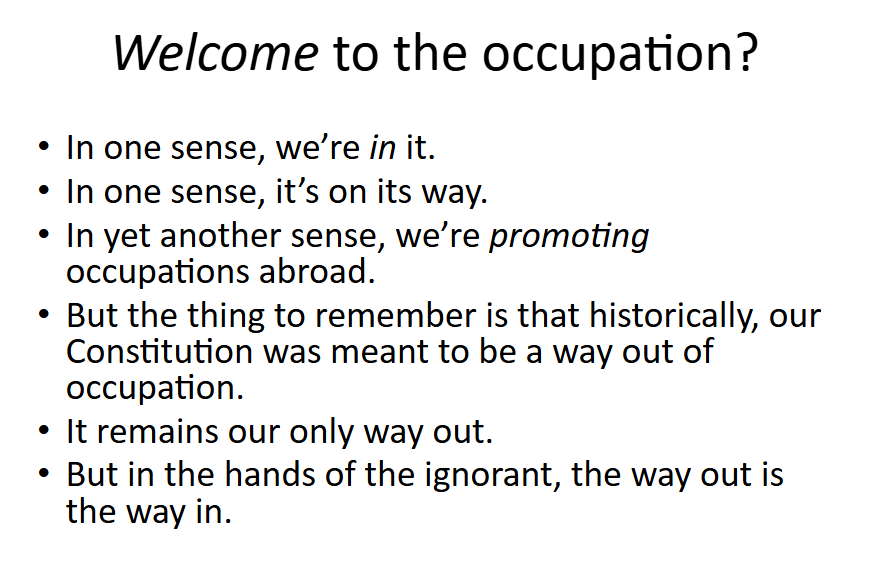
I’ve screenshotted two slides from a lecture I gave at Felician University on Constitution Day back in 2017, plus a picture of myself as a younger man wagging a finger at an indifferent world. The title was partly a riff on Russell Means’s lecture, “Welcome to the Reservation,” and partly on Guns N Roses’s “Welcome to the Jungle.” The title of the present post, of course, is an allusion to the Sex Pistols’s “God Save the Queen.” I guess I’ve had a little trouble picking a Muse–Axl, Russell, or Johnny? But fascism is a both/and, not an either/or proposition. So welcome to the reservation, the jungle, and the loss of your future. They’re all here.
 Policy of Truth