Notes on Migrant Justice
In two posts here, I’ve taken issue with the idea that Princeton’s recent passage of (or even mere discussion of) the ITA Resolution has induced ICE to raid the town and detain people. The basic premise behind this claim is that ICE operations target municipalities that express opposition to ICE. The further implication is that if you want to avoid ICE operations where you live, you have to tone down your public opposition to ICE, and adopt a “quiet” form of dissent. It can’t be stressed enough how dangerously out of touch with reality this claim is. If put into practice, it would mean the end of public opposition to ICE at a time when public opposition is clearly working, and is all we have.
In my first statement to the Princeton Municipal Council, I pointed out that there was no evidence that ICE had specifically targeted any municipality that had passed an ITA resolution. I then suggested that if anyone had evidence to the contrary, they should produce it. No one has. The first ITA municipal resolutions were passed in Chatham and Madison on December 9, 2024. Many of the rest were passed between January and March of 2025. The municipalities that have seen upticks in ICE activity are all big cities that are ripe targets for ICE anyway. The smaller towns have seen no such uptick.*

Delaney Hall, Newark, New Jersey (photo: Irfan Khawaja)
We now have nine months of evidence in hand. None of it supports the “keep quiet” claim. I regard that as conclusive on its own, even if ICE operations were to start up tomorrow in every place where we haven’t seen any. It’s the essence of cherry picking to dismiss nine months without raids, and then fixate on the first raid that happens to take place. The fact remains: many towns have passed pro-ITA resolutions months ago, and have not seen raids. So I would repeat: If anyone thinks they have evidence for the “resistance means retaliation” thesis, feel come up with it. If not, stop making the claim, or better yet, withdraw it.
In a later post on the subject, I took issue with a prominent and well-regarded Princeton activist who went out of his way to insinuate that a recent ICE raid in Princeton was a response, not to the actual passage of a pro-ITA resolution, but to mere public deliberations about it in advance of passage. This individual admitted to having zero evidence for his claim, but made the claim anyway. It’s hard to see what this maneuver accomplishes beyond de-legitimizing the resistance, legitimizing the spread of rumors, and helping ICE.
But the raids of the last few days should be the last nails in the coffin of this “keep quiet” thesis. In a 24-hour span over August 20-21, ICE raided three places in central Jersey: Edison, Hightstown, and Trenton. The Edison raid was reputedly the largest in the United States since Trump took office, with 29 people arrested. The Hightstown raid led to one arrest, and the Trenton raid, though apparently aimed at a whole extended family, ended up arresting only one person, mostly because rapid responders on the ground thwarted ICE’s efforts at doing more damage. (More on the Trenton raid, now going viral, in a forthcoming post.)
Of these three municipalities, neither Edison nor Hightstown have passed pro-ITA resolutions. We thus face the anomaly that the biggest immigration raid in the United States so far has targeted a town, Edison, that has not passed a pro-ITA resolution, and the further anomaly of a garden-variety raid in another town, Hightstown, that has also not passed one. So no resolution has meant plenty of detentions.
We also have a raid in a pro-resolution city, Trenton, but no evidence that the raid was triggered by Trenton’s pro-ITA resolution. Trenton’s pro-ITA resolution was passed six months ago, on February 18, by its City Council. If a six month lag between passage of a resolution and occurrence of a raid counts as evidence of retaliation by ICE, then virtually anything can be turned into evidence of retaliation, and we’re no longer in the realm of objective evidence but of pure speculation.
As it happens, there was a car chase involving ICE a couple of days ago in Chatham and Madison, both pro-ITA towns. But it’s a stretch to turn a car chase nine months after passage of the resolution into evidence against the resolution. The occurrence of the chase is as easily explained by chance as by reference to the resolution. To think that a resolution passed in December produced a car chase in August is to act as though passage of a municipal resolution conferred perpetual immunity on any town that passed it, which is absurd.
Now consider Princeton. The ICE raids began in Princeton in July 2024, months before the ITA was ever proposed in the state legislature, and ten months before the resolution was first discussed in the Council. Princeton’s pro-ITA resolution was passed on August 11, weeks after the largest recent raid in town, on July 14. Unless you believe in retro-causation, the passage of the resolution cannot have caused these raids. Not even discussion of the resolution can have caused the first one.
The logical conclusion to draw is that the people floating these “ICE retaliation” claims are making some capriciously arbitrary assertions. ICE raids have happened a year before the passage of a resolution (Princeton), weeks before passage (Princeton again), six months after passage (Trenton), in the total absence of a resolution (Edison and Hightstown), and in some cases, not at all despite a resolution (Flemington, Bloomfield, Maplewood, Madison, etc.). In other words, we have literally every permutation here except one that shows that resolutions cause retaliation.
But it gets worse. It’s a huge under-statement to say that the biggest ICE raid took place in a town that has “not passed a pro-ITA resolution.” If any one municipal government in New Jersey deserves a medal in the pro-ICE and pro-Trump Bootlicking Olympics, it’s Edison. And yet Edison has been on the receiving end of some of the biggest, most violent, and most disruptive ICE raids that have taken place.
Consider a case likely unknown to outsiders, and not particularly well known even to New Jerseyans. On January 1, 2024, a bus carrying 38 asylum-seekers displaced from Texas by Governor Greg Abbott stopped at Edison rail station en route to their final destination of New York City. The point of stopping was partly to take a break, but also to bypass Mayor Eric Adams’s Emergency Executive Order 538 (extending several prior ones), limiting the times when buses could enter New York City (between 8:30 am and noon, M-F), demanding 32 hours’ prior notice of entry, and limiting where migrants could be dropped off.
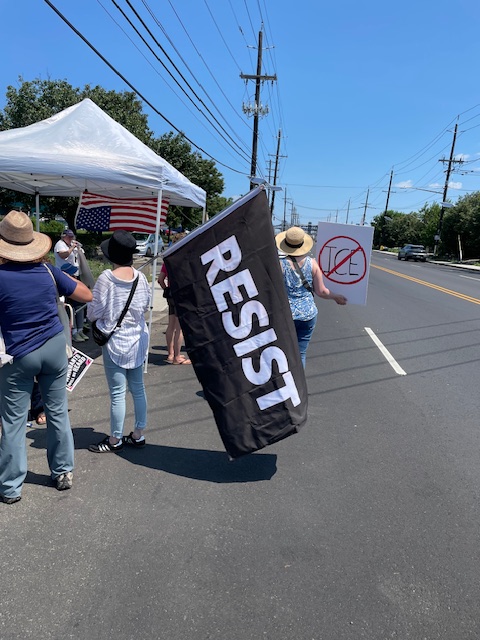
Anti-ICE protest: Delaney Hall, Newark, New Jersey (photo: Irfan Khawaja)
The migrants had planned to board trains at Edison, along with Trenton, Fanwood, and Secaucus, and enter New York by rail. The total number of migrants slated to enter New York was about 1,000 over the course of a few days. About 1.63 million workers commute into Manhattan every day. Almost 20,000 people flock to Madison Square Garden for every game or concert there (and there are 320 a year). The migrants, then, constituted less than 0.0006% of a given day’s commute, and 5% of the audience for a single show by Taylor Swift or Katy Perry. And yet all-out panic ensued.
Responding to the sheer presence of these migrants in town, Sam Joshi, the mayor of Edison, called out the Edison Police, ordering officers to force the migrants to remain on the parked bus–no getting off for bathroom breaks, or to stretch out, get some fresh air, or take the train into New York.** About twenty of the passengers got off the bus before the police got there; the other eighteen or so were detained once they arrived.
A thirty minute stand-off ensued during which Edison Police held the migrants on the bus and interrogated bus company employees without citing (or having) any legal justification for doing so. The Immigrant Trust Directive, binding on all New Jersey police departments, prohibits the police from detaining anyone based solely on the target’s immigrant status; the Fourth Amendment proscribes search or seizure without a determinate legal basis. Both were unapologetically violated in this case.
New Brunswick Today has cogently argued that the migrants’ civil rights were violated on top of that. In the third video posted on NBT‘s site, you can hear one officer say (at second 22), “It looks like Hispanics.” That’s the only discernible reason why anyone was detained. “Who’s in charge of them?” the officer asks, on the feudal premise that every busload of passengers is somebody’s ward. A stammering bus employee steps forward without being able to explain how it is that he was in “charge” of anyone. He wasn’t. They were asylum seekers, not prisoners. NBT‘s reporter puts it well: “Edison officers shown in the videos repeatedly indicated the bus and its passengers would have to leave the entire 30 square-mile Township, a potential violation of their civil rights,” under US Code Title 18, Sections 242 and 245.
A public records request by New Brunswick Today later revealed that the police, not content to violate the migrants’ rights, decided to taunt and threaten them as well. A sample:
“Have your service weapon pointed out the window at all times,” joked Officer Zachary Dlabik.
“Get out of Edison!” added Officer Spadaro, making his hand into the shape of a gun.
“Yee-haw! Corralin’ ’em out,” says Dlabik, pretending to fire his fingers into the air like guns.
Dlabik’s tone turned serious, as he walked with his colleagues to an idling police cruiser and lamented the situation that was playing out just a couple of hours into the New Year.
“I can’t believe this is our country, that this just happens. It’s an actual invasion. It’s actually happening,” Dlabik continued.
“You ever see Red Dawn?” Officer William Kenney then asks his colleague, apparently referencing the 1984 film (or the 2012 re-make) about a fictional invasion of the United States.
“Instead of paratroopers, it’s fuckin’ buses,” said Kenney. “Maybe there’s about 20 more [people] underneath the undercarriage of that bus.”
The recordings also capture the group of responding cops bantering among themselves about the situation, joking and fantasizing about sicking a “drug dog” on the immigrants and escorting the bus out of town at gunpoint.
Clearly, Edison’s finest were confident enough to say all of this out loud; they knew that they could say just about anything with impunity, and knew that the mayor had their backs when they did. They also knew that nothing would happen to them no matter what they did. And nothing did. “Nobody’s getting off this bus until I can ID you guys and we figure out what’s going on.” That’s the key phrase of the night, one familiar to me from riding the buses under the Israeli occupation. The underlying offense? Missing the last train from Jersey to New York, a commonplace occurrence that bears zero connection to any legal infraction in any known body of law.

Resistencia en Accion in Elizabeth, New Jersey (photo: Hilary Persky)
Ultimately, no one still on the bus was permitted to get off. The bus was then forced out of the parking lot and escorted out of town, like something straight out of the Freedom Rides during Jim Crow. The police repeatedly instructed the “people in charge” not to permit the bus passengers to set foot in Edison. It remains unclear what legal authority the Edison Police had to demand that anyone leave city limits simply because the mayor didn’t want them there. I guess it was unclear in mid-twentieth century Mississippi, as well.
Bear in mind that all of this was done with the knowledge and explicit direction of Edison’s mayor. And bear in mind that these were traumatized people (including children) who had escaped misery in their home countries, had made their way across hundreds or thousands of miles of difficult, hostile territory, had been treated as enemy aliens in Texas, and had then been displaced to New York like unwanted garbage after that. Bear in mind, finally, that the bus ride from Texas to New Jersey is about 40 hours long. People who had just traveled 40 hours by bus and still had an hour or two to go were not allowed to get off the bus because the mayor of Edison, a “son of immigrants,” hated them enough to make them to suffer discomfort and intimidation.
Am I making the last part up? Is it mere inference? No, it’s essentially what Joshi said (see sources 1, 2, 3, 4, and 5). The “illegal migrants,” he said, were “unwelcome” in his town, and “belong on the other side of the border.” Direct quote:
If any bus, train, or plane of illegal migrants come to Edison, I have instructed our law enforcement and emergency management departments to charter a bus to transport illegal migrants right back to the southern Texas/Mexico border.
He then lectured the world at large about the alleged financial burden of having to put up so many migrants (in the full knowledge that none were staying in Edison), and delivered the wisdom that his family had come here legally, so why couldn’t they? (I’ll discuss Joshi’s depraved and ignorant claims at greater length in a separate post.)
So if ever there was a pro-ICE town in New Jersey, Edison is it. Yet Edison has been hit with two big ICE raids within the last few weeks, both at large warehouses in town–one at Alba Wine & Spirits Warehouse on July 8-9, the other at a Prologis warehouse at 45 Patrick St on August 20. What then of the “retaliation” thesis? What are we to make of the fact that the most pro-ICE town in New Jersey is attracting some of the biggest ICE raids in the state?
As I said in my Princeton statement, it has less to do with municipal politics, whether pro- or anti-ICE, than with numbers: immigration enforcement is driven by quotas, and Edison and environs are a target-rich environment perfectly tailored to the satisfaction of those quotas. That said, there’s some complexity here that I’d like to discuss in my next post. The satisfaction of quotas and the pursuit of political aims are not, after all, mutually exclusive activities. A quota is an implicit statement of political aims, and the attempt to meet a quota can be (and often is) combined with a desire for retaliation. There’s some logic to work through here, as well as some political economy, and some issues in the logistics of law enforcement.
But once we work through this complexity, I think it becomes clear that the result doesn’t help the “keep quiet” crew. At the broadest level, call it the level of grand strategy, the weaponization of immigration enforcement is driven, broadly speaking, by punitive considerations. Immigrants are to be punished for being here. But that doesn’t explain the timing or occurrence of particular operations. At the next level down, call it the level of strategy, immigration enforcement is driven by quotas. The numbers game explains why operations are initiated and against what targets. At the next level down, call it the tactical, we get tweaks on the strategy: once an operation is under way, it can, in its later stages be adjusted to matters of PR and other minutiae: should it take place on Monday or Tuesday? Morning or evening? Before a particular political or after? Etc.
In other words, retaliatory considerations enter in a broad way at the beginning and a narrow way at the end. But they don’t drive the timing or targeting of particular operations as such. So it’s a dangerous illusion to think that speaking out is what launches the juggernaut, and quiescence is what makes it go away. Or so I’ll argue.
*The towns that have passed pro-ITA resolutions include: Atlantic City, Bloomfield, Chatham, East Windsor, Flemington, Highland Park, Madison, Maplewood, Morristown, Paterson, Plainfield, Princeton, and Trenton. Hoboken, Newark, and Jersey City are often included in the list given their presumptive status as “sanctuary cities.” Among smaller municipalities, Bloomfield, Chatham, Flemington, Madison, Maplewood, and Morristown have seen no uptick in ICE raids since passage of their resolutions. Among smaller municipalities, Princeton has seen raids, but raids there preceded passage of the resolution. There have been raids in Paterson, Trenton, Newark, and Jersey City, and there’s been political retaliation (law suits) against Newark, Paterson, Jersey City and Hoboken. But those are cities with a sizable number of targets as well. The remaining cases are equivocal.
Observers have professed to being baffled by some of the Justice Department’s adverse actions, which bear no clear connection to pro-immigrant policies, and have even been directed at conservative, anti-immigrant districts. Some of these actions have later been withdrawn, compounding the mystery.
**Very strictly speaking, the Edison Police was called by the New Jersey Transit/Amtrak Police, but it’s clear from the mayor’s own statement that the Edison Police was under a standing order to act as they ended up doing.
 Policy of Truth
Pingback: ITA Resolution for Montgomery | Policy of Truth
Pingback: The ITA Resolution Campaign: An Update | Policy of Truth
Pingback: The Immigrant Trust Tour: New Brunswick | Policy of Truth