Every now and then I’ll run into a Muslim who sees the kuffiyah around my neck and starts up a conversation about Palestine. Much anguished hand-wringing takes place in these conversations, often with quasi-religious overtones, and not a few pious tears are shed. Why don’t “the Muslims” do anything? Why have the Muslim armies not intervened? Where is our Saladin?
Eventually, I’ll point out that there are a few modest but entirely pragmatic things that us mortals can do for Palestine. The affluent among us can, for instance, give money to a number of eminently worthy pro-Palestinian causes. And the vast majority of American Muslims are affluent. Speaking of which: would Brother Ahmad or Sister Bilquis be willing to write a check or activate their Venmo account to that end? I can supply a long list of reliable, worthy organizations that could make excellent use of any sadaqa sent.
Pained, embarrassed smiles follow, and then a liturgy of logistical hurdles. Money? Sigh. What good would would that do? Money won’t end the war. The Israelis won’t let the aid in anyway. How do we know that our money won’t be misspent? What if the Israelis are right, and Hamas is stealing the aid? What if the American authorities come to regard the aid as material support for terrorism?
There’s never any shortage of objections. Jihad ends where the bank account begins.
So what should we do instead? I ask. “We should pray,” comes the pious response. “Pray.” It almost seems unkind to raise a comparable set of logistical questions in reciprocation. What good does prayer ever do? How will prayer end the war? How will prayer ensure that aid penetrates the blockade, and goes to deserving recipients? While we’re at it, what information could we send the recipient of our prayers that He doesn’t already presumptively know? Why should an all-knowing, all-powerful, all-good deity need the petitions of one part of his creation to save another from destruction by a third?
The last few questions raise a kind of meta-question: to whom are these prayers being addressed, anyway? To God, of course, but to what kind of God? It’s a timely question to ask, as tomorrow, June 6th, is Eid al Adha, the Festival of Sacrifice, the holiest day in the Islamic calendar. And what does Eid al Adha commemorate? Well, it commemorates Abraham’s willingness to murder his son at God’s command. Reflection on the meaning of this holiday is, we might say, a revelation of its own. In revealing the nature of the God we’re expected to worship and petition, it inadvertently explains why such a God might be indifferent to the genocidal antics of his creation.
We all know some version of the story: God commands Abraham to kill his son; Abraham eagerly sets out to do it, but is stopped at the last moment by an angel sent to stay his hand. The command, we then learn, was a test of Abraham’s loyalties. Abraham’s evident willingness to kill his son shows us that he passes the test by expressing the right set of loyalties. God comes first, and everything else is a distant second–including his son, his self-respect, and any autonomous commitment he might have had to justice. 
Caravaggio, The Sacrifice of Isaac (1603)
The Qur’anic version of this story differs from the Biblical one in a few irrelevant but nonetheless interesting particulars. In the Biblical version, God explicitly calls Abraham out by name, and explicitly orders him to kill his son, also mentioned by name (Genesis 22:1-2). In the Qur’anic version, by contrast, God comes across as too busy to make an appearance, and too wary to issue an explicit command (Surah as-Saffat, 37:101-2). Like Hitler at Wannsee–or Hitler not at Wannsee–the Muslim God prudently absents himself from the scene of the crime. You can almost hear him protesting his innocence: He didn’t do nothing. And He didn’t.
Instead, Abraham has a mysterious God-shaped dream from which he infers–mysteriously but unambiguously–that God has commanded him to kill his son. “O my son, for I see in the dream that I am slaughtering you” somehow ends up entailing “And so God has put me under a categorical imperative to do so.” But there’s no indication that the Qur’anic Abraham hears a word from God, even in the dream. It’s the reader who’s left holding the theological bag, that is, left to supply the tacit inference whose absence would reduce the whole drama to plain old sociopathy.
Some Islamic commentators, like Ibn Sina and Ibn Rushd, naturalize the dream, taking it to be a “symbolic representation” of a divine test, with Ibn Rushd going so far as (seeming to) deny its divine command-like status. Others, like Ghazali, interpret it as a fully literal message sent to Abraham by God in dream form. Neither option really faces the underlying problem or resolves it: why comply? This problem arises, to be sure, for the Biblical version, but arises more acutely for the Qur’anic one. No fallible person could be certain about the epistemic status of the command issued by either the Biblical or the Qur’anic version, but at least the Biblical version of the command issues in an apparently obvious way from God. If you believe that much, you’re home free.
The Qur’anic version of the “command” does not issue in an obvious way from God, at least not from Abraham’s perspective. It’s just a dream. You could insist (as many Muslim thinkers have) that because Abraham was a prophet, his dreams are all prophetic dreams, and since prophetic dreams have divine warrant, anything a prophet sees in one has the status of a divine injunction. But that’s just ad hoc. If Abraham has a wet dream about some hot chick in Beersheba, should we infer that God has put him under a command to have sex with her? That may seem a tasteless or blasphemous thing to say, but it’s also kind of obvious. The “prophetic dream” thesis holds that a prophet’s dreams are revelations from God. But either all of them are, or some are. If all of them are, then prophets only have as many dreams as God intends revelations. If some are, which ones, and what about the others? The more you think about it, the more you come to realize that we know a lot less about Abraham’s dream life than this thesis requires.
Muslim commentators thus face a further problem not faced by Christians or Jews: the source of the command issued to Abraham is totally uncertain, indeed, is not issued in the imperative voice as a command, at all. Abraham has to work to turn it into a divine command, work he seems perfectly happy to do. The command gets its (supposed) moral authority from Abraham’s essentially unwarranted belief that the command must have originated with God. But Abraham is given no clear reason for thinking that it did, and neither are we. The simple fact is that Abraham is flying blind in moral space, and inviting us to take the plunge along with him. It seems exactly like the kind of act no one should want to follow.
In the Biblical version, the son-to-be-killed is Isaac (Genesis, 22:3); in the Qur’anic version, the son’s name is discreetly left out, but scholars have doxxed the kid, inferring persuasively enough that the son in question is Ishmael, or Ismail in Arabic (reading Qur’an 37:101 with 37:112). In the Biblical version, Abraham tricks Isaac into accompanying him to Mt Moriah, where the sacrifice is to take place (Genesis 22:8). In the Qur’anic version, Abraham gets Ishmael’s explicit, informed consent to the child’s own murder, going so far as to ask Ishmael explicitly for his buy-in. (Qur’an 37:102, lit., “So whatddya think?”).
Without batting an eye, Ishmael signs on to the venture, and the two head off to some unnamed place to do the dirty deed. It’s interesting that it’s Ishmael, not Abraham, who invokes God’s name to sanctify the act. Abraham doesn’t so much as mention God. It’s Ishmael who infers without being told that it had to be God–who else to credit?–and takes that as a sufficient reason to accept his father’s offer. Put differently, the Muslim version of the story turns out to be a literal case of “manufactured consent” avant la lettre. Chomsky would have had a field day with this, as would Freud.
In both stories, murder is averted at the last minute by slashing the throat of a nearby quadruped, and calling it a day. It would have been anti-climactic not to spill any blood, so someone’s got to get their throat cut. And since two-legs are good and four-legs bad in this moral universe, anyone can predict who that’s going to be.
Irrelevant particulars aside, the message common to both versions of the Binding of the Son is pretty obvious: if God tells you to kill some innocent person, do it. Don’t hesitate. It’s bad form. Granted, the command makes no sense. Granted, there’s no way to identify its origins. Granted, the command involves a cruel, quixotic, psychotic way of testing anyone’s moral resolve. Granted, the injunction to kill an innocent person contradicts God’s prohibitions not to do so, or at least contradicts Him when He’s in an anti-murder mood; in fairness, the injunction to kill one innocent person coheres pretty well with God’s other injunctions to kill lots of innocent people–the real problem being how to put God’s various whims into a coherent whole. Granted that there’s the obvious possibility of a catastrophic, irreversible mistake, a possibility that makes zero difference to Abraham’s deliberations–and in the Islamic version, to Ishmael’s. But still, when God tells you to kill your son, you have no choice but to obey. What could be more obvious, and more obviously worth celebrating? 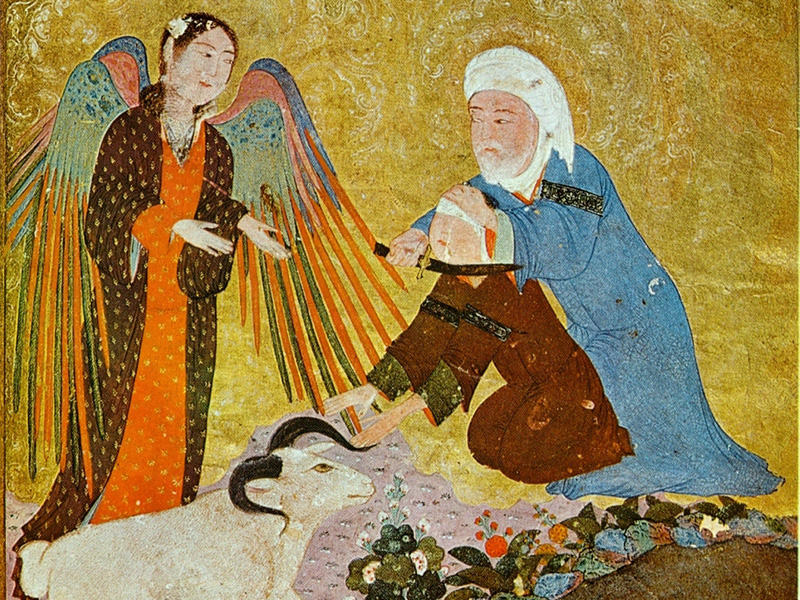 Ibrahim’s (Abraham’s) sacrifice.” Timurid Anthology, Shiraz, 1410-11, Gulbenkian Museum, Lisbon, Portugal. Image courtesy of Creative Commons
The sacrifice being celebrated during Eid al Adha, then, is the purest form of sacrificium intellectus, the form common to all three Abrahamic faiths: If you hear a command and are sure it came from God, the thing to do is to power down your mind or throw it away, then obey the dumbest, craziest, most fucked up voice in your head. Do whatever it tells you. Don’t worry about coherence. Don’t worry about consequences. Don’t worry about integrity, innocence, or harm. Just act before your faith evaporates and doubts start to arise. This is the fable to which millions of “traditional, conservative” people profess adherence while criticizing the “mindlessness” of political activism.
For fifty years, I’ve heard Muslims complain about Islamophobia. I don’t dispute that Islamophobia exists, and is an unjust, harmful thing. But I’ve always wanted to respond: what part of Islamophobia is really worse than what Islam itself teaches?
Take the worst case scenario. Imagine that some ghastly Islamophobe–some debased Zionist fanatic–kills you because you’re a Muslim. Even so, you retain the power to condemn the act even as you take your last breath. Isn’t that what the martyrs of Islam have always done, from Summaya bint Khayyat to Khader Adnan down to the last person starved by the Israelis in Gaza? It’s terrible and tragic to die a martyr, but martyrdom is a perfect exemplification of dignity and integrity: the martyrs died, but they judged; they suffered, but they condemned. Martyrdom in Arabic is an act of witnessing: a martyr is a shahid, and a shahid bears witness to the manner of their own death. Bearing witness is not a value-neutral exercise, but just the reverse. It’s a measurement, to the atom’s weight, of the good and evil one sees before one’s eyes (Qur’an 99:7-8).
That is not what Abraham or his son did. A martyr retains their moral agency to the end. Abraham surrendered his moral agency to a God who commanded him to violate his moral agency in the name of morality. It’s hard to think of anything worse, or less coherent. But this is what we’re being asked to celebrate and venerate on Eid al Adha. We should, as one, refuse.
It’s no wonder that Muslims have such trouble reconciling their commitment to Eid al Adha with their commitment to Palestine. Eid al Adha asks us to celebrate a God who orders the murder of the innocent. Palestine demands that we smash the idols who issue such demands. Eid al Adha asks us to respect the command to kill a helpless child, then invites us to smile in relief when the angel commands Abraham to kill a helpless animal. But Palestine shows us the evil of killing the helpless as such. Sometimes, God is not our teacher, but the one in need of instruction. His creation teaches us what He has yet to learn.
Genocide doesn’t begin in a day. The proclivity to kill is built up and normalized over generations. It always begins with the command to destroy the innocent for some higher cause. It begins, for Muslims as for Christians and Jews, with Abraham and the word of God.
A piece of tough love, then, for my Muslim brethren, particularly the ones who’ve done nothing for Gaza, but have decided that it does no harm to “celebrate” Eid al Adha. If you really want to help Palestine by doing nothing, try this: Take a day’s fast from praying. Stop bowing down for one day to this senseless, sadistic God you’ve invented and whose edicts you’ve unthinkingly swallowed. Devote one day of your life not to prayer or even to the failure to pray, but to anti-prayer. Fight a jihad against your own desire to surrender to tyranny, and see what happens. Even the Muslim God, I’d like to think, could accept a wager like this.
I know there’ll be some offended Muslims out there who’ll wonder why I picked this time for this polemic, or wonder why I haven’t gone after Judaism or Christianity with the same intensity as I have Islam. The genocide in Gaza is after all a Zionist one, and the Zionists claim to represent a Jewish State. Why not attack Exodus on Passover, or the Book of Esther on Purim?
I guess you’ll just have to accept on faith that I really could have. I was born into Islam, educated into Christianity, and married into Judaism. There’s more than enough rancor there for a fair division. But Islam names the principle common to all three faiths, and the Muslim God is supposedly the one who “perfected” the message that all three share (Qur’an, 5:3). So He’s got to come in for his fair share of grilling.
It should surprise no one that a God who so blithely orders the killing of the innocent should be so little discomfited when His creation begins to mimic His proclivities. A smarter God would have grasped that He’d created child-like creatures only too apt to mimic their maker. A smarter creation might have left infantile mimicry behind and sought something more expressive of moral maturity. Either way, Abraham’s sacrifice is a moral mire. Accept the premise involved, and you’ll always have a soft spot for the kind of God who demands blood sacrifice, and the kind of God-mimics who act on it. Look around. That’s the world we live in, and the celebration of Eid al Adha is part of the reason why.
 Policy of Truth
LikeLiked by 1 person
It’s a long way down.
LikeLike
“Viewpoint diversity.”
LikeLike
Pingback: Morituri Te Salutant | Policy of Truth