(This post gives away the whole plot of the movie “The Sea of Trees.”)
My wife Alison took her life four years ago today in Toronto–March 4, 2021. She was discovered, still alive, during a pre-scheduled building inspection of her townhouse. She was rushed to the hospital but died there. She’d been hospitalized for an earlier attempt on her life in February of that year, and had made at least one yet earlier attempt several years before we’d been married. Suicide was a preoccupation of hers for the duration of our admittedly brief marriage. She brought it up repeatedly in conversation in ways that are easy enough to remember, but also in ways I ended up suppressing.
Alison was a onetime film student, a cinephile, and a gifted amateur photographer. She also, unknown to me, had three separate Instagram accounts, each corresponding to what she took to be the three separate ‘personalities’ she possessed. It only occurred to me several months after her death that she’d been preparing me for years for her suicide by having us watch films together that depicted suicides, expatiating on each film to draw out its meaning, and then letting it simmer.
She later made esoteric references to some of these films and conversations in her Instagram posts. Though she never told me about the Instagram accounts, and I didn’t get on Instagram until after her death, there’s a certain strange plausibility to the thought that she expected me to discover her Instagram account and posts (as I did), and expected me to decipher their hidden meaning (as I think I have). It’s typical of Alison that she would have made a macabre mystery of her death, putting the mystery out there as something to be resolved, while gambling on the possibility that it never would. Either she’d be discovered or remain a mystery, and oddly enough, either option was a win.
In a post she wrote on November 9, 2020, she posted a photo of a maple tree whose leaves had all turned yellow. The photo is touched up to give the image an abstract quality, something she frequently did with the photos she took in the last few months of her life. The caption of the photo says: “Fall colors. One of my rooms will be this color. Probably the kitchen.” At face value, the post seems merely to express a banal thought about interior decoration: she’s thinking of getting a new place, and thinking of painting the kitchen yellow. And maybe that’s all she was saying.
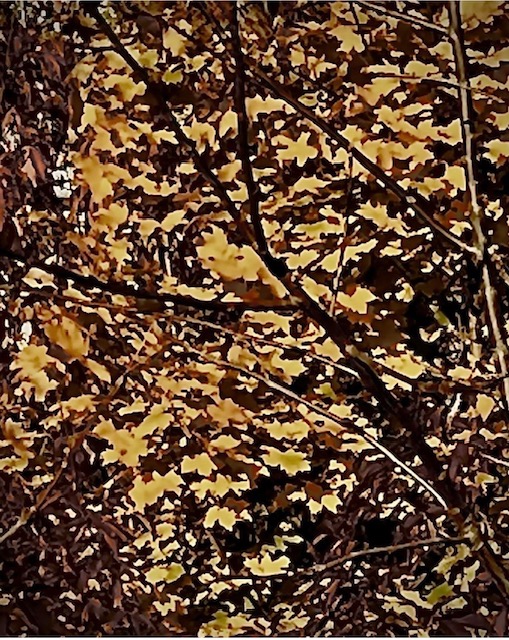
But I doubt it. Alison trafficked in symbolism. She yearned to be understood, indeed, yearned to be understood by me, and, even in suicidal despair, perhaps especially so, might have thought she’d reach me by some indirect, cryptic means. This isn’t the only post that fits this pattern.
Though she hadn’t fully resolved on suicide by November, she was clearly on track to it. Within a few weeks of this post, she’d posted what looked very much like a visual dress rehearsal of her own death on Instagram. So the idea of planning the paint job of a prospective kitchen seems implausible. Not impossible, of course. But a long shot.
In any case, she had no money with which to buy a new place, much less to paint the kitchen yellow. I have the notes she wrote in one her notebooks before her death, and they fixate on money issues. She was, to put it bluntly, running out of money. In fact, the problem she faced was not what color to paint her kitchen, but homelessness. She didn’t have enough money to house herself in Toronto, and I was forced to sell our house on short notice in New Jersey. We were in fact mere weeks from foreclosure. If we didn’t sell, we would foreclose; once we sold, we’d both become homeless.
By my lights, homelessness was a pressing, immediate problem, but foreclosure unthinkable. Homelessness was a problem in the present, to be solved in the present. Foreclosure would eventually make us homeless, but follow us forever. Better one problem than two–so homelessness it was. Alison hated this reasoning, but knew there was no alternative to it, and so, knew that a nice yellow kitchen wasn’t in the offing. She was, to be sure, given to flights of fancy, and maybe this is one of them. But there’s a competing hypothesis.
My supposition is that she wasn’t really thinking of interior decoration, not in any literal or straightforward sense. She was, as I see it, sending an esoteric posthumous message, one to be interpreted by the disciple she had painstakingly chosen for such messages–me. Even if she wasn’t consciously thinking of that when she sent it, I have to think that the thought was latently there. After years of encountering these “coincidences” with her, I’ve come to stop regarding them that way.
The odd depiction of the tree, as well as the mention of leaves, of fall (her favorite season), and of the color yellow, all call to mind Gus van Sant’s 2016 film, “The Sea of Trees,” which we saw together at her suggestion. I had somehow “forgotten”–really, repressed–the memory of watching this film with her. I only remembered it one day, months after her death and apropos of nothing, after encountering a passing reference to suicide in a book I’d been reading about the history of Japan. Though I don’t remember exactly when we saw the film, I remember being deeply moved by it at the time, but had forgotten virtually everything about it until I went out and read the Wikipedia entry for it. Reading it shocked me out of my senses. I just recently brought myself to watch it again, only to intensify the shock.
The film depicts the crumbling marriage of Arthur, an underemployed physics professor, and Joan, a successful real estate broker. Arthur is an adjunct at a local university making a miserable wage, but tied to the job in the hopes of producing the grand slam publication that gets him out of the career hole he’s in. Joan thinks it’s well past time for Arthur to get some self-respect, get a real job, and get a life. Every conversation they have becomes an excruciating war of words. Arthur tends to win on points; Joan tends to hit below the belt.
One day, in the midst of one of these quarrels, Joan has a nosebleed, and it’s discovered that she’s suffering a brain tumor. The two put their marital spats on hold for long enough to see Joan through to the initial stage of recovery, which she successfully reaches. The love the two felt for each other begins once again to return. Eventually, Joan is discharged from the hospital and sent by ambulance to a recovery center. Arthur follows behind the ambulance, talking to Joan on a cellphone. In the middle of a conversation about her favorite color and favorite season, Joan’s ambulance is hit by a truck, killing her. Apparently, Arthur never knew Joan’s favorite color or season, and never hears it from her. At her funeral, it occurs to him that in his narcissism, he never actually knew his wife. She was in a deep sense a stranger to him. And now she’s gone.
In guilt and despair, Arthur travels to Japan to commit suicide in the famed Aokigahara, the famous Sea of Trees on the northwest flank of Mt Fuji, where people are known to go to commit suicide. After an abortive attempt at suicide, Arthur meets a Japanese man, Takumi, also an abortive suicide. The two share details of their lives, including in Takumi’s case the names of his wife and daughter, and then try to escape the forest, only to end up disoriented and lost. Arthur ultimately makes it out, but is separated from Takumi. Unable to find or save Takumi, Arthur is rescued, but forced to leave him behind. 
Aokigahara Forest, seen from Mt Ryu (photo credit: Alpsdake, from Wikipedia)
It’s later revealed that there was in fact no Takumi. Takumi seems either to have been a figment of Arthur’s imagination, or Joan’s spirit in supernatural form, sent to pre-empt Arthur’s suicide. Or so Arthur is led to believe by the authorities, who clearly seem to believe that he confabulated the whole thing. Unable to believe them, he returns to the forest in search of Takumi, only to find the jacket in which Arthur had wrapped Takumi, but no Takumi–just a glowing orchid underneath the jacket. Orchids had been Joan’s favorite flower, planted at a favorite lakeside cottage earlier in their marriage. The forest turns out to be a sort of purgatory, where the spirits of one’s loved ones are, in Takumi’s words, “closest during your darkest moments.”
On returning home, Arthur ends up discovering by happenstance that the Japanese “names” Takumi had given of his wife and daughter are not names at all, but the Japanese words for “yellow” and “winter.” We’re meant to infer that “yellow” and “winter” were in fact Joan’s favorite color and season, respectively, the answers to the questions Arthur had asked of her just before she was killed. The film ends with a trip Arthur takes to the lakeside cottage to plant orchids where Joan had once planted them.
It may or may not be a coincidence that I myself was an underemployed academic, that Alison saw herself as the successful professional of our marriage, that her complaints about me mirrored Joan’s complaints of Arthur, that our marital spats resembled theirs, that she was physically disabled and required caretaking, and that Alison was involved in a traffic accident much like Joan’s–except that Alison’s accident involved a bus rather than a truck, and left her disabled rather than dead. It may only be a coincidence that the tagline for the Instagram account in question reads “All who wander are not lost,” that this particular post depicts what looks to me like an undulating sea of leaves if not trees, that the post goes out of its way to mention the color yellow, and that like Joan, Alison adored bodies of water.
It obviously is not a coincidence that she insisted on having us watch a film that had been panned by the critics, that she went out of her way to defend it, that she lectured me on the fine points that made the film the masterpiece she thought it was, that it was about suicide, that suicide was her idee fixe, and that “Sea of Trees” is one of several films about suicide that she induced me to see, and that somehow mirrored our lives. I don’t know what to make of the further fact that Alison’s mother’s name is “Joan Winter.” But it is.
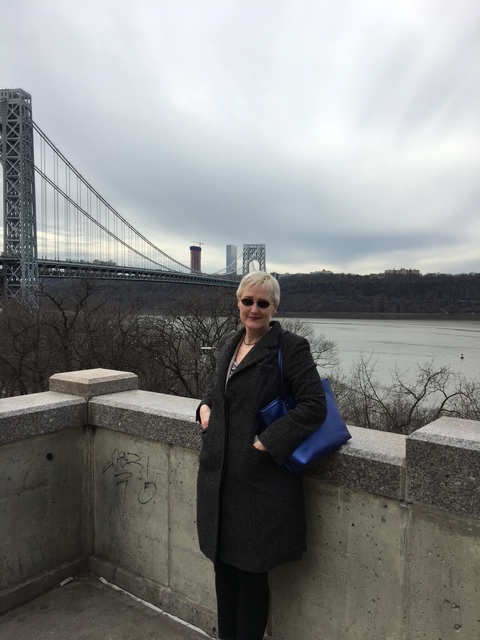
Alison, stylish but in a mood to match the weather; Washington Heights, New York, March 2017
So what does any of that mean? Even if it’s not a coincidence, or set of coincidences, what implication could it have?
I suppose I’ve said it already. I’m convinced that Alison predicted the course of my reaction to her suicide, chose this film (among others) with that thought in mind, and hoped I would, by anamneusis, decipher her intended meaning in showing it to me. This may sound crazy or far-fetched, and maybe some of the details are, but the evidence for it is as obvious as evidence gets: she went out of her way to say so, over and over. Alison harped for years not just on her death, which she typically imagined out loud to be a suicide, but on the probable reactions to it, as well as what would be the appropriate reaction to it. For obvious reasons, I was the focus of many of these speculations and quasi-prescriptions. Virtually everything she had to say was a form of remonstrance-before-the fact. “I’ll haunt you when I’m gone.” “You’ll miss me when I’m gone.” “When I’m gone, you’ll realize the pointlessness of so much of what you spend your time on.” “What will you do when it happens? You’ll wander about, lost, in a trance, wondering about the choices you’d made.” And my favorite: “What will any of this matter if one of us is hit by a truck?”
Many of Alison’s pre-emptive remonstrances came after a bout of suicide-centered movie-watching, though admittedly, some came without any clear prompting at all. I generally dismissed them, shut them out, often successfully “forgot” them. I can’t think of a single occasion when I warmed to the subject. I didn’t want to talk about her death. I wanted her to stop talking about suicide. I found her morbid predictions wearisome and pedantic. But in retrospect, like so many of her irritatingly oracular pronouncements, much of what she said ended up being shockingly prescient. I guess that only makes sense, since all of them were tailored to the act she had in mind for herself–for all of us.
Alison committed suicide in the midst of a divorce she initiated, a divorce she attributed to my defects as a husband. The divorce quickly became acrimonious, then bitterly adversarial. We both played our share of legal hardball as it wore on. She drove me to bankruptcy and penury, but there’s a sense in which, in prevailing against her, I drove her past mere penury and hardship to death itself. I won every battle, and the war itself, but you might say that she won the post-war settlement.
It started when she stole my car, defaulted on her financial obligations, and fled to Canada, where she was born. She then filed a contested divorce action, threatening to clean me out. My overall strategy was to ensure that by the time the case was brought before a judge, there would be no property left to contest, and that’s what happened. I retaliated over the car, and won. I insisted on selling the house, and prevailed. With nothing left to contest, the “contested action” was rendered irrelevant, and ultimately dismissed.
The rest was a war of attrition where I had most of the advantages. It helps not to be disabled. I had originally lost my job, but managed to get another one, and managed to stay employed for the duration. She lost her business and lost her income altogether, unable even to recover on the thousands of dollars that she was owed. I was able to retrieve most of my belongings from our house before it was sold. She wasn’t. She lost just about everything she ever owned. Since we essentially broke even on the house, we not only were rendered homeless by the sale, but lacked the money to do anything about it. I had friends on whom to rely for housing and plain old charity. She didn’t. Meanwhile, her lawyer made extravagant promises but never delivered. Mine pushed me deep into debt, but won the case. Key people stepped up at key moments to help me. No one ever stepped up to help her. If it had been a war, she fought valiantly, but I had the better strategy and better luck on my side. That’s why I’m here, and she’s not. I won.
Her suicide was, among other things (many other things), an act of retaliation, a posthumous nuclear strike against the man who had outplayed and out-lived her. But though spiteful, Alison was more than a merely vengeful spirit. She knew that in killing herself, she was sticking a dagger in me. But she loved me enough to make sure that however deeply she cut, I wouldn’t bleed to death. Like Shylock, she wanted her pound of flesh. Unlike Shylock, she tried to have a surgeon on hand. A very metaphorical surgeon, to be sure, one with no real guarantee of success, but capable of helping the patient who helped himself.
The first few months after her death were marked by a shock and grief so numbing that they found no real outlet for thought or action. Montaigne says that deep grief benumbs the soul and leaves it paralyzed. That’s how it was.
Then the obsessions began, the compulsive desires to re-visit, re-play, re-live, catalogue, taxonomize, discover, and explain what had happened. From paralysis as stasis I went to paralysis as self-torture.
Gradually, the guilt and despair set in. She had pushed me to the wall, and we played hardball for the better part of year. But I survived, and she didn’t. Was her death the price of victory? Did I kill her? Maybe not literally, but surely some part of her death was my doing. Yes, she took her own life. But I had an undeniable hand in creating the pressure that pushed her there. In one sense, you could say that I didn’t know she was going to commit suicide, but in another, how could I not have known? She spent years talking about it. What else does knowledge require? An engraved invitation to the act?
Worse still, she’d made a prior attempt at suicide in February. My lawyer told me at the time not to engage, and I didn’t. Should I have listened to him? What do lawyers know about love? We pay them for legal advice, not for advice on what to do when your estranged wife tries to commit suicide. Yet I listened, and obeyed.
Did she push me into killing her? Or did she push me into putting her into the state that induced her to kill herself? Does it matter? How do we unravel the tangled causality of unwitting but obscurely culpable complicity? Or should one know better, and simply let it lie? If I had pushed her into death, it now seemed that she was pushing back from the grave. If so, maybe it was best to stop the cycle of push and pull. What else was left to do but to end the shoving match and join her? Death itself would not do us part.
Much of my despair was merely passive, less a positive desire for oblivion or self-punishment than a gradual loss of interest in life itself. Then came the obsessive desire to settle in beside her in the ground, alongside the ashes and the earth, to find a final, deserved place of repose beside her, and bring this undignified drama to a dignified end.
I was stopped, I think, less by any great love of life than by the uneasy sense of inconsistency in my imaginings of death. In one sense, death was the ultimate form of oblivion: once you take the plunge, there’s nothing but nullity. In another, it was the continuation, by enigmatic means, of what I once had: it’s impossible fully to suppress the thought that death will bring a consummation of some mysterious but vividly imaginable kind, one that takes place in some mysterious but somehow familiar dimension. Death becomes a place like the world we inhabit, just cleaned up and dream-like. In one sense, ultimate separation; in another sense, ultimate union. In one sense, ultimate divorce, in another sense, ultimate reconciliation. Which thing was I seeking? How could death be a seeking at all? Was seeking the point, or was sheer renunciation the thing? So many conundrums. That was the difference between me and Alison. I was Hamlet. She was Ophelia.
I found myself having actively, strenuously, to suppress the thought that Alison was somehow, in some nearby dimension, alive–and that I really would or at least might, encounter her there by the simple act of leaving this one. I caught myself trying to convince myself that her death was an elaborate hoax. That thought gradually morphed into skepticism that her death had been fully proven to my satisfaction.
Worried at the patent insanity of these thoughts, I consciously suppressed them, only to have them show up night after night in my dreams–more dreams that I can count or remember. Alison in Prague. Alison at Inspiration Point on the Henry Hudson. Alison on the other side of an unfamiliar apartment. Alison calling me out of the blue to berate me from the grave. Dreams more real than any waking reality. Dreams more plausible than what had actually happened. Dreams that soothed while they lasted, and that bludgeoned and eviscerated when they ended. Dreams of conversations from the beyond, wrapped in mysteries about how they could be taking place at all.
I hesitated to delete her contact information from my phone. What if she was still there? “Think not that those who are slain in God’s way are dead,” says the Qur’an of the martyrs who do battle on God’s behalf. “They live, finding their sustenance in the presence of the Lord” (Qur’an, 2:154, 3:169). A convoluted thought under any circumstances, much less these, but harder to suppress than you might imagine. A friend saved Alison’s podcasts for me, but listening to them is torture. It can’t be that the person speaking these words lacks material form. It can’t be that the words reach me on behalf of a cipher. It must be that for the duration for which I hear her, she lives. I hear, therefore she is. 
Inspiration Point on the Henry Hudson Parkway, a scene of persistent hauntings (photo credit: Beyond My Ken, Wikipedia)
Ordinary life was its own sea of trees for me, the purgatory where the spirits of the dead were closest during my darkest moments. I discovered Alison’s post, or rather, grasped its meaning, during one of those darkest moments. It’s tempting to try to find some very precise set of analogies to capture what she had in mind. Perhaps the yellow of the trees is an analogy for the sun–a favorite image of hers, and her mother Joan’s nickname for her (“Sunny Bun”). Perhaps the reference to kitchens is an allusion to her love of cooking–a reminder of all the times I was late to dinner, clacking away at a computer when I should have been with her in the kitchen.
But there’s no point to precision of this sort. Alison was a spontaneous rather than precise thinker, and would not have bothered to worked out the details of some very precise analogy. The reference to yellow and trees is simply meant to conjure up a memory of the film. The plot of the film is meant to draw attention to the lives of the film’s characters. Reflection on their lives is meant to draw attention to similarities with ours. Reflection on the film is meant to draw attention to subtleties about our own relationship that she recognized but never explicitly acknowledged. Think on this, she’s saying. You’re Arthur. I was Joan. And now I’m Takumi. We were both wrong about so many things. We failed to speak and listen when we should have. Were you listening when I told you we’d been in this situation someday? Do you remember what I said? Can you remember me as I was? Do you still love the person you remember? Did you ever?
At first, it all seemed to make things worse, but it ended up showing me the way out of purgatory and back into the world. The memory of the film, deliberately implanted in my mind, reminded me of my kinship to Arthur–the defective husband–but more importantly, reminded me of her kinship to the spirit of Joan. Alison was notably inarticulate during our marriage about how she felt about me, not because she was naturally inarticulate or insensible, but because she felt, however wrongly, that her feelings for me were not reciprocated. Like the marriage depicted in the film, the affection in our marriage often seemed to operate in secret, expressed less in overt expression than in covert maneuvers.
She could only express her love through a kind of cinephile encryption, in the hopes that her intellectual husband would belatedly discover its meaning, if only in the throes of some agony that forced the inquiry upon him, and that forced his recognition of her. “You didn’t have to do this,” I sometimes think, “to get me to acknowledge you.” But then I remember what I was like in real time, in real life, and start to see her point. Who could count the number of times I failed, in life, to give her the acknowledgement she craved? She had to die and half-drag me into death to force it out of me. And now she has.
The filmic parallels aren’t entirely straightforward. While it’s easy to think that I was Arthur and Alison was Joan (and Takumi), there’s a different sense in which she was, in her own mind, an Arthur without a Joan or a Takumi. When she left our home, she entered her own sea of trees. Everything she did from there on out was a prelude to her eventual death. I can see this from her Instagram posts–the retreat into a private, idiosyncratic self; the memorialization of a newly abstract “late style” in her photography; the cryptic (and sometimes not so cryptic) references to death and trauma; the dress rehearsal scene for suicide itself. Though she had obsessed about suicide for years, I can’t imagine that she was able somehow to embrace it without difficulty. She had to work up to it, however hesitantly.
But she did so alone. I had not prepared some grand anamneutic drama to ease her way into the act. I had not concocted some grand cryptographic billet doux to express my subterranean love for her. I pushed her to the edge and left her there. Her friends recoiled from her apparent expressions of malice and insanity, and abandoned her. Her lawyer promised the sky but delivered dashed expectations and bankruptcy. When the day came, she faced it alone. Her only companion was our cat, Hugo. She mixed an overdose cocktail of hydromorphone and Klonopin, and consumed it. “I always have enough of both for an emergency,” she often told me. I always found it hard to imagine that she really meant to use it. What’s a husband for, if not to pre-empt such an emergency?
The suicide seems not to have worked according to plan. I know she planned her death to coincide with the building inspection on the 4th, but I don’t think she planned to be alive for it. Yet she was. Whoever discovered her rushed her to a nearby hospital by ambulance. Her medical records are notably cagey about what exactly happened in the ER. But the details don’t matter. What happened is what she wanted to happen. So she was Arthur and she wasn’t. Unlike Arthur, I don’t think she had second thoughts–not that I can really know. But more important, unlike Arthur, she was resolved on suicide because she was convinced she had no one left to live for. No healing spirit. No filmic redemption. Just an implacable wall of hostility from me, looming bankruptcy, imminent homelessness, a failed legal case, and a prospective lifetime of chronic pain. Oblivion must have seemed an obvious remedy.
Could I be over-interpreting a three-line Instagram post? Maybe. There’s obviously the danger of over-compensating now for the communication breakdowns of the past. I could tell you that Alison was trying to communicate her plans for death by the method of idiosyncratic cinephile encryption, and you could reasonably retort that she was merely talking about the envisaged color of her future kitchen. I could say that I’m right because she was my wife, and I knew her better than anyone, but you could say that I’m hardly an impartial witness, and that the appeal to personal knowledge is conveniently unverifiable. Which of us could conclusively prove their case, and how?
Even if I had cracked the code in real time, what difference would it have made? It’s one of the pieties of our time that every would-be suicide should be detected and pre-empted. I don’t believe that, and neither did she. Not all suicides can be detected, and even if detected, not all should be pre-empted. Not that we shouldn’t try to dissuade those who express the desire to commit suicide, or make the world a place that no one voluntarily wants to leave. But it’s no one’s place to play God. One person’s life is not the prop for the mental health nostrums of the day.
Alison didn’t just dream up the idea of suicide out of nowhere. She had her reasons, many of them, in my view, totally ill-conceived, but some perfectly reasonable, and all of them undeniably hers. I couldn’t have swooped in over the Canadian border to play Suicide Watch Superhero even I had figured out what was about to happen. Those who made the attempt failed. Such failures are just part of life. They leave wounds, sometimes permanent ones. But those are part of life, too.
It would, I suppose, be suitably dramatic if I could tell you that I took orchids to her grave and planted them there, or that I painted my kitchen yellow in her honor. But I didn’t. Life may resemble a movie, but isn’t one. Her ashes were buried among the Winters six months after her death. Her family didn’t want me at the burial, so I visited a year later on my own, entirely empty handed. I left nothing but tears and took nothing but pictures.
Her mother Joan died a few months ago, and is to be buried next to Alison. I loved them both. May they rest together, in peace.
 Policy of Truth

This is incredibly powerful, and I have nothing adequate to say.
You mention her Instagram tag line “All who wander are not lost” (which is echoed in your Qur’anic quote “Think not that those who are slain in God’s way are dead” — was that deliberate?). Not sure if you know this, but just in case you don’t, the line is from a poem in Lord of the Rings, but combines the grammar of the first line with the substance of the second. I don’t know whether the Tolkien reference has any further significance:
All that is gold does not glitter,
Not all those who wander are lost;
The old that is strong does not wither,
Deep roots are not reached by the frost.
From the ashes a fire shall be woken,
A light from the shadows shall spring;
Renewed shall be blade that was broken,
The crownless again shall be king.
LikeLiked by 1 person
Thanks. I’m grateful for your comment. The juxtaposition of the Instagram tag and the Qur’anic quote was something that consciously occurred to me, but after the fact. It wasn’t really “deliberate.” It spontaneously occurred to me, I wrote it down, I had second thoughts about it, but then it occurred to me that it fit. So I left it.
I don’t know Tolkien at all, and am not sure she did. I somehow doubt that she read it, but she was a big film buff, so she may have seen the film series. I’m more inclined to think that she just plucked the tagline from common speech, but the connection back to the film seems more than a coincidence. It’s regrettable that she didn’t know Tolkien, because I’m sure she would have loved that verse (as I do).
This is only tangentially related, but in one of her personalities–the most effusive, eccentric, and prolific–she went by the handle “Sigyn Kathleen.” Kathleen was her middle name. The Sigyn (I gather from Wikipedia) is a Norse deity who assists her husband Loki to victory from captivity. I don’t know how she came upon this, but she had clearly pored over the Wikipedia entry, and very obviously meant for the reference to be discovered and thought through:
I didn’t quote it because it seemed like overkill, and because without a bit more backstory than I decided to give, some of it is obscure. But if you set aside the reference to sons as irrelevant, you get the idea of a Loki captured and enchained by forces majeures–biographical ones, if we want to naturalize a bit. And these forces might prove venomous. “When the bowl becomes full she leaves to pour out the venom.” Well, that’s one way of putting her various departures. “As a result, Loki is described as shaking so violently…” Well, that happened, too. “And this process repeats until he breaks free…”
It’s entirely in keeping with her personality that she would want to enact the Sigyn drama, and then leave cryptic hints of what she was doing. There’s something awe-inspiring about the sanity-defying deliberateness of the whole scheme. But that’s exactly what she wanted to convey. From a superficial glance, her life seemed an inconsequential failure. The enactment of this drama, and the ending she devised for it, was her means of redemption from beyond the grave. There was something eerie, almost supernatural about her–much, much more than met the eye. I only wish she was here to hear me say it.
LikeLike
I somehow doubt that she read it, but she was a big film buff, so she may have seen the film series
It’s been a while since I saw the movies, so I can’t say for sure, but I don’t think the line is used in the movies. Tolkien’s writings are filled with poetry, and the movies use only a few snippets.
Incidentally, many of the names in Tolkien’s works are borrowed from Norse sources. He doesn’t use “Sigyn,” but “Vali” is his term for a god or angel, and “Narvi” (same as “Narfi”) was the dwarven craftsman who carved the password-protected magic Door of Durin that’s one of the best-known images from his work. Probably no connection, but there it is.
https://static0.gamerantimages.com/wordpress/wp-content/uploads/2022/03/Moria-Doors-of-Durin.jpg
LikeLike
Ah, interesting. Thanks.
LikeLike
The photo of leaves reminds me of another Tolkien passage, likewise from Lord of the Rings:
‘There lie the woods of Lothlórien!’ said Legolas. ‘That is the fairest of all the dwellings of my people. There are no trees like the trees of that land. For in the autumn their leaves fall not, but turn to gold. Not till the spring comes and the new green opens do they fall, and then the boughs are laden with yellow flowers; and the floor of the wood is golden, and golden is the roof ….’
LikeLike
Irfan, the raw emotion of your narrative takes my breath away. I had known much, but not all, of Alison’s story. You are very brave to have faced the emotional risk of not just pondering the clues that Alison left behind–Alison seemingly assured that you’d be up to the task of deciphering most of them–but you laid bare, publicly, your part in the story that unfolded. You jumped into the void, with no parachute, not knowing where you’d land. I hope the piece was, in some way, a catharsis for you. You’ve suffered enough from the fallout of what happened, for this lifetime.
For what it’s worth, when I hear the word, “wanderer,” I think of Friedrich’s “Wanderer Above the Sea of Fog.” My thoughts about it are not likely what Friedrich was trying to convey. I think of it as someone alone, disconnected from society/the world at large, perched above it all, and watching the world in an almost disconnected way, as if it were a play, not real life—the wanderer both wishing they were a part of the human community, while also being gratified not to be. Susan
LikeLiked by 2 people
Thank you. For some (technical) reason, I can’t “like” comments, but I would if I could.
You’re right that the whole thing was jumping into a void. I had no idea what I was getting into, but have no regrets.
I guess writing the piece was cathartic, though I never really know when that’s true. It was terribly wrenching. I don’t know if that comes across. I try not to force it on the reader, but try not to hide it, either. In some ways, I thought I had made my peace with Alison’s death when I visited her gravesite a week before the October 7 attacks. Then the attacks came, and the war, and that overshadowed Alison, but also seemed to overturn whatever peace I had made with the world. Last year, the anniversary of her death had less impact than it did this year. I was too focused on Palestine. This year, I happened to discover the FB predecessor of this post, and casually thought I’d “touch it up” and re-post it. But then it dragged me in, and realized that the whole thing was still an open wound.
It occurs to me that I always associate Friedrich’s “Wanderer” with the book covers it adorns–Nietzsche, for instance. I hadn’t realized until this moment how misleading that was. It gives the painting a triumphalist feel that it may not have.
The situation you describe is actually very painful. I’m thinking of various people it might describe. It sort of describes Alison, but not entirely. Unlike your description, Alison saw herself as fully engaged by the human community but excluded from it. It was as though there was some invisible barrier that kept her out. She wished she was a part of it, but was deeply wounded at the fact that she wasn’t. If you knew her, you’d grasp in five minutes why she was excluded. It was pretty obvious, actually. Many people found her demeanor instantly off-putting. She often said things (sometimes innocently, sometimes not) that were uninformed and offensive. A first impression of her, particularly in public, was bound to be very misleading. Most people lacked the patience for a second impression.
I don’t mean any self-flattery in saying this: I really was an exception to that rule, and that’s why she both hated and adored me. She adored me for being the exception to the rule, but hated the dependence on me that it produced. I understood her, no one else did. And I took the time to do it. No one else did.
I had a response in kind to that dynamic: I loved being adored and hated being hated. She wanted total acceptance without dependency. I wanted to be adored but needed plenty of space. You can see how unrealistic this is. But we weren’t realistic people. We were, in our own ways, damaged, desperate, and unyielding. No surprise how it ended up.
I think this means that neither of us were really “wanderers” in your sense. We desperately needed each other, but on incompatible terms. We didn’t know how to negotiate. We only knew how to fly off the handle. The “wandering” she did was at the very end, but I wonder even about that. I oscillate between thinking that she was set on suicide from the outset, and thinking that she was driven to it in a desperate moment. I don’t really know why I torment myself over this, except that doing so is a way of keeping her alive in the only way I can.
LikeLiked by 2 people
I wonder why it lets me like comments but doesn’t let you do so.
LikeLike
I’m sure there’s a way to blame DEI, wokeness, illegal migrants, trans people, Kant, Marx, Engels, Rousseau, post-Modernism, and/or Hamas for it. All I know is that I pay $100 a year for glitch-laden site, but haven’t had the gumption or sense to leave it and go on Substack.
LikeLike
The off-putting first impression, yes. But, dear to you, and so — I resolved — dear to me, too. I got started on that second impression! I really began to appreciate Alison. I think of her, and you, and the relationship I saw from the outside mostly, whenever my spinach stays fresh due to the trick she taught me.
I just went back and read my last text conversation with Alison (she was reaching out to me, wanting to know if we were still friends and could chat every once in a while). Strangely, I never read her last flurry of short replies. Rather disconcerting to read them now.
What you say here touches me deeply, too deeply to express (as you know, my mother — another person hard to be in any intimate relationship with — committed suicide when I was in my mid-twenties).
This lyric captures something of my experience right now (and maybe some of yours, too).
“Got a box full of letters
Think you might like to read
Some things that you might like to see
But they’re all addressed to me
Wish I had a lot of answers
Because that’s the way it should be
For all these questions
Being directed at me
I just can’t find the time
To write my mind
The way I want it to read…”
Jeff Tweedy (Wilco)
LikeLike
Thanks for that comment. It means more than I can say. Alison craved acceptance from my friends, and probably got more from you than from anyone. In some ways, you were the most insider-like of the outsiders in our marriage. I think, in particular, of the friction-laden period right after our marriage and before we bought the house–the first half of 2018, when the friction-causing topic was whether or not to buy. Your knowledge of real estate dissipated a lot of tension. And she bonded with you once we moved in, when she wanted to fix the place up. It’s actually painful to think that your last trip to our house, in March 2020, focused so much on the house, all of which ended up being moot.
I just went back and re-read some of my exchanges with Alison. It occurs to me now, painfully, that I didn’t read them all, read some cursorily, and read others in a purely defensive spirit that failed to give them the right uptake. In some cases, this strikes me as a gigantic, terrible failure on my part. But I think my failure is somewhat mitigated by the fact that Alison’s manner of communicating was so scattershot and voluble that no one could actually process everything she said. It was almost as though you were being put to a kind of verbal “Where’s Waldo?” test.
She would cram things of earth-shaking significance into paragraphs of tangents and banalities. It was as though she was daring you to stop pay attention, then dropping something that should have riveted your attention. But sometimes one failed. I failed. I failed more than anyone, because more than anyone, I was right there, on what was supposed to be the receiving end. People say that I’m “too hard on myself” in connection to Alison, but I don’t agree. When I force myself to re-visit some of our exchanges, I see vividly that contrary to anyone’s presuppositions about us, there were moments when she was the rational party to the relationship, and I wasn’t. And at those times, I either wasn’t listening, or was listening only pro forma, not taking things in.
I like the Wilco song. It takes me straight back to 1995, two years before I met Alison at the IOS Conference at Charlottesville. I wish I knew then what I know now. But I didn’t. And probably couldn’t.
LikeLiked by 1 person
I meant to say, your relationship with your mom is always in my mind when I write these things. I remember thanking my lucky stars nothing like that had happened to me, but then it did.
LikeLiked by 1 person