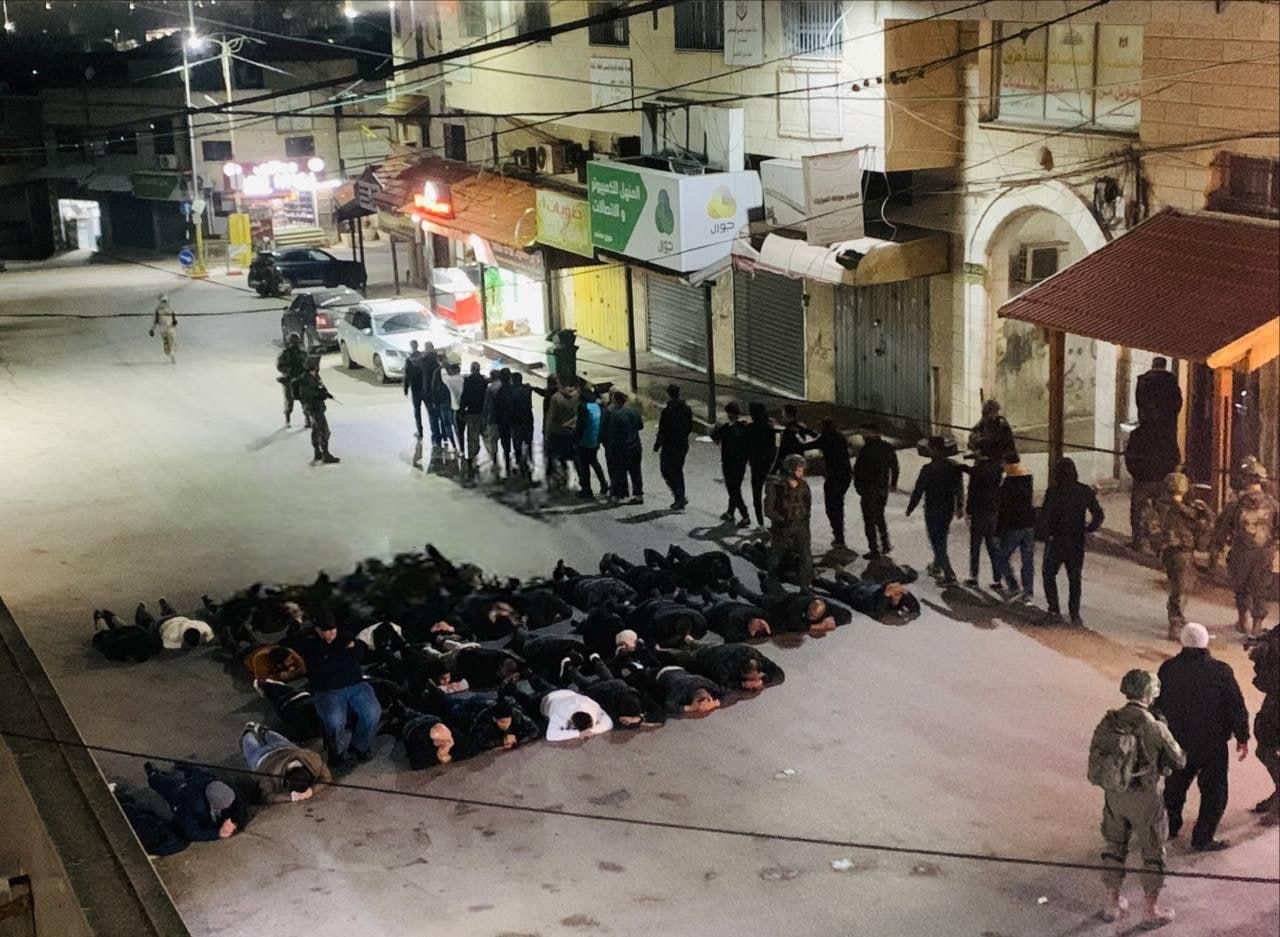
This is what the vaunted “ceasefire” actually looks like in the West Bank: disarm the population, box them in, round them up, incarcerate them en masse. The occupation has quietly swept dozens into jail, and settlers have set fire to the village of Sinjil. Not a shot fired, though.
As far as the West Bank is concerned, the “ceasefire” is a further suspension of the rights the Palestinians never had. That was the Israelis’ incentive for wanting it. The population now awaits its fate, bowing as if before a self-proclaimed deity.
They say that God works in mysterious ways, but honestly, the mystery clears up once you think about it. Power is addictive, and absolute power is a never-ending high. Or so it seems when you’re high on your own supply, and there’s no one sober enough to cut it off.
Here is The New York Times on what the “ceasefire” looks like in the West Bank:
Israeli security forces on Tuesday embarked on a military operation in Jenin, a Palestinian city in the Israeli-occupied West Bank, as Israel turned its focus to an area seen as a hotbed of militancy just days after a temporary cease-fire took hold in Gaza.
Prime Minister Benjamin Netanyahu of Israel said in a statement that the operation, the latest in a string of West Bank raids over the past year, was aimed at “eradicating terrorism” and would be “extensive and significant.” The Palestinian Authority’s health ministry reported that eight people had been killed and at least 35 injured during the first hours of the operation.
For Mr. Netanyahu, the operation in the West Bank could serve as a distraction from Gaza, where Hamas gunmen paraded through the streets even before the cease-fire started on Sunday, a show of force signaling that it had survived the 15-month war despite Mr. Netanyahu’s vows to destroy it.
In other words, all that Israel has done has trade a temporary “ceasefire” in Gaza for American-sponsored warfare against the population of the West Bank, and trade the prisoners they’ve released to Gaza for new hostages they’ve taken in the West Bank. The ultimate aim of this process is outright annexation.
Here’s Al Jazeera for a more straightforward, less antiseptic depiction:
At least 10 Palestinians have been killed in Israeli attacks across Jenin governorate in the occupied West Bank, the Palestinian Ministry of Health said.
The Israeli army said earlier on Tuesday that soldiers, police and intelligence services launched a “counterterrorism action”, but gave no further details.
The Israeli assault is called “Iron Wall,” after a famous essay by Vladimir Jabotinsky, an early Zionist (and fascist) intellectual.
None of this would surprise anyone with a historical knowledge of Israel’s conduct during ceasefires. Here’s a summary from historian Zachary Foster’s account of Israel’s ceasefire talks with Hamas since 2008:
Israel and Hamas signed at least six ceasefire agreements in 2008, 2012, 2014, 2019 and 2021. Each case followed a similar trajectory. Hamas, by and large, observed the agreement. Israel, by and large, did not. Eventually, Israeli violence elicited Hamas rocket attacks, which elicited an Israeli campaign of aggression in Gaza, which resulted in another ceasefire, and then the pattern repeated itself.
Foster goes on to detail the history in the essay itself. Historical bottom line: Israel is the violator, Hamas the adherent. Israel is the aggressor, Hamas the defender.
Here’s a micro-study by Foster of the weeks just before October 7, 2023, going back to mid-September:
And so while Israelis may have felt that they were living in a blissful state of calm and tranquility before Oct. 7th, no such “ceasefire” existed for Palestinians, who were living in a violent state of siege, occupation and apartheid.
Foster details more than four dozen Israeli attacks on Palestinians in the month or so before October 7, 2023. Verdict: Israel is the aggressor, the Palestinians the defender; Israel is the initiator of force, the Palestinians the retaliators.
This should remind us of the obvious: October 7 is just one day in a sequence of prior and subsequent violence. It’s not the beginning of hostilities, the initiation of force, or the beginning of “the war.” When Zionists tell us that more Jews died on October 7 than on any day since the Holocaust, they forget and want us to forget that more Palestinians have died on many days than have Jews on any given day since the Holocaust. Israel has spilled far, far more Palestinian blood than the other way around.
Here is Chris Hedges stating a more general point about Israel’s historical track record when it comes to ceasefires:
Israel, going back decades, has played a duplicitous game.
It signs a deal with the Palestinians that is to be implemented in phases. The first phase gives Israel what it wants — in this case the release of the Israeli hostages in Gaza — but Israel habitually fails to implement subsequent phases that would lead to a just and equitable peace.
It eventually provokes the Palestinians with indiscriminate armed assaults to retaliate, defines a Palestinian response as a provocation and abrogates the ceasefire deal to reignite the slaughter.
As Hedges points out, we’re still waiting, more than two decades after the fact, for the “phased withdrawal” from the West Bank that Israel was supposed to have made in 1998. I’m sure we’ll wait another twenty years, and another twenty after that, without ever seeing a withdrawal.
Paul Pillar on the same topic:
The agreement has the earmarks of only a temporary pause. The ceasefire is for six weeks, with any extension dependent on the success of future negotiations. A second and third phase are envisioned that would see the release of more hostages by each side and further withdrawals by the Israeli military, along with a reconstruction plan, but so far those phases are just outlines of objectives and not a real coming to terms. In short, the negotiators reached a short-term bargain while punting more difficult issues. …
Resumption of the assault may come after the six-week ceasefire expires and negotiations over phases two and three fail to reach an agreement. Or, Israel may find excuses to resume the assault sooner. Netanyahu has a long history of reneging on international agreements, dating back to the Wye River Memorandum reached during his first term as prime minister in 1998, which provided for partial withdrawals in the West Bank that Israel never implemented. More recently, Israel has repeatedly and extensively violated the Lebanon ceasefire agreement reached last November.
As far as the West Bank is concerned, the assault Pillar predicted came a week after he wrote those words. It won’t be long before it returns to Gaza.
Or look at the more recent ceasefire with Lebanon:
Israel has been accused of violating the ceasefire by the Lebanese government,[50] by Hezbollah and by France. On 2 December, France reported that Israel had violated the ceasefire 52 times.[24] Israeli attacks on Lebanon have killed 3 Lebanese civilians since the ceasefire went into effect.[8] Israel has accused Hezbollah of violating the ceasefire. As of 28 November, there were no reported instances of Hezbollah firing at Israel since the ceasefire took effect.[50]
The ceasefire with Lebanon became effective on November 27. So we’re talking about 52 alleged Israeli violations within the first week.
Don’t get me wrong. I’m glad there’s a ceasefire. I called for one myself back on October 7, 2023, along with a hostage exchange. But we need to distinguish a ceasefire from a pause, realism from wishful thinking, and an agreement from a fraud. It’s an axiom that when you’re dealing with the Israelis, you’re dealing with wholesale fraud. The only real questions worth asking are how long it takes a given person to figure that out, and why it takes them as long as it does.
Thanks to Susan Gordon for reading closely enough to catch my typos.
 Policy of Truth
Pingback: Gaza: Tod Macht Frei | Policy of Truth