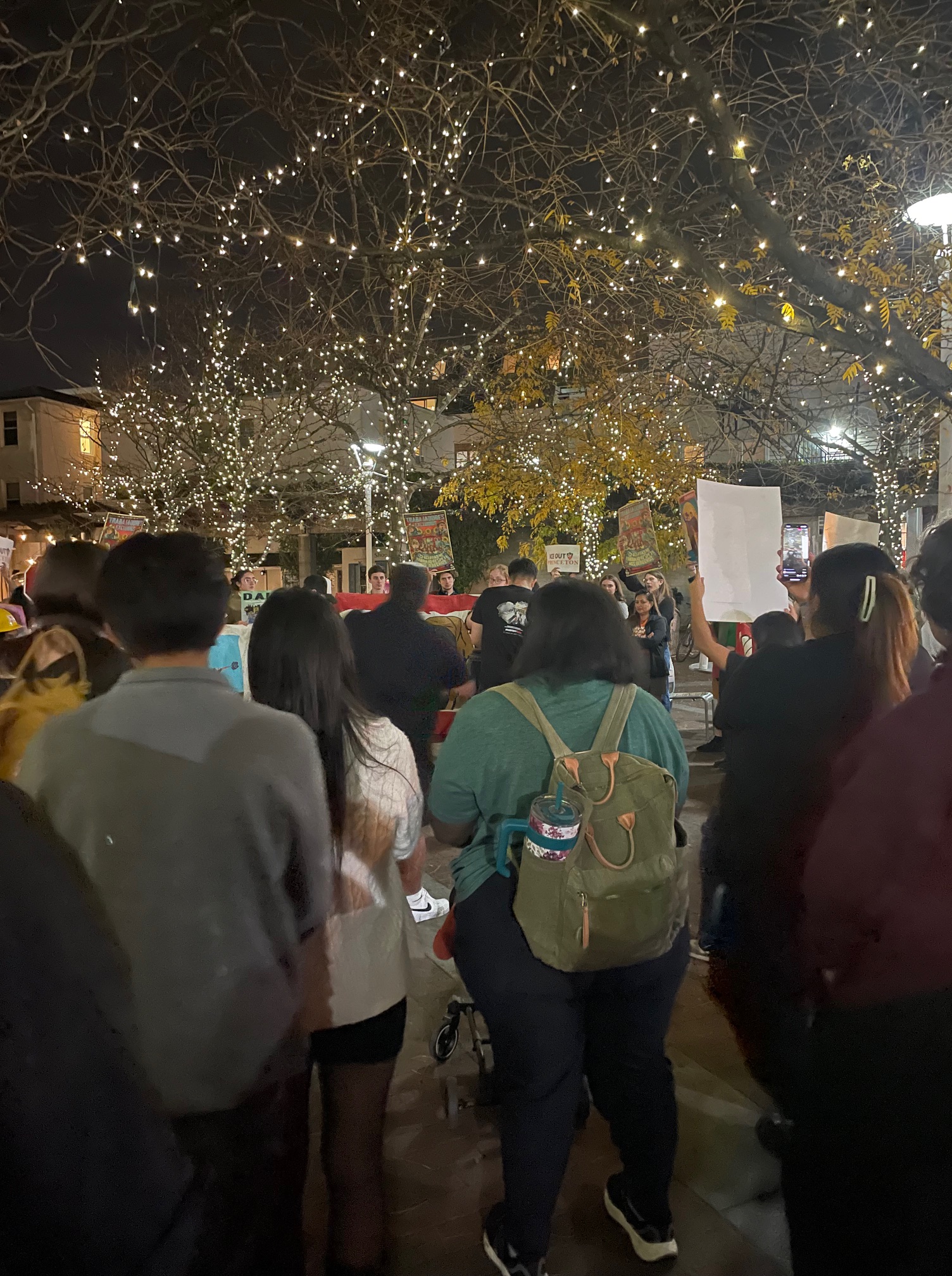
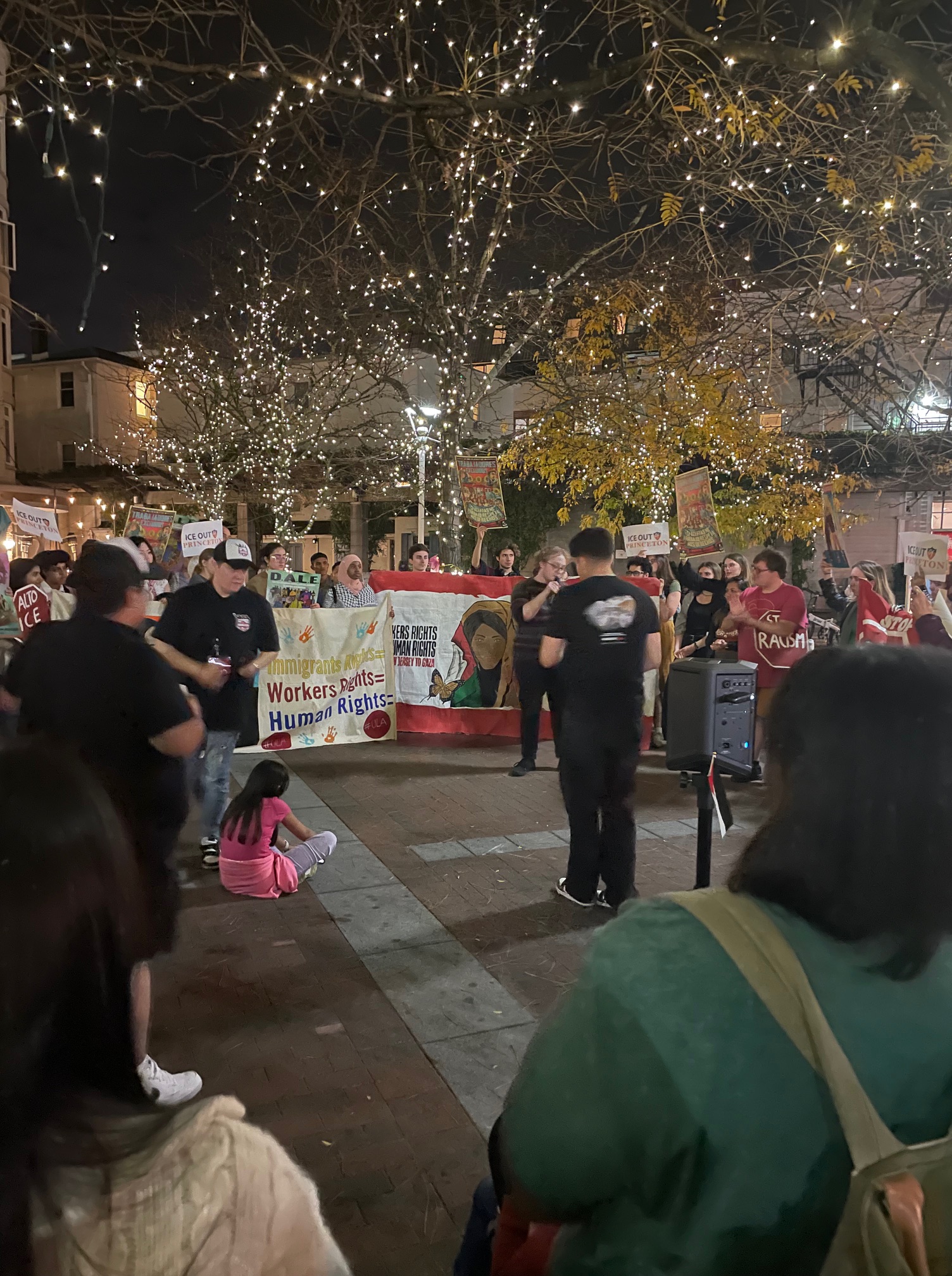
I encountered this rally purely by chance tonight at Hinds Plaza in Princeton, focused primarily on migrant rights. Short speeches in English and Spanish, then a quick march from Hinds Plaza to Palmer Square and back. Ran into a handful of Trump supporters who tried to drown us out with an infantile chant, but ignored them, yelled louder, and walked past.
If you think you can successfully resist injustice or make political change by sitting placidly at a desk or staring resolutely at a screen, you’re wrong. Political change doesn’t happen without physical presence and collective physical activity–in the workplace, in the streets, in college quads, in houses of worship, in the galleries of legislatures and courthouses, in interrogation rooms, in jail cells, in hospital emergency rooms, and in the mortal struggle that takes place between the ER and the morgue. If you think you can non-physically cognize or will political change into existence, the only changes that will occur will be non-physical ones that make contact with nothing but the contents of your mind. This is not to denigrate the need for theory, reflection or planning. It’s not to denigrate the need for pursuits beyond the political. But political change is not a magic trick worked in solitude. It takes collective solidarity, collective passion, collective persistence, and collective action.
To produce those things, you have to get up, stand up, march, yell, chant, sing, lock arms, break bread with people odd and unfamiliar to you, face down hostility, and learn how to fight. Nothing of consequence happens until you do–and nothing of consequence may happen if you do. It won’t suffice to read, vote, cry, wring your hands, or click “send” in the comfort of your study. You have to be willing to get out of your seat. You have to be willing to bleed. You’re not willing? It’s too much bother? It cuts against your sense of being an objective, impassive spectator, coldly recording the truth of the matter, but above it all? No problem. But then the hard, objective truth of the matter is that as far as politics is concerned, you don’t matter. Whatever credit there is for whatever deserves credit is someone else’s, not yours.
There was a time when even I thought that “El pueblo unido jamas será vencido” was too corny to yell in public (“the people united will never be defeated”). It ceases to be corny when “pueblo,” and “vencido” become more than mere abstractions–when the prospect of defeat and destruction become real, and elicit belated action. That prospect is here. It’s not going to wait for you or do you the courtesy of bypassing you because you’re such a nice person. It’s not going to send you an engraved invitation to whatever it has in mind for you. The machinery of death will creep at a petty pace from day to day until one day it inexplicably decides to hurry things up. You could wait and see what happens. But I wouldn’t.
 Policy of Truth
Not sure I agree. The number of writers who achieved massive political influence through their writings, without hitting the streets — who indeed sometimes couldn’t hit the streets because they were incarcerated — is pretty large. In many cases, spending less time writing and more time protesting in the streets may be sacrificing a crucial comparative advantage. If Thomas Paine’s time spent writing Common Sense or Rights of Man had instead been spent in street protests, I doubt he would have added any particularly distinctive street-protest skills.
LikeLike
The contrast I mean to draw is not between writing and street protests per se, but between a disengaged, spectatorial conception of politics and an experiential, actively engaged and committed one. There is, to be sure, a division of labor and a set of trade-offs involved. Any movement, no matter how activist, will have its share of people who spend time in solitude away from the noise of the crowd. And no activist or practitioner is (or should be) purely that, in the sense of taking no time off for leisure or reflection.
But the fact remains: action in political contexts is collective and physical. Theorizing or polemics that fails to be responsive to that fact–or goes out its way to refuse a response–is literally pointless. One way to respond is to be an activist. Another way is to engage in a mix of activism and intellectual pursuits that inform that activism. The mix can involve more emphasis on, say, reading and writing than on engagement in street protests. But a person whose writing is totally detached from real-life political engagement is impoverished and pointless. Who is the audience? What is the point? If the claim is that they’re seeking truth, why the particular truths that end up on the page? Why not just produce a data feed of random truths? What physical actions by which collective entities are being sought or solicited by the truths being pursued?
Even if an author doesn’t literally engage in the physical actions or participate in the collective entities that realize justice, he needs an answer to how he sees his writing as connecting with some real-life actions by real-life collectives. An author or keyboard jockey who responds with, “Well, I’m a theorist; action is not my business,” is talking nonsense. Political theorizing is inherently about action. You can’t theorize competently about politics and think that action is not your business. If you do, you’re in the wrong business. Put somewhat differently, at a minimum, a political theorist has to have an account of how his theorizing promotes justice in the physical world.
But I would go farther than that. A political theorist or polemicist with no first-hand experience of collective action is like a philosopher of education who’s never done any actual teaching, a philosopher of law who’s never dealt with the law, or a bioethicist who avoids hospitals. I wouldn’t say that it’s literally impossible to pull off one of these combinations, but the result is bound to be defective and unsatisfying. A very smart theorist can find ways to compensate for those defects, but they remain defects. This seems to me a huge problem in a lot of analytic philosophy of a few decades ago, only remedied when normative theorists stopped worrying about being analytic philosophers and started writing philosophy more responsive to their own aims and experiences.
Paine isn’t a counter-example to my view, but an instance of it. Paine wrote Common Sense when he was “embedded” as a volunteer in the Revolutionary Army–about as clear an instance of engaging in collective physical action as you could get (and willing to bleed for it on top of that). All of Paine’s writings, including The Rights of Man, unapologetically reflect his first-hand experience in practical politics. What I’m objecting to is an approach to politics that does the reverse.
LikeLike
“But a person whose writing is totally detached from real-life political engagement is impoverished and pointless. Who is the audience? What is the point?”
But why need those be questions that they must ask? The audience that finds a writer and makes use of their writing is often not the sort of the writer had mind anyway. And many writers have their greatest influence after they’re dead, or even have no influence until they’re dead. And even those who have great influence while alive are often ivory tower thinkers remote from political activism, like Rawls.
In writing the Declaration of Independence, Jefferson certainly didn’t mean to be inspiring the 1848 Seneca Falls declaration of women’s rights. In writing about performative utterances, J. L. Austin certainly didn’t mean to be inspiring a line of argument within radical feminism.
Who was the audience for La Boétie’s Discourse? Who knows? He didn’t publish it in his lifetime, it’s highly abstract and hard to connect with the actual political conditions of his day, it actually seems inconsistent with what he is known to have thought about at least some of the actual conditions of his day. It might as well have sprouted up out of the ground with no author and no intended readership. But it influenced Thoreau, Gandhi, and Martin Luther King.
LikeLike
To answer your “why” question: An author who has a thesis has to make clear what her thesis is. If the thesis is about ethics or political philosophy, the thesis has to have some bearing on action, and I’m saying that the author has to make clear how the thesis does so. Since action has to be brought about by particular people, an action-guiding thesis has to be directed to the people who will be guided by it. If it doesn’t, the thesis lacks clarity, which strikes me as a defect. We judge a piece of theoretical writing by the author’s stated aims. To the extent that she fails to make those clear, or fails to achieve them, the work is defective.
I acknowledge that there’s a lot of work that has influence beyond the author’s stated intentions. But the merits or demerits of a piece of theoretical writing is primarily a matter of the author’s actual (ideally, explicit) aims. In cases where the author influences someone centuries later, I would say that the cases fall into two categories. The first is where the author’s stated intention and the later influence are sufficiently similar so that the later influence is an application to a different context of author’s stated intention for the context he discusses. The second is where the later influence is so far removed from the author’s stated intention that it may count as an indirect, distant influence but it’s not really an application of the original thesis.
In the first case, where the later influence is good, the original author gets some credit. Where it’s bad, she gets some blame. But in the second case, she gets neither credit nor blame regardless of how things turn out. In either case, however, the original author’s clarity or unclarity about what she was trying to accomplish in the world (apart from the republic of letters) is crucial. The less clear she is, the less able we are to track the relationship between what she wrote and what ended up happening. I regard that as a defect. Granted, the better the writer, the better the offsetting virtues. But it’s still a defect.
As for your examples, I haven’t read La Boetie, so I can’t comment on that case. But what I’ve said above still has application. To the extent that La Boetie influenced Thoreau, Gandhi, and King, that’s a positive set of consequences, but to the extent that those influences were totally unanticipated and totally unrelated to any practical aim he had, he can’t really get any credit. Imagine that a student of mine thinks that I’m really cool, and accomplishes something great by trying to imitate me. Yet imagine that their accomplishment has absolutely nothing to do with anything I taught them or intended to. In that case, I’ve been an unintended positive influence, but the influence has nothing to do with any of my aims. That’s good, but it’s not a vindication of my teaching. By analogy, the same applies to a text.
Jefferson is a paradigm of the sort of writer and writing I’ve been defending. He himself was an activist and theorist, and the Declaration of Independence directly and explicitly answers my “audience” and “purpose” questions in the text itself. I would say that Seneca Falls is a clear application of Jefferson’s political conception, whether he would admit it or not.
Rawls is not quite a paradigm of my view, but still fits. Rawls is very clear about his intended audience and aims, and more explicit than most political philosophers about the mechanisms he has in mind for translating his political conception into real-life practice. I disagree with him about the details, but would say he gets points for doing what he does. He’s a little too ingenuous at times about how politics really works, but that seems to confirm the view I’m defending: if he’d been less “ivory tower” and more hands on, he might not have been so ingenuous.
J.L. Austin is a sort of borderline case that I’d have to re-read to get fully clear on. He’s not primarily an ethicist or political philosopher, so I’m not sure he operates under the stricture I’ve been laying out here. But he addresses parts of language that have normative implications, so to that extent he does. I actually regard it as something of a defect in Austin that he seems at times to be solving puzzles for their own sake rather than explaining any larger practical context for the task of solving them, but given his brilliance, one is inclined to overlook this.
I agree that radical feminists have done interesting things with Austin’s work. I’m torn as to whether these “interesting things” are just straightforward implications of Austin’s work, or mere influences so far outside the original context of Austin’s theorizing that they’re not that. I’m not enough of an expert on either Austin or feminist theory to give you a clear answer there. But I don’t think the example contradicts what I’ve said.
LikeLike
to the extent that those influences were totally unanticipated and totally unrelated to any practical aim he had, he can’t really get any credit. Imagine that a student of mine thinks that I’m really cool, and accomplishes something great by trying to imitate me
That doesn’t seem like a fair analogy though. What Thoreau, Gandhi, and King were getting out of La Boétie wasn’t just something like his cool vibe. It was his arguments. The arguments work or don’t work, regardless of whatever particular political implementation he had in mind (if any).
I actually regard it as something of a defect in Austin that he seems at times to be solving puzzles for their own sake rather than explaining any larger practical context for the task of solving them
On this point I’m Aristotelean: a conception of knowledge focused only on practical results and not on insight for its own case is slavish.
LikeLike
Well, the first line of the NE says that action, decision, and inquiry aim at an end. So every inquiry (including the most theoretical) aims at some practical result, and has to be made coherent with all of our other practical aims. If the overarching practical result is eudaimonia, and eudaimonia is constituted by virtue (including justice), then every inquiry somehow has to promote and/or be regulated by justice.
On an Aristotelian view, “insight for its own sake” is really a shorthand for “insight for its own sake while being for the sake of eudaimonia and expressing the unity of virtue, including justice.” The latter formulation rules out both pointless inquiries as well as inquiries that either violate or fail to promote justice. Even the most theoretical inquiries–cosmology, metaphysics, theoretical mathematics–cost money. So it’s legitimate to ask why they’re worth pursuing and paying for. A theoretical discipline that lacked a worked-out answer would (on my view) be defective. Its practitioners couldn’t just say, “Well, we pursue knowledge for its own sake, we like it, and that should suffice.” It’s fair to ask them what further benefit is produced and expect an answer.
Anyway, my claim wasn’t that every inquirer should focus only on practical results but that inquiry in normative theory is improved by clarifying its relation to practical results. Also that political change can’t take place by refusing to focus on practical results. Beyond that, I would say that virtue requires phronesis, but phronesis requires habituation in just actions beyond the purely cognitive–which is what activism is.
LikeLike
Well, officially for Aristotle the unity of virtue holds only among the ethical virtues, including phronēsis as the intellectual virtue specifically entangled with the ethical virtues, but not including the other intellectual virtues, and thus not including sophia and its distinctive activity of theо̄ria. However, as I interpret Book X, there’s a broader unity of virtue in which sophia and theо̄ria are implicated after all; and if that’s not his view, it should be. So I’ll concede your point on that.
However, when you say that this broader unity of virtue “rules out both pointless inquiries as well as inquiries that either violate or fail to promote justice,” I have to kick. First, inquiries that serve no other component of eudaimonia beyond intellectual insight (so long as they don’t conflict with them) are not “pointless.” Second, while such inquiries are indeed required not to violate justice, the claim that they must promote justice seems too strong.
And yes, certainly, “it’s legitimate to ask why [intellectual pursuits are] worth pursuing and paying for.” But the Aristotelean answer is not, or not primarily, that they subserve other components of eudaimonia (even though they do). It’s because of the value that they themselves embody.
LikeLike
I basically agree with everything in your last comment, but I’m sure we’re still disagreeing about something, so let me see if I can pinpoint it or diagnose the underlying issues.
You’re right to question my earlier claim that every inquiry must literally promote justice. That may be too strong, except in the possibly Pickwickian sense that if a given inquiry is worth pursuing and paying for, then the inquirer who engages in it is promoting justice insofar as she does so well, i.e., to the best of her abilities (and isn’t to the extent that she isn’t). But perhaps that’s just another way of saying what you’re saying in your third paragraph.
But the brevity of that formulation may be concealing a deeper disagreement at a different level. I think it can be legitimate to ask, say, an academic specialist to explain (perhaps in public, to the public) what broader implications her research has for the human good. This is, I think, a fairly common request on grant applications and the like. Other things being equal, I think it would be wrong to refuse or object to such a request on the grounds that the specialist owes non-specialists nothing in the way of an account of the broader implications of her specialized inquiries.
Here is a page from the website of UCSD’s Department of Cosmology:
https://cosmology.ucsd.edu/outreach.php
Other things equal, I think UCSD Cosmology has an obligation to do this kind of thing, particularly if they’re taking public funds. I guess I’m not sure exactly how I would want to formulate this obligation. Yes, the primary value of a Dept of Cosmology is the work it does in cosmology, not the further outreach it does in addition. So there I agree. But things don’t end there. When I say “It’s legitimate to ask why cosmology is worth pursuing and paying for,” what I really mean is: If I were providing the funds for a Dept of Cosmology, I would acknowledge that the funds were intended primarily for doing specialized inquiries in cosmology. Full stop. But I would also want some assurance that these specialized inquiries could be integrated back into knowledge generally, and further assurance that there was a way of integrating the specialized knowledge back into a knowledge of the human good.
If the cosmologists said, “no,” I would want to know why, regarding the “no” as disappointing, but not a deal breaker. Maybe they lack the time for outreach or feel that the money on offer is insufficient to do cosmology plus outreach. Fine. I don’t want to deprive them of what’s rightfully theirs, and maybe I don’t fully grasp what they need in the way of resources. (Of course, if they know that, that would be their go-to answer.)
Maybe they don’t feel qualified to say anything about how cosmology relates to anything else. (Specialists often say this.) That seems a questionable excuse. Don’t all epistemic agents have the qualifications to bring the sum total of their beliefs into reflective equilibrium, and explain how they did so? Everyone is qualified to be an epistemic agent qua epistemic agent. I mean, if they feel unqualified to explain how cosmology relates to the human good, how do they think that Irfan Khawaja, a non-cosmologist, could possibly know that cosmology was worth funding? And yet I do.
But suppose they’re saying no simply because they see money coming, and they feel entitled to take the money and do their thing without acknowledging any obligation to the source? They are, after all, repositories of a wisdom that stands higher even than the components of eudaimonia. Why can’t they just take the money and run, a la Robert Stadler (or Robert McNamara)?
My answer would be: because my aim is to endow a community of scholars, not a class of scholarly aristocrats. I think this speaks to a tension within Aristotle. Politics I seems to imply that the polis is an association of associations such that each subordinate association in it has a common good and serves the overall common good of the polis. That includes Departments of Cosmology and Philosophy. On this view, by transitivity, each academic department would serve the good of the polis. By contrast, Metaphysics I.2 seems to imply (or at least cites endoxa that imply) that the wise are not subordinate to anyone or anything. Meanwhile NE VI.13 splits the difference between these with the anodyne, unobjectionable (but uninformative) observation that phronesis prescribes for the sake of theoria without prescribing to it. It’s the Metaphysics I.2 conception that I find problematic. Are scholars really a caste apart, entitled to do their thing without acknowledging any obligation to the polis? I don’t think so.
In an ideal world, I would say, a university would have a common good, and so would every department in it. So conceived, the university’s common good would be integrated with that of the (ideal) polis. Scholars would have academic freedom, of course, and tenure (etc.) but at some level they would be obliged to contribute to the common good of department, university, and polis, regardless of their AOS. I know that “productive” academics love to grumble about this when it comes to having to engage in university self-governance, but I regard such complaints as unworthy and unjust. The same academics will tell you that the university is a domain of institutional neutrality that stands above the fray of mere politics. I don’t buy any of that. An academic has two, perhaps three, distinct sets of obligations: as a scholar, as a member of the university community, and as a member of the political community. Ideally, these are not three separate and unrelated aims but an integrated set of them.
I grant that we live in a non-ideal world in which it can be intolerably risky to adopt the hyper-teleological or perhaps hyper-political conception of the university I’ve just described. Maybe we’re better off with something much weaker. Fine, but I would insist that the ideal remains the ideal regardless, and exerts normative pull on the non-ideal.
I don’t know if what I’ve just said helps pinpoint the disagreement between us (assuming there is one), but it’s part of what motivated my blog post, and part of what’s motivated my further comments. I’m actually at work on a couple of writing projects on this, so I appreciate the chance to think out loud about it.
To return to my original post: I think one problem with the way I wrote the OP is that my aggressive use of the second-person pronoun tends to introduce a confusion between types and tokens that obscures the need for a division of labor in intellectual-political matters. I don’t think there’s any disputing that political change requires political activism, and I doubt you’re disputing that. The question is whether, granting that, I’m leaving sufficient room for normative inquiry that involves little explicit or intended bearing on action. I might not be. So I’ll grant that. I might be overstating the way in which “you” must be engaged in activism regardless of who you are and what further aims you have.
But I guess I would insist on two things here. One is that to the extent that someone isn’t engaged in activism, they can’t really take credit for the benefits of any activism that takes place.
Second, I think there is a trade-off here that works two ways. Engagement in activism can (I admit) compromise objectivity and sap energy that might otherwise have been better spent in high quality theoretical activity. But equally, abstention from activism can be epistemically impoverishing. There is an important distinction between wholehearted first-personal action and Olympian disengagement. Whatever the value of the latter, there is a real epistemic loss in normative theorizing that stays there without budging. It’s as though someone offered a set of prescriptions and then said, “Well, God knows how any of this works in practice, if it even does. Don’t ask me. I’m just sitting here generating onerous prescriptions in a comfortable office.” I mean, come on. Imagine an architect generating plans for buildings no one can build, or a composer composing music no one can play. That’s not wisdom. It’s an affront.
And (I can’t help adding) a fair bit of this Olympian disengagement ends up being a pretense or posture. I see a lot of this at Princeton, where Olympian Neutrality has been weaponized (largely by right-wing members of the Dept of Politics against left-leaning activism), on the premise that scholarly objectivity and productivity–“professionalism”–demands neutrality. I think this attitude has become endemic in American higher education, and requires unmasking and critique. “Leave Us Alone! We’re Busy Trying to Be Reactionaries and Quietly Enroll the University in Our Projects.”
Last point. I think it’s worth remembering that activism does not = street protest any more than democratic politics = voting. Street protest is really just the outreach function of activism, an attempt to give the public a glimpse of the rest of the activist enterprise. The organization that organized the protest in the original post is called Resistencia en Accion New Jersey. They do street protests, but they have three campaigns and four committees which engage in activism that is mentioned in street protests but not done there.
https://resistenciaenaccionnj.org/committees/
Resistencia’s meeting place is three blocks from the University, but the difference in style and substance between a Resistencia meeting and a meeting of the University’s so-called Resources Committee is a study in contrasts. The one is focused on action and engagement in a context of political urgency. The other is motivated primarily by the desire for stasis, stability, Philistine legalisms, and the endless deferral of decision or action–on the premise that at the end of the day, nothing outside of the University is all that urgent. After years of engagement with activists of the Resistencia type, I’ve lost my patience and respect for academic pseudo-politics. Unfortunately, I have no choice but to deal with it. But every moment I deal with it is a moment spent resisting the desire to wipe it off the face of the planet.
LikeLike
This may be a more informative link on Resistencia’s activities:
https://resistenciaenaccionnj.org/campaigns/
Incidentally, I highly recommend this book that I’ve been reading lately. I’d recommend it for our discussion group, but it’s a little too narrowly focused.
https://www.cambridge.org/core/books/aristotle-on-the-uses-of-contemplation/14962F5B7153012A256FB48B5A27CCE8
LikeLike
Coverage by The Daily Princetonian:
https://www.dailyprincetonian.com/article/2024/11/princeton-news-broadfocus-protest-trump-resistencia-en-accion-migrant-rights
LikeLike