Postcards from Abu Dis (2): Pedagogy Under Occupation

My political philosophy class here at Al Quds University has met either once or twice so far, depending on how you count. I’m told that 19 students are enrolled, but only one showed up on the first day, so I didn’t really teach that much. Four students showed up for class two, so we had a full class. I’m told that this pattern of attendance (or non-attendance) is a bit of a tradition in this neck of the woods: things start slowly at first, and then, little by little, build to a pedagogical crescendo. It’s the reverse of the pattern I’m used to at Felician, where everyone on the roster shows up on the first day of class, but fewer and fewer show up as the term wears on, so that by the last day, you’re lucky if anyone shows up–and at some level, they’re lucky if you do.

There’s a sense in which what I’m doing here at Al Quds is pedagogically controversial and a departure from my usual approach to teaching. Without literally engaging in advocacy in the classroom, I’m taking an overtly political approach to how I’m framing the class. I am, in effect, unapologetically teaching not political philosophy per se, but “Political Philosophy (and the Occupation).” Though it’s not what I would do in the average American classroom, I’d like to think that it could bear scrutiny by observers from back home. So I thought I’d say a bit about it, and invite some scrutiny.

There’s no way to teach political philosophy from a literally neutral perspective. You can’t successfully teach, say, Plato’s Republic or Hobbes’s Leviathan simply by showing up in the classroom, knowing nothing about the interests or psychology of your students, and “covering the material.” That’s a recipe for pedagogical failure. It may work in other disciplines, but it can’t work in philosophy. The problem with it is that philosophical “material” is too open-ended and protean to be approached in this way. There’s no single, standardized “right way” to teach a philosophical text. There are too many choices to be made–regarding translation, selections, questions to be pursued and not pursued–and too many legitimate ways of making them. Choices of that kind are dictated in part by the audience you want to reach, and what you want to achieve with them.
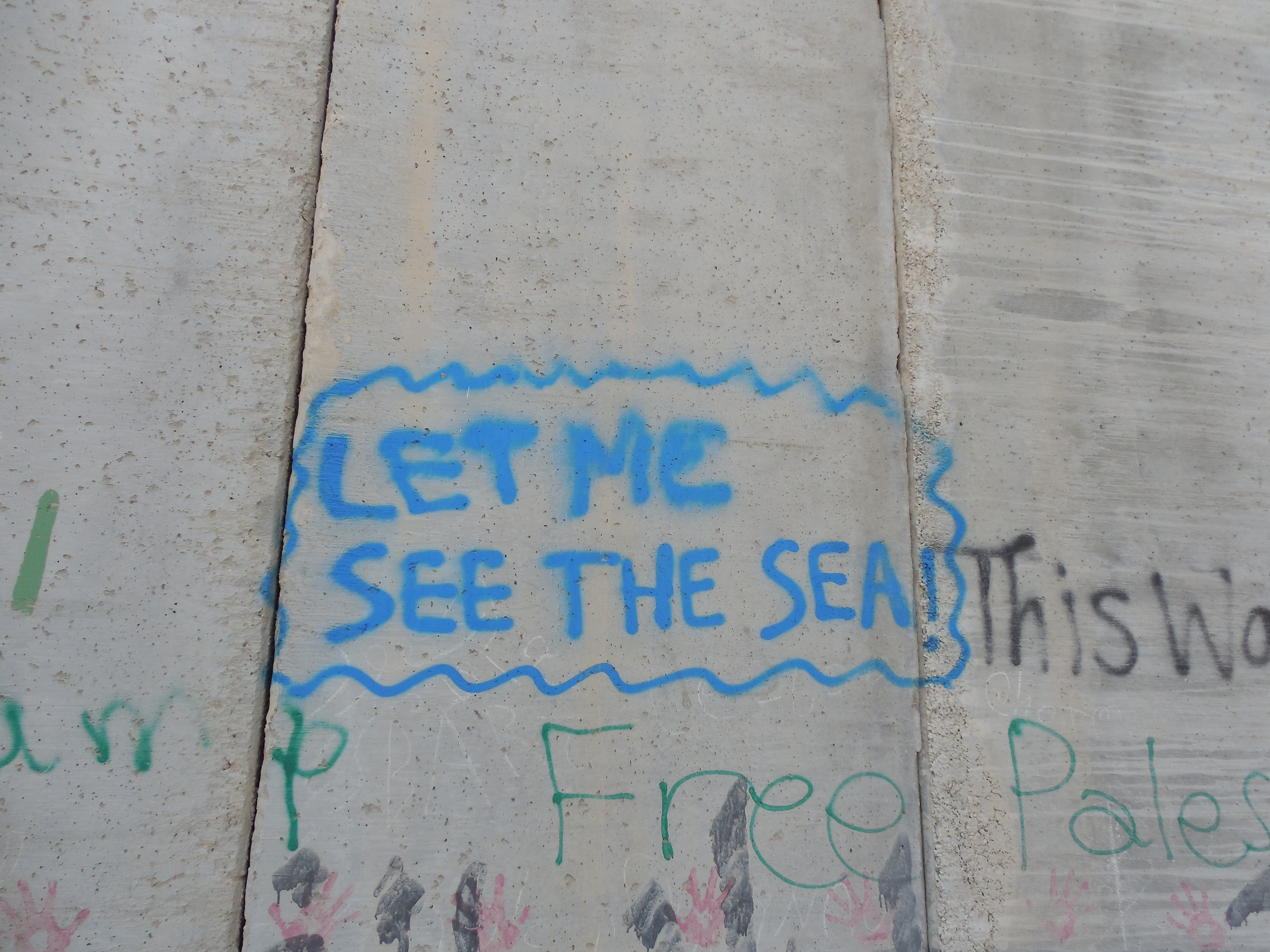
thesea

Suppose you decided to teach Plato’s Republic, and “simply” wanted to “cover the arguments,” whether in the sense of merely summarizing them, or summarizing them, laying them out in deductive fashion, and testing each of them sequentially for validity and soundness. I suppose you could do that, and at some level, anyone would have to do a bit of it. But you couldn’t leave things there. The “material” you’d ideally want to cover is not reducible to a summary of the arguments in “the” text, or even reducible to a summary plus a sequential set of tests of the soundness of each argument (assuming that that’s even possible, and waiving questions about how to individuate the arguments in the text). At a minimum, what you’d need in addition to all of that is analysis of the contested concepts of each of the premises of every major argument–and not just a straight “conceptual analysis” as analytic philosophers often use that phrase, but a sort of dialectical and rhetorical analysis that takes stock of what those concepts mean to your students both cognitively and emotionally.

Putting things slightly differently: if you want the material to sink in—in any sense of “sink in”—you have to ask how it connects with the beliefs, desires, habits, practices, preoccupations, etc. (call it the ‘context’) that the students bring to the text. How do they conceptualize “justice,” “friendship,” “harm,” “advantage,” “promises,” “debt,” and so on? If you ignore that personal context, the class will backfire: the text becomes a series of alien and alienating abstractions without connection to the students’ experiences. That’s what makes teaching both challenging and enjoyable, and somewhat analogous to psychotherapy. Whether you’re teaching philosophy or engaging in therapy, you can’t waltz in, hit your “audience” with a Power Point presentation and waltz out. You have to interact with themgoing back and forth between the text and the context they bring to it, until each thing manages actively to illuminate the other. (By the way, this is why online teaching will never become a literal substitute for on-the-ground teaching in philosophy.)
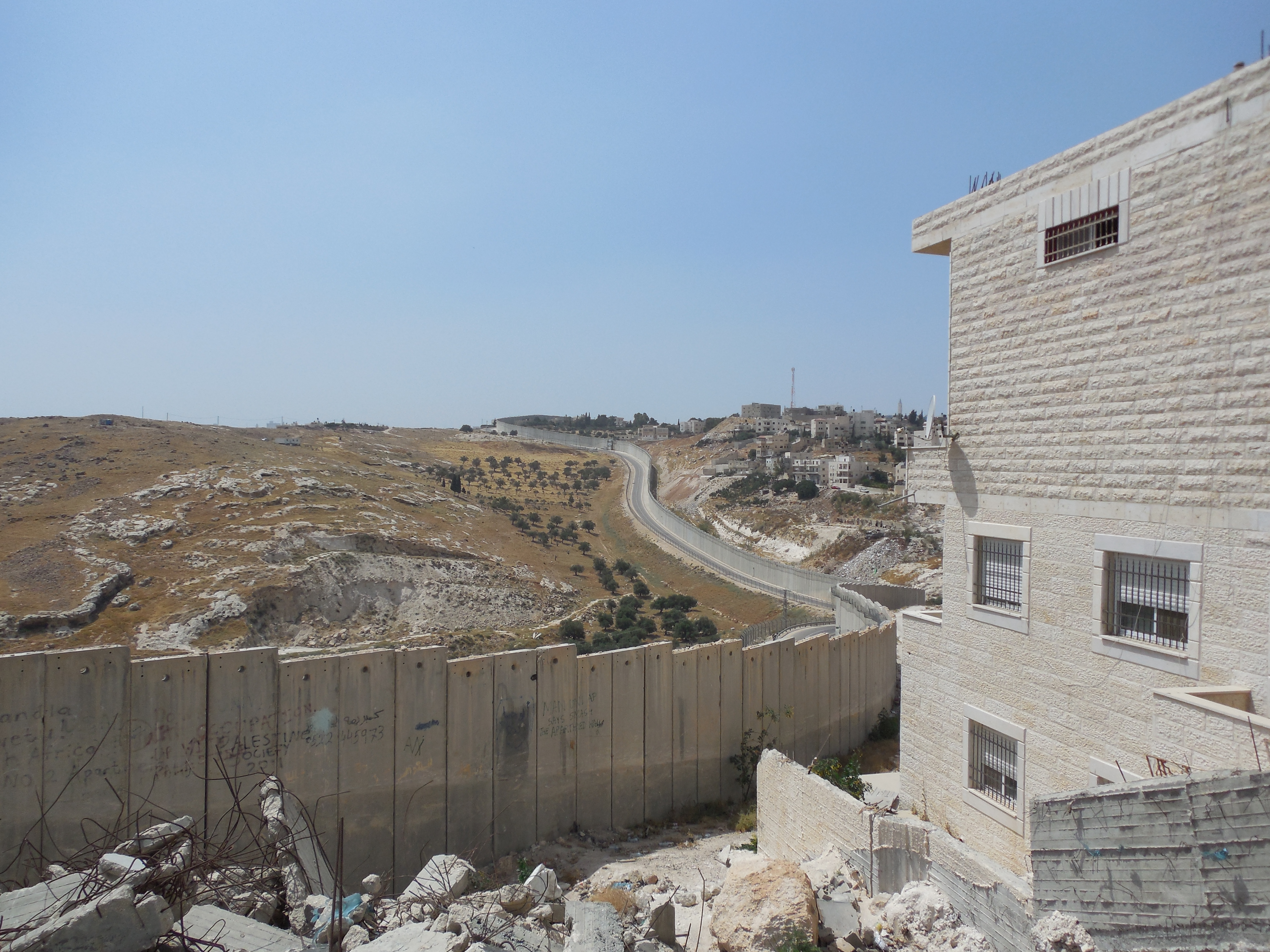
wall1

The issue becomes particularly acute when you’re teaching a dialogue like the Republic: dialogues are stories, and readers either relate or don’t relate to a story.There is no successful way to teach “the arguments” of Plato’s Republic while ignoring how students relate to Socrates, Glaucon, Polemarchus, and Thrasymachus as characters. You might as well read The Brothers Karamazov “for the arguments” while ignoring the brothers.

In fact, the dialogue form is what makes Plato’s Republic such a hard but great text to teach. What would make Aristotle, Machiavelli, Hobbes, Locke, and Mill easier to teach would be some way of presenting them in dialogue form. But that, of course, is what a class on such texts has to become. What Socrates says to those characters in the Republic is informed by his knowledge of their personalities, and the same thing has to be true of a successful instructor teaching Aristotle and the rest. Absurd and presumptuous as it may sound, once you teach Plato’s Republic, and move on to the rest of the class, you the instructor have to play Socrates to the Glaucons, Adeimantuses, Polemarchuses, and Thrasymachuses in your classroom–but on Aristotelian, Machiavellian, Hobbesian (etc.) material. The classroom has to become an extended dialogue.

wall2

As an American, 99.99% of the teaching I’ve ever done has been done in the United States. Even there, regional and institutional differences have always necessitated adjustments to my pedagogical methods. I saw this with blinding clarity one semester when I happened simultaneously to be adjuncting at Princeton University, The College of New Jersey, and Mercer County Community College—three institutions within a few miles of each other, but that may as well have been located in different galaxies. Princeton is an Ivy League university, TCNJ is a small state college, and MCCC is a two-year county college devoted to remedial work.

I’ll admit that I had a few Stand-and-Deliver-type fantasies about teaching my MCCC students by exactly the same standards and methods as my Princeton students, but mercifully, those plans didn’t get past the fantasy stage. The differences between Princeton and MCCC students, learning philosophy within five miles of one another on different sides of Route 1, are a blog post in themselves, but suffice it to say that they demanded drastically different pedagogical treatment. I didn’t happen to teach the same class at both places, but if I had, they’d have to be taught in radically different sorts of ways. And what applies to two or three different schools in Mercer County a fortiori applies to a school thousands of miles away in the Jerusalem Governorate. It makes no sense to teach Palestinians philosophy the way I teach it to Americans.
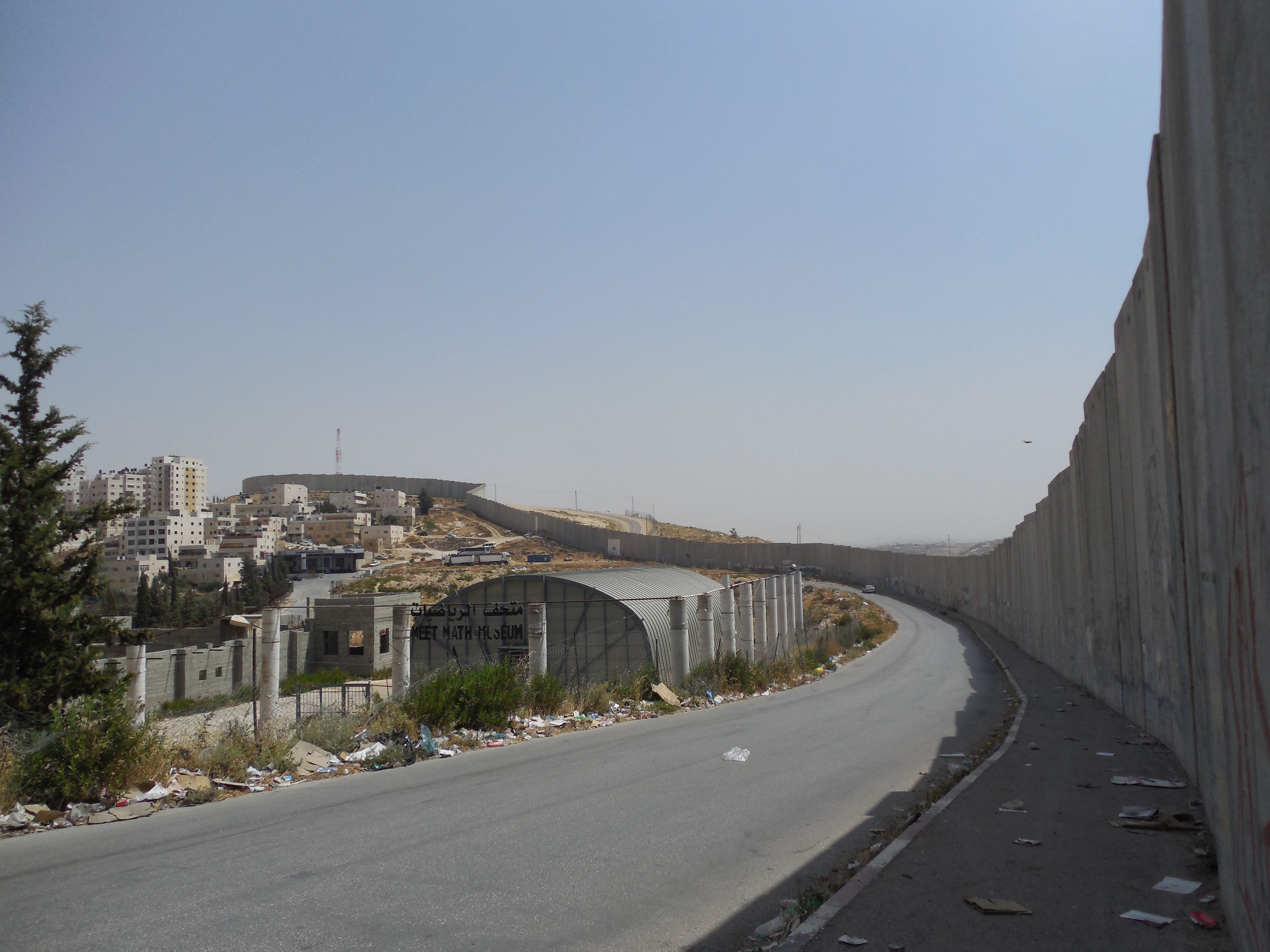
wall4

In general, the American students I’ve taught—twenty-one years’ worth of students at seven institutions in three states—are politically disengaged. They’re preoccupied with personal concerns and personal pleasures that push political concerns to the side: clubbing, drinking, drugs, sex, sports, shopping, and parties on the frivolous end; friends, family, romantic relationships, career choices, money, logistical worries (e.g., transportation, child care, etc.), and medical-mental health issues at the more serious end. Military veterans aside, the political world doesn’t interest them, and to put the point somewhat uncharitably, they rarely have anything of interest to say about it, either. The political issues that concern them are hyperlocal issues of direct consequence to them, e.g., the rules and regulations governing student loans. (It seems to me characteristically New Jersey-esque to think that defaulting on one’s college loans is a significant form of political protest. But I’ve complained about this attitude too recently to spend time on it now.)

The sort of issue that consistently makes its way to the front page of The New York Times strikes most of my students as distant, abstract, and ultimately meaningless. Take the headlines above the fold in today’s edition of the Times (meaning the June 9 edition): “Justices Reject Passport Law on Jerusalem”; “A Raid on ISIS Yields a Trove of Intelligence”; “Evangelicals Open Door to Debate on Gay Rights”; “A Rare Gambit Seeking Justice for a Shot Boy.” I can just hear my students asking:  What does any of that have to do with my life?

It’s tempting to respond that while the details of these stories aren’t directly related to their lives, surely justice, rights, intelligence and passports/constitutionalism are relevant. Isn’t that enough to get students engaged with politics? The answer is “no.” The response presupposes a concern with principle and a degree of empathy for others that isn’t always there (=usually isn’t there), and can’t easily be taught, if it can be taught at all, at least in a classroom (cf. Plato’s Meno).

In my experience, not even crime and race relations are an exception to the general rule of political disengagement, at least not in suburban New Jersey. The events of the last year–Ferguson, Cleveland, etc.–haven’t really changed anything. After all, race relations on campus (my campus) are generally good, and a black guy is president: that tends to be good enough to preserve the equilibrium of complacency. As far as my students are concerned, Ferguson, Cleveland, and even Staten Island may as well be foreign countries. So the pedagogical task in the American context is to find a way to make the political personal–to make it matter to students in a personal way.

Here in Palestine, the situation is just the reverse: the political is already personal; the (merely) personal is relatively unimportant. More specifically, for the Palestinian students I’ve met, occupation is their preoccupation. Like anyone, they may well be preoccupied, more remotely, with personal concerns and pleasures (hookahs, cigarettes, coffee, hanging out in cafes), but the burning issue that concerns them is life under Israeli military occupation. What they need (as I see it) is a means of standing back and taking a broader perspective on things than the daily grinding outrage they feel about the situation they’re in. That said, one can’t expect them simply to ditch the outrage and theorize in the abstract.

There’s a balance to be struck here, and it’s a hard balance to find. From experience, I’ve decided this time to push things in the politically engaged direction after having made the mistake last time I was here of pitching things in an overly abstract way. When I lectured here two years ago on Locke, I’d intended to give a relatively uncontroversial overview of themes in Locke’s political philosophy, along with a sketch of Locke’s relevance, at a very high level of abstraction, to the Israel-Palestine dispute. That first lecture (of three) didn’t go well, and its failure was a valuable learning experience for me. (I learned quickly enough to make the second and third lectures more successful, but they were on different topics anyway.) I still don’t think I said anything false, but much of what I said was irrelevant to the audience I was facing. And it’s not that I knew nothing about my audience’s concerns; I knew that they were living under a military occupation and resented it. But I had misjudged the degree and intensity of that resentment. I also knew less than I thought I did about the occupation itself.

Psychologically, I came to realize, my Palestinian audience simply could not focus on Locke qua Locke, abstracting entirely from Locke’s relevance to the occupation. My Locke lecture was, for them, like an outlandish two-hour thought-experiment offered for reflection to people in prison. “You keep talking about rights,” I remember one guy saying. “But we don’t have any of these rights.” And not having them became an insuperable barrier to hearing what I had to say about Locke. It wasn’t, strictly speaking, an objection to anything I had said. I hadn’t after all said that they had the rights Locke says we have. The objection was that in jumping straight into Lockean theory, I had made demands of them that flouted their experience.
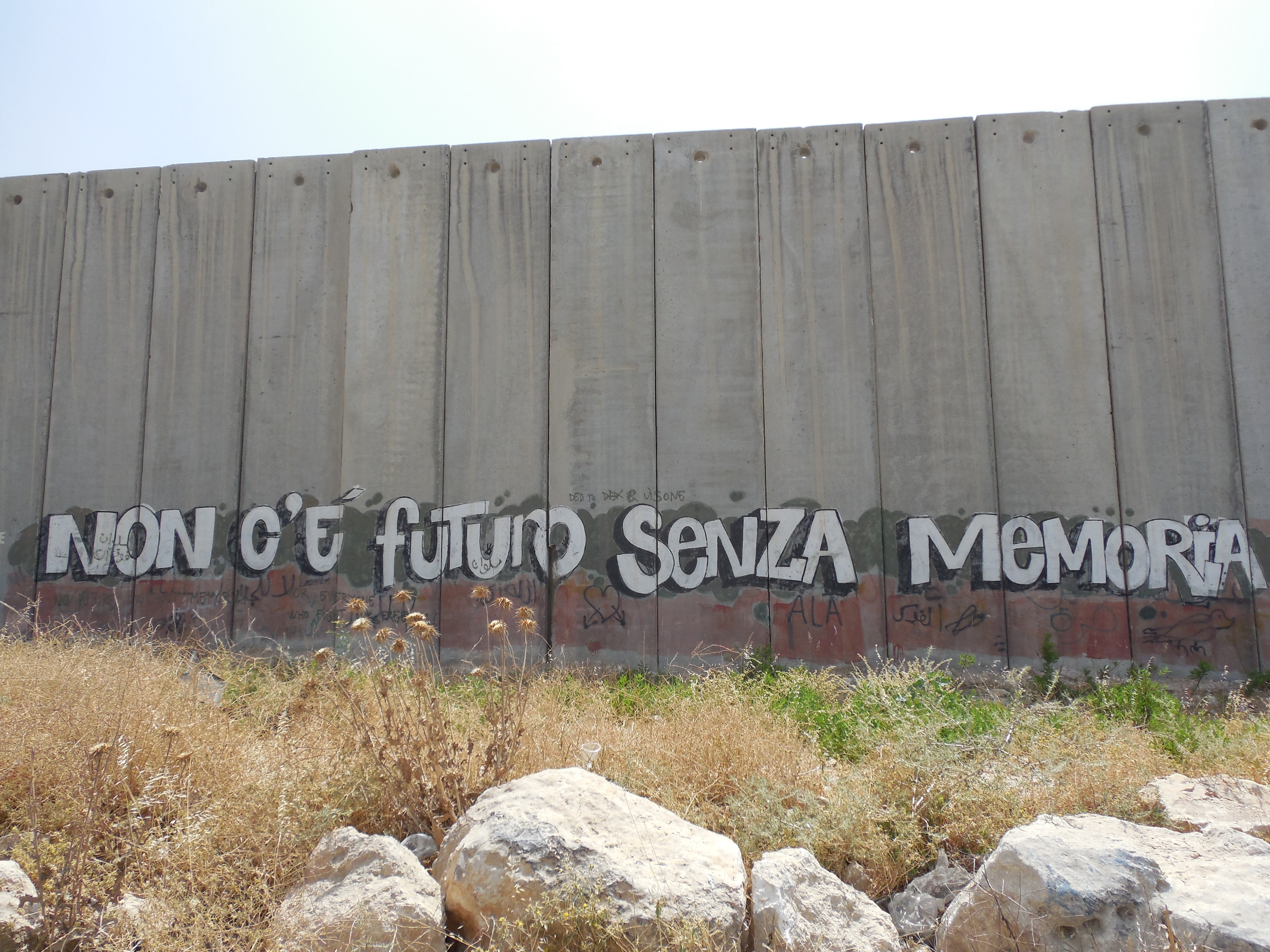
wall5

Pedagogically, one has to make a choice here that one doesn’t, I think, have to make back home. If I’m going to get students here to open up psychological space for theorizing, I can either motivate that theorizing as a good thing in general, or as a good thing as a form of resistance to the occupation. And I’ve decided to go with the latter. I don’t see the point in pretending that I’m neutral on that subject, or even that the purpose of the class is neutral with respect to it. I’m not neutral, and neither is the class. The occupation is unjust. The class is a form of resistance to it. Enough divides me from these students as it is, even in the context of that agreement, to justify using the agreement to forge a common bond, and letting it promote classroom rapport. I’m teaching here to help them think their way out of the occupation, insofar as that can be done.

I’m teaching Plato tomorrow, but I think the point can more easily be conveyed by thinking about Locke. In teaching Locke here last time, I realized that one can’t teach Locke in Palestine by putting the text of the Second Treatise at the forefront and keeping the occupation on the backburner. One has to bring Locke to the occupation, and vice versa. To give a sense of what I mean, imagine a hypothetical class or set of classes on the first five chapters of Locke’s Second Treatise, as follows.

The class begins with Locke’s account and definition of “political power” in ST I.3. The definition seems straightforward enough; I don’t recall any of my teachers or interlocutors spending much time on it. But the details of the definition have a certain subtle significance in a Palestinian context, as applied to the Oslo definitions of Areas A, B, and C in the West Bank. Who (it’s worth asking) has Lockean “political power” in each place under that arrangement–Israel or the Palestinian Authority? That way of asking the question turns out to be both illuminating and disorienting. On a conventional view, the Palestinians rule Area A, there’s joint rule in Area B, and the Israelis rule Area C.* But that’s not the question. The question is: Who has Lockean political power over the West Bank? And the answer is that the Israelis do. That’s why the tripartite division of the West Bank doesn’t change the fact that the West Bank remains as occupied as it ever was: it remains occupied by Israeli political power in the specifically Lockean sense, not the conventional one, something worth bearing in mind when one faces someone who insists that the West Bank is “no longer occupied.”

Move to book II of the ST, which discusses Locke’s conception of the State of Nature. Most of PoT’s readers can probably recite some version of an undergraduate lecture on this topic: “A Lockean State of Nature is a hypothetical state of affairs in which persons exist with rights of freedom and equality, but without a common political power.” The sticking point is “hypothetical.” Yes, that’s what the words say, but what is a State of Nature really like? Nozick is somewhat helpful in clarifying this a bit:

To understand precisely what civil government remedies, we must do more than repeat Locke’s list of the inconveniencies of the state of nature. We also must consider what arrangements might be made within a state of nature to deal with these inconveniences…Only after the full resources of the state of nature are brought into play…will we be in a position to see how serious are the inconveniences that yet remain to be remedied by the state, and to estimate whether the remedy is worse than the disease. (Anarchy, State, and Utopia, pp. 10-11).

At this point, however, Nozick offers a very abstract (some would say implausible, fantastic, and rationalistic) account of protective associations, dominant protective associations, invisible hand explanations, and the task of backing into the state. It’s intended as a just-so story, but it sort of seems like a fairy story.

But there’s another way, a more concrete way, to see how serious are the inconveniences of life without a state. Go to a place that doesn’t have a state and take a look around. For instance, go to Area B in the West Bank and ask: is Area B a Lockean State of Nature? What inconveniences arise from the absence of a state here? What improvements, if any, would be made if a state could be brought into existence? What kind of state would improve things, and how? Your answers may not generalize to every State of Nature, but they may tell you something that you won’t get by reflecting from your armchair (a la Nozick) on Proudhon, Schelling, Rothbard, and Boulding. (Incidentally, go back and re-read p. 4 of Anarchy on this very under-remarked issue–how exactly do we conceptualize the State of Nature–and the question turns out to be both central to Nozick’s conception of political philosophy, and totally unresolved. But that’s a topic for a different post.)

Move now to book III of the Second Treatise, on the State of War. It might be valuable to apply a similar approach to this topic as to the last one. We can all read Locke’s definition of the State of War without any trouble, but how does it apply to particular cases? For instance: is the Palestinian Authority in a (Lockean) State of War vis-à-vis Hamas and/or Israel right now? Can the Palestinians be in a State of War vis-à-vis the Israelis if Abu Mazen (Mahmoud Abbas) has sworn off “armed struggle” as a means of dealing with the occupation? Can a State of War obtain between two parties, like the PA and Hamas, that have formed an alliance with one another, albeit in a state of nature? Questions like that give Locke a poignancy in the Palestinian context he wouldn’t otherwise have had.

Book IV of the Second Treatise discusses slavery: some sensitive topics come up here. On Locke’s view, slavery is “the State of War continued, between a lawful conqueror and a captive” (ST IV.24.16ff). Does that mean that the Israeli occupation is a form of slavery in Locke’s sense? Arguably, it does. Though Locke is famous for the view that suicide is morally impermissible (since we’re all God’s property, ST II.6.19), he leaves the door open for suicide under slavery (ST, II.23.13) while “resisting the will of [one’s] master.” But if you can commit suicide under slavery as a form of resistance to your master, can you kill your master while you’re at it? If the occupation turns out to be a form of Lockean slavery, that gives Locke a closer kinship to Hamas and Islamic Jihad than anyone might have expected, a thought that seems to have escaped most academic interpreters of Locke I’ve read.

Finally, consider Locke on property, with an explicit view to the implications of his views on property disputes in Israel and the West Bank (ST V). Here’s a short laundry list of questions that occur within the first few paragraphs of Locke’s discussion:

  • If, as Locke tells us, we’re to rely on reason and revelation for our account of property (ST V.25.5), does that mean that Islamic sharia is a legitimate source of norms regarding property rights? Sectarian prejudices aside, why wouldn’t it be?
  • While we’re on the topic: Is Locke pro-Palestinian or pro-Zionist or neither? Is Locke’s labor-based conception of property an implicit defense of the Palestinians’ natural right to stay on the land in defiance of legal processes that evict them, or is just a set of anachronistic apologetics for Labor Zionism?
  • According to Locke, initial appropriation of land proscribes wasting it, demands its improvement, and requires leaving ‘enough and as good’ for others (ST V.31-33). The model Locke seems to have in mind is agriculture—even more specifically, the English enclosure movement. But how does that relate, if at all, to nomadic Arab Bedouins in Israel/Palestine?
  • According to Locke, God gave the use of the land to “the industrious and rational” (ST V.34.5). Do Bedouins qualify as “industrious and rational” in the relevant sense? Or is Israel right to think that they’re neither: that nomadism wastes land, environmentally degrades it, and uses too much space, so that there’s a justification for expropriating Bedouins by force and putting them in settled and civilized housing projects?

That’s just a hypothetical set of classes on Locke. I doubt even the most proficient instructor could do more than scratch the surface of the issues I’ve mentioned in an actual class. But what’s true of Locke ends up being true across the board. To teach Plato, Aristotle, Machiavelli (etc.) in Palestine, you have to ‘Palestinianize’ those texts. I don’t mean, of course, that you read them for things that aren’t in them. I mean that you have read them for what’s in them in relation to the context that surrounds you, where the context picks out features of the text or approaches to the text you might not otherwise have focused on.

The irony is that doing so makes these texts both easier and more difficult to teach at the same time, but in different respects. Easier because it gives them a concentrated focus that they would otherwise lack. More difficult because one rarely reads them in this way back home, and the task of integrating theory and practice is a difficult one where an outsider like me is forced to do a fair share of groping in the dark.

I told my students the other day that life under occupation gave them an advantage that few people have, and that as students of political philosophy, they ought to be grateful for it.

That got their attention. One of them asked me (with all due respect) what the hell I was talking about. I told her (them) that the advantage in question was epistemic: few people in the world live under military occupation, from which it follows that few people know what it’s like to live under one. Arguably, that goes for most philosophers, including most (though not all of) the philosophers we’re about to read in the course. Plato, Aristotle, Hobbes, and Mill didn’t (as far as I know) live under occupation-like conditions, though arguably, Machiavelli, Locke, and Marx did.

Since (I suggested) Palestinians can’t wish the occupation away, they might as well capitalize on whatever features of it can be put to their advantage. Political philosophy gives its devotees a perspective on their immediate political situation that facilitates a comprehension that they might not otherwise have had. But it works the other way around as well: ‘naïve’ readers may well have something to teach the giants of philosophy what they would never have thought of on their own.

That, at any rate, is my bet. I’m curious to see if I win it.

*Thanks to Kate Herrick for spotting a typo in the original version of this sentence.

Thinking about BDS (1): Infantilization, ‘Safe Spaces’, and Threats to Discourse

An angry discussion has broken out about the self-infantilizing character of American university life (and beyond). The basic argument is that contemporary American universities have, in the name of an infantilizing form of pseudo-therapeutic psychobabble, come to stigmatize the very idea of discourse or debate that hurts anyone’s feelings. The criticism comes mostly from the political-academic right (in some sense, however vague) and targets the political-academic left (in the same vague sense). Here’s a piece on the subject in Intercollegiate Review. Here’s an overview from Inside Higher Ed from last year, and a much-discussed one from The New York Times this past March. Here’s a critical commentary from Salon inspired by the Times article. Here’s a more aggressive take on the same from Reason magazine. Here’s the take at the Breitbart site. Here’s the most recent take from BHL.

I basically agree with “the right” on this one, at least in a qualified sort of way. I agree that discourse at American universities is, across the board, irrationally constrained by pseudo-therapeutic rather than truth- or justice-guided norms. We care far too much about how people will feel than how they think, or how they should be thinking. We also care too much about how people will feel than we do about how good our arguments are, how much evidence supports them, or for that matter how rhetorically persuasive they would be to a person of psychologically normal sensibilities.

I don’t mean to suggest that we should be insensitive to people’s feelings or special sensitivities, or to go out of our way to offend them. There’s a balance to be struck between candor and tact. But the balance cannot involve the outright sacrifice of alethic to therapeutic concerns: “sensitivity” can’t dictate that nothing be said out loud that might be construed as insensitive or “triggering” for some person or audience.

I reached the absolute limits of my patience with the “sensitivity” phenomenon when I was obliged last year (along with the rest of the faculty and staff at my institution) to take “sensitivity training” designed to ensure compliance with federal anti-discrimination laws, as follows:

As a Catholic/Franciscan institution of higher education, Felician College unconditionally rejects all forms of discrimination and acknowledges our obligation to safeguard and enhance the dignity of every member of our College community. As part of our commitment  to create and to maintain an environment free of discrimination, intimidation, humiliation and harassment of any kind, and in compliance with both federal and state recommendations, all members of the Felician College faculty and staff are required to complete training on identifying and preventing harassment and discrimination in the workplace. …

It is a legal requirement that we provide harassment training annually.  Since it is very difficult to get everyone together for a lecture format, we have contracted with  Workplace Answers to provide online training for Felician College.  The basic module for faculty/staff should take no more than 40 minutes, the supervisory module (if required) about 20 minutes.  The FSI Corporate Compliance module is self-paced.

Feel free , incidentally, to take a look at the website of Workplace Answers to try to figure out what they’re all about. At best I think you’ll learn that online harassment training is a big and lucrative business involving the marketing of a lot of vacuous cliches.

It sounds innocuous, doesn’t it? It isn’t. If you actually endure the training, you’ll discover that the entire “compliance module” is a systematic assault on the norms of inquiry, discourse, and academic life. Here’s an actual example taken verbatim from the module: it is (we are told) unlawful harassment for a professor to hang a poster inside his office of the word “War” with a red slash through it, because the extremist anti-war message involved could be construed as “threatening” to, “discriminatory” against, or “harassing” of military veterans. (I can’t reproduce the actual graphic, because it’s protected by copyright.) The tacit reasoning seems to be: opposition to a political policy can be construed as “threatening” to those who (presumptively and stereotypically) may be thought to support the policy (e.g., veterans can be presumed to support war); meanwhile, passive acquiescence in the status quo, however unjust, is legally obligatory and “professionally appropriate” behavior.

One implication here seems to be that while combat veterans can handle combat on the battlefield, they cannot be expected to handle ideas like war in a university. Presumably, all returning military veterans suffer from a form of PTSD so intense that they will collapse into a dysfunctional heap at the mere mention of the word “war”–from which it follows that the word must never be spoken in their presence (except, I suppose, to praise it).* A second and more general implication seems to be that  “professionalism” in the “corporate” (=academic) context requires us to avoid discussing anything that might offend anyone’s sensitivities, even if doing so is central to the academic enterprise.

As I said before, most of the criticism of “academic infantilization” has targeted the left from the right, but one group, essentially located on the right, seems to me to have taken the infantilization of academic discourse to a generally undiscussed extreme. The group in question is the anti-BDS movement (or more pedantically, the anti-BDS counter-movement, since it opposes BDS, which precedes it).** In saying this, I don’t mean to be pronouncing on the correctness or incorrectness of BDS as a strategy for dealing with the Israeli occupation. That’s a complicated topic on which I reserve judgment, and which I’d like to think through here over the next few months. What’s clear, however, is that whether BDS is right or wrong–even if it’s entirely wrong–its critics and the movement they represent are a threat to the academy and to political discourse as such.

Two tactics are essential to the anti-BDS repertoire and particularly subversive of rational discourse: (1) gratuitous recourse to the race card, in the form of reflexive accusations of anti-Semitism as a means of discouraging debate; (2) resort to the (literal) use of force through “lawfare” in order to put BDS out of commission by force of law, and thereby put an end to debate that way. Many groups (especially ethno-religious groups) employ one or the other or both of these tactics, but few have done a “better” job of combining them in a single integrated assault on the norms of discourse. In doing so, the anti-BDS movement has, on American university campuses, become the discursive equivalent of the “price tag” movement in Israel: they’re among the vandals of our intellectual life. I find it instructive that right-wing critics of infantilized/trigger-warning discourse have almost nothing to say about this brazenly obvious example of the phenomenon they deplore. But they don’t.

One task on my agenda here in Palestine is to clarify my own views on BDS: I’ve been asking everyone I meet here in Palestine (and will ask anyone I meet in Israel) what they think about BDS. Personally, I’m in favor of divestment on the Princeton model, agnostic about sanctions, skeptical about boycotts, and generally opposed to academic boycotts. I realize that that sentence by itself will cost me friendships across the entire political spectrum. But that’s where I stand, at least for now.

In favor of BDS: I worry about anti-Semitism and about double standards within BDS, but I’m also uncompromisingly opposed to the Israeli occupation/settlement enterprise, and frankly have lost patience with views of a sort that permit opposition to the occupation but proscribe doing anything about it. That’s led to nothing but five decades of occupation, subsidized and supported by the American taxpayer. In a sense, it’s led to something worse: our acquiescence in the idea that it’s our fate or role to support the morally insupportable by insisting that it’s somehow a moral imperative to do so. We’ve become mere means to the end of the Israelis’ making the Palestinians mere means to their ends. And that has to end. BDS looks like the only viable option for hastening the end, or at least doing what’s in our power to hasten the end. So in principle, sign me up.

Skepticism about B and S: Though divestment seems relatively uncontroversial to me, non-targeted boycotts and sanctions potentially seem indiscriminate in their punitive features, and counter-productive in the sense of attacking the very parts of the Israeli public most sympathetic to Palestinian rights. So I can’t sign on the dotted line to the whole package, but am not willing to dismiss BDS out of hand, either. (I can, however, think of both American and Israeli companies and institutions that deserve to be boycotted.)

That said, one can’t even begin to think clearly about any of that in the atmosphere of hysterics generated by the anti-BDS movement. Hence the need for an initial blog-based “ground clearing” operation. In the next part of this series, I’ll talk a bit about the anti-Semitic “race card,” and its effects on discourse about Israel. In a third part, I’ll talk about the attempt to deal with BDS through “lawfare.” I don’t mean either discussion to be comprehensive; it’s a complicated topic, and I’m sure I’ll be returning to it periodically after this initial series is over (uncharitable interpretation: “Khawaja has an unhealthy obsession with that topic”). So there will be indefinitely many parts to this series as a whole.

More soon.

 *I teach at a “veteran friendly” institution, and have taught and taken classes with former combat veterans for years. They certainly do have special needs and sensitivities, but they also tend to be among the most mature and engaged students in a given classroom. I find Workplace Answers’s depiction of them frankly stupid, and I suspect that the veterans I know would, too.

**For vehicles of the movement, see The AMCHA Initiative, the BDS section of the Anti-Defamation League’s website, BDS Cookbook, Buycott Israel, Divest This, Divestment Watch, Engage, Israel Action Network, Israel On Campus Coalition, The Israel Project, and Scholars for Peace in the Middle East. See also Cary Nelson and Gabriel Noah Brahm’s The Case Against Academic Boycotts of Israel (2015). The title of the Nelson-Brahm book is a classic case of falsity in advertising: despite the title, the book is a wholesale critique of BDS as such, not just of academic boycotts. Despite the protests of a single author (Michael Berube), seven authors in the book go out of their way to argue that the BDS movement as a whole is anti-Semitic–a view clearly shared by the editors.

Postcards from Abu Dis (1)*

So here I am, blogging “live” from Abu Dis. I’ve settled in a bit, the jet lag is starting to wear off, and I’m getting ready for my first class tomorrow, which I’m hoping will be a case of found rather than lost in translation: I’m speaking in English, and a translator is translating into Arabic for the students, and then back into English for me (and so on). We’re working on acquiring and distributing serviceable Arabic translations of Plato’s Republic, Aristotle’s Politics, Machiavelli’s Prince, Hobbes’s Leviathan, Locke’s Second Treatise, Mill’s “On Liberty,” Marx’s Communist Manifesto, and just maybe, Marx’s “British Rule in India.” With the possible exception of the very last reading, I’m pretty confident that translations are out there and can be found–though I suppose that  you’d want more than a vote of “pretty confident” from a professor whose class starts tomorrow morning.

That said, I do wish I had paid more attention in Arabic 101 (as well as Arabic 102 and Arabic 103) in college, but I clearly didn’t learn enough to understand or carry on an ordinary conversation, much less teach a political philosophy seminar. Let that be a lesson for all students everywhere who ask that ridiculous question, “But when will I ever use this stuff that I’m learning?” How about: “What will you do when the unforeseeable occasion arises that demands knowledge you were supposed to have gotten but didn’t?” You’ll plead ignorance, that’s what you’ll do. And you’ll look and feel like a blithering idiot. How’s that for an answer?

How this translation thing will work is anybody’s guess, but I’m game, and I hope the students are, too. I met three of my students the other day–we exchanged enthusiastic smiles at one another for lack of being able to engage in mutually comprehensible discourse–and I’m told that I’ll have a total of between 12 and 15 students in the class. (A colleague at Felician tells me that they’re running summer classes with enrollments as low as 5. Ha!) We’re scheduled for a nice seminar room with a long rectangular table. A few cups of the Arabic coffee I’ve been having lately, and I think I’ll be ready for anything.

I don’t mean to be minimizing the hardships of life under military occupation–at least for people without an American passport like mine–but you could hardly have dreamt up better conditions for philosophical contemplation than the ones I’m currently in. I’m living in a spare but comfortable dorm room on the eighth floor of a four-tower housing complex. I’m the only human occupant of any of the four buildings: it’s like living in a non-scary version of “The Shining” (if that makes any sense). The other occupants include an unending series of pigeons whom the building manager allows to roost where they will–because “they’re guests, too.” Those bloodthirsty Palestinians!

The weather has been clear everyday, with temperatures hovering in the upper 70s and low 80s during the day, and upper 60s at night. A Mediterranean breeze riffles through my open window, and my ears are caressed by the twittering of birds, and the melody of children at play (never thought you’d see me write that, did you). I’ve had nowhere to go today, and apart from a quick trip into town, nothing to do but read, write, and look idly out of my eighth-floor window. It’s like a single person’s version of that old Belinda Carlisle song (if that makes any sense).

I’ve had a whirlwind few days. Last night, Rawan Dajani, one of the many hard-working people who work at AQU’s PR office, took me–of all places–to a reception at the U.S. Consulate in West Jerusalem, where I hobnobbed with the movers and shakers of Jerusalem. The food was good (grape leaves, sushi, hors d’ouevres, Jerusalem-style pizza, Palestinian pastries), but the music was even better (a jazz group from Nazareth), and the company was better than either. We got there too late to hear the departing Consul General’s speech–all I heard was the word “terrorists” as I went through security–but here it is.

After a few unsuccessful attempts, I even managed to have a conversation with the Consul General, Michael Ratney. Mr. Ratney and I discussed the complexities of the political situation. It was a productive conversation, and we agreed to re-convene in the near future for further talks. In a highly positive development, he told me–and here I quote directly–that he was “very pleased to meet” me. So I’m happy to report that progress is being made on all fronts, and look forward to continuing conversations with him on matters of mutual concern.

After the reception, Rawan and I visited the controversial Mamilla Cemetary, the opulent Mamilla Mall, and the hard-to-characterize Festival of Light in the Old City of Jerusalem, but I’ll have to save serious discussion of all of that for another post.

Well, except for one thing: I gather from a report on CBS News that there was a protest and some police action in response to the Festival a few days ago, but the only disturbance I managed to encounter that night was sleep disturbance due to jet lag. Incidentally, I find the line of questioning by the interviewer in the CBS video I just linked to rather silly: “Things have been calm in Jerusalem ‘lately,’ so was there anything that precipitated these protests?” The assumption seems to be that protesters are stimulus-response machines who won’t protest unless some proximate event precipitates it. But tensions have been “simmering” here for years, and the underlying problems have gone unresolved, so there’s nothing surprising about protest in East Jerusalem when it does arise.

Anyway, as I said, I’ll save discussion of the politics (and in the case of the Festival, the aesthetics) for later posts. For now, I’ll just say that Rawan and I were there for about an hour last night; it was packed with throngs of Israelis, Arabs, and foreign tourists, but I perceived no tension at all.

So what’s it like here in the West Bank?  I’ve put a photo of my immediate surroundings in the header photos (and I’ll putting more in as I take some), so you’ll see that come round the photo carousel every now and then. I’ve already told you about the weather, and I haven’t had enough meals to tell you about the food, so about sound? What does it sound like in the West Bank?
Here, from a few days’ experience, is what the average evening sounds like in Abu Dis:
7:30 pm: preliminary call to maghrib (evening) prayer followed by call to prayer followed by prayer (VERY LOUD)
8:30 pm: celebratory machine gun fire and fireworks** followed by loud amplified music (yes, every night)
9-10 pm: dog fights and miscellaneous dog howling that echoes throughout the valley
10 pm: night time (isha) call to prayer
11 pm: eerie, reverential silence…until….
12 midnight: roosters crow midnight for half an hour
1 am: cat fights
2 am: dead silence punctuated by random horn blowing and trucks in low gear straining to get up the hill
3 am: cats, roosters, pigeons, donkeys, and occasional dog engage in high volume interspecies call-and-response communication, the cats being the loudest and sounding weirdly human
4 am: morning call to prayer (fajr)
5 am: in direct contradiction of all rooster stereotypes, roosters fail to crow for sunrise
9 am: someone operates a pneumatic drill for an hour
The strangest thing is that I actually slept rather well, and feel totally refreshed.
It’s a rather paradoxical place, this Palestine. More soon.
*I was originally going to call this series “Live from Abu Dis,” but dropped it for two reasons: (a) The blog currently has more Palestinian than American readers, and I’m not sure Palestinian readers would understand the (not all-that-funny) allusion to “Saturday Night Live”; (b) every blog post from anywhere is live, so “Live from Abu Dis” ultimately makes no sense. I almost called it “Postposts from Abu Dis,” but I think you can figure out why I didn’t. So “Postcards” it is. Wish you were here!
**I had originally written “celebratory machine gun fire,” but I discovered last night that they were fireworks. Less dramatic, I realize (June 14).
August 3, 2015: I later discovered that machine gun fire was interspersed with the fireworks (and vice versa).

Beyond Chutzpah: Chase, Israel, Palestine, and OFAC

Here’s an actual conversation I had about two hours ago at my local Chase branch office.

Chase Banker: Hi, can I help you?

Irfan: Yes, I’m going abroad for two months, so I wanted to alert you to the fact that my debit and credit card transactions will be taking place in foreign countries starting June 1.

Chase: OK, where are you going, and for how long?

Irfan: Well, first to Italy, then to Israel, along with the West Bank and possibly Gaza. For the months of June and July.

Chase (sharply): Those are all the same country. [I take it she meant Israel, the West Bank and Gaza are the same country, not that Italy is part of Israel or vice versa.]

Irfan: OK.

Chase (checking computer screen): Well, Italy is fine, but unfortunately, Israel is on the US government’s OFAC list, and we can’t guarantee the security of your transactions there. [“OFAC” stands for the Office of Foreign Assets Control of the U.S. Department of Treasury. The OFAC list is the list of countries sanctioned by the US Government. Israel is not specifically on it.]

Irfan: So my debit card won’t work in Israel?

Chase: It may or may not work. We just can’t guarantee it. Being on the OFAC list means that it’s been determined that financial transactions in that country are at high risk for fraud.

Irfan: Does it matter whether I use the card in Israel or in the West Bank?

Chase (sharply): Those are the same country. [No they fucking aren’t, but let it go.]

Irfan: Can I use my credit card there?

Chase: Yes. But there are transaction fees. Are you aware of the fees?

[Awkward puzzled WTF pause. Traffic roars by on Bloomfield Avenue. Grand Funk Railroad plays in the background on someone’s stereo, proclaiming the prima facie obvious fact that they’re an American band.]

Chase (brightly): Do you have a Traveler’s Reward credit card with us?

Irfan: No.

Chase: Well, if you get one, you can avoid all those fees. [All what fees? The ones that accrue to the transactions you supposedly can’t guarantee because Israel is supposedly on the OFAC list that it isn’t actually on?]

Irfan: Well, OK.

Chase: There’s no annual fee in the first year.

Irfan: Great!

Chase: And the annual fee is $90 in the second year.

Irfan (remembering that the same exact banker made the same same exact offer the last time I came in to inform Chase that I was traveling abroad, and that I had the presence of mind to decline it last time):

Chase: I’ve just run your information through the system and you’re approved! All you need to do is sign here.

Irfan (opening my mouth as if to engage in a speech act, but flummoxed at the unexpected silence that ensues):

Chase: Just sign here.

Irfan (sullenly): OK.

Chase: And here.

Irfan (yet more sullenly): OK.

Chase: And here.

Irfan (making lemonade out of self-made lemons): So I can use this card without any problems in Israel? [Of course, I’m not really going to Israel, but let it go.]

Chase: Yes, of course. [Apparently, Israel suddenly got off the OFAC list because I’ve decided to use the Chase Sapphire Traveler’s Reward Card with a 15.99% APR and a $90 annual fee, which I inexplicably agreed to use in order to avoid foreign ATM transaction fees that would probably be less than $90.]

Irfan (forgetting to ask: “So how the hell is the security situation of this card any different from the other ones?”): OK, thanks.

Chase: Have a safe trip!

Well, I guess it’ll be safe from transaction fees, if nothing else.

This is the first time I’ve encountered this “Israel is on the OFAC list” bullshit, despite having been to Israel/Palestine in 2013, having gone to Pakistan in 2012, and having gone to Nicaragua in 2014. But I’m not the only one who’s been fed this party line, and not the only to have complained about it. Here’s an online discussion at Trip Advisor. And here’s an article about the issue from the Times of Israel. An excerpt:

John Sullivan, a spokesman from the US Treasury Department, told the Times of Israel that “Israel is not on any OFAC lists whatsoever.”

‘We’re in the business of enforcing sanctions on rogue regimes – Iran, North Korea, and the like – and I can assure you that OFAC has nothing to do with Israel, an important US ally’

And yet: my Chase banker just told me, unequivocally, that Israel was on the OFAC list–and apparently, Chase has been telling its customers this for years.

What to make of this? If you go to the OFAC site, and put “Israel” into the search engine, you get nothing: Israel is not on the OFAC sanctions list per se. But if you look at the small print on the Sanctions List Search page, you’ll find this:

This Sanctions List Search application (“Sanctions List Search”) is designed to facilitate the use of the Specially Designated Nationals and Blocked Persons list (“SDN List”) and all other non-SDN lists, including the Foreign Sanctions Evaders List, the Non-SDN Iran Sanctions Act List, the Part 561 list, the Sectoral Sanctions Identifications List and the Non-SDN Palestinian Legislative Council List.

My hypothesis is that the Non-SDN Palestinian Legislative Council List consists of Palestinian entities that are blocked by OFAC. Taking advantage of the fact that the Palestinian entities or persons are blocked, and conveniently equating Palestinian entities with Israeli ones (on the grounds that the West Bank and Gaza just are Israel), Chase has taken to claiming that Israel is on the OFAC list, and used that as its basis for making whatever other claims it wants to make and adopting whatever other policies it wants to adopt. That, I take it, is the explanation for the otherwise puzzling (and pedantic) mantra I got from my Chase banker to the effect that Israel, the West Bank, and Gaza are “the same country,” when they obviously are not the same country by anyone’s reckoning–whether Israeli, Palestinian, American, European,  non-Palestinian Arab, or otherwise.

Since a bank is not the place–or is typically not thought to be the place–for a discussion about Final Status Negotiations and the fate of Oslo II, this set of bankerly mantras gets sloughed over by customers who want to get things over with and move on. But the technique in question is known as “deceiving one’s customers with double talk,” and there is some irony in the fact that Chase has the chutzpah to use the technique on its customers while claiming to keep those customers safe from fraud.

Extraordinary contexts aside, I don’t think that deception benefits anyone, and don’t think it should be tolerated in anyone, even if it’s supposedly well-intentioned, and even if no identifiable entity or person is harmed by it in some egregious or obvious way. If Chase has good reasons for singling out ATM transactions in Israel, it should be able to state what those reasons actually are without having to resort to deception. If the reasons have something to do with Palestinian entities, let’s hear that, and hear why. But there really can’t be a justification for claiming that Israel is on the OFAC list when it obviously is not, or claiming that the West Bank and Gaza (!) are “the same country” as Israel, a preposterous view that, perversely enough, puts Chase in the company of Hamas, Hezbollah, and Gush Emunim. Even the Likud Party recognizes the need to annex the West Bank. It doesn’t (yet) have the nerve to claim that the West Bank is Israel. I guess it reserves that sort of thing for American bankers.

Libertarians have long argued that commercial transactions should be regarded as essentially amoral and apolitical transactions, narrowly pecuniary in scope, subject only to the requirements of mutual consent, mutual monetary gain, and nearly unlimited toleration for ignorance and vice. Socrates knew better: honesty, justice, and self-respect demand more of us, and more of those with whom we deal in any kind of transaction, be it for money, sex, power, fame, or anything else. If Zionists and anti-Zionists can agree on anything, we should be able agree not to be bullshitted by a bunch of bankers about the political issues that divide us.

I regret my own pusillanimity on this score, and hereby opt for a different soundtrack for next time:

Nothing in the street–any street, from Cleveland to Al Quds–is going to look any different than it does right now if we put up with everything that’s served up by slick BS artists who exploit the amoral sanctuary they get from commerce as conventionally conceived. As Gandhi came close to saying, we have to become the change we want to see in the world–one transaction at a time, until the change comes. It may not suit everyone’s conception of “civility,” but as Barry Goldwater came close to saying, incivility in the pursuit of justice is no vice.

Postscript, June 15, 2015: In a monumental irony, a week after I posted this, someone somehow managed to use one of my Chase cards to run up eleven unauthorized purchases totaling $1700. No, not in Tel Aviv, Jerusalem, or Ramallah, but in Brooklyn, NY, a godforsaken place that should obviously be put on the OFAC list.

Incidentally, re my Chase Sapphire Traveler’s Reward Card? No one around here accepts credit cards.

Check Your Suburban Privilege

Perhaps I’m being petty, but I’m convinced that there is a distinctive ethos endemic to the suburban American northeast which might be called the suburban entitlement mentality. (I’m sure it ranges beyond that, but that’s the version I know best. I didn’t encounter it when I lived in the midwest–though I encountered other unsavory things.) I’m not a Kantian, but there are days when I think that some of the essential elements of Kant’s moral philosophy–action from the motive of duty, universalizability–were formulated in (over)reaction to a version of the mentality I have in mind. Continue reading

Jerusalem: One City, Three Faiths, Total Madness (Jerusalem Day Edition)

I know it’s a little morbid, and possibly a little mean-spirited, but this being “Jerusalem Day,” I couldn’t resist juxtaposing the opening passage of a touristy photo album of Jerusalem I own with some You Tube videos of Jerusalem today.

The Holy Land has always exerted a fascination for people from almost every part of the world. It is, of course, a land like any other, but made holy by its association with three of the world’s great religions, those of Judaism, Christianity, and Islam. …

The jewel of the Holy Land is, of course, Jerusalem. It is doubtful if any other place on earth can have been more revered, reviled, destroyed, rebuilt and built over than Jerusalem, but despite this, its magic still comes through to captivate new generations.

“Its magic.” I first read that passage at age 9, and used it as the opening of the sunny, well-received presentation I did as the only Muslim kid in Jewish day camp at the YM-YWHA of Metro New Jersey (now the JCC of Metro West). “Jerusalem, Home of Three Faiths,” is what it was called. Everyone clapped. Then, in celebration of God’s creation and the brilliance of my presentation, we had shabboswe went downstairs, ate some challah, drank Manischewitz grape juice, and went outside to sing Don McLean’s “Waters of Babylon” by a babbling brook in a grove of weeping willow trees by Northfield Avenue. (I’m really not making any of that up.) Jimmy Carter was President. Sadat had just gone to Jerusalem. The Camp David Peace Talks were taking place. Peace seemed possible. Did I mention that I was 9, and very impressionable?

So here’s Jerusalem today–The March of the Flags on Jerusalem Day 2014, celebrating Israel’s conquest of East Jerusalem in the 1967 War. It’s in today’s news as well.

If the Nazis have the right to march through Skokie, should anti-Arab Jews have the right to march like this through Arab East Jerusalem? Sure–assuming that Arabs can do the same thing in the Jewish Quarter.

It’s worth noting, by the way, that the Nazis never did march through Skokie. The ACLU argued that the Nazis had the right to march through Skokie–and the Supreme Court agreed–but ultimately, the Nazis held their rally in the Federal Plaza in Chicago. I’m inclined to think that rallies like the Nazis-in-Skokie or anti-Arab-Israelis-in-Arab-East-Jerusalem ought to be held at places that involve a buffer between the potentially warring parties. Actually, it’s an interesting question whether a rally that will predictably induce violence–rather than explicitly incite it–ought legally to be required to take place in a location that facilitates more effective policing in anticipation of violence. The antics of the Westboro Baptist Church provide a similar (though not identical) case in point.

In any case, the Jerusalem Day video gives new meaning to the old Offspring song, “Come Out and Play (Keep ’em Separated).

It goes down the same as the thousand before
No one’s getting any smarter, no one’s learning the score
Your never ending spree of death and violence and hate
Is gonna tie your own rope, tie your own rope, tie your own…

Here’s a rally by the Islamic group Hizb ut Tahrir in the Al Aqsa Mosque compound. The compound is just a few hundred yards (if that) from Damascus Gate, depicted in the previous video.

You have to wonder whether Hizb ut Tahrir really wants to drag the Pakistani military into this. I guess they’ve forgotten that during Black September in 1970, the Pakistanis sided with King Hussein against the PLO,  drove them out of Amman by brute force, and killed thousands of Palestinians in the process (ironically, that’s the video that queues up immediately after this one on You Tube). They also seem to have forgotten that so far, the Pakistani military has started every war that it’s fought, and lost every war that it’s started–including a genocide of its “Muslim brothers” in Bangladesh. I’m assuming that if Hizb ut Tahrir really thinks that the Pakistani military is killing “its brothers” in its fight against the Pakistani Taliban, they’re suggesting by implication that they regard the Taliban as the rightful rulers of Pakistan. Which I guess makes the rest of Pakistan almost literally chopped liver.

I’ve saved the best for Christianity. I was going to insert a video of a speech by Glenn Beck from 2011, but I decided on this gem instead. Incidentally, this video ends at 3:22, not at 5:39, so persevere for three minutes and watch it until the end. The long blank spot that follows the presentation is merely symbolic.

Well, that clarified everything. “For those who are led by the Spirit are the children of God” (Romans 8:14). I guess St. Paul wasn’t kidding about “children.”

What was it Don McLean sang? “We lay down and wept”?

Happy Jerusalem Day!

Postscript, May 18, 2015: Here’s the New York Times’s coverage of Jerusalem Day. You’ll have to read it to the end to understand this mordant passage:

The noise of the marchers thickened, along with the sound of stun grenades outside.

As dinner ended, the younger children raced to the balcony to see what was going on. “Come back!” the women shouted, to no avail.

Sighing, Umm Nidal, in a long head scarf and skirt, joined them. They were the only Palestinians leaning out to watch the marchers; nearby, soldiers stood on a roof.

Seeing the teenager’s rude gesture, the 3-year-old twins Razan and Raghad thought it was a friendly gesture and waved back. “Bye-bye!” they called.

The Saudi-Israeli Double Standard

When the Israelis did exactly this in Gaza last year, there was plenty of indignation to be heard in and around the academy, despite the fact that the Israeli military action took place during the middle of the summer:

The Saudi escalation over the last few days had drawn sharp criticism from human rights groups as well as the United Nations. Saudi officials told residents of Saada on Friday to leave the area and declared the entire province a military zone.

In a statement on Saturday, Johannes van der Klaauw, the United Nations humanitarian coordinator, said the threats against Saada had “put countless civilians at risk.”

“The indiscriminate bombing of populated areas, with or without prior warning, is a contravention of international humanitarian law,” he added.

Mr. Saleh’s residence in Sana sits in a densely populated area, and near large shopping malls. Several airstrikes hit his compound overnight and early Sunday, slightly injuring a grandson and a brother-in-law of Mr. Saleh’s and two other people, according to people close to the former president who asked not to be named to discuss what happened.

For some reason, when the Saudis do the same thing–bomb indiscriminately within a declared military zone–there’s less comment, at least from the academy (though note the comment of the United Nations, which contradicts the usual pro-Israeli propaganda that Israel is the only country singled out for criticism by the UN). The usual explanation for the scrutiny of Israeli military actions is that as Americans (or Europeans) we’re complicitous in what the Israelis do, given the degree of military and economic support we provide them. But exactly the same thing applies to the Saudis. The degree of support may differ, but the difference makes little difference.

It won’t be easy for the US to distance itself from the Saudis, given our addiction to their oil, and our delusion that their absolute-totalitarian monarchy guarantees regional stability. I doubt we’ll hear anything useful from the academic departments in this country and elsewhere that are funded by Saudi sources. But it’s time to contemplate the idea of some equivalent of Boycott-Divestment-Sanctions from Saudi Arabia, which deserves it more than Israel does. The idea seems to have been contemplated here and there, but not in any sustained way.

So far, the best idea I’ve heard comes from my father:

I won’t do hajj in Saudi Arabia until they turn Mecca and Medina over to a responsible private entity that knows how to engage in crowd control, like the Disney Corporation. I don’t intend to give the Saudi kings my money for any reason, much less in the name of God.

Postscript, May 16, 2015: Some interesting and relevant material I’ve encountered, since writing this post.

(1) “Israel Says Hezbollah Positions Put Lebanese at Risk” (New York Times, May 13):

Effectively, the Israelis are warning that in the event of another conflict with Hezbollah, many Lebanese civilians will probably be killed, and that it should not be considered Israel’s fault.

“The civilians are living in a military compound,” a senior Israeli military official said at military headquarters in Tel Aviv, speaking on the condition of anonymity because he was discussing delicate intelligence matters.

The situation mirrors the one that the Saudis are confronting in Yemen (discussed in the original post).

(2) “Israeli Demolition Plan for Bedouin Village Sparks Outcry” (New York Times, May 14):

After years of legal battles, Israel’s Supreme Court last week cleared the way for the government to uproot the nearly 60-year-old Bedouin Arab village of Umm al-Hiran, a dusty hill of ramshackle dwellings without proper electricity or water hookups, and in its place build “Hiran,” a new community seemingly catering to Jews that is expected to feature a hotel and country club.

NB: Umm al Hiran is in Israel proper, not in the Occupied Territories.

At first glance, the Israeli action here seems similar to urban renewal elsewhere (see Matt Faherty’s description of urban renewal in Dharavi, Mumbai, or Martin Anderson’s account of the American version). But scholars like Oren Yiftachel and Maha Samman have argued that the Israeli version involves a systematic form of planning-based “ethnocracy.” Arguably, it resembles our own placement of Native Americans on reservations.

Actions like this, I take it, explain the hostility to Lockean-type conceptions of property on the part of Palestinian political theorists and activists I’ve met: if from an Israeli perspective the Bedouins are “wasting” their holdings, they lose their entitlement to them (cf. Locke’s Second Treatise, para. 31.7-15). Put another way, Bedouin property seems to be regarded as “blighted” in a way that justifies urban renewal with an offer of compensation (cf. Berman vs. Parker [1954]). (Richard Epstein’s discussion of urban renewal is worth consulting in this context: Takings, pp. 178-80).

(3) “Campus Debates on Israel Drive a Wedge Between Jews and Minorities” (New York Times, May 10): a much discussed piece on tensions arising from the successes of BDS on American college campuses. Here are the letters responding to it. Here’s the Public Editor’s discussion. A broader view of the divestment issue. Divestment is voted down at Princeton.

(4) The controversy over Ayelet Shaked, Israel’s Justice Minister-designate, and apparently, a fan of Ayn Rand: Criticism from Ha’aretz. A profile from The New York Times. Electronic Intifada, with a translation of her incendiary Facebook post (later taken down). I don’t know Hebrew, and can’t vouch for the accuracy of the translation; its accuracy has been disputed (by Shaked). [Just to clarify: she didn’t write the post; she re-posted it, with evident approval of its claims.]

(5) Back to the Saudis: The Saudis are unhappy that we aren’t willing to go to war with Iran to defend their kingdom. Meanwhile, the Pakistanis, while assuring the Saudis of their support in principle, have voted not to send troops to defend them against the Houthis. Meanwhile, the Saudis inform us that they expect better of Pakistan. Frankly, I hadn’t expected so much. The (imperfect) text of the Pakistani resolution. For once, I’m proud of Pakistan.

Postscript, May 30, 2015: It turns out that there is a boycott against the United Arab Emirates–or more precisely, against the Guggenheim in the UAE–led by an organization called the Gulf Labor Artist Coalition. This boycott doesn’t seem much different in goal or rationale from the academic-cultural boycotts of Israel that are so bitterly condemned as evidence of anti-Semitism. It certainly contradicts the claim that Israel is unique in being “singled out” for boycott.

I just happened to read about this boycott in an Op-Ed in yesterday’s New York Times, and haven’t had the chance to study it. I’m curious as to whether the author of the the Op-Ed can be construed as supporting or calling for a boycott himself. He doesn’t quite come out explicitly in favor of the Gulf Labor Artist boycott, but he certainly supports its aims. He also seems informally to be censuring NYU, the Guggenheim, and the Louvre; does that amount to a call for a boycott until they change their policies? I’m not sure.

The question is relevant in virtue of the stance taken by the American Association of University Professors (AAUP), which holds–puzzlingly, in my view–that there is a fundamental difference in kind between the sort of censure that the AAUP makes of institutions that fail to satisfy its strictures on academic freedom, and boycotts of the sort recommended by BDS and (I take it) the Gulf Labor Artist Coalition.

Martha Nussbaum has (to my mind unconvincingly) tried to flesh out the argument in a 2007 article in Dissent, “Against Academic Boycotts.” “Censure,” she claims (by contrast with boycotts), “does nothing to diminish the academic freedom or access of individuals: professors teaching at censured universities are actually helped in their attempt to secure their rights, and in the case of government-directed censure, academics and citizens generally are not affected at all.”

Contrary to Nussbaum, I don’t see how either censure or boycotts violate anyone’s freedom. In claiming that boycotts violate freedom, she seems to be presupposing a rather idiosyncratic conception of freedom; I’d be curious to know which one she has in mind, who has defended it, and where. Both censure and boycotts can diminish access, depending on the (highly contingent) consequences that arise from them.

Again, contrary to Nussbaum, if censure damages an institution’s reputation (which seems to be its purpose), the damage might affect enrollments, which might in turn affect whether or not the institution stays open. Having your institution closed certainly affects an individual’s “access” to the job that they had there.

Once again, contrary to Nussbaum, professors teaching at censured universities are not helped in securing their rights if they think that the censure was unjustified and if the censure damages the reputation of the institution. In that case, rights aside, they’ve been dealt with unjustly and/or harmed.

Finally, in the case of government-directed censure, the censure takes place in the name of every citizen. Some citizens may reject the basis of censure, and are certainly affected by a government that wrongheadedly directs censure in their name. So the case of government-directed censure turns on the justifiedness of the censure. When Narendra Modi was barred from entering the U.S., it seems obvious that the people who invited him here to speak were affected by the ban: they couldn’t hear him speak (at least in person). Likewise in the case of Tariq Ramadan: Notre Dame invited him to teach, but its expectations were adversely affected by his not being allowed into the country. I regarded (and regard) the Modi ban as justified and the Ramadan ban as unjustified, but in both cases, it seems obvious that citizens were affected by them.

In any case, I hope to blog on this and related issues sometime this summer.

From Assurance Contracts to “Compulsory” Voting

Jason Brennan has a series of posts up at BHL on compulsory voting. One of his arguments against compulsory voting is what he calls the Assurance Argument:

The Assurance Argument

  1. Low turnout occurs because citizens lack assurance other similar citizens will vote.

  2. Compulsory voting solves this assurance problem.

  3. If 1 and 2, then compulsory voting is justified.

  4. Therefore, compulsory voting is justified.

I’ve sketched a version of the Assurance Argument here at PoT that’s immune to Brennan’s criticisms. It doesn’t exactly correspond to Brennan’s version of the Assurance Argument above, but I think it’s close enough in form to be worth discussing in the same breath.

I have yet to set it out formally, but my version of the Assurance Argument turns on the idea of an assurance contract to vote. The basic idea is this: Take a context in which low voter turnout is a bad thing you justifiably want to remedy. Find a population apt to vote in a single direction as a unified voting bloc. Make sure that what they’re voting for not only promotes their interests, but in doing so, promotes the common good. Then come up with a mechanism for generating and enforcing an assurance contract that gets that population to vote the relevant way. If you work with the right population, pursue the right aims, and fashion the right contract, my view is that you can generate a binding obligation to vote in the population, and in doing so, solve the assurance problem that Brennan treats as essentially insuperable.

Given the preceding context,  premise (1) of Brennan’s version is fine as is, but the rest has to be modified as follows: In premise (2), substitute “an assurance contract” for “compulsory voting.” In (3) and (4), substitute “enforced contract remedies” for “compulsory voting” (and change the grammar). With that in place, you have a version of the Assurance Argument that comes as close as possible to an argument for “compulsory voting” without quite crossing the line into literal compulsion. 

The general idea is that in any political context in which you can induce people to form an assurance contract to vote, you can “compel” them to vote, or else exact a penalty for failure to vote. That sounds implausible if you’re talking about American elections, but there are other contexts in which it’s feasible.

During the intifadas, Palestinian politics involved mass action where compliance was universally expected, and non-compliance was severely penalized (sometimes by death). The point is that in cases like this, we’re talking about a political culture that involves a strongly solidaristic ethic, where structures are in place for mass collective action.

Imagine that West Bank Palestinians somehow acquired the right to vote in Israeli elections (or East Jerusalemite Palestinians just decided to exercise their pre-existing right to vote), and that the mass action in question turned from coercive uprising-related activity to electoral politics. My claim is: If you can induce near-compliance with the dictates of an uprising (as you can), you can induce explicit consensual compliance with an assurance contract involving a promise to vote in an election. If you can do that, you can compel compliance with the contract.

More specifically: Imagine an electronic caucus–like a MOOC–in which everyone in a given population is expected, due to social pressure, to log on and decide on a course of electoral action. Everyone who logs on then becomes part of a (potential) assurance contract. The numbers are tallied, and if they’re sufficient to tip the election, the contract is considered valid, and people are expected to vote accordingly. If not, the caucus dissolves. (In other words, what I’m calling a caucus really has the function of a caucus plus a census plus an assurance contract.)

Suppose that the numbers are there to tip the election. Then everyone is expected to vote as specified in the contract. Suppose that the contract calls for x votes for a certain candidate/slate/policy. If x votes show up in the election results, fine. But if fewer do, it follows that there were free riders who reneged on the contract. In that case, it becomes a matter of finding out who they are, so as to exact a penalty for non-compliance. Now suppose that the balloting is open, not secret. If so, then if (say) Khawaja failed to vote for the agreed-to candidate, and there’s no secret ballot, someone will squeal on him when the Free Rider Commission makes its inquiry. Under such conditions, I suspect that there will be very few free riders.

If you can pull all that off, you can “compel” votes that tip the scales of the election. The obstacles to pulling it off are psychological rather than conceptual. If the right psychological dispositions were in place–if Palestinians regarded elections the way they regard uprisings, and the Israelis allowed them to organize politically, and allowed them to vote, etc.–you could generate an electoral assurance contract mechanism involving (a) numbers large enough to affect an election but (b) small enough to organize and hold compliant to the terms of the contract. This only seems implausible to Americans because we live in a huge, highly impersonal, individualistic, diverse, and cosmopolitan society where such a contract seems like a mere thought experiment. If you live in a smaller scale society with a different political ethos, however, it’s within the realm of nomological possibility.

The point I’m making isn’t so much about Israelis and Palestinians as about assurance contracts and elections. Even if the preceding doesn’t literally apply to the Palestinian case, my point is, if you can find a case that satisfies the description I’ve just given, you can run some version of an assurance argument on it. It’s an empirical question whether you can generate or discover such a case. I’m not a political scientist, and don’t know the literature very well, but as an armchair consideration, I don’t find my empirical assumptions implausible, and they merely have to be possible to get the argument off the ground. Maybe Brennan discusses the relevant empirical issues somewhere (he’s written a great deal that I haven’t read), but he doesn’t do so in The Ethics of Voting or in “The Right to a Competent Electorate,” which I have read.

There are lots of details to work out here, but once you grasp the principle involved, the sketchiness of the proposal is not an objection to the basic idea. At any rate, my argument is immune to what Brennan calls the Burden of Proof and the Worse Government arguments.

Here’s the Burden of Proof Argument:

The Burden of Proof Argument

  1. Because compulsory voting is compulsory, it is presumed unjust in the absence of a compelling justification.

  2. A large number of purported arguments for compulsory voting fail.

  3. There are no remaining plausible arguments that we know of.

  4. If 1-3, then, probably, compulsory voting is unjust.

  5. Therefore, probably, compulsory voting is unjust.

As a response to my argument, the BP argument fails at premise (1): premise (1) doesn’t apply to my argument because unlike compulsory voting in the literal sense, there’s no initiatory compulsion involved in my assurance contract idea, and no special burden of proof is required to hold someone to a contract to which they’re explicitly a party.

Here’s the Worse Government Argument:

 The Worse Government Argument

  1. The typical and median citizen who abstains (under voluntary voting) is moreignorant, misinformed, and irrational about politics than the typical and median citizen who votes.

  2. If so, then if we force everyone to vote, the electorate as a whole will then become more ignorant, misinformed, and irrational about politics. Both the median and modal voter will be more ignorant, misinformed, and irrational about politics.

  3. If so, in light of the influence voters have on policy, then compulsory voting will lead [to] at least slightly more incompetent and lower quality government,

  4. It is (at least presumptively) unjust to impose more incompetent and lower quality government.

  5. Therefore, compulsory voting is (at least presumptively) unjust.

This argument fails at premise (1) as well. As far as I can tell, premise (1) implicitly makes a claim about the median American voter. But I’m not talking about American voters; I’m talking about non-American ones. Unless the claims of (1) generalize to the voters I have in mind, the WG argument involves an ignoratio elenchi against my proposal.

If anyone can cite studies that show that, say, Israeli Arab voters are misinformed, ignorant, or irrational when they vote for the United Arab List, I’d like to see it. If anyone can cite studies that show that East Jerusalemite Palestinians would be misinformed, ignorant, or irrational to vote for (candidates that favor) more housing permits, I’d like to see that, too. But I’m skeptical.

*I changed the title of the post after posting.

Rights for Peace

This Op-Ed by Youssef Munayyer in today’s New York Times sounds just the right note on the Netanyahu victory, and convinces me, at last, of the need for some version of Boycott, Divestment, and Sanctions against Israel–or more precisely, what I like to call “D without BS,” divestment from companies that promote the Israeli occupation and settlement enterprise, minus boycotts and sanctions.

Here’s Munayyer’s statement of the problem:

Israelis have grown very comfortable with the status quo. In a country that oversees a military occupation that affects millions of people, the biggest scandals aren’t about settlements, civilian deaths or hate crimes but rather mundane things like the price of cottage cheese and whether the prime minister’s wife embezzled bottle refunds.

For Israelis, there’s currently little cost to maintaining the occupation and re-electing leaders like Mr. Netanyahu. Raising the price of occupation is therefore the only hope of changing Israeli decision making. Economic sanctions against South Africa in the 1980s increased its international isolation and put pressure on the apartheid regime to negotiate. Once Israelis are forced to decide between perpetual occupation and being accepted in the international community, they may choose a more moderate leader who dismantles settlements and pursues peace, or they may choose to annex rather than relinquish land — provoking a confrontation with America and Europe. Either way, change will have to come from the outside.

Here’s his solution:

The old land-for-peace model must now be replaced with a rights-for-peace model. Palestinians must demand the right to live on their land, but also free movement, equal treatment under the law, due process, voting rights and freedom from discrimination.

Mr. Netanyahu’s re-election has convincingly proved that trusting Israeli voters with the fate of Palestinian rights is disastrous and immoral. His government will oppose any constructive change, placing Israel on a collision course with the rest of the world. And this collision has never been more necessary.

The election results will further galvanize the movement seeking to isolate Israel internationally. B.D.S. campaigns will grow, and more countries will move toward imposing sanctions to change Israeli behavior. In the past few years, a major Dutch pension fund divested large sums from Israeli banks active in the West Bank, and hundreds of millions of dollars have been divested from companies, like G4S and SodaStream, that operate in occupied territory.

There won’t be real change on the ground or at the polls without further pressure on Israel. And now, that pressure will increase. For this, we have Mr. Netanyahu to thank.

It’s taken me fifteen years of dithering skepticism about divestment to get to the point of agreeing with an analysis like Munayyer’s–and I think there are legitimate questions to be asked about the criteria to be used to decide questions of divestment–but the election results demonstrate that the time really has come to divest from the occupation. The failure to consider the adoption or promotion of divestment for fear of being accused of anti-Semitism has simply become a way of rewarding the Israelis for their intransigence in the West Bank. I’m sorry, but I can no longer believe in the fairy tale of civility, good will, desire for peace, or respect for rights that we’re all obliged to attribute to the Israelis. It’s not there. This election tells us that the writing is on the wall. We’ve written them blank checks for decades; they’ve rewarded us with contempt. It has to end.

Though I don’t know where he stands on divestment, I recommend Hussein Ibish’s recent essays on similar topics in The National and in Now.

Postscript, March 22, 2015: I missed this piece by William Saletan in Slate a few days ago, but it collects a lot of useful evidence, and seems to me exactly on target. (ht: Qasim Rashid’s FB page)

Postscript, March 24, 2015: Matt Faherty sends along this interesting piece from Harvard Business Review on what the author takes to be the relative inefficacy of divestment as a strategy for change or protest. Without disputing the author’s narrow claim (about investments), I’d say two things: (1) the author himself concedes that divestment played an important role in the devolution of South African apartheid, and (2) part of the case for divestment is “symbolic” rather than “instrumental”; one divests from an immoral enterprise from “clean hands” considerations, to avoid complicity in the immorality involved. But the topic could use further discussion.

The two best studies of the South African case that I know are Ronald Segal’s Sanctions Against South Africa, and Robert Kinloch Massie’s Loosing the Bonds: The United States and South Africa in the Apartheid Years. Massie’s book (which covers divestment) is of particularly direct relevance. Segal’s book, though valuable, is more about sanctions than divestment per se.

I’m embarrassed to say that I haven’t really kept pace with the BDS literature on Israel/Palestine, but it’s expanding at a pretty rapid rate. The standard pro-BDS text is Omar Barghouti’s (et al) The Case for Sanctions against Israel. A standard anti-BDS text is Cary Nelson’s (et al) The Case Against Academic Boycotts of Israel.   I haven’t read either book, so I’m not recommending or endorsing, just mentioning them.

Postscript, April 3, 2015: There’s recently been a controversy at Princeton University about divestment from Israel. This letter from John Waterbury (emeritus professor of Politics) is a nice statement of the case for divestment “from all companies that contribute to or profit from the Israeli occupation of the West Bank and continued siege of Gaza.”

I agree with the first conjunct but not the second. I think Princeton ought to divest from all companies that contribute to or profit from the Israeli occupation/settlement enterprise in the West Bank, but not from companies that contribute to/profit from the Gaza siege. Waterbury doesn’t mention that if Princeton divests from companies that contribute to and profit from the Israeli siege of Gaza, it ought to do the same for companies that contribute to and profit from the Egyptian blockade of Gaza. It expresses a double standard–and plays into the hands of divestment’s critics–to fail to mention Egypt in the same breath as Israel in this context, when both countries are doing the same thing. (In fairness to Waterbury, the original statement from Princeton Divests does explicitly mention Egypt.)

I’d also explicitly want to stipulate that divestment cannot be construed to involve objections to ventures like this one, as many advocates of divestment would like to assert. The company in question is not profiting from the occupation but profiting despite it. Unfortunately, the distinction between profiting from and profiting despite the occupation seems to be lost on many left-wing advocates of divestment, who seem willing to pounce on any profitable Israeli-Palestinian venture, simply because it is profitable and puts Israelis and Palestinians in cooperation with one another on capitalist or quasi-capitalist lines. I don’t accept that, and don’t want to be associated with it. Here’s an example of the sort of attitude I have in mind (from Electronic Intifada). The review of “Under the Sun” contained in the preceding link is both wrongheaded and egregiously dishonest, and is just one of many reasons why skepticism about the divestment movement is justified even if divestment turns out to be the right thing to do.

Postscript, April 10, 2015: So let me get this straight: A bank can be held liable in federal court for facilitating terrorist attacks when it funds the terrorist organizations behind the attack, even if the bank follows established compliance standards designed to avoid liability.  Meanwhile, it’s anti-Semitic to suggest that we divest from companies that play an active role in the state-sponsored Israeli expropriation of Palestinians, even when that enterprise involves torture and homicide. In other words, facilitation of terrorist attacks (by Muslims) deserves legal sanctions, but divesting from state-sponsored rights violations (under the auspices of a Jewish state) deserves defamation. The “principle” involved here, if you can call it that: Jewish lives matter; Palestinian lives don’t. Palestinian terrorism matters; Israeli rights violations don’t. As a bonus: reckless, well-poisoning ascriptions of “anti-Semitism” are fair game in defense of Israel. Call it what you want, but it isn’t justice.

CFP: Lockean Libertarianism

Roderick Long has a CFP up at his website for a workshop on Lockean Libertarianism at MANCEPT, to be held this September at the University of Manchester in the UK. I’ve heard great things about MANCEPT, and encourage interested others to submit abstracts to it. Details at Austro-Athenian Empire, via the preceding link.

Here’s the abstract for a paper I have in mind. The title alludes to the story of Jeptha and the Ammonites from the Book of Judges in the Hebrew Bible, which Locke mentions at the end of the third chapter of the Second Treatise. Comments welcome, including bibliographical suggestions, especially comments about work that’s relevant to the project but that I seem to have missed.

Israel and Ammon: Toward a Neo-Lockean Historiography of the Land Question in Palestine, 1917-1929

Locke’s theory of property rights finds its way into four distinct literatures:

(1) Philosophers and political theorists have assessed Locke’s arguments for validity, soundness, and cogency.

(2) Historians have situated Locke’s arguments within the broader, mostly Euro-American contexts in which it fits (e.g., Western political thought, Anglo-American political history, etc.)

(3) Libertarian theorists have tried to integrate neo-Lockean insights into contemporary libertarian theory, and/or tried to apply these insights to relatively contemporary policy issues, typically within a First World context.

(4) A relatively small minority of writers has discussed the bearing of Lockean theories of property on issues of rectificatory justice—some to defend Lockean theory, others to criticize it.

Call (1)-(4) as the Locke literature. Almost none of this literature discusses the topic of contemporary (i.e., twentieth and twenty-first century) land disputes in Israel-Palestine.

The historiography of Zionist-Palestinian land disputes may usefully be divided into three categories:

(5) Zionist partisans hope to produce a historiography of Zionist-Palestinian land disputes that vindicates the Zionist project in historic Palestine.

(6) Anti-Zionist partisans hope to produce a historiography of the same land disputes that de-legitimizes the Zionist project in historic Palestine.

(7) Historiographical neutralists aim to offer what they take to be an ideologically neutral account of the relevant history.

Call (5)-(7) the historiographical literature. For a variety of reasons worth exploring, both Zionist and anti-Zionist partisans regard Lockean theories of property as subversive of their ideological aims. Meanwhile, neutralists regard the adoption of any abstract theory, whether Lockean or otherwise, as subversive of the objectivity required for the historiographical enterprise.

In “Israel and Ammon,” I suggest that a neo-Lockean approach to the history of land disputes in Palestine offers a useful corrective to the problematic assumptions of both the Locke and the historiographical literatures. For purposes of the paper, I rely on the account of Zionist-Palestinian land disputes in Kenneth Stein’s landmark book, The Land Question in Palestine, 1917-1939, narrowing my focus to the years 1917 and 1929. Though Stein—in my terminology, a historiographical neutralist–doesn’t mention Locke, Locke’s theory is obviously relevant to the material he very lucidly presents.

Reading Stein via Locke (and vice versa) is therefore a useful dialectical exercise. By doing so, we come to see the extent to which the historiographical literature—including its putatively neutralist practitioners–relies on controversial normative assumptions about property; we’re also forced to confront the ahistoricity and ethnocentricity of the Locke literature as currently written, as well as its relative inapplicability to real-life situations. Both sets of problems, I suggest, need correction.

More generally, I conclude that Lockean ideas are of crucial relevance to historiography, but only in a modified form that facilitates their application to such issues. The abstract, ahistorical, and culturally bound features of the Locke literature need to be revised in the direction of general applicability; the normative (or anti-normative) assumptions of the historiographical literature need to be challenged outright. So conceived, a neo-Lockean historiography affords us a more integrated account of the relation between theory and practice, and yields valuable insights for Locke scholarship, political philosophy, and historiography.

Postscript: Here’s a related conversation taking place at Notes on Liberty, via Matthew Strebe.