Just a quick announcement that there will be something of a PoT presence at the American Philosophical Association’s Eastern Division meeting this January in New York (to be held at the opulent, hence utterly unaffordable Sheraton New York Times Square). Roderick Long has, through the Molinari Society, arranged a two-part session for Tuesday afternoon, January 16th: “Nation-States, Nationalism, and Oppression” in the 2-3:50 pm slot (Session G7C, listed at APA Draft Program, p. 33), and “Topics in Radical Liberalism” in the 4-5:50 pm slot (Session G8C, listed at APA Draft Program, p. 37). I’ll be presenting some version of my PoT blog post, “Teaching Machiavelli in Palestine” in the first of the two sessions. Continue reading
From Apartheid to Genocide: Israel in Gaza
Blood on all our hands
We cannot hope to wash them clean
History is mystery
Do you know what it means?
Motorhead, “Brotherhood of Man“
In an earlier post, I wrote:
Whether I end up keeping the resolution or not, and barring some extraordinary event that absolutely “demands” comment, my aim is to keep my counsel for the next full year, from now until the beginning of November 2024.
That “extraordinary event” is here. Israel’s open, unapologetic attacks on the medical system of both Gaza and the West Bank are a conclusive indication that we’ve reached a macabre turning point in this “war.” Continue reading
Teaching Osama bin Laden’s “Letter to the Americans”
I’m told that Osama bin Laden’s 2002 “Letter to the Americans” is currently trending on TikTok, and that some people have encountered my short pedagogical paper about it from the Winter 2017 issue of Reason Papers.
The paper began life as a presentation to the 2011 conference of the Association of Core Texts and Courses, which explains the somewhat cryptic references in it to “dialectic” and “the Core” (“dialectic” was, if I remember, part of the official theme of the conference). The presentation later became a contribution to RP‘s “Afterwords” section, where it was called “You’ve Got Mail: Teaching Osama bin Laden’s ‘Letter to the Americans,‘” Reason Papers 39:2 (9 page PDF). Continue reading
How to Fix the United States
How to Fix the United States: Amendments and a Constitutional Convention
At this point, it must be obvious to everyone paying attention that the United States is a nation in deep trouble. Over the last two decades, both the effectiveness and democratic credentials of the US federal government have gone into decline, which has helped to drive increasing political polarization and public frustration that steepens the decline. More of the public turn to extremist politicians promising to eviscerate their political enemies, which makes the compromises needed in the American federal system totally impossible. Even the basics cannot get done: a single senator holds up over 300 military officer promotions for many months; a group of six radical House members out of 435 cause a government shutdown by holding up funding bills. Continue reading
Bi’l Haq, B’Sabr
By the passage of time
Surely humanity is in grave loss
Except those who have faith, do good, urge each other to the truth (bi’l haq), and urge each other to perseverance (b’sabr).
–“Al Asr,” Qur’an 103:1-3
After some thought, I’ve decided to keep the implicit resolution I made in this post awhile back, and take a break from public commentary on Israel and Palestine, and for the most part from blogging and social media altogether. Whether I end up keeping the resolution or not, and barring some extraordinary event that absolutely “demands” comment, my aim is to keep my counsel for the next full year, from now until the beginning of November 2024. Continue reading
Health Facilities and Human Shields
It’s frequently asserted as an unchallengeable axiom that Hamas uses health facilities as a base of military operations, so that Israel is forced–by Hamas’s callous, murderous use of human shields–to target these facilities. I’m very skeptical of this claim, but let me set that particular skepticism aside for now. Consider this item below, which comes from a neutral third party, the World Health Organization (WHO). What it reports is a series of Israeli attacks on Palestinian health facilities.
Let’s suppose that Hamas does indeed use health facilities as a base of operations, thereby treating the patients and staff as innocent human shields. Still, that claim leaves us with a quantitative problem. How often? Put another way, how do we determine, in particular cases, whether this accusation is true? (a) Do we simply treat it as an axiom that regulates any evidence we receive about Palestinian health facilities hit by Israeli fire? Or (b) do we treat each case on its own merits, granting as much credence to the “human shield” hypothesis as is warranted by the evidence in each case, and taking it from there? Continue reading
The Epistemology of Mass Death
Does the item below reflect a good faith attempt to avoid civilian casualties, or does it express a cynical, murderous attempt to demand the impossible, then set up a pretext for the mass killing of large swatches of north Gaza (in principle all of it)–and as much of south Gaza as Israel chooses to hit, while demanding that the northern population flee there?
To belabor the obvious: both hypotheses are in play, as are all of the ones intermediate between them. Strictly speaking, the evidence neither rules in nor rules out either hypothesis. But no impartial observer could say that American political discourse is structured by the preceding fact. The obvious, ubiquitous epistemic imperative appears to be: rule out the latter, “pretext-for-mass-killing” hypothesis a priori, on pain of being labeled a terrorist-sympathizer, an anti-Semite, or a traitor. Why? Are we not permitted even ex hypothesi to consider the ascription of malign motives to Israel? In that case, I guess I’m not interested in getting anyone’s permission before I do.
Continue readingVery Close to the Madding Crowd
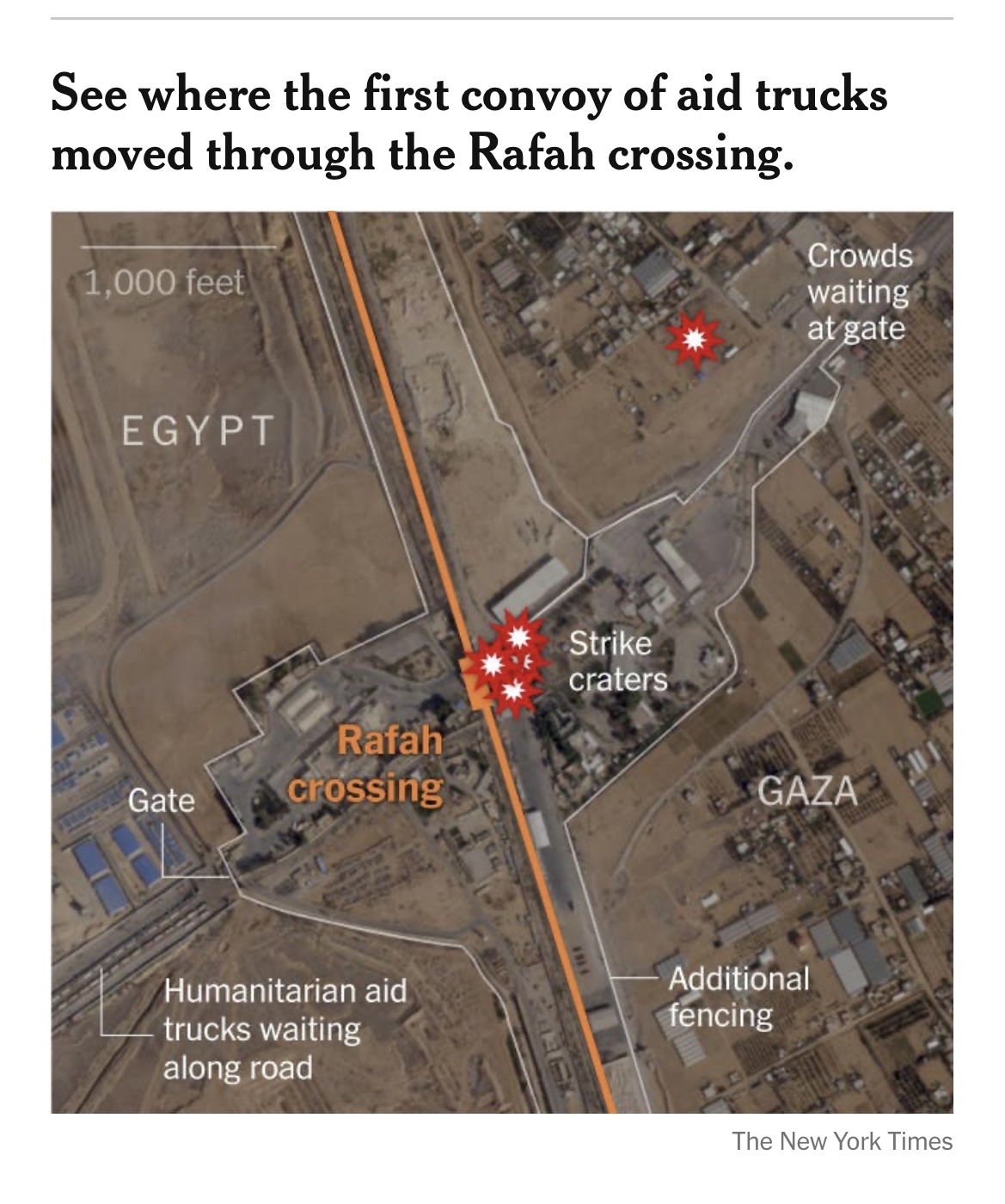
What was the military objective of bombing precisely where civilians were gathered to leave Gaza? Defeasible hypothesis: to bomb precisely where civilians were gathered to leave Gaza.
good-for, well-being and agent-relative value
Is a kind of value associated specifically with there being reason (not shared with others) for one to desire/value and promote/secure one’s well-being (or particular elements of it)? If so, how should we characterize it?
One natural suggestion is this: X’s well-being is valuable to X. The value here would be agent-relative, as distinct from value simpliciter (or agent-neutral value).
Against this suggestion, it is pointed out that the value language we generally use here is the language of good-for. For example, there is reason (not shared by others) for X to secure that-P because that-P is good for X. And we don’t generally use the language of valuable-to or valuable-relative-to. Of course, this does not preclude the concept (and property) of agent-relative value being required for philosophical theory, for descriptive and explanatory virtue or adequacy. The point, I think, is meant to set up a kind of burden of proof.
The Grating Roar
Come to the window, sweet is the night-air!
Only, from the long line of spray
Where the sea meets the moon-blanched land,
Listen! you hear the grating roar
Of pebbles which the waves draw back, and fling,
At their return, up the high strand,
Begin, and cease, and then again begin,
With tremulous cadence slow, and bring
The eternal note of sadness in.
–Matthew Arnold, “Dover Beach“
I was texting today with a friend in the West Bank. I ranted awhile about The Situation. He made no effort to join in. Finally, he said:
I promise you to be peaceful and to teach my people that.
It seemed to come from out of nowhere, but maybe that’s because I’d been monopolizing the conversation. I told him that peace was best, but that we all have a right to defend ourselves. He didn’t respond. An hour after that, he sent me videos of the Israeli military invading his village, driving vehicles with proud Stars of David flags affixed to them, smashing down doors, doing house-to-house searches, etc. etc. Injunctions to peaceful non-violence seem anemic in this context; invocations of the right to self-defense, futile. Continue reading
 Policy of Truth