Adjuncting at Al Quds

I’m happy to report that I’ve just accepted an offer do some adjunct teaching this summer for the Philosophy Dept at Al Quds University in the West Bank town of Abu Dis (in Area B, under joint Palestinian-Israeli control). I’m a big fan of Al Quds, and of the Philosophy Dept there. This will be a return trip for me, and I’m very glad for the opportunity to go back.

Photo credit: “Mur abou dis”. Licensed under CC BY-SA 3.0 via Wikimedia Commons – http://commons.wikimedia.org/wiki/File:Mur_abou_dis.jpg#/media/File:Mur_abou_dis.jpg

I’ll be teaching a single section of political philosophy–Plato, Aristotle, Machiavelli, Hobbes, Locke, Rousseau, Mill, and Marx–to about fifteen Palestinian undergraduates. I’ll be teaching in English, the students will be reading in Arabic, and a translator will be there to translate our conversations to one another. I gave three lectures at Al Quds back in 2013 under a similar arrangement, and it was one of the most challenging-rewarding experiences I’ve ever had. Believe it or not, there’s already a literature on experiences of this sort, so I guess I’ll be taking my copy of Carlos Fraenkel’s Teaching Plato in Palestine for guidance, and comparing notes with him. (The last time I was in Palestine, I vividly remember thinking that Plato in particular seemed intensely relevant to the place.)

I’m looking forward to blogging this summer for PoT from Abu Dis and from the West Bank (and Israel) generally. I’m hoping to do some “political sightseeing” throughout the West Bank and Israel, and would be grateful for any questions PoT readers have about local conditions that help me frame the sightseeing and blogging I do.

By sheer coincidence, I’m also looking forward to connecting with a Felician student of mine, Hilwa Abdallah, whose family is from Ramallah and who will be there when I am. I understand that I’m invited to dinner, and I intend to eat without takallaf. How I manage to navigate Ramadan in the West Bank remains to be seen.

Thucida Who?

Actual comment by a colleague of mine over lunch, not intended as humor:

I firmly believe that every citizen of this country should read Thucydides.

Frankly, I’d regard it as a major accomplishment if I could get 100% of my own students to pronounce “Thucydides.”

I don’t think my colleague has heard of Bryan Caplan. Honestly, I was afraid to ask.

Ninth Annual Felician Ethics Conference: Saturday, April 25

Strictly speaking, it’s the Ninth Annual Conference of the Felician Institute for Ethics and Public Affairs. It’s taking place this coming Saturday, essentially all day (9 am – 6 pm), at Felician’s Rutherford, New Jersey campus (223 Montross Ave, Rutherford, NJ, 07070). Fairly easy access from New York City: take the 190 bus from Port Authority (bound for Paterson), and stop at Montross and Union Avenues in Rutherford; turn left onto Montross and walk about a quarter of a mile to campus.

I’m gradually getting permission from participants to post their papers on the Institute’s website. So far, five eight of them are up, and I’m hoping to put more up soon. I’m chairing/commenting on sessions on meta-ethics, evil and harm, and virtue ethics. Besides the ones I’m chairing, there are sessions on distributive justice, bioethics, meta-ethics, well-being, a session on economic issues (Rawlsian and BHL-oriented), and historical papers on Seneca, Sidgwick, Proust, and Kierkegaard.

The plenary is a defense of markets in political votes, by James Stacey Taylor of The College of New Jersey. If you’re in the area and in the mood for some ethics, consider stopping by; at least one PoT-head besides me, Michael Young, will be there. Registration is $10 for graduate students, $20 for everyone else. A bunch of us (so far five six  seven of us) will be going out to dinner after the conference; if you’re interested in coming along, please contact me via the email listed on the website (via the link in the preceding paragraph). (PS, April 23: The reservations have been made.)

I’ve been organizing this conference since 2009, and every time I do it, I’m struck again by how many talented philosophers there are out there, and how much sophisticated philosophy they’re generating. It’s a lot of work to organize a conference, but it’s been a privilege to work with the philosophers who attend the conference; that by itself has made it all worthwhile.

Spring 2015 Issue of Reason Papers Is Out

The newest issue of Reason Papers, volume 37.1 (Spring 2015), is now out, our first issue since last July. We’ve been off schedule since 2013, but we’re back on track now, and should have another issue out this fall. Here’s a link to the PDF of the whole issue (189 pages). Here’s a link to our Archive page, which gives access to individual articles. At a mere 189 pages, this issue is shorter than 36.1 (which clocked in at 223 pages), but packed with great material. As usual, there’s an interesting (and coincidental) synergy between some of the pieces.

The issue starts off with a symposium on Christine Vitrano’s 2013 book, The Nature and Value of Happiness, originally an Author-Meets-Critics event at Felician College. John Kleinig makes an Aristotelian-type case against Vitrano; Christopher Rice offers a hedonist objection to her view. And of course, Vitrano responds to both critics. Many of the same topics arise in a different form in David Kelley’s discussion of Ole Martin Moen’s 2012 paper on the Objectivist Ethics (PDF, 30 pages). It pays to read the happiness symposium and Kelley’s discussion of Moen’s article in tandem, and may pay to read both in tandem with recent conversations here at PoT on related subjects. There’s also a book review in the issue on happiness and well-being (by Gary Jason); I anticipate we’ll be getting more material on happiness in the near future.

The symposium on emergencies has two very different pieces, one by Stephen Kershnar on the ethics of warfare, the other by Thomas May and colleagues on emergency planning in medical contexts. The latter article offers a useful coda to the Ebola outbreak last fall. I had wanted to contribute an essay on the definition of “emergency” in Rand’s “The Ethics of Emergencies,” but unfortunately didn’t get around to writing it.

The articles speak for themselves–one on rational choice, one on egoism, one attorney-client confidentiality, one on abortion. I got a lot out of reading them. Naturally, so will you.

Other material continues the discussion of Nozick and Marx from last summer’s issue (Mark Friedman vs. Danny Frederick on Nozick in the Discussion Notes, plus Dan Swain’s review of Paul Blackledge’s Marxism and Ethics). There’s also a short review of Islamic Political Thought–according to our reviewer Adam Walker, “a welcome and useful resource for the non-specialist reader” (worth comparing with Betsy Barre’s 2011 review of Princeton Readings in Islamist Political Thought).

Finally, two snappy pieces in the Afterwords–a review by Robert Begley of the film “Whiplash” (which came out this past fall; if I got out more I’d have seen it by now, but in the last  year I’ve only managed to see “Atlas Shrugged 3” and “Interstellar“*) and a short piece by NOL’s Brandon Christensen about his undergraduate experiences at UCLA with Young Americans for Liberty and Students for Liberty. The latter piece is part of our series on contemporary student activism, which began in the July 2014 issue with a book review by the globe-trotting Matt Faherty. Reflecting on what these guys say, it occurs to me that we ought to branch out and get some writing not just from other libertarian activists, but from activists across the political spectrum.

So essentially: drop everything, cancel all the plans you had for this weekend, and read the whole issue. You won’t regret it. You have my word.

Totally random postscript, May 14, 2015: I belatedly remembered that I also saw the movie “Wild.”

Rethinking Rights (and Freedom): A Series

I’ve decided to start what I envision as an ongoing series of posts here at PoT, called “Rethinking Rights.” A couple of posts have already implicitly discussed the topic: Though I focused on the “traffic ethics” angle at the time, part of the point of last summer’s series on honking at a dangerous intersection was to re-think how the concept of rights applies to noise-based nuisances. Rethinking rights is also related to Gordon Barnes’s post on the freedom fetish, and to my posts on self-defense and local government, among others. Though I meant it as a joke, my recent post on noisy neighbors was arguably on the same topic. There are probably some others as well. Since rights and freedom/liberty are on some accounts closely related concepts, feel free to regard the series as in principle extending to the topic of freedom/liberty as well. (I just happen to know a PoT reader chomping at the bit to become a PoT blogger and write on that topic.)

While any authorized PoT blogger can contribute to the series (and any approved commentator can comment on it), my own personal motivation for rethinking rights is that I find the issue overridingly important, but find myself dissatisfied by the conceptions of rights I’ve encountered in the philosophical literature and in ordinary discourse. The Objectivist conception of rights strikes me as either too narrow or ultimately indeterminate. The libertarian conception is on some accounts even narrower, but also problematically deontic. (Yes, I regard a commitment to deontology as a problem.) The standard left-liberal conception, which (on some accounts) includes a strong version of positive rights, and (on others) includes “collective” rights to ethno-national self-determination, strikes me as too broad, and problematically collectivist. (Yes, “collectivism” is a problem, too.) More radical conceptions of rights, which confer rights on embryos, fetuses, non-human animals, and non-living things, strike me as much too broad. Conceptions of rights drawn in positivist fashion directly from blackletter law strike me as arbitrary and insufficiently focused on moral essentials.

And yet I don’t want to let go of rights-talk, either: I don’t, for instance, buy the Benthamite, Burkean, Marxist, or MacIntyrean rejections of the concept of rights. I don’t even buy communitarian claims about the supposed excesses of rights talk. I’m convinced that there’s an account of rights “out there” that avoids the pitfalls of the existing accounts while bypassing the objections of rights-skeptics. It just needs to be worked out in an explicit way. (On PoT.)

My aim in the series (which need not be the aim of any other contributor) is to (begin to) work out a conception of rights that’s broader and more determinate than the Objectivist/libertarian conception, narrower than the left-liberal conception, and more focused on specifically moral essentials than the sort of account you’d get by perusing a standard textbook of criminal, tort, or business law. A further constraint on the theory is that it has to cohere with a recognizably Aristotelian conception of human flourishing and moral virtue. An aspiration of the series is to think about topics, or spheres of life, that go relatively (or completely) undiscussed in the Anglo-American analytic literature.

I don’t imagine that I can work out a theory of rights in a series of blog posts, even a few years’ worth of them. My aim is a bit more modest: to rebut some defective ideas; to sketch some promising new lines of thought; to uncover previously hidden areas of inquiry worth probing; and so on.

I have a first post in mind, which I’ll post sometime this weekend–most likely after I announce the publication of the new issue of Reason Papers (Spring 2015, volume 37.1).

April 13

It’s a day of anniversaries.

For one thing, it’s Matt Faherty’s birthday. Happy birthday, Matt!  His birthday was April 12. Whoops.

It’s also the late Christopher Hitchens’s birthday. Happy birthday, Christopher, wherever you are.

I got to know Hitchens during the 2000s, and we corresponded for a few years by email. Every year around this time, we used to joke about the fact that his birthday happened to fall on the anniversary of the Jalianwala Bagh Massacre of 1919.

Not that it was all that humorous a topic. Here it is, as depicted in the film “Gandhi.”

My grandfather–my father’s father–was there. Obviously, he escaped, or I couldn’t sit here and tell you about it. I never met him (he died in Pakistan when I was a small child), so I can’t pretend to have some powerful personal bond with him, or via him, with the event. But I’ve heard the family lore about him, and about 1919 (and 1947), so that’s the connection.

My biggest fear after 9/11 and our wars in Afghanistan and Iraq was that some day we’d repeat some American equivalent of Amritsar somewhere, and that I’d have to live as the citizen of a country stained with the blood of innocents like the ones at Jalianwala Bagh. Have we escaped that fate? Well, I can’t think of a literal equivalent of the Amritsar Massacre since My Lai, but then, browsing my way through the Senate’s Torture Report, I can’t say we’ve entirely escaped the Amritsar Syndrome, either.

David Cameron famously (or notoriously) refused to issue an apology for the massacre. It’s wrong, he said (in 2013), “to reach back into history and to seek out things you can apologise for.” I have mixed feelings about the statement, but in truth, he has a point: it’s one thing to acknowledge, but another thing to apologize for, an event nearly a century in the past.

As he prepared to leave Amritsar, Cameron explained why he had decided against issuing an apology. “In my view,” he said, “we are dealing with something here that happened a good 40 years before I was even born, and which Winston Churchill described as ‘monstrous’ at the time and the British government rightly condemned at the time. So I don’t think the right thing is to reach back into history and to seek out things you can apologise for.

“I think the right thing is to acknowledge what happened, to recall what happened, to show respect and understanding for what happened.

“That is why the words I used are right: to pay respect to those who lost their lives, to remember what happened, to learn the lessons, to reflect on the fact that those who were responsible were rightly criticised at the time, to learn from the bad and to cherish the good.”

The last word, however, goes to the birthday boy–the older one, I mean. Here’s a passage from Christopher Hitchens’s “A Sense of Mission,” an appreciation of The Raj Quartet (in fact, the appreciation that induced me to read The Raj Quartet, and make it one of my favorite works of literature, alongside A Passage to India). He’s referring simultaneously to the Indian Mutiny of 1857 and the Amritsar Massacre:

It’s not too much to say that these two symbols form the counterpoint of The Raj Quartet. On the one hand is fear–in part a guilty fear–of treachery, mutiny, and insurrection; of burning and pillage in which even one’s own servants cannot be trusted. On the other is the fear of having to break that trust oneself; of casting aside the pretense of consent and paternalism and ruling by terror and force. The persistence of these complementary nightmares says a good deal about the imperial frame of mind (Prepared for the Worst, p. 219).

“The imperial frame of mind”: I’d like to think that it’s all essentially irrelevant to us. In any case, when I think of the Jalianwala Bagh Massacre, as I do each year, I’m reminded of why I’d like to keep it so–or come to that, make it so.

Postscript: This article about Blackwater in Iraq almost got me to rethink my claim about our not repeating Amritsar. [Added later: I’d forgotten about Haditha when I wrote this. Here’s material on Haditha from Democracy Now, and an interesting but overly sanguine article from The Atlantic. The author of the second piece somewhat ingenuously writes, “In a liberal democracy…we put a very high burden on the state in taking away the liberty of a citizen accused of a crime.” Well, we ought to, and would like to think that we do. But it’s a stretch to assert that we do. Civil asset forfeiture is the most obvious counter-example, but the whole of the drug war provides another.]

Postscript 2: Horrifyingly worth reading, from the Hindustan Times: excerpts of Dyer’s testimony before the Hunter Commission.

Another Query: Retributivist Solutions for Noisy Neighbors

While I’m in bleg/query mode, maybe someone has a suggestion–hopefully a punitive, retributivist-type of suggestion–for what ought to be done to/with/about people like this.

I live under neighbors like the ones in the video, and have for about a year now. For the ultimate journey through cognitive dissonance, I’d suggest trying to make your way through Sartre’s Being and Nothingness while your upstairs neighbors are going at it and feral mice crawl into your bed.

But hey. “Be well.” This is no social crisis, just another tricky day at the apartment complex.

(ht: Kate Herrick)

Query: Letters of Recommendation for Grad School

In blog talk, this entry qualifies as a “bleg,” but since I hate that term, I’m calling it a “query.”

Students sometimes contact me with questions about academic life on the mostly false premise that I know all about how it works, and how to negotiate the various shoals it presents. I do the best I can, but I always doubt the value of the answers I give, and could use a reality check on this one.

I recently got a query from someone interested in going to graduate school in anthropology. He majored in anthropology during his undergraduate years, and graduated from college a few years ago (two years ago, I think). He’s now looking to apply to graduate school, but faces the familiar problem of going back and asking for letters of recommendation from professors who may or may not remember him. He went to a large public R1 university where there was little one-on-one contact between professors and undergraduates.

Here’s a paraphrased version of his question:

Should I ask for letters of recommendation from professors who may or may not remember me (probably don’t remember me), or should I ask for letters from the graduate students and post-docs who taught the discussion sections for the lectures I attended? I’ve kept in touch with the latter bunch, so they have a better idea of who I am, what I can do, and my general fitness for graduate school. I’m just not sure it makes sense to ask for letters from people who don’t have tenure-track positions.

I told him that the ideal thing to do would be to find the sub-set of people who were then graduate students or post-docs but now have tenure-track/full-time positions, and ask for letters of recommendation from them.

Supposing that no one fits that description, however, he should go back to the professors he had rather than to people who are currently grad students or post-docs. My assumption is that admissions committees won’t take letters from the latter group very seriously. I don’t actually know that that’s the case, however, and seem to remember writing a few letters of recommendation when I was an adjunct without a PhD (not that I know how well they worked). Hence the query. (Incidentally, I think the relevant issue is not whether the faculty member has a tenure-track position, but whether he or she has a full-time position, regardless of its tenure-stream status.)

I understand the precariousness of this student’s predicament, however. How do you go back to professors who don’t remember you and ask for a letter of recommendation? What would they say in the letter about you, and on what basis? (“He was one of the many students to whom I lectured in the past few years. Frankly, he’s a blur to me–but an academically promising blur.”) Could you expect letters of that nature to be any good?

I came up with the following suggestion: Suppose that none of your old TA’s currently have tenure-track (or full-time) academic positions. Go back to them and ask for letters of recommendation from them, but have their letters co-signed (or even just signed) by the professor they taught for. That is, as far as I know, a somewhat unorthodox arrangement, but I don’t see anything wrong with it, and it seems to me to make the best of an otherwise awkward situation.

I’m curious what readers think.

Update: You’ve Got Another Academic Thing Coming

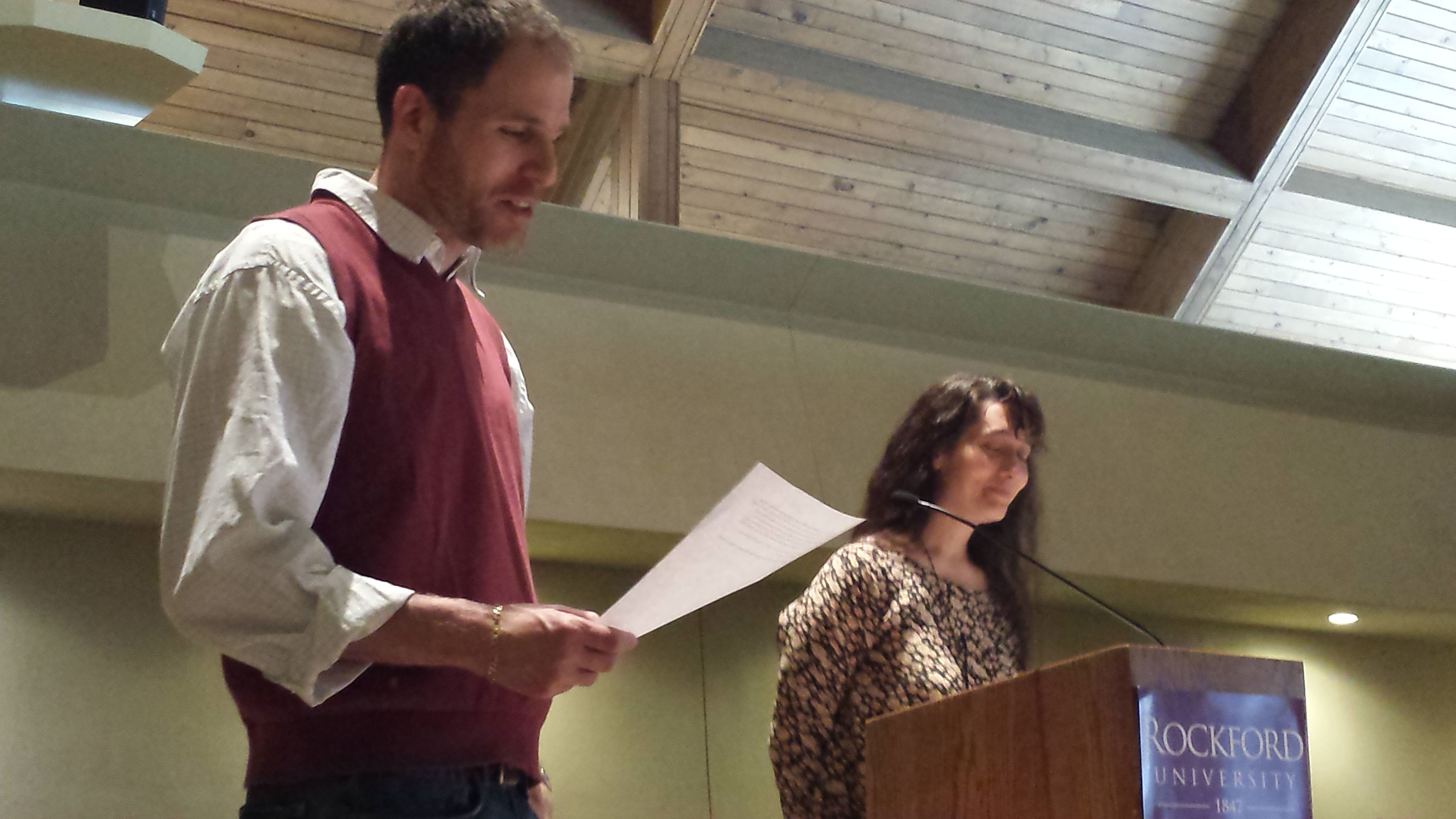
A little while back I mentioned that Carrie-Ann was giving a talk at Rockford University on Ayn Rand and Mike Rowe. The talk seems to have gone well; Carrie-Ann sends the following picture of herself at the podium, being introduced by Shawn Klein of Rockford’s Philosophy Department (photo credit: Stephen Hicks).

RU visit introduced by Shawn

Carrie-Ann tells me that she’ll be blogging her talk soon and eventually posting it at her Academia site, but in general (I’ve read a copy), it’s a discussion (comparison/contrast) of Rand’s views on the moral psychology of work and/versus Mike Rowe’s as laid out on Rowe’s show, his web writings, and in his recent book Profoundly Disconnected.

(Incidentally, though not directly related to Carrie-Ann’s topic, this profile of NOL editor Brandon Christensen’s experiences with homelessness is at least indirectly relevant to the topic and very much worth reading. Not quite a “dirty job” but a “dirty education”: the lengths to which some people will go to get a college degree!)

One basic claim that Rand and Rowe seem to have in common concerns the morally redemptive nature of productive work across the spectrum of types of work–from “clean” to “dirty” (in Rowe’s sense of dirty). A corollary seems to be that it’s more in your interest to work than receive a hand-out, assuming that you’re capable of working. Another corollary seems to be that it’s more in your interest to do dirty work than receive a hand-out while holding out for clean work, assuming that you’re capable of doing the work in question.

A related implication is that when you look for work, ceteris paribus, the choiceworthy features of the work are its not-necessarily-remunerative virtue-realizing features,* not how much money you make from it. In other words, faced with two jobs each of which pays a sufficient amount, you ought to pick the virtue-promoting job over the more remunerative (but less virtue-promoting) one. Similarly, faced with two jobs, one of which is virtue-promoting and pays peanuts, and the other of which pays a lot but is immoral, you ought to pick the former. Those are all, of course, large claims that would have to be developed in ways that go beyond the paper in its current form.

One topic not discussed in the paper but badly in need of discussion is what Randian egoism has to say about the tension between a commitment to egoism and the existence of dangerous-but-necessary jobs, or even a commitment to egoism and the existence of necessary-but-merely arduous-and-messy jobs.  Take jobs like military combat, policing (as well as prison work), fire-fighting, and certain types of construction work, farming, mining, and roofing, etc. They’re all necessary in the sense that they need to get done for the efficient or even minimal functioning of a modern society. If they didn’t get done, we wouldn’t have societies of the sort we’re used to.**

But what egoistic motivation beyond economic necessity or lack of better alternatives (in cases where those are applicable) would induce someone to take such a job? If there is no non-necessity-based egoistic reason for taking such a job, it seems rational to shun them. If it’s rational to shun them, then under ideal conditions, no egoists (or relatively few egoists) would be found in such jobs. Granted, conditions are rarely ideal, but the point is, the better the conditions, the fewer the egoists would gravitate toward such jobs, and under good conditions, few egoists would do them.

Suppose ex hypothesi that we’re in the near-ideal situation where the egoists are doing the “better” jobs and the worse jobs are done by non-egoists (by people whose reasons for doing those jobs is inherently incompatible with egoism). Then it seems that in order to enjoy the fruits of modern society–itself an egoistically rational aim–egoists must of necessity rely on the work (and motivations) of non-egoists. If so, egoism is vulnerable to the charge of failing the test of universalizability or (putting the same point another way) requiring a (conceptual) form of parasitism. Egoism only works, in social terms, if many people aren’t egoists and the egoists rely on them in the way that Aristotle’s virtuous aristocrats rely on natural slaves.

I don’t mean to imply that the preceding objection is necessarily sound, just to suggest that it hasn’t gotten enough sustained attention by defenders of ethical egoism as it deserves. That said, Greg Salmieri (Rutgers, Stevens Institute) has been working on the closely-related topic of exploitation in Aristotle’s social theory. I expect that there’s some convergence between Carrie-Ann’s paper and Salmieri’s.

Meanwhile, to move from the virtue of productiveness to the vice of bestial cowardice, I have to confess that I ended up not attending the ACTC conference at which I was supposed to give my paper on the Nicomachean Ethics and the Grant Study (mentioned in the same post as Carrie-Ann’s paper). I finished the paper the night before I was supposed to leave, then got home to discover that my apartment had been infested with mice. (I’ve had an ongoing sporadic mouse problem these past few weeks, but my point is, when I got home, things crossed the hard-to-define-but-easy-to-discern threshold from mouse problem into mouse infestation.) The damn things kept me up all night, and then obliged me to turn from humane-but-totally-ineffective methods of rodent deterrence to inhumane, lethal methods drawn from years of personal observation of U.S. foreign policy.

I had mentioned my mouse problem in passing to my critical thinking students, one of whom turned my random complaint into a teaching moment by asking, “So why assume that you can’t learn to co-exist with the mice in your house?” Part of it (I said) was that mice spread disease. (Response: “Yes, but people spread disease, too. So you’d kill people if you thought they’d spread disease?”) But part of it, I must confess, is simply that I’m skeeved out by the thought–and not just the thought, but the actual physical reality–of sharing my bed with a passel or herd (or whatever it’s called) of feral mice. Granted, as a divorced single man, I should probably welcome the presence of anyone in my bed, but unfortunately, I don’t. (Yes, they’ve crawled into my bed at night with me in it, I’m not making that up.) I know it’s crude of me to put things this way, but I also can’t help mentioning that the mice pay no part of the rent and do not help at all with household chores.

What would Aristotle do? I don’t know, but here’s what he has to say, in what I think is the only mouse-related passage in the Nicomachean Ethics:

If, for instance, someone’s natural character makes him afraid of everything, even the noise of a mouse, he is a coward with a bestial sort of cowardice. (NE VII.5, 1149a7-8).

Yeah, well, call it another chapter from my ongoing memoir, Profiles in Bestial Cowardice. I almost think it’s worse than bestial cowardice. I mean, if I were a bona fide beast–something terrifying, like a tabby or a terrier–I’d at least have the courage to attack the mice mano a mano. But I’m a middle-aged twenty-first century American professor. I haven’t had a fist fight in decades. As it stands, I’ve just armed my apartment with a series of ultrasonic devices, traps, and poison in the hopes that I can drive the intruders away by high-tech methods of shock and awe. I guess we have to invent another category for people like me: sub-bestial cowardice. Or: Not-even-bestial cowardice. Or: pathetic over-civilized wimpiness.

Anyway, my new surge strategy seems to be working about as well as Bush’s did in Iraq and Obama’s in Afghanistan (wish list item: weaponized drones), but too late for my presence at the ACTC conference. My session starts in an hour, but I’m six hours’ drive away.

The point is, I write about virtue. I never said I had it.

*I had originally written “non-remunerative,” but that seems too strong.

**For interesting but in my view inadequate discussion of this topic, see chapter 11 of Alasdair MacIntyre’s Dependent Rational Animals and “Politics, Philosophy, and the Common Good” (reprinted in Kelvin Knight’s The MacIntyre Reader). Though not an egoist, MacIntyre faces a version of the problem mentioned in the text, but contrary to the impression he gives, never really resolves it.

From the Nicomachean Ethics to the Grant Study

[Here as promised is a first draft of the paper I’ll be giving this Saturday at the annual conference of the Association for Core Texts and Courses in Plymouth Harbor, Massachusetts. Papers for the conference are supposed to be short, non-technical treatments of a core text or two appropriate for undergraduate teaching, along with a rationale for teaching them. This year’s theme is the relation between the arts and sciences in undergraduate education. Comments are welcome, though I probably won’t see them until next week. I’ll add hyperlinks next week as well. This discussion was quite helpful to me in thinking things through.]

Continue reading