April 13

It’s a day of anniversaries.

For one thing, it’s Matt Faherty’s birthday. Happy birthday, Matt!  His birthday was April 12. Whoops.

It’s also the late Christopher Hitchens’s birthday. Happy birthday, Christopher, wherever you are.

I got to know Hitchens during the 2000s, and we corresponded for a few years by email. Every year around this time, we used to joke about the fact that his birthday happened to fall on the anniversary of the Jalianwala Bagh Massacre of 1919.

Not that it was all that humorous a topic. Here it is, as depicted in the film “Gandhi.”

My grandfather–my father’s father–was there. Obviously, he escaped, or I couldn’t sit here and tell you about it. I never met him (he died in Pakistan when I was a small child), so I can’t pretend to have some powerful personal bond with him, or via him, with the event. But I’ve heard the family lore about him, and about 1919 (and 1947), so that’s the connection.

My biggest fear after 9/11 and our wars in Afghanistan and Iraq was that some day we’d repeat some American equivalent of Amritsar somewhere, and that I’d have to live as the citizen of a country stained with the blood of innocents like the ones at Jalianwala Bagh. Have we escaped that fate? Well, I can’t think of a literal equivalent of the Amritsar Massacre since My Lai, but then, browsing my way through the Senate’s Torture Report, I can’t say we’ve entirely escaped the Amritsar Syndrome, either.

David Cameron famously (or notoriously) refused to issue an apology for the massacre. It’s wrong, he said (in 2013), “to reach back into history and to seek out things you can apologise for.” I have mixed feelings about the statement, but in truth, he has a point: it’s one thing to acknowledge, but another thing to apologize for, an event nearly a century in the past.

As he prepared to leave Amritsar, Cameron explained why he had decided against issuing an apology. “In my view,” he said, “we are dealing with something here that happened a good 40 years before I was even born, and which Winston Churchill described as ‘monstrous’ at the time and the British government rightly condemned at the time. So I don’t think the right thing is to reach back into history and to seek out things you can apologise for.

“I think the right thing is to acknowledge what happened, to recall what happened, to show respect and understanding for what happened.

“That is why the words I used are right: to pay respect to those who lost their lives, to remember what happened, to learn the lessons, to reflect on the fact that those who were responsible were rightly criticised at the time, to learn from the bad and to cherish the good.”

The last word, however, goes to the birthday boy–the older one, I mean. Here’s a passage from Christopher Hitchens’s “A Sense of Mission,” an appreciation of The Raj Quartet (in fact, the appreciation that induced me to read The Raj Quartet, and make it one of my favorite works of literature, alongside A Passage to India). He’s referring simultaneously to the Indian Mutiny of 1857 and the Amritsar Massacre:

It’s not too much to say that these two symbols form the counterpoint of The Raj Quartet. On the one hand is fear–in part a guilty fear–of treachery, mutiny, and insurrection; of burning and pillage in which even one’s own servants cannot be trusted. On the other is the fear of having to break that trust oneself; of casting aside the pretense of consent and paternalism and ruling by terror and force. The persistence of these complementary nightmares says a good deal about the imperial frame of mind (Prepared for the Worst, p. 219).

“The imperial frame of mind”: I’d like to think that it’s all essentially irrelevant to us. In any case, when I think of the Jalianwala Bagh Massacre, as I do each year, I’m reminded of why I’d like to keep it so–or come to that, make it so.

Postscript: This article about Blackwater in Iraq almost got me to rethink my claim about our not repeating Amritsar. [Added later: I’d forgotten about Haditha when I wrote this. Here’s material on Haditha from Democracy Now, and an interesting but overly sanguine article from The Atlantic. The author of the second piece somewhat ingenuously writes, “In a liberal democracy…we put a very high burden on the state in taking away the liberty of a citizen accused of a crime.” Well, we ought to, and would like to think that we do. But it’s a stretch to assert that we do. Civil asset forfeiture is the most obvious counter-example, but the whole of the drug war provides another.]

Postscript 2: Horrifyingly worth reading, from the Hindustan Times: excerpts of Dyer’s testimony before the Hunter Commission.

Another Query: Retributivist Solutions for Noisy Neighbors

While I’m in bleg/query mode, maybe someone has a suggestion–hopefully a punitive, retributivist-type of suggestion–for what ought to be done to/with/about people like this.

I live under neighbors like the ones in the video, and have for about a year now. For the ultimate journey through cognitive dissonance, I’d suggest trying to make your way through Sartre’s Being and Nothingness while your upstairs neighbors are going at it and feral mice crawl into your bed.

But hey. “Be well.” This is no social crisis, just another tricky day at the apartment complex.

(ht: Kate Herrick)

Query: Letters of Recommendation for Grad School

In blog talk, this entry qualifies as a “bleg,” but since I hate that term, I’m calling it a “query.”

Students sometimes contact me with questions about academic life on the mostly false premise that I know all about how it works, and how to negotiate the various shoals it presents. I do the best I can, but I always doubt the value of the answers I give, and could use a reality check on this one.

I recently got a query from someone interested in going to graduate school in anthropology. He majored in anthropology during his undergraduate years, and graduated from college a few years ago (two years ago, I think). He’s now looking to apply to graduate school, but faces the familiar problem of going back and asking for letters of recommendation from professors who may or may not remember him. He went to a large public R1 university where there was little one-on-one contact between professors and undergraduates.

Here’s a paraphrased version of his question:

Should I ask for letters of recommendation from professors who may or may not remember me (probably don’t remember me), or should I ask for letters from the graduate students and post-docs who taught the discussion sections for the lectures I attended? I’ve kept in touch with the latter bunch, so they have a better idea of who I am, what I can do, and my general fitness for graduate school. I’m just not sure it makes sense to ask for letters from people who don’t have tenure-track positions.

I told him that the ideal thing to do would be to find the sub-set of people who were then graduate students or post-docs but now have tenure-track/full-time positions, and ask for letters of recommendation from them.

Supposing that no one fits that description, however, he should go back to the professors he had rather than to people who are currently grad students or post-docs. My assumption is that admissions committees won’t take letters from the latter group very seriously. I don’t actually know that that’s the case, however, and seem to remember writing a few letters of recommendation when I was an adjunct without a PhD (not that I know how well they worked). Hence the query. (Incidentally, I think the relevant issue is not whether the faculty member has a tenure-track position, but whether he or she has a full-time position, regardless of its tenure-stream status.)

I understand the precariousness of this student’s predicament, however. How do you go back to professors who don’t remember you and ask for a letter of recommendation? What would they say in the letter about you, and on what basis? (“He was one of the many students to whom I lectured in the past few years. Frankly, he’s a blur to me–but an academically promising blur.”) Could you expect letters of that nature to be any good?

I came up with the following suggestion: Suppose that none of your old TA’s currently have tenure-track (or full-time) academic positions. Go back to them and ask for letters of recommendation from them, but have their letters co-signed (or even just signed) by the professor they taught for. That is, as far as I know, a somewhat unorthodox arrangement, but I don’t see anything wrong with it, and it seems to me to make the best of an otherwise awkward situation.

I’m curious what readers think.

Update: You’ve Got Another Academic Thing Coming

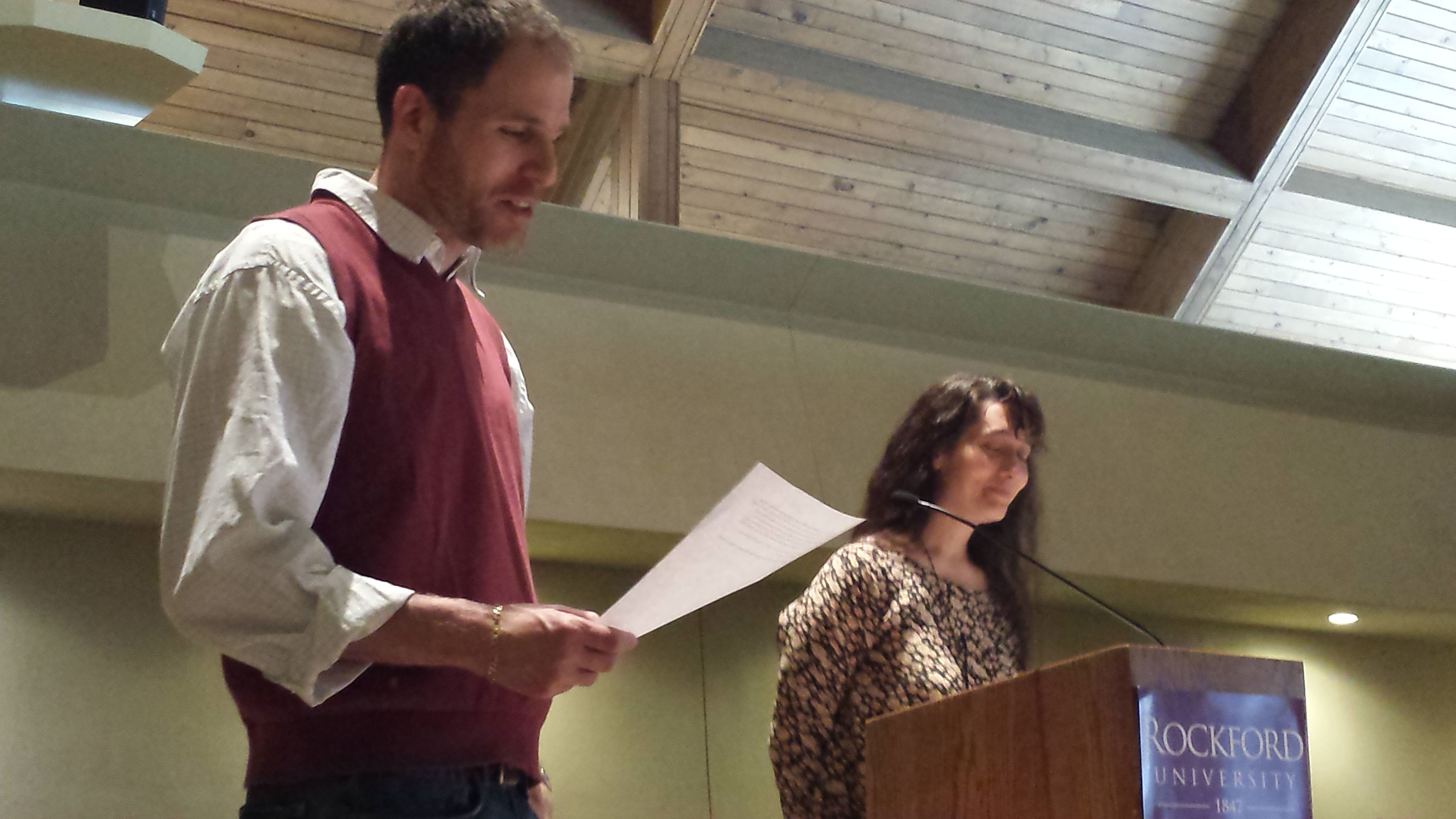
A little while back I mentioned that Carrie-Ann was giving a talk at Rockford University on Ayn Rand and Mike Rowe. The talk seems to have gone well; Carrie-Ann sends the following picture of herself at the podium, being introduced by Shawn Klein of Rockford’s Philosophy Department (photo credit: Stephen Hicks).

RU visit introduced by Shawn

Carrie-Ann tells me that she’ll be blogging her talk soon and eventually posting it at her Academia site, but in general (I’ve read a copy), it’s a discussion (comparison/contrast) of Rand’s views on the moral psychology of work and/versus Mike Rowe’s as laid out on Rowe’s show, his web writings, and in his recent book Profoundly Disconnected.

(Incidentally, though not directly related to Carrie-Ann’s topic, this profile of NOL editor Brandon Christensen’s experiences with homelessness is at least indirectly relevant to the topic and very much worth reading. Not quite a “dirty job” but a “dirty education”: the lengths to which some people will go to get a college degree!)

One basic claim that Rand and Rowe seem to have in common concerns the morally redemptive nature of productive work across the spectrum of types of work–from “clean” to “dirty” (in Rowe’s sense of dirty). A corollary seems to be that it’s more in your interest to work than receive a hand-out, assuming that you’re capable of working. Another corollary seems to be that it’s more in your interest to do dirty work than receive a hand-out while holding out for clean work, assuming that you’re capable of doing the work in question.

A related implication is that when you look for work, ceteris paribus, the choiceworthy features of the work are its not-necessarily-remunerative virtue-realizing features,* not how much money you make from it. In other words, faced with two jobs each of which pays a sufficient amount, you ought to pick the virtue-promoting job over the more remunerative (but less virtue-promoting) one. Similarly, faced with two jobs, one of which is virtue-promoting and pays peanuts, and the other of which pays a lot but is immoral, you ought to pick the former. Those are all, of course, large claims that would have to be developed in ways that go beyond the paper in its current form.

One topic not discussed in the paper but badly in need of discussion is what Randian egoism has to say about the tension between a commitment to egoism and the existence of dangerous-but-necessary jobs, or even a commitment to egoism and the existence of necessary-but-merely arduous-and-messy jobs.  Take jobs like military combat, policing (as well as prison work), fire-fighting, and certain types of construction work, farming, mining, and roofing, etc. They’re all necessary in the sense that they need to get done for the efficient or even minimal functioning of a modern society. If they didn’t get done, we wouldn’t have societies of the sort we’re used to.**

But what egoistic motivation beyond economic necessity or lack of better alternatives (in cases where those are applicable) would induce someone to take such a job? If there is no non-necessity-based egoistic reason for taking such a job, it seems rational to shun them. If it’s rational to shun them, then under ideal conditions, no egoists (or relatively few egoists) would be found in such jobs. Granted, conditions are rarely ideal, but the point is, the better the conditions, the fewer the egoists would gravitate toward such jobs, and under good conditions, few egoists would do them.

Suppose ex hypothesi that we’re in the near-ideal situation where the egoists are doing the “better” jobs and the worse jobs are done by non-egoists (by people whose reasons for doing those jobs is inherently incompatible with egoism). Then it seems that in order to enjoy the fruits of modern society–itself an egoistically rational aim–egoists must of necessity rely on the work (and motivations) of non-egoists. If so, egoism is vulnerable to the charge of failing the test of universalizability or (putting the same point another way) requiring a (conceptual) form of parasitism. Egoism only works, in social terms, if many people aren’t egoists and the egoists rely on them in the way that Aristotle’s virtuous aristocrats rely on natural slaves.

I don’t mean to imply that the preceding objection is necessarily sound, just to suggest that it hasn’t gotten enough sustained attention by defenders of ethical egoism as it deserves. That said, Greg Salmieri (Rutgers, Stevens Institute) has been working on the closely-related topic of exploitation in Aristotle’s social theory. I expect that there’s some convergence between Carrie-Ann’s paper and Salmieri’s.

Meanwhile, to move from the virtue of productiveness to the vice of bestial cowardice, I have to confess that I ended up not attending the ACTC conference at which I was supposed to give my paper on the Nicomachean Ethics and the Grant Study (mentioned in the same post as Carrie-Ann’s paper). I finished the paper the night before I was supposed to leave, then got home to discover that my apartment had been infested with mice. (I’ve had an ongoing sporadic mouse problem these past few weeks, but my point is, when I got home, things crossed the hard-to-define-but-easy-to-discern threshold from mouse problem into mouse infestation.) The damn things kept me up all night, and then obliged me to turn from humane-but-totally-ineffective methods of rodent deterrence to inhumane, lethal methods drawn from years of personal observation of U.S. foreign policy.

I had mentioned my mouse problem in passing to my critical thinking students, one of whom turned my random complaint into a teaching moment by asking, “So why assume that you can’t learn to co-exist with the mice in your house?” Part of it (I said) was that mice spread disease. (Response: “Yes, but people spread disease, too. So you’d kill people if you thought they’d spread disease?”) But part of it, I must confess, is simply that I’m skeeved out by the thought–and not just the thought, but the actual physical reality–of sharing my bed with a passel or herd (or whatever it’s called) of feral mice. Granted, as a divorced single man, I should probably welcome the presence of anyone in my bed, but unfortunately, I don’t. (Yes, they’ve crawled into my bed at night with me in it, I’m not making that up.) I know it’s crude of me to put things this way, but I also can’t help mentioning that the mice pay no part of the rent and do not help at all with household chores.

What would Aristotle do? I don’t know, but here’s what he has to say, in what I think is the only mouse-related passage in the Nicomachean Ethics:

If, for instance, someone’s natural character makes him afraid of everything, even the noise of a mouse, he is a coward with a bestial sort of cowardice. (NE VII.5, 1149a7-8).

Yeah, well, call it another chapter from my ongoing memoir, Profiles in Bestial Cowardice. I almost think it’s worse than bestial cowardice. I mean, if I were a bona fide beast–something terrifying, like a tabby or a terrier–I’d at least have the courage to attack the mice mano a mano. But I’m a middle-aged twenty-first century American professor. I haven’t had a fist fight in decades. As it stands, I’ve just armed my apartment with a series of ultrasonic devices, traps, and poison in the hopes that I can drive the intruders away by high-tech methods of shock and awe. I guess we have to invent another category for people like me: sub-bestial cowardice. Or: Not-even-bestial cowardice. Or: pathetic over-civilized wimpiness.

Anyway, my new surge strategy seems to be working about as well as Bush’s did in Iraq and Obama’s in Afghanistan (wish list item: weaponized drones), but too late for my presence at the ACTC conference. My session starts in an hour, but I’m six hours’ drive away.

The point is, I write about virtue. I never said I had it.

*I had originally written “non-remunerative,” but that seems too strong.

**For interesting but in my view inadequate discussion of this topic, see chapter 11 of Alasdair MacIntyre’s Dependent Rational Animals and “Politics, Philosophy, and the Common Good” (reprinted in Kelvin Knight’s The MacIntyre Reader). Though not an egoist, MacIntyre faces a version of the problem mentioned in the text, but contrary to the impression he gives, never really resolves it.

From the Nicomachean Ethics to the Grant Study

[Here as promised is a first draft of the paper I’ll be giving this Saturday at the annual conference of the Association for Core Texts and Courses in Plymouth Harbor, Massachusetts. Papers for the conference are supposed to be short, non-technical treatments of a core text or two appropriate for undergraduate teaching, along with a rationale for teaching them. This year’s theme is the relation between the arts and sciences in undergraduate education. Comments are welcome, though I probably won’t see them until next week. I’ll add hyperlinks next week as well. This discussion was quite helpful to me in thinking things through.]

Continue reading →

David Potts on the Dunning-Kruger Effect

It’s a little known fact that some of PoT’s most avid and engaged readers lurk behind the scenes, being too bashful to log onto the site and call attention to themselves by writing for public consumption. What they do instead is read what the rest of us extroverts write, and send expert commentary to my email inbox. I implore some of these people to say their piece on the site itself, but they couldn’t, possibly. They’re too private for the unsavory paparazzi lifestyle associated with blogging.

About a month ago, I posted an entry here inspired–if you want to call it that–by a BHL post on graduate school. Part of the post consisted of a rant of mine partly concerning this comment by Jason Brennan, directed at a commenter named Val.

Val, I bet you just think you’re smart because of the Dunning-Kruger effect.

Clinical psych is easy as pie. It’s what people with bad GRE or MCAT scores do.

My rant focused on Brennan’s conflation of psychiatry and clinical psychology in the second sentence (along with the belligerent stupidity of the claim made about clinical psychology), but a few weeks ago, a friend of mine–David Potts–sent me an interesting email about the Dunning-Kruger effect mentioned in the first sentence. David happens to have doctorates in both philosophy and cognitive psychology, both from the University of Illinois at Chicago; he currently teaches philosophy at the City College of San Francisco. In any case, when David talks, I tend to listen.

After justifiably taking issue with my handwaving (and totally uninformed) quasi-criticisms of Jonathan Haidt in the just-mentioned post, David had this to say about the Dunning-Kruger effect (excerpted below, and reproduced with David’s permission). I’ll try to get my hands on the papers to which David refers, and link to them when I get the chance. I’ve edited the comment very slightly for clarity. I think I’m sufficiently competent to do that, but who knows?

First, about the Dunning-Kruger effect. I had never heard of it, which got my attention because I don’t like there to be things of this kind I’ve never heard of. So I got their paper and a follow-up paper and read them. But I was not much impressed by what I read. How is Dunning-Kruger different from the well-established better-than-average effect? For one thing, [Dunning-Kruger] show — interestingly — that the better-than-average effect is not a constant increment of real performance. That is, it’s not the case that, at all levels of competence, people think they’re, say, 20% better than they really are. Rather, everybody thinks they’re literally above average, no matter how incompetent they are. This is different from, say, knowledge miscalibration. Knowledge miscalibration really is a matter of overestimating one’s chances of being right in one’s beliefs by 20% or so. (That is, people who estimate their chances of being right about some belief at 80% actually turn out to be right on average 60% of the time; estimates of 90% correspond to actually being right 70% of the time, etc.) But in the cases that Kruger and Dunning investigate, nearly everybody thinks they’re in the vicinity of the 66th percentile of performance, no matter what their real performance. So that’s interesting.

But that is not the way Dunning and Kruger themselves interpret the importance of their findings. What they take themselves to have shown is that incompetent people have a greater discrepancy between their self-estimates and their actual performance because, being incompetent, they are simply unable to judge good performance. If your grasp of English grammar is poor, you will lack the ability to tell whether your performance on a grammar test is good or bad. You won’t know how good you are — or how good anyone else is for that matter — because of your lack of competence in the domain. Lacking any real knowledge of how good you are, you just assume you’re pretty good. On this basis, they predict that incompetent people will very greatly overestimate their own competence in any domain where the skill required to perform is the same as the skill required to evaluate the performance. (Thus, they do not suppose that, for example, incompetent violin players will fail to recognize their incompetence.)

The trouble I have with this is that it is not well supported by the data. What their data really show, it seems to me, is that in the domains they investigate, nobody is very well able to recognize their own competence level. The plot of people’s estimates of their own abilities (both comparative and absolute) against measured ability does slope gently upwards, but very gently, usually a  15% – 25% increase despite an 80% increase in real (comparative) ability level. The highly competent do seem to be reasonably well able to predict their own raw test scores, but they do not seem to realize their own relative level of competence particularly well. They consistently rate their own relative performances below actuality. For example, in one experiment people did a series of logic problems based on the Wason 4-card task. Participants who were actually in the 90th percentile of performance thought they would be in about the 75th percentile. In another study, of performance on a grammar test, people who performed at the 89th percentile judged that they would be in the 70th. Then they got to look at other participants’ test papers and evaluate them (according to their own understanding). This raised their self-estimates, but only to the 80th percentile.

It is true that poor performers do not recognize how bad they are doing in absolute terms. But the discrepancy is not nearly as great as the discrepancy with regard to comparative performance. In the logic study, after doing the problem set and giving their estimates of their own performance, people were taught the correct way to do the problems. This caused the poor performers to revise their estimates of their own raw scores to essentially correct estimates. But they still thought their percentile rankings compared to others were more than double what they really were. (They did revise these estimates down substantially, but not enough.)

I think Dunning and Kruger have latched onto a logical argument for the unrecognizability of own-incompetence in certain domains and that they are letting that insight drive their research rather than measurements. No doubt if the knowledge of a domain necessary to perform well is also essential to evaluating performance in that domain — one’s own or anyone else’s — then poor performers will be poor judges. This almost has to be right. But the effect seems small insofar as it is attributable to the logical point Dunning and Kruger focus on. The bulk of their findings seems to be attributable, not to metacognitive blindness, but to social blindness to relative performance on tasks where fast, unambiguous feedback is in short supply. In domains where fast, abundant, clear feedback is lacking (driving ability, leadership potential, job prospects, English grammar, logic), nobody really knows very well how they compare with others. So they rate themselves average, or rather — since people don’t want to think they’re merely average — a little above average. And this goes for the competent (who accordingly rate themselves lower than they should) as well as the incompetent.

My low opinion of the Dunning-Kruger effect seems to be shared by others. I have on my shelf six psychology books published after Kruger and Dunning’s paper became common coin, which thoroughly review the heuristics and biases literature, four of which I’ve read cover to cover, and only two of them make any mention of this paper at all. One cites it together with two other, unrelated papers merely as finding support for the better-than-average effect, and the other cites it as showing that even the very worst performers nevertheless tend to rate themselves as above average. In other words, none of these books makes any mention at all of the Dunning-Kruger effect.

But if the Dunning-Kruger effect isn’t of much value as psychology, it’s great for insulting people! Which is no doubt why it is well known on the Internet.

I didn’t know any of that, and thought it would better serve PoT’s readers to have it on the site than moldering in my inbox.
PS. I’ve been having trouble with the paragraph spacing function in this post, as I sometimes do, so apologies for that. I don’t know how to fix it; when I do, it seems fixed, and then the problem spontaneously recurs. (I guess I’m an incompetent editor after all.)
Postscript, December 20, 2015: More on the Dunning-Kruger effect (ht: Slate Star Codex).

Scruton on Beauty: Six Platitudes (Part 2 of 3)

Back to Scruton’s platitudes. This post focuses on (4)-(6).

Platitude 4: Beauty is the subject-matter of a judgment, the judgment of taste.

Simple and innocuous as it looks, I’m not entirely sure what (4) says. I may be overthinking this one, but I find it confusing.

One possibility is that (4) is a claim about the etiology of our first-personal sense of beauty. In other words, it says: when S finds something X beautiful, he does so because his faculty of taste produces the judgment “X is beautiful,” whereupon S finds X beautiful. This view seems modeled on a cognitivist theory of the emotions. On a cognitivist theory, my experience of an emotion is produced by emotion-relevant judgments. My experience of (say) grief presupposes prior judgments of loss, my experience of anger presupposes prior judgments about justice (and grievance), my experience of guilt presupposes prior standards of right and wrong and beliefs about when I’ve violated them. I come to the scene, to speak, with these various judgments in place. When the occasion calls for them, the judgments trigger emotions. So: I attach a high value to friendship with a certain friend; the friend dies; I judge that I’ve suffered a great loss; I feel intense grief. I feel great pride in my work; someone casually insults it; I feel a sense of grievance at the person; I feel anger. And so on. The relevant point is in some complex way, the judgment has asymmetric causal priority to the feeling. The judgment causes the feeling, but not vice versa.

By parity of reasoning, the claim about beauty might go something like this: I come to the scene with various beauty-relevant judgments in place. When the occasion calls for them, the judgments trigger the apprehension of beauty. It isn’t entirely clear what judgments produce what apprehensions, but we might say that when I judge that X is symmetrical, harmonious, or in some sense fitting, I come to regard X as beautiful. I’m not really sure that this is what Scruton has in mind, but if it is, whether or not it’s true, it’s obviously not a platitude but a complex claim arising from an analogy to a highly theoretical claim about the emotions.

Another possibility is that (4) is just a trivial claim intended as a preface to platitude (5). Platitude (5) discusses the nature of our judgments of taste, and all that (4) does is to set up (5) by asserting that we make such judgments. That we make judgments about beauty (full stop) obviously is a platitude, and something I’d never deny, but I think Scruton wants (4) to say more than that. And I strongly suspect that he wants it to say something I would deny.

I think (4) is ambiguous as between describing the etiology of the apprehension of beauty in the naive perceiver, and describing what theorists do when they theorize about beauty. So the “trivial claim intended as a preface to (5)” is really saying: when we turn beauty into a topic of theoretical discussion or inquiry, the inquiry concerns the judgments we make about beauty, not, e.g., how we feel about beautiful objects or any other passive-affective response we have to the beautiful. That may sound trivial to some, but taken literally, I don’t think it’s true. The emphasis on judgment seems to presuppose that our experience of beauty–including our experience as theorists about it–is reducible to the judgments we form about it. The suggestion seems to be that when we theorize about beauty, our theorizing concerns the truth and falsity of our judgments about beautiful things–full stop. Granted, Scruton doesn’t say this, but I think (4) implies it.

I take the following thought to be true and incompatible with (4): Part of the “subject-matter of beauty” is our passive-affective response to it. It’s essential to our experience of beauty that at some level, we are held by and surrender to it; in some cases, we’re in thrall to it (or more decorously, “enthralled by” it). Since our response to beauty takes that partly passive form, passive response is part of the subject matter of beauty–but judgment is not a passive response in the relevant sense. There is, in other words, something more to the subject matter of beauty than judgments of taste, however important they may be.  The sense of awe, pleasure, excitement, and catharsis or envy, resentment, guilt, and apprehension elicited by beauty may all be related to our judgments, but those reactions aren’t reducible to judgments. They’re experiential reactions to beauty. Once we conceive of the subject-matter of beauty in this way, however, it becomes impossible to accept Scruton’s platitude (5) at face value, for reasons I’ll describe when I get to it.

Botticelli’s Venus

Incidentally, it’s not clear to me what the word “taste” adds to this platitude. If the reader knows something about the history of aesthetics, the word “taste” will probably call to mind the long history of philosophical discussions of that term in Hume, Burke, Kant, and so on. If readers know nothing about the history of aesthetics, the word “taste” will probably call to mind the sense of “taste” involved when we discuss food (in the crudest sense: “This tastes good,” “This tastes terrible,” “This is salty,” “This is sweet,” etc.). I’m guessing (from things Scruton says in the text of the book) that what he really intends is a use of “taste” that calls on the colloquial English meaning of the word, where it means “refinement” or “a cultivated sense of discrimination,” such as when we refer to a “tasteful arrangement of flowers” or a “person of good taste.”  I’m guessing that this third sense of taste is in some sense intermediate between the high theoretical and low culinary.

I’m inclined to say that the introduction of such a loaded and equivocal term nullifies (4)’s claim to being a platitude, unless the platitude itself specifies which of the three intepretations Scruton intends. It would obviously beg the question to begin with a platitude about “taste” and then bait-and-switch the reader into the suggestion that in accepting a platitude about that innocuous idea, taste, he had actually just signed on to a contentious version of the theory of aesthetic judgment advanced in Kant’s Third Critique. That’s what I think Scruton eventually ends up doing.

Platitude 5: The judgment of taste referred to in (4) is about the beautiful object, and not about the subject’s state of mind. In describing an object as beautiful, I am describing it, not me (or my reaction to it).

This is where the action is. Part of what makes (5) seem like a platitude, I think, is that Scruton has front-loaded (4) so that (5) becomes a platitude–or rather, so that he relies on the reader to turn it into one. Platitude (4) is so thin that one doesn’t at first know how to read it. Once one gets to (5), however, one then realizes what Scruton had packed into (4), so that (4) becomes determinate and intelligible–but ceases to be a platitude.

It’s a commonplace of metaphysics and meta-ethics that the face-value grammar of our discourse about universals, colors, and moral values seems to entail a strong form of realism about all three. “My desk is rectangular” seems to imply that rectangularity is a feature of the desk and that a qualitatively identical feature of rectangularity is “exemplified” in my office-mate’s desk. There’s no need to introduce consciousness (concepts, relative similarity, etc.) to explain the face value realist account of rectangularity. “My computer is black” seems at face value to suggest that blackness is an intrinsic feature of the computer, and not a disposition or relation that makes any reference to me as the percipient. “Genocide is wrong” seems at face value to predicate “wrongness” of a certain act, and not of the consequences of (extrinsic to) the act. So, we conclude, the act is “intrinsically wrong,” in the sense that its wrongness is contained within it without our having to consider the act’s relation to anything else, like the agent’s well-being. Wrongness is a property of the act, and of nothing but the act. There’s no reason to invent or imagine a further relation to anything else.

I take Scruton to be saying something similar about beauty. When I say that “Brahms’s Fourth Symphony is beautiful,” the face value grammar of the sentence suggests that beauty is being predicated of the symphony, full stop. And the face value grammar often mirrors the face value phenomenology. When I listen to the symphony and judge it beautiful, it doesn’t (or doesn’t have to) feel like I’m talking about myself, or reporting on my own mental states. People typically say, “It’s beautiful,” or “How beautiful that performance was,” not “The first movement of the Brahms feels exceptionally beautiful,” much less, “How beautifully I reacted to this evening’s Brahms!” (On the other hand, we do say, “I was moved to rapture by the Brahms tonight,” etc. Lexicography tends to prove less than philosophers think it does, partly because philosophy isn’t lexicography, and partly because philosophers aren’t lexicographers.)

Without disputing anything in the preceding paragraph, I would just flatly insist that none of it really serves to make Scruton’s point or to make a platitude of (5) any more than the face value grammar of “My desk is rectangular” makes a platitude about metaphysical realism, or “The sky is blue” proves that color has to be attributed to the sky and not to a complex relation between us and the sky, or “Genocide is wrong” proves that the wrongness predicated of genocide is a feature of of the “act itself” rather than any relation the act bears, say, to our well-being.# Yes, if you define the “subject matter of beauty” as consisting in judgments of taste that involve the ascription of “beauty” to objects, and you insist that the face value grammar of “X is beautiful” settles the matter, and (habituated by that thought) you then habitually experience beautiful things with those assumptions in mind, then of course (5) will seem like a platitude. But ironically, it will only seem that way in virtue of idiosyncratic facts about your psychology. That’s not how it seems to everyone.

Sargent’s Lady Agnew of Lochnaw

The real platitude, I think, is something closer to the denial of (5). (I owe that observation to one of my Phil 260 students.) We find things beautiful. We find some things more beautiful than others. We have powerful reactions of some kind, whether intensely positive or intensely negative, to what we find beautiful. But we cannot, at the outset, justify our judgments about beauty, whether to ourselves or to others. Put almost anyone on a justificatory regress about their aesthetic judgments and they will fail–and I mean abjectly fail–after a few steps, no matter how obviously beautiful the object under discussion. Here’s a crude sample of such a discussion, but feel free to try it on anything you like.

“Why is Brahms’s Fourth Symphony beautiful?”

“Well, there’s that gorgeous, romantic, dissonant opening movement.”

“That’s circular. “Gorgeous” and “beautiful” are synonyms. Try again.”

“Well, it’s the chromaticism that just pervades the piece.”

“Why does chromaticism make it beautiful? If I just went up the piano keys, that would be chromaticism, too. Would it be beautiful?”

“No, but just going up the piano keys is an artless form of chromaticism. When Brahms does it…”

“When Brahms does what? That’s what I’m asking.”

“Come on. Don’t be an ass. Just listen to the damn symphony, it’s there if you open your ears!”

Etc. It’s much easier to pick out features of a beautiful object that one likes than to explain why it is beautiful, and that in fact is what we do when we apprehend beauty. We respond intensely to it, and part of our response is simply a passive experience that we can barely put into words. Once we do put it into words, the words involve some straightforward predications of the “X is beautiful” variety. But in their naive form, these predications blur the distinction between description, evaluation, and purely expressive utterance. “X is beautiful” is equivocal at the outset as between “Beauty is a feature of X,” “X satisfies certain criteria to such a degree that a conclusive verdict of beauty can be rendered on it,” and “Oh my God, the beauty of X!” which in extreme cases resembles the gibberish one utters in the throes of passion rather than any calm predication of a property to an object existing independently of one’s cognitive faculties.  That’s the real platitude concealed by (5), and the platitude makes essential reference to the very thing that Scruton throws out.

Another aspect of the same platitude (my platitude, not Scruton’s): There are two fundamental categories of people: those who dogmatically make judgments of beauty without being able to justify them, and those who make such judgments but are self-conscious about their inability to justify them. One platitude here is that the first group is dogmatic; its members are willing to take their face value judgments of beauty as knowledge without asking many questions about how those judgments are to be justified, much less actively seeking a justification. Another platitude is that insofar as the non-dogmatic lack justification, they sacrifice Scruton-like aesthetic realism to epistemic virtue by the device of aesthetic subjectivization. In other words, they hedge their aesthetic judgments so that the judgments are (partly) about their own subjective reactions to beautiful objects, not objects-out-of-relation-to-their-subjective-reactions. Put yet differently, they model their aesthetic judgments on judgments of taste in food. It’s a platitude that our reactions to food are partly about the food and partly about us. Some people like baingan bhartha, some like sushi, some like pizza, some like fried catfish, some like okra; some don’t. It’s a platitude that culinary taste is partly in the eye of the taster. Similarly, I think it’s a platitude that beauty is partly in the eye of the beholder. (I don’t see what non-arbitrary way Scruton has for distinguishing the culinary from the aesthetic cases.)

I suppose my point could be put in yet a different way, if it helps. I suppose that the real platitude here is a disjunctive and aporetic one. It is not, as Scruton supposes, that our judgments of beauty are all about the object and not about us. Nor is it that our judgments of beauty are about us and not about the objects. It’s that in some complex way, our judgments of beauty are about both, but that most of us don’t know how to reconcile the two facts, so that we slide from the Scrutonian realism to extreme subjectivism without being able to find the mean between them. One and the same person will tell you that “beauty is in the eye of the beholder” and tell you that Botticelli’s “Venus” or Sargent’s “Lady Agnew of Lochnaw” are objectively more beautiful than de Kooning’s “Woman.” (Sometimes the same person will say it to himself.) All three or four claims might in principle be true. It’s just not clear how to reconcile them. So we’re stuck with the aporetic platitude that we tend to believe all three or four sorts of things at once.

Bottom line: No matter how you slice it, (5) isn’t a platitude.

Platitude (6): Despite (5), there are no second-hand judgments of beauty. There is no way that you can argue me into a judgment that I have not made for myself, nor can I become an expert in beauty, simply by studying what others have said about beautiful objects, and without experiencing and judgment for myself.

I agree with a great deal of this platitude, but find one aspect of it puzzling. I agree that there are no second-hand judgments of beauty, and that there is no way that you can argue me into a judgment that I have not made for myself. I also agree that I can’t form judgments of beauty without experiencing the beautiful objects for myself. What I find puzzling (ironically, given the discussion of [5] above) is how much scope Scruton is willing to grant to rational argumentation when it comes to belief-formation and belief-revision about aesthetic matters. The discussion in the book leads me to think that he gives too little.

People argue all the time about the aesthetic merits of all kinds of works of art. Music is perhaps the hardest to argue about, literature perhaps the easiest (not that it’s easy). So let me take the easiest case for myself, literature.

Suppose that two people, A and B, disagree about the beauty of a work of literature. Suppose that they decide to argue the issue. Suppose that A is right, and B is wrong, but suppose that B isn’t culpably wrong, and is open to argument. And suppose that A is sincere about arguing to the best of her abilities rather than wanting simply to win points or express some priggish or self-righteous attitude, etc. So they have an argument whether X is beautiful. How does (6) bear on what they can say to one another?

De Kooning, Two Women in the Country

Scruton almost sounds as though he means that given (6), A and B have nothing to say to one another. But that’s very implausible. It may be a platitude that there are limits to what one person can convince another of in the domain of aesthetics, but that claim (though true and a platitude) is far weaker than the claim that rational persuasion is literally impossible. Surely A can say something that induces B to change her mind.

Scruton might mean that A cannot literally force B through argument to accept A’s judgment about the beauty of the object under discussion. There are, so to speak, no “coercive” arguments in aesthetics. I’d grant that, but not only does it seem weaker than (6), it doesn’t seem specific to aesthetics. No one can literally force anyone to believe anything. A’s convincing B of something requires self-initiated cognitive activity by B, whether we’re talking about aesthetics or mathematics. You can force a child to recite her multiplication tables, but the result is not belief. You can torture someone into believing that 2 + 2 = 5, or that he loves Big Brother, but that isn’t belief, either. So one puzzle about (6) on this interpretation is why Scruton thinks it’s a platitude about beauty rather than about belief.

I think Scruton really wants to make the Aristotelian (or Wittgensteinian) point about the relation of direct experience to justified belief. You don’t need directly to have experienced one million objects to know that 500,000 + 500,000 = one million, but you need to have experienced Brahms’s Fourth or Constable’s landscapes or the Taj Mahal (or whatever) to be in a position to believe anything about their beauty. If you regard me as a trustworthy and reliable science reporter, you’re justified in believing me when I tell you that the most recent psychiatric research indicates that there is no established causal connection between overseas deployment in Iraq or Afghanistan and the rate of suicide in American military personnel. I can just tell you that it was reported last Wednesday in JAMA Psychiatry, and that ought to be enough.* But there is no expertise in me that warrants your believing my claim that the most recent aesthetic research proves that Beethoven’s Ninth is the greatest symphony of all time, that Vermeer is a sublime painter, or that Megadeth’s “Rust in Peace” is surely one of the greatest speed metal albums of all time.** Put simply, testimonial evidence counts for nothing when it comes to judgments of beauty.

If that’s what Scruton means (the interpretation I’ve ascribed to him in the preceding paragraph), I’m willing to sign on. I would just say two things. First, this interpretation of aesthetics isn’t specific to aesthetics, either. The same might be said of ethical knowledge. Suppose that you’re a miser who refuses to give a dime or devote a minute of your time, to charity. Suppose I offer you an argument to the conclusion that charity is a virtuous activity, and that everyone should be virtuous. Suppose that the argument is sound and cogent. Grasping its soundness and cogency might still require you to grasp the concepts embedded in each of the premises, and part of grasping them might be experiential. You might, for instance, have to grasp the concepts of “misfortune” and “suffering,” where grasping them required your experiencing misfortune and suffering. A non-experiential grasp of morally relevant concepts might be the cognitive equivalent of a color blind person’s grasp of claims about color. I don’t know that that rebuts (6), except insofar as Scruton meant (6) to be unique to aesthetics. (He may not have.)

Second, Scruton’s Aristotelian-Wittgensteinian point can’t be construed to imply a ban on belief-transformative arguments about aesthetics. Imagine that A and B from above are arguing about Nabokov’s Lolita. A finds Lolita beautiful; B is disgusted by it. Let’s imagine that A is right and B is wrong (with all the other stipulations from above). Suppose they argue about the novel for years, carefully tracking the reasons for their various disagreements. Eventually A could come to realize that B’s reactions were a function of certain cognitive defects or mistakes in B. Perhaps B thinks that acknowledging the beauty of Lolita commits B to denying the moral depravity of Humbert Humbert’s rape-seduction of a twelve year old girl. Perhaps B was herself a victim of abuse, and can’t easily appreciate a novel that triggers memories of that abuse. Etc. Suppose, however, that A recognizes B’s debility and offers the magic argument that side-steps it. Scruton cannot plausibly deny that such a move might induce B to revise her beliefs in A’s direction. But (6) seems formulated to lead one to that conclusion.

Enough for now. At some point, I’d like to address some issues of method involving the use of platitudes in philosophical theorizing.

# I re-wrote this sentence after posting. The first version was miserably verbose.

*”Ought to be enough” to believe that the finding was made and is probably significant, not enough to believe that the findings are conclusively true.

**Can speed metal be “beautiful”?

Scruton on Beauty: Six Platitudes (Part 1 of 3)

I’ve been thinking a bit about beauty, partly because I’m anticipating its return with the advent of spring, partly by reflection on Matt Faherty’s recent aesthetic musings on India here at PoT, but mostly because I’ve been teaching it in my Phil 260 aesthetics class via Roger Scruton’s stimulating little book, Beauty: A Very Short Introduction. Scruton opens the book with the recommendation that we “take a lesson from the philosophy of truth,” and apply it to the study of beauty:

…philosophers have suggested that a theory of truth [and by implication, a theory of beauty] must conform to certain logical platitudes, and that these platitudes–innocuous though they may seem to the untheoretical eye–provide the ultimate test of any philosophical theory. …

Philosophers say profound-seeming things about truth [and beauty]. But often the air of profundity comes at the cost of denying one or other of those elementary platitudes.

It would help to define our subject, therefore, if we were to begin from a list of comparable platitudes about beauty, against which our theories might be tested. (pp. 4-5)

As someone with a theoretical eye, I don’t (with one exception) find Scruton’s platitudes innocuous; I find them either ambiguous or question-begging. And though something like Scruton’s platitude-based method seems almost inevitable at the outset of an inquiry like his, I still find it problematic. In this post I want to work through the first three of the platitudes. In a second post, I’ll work through the second three. If I can manage it, I’ll try to write a third post on platitudes and method.

Scruton’s platitudes about beauty

Here are Scruton’s six platitudes about beauty. I’ve reworded them very slightly for clarity, but I’ve taken them essentially verbatim from p. 5 of the book:

(1) Beauty pleases us.

(2) One thing can be more beautiful than another.

(3) Beauty is always a reason for attending to the thing that has it.

(4) Beauty is the subject-matter of a judgment, a judgment of taste.

(5) The judgment of taste referred to in (4) is about the beautiful object, not about the subject’s state of mind. In describing an object as beautiful, I am describing it, not me (or my reaction to it).

(6) Despite (5), there are no second-hand judgments of beauty. There is no way that you can argue me into a judgment that I have not made for myself, nor can I become an expert in beauty, simply by studying what others have said about beautiful objects, and without experiencing and judging for myself.

Two preliminary points:

First, Scruton takes for granted that we all know what a “platitude” is, or what counts as one. Part of the problem I have with platitudes as starting point for inquiry is that it’s not clear to me what counts as one, or what epistemic/methodological role they’re supposed to play in theorizing. For purposes of this post, I’ll take a platitude to be a self-evident or at least obvious truth that is taken as a datum and whose truth is explained by the theory. By that criterion, a platitude fails if it’s either (a) false, or (b) true but neither self-evident nor in any plausible sense obvious. I’m not sure that Scruton would agree with this characterization, but I’ll rely on it for now, and return to the issue when (or if) I discuss method.

Second, I find Scruton’s platitudes excessively vague as stated. One systematic ambiguity is whether each platitude is to be asserted–or is assertible–in the first person. Claim (6) seems (to me) to entail a “yes” answer to that question. In other words, platitude (1), “Beauty pleases us,” should more precisely (but more awkwardly) be read:

For any “I” under the relevant conditions: “What I regard as beautiful pleases me.”

Platitude (2), “One thing can be more beautiful than another” should be read:

For any agent: “My verdicts on beauty regularly take a comparative form such that I regard one thing as more beautiful than another.”

Given the tediousness of going through the whole list and translating each of the platitudes into the first-person, I’m inclined to say, “And so on down the list, mutatis mutandis.” But if you actually do the exercise, it’s not entirely clear that that “mutatis mutandis” can cleanly be carried out. Where platitude (6) seems to demand translatability into the first-person, platitude (5) seems to cut against it. This is an interesting problem; it suggests that Scruton’s list is not entirely coherent. This may not come as news to Scruton, since he intends the list to produce a paradox or apparent paradox.

Anyway, the issues here are too nit-picky for a blog post, so I won’t belabor them here. For present purposes, I’ll treat Scruton’s versions of the platitudes as equivalent to first-personal translations of the platitudes, and use them interchangeably. That said, the discussion of platitudes (5) and (6) may ultimately suggest that that was a mistake.

With those preliminaries out of the way, let me move to the platitudes themselves.

Platitude 1: “Beauty pleases us.”

I’m not sure whether Scruton intends (1) to hold “always and for the most part” (hos epi to polu) in Aristotle’s sense, or whether he means it to be an indefeasible conceptual truth about beauty. Taken in the first sense, I suppose it has a certain plausibility to it, but since we don’t know how defeasible a generalization it is at the outset, we can’t know whether or not the defeaters are of theoretical significance. Taken in the second sense, I don’t think (1) is true. Sometimes beauty doesn’t please “us,” but produces envy, resentment, and apprehension. The cases in which beauty doesn’t please us are psychologically unsavory, but my point is that they’re possible, and their sheer psychological strangeness draws attention to ways in which our response to beauty is shaped by our nature as perceivers of beauty, and not just by the beautiful properties of the the beautiful objects themselves.

Jen and Jane. Consider two women, Jen and Jane, who are friends (or frenemies). Assume that Jen is undeniably beautiful. Assume that Jane is (in her own eyes) “plain.” Jane fully recognizes that Jen is beautiful, but gets no pleasure whatsoever out of the recognition. What she feels instead is overwhelming envy and resentment.* Jen’s beauty strikes Jane down in the way that Kant took the voice of duty to strike all of us down: it cuts at her sense of self-esteem, and leaves a residue of humiliation in its place. If Jane’s reaction to Jen is merely possible, we have a first counter-example to (1): Jane cannot sincerely assert a first-personal version of “beauty pleases us” for this instance of beauty. Actually, I think the reaction-type is more than merely possible, but fairly common. But its frequency or infrequency doesn’t affect my point, one way or the other. Neither does the admittedly stereotypical character of the counter-example, which (I realize) comes straight out of the Grimm Brothers’ version of Snow White (or the latest issue of People magazine).

To respond in advance to a couple of potential objections:

(a) You might think that it’s cheating to drag human beauty into the analysis, because doing so can be expected to drag problematic psychological tendencies like envy into what ought to be an inquiry into aesthetics (understood as an inquiry into the nature of art, or perhaps art and nature). But Scruton himself insists on offering an analysis of beauty that includes human beauty, so that can’t be a legitimate objection, at least for him. And anyway, if an aesthetic inquiry into beauty includes natural beauty, it would be ad hoc to exclude human beauty from consideration.

(b) Scruton might insist that my example is simply impossible. It’s a conceptual truth (he might say) that if (or to the extent that) Jane feels envy and resentment in the presence of Jen’s beauty, she doesn’t genuinely or sincerely recognize Jen’s beauty. If Jane feels envy at the perception of Jen’s beauty, Jane must merely be acknowledging that beauty pro forma, but not being fully receptive to it. If she was fully receptive to it, Scruton might say, she would of necessity feel pleasure.

Here I would respond that while the conceptual truth in question may or may not be true, if it turns out to be true, (1) has turned out to be a complex and controversial thesis in moral psychology requiring extensive argument, rather than a platitude.

(c) We might imagine a variation on (b). Scruton might respond that while envy and resentment are possible responses to Jen’s beauty, their presence in Jane doesn’t really contradict his platitude. The platitude merely says that Jane must feel pleasure at the apprehension of Jen’s beauty; it doesn’t say that she can’t feel other things as well. So while Jane may ex hypothesi feel envy at the apprehension of Jen’s beauty, that envy can sit side by side with a residue or tincture of pleasure. In fact, conceiving of the envy as compatible with the pleasure makes the scenario more plausible than it might otherwise be, because it explains why Jane’s envy is so perverse: the envy that Jen elicits in Jane has to fight the pleasure Jane naturally feels. In other words, Jane has to work at being envious of Jen, and work at extinguishing the pleasure she feels at Jen’s beauty. Since she does feel pleasure, however, the platitude remains in tact.

I take this response to be a more complex form of the preceding one, and my own response to it is correspondingly similar: it may or may not be true, but if true, claim (1) is no longer a platitude.

(d) Scruton might insist that where someone feels envy instead of pleasure at beauty, the envy is directed at the person, but the pleasure is directed at the beauty, in which case platitude (1) is left in tact.

This move certainly saves the thesis, but it seems ad hoc to me. It seems more plausible to me to think that the envy is a reaction to the beauty-as-exemplified-by-the-person, and since all human beauty is beauty-exemplified-by-a-particular-person, it seems implausible to detach the beauty and reify it into an object of pleasure simply to escape the commonplace observation that beautiful people sometimes provoke negative reactions qua beautiful.

So I conclude for now that the counter-example works. It might seem like overkill to offer another counter-example, but I think the number and variety of possible counter-examples to (1) suggests that it really cannot be a platitude at all.

Straight Joe, for whom beauty = threat. So let’s keep Jen in place, get rid of Jane, and introduce Joe. Joe is one of Jen’s co-workers. He’s in the tenth year of a loveless and sexless marriage; he fears the possibility of divorce (which he can’t bear to seek) and the possibility of (his own) infidelity (which he’s vigilant about acting on). His first response, on seeing Jen, is not the natural one that Scruton envisions, “She’s beautiful, how pleasurable an experience it is to see her,” but the more defensive one you might expect of a deeply repressed person: “She’s beautiful, she’s a threat; in fact, her very beauty is threatening and anxiety-producing.” Give Joe long enough in his situation, and he may well habituate and generalize the “beauty = threat” reaction. If so, Joe would be another counter-example to Scruton’s thesis.

Closeted Joe, for whom beauty = threat. Change the Straight Joe example, so that Straight Joe becomes Closeted Joe. In this version, Joe is gay. Unfortunately, he doesn’t accept his sexual identity; he’s not just in the closet, but in denial about it. Though he feels no attraction to women, he feels, as a matter of duty, that he ought to be attracted to them. Since he’s perfectly capable of distinguishing beautiful from non-beautiful women,** he decides to sail the seven seas in search of a truly beautiful woman, on the premise that his best shot for feeling genuine attraction to a woman is to try to date the most beautiful woman around. Assume that he’s good-looking enough himself to be confident of his prospects in this respect. Lo and behold, he meets the beautiful Jen at work. Given her beauty, she seems the perfect candidate for Joe’s project. Yet he feels no pleasure in the presence of her beauty. He feels dread.

Sadhu. If none of the preceding work counterexamples work for you, go back and read Matt Faherty’s account of Sadhu, the celibate Hindu priest whose vows prevent him from talking to women. It’s plausible to think that if Jen crossed Sadhu’s path, and Sadhu regarded her as beautiful, he might regard her as even more deeply threatening than either of the preceding Joe’s would. Feel free to substitute Jewish, Christian, or Islamic examples for Sadhu. Or feel free to change the genders or sexual orientations of the relevant parties. Any combination should work, as long as the repressed party regards the other party as beautiful.

It’s possible that what my counter-examples show is that a given person’s reaction to beauty can be blocked in one domain while producing pleasure in all other domains. In other words, Jane, the two Joes, and Sadhu might all react negatively to female beauty of the Jen variety, but still find pleasure in other sorts of beauty. That’s certainly possible, and compatible with some version of (1), but not obviously compatible with the version Scruton actually states in the book.

Aesthetic envy. All of the preceding counter-examples focus on human beauty. It’s natural to infer, then, that platitude (1) is vulnerable only from that direction. But I think the underlying point of the counter-examples can be generalized past human beauty to beauty quite generally.

I adapt the idea from a 1971 essay of Ayn Rand’s, “The Age of Envy.” In it, Rand suggests that envy is a form of resentment that consists in hating the good for being good–in effect, of hating the qua good. Rand’s suggestion may or may not be coherent; it may or may not be possible to hate what you take to be the good for being what you take to be the good, whether under that description or even under some opaque one. But suppose ex hypothesi that it is possible. If so, it’s equally possible that envy has an aesthetic counterpart–hatred of the beautiful for being beautiful, or hating beauty qua beautiful.*** Call this attitude aesthetic envy. If it existed, aesthetic envy would be a more globally nihilistic response to beauty than that depicted in the preceding examples. If aesthetic envy existed, then, it would be a clear counter-example to platitude (1). I’m not sure whether it does exist, but the very fact of puzzlement about its existence suggests that (1) cannot be a platitude.

Platitude 2: One thing can be more beautiful than another.

This platitude seems just right. I can’t think of a counter-example to it. I found myself wondering whether Scruton’s use of it was meant to parallel Aquinas’s Fourth Way.


Platitude 3: Beauty is always a reason for attending to the thing that has it. 

It’s tempting to infer that (1) entails (3): if beauty pleases us, and we always have a reason to attend to what pleases us, then we always have a reason to attend to beauty. That’s the gloss that Scruton seems to offer in his book, but plausible as the entailment seems, (1) doesn’t strictly speaking entail (1) unless we assume that we always have a reason to attend to what pleases us. Claim (3) doesn’t entail (1), either. Even if beauty were always a reason for attending to the thing having it, we might always have a reason that was detached from the pleasure afforded by beauty.

Ultimately, though, neither entailment really matters for the point I want to make. Since I don’t think that (1) is true as stated, it’s entailing (3) is irrelevant. And claim (3) involves a problem similar to claim (1). It’s not clear whether in offering (3), Scruton wants to offer a strong, indefeasible claim, or a weaker, defeasible one. The phrase “always a reason” pushes in both directions at once.

Consider two conceptions of reasons. On one view, which I’ll call the optimization view, an agent S faces a set of options at a given time (A, B, C, D, E), and one of those options, (say, A) is all things considered best under the circumstances, and therefore rational for S. When the agent chooses A over the others, A fully overrides the others without residue, so to speak. In other words, S has reason to perform A at t, and no reason whatsoever to perform any other action within the set (or obviously, outside of the set). In other words, the agent always has reason to take the best action, and only the best action provides (any) reason for action. Every other option simply drops out without residue as normatively irrelevant. On this view, to say that S “always has reason to attend to the beauty of what has it” is to say that every action without exception ought to be devoted to the beauty of something–possibly true, but very far from being a platitude. I find it very unlikely that this is the view Scruton wanted to adopt.

On another view, the weighted reasons view, an agent S faces a set of options (A, B, C, D, and E) at t. But S‘s having sufficient reason to perform A is on this compatible with his having some reason to perform B. It’s just that S‘s reason for A outweighs his reason for B at t. On this view, S “always has reason to attend to the beauty of what has it” means that if S has the option of attending to something beautiful, it’s always the case that S has some reason to attend to the beauty in that beautiful thing, even if the reason to attend to it is outweighed by a reason to attend to something else.

The preceding reasoning has two implications, both of them incompatible with the platitude status of (3). First, (3)’s status as a platitude mostly likely presupposes the weighted view of reasons. But a platitude about beauty cannot presuppose a controversial theory of reasons, and the choice between the optimizing and the weighted reasons conceptions is controversial if anything is.

Second, even if one adopts the weighted reasons view, though that view is compatible with (3), it is–I think–unclear how it applies to (3) in any particular case, because it is radically unclear what (3) really means. Right now, I’m sitting in an office that contains a few arguably beautiful artifacts with easy access to many more: there are two calendars on the wall (one displaying the art of Edward Hopper, the other of Tom Thomson), a framed piece of brasswork from Pakistan containing a calligraphic inscription of the “Throne Verse” from the Qur’an, a sleek Jensen computer speaker, a beautiful black Gibson SG guitar (in its case, but I know that it’s there), and a computer hooked up to the Internet affording nearly unlimited access to beautiful objects online. What does it mean to say that the beauty of these things is always a reason to attend to them if I spend most of my time in the office not attending to them but still (dispositionally) thinking them beautiful? I don’t understand (3) well enough to know how it applies to this mundane case, mostly because I don’t think it’s clear enough to apply to such cases–in which case it’s not a platitude.

Let me leave things there for now, and return to platitudes (4)-(6) in a later post.

Notes

*I actually regard the phrase “envy and resentment” as redundant, but use it to underscore the fact that I take S‘s being envious to entail S‘s having resentment toward the object of envy. Not everyone interprets envy in this strongly malign way, but I distinguish envy (which implies resentment) from jealousy (which need not), taking envy to be the “darker” emotion. Here I follow Ayn Rand’s insightful analysis of envy in her 1971 essay, “The Age of Envy,” in The New Left: The Anti-Industrial Revolution (second edition).

**I’ve tortured a long series of gay men with the question, “Can you distinguish degrees of attractiveness in women?” and their answer is always a weary “yes,” though the answers they give in elaboration of the point (as well as the examples they offer) are interestingly different from one another.

***It’s tempting here to think of the character of Salieri as depicted in the film Amadeus as expressing aesthetic envy, but that’s a mistake. Salieri doesn’t hate Mozart’s music for being beautiful; he hates Mozart for producing such beautiful music. The hatred for Mozart presupposes pleasure in the beauty of Mozart’s music.

A better example might be the implicit aesthetic of Marilyn Manson’s song, “The Beautiful People.” Insofar as the song contains a coherent thought, the thought seems to mock “the beautiful people” for being beautiful. But it’s not clear that the song is even minimally coherent or meaningful.

One example I’ve encountered comes from people critical of environmentalism to the point of repressing their own reactions to natural beauty. In cases like that, however, it’s not clear whether the people in question recognize natural beauty and resent it qua beautiful, or have come to cultivate attitudes that require them to repress the recognition of natural beauty altogether.

A last example: the iconoclasm of fundamentalist religious groups like ISIS or the Taliban might seem to express aesthetic envy, but it’s probably more plausible to interpret iconoclasm as a denial of the beauty of images rather than hatred for beauty acknowledged to exist in them. (Interestingly, though, Alejandro Amenabar’s film “Agora” depicts one of its characters’ iconoclasm in terms that at least approximate aesthetic envy. See 8:40 and just following.)

It remains unclear to me whether the aesthetic envy I describe in the text is psychologically possible.
You’ve Got Another (Academic) Thing Coming

Passover and Easter are coming up, signifying events of cosmic significance: Easter heralds the Resurrection, Passover the Jews’ exodus from bondage in Egypt. Customarily, both holidays betoken the coming of spring, at least in the Northern Hemisphere. But most importantly of all, both days bring glad tidings of …wait for it…yes, the height of the academic conference season. April showers bring May flowers, but April’s conference presentations bring next season’s peer-reviewed publications. “April is the cruelest month, breeding/Manuscripts out of the dead land….”

Anyway, with that preface, I’m happy to announce the schedule for the Ninth Annual Conference of the Felician Institute for Ethics and Public Affairs. It’ll take place all day, Saturday, April 25 at Felician’s Rutherford, New Jersey campus (223 Montross Ave, Rutherford NJ, 07070). The plenary speaker is James Stacey Taylor of The College of New Jersey, defending the idea of markets in political votes. As usual, we’re fielding twenty papers this year–two sessions on meta-ethics, one on well-being and related issues, two on moral psychology, two on social/political philosophy, one on virtue ethics, one on bioethics, and one (for lack of a better description) on ethics and literature (featuring papers on Proust and Kierkegaard). Come by if you’re in the area; I’m hoping to post some of the papers online before the conference so that you can take a look even if you can’t make it to the conference itself.

While I’m in announcement mode, I thought I’d mention some PoT-head doings that the doers are too bashful to brag about on their own (or on her own, as it may be). Shawn Klein of Rockford College has just announced the imminent publication of an edited collection, Steve Jobs and Philosophy: For Those Who Think Different, from Open Court. Occasional PoT-head Carrie-Ann Biondi has a paper among sixteen others in there, called “Counter-Culture Capitalist” (which I’ve read in manuscript and rather like). As it happens, Carrie-Ann is speaking this Thursday (April 2) at Rockford College on a somewhat similar topic, “Mike Rowe and Ayn Rand: Somebody’s Gotta Do It“; the talk is sponsored by the Center for Ethics and Entrepreneurship at Rockford.

While I’m singing Carrie-Ann’s praises, I may as well mention her (rather pugillistically titled) discussions of Marx, MacIntyre, and Rawls in “Three Enemies of Capitalism,” Parts I and II, which began life as a pair of lectures at The Atlas Society’s 2014 Atlas Summit. Here’s the first lecture, and here’s the second.

Finally, Roderick Long is announcing a Call for Abstracts for a Molinari Society session on “Police Abuse: Solutions Beyond the State” at the APA’s Eastern Division Meeting, due date May 18.  Of course, I couldn’t possibly announce a CFA on that topic and not cap it off with something like this….

You might as well begin to put some abstracts in your life.