Adventures in Campus Diversity

We’re covering issues at the intersection of race and criminal justice in my Phil 250 class (“Making Moral Decisions”) via Michelle Alexander’s 2013 TED talk, “The Future of Race in America,” and Heather Mac Donald’s 2008 City Journal article, “Is the Criminal Justice System Racist?”

Two representative vignettes from class:

Section A: A black student tells the story of how he was accosted by the police this summer on Felician’s Rutherford campus. Why? He was walking down the street while looking intently at his phone; the officer who stopped him worried out loud that he was taking pictures of buildings on campus–a worry made salient (the officer said) by the possibility that he might be affiliated with ISIS. The officer then asked to see the student’s ID, and demanded his name, address, and phone number on the grounds that it would be beneficial for the Rutherford Police to have this information in case the student ever lost his wallet in town.

Section B: On watching the Alexander video–which asserts that the American criminal justice system has come to replicate a twenty-first century form of Jim Crow–a white student asks, in exasperated bewilderment: “What the fuck is ‘Jim Crow'”?

I swear to God I’m not making any of this up.

Economic Rationality versus Full Rationality

An economist—and perhaps most people—would treat the punishment a criminal justly suffers as the result of his wrongdoing as a bad thing for the criminal. But Plato argues (for example, in the Gorgias) that punishment is good for the criminal because it corrects his unjust ways and makes him a better person. And, assuming for the sake of argument that Plato is right about the effect of punishment, he has a point. But of course, so does the economist. Now, if both are right, it seems to follow that we have two different ways of calculating our good, the one invoked by the economist and the one invoked by Plato. Are there really two distinct ways of calculating our good, or is this a mirage? If there really are two, what distinguishes them and how is each justified?

The two ways might be reconciled if the criminal is merely short sighted and doesn’t realize that he can after all maximize his gains by undergoing punishment. Undergoing punishment would then be like taking medicine to become healthy. Taking medicine is locally a negative event, true enough, but it results in higher global rewards. In another metaphor, punishment is a local minimum that must be traversed to reach a global maximum—a trough one must pass through to reach a higher hill.

But this won’t do. The economist’s view of punishment as negative is not so easily set aside. The economist can easily explain the good of taking medicine: the individual compares the negative degree of the treatment (together with the probability of its effectiveness) with the negative degree of the ailment (together with its probable future course without treatment) and chooses the less negative of the two expected futures. Assuming the medicine would work and is not worse than the ailment, then, taking the medicine is good. But this only works because the ailment is evaluated negatively. And the trouble is that it is hardly clear that the criminal regards his own “ailment”—dishonesty, injustice—as a negative. Or anyway, as sufficiently negative to counterbalance the profits of crime.

Injustice might be a global negative if it results in lost economic opportunities, if it is bad business. In that case, punishment would turn out to be good in economic terms if it shocks the criminal out of his unjust habits or proclivities and converts him to justice. Then punishment would be the trough the criminal passes through to reach the higher hill of justice and its greater profitability. In many cases, this might be correct. But surely not in all. It is naïve to think that justice is always the most profitable course of action, even in the long run. (And by the way, there is not always a long run.) There will always be opportunities to commit injustice with very little risk of detection or punishment, so that the most profitable course of action is to mimic a just person while taking advantage of these opportunities as they arise. An interesting result of game theory is that such opportunities will tend to proliferate as the number of just persons in a society increases. For, the greater the number of just agents, the less is the need for an apparatus of vigilance, wariness, contracts, lawyers, detectives, prosecution, and enforcement. So, since these things are not free, they will atrophy, thus enlarging the opportunities for injustice. Therefore, the more that just behavior prevails in a society, the more injustice is encouraged by utilitarian considerations; i.e., by economic rationality.

The paradigmatic illustration of the economic problem of justice is, of course, the prisoner’s dilemma. In a prisoner’s dilemma, it is good to cooperate if you are with another cooperator—but it is even better to defect. Notice that the paradox of “rational” decision making yielding suboptimal outcomes in the prisoner’s dilemma cannot be resolved by the agents taking a longer or more comprehensive view of their interests. These are specified in the decision table, and as long as the situation is a true prisoner’s dilemma, economic rationality dictates the suboptimal outcome. The only way to reach the mutually optimal outcome is for the agents both to ignore the values specified in the decision table and in effect to value cooperation for its own sake. This fact is sometimes expressed by statements like, “it is rational to be irrational in a prisoner’s dilemma.” This is just to say that the agents could achieve a higher value outcome by not caring about value (and caring about cooperation instead). But such statements are not strictly true. On the one hand, if the agents really care less about the values in the table than about cooperation, then they are not being irrational when they cooperate; they are satisfying their preferences. And such an agent should still remain satisfied even if he is defected on. On the other hand, if the agents’ “irrational” behavior is really rational only because of the higher value outcomes they achieve, then that implies that the values in the table are the most important thing after all. And in that case, cooperating really is irrational. For, if the second agent cooperates, the first agent does better by defecting. And if the second agent defects, the first still does better by defecting. So regardless of what the second agent does, the first gets a higher value outcome by defecting. There is simply no way around this conclusion as long as the decision table values are the ruling consideration.

Both the conventional economic agent who defects in the prisoner’s dilemma and the devoted cooperator could therefore be said to be rationally pursuing their preferences but merely to have different preferences. And we could say that the decision table in the prisoner’s dilemma does not accurately depict the devoted cooperator’s values. Perhaps the devoted cooperator is constitutionally unable to place much value on a good acquired through defection. For such a person, a prisoner’s dilemma decision table could not be constructed. He would be immune to the prisoner’s dilemma! Of course, he might also become the victim of defections. But in accordance with his scale of values, he would still be satisfied with his own course of action. Thus, the conventional economic agent and the devoted cooperator could be made equivalent as regards rationality. Each rationally pursues his values. It’s just that their values are not the same.

I want to resist this line of thought. I think there is a more comprehensive sense of “rational,” in which we can say that the devoted cooperator is more rational than the conventional economic agent in the prisoner’s dilemma, and in which we can agree with Plato that punishment is good for the criminal, at the same time as there is a more limited, economic sense of the term, in which defection is rational in the prisoner’s dilemma and punishment is bad for the criminal.

If the devoted cooperator is “really” rational, more so than the conventional economic agent, how is this so? It can only be because the devoted cooperator pursues his real interests and the economic agent does not. How can we say what these are? In Aristotelian fashion, we must appeal to the total, integrated good functioning of the organism, the human being. This should mean success in getting external rewards, as well as an absence of internal conflict, disruption, and discord. One should be comfortable and pain free in one’s own skin as well as efficacious in external functioning and successful in promoting one’s own existence in one’s environment. One should be well-adjusted both internally and externally.

Are our true interests in this sense better achieved by the devoted cooperator than by the economic agent? Not necessarily, if we restrict our attention to external rewards. True, the devoted cooperator will always outcompete the economic agent in a world where there are other devoted cooperators around and where these can be reliably identified. As long as cooperators can identify each other and exclude conventional economic agents (who will defect whenever possible), cooperators will achieve the higher gains. The trouble is that the conventional economic agents will learn to mimic cooperators and thereby exploit them. And, as argued above, the more cooperators predominate in society, the easier exploitation by the conventional economic agent becomes. Therefore, as far as economic rewards go, it will always be possible for at least some conventional economic agents to hold their own with devoted cooperators. Thus, although economist Robert Frank, in his brilliant Passions within Reason (W. W. Norton, 1988), argued that a disposition to devoted cooperation could evolve in a society by devoted cooperators’ ability to outcompete conventional economic agents, he did not argue that devoted cooperators could succeed to such an extent as to drive conventional economic agents entirely from the field. The predicted outcome is a draw: there will always be some equilibrium consisting of a certain percentage of devoted cooperators and a certain percentage of conventional economic agents.

On the other hand, when it comes to internal success—the personal, psychological, social, “organismic” or holistic well-being of the agent—the devoted cooperator would seem to have a clear advantage. It may be that the conventional economic agent can outcompete the devoted cooperator in the sphere of economic rewards through mimicry, but the internal cost of this strategy is likely to be high if it entails living as a “Talented Mr. Ripley” who constantly deceives others and is conscious of the pain he brings them, whose life is a frenetic balancing act between lies and the truth, who must be constantly vigilant against the intelligence and perceptiveness of others, who lives in constant fear of getting caught, who is socially isolated and never able to really reveal his true self to anyone, and so forth. These are genuine aspects of well-being, but they do not show up—not directly—in the accounting of material rewards.

Yet the accounting of material rewards is important on its own. It is the basis of economic science and as such has a considerable measure of predictive success. Nearly all business activity—of banks, shops, factories, you name it—is measured in its terms, which seems right. People engage in economic activity to make money, and firms compete in an economic environment in which their growth and indeed their survival is determined by material outcomes. Again, analyses like Frank’s focus exclusively on material rewards, and they are very valuable. It is important to be able to see the sense in which defection is the rational action in the prisoner’s dilemma and the sense in which punishment is bad for the punished. But these cannot be seen from the standpoint of full rationality, which takes account of internal as well as external rewards. From the standpoint of full rationality, defection in the prisoner’s dilemma is pathological and corrective punishment is beneficial.

The standpoint of exclusively material rewards is important because very often, rightly or wrongly, it is how we actually reason and function. This is why it is predictively so successful. And in many contexts this standpoint is not unreasonable. Consider that ultimately our shaping is by the evolutionary process of natural selection, and natural selection is driven entirely by material outcomes.

Some economists may say that their focus is not on material rewards exclusively, but on “utilities,” which include all forms of preference satisfaction, internal (psychological, etc.) as well as external (material). They may say this, but it isn’t true. Nearly all economic analyses are conducted in terms of money, for example. The fact is that it is material goods that are almost always the exclusive focus of economic analysis. This is just why some of the analyses of Gary Becker, for example, which invoke the utility we place on the welfare of spouses and children, are so extraordinary—because they are so rare. In addition, the internal rewards I am talking about are not a matter of utility or preference satisfaction, but of objective well-being or good functioning, regardless of whether it is recognized or valued by the agent.

It seems, then, that there are grounds for two conceptions of rationality, an economic conception that focuses exclusively on material outcomes, and a full conception that focuses on holistic well-being, including internal as well as external flourishing. Economic rationality may be the more natural of the two. It is certainly more common. It is thought to be hard-headed and no-nonsense. It is the conception according to which defection is rational in the prisoner’s dilemma and punishment is bad for the criminal. Full rationality is the comprehensive conception. It encompasses the material rewards of economic rationality and also the rewards of proper internal functioning. These latter are less easily specifiable or measurable, but they are real and important nevertheless. It is full rationality that enables us to see why it is rational to be a devoted cooperator and why corrective punishment is good for the criminal. Full rationality takes as its standard our complete good, not just material well-being.

Now, a reason this matters for social theory: Libertarianism can be described as the political philosophy that assumes that economic rationality is all there is to rationality. But the above analysis indicates that it isn’t. Economic rationality falls short of full rationality. So the challenge for a post-libertarian political philosophy can be put this way: How to integrate the insights of economic rationality and the importance of individual liberty into a broader conception of the human good.

On Logic, Aristotle and Rand

Any corrections, disputations, or other comments from participants here, I welcome. In the last paragraph of this piece, I mention further discernments yet to be drawn out in the scope of this topic. These I am working on at present using works of a number of modern scholars on Aristotle, and of course, his own text. The work presented below is to become a portion of the book I’m writing (probably in a second chapter, following one on Nietzsche/Rand). My target audience for the book would be anyone with the ability and interest to read and absorb such a composition as Galt’s speech. Surely, additional explanation for the stretch of text below, such as the basics of syllogism, will be needed, at least in a note for the book version. In the end, I don’t want to suppose that all readers in the target audience have had a first course in logic. I realize that the citations would not be of interest to some such readers, but in this blog, as in the book, I expect scholarly readers as well. And anyway, I require that aspect for my own interest and roadmap.

On Logic, Aristotle and Rand

Rand set out:

To exist is to be something, as distinguished from the nothing of non-existence, it is to be an entity of a specific nature made of specific attributes.[1] Centuries ago, the man who was—no matter his errors—the greatest of your philosophers, has stated the formula defining the concept of existence and the rule of all knowledge: A is A. A thing is itself. You have never grasped the meaning of his statement. I am here to complete it: Existence is Identity, Consciousness is Identification. (AS 1016)

By “greatest of your philosophers,” Rand meant Aristotle. Unlike moderns such as Leibniz, Baumgarten, Kant, or Rand, Aristotle did not connect a “law of identity,” in so many words, with his principle of noncontradiction.[2] Aristotle also did not connect the law of identity that speaks to the distinctive natures of things with a formula such as “A is A” or “A thing is itself.” Aristotle would say “A thing is itself” is nearly empty and useless, and he would not connect that proposition to “A thing is something specifically,” which he thought substantive and important.[3]

Aristotle observed that saying “Man is man” or “The musical is the musical” and so forth are all occasions of affirming that a thing is itself. Someone who had said “Each thing is itself” might have meant “Each thing is inseparable from itself; and its being one just meant this” (Metaph. 1041a1). This meaning in A is A states a truth of all existing things—an existing thing is one, one with itself—and that is, I’d say, sufficient for some tare weight of objective meaningfulness in the statement. That much of A is A is a background assumption in all other meaningful statements.

In mathematics if we can show that an equation can be reduced to the equation 1=1 or 2=2 or sinq=sinq, and so forth, we have proven that the initial equation (apart from any physical application) is true. That is a usefulness of “A thing is itself.” In science one aim (and thrill) is discovery of A is A sleepers. This has been accomplished through the join of observation, mathematics, and induction. Examples are the discovery that the evening star is the morning star and that light is electromagnetic radiation (within a certain range of radiation frequency).

For Leibniz “the primary impossibility is this: A is not A; just as the primary necessity in propositions is this: A is A” (1678, 187). The identity of which Leibniz speaks as a basis of logical necessity is the identity of sameness. A demonstration establishes a sameness between the subject and predicate in the conclusion. It shows that the conclusion’s predicate is contained in the conclusion’s subject. Among the premises could be observations or intellectual truths.[4] The demonstration proceeds by recognizing definitions and by substitution. For effective use in proofs, definitions must not contain contradictions, manifest or concealed. It is not enough that we understand what we say in a definition, for it can still be the case that our definition is of something impossible.[5] Natures of things are implicated in deductive proofs by the observations, intellectual truths, and definitions employed in the demonstration.

Loemker writes of Leibniz: “Contradiction, . . . or the principle of impossibility, is implied in identity, and the two are opposite aspects of the same law, which Leibniz sometimes calls the basic law of being” (1969, 24). In Leibniz’ view, the law of identity entails that predicates of affirmative propositions are contained in their subjects. As with Aristotle, with Leibniz the primary form of being is substance. Identity-containments by subjects of their predicates record the relation of substance to its modifications. Such identity-containments look rather like Rand’s identity of character, or nature.

Rand did not continue with Aristotle’s central concept of substance, rather, she made existence most fundamental and made natured entity the primary form of existence. Entity, not substance, takes the role of bearing attributes and actions. Rand’s conception that “logic is the art of non-contradictory identification” and that “logic rests on the axiom existence exists” embed logic in her fundamental metaphysics: Existence exists and is identity; consciousness is of existence and is identification. In amplification of her compact statement “Existence is identity,” Rand goes on to say that the law of identity (and lack of contradiction) applies to objects, to attributes, to actions, and to their compositions into larger wholes.[6] In Rand’s metaphysics, identity as to nature is tied at the most basic level to identity as self-sameness. For Leibniz identity as self-sameness is the deeper reality of the two. Not so for Rand.

Rand shared with Leibniz the view that the principle of noncontradiction rests on the law of identity. In the 1960’s lectures Basic Principles of Objectivism, Nathaniel Branden held forth and explained Rand’s idea that the law of identity is the basic principle of metaphysics and of epistemology.

The three . . . laws of logic are: The Law of Identity, the Law of Contradiction, and the Law of Excluded Middle. The last two are merely corollaries or restatements of the first.

[The law of identity] is the link between the two sciences, the bridge between existence and consciousness, between reality and knowledge.

As a principle of metaphysics, the Law of Identity tells us that everything which is, is what it is. As a principle of epistemology, it tells us that contradictions cannot exist, that a thing cannot be A and not-A. (Branden c. 1968, 66–67)

Those relations on identity and noncontradiction were also presented by Leonard Peikoff in his 1972 lectures on the history of philosophy, where he indicated historical philosophic puzzles resolved by these Randian conceptions. In Objectivism: The Philosophy of Ayn Rand, Peikoff writes:

The law of identity acts as a bridge linking existence and consciousness, or metaphysics and epistemology. The law acts as a bridge in a second respect also. The law defines the basic rule of method required for a conceptual consciousness to achieve its task. In this regard, the law tells man: identifications must be noncontradictory.

. . . Aristotle’s law of contradiction states . . . nothing can be A and non-A at the same time and in the same respect. This is not a different fact from the law of identity. It is a corollary of the latter, a restatement of it for the purpose of guiding human cognition. (1991, 118–19)

Rand’s sense of identity basing noncontradiction goes beyond Leibniz to include natures at the most fundamental level of identity. Identities of nature or character are not modifications of existence. Existence is identity, not only identity of sameness, but identity of character.[7] There are no existents without both of those aspects of identity.

There are occasions in which one could say “Man is man” by way of stressing that some stunning actions of man are among human capabilities, parts of human nature. Seeing the first man walk on the moon, one might say “Man is man.” Seeing Romeo take his life, one might say “Man is man.” The reader of Atlas Shrugged finds Ayn Rand proclaiming “Man is man” with a meaning along these lines. Her proclamation was to stress that, notwithstanding his freedom of mind, man has a definite nature, that he is nothing but man, and that he is one.

In Rand’s fundamental Existence is identity, the identity of an existent includes its that/which and its what. Rand states her finer structure for the law of identity as follows:

Whatever you choose to consider, be it an object, an attribute, or an action, the law of identity remains the same. A leaf cannot be a stone at the same time, it cannot be all red and all green at the same time, it cannot freeze and burn at the same time. A is A.

. . .

A contradiction cannot exist. An atom is itself, and so is the universe; neither can contradict its own identity; nor can a part contradict the whole. (AS 1016)

Aristotle was the founder of logic, and his great contribution thereto was his theory of correct inference, which is largely his theory of the syllogism. Though he did not realize it, the formula “A is A” in the form “Every A is A” can be used to extend the kingdom of the syllogism. By about 1240, Robert Kilwardly was using “Every A is A” to show conversions such as the inference “No A is B” from the premise “No B is A” can be licensed by syllogism.[8] Aristotle had taken these conversions, like the first-figure syllogistic inferences, to be obviously valid and not derivable.[9] Aristotle takes first-figure syllogisms to be obviously valid and the paragons of necessary consequence. The mere statement of these syllogisms makes evident their necessary consequents. Using conversions as additional premises, Aristotle shows that all syllogisms not first-figure can be reduced to first-figure ones. Their validity is thereby established, by the obvious validity of the first-figure ones and by (what he took to be) the irreducible obvious validity of the conversions.[10]

We find Leibniz, four centuries after Kilwardly, illustrating the utility of Some A is A for concluding Some A is B from All A is B via a syllogism, third mood of the first figure. “I offer these examples . . . to show that identities do indeed have a use and that no truth, however slight it may seem, is completely barren; on the contrary, . . . these identities contain the foundations for all the rest” (Leibniz 1679, 226; see also 1705, 362–63).

There are places in which Aristotle connects “A thing is something specifically” or “A thing is what it is” with the principle of noncontradiction: “The same attribute cannot at the same time belong and not belong to the same subject in the same respect” (Metaph. 1005b19–20). Though not given the pride of place given it by Rand, there is some recognition that Existence is identity in Aristotle: “If all contradictories are true of the same subject at the same time, evidently all things will be one . . . . And thus we get the doctrine of Anaxagoras, that all things are mixed together; so that nothing exists” (1007b19–26).[11] Aristotle realized too that any existent not only is, but is a what.[12]

Rand acknowledges the greatness of Aristotle particularly for his laws of logic, as they are called in elementary logic texts of today and the last few centuries: the laws of noncontradiction,[13] excluded middle,[14] and identity. Those are important principles of logic, though, as we have seen, Aristotle was not securely on board with that last one. It is not clear that Rand was cognizant of the even greater importance for logic of the theory of correct inference that Aristotle invented with his theory of syllogism.

The tremendous importance of the laws of noncontradiction, excluded middle, and identity, in Aristotle’s sense of them or in Rand’s, is importance for metaphysics, thence all appropriate thinking on account of that metaphysical structure.[15] Rand praised Aristotle also for his identification of “the means of human knowledge.” That was in a postscript to her Atlas Shrugged. Presumably, this point of praise refers not only to the role of the three laws of what may be called metaphysical logic,[16] but to Aristotle’s general picture of how we obtain knowledge by reasoning on sensory experience, not by mentally contacting a transcendent platonic realm of forms.[17] Rand writes also that Aristotle’s “incomparable achievement lay in the fact that he defined the basic principles of a rational view of existence and of man’s consciousness: that there is only one reality, the one which man perceives—that it exists as an objective absolute . . .” (1961, 22).

This particle has the set of properties A.

Particles having the set of properties A are electrons.

Therefore, this particle is an electron.

That is a case of a first-figure syllogism, or anyway, excluding singular terms from syllogisms, it is a close relative of that first-figure, third-mood syllogism: Some a’s are b, and all b’s are c; therefore, some a’s are c. On account of a syllogistic inference such as my electron one, Rand could sensibly say “the process of subsuming new instances under a known concept is, in essence, a process of deduction” (ITOE 28). This deduction looks every bit like a case of identification, based on Rand’s kind-sense of identity, though without reliance on the principle of noncontradiction. So I’d say Rand got the genus right, though the differentia wrong, when she defined logic as the art of noncontradictory identification.[18] Perhaps “the art of perfectly truth-preserving inferential identification” would be a better definition of deductive logic devolving from Rand’s conception that logic is slave of existence,[19] that existence is identity, and that consciousness is identification.

The inferences of first-figure syllogisms are, I maintain, licensed directly by identity alone, in Rand’s full sense of identity, and without recourse to noncontradiciton. Nathaniel Branden and Leonard Peikoff erred in trying to support Rand’s definition of logic, with its differentia of the noncontradictory, by appeal to noncontradiction rather than directly to identity as basis of the inference in a certain first-figure syllogism.[20] It is the inference-form of my electron example, but in the familiar case: Socrates is a man, all men are mortal, and therefore, Socrates is mortal. They rightly point out that denial of this inference would lead to contradiction,[21] but that is not to the point of first basis: One already knows that these first-figure inferences are valid, that their conclusions necessarily follow, just as Aristotle observed.

Rand took thinking and logical inference to be volitional cognitions. “To think is an act of choice. . . . The connections of logic are not made by instinct” (AS 1012). Logical inference is consciously directed, in Rand’s view, and that seems right to me in consideration of the process of bringing forward and latching onto logically relevant reasons for some target proposition and the process of finding implications of some target proposition.

Rand wrote further: “The pre-conceptual level of consciousness is nonvolitional; volition begins with the first syllogism” (1961, 15). I rather think volitional thinking, with action- and image-schemata, is in the repertoire before attaining first uttered word (at about one year), which word is co-referential and incorporated into schemata (and later into sentences). But the thing of present interest is Rand’s notion that volition begins with the first syllogism. That would be a deductive inference, whereas the abstractive process of getting one’s first worded concepts would really be, in her view, an induction. “The process of observing the facts of reality and integrating them into concepts is, in essence, a process of induction” (ITOE 28).

At times Rand seems to use syllogism in a super-broad, rather emblematic way to mean simply any logical inference, deductive or inductive.[22] Pellegrin points out that at 92a28 of Post An. “the term syllogism is taken in a broad and non-technical sense” (2010, 131n15). In the Barnes translation of Post. An., the term syllogism does not appear in this line. Rather in Barnes, Aristotle’s allusion reads “if you produce a demonstration in this way.” In a translation appearing in Code 2010, the allusion reads “for this manner of syllogism” (78). Taking demonstration in an ordinary, nontechnical way, I suggest that the places in which Rand uses syllogism in a broad and nontechnical sense, she means demonstration (or validation) in a broad and nontechnical sense. That is, in a sense broad enough to include demonstrations by deductive inference (say, mortality of man from mortality of animals) as well as demonstrations by induction (say, from various sets of evidence to the mortality of all animals, to the roundness of the earth, or to the cause of the tides).

Rand’s broad use of syllogism is a bit grating in speaking of the right way of changing adult minds, authentically changing them, coordinate with their autonomy and with objective facts.[23] Logic would have been better, reason better still. Her use of syllogism in connection with acquisition of one’s first concepts is grating to the point of a jam. Some sort of abstractive induction is prize principle of that day, and even demonstration (or validation) would seem out of order as characterization of what is happening in that day of the child’s development: (i) personal grasp and naming of some class of items grouped by similarity facts and (ii) boost in personal power of communication by that acquisition.

Notwithstanding such fumbling, I incline to think Rand has proposed worthwhile extension and reform of Aristotle in philosophy of logic; with her conception of logic and all cognition as identification; with existence (ever with identity) supplanting being; with entity supplanting substance; with identity supplanting form; and with essential characteristic(s), as relative to a context of knowledge, supplanting absolute essence. I expect all these shifts imply further differences, yet to be discerned, between logic in Aristotle and logic as it should stand in the metaphysics and epistemology of Rand.

Notes

[1] Cf. Avicenna 1027: “It is evident that each thing has a reality proper to it—namely, its quiddity” (I.5.10). I shall use what or whatness in place of the traditional quiddity (quidditas); see e.g. Gilson 1939, 199.

[2] Leibniz 1678; Baumgarten 1757 [1739], §11; Kant 1755, 1:389; 1764, 2:294. Rand, in the “About the Author” postscript to AS, and N. Branden, in Basic Principles of Objectivism, erroneously thought Aristotle held the tight bond of identity and noncontradiction that had actually come to be recognized only with Leibniz and his wake.

[3] Aristotle, Metaph. 1030a20–24, 1041a10–24.

[4] Intellectual truths such as “Nothing is greater or less than itself.”

[5] Leibniz 1684, 293.

[6] AS 1015–16.

[7] Cf. Peikoff:

Aristotelians seem committed, in spite of themselves, to the view that particulars qua particulars are unknowable by man. Every determinate characteristic of a particular, and thus everything knowable about it, is placed ultimately on the side of Form; Matter in itself is the unorganized, the indeterminate, the nothing-in-particular; it is, as . . . Aristotle put it, “unknowable.” But if all we can ultimately know of a particular is Form; if the individualizing element, the principle of individuation, is in itself unknowable; does this not suggest that the individuality of things is in itself unknowable, i.e., that particulars qua particulars are unknowable? (1964, 214)

[8] First mood of the second figure; Kneale and Kneale 1962, 235–36; see also Kant 1800, §44n2.

[9] Lear 1980, 3–5.

[10] Lear 1980, 1–14.

[11] See also Aristotle, Metaph. 1006b26–27, 1007a26–27. Let EI designate Rand’s “Existence is Identity.”Aristotle, Avicenna, Henry of Ghent, John Duns Scotus, Francis Suárez, Spinoza, Leibniz, Baumgarten, Kant, and Bolzano also reached principles close to (EI), though not the Randian rank of (EI) or near-(EI) among other metaphysical principles. A Thomist text Rand read had included: “What exists is that which it is” (Gilson 1937, 253). That is a neighbor of Rand’s “Existence is identity.” Neighbor Baumgarten: “Whatever is entirely undetermined does not exist” (1757, §53).

[12] Metaph. 1030a20–24; Post. An. 83a25–34.

[13] De Int. 17a33–35; Metaph. 1011b26–27; Plato, Rep. 436b.

[14] De Int. 17b27–29; Metaph. 996b26–30.

[15] Cf. Bolzano: “The name of laws of thought is justified to a certain extent because laws of things as such are also laws of our thinking of those things” (1837, §45).

[16] Cf. Rödl 2012, 22, 39–43.

[17] Aristotle, Post. An. 99b35–100b5; Salmieri 2008; 2010.

[18] AS 1016.

[19] “Logic rests on the axiom that existence exists” (AS 1016). That does not imply that logic is not a tool of right inference concerning propositions containing only terms referring only to nonexistent things (specified by mention of existent things).

[20] Branden c.1968, 67; Peikoff 1991, 119. Leibniz errs in this way as well; 1678, 187. But on another occasion, Leibniz writes, after listing some “Propositions true of themselves” (such as A is A), writes “Consequentia true of itself: A is B and B is C, therefore A is C” (quoted in Kneale and Kneale 1962, 338).

[21] See further Buridan 1335, 119–20.

[22] The first definition of syllogism in my American Heritage Dictionary is as in any elementary logic text. The second definition is: “Reasoning from the general to the specific; deduction.” The definitions are very like these in my Webster’s Unabridged.

[23] AS 1022–23.

References

Aristotle c. 348–322 B.C. The Complete Works of Aristotle. J. Barnes, editor (1984). Princeton.

Avicenna 1027. The Metaphysics of The Healing. M. E. Marmura, translator (2005). Brigham Young.

Baumgarten, A. 1757 [1739]. Metaphysics. 4th ed. C. D. Fugate and J. Hymers, translators (2013). Bloomsbury.

Bolzano, B. 1837. Wissenschaftslehre. P. Rusnock and R. George, translators (2014).

Branden, N. c. 1968. The Basic Principles of Objectivism Lectures. Transcribed in The Vision of Ayn Rand (2009). Cobden.

Buridan, J. 1335. Treatise on Consequences. S. Read, translator (2015). Fordam.

Code, A. 2010. An Aristotelian Puzzle about Definition: Metaphysics Z.12. In Lennox and Bolton 2010.

Gilson, E. 1937. The Unity of Philosophical Experience. Ignatius.

——. 1939. Thomist Realism and the Critique of Knowledge. M. A. Wauk, translator (1986). Ignatius.

Kant, I. 1755. A New Elucidation of the First Principles of Metaphysical Cognition. In Walford and Meerbote 1992 (WM).

——. 1764. Inquiry Concerning the Distinctness of the Principles of Natural Theology and Morality. WM.

——. 1800. The Jäsche Logic. J. M. Young, translator. 1992. In Immanuel Kant – Lectures on Logic. Cambridge.

Kneale, W., and M. Kneale 1962. The Development of Logic. Oxford: Clarendon Press.

Lear, J. 1980. Aristotle and Logical Theory. Cambridge.

Leibniz, G. W. 1678. Letter to Herman Conring – March 19. In Loemker (L) 1969.

——. 1679. On the General Characteristic (L).

——. 1684. Meditations on Knowledge, Truth, and Ideas (L).

——. 1705. New Essays on Human Understanding. P. Remnant and J. Bennett, translators (1996). Cambridge.

Lennox, J. G., and R. Bolton, editors, 2010. Being, Nature, and Life in Aristotle – Essays in Honor of Allan Gotthelf. Cambridge.

Loemker, L. E., translator, 1969 [1952]. Gottfried Wilhelm Leibniz: Philosophical Papers and Letters. 2nd edition. Kluwer.

Peikoff, L. 1964. The Status of the Law of Contradiction in Classical Logical Ontologism. Ph.D. dissertation.

——. 1991. Objectivism: The Philosophy of Ayn Rand. Dutton.

Pellegrin, P. 2010. Definition in Aristotle’s Posterior Analytics. In Lennox and Bolton 2010.

Plato c. 428–348 B.C. Plato: Complete Works. J. M. Cooper, editor (1997). Hackett.

Rand, A. 1957. Atlas Shrugged. Random House.

——. 1961. For the New Intellectual. Signet.

——. 1990 [1966–67]. Introduction to Objectivist Epistemology. Expanded second edition. H. Binswanger and L. Peikoff, editors. Meridian.

Rödl, S. 2012. Categories of the Temporal – An Inquiry into the Forms of the Finite Intellect. S. Salewski, translator. Harvard.

Salmieri, G. 2008. Aristotle and the Problem of Concepts. Ph.D. dissertation.

——. 2010. Perception, Experience and the Advent of Universals in Posterior Analytics II.19. In From Inquiry to Demonstrative Knowledge – New Essays on Aristotle’s Posterior Analytics. J. H. Lesher, editor. Academic.

Walford, D., and R. Meerbote, translators, 1992. Immanuel Kant – Theoretical Philosophy, 1755–1770. Cambridge.

© Stephen C. Boydstun 2015

Happy Halloween 2015

I’m reblogging this post I did last year, slightly modified.

Halloween has, for as long as I can remember, been the only holiday I’ve ever been able to take seriously or wholeheartedly to celebrate. As an ex-Muslim, I have a certain affection for Ramadan, but Ramadan isn’t really a holiday, and unfortunately, none of the Muslim holidays (the Eids) are seasonal, seasonality being an essential property of a real holiday. In fact, generally speaking, Muslims have trouble figuring out when exactly their holidays are supposed to take place–another liability of being a member of that faith.

Having spent a decade in a Jewish household, I have some affection for some of the Jewish holidays–Yom Kippur and Passover, though not Hannukah or Purim–but always with the mild alienation that accompanies the knowledge that a holiday is not one’s own: it’s hard to be inducted into a holiday tradition in your late 20s, as I was.

I like the general ambience of Christmastime, at least in the NY/NJ Metro Area, but unfortunately, once you take the Christ out of Christmas, you take much of the meaning out of it as well–Christmas without Midnight Mass being an anemic affair, and Midnight Mass without Christ being close to a contradiction in terms. Not being a Christian, I find it hard to put Christ back into Christmas, mostly because he’s not mine to put anywhere in the first place. (Same with Easter.)

The secular holidays are, I’m afraid, a sorry set of excuses for holidays. I’ve trashed Columbus Day on this blog (more than once), Independence Day on another, and I endorse Christopher Hitchens’s description of New Year’s Eve as the “worst night of the year” (and U2’s description of the Day as essentially unremarkable). Thanksgiving is too damn complicated, given its connection to family, and the political holidays (Presidents’ Day, MLK Day, Memorial Day, Veterans’ Day) are either too political, too contrived, and/or too somber to count as real holidays. Labor Day is a day off, not a holiday. It’s not the same thing.

danse-macabre-966x1024.jpg (966×1024)

So what’s left? The purest, most innocent, most seasonally appropriate, most nostalgic, and most celebratory of all holidays, Halloween.

I’ll concede this much: El dia de los muertos, All Saints’ Day, and All Souls’ Day are perfectly respectable cousin-holidays to Halloween and fit for post-Halloween celebrations, but their value supervenes on that of Halloween; in and of themselves, they don’t quite cut it, at least for me. (Scary thought: only a philosopher could manage to use the words “supervene” and “Halloween” in the same sentence.) What all four holidays have in common is a properly autumnal and properly macabre preoccupation with mortality, which is the only point of having a holiday in the first place. The point of a holiday is to celebrate life  in the shadow of death, in the full knowledge that it’s there, lurking in the shadows and crevices of life–and in the full knowledge that though it’s there, it doesn’t matter.

inness_early_autumn.jpg (923×613)

It’s a near tragic fact that Halloween itself almost went extinct. I have nostalgic memories of Halloween from childhood, but sometime in the mid-80s, Halloween’s luster was dimmed by a series of candy poisonings, razor-bladed apples, and other scares (or so we were led to believe); I distinctly remember when Halloween was cancelled–abolished, outlawed–in my town in the mid-80s. It took a long time for the holiday to recover from its de jure abolition, and  just as it seemed to have been doing so, it was cancelled two years in a row in the Metro Area for climatological reasons–for the freak snowstorm of 2011, and then for Hurricane Sandy in 2012. It made a comeback these past few years, and I’m hoping it makes a bigger one this year. All systems appear to be “go” for a comeback: Halloween falls on a Saturday this year; the weather is supposed to be perfect; and judging from the neighborhoods I’ve seen across north Jersey, everyone–infants, adults, and everyone in-between–is more than ready to celebrate.

Main+Street+Halloween-a.jpg (1432×1050)

Every holiday has an aesthetic, and needs artwork to match. In recent times, I’d nominate Tim Burton as the Master Artist of Halloween. Going further back in time, I might award that title to Bram Stoker, Mary Shelley, or Washington Irving.

Anyway, over the years I’ve been surprised to discover how many people–or at least, how many Americans between the ages of 20 and 50–have childhood  memories of listening to some version of Camille Saint-Saens’s little piece, “Danse Macabre,” around Halloween-time. I myself remember listening to a version of it playing over an animated “filmstrip” (remember those?) of dancing skeletons, care of my grade-school music teacher, Mrs. Davidson–to whom I’m eternally grateful. Unfortunately, I haven’t been able to find a video version of the filmstrip anywhere. That said, there are lots of versions of “Danse Macabre” online; I couldn’t quite find the perfect one, but this one had the right quirkiness about it.

For a more musically satisfying version of “Danse Macabre,” check out Clara Cernat and Thierry Huillet’s version for violin and piano.

This year’s Halloween art exhibit comes from Melissa Macalpin’s “Getting Ready for Halloween.” (I can’t seem to insert the artwork directly into the post. According to Melissa (sort of), “copyright is old-fashioned,” so if I could, I would.)

This year’s metal soundtrack is King Diamond’s Abigail.

I don’t know what’s scarier–the music, or that I’m linking to it on what’s supposed to be a semi-serious, occasionally quasi-academic blog. Anyway, thanks to Vik Kapila for the suggestion.

By the way, don’t forget to vote in this crucial electoral race. Vote early and vote often, since the rules explicitly allow for it. Naturally, I cast several votes for AC/DC. I suggest you do the same. Or else.

Postscript, November 1, 2015: Well, another successful Halloween gone by. Conditions for it probably couldn’t have been better–Halloween on a bright October Saturday that turns gloomy as the day goes by, followed by an overcast All Saints’ Day falling on the Sunday when Daylight Savings Time ends.

My impressions of Halloween aren’t much changed from what they were last year: fairly large throngs of trick-or-treaters, but concentrated in very specific parts of town officially designated for the official purpose of Municipal Celebration of Halloween. Lots more adult involvement than when I was a kid; lots more adult supervision and regulation; more police involvement; strictly circumscribed hours. There’s a bit of anti-climax here: Halloween has now become six weeks of build-up toward a holiday that’s mandated to take place between the hours of 5 and 8 pm on a single evening.

Anyway, part of what makes Halloween an attractive holiday, at least in the suburbs, is the contrast it offers to the usual pathetic patterns of suburban life. Sad but true: Halloween is virtually the only night of the year when people leave the electronified comfort of their oversized homes to go out on the streets and interact with their neighbors for a few hours.

Watching the scene here in north Jersey, I couldn’t help thinking about the stark contrast with Abu Dis in Palestine, where I spent the summer: in suburban New Jersey, nightfall induces kids to retreat to the fortress-like compounds of their homes; in Palestinian towns and cities, by contrast, kids are up at all hours, playing in the streets. Both sets of kids are up, mind you; it’s just that suburban American kids are inside, in front of TV sets and video games, whereas the Palestinian kids are out and about. Meanwhile, suburban American parents treat their antiseptic neighborhoods as though they were chronically populated by witches, goblins, and werewolves. At the other extreme, Palestinian parents seem unfazed by permitting their children to play in streets riven by tear gas and gunfire.

Another unspoken but attractive secret of Halloween: In many neighborhoods, Halloween is one of the few nights on which  the de facto (and implicitly de jure) racial segregation that rules suburban life is temporarily allowed to lapse. Where I live, black kids from surrounding urban areas migrate en masse to the safety and affluence of the white suburbs, in search of better candy prospects than might be possible back home. For one night, then, crowds of black people converge on white neighborhoods without anyone’s regarding it as a threat–i.e., as a prelude to rioting or looting. In other words, #BlackLivesMatter temporarily becomes #CandyMatters. Since the two messages are in principle logically compatible with each other, everyone agrees for a night to focus on the latter, and a great time is had by all. Maybe they should introduce Halloween to Jerusalem and Hebron?

Speaking of Jerusalem and Hebron, there’s a big “debate” out there about political correctness in costumes, and the (supposed) dangers of “cultural appropriation” in costume-wearing. I’m going to save that one for next year. On a related topic, however, I couldn’t help being amused at how Islam is slowly but surely finding its way into Halloween culture. I tagged behind a group of kids last night dressed as terrorists: instead of “trick or treat,” they went door to door shouting “Allahu akbar!”  (Guilty confession: I found that pretty funny.) I also find it interesting that the newer film versions of Dracula–Bram Stoker’s Dracula (1992), Dracula Untold (2014)–now go out of their way to depict Dracula’s turn to vampirism as a response to Ottoman Islamism, an interesting inversion of the usual grievance-based explanations for Islamic terrorism.

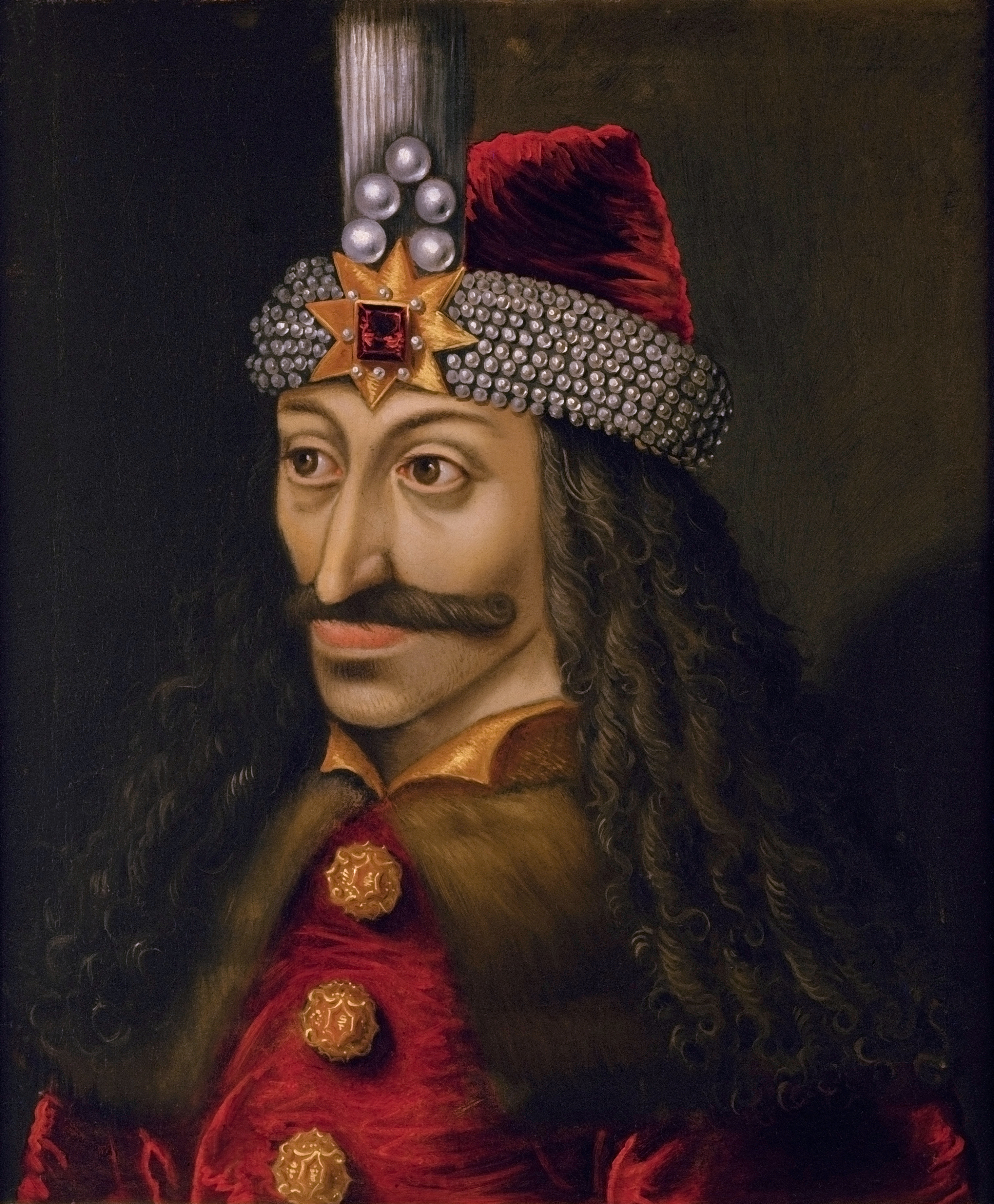
The Dracula-as-anti-Islamist theme is a deliberate departure from, almost an inversion of, the depiction of Dracula in Bram Stoker’s novel. Though Dracula’s historical precursor Vlad the Impaler fought the Ottomans, anti-Islamism plays almost no role whatsoever in Stoker’s Dracula: Stoker’s Dracula equates the “Turk” with white invaders (Wallachian, Saxon, Austro-Hungarian); meanwhile Stoker “Orientalizes” Dracula himself despite his (Dracula’s) past life (lives?) as an anti-Ottoman freedom fighter. Transylvania, Dracula tells Jonathan Harper, “was the ground fought over for centuries by the Wallachian, the Saxon, and the Turk.”

Why, there is hardly a foot of soil in all this region that has not been enriched by the blood of men, patriots or invaders. In old days there were stirring times, when the Austrian and the Hungarian came up in hordes–men and women, the aged and children too–and waited their coming on the rocks above the passes, that they might sweep destruction on them with their artificial avalanches. When the invader was triumphant he found but little, for whatever there was had been sheltered in the friendly soil. (Bram Stoker, Dracula, p. 22).

In other words, Dracula was a rock-throwing Transylvanian nationalist ready to fight any invader who dared set foot in his lands.

Which is why Stoker gives him the physiognomic treatment reserved for Oriental nationalists:

The mouth, so far as I could see it under the heavy moustache, was fixed and rather cruel-looking, with peculiarly sharp white teeth; these protruded over the lips, whose remarkable ruddiness showed astonishing vitality in a man of his years (p. 18).

Interestingly, Stoker gives a much longer description of Dracula’s physical appearance but pointedly (so to speak) omits a description of the Evil One’s eyes. All in all, Stoker’s Dracula sounds like the spitting image of Yasir Arafat. Right?

Yasser_Arafat.jpg (1691×2539)

Vlad_Tepes_002.jpg (392×483)

Photo credits: Wikipedia

Right. Obviously, they’re not going to give the game away by opening their mouths.

Clearly, there are dissertations waiting to be written here: Dracula and the Ottoman OtherStok(er)ing Orientalism, (Jonathan) Ha(n)k(er)ing After British Imperialism, and so on, and my only regret is that I can’t write any of them. But obviously, some have, and more power to them. Read them, the tenure-seekers of the night. What music they make!

All right, enough: off to really scary things. Like paying the rent.

New Blogger: Stephen Boydstun

I’m happy to announce that Policy of Truth is getting yet another blogger, Stephen Boydstun. I don’t exactly remember where Stephen and I met, but I think it was either at Marsha Enright’s justifiably famous New Intellectual Forum “salon” in Chicago in the early 1990s, or at one of the Institute for Objectivist Studies summer seminars around the same time. Anyway, we met a long time ago, and we’ve been talking philosophy ever since. The last time we did that (in person, anyway) was 2013, at the epistemology seminar that Carrie-Ann and I did in Glen Ridge.

Here’s a bio of Stephen I found online:

My academic backgrounds are in physics, philosophy, and engineering. My engineering work was building locomotives, then I switched to nuclear power electrical generation. Engineering rounded out the understanding of the physical world I had from physics. Now all those backgrounds, and long study of philosophy, too, are put into my project of writing my own philosophy.

I created, financed, and edited Objectivity, a hardcopy “journal of metaphysics, epistemology, and theory of value informed by modern science” (1990-98). All issues of Objectivity are now freely available online for readers and researchers.

On the romantic side, my partner’s name is Walter. We have been together nineteen years. He has two sons and one grandson, now age fourteen. It is wonderful to have a family.

The last sentence of the first paragraph refers to a book that Stephen is currently working on, parts of which I believe he’ll be trying out on us. (Here’s another bio of Stephen I found, by the way.)

And here’s a bit about the book in question (written in December 2014):

I have been writing a book of philosophy since last January [2014]. It is my first. Throughout the preceding thirty years, I had written essays. Writing essays had to be stopped while I write this book. Into my book, as into all my previous essays, there goes a lot of study. My writings in philosophy are informed by the history of philosophy and contemporary philosophy and informed by mathematics and by modern physical science, engineering, biology, neuroscience, and psychology. …

I cannot share the title of my book at this time. It deals with metaphysics, epistemology, and theory of moral value. I shall not be treating esthetics. Theory of individual rights will be entered, but beyond that, I shall not undertake political philosophy.

So it looks like some of us are actually going to have to learn some science if we’re to understand what Stephen is talking about–something I haven’t bothered to do since the introductory Geology/Biology course I took in my sophomore year of college (roughly: “Rocks and Cells for Idiots 101”).

Like all PoT bloggers Stephen will be blogging whenever he wants. I have no idea when that will be, but until then, a warm welcome from the rest of the PoT crew….

And now back to our regularly scheduled programming of bad jokes and overheated polemics from yours truly.

Postscript, November 5, 2015: Stephen will be blogging under the online moniker “guyau.”

Robot Sex: A Quickie

I’ve been too busy lately to write any new blog posts, but not so busy that I haven’t been able to spend some of the little free time at my disposal reflecting on that overridingly important issue du jour, robot sex. Stephen Hicks’s discussion is one of the more enlightening ones I’ve read so far–exemplary for getting past the “ew factor” (in which I was mired before I read it) and clarifying the relevant issues.

The next step would be to come up with a way of distinguishing between those for whom robot sex was an all-things-considered best option considering the circumstances, and those for whom robot sex was a problematic form of acquiescence in the less-than-best, i.e., the moral equivalent of “settling” or satisficing. For whatever it’s worth, my own view is that robot sex can be a “best option considering the circumstances” in the first five of the bulleted cases Hicks mentions, but is an acquiescence in the less-than-the-best in the latter two.

Unfortunately, I can’t elaborate on that right now, because I’m soon due at a talk on…Gaza. There’s something surreal and disorienting about a world in which one spends part of the day doing real work, part of it reflecting on robot sex, and part of it attending a lecture on Gaza–something problematically reminiscent of Marx’s explication/defense in The German Ideology of the dilettantism of communist society:

In communist society, where nobody has one exclusive sphere of activity but each can become accomplished in any branch he wishes, society regulates the general production and thus makes it possible for me to do one thing today and another tomorrow, to hunt in the morning, fish in the afternoon, rear cattle in the evening, criticise after dinner, just as I have a mind, without ever becoming hunter, fisherman, herdsman or critic.

I realize that I’m digressing here, but mutatis mutandis, doesn’t Marx’s aspiration describe middle- to upper-middle class capitalist society?

I think it does, but I don’t have time to elaborate on that, either. Off to Gaza-in-Clifton, then. With luck I’ll manage to summarize the water symposium and Gaza talk later in the week.

#OpenGaza: Trauma and Hope, First Hand

Just a shout-out to anyone in the north Jersey area interested in attending this event, #OpenGaza: Trauma and Hope, First Hand, taking place this Tuesday, October 27, 8-10 pm at the Palestinian American Community Center of Clifton, New Jersey, 388 Lakeview Ave., Clifton, New Jersey 07011. Speakers include Dr. Yasser Abu-Jamei, Executive Director of the Gaza Community Mental Health Programme, and Ran Goldstein, Executive Director of Physicians for Human Rights, Israel. The event is free. I’ll be there, and easy enough to pick out of the crowd–the fiftyish woman with stylish glasses, suave, oddly masculine looks, and black nail polish. (ht: Mondoweiss)

By coincidence, last month I spent a weekend “conferencing” with Izzeldine Abouelaish, founder of Daughters for Life and author of I Shall Not Hate: A Gaza Doctor’s Journey. Izzeldine, whose daughters and niece were killed in 2009 by Israeli rocket fire in Gaza, is one of those supposedly mythical Palestinians committed to peace despite having endured trauma at Israeli hands. More on Izzeldine’s book once I finish it; for now, I just couldn’t resist mentioning the coincidence of “two-doctors-from-Gaza-with-messages-of-hope-amidst-trauma.”

Mention Gaza to the average American news junkie, and the immediate association is “Hamas” and “Islamist fanaticism.” Not that those things don’t exist, but there are more things in Palestine than are dreamt up by such stereotypes, and I’d like to think that events like the PACC talk and like Izzeldine’s book and foundation will eventually break the reflexive associations of “Palestinian” with “wild-eyed religious psychopath” and replace them with something more respectful of reality. The audacity of hope, to borrow a phrase.

Communication Breakdowns: Heckling, Interruptions, Screaming Matches and Other Violations*

If you doubt that, try to watch the videos embedded in this link, if you can. You can’t, because the heckling drowns out the speaker. The police, we’re told, refused to escort the hecklers out on “free speech” grounds, but the ultimate result was that Levy was unable to give his speech. It’s an understatement to call that “problematic.”

The preceding set of videos happens to involve a pro-Palestinian speaker and pro-Israeli hecklers, but the principle applies all ways around. Here’s Israeli ambassador Michael Oren being heckled during a speech he gave (or tried to give) at UC Irvine in 2010. I admire Levy and despise Oren, but I have the same view in both cases: the anti-Oren hecklers, like the anti-Levy ones, should have been removed from the hall–by force, if necessary.

Heckling may well take the form of speech, but it violates free speech by interfering with the free speech rights–disturbing and interrupting the speech–of the person who has prior claim to the floor. It can sometimes be unclear who has prior claim to the floor–which is why we have rules of order–but it usually isn’t. When it is clear, it’s equally clear what should be done with hecklers: either shut up or be thrown out and locked out. This sort of reaction is graceful and intelligent, but it still sort of misses the point and misses the mark (I’m referring to the effort at persuasion before the removal). So should senators be thrown out of the State of the Union address? Yes, senators too.  For a one-word outburst? For a one-word outburst. Even if Obama was lying? Even if Obama was lying.

Feel free to demonstrate outside the hall, or to ask brutal questions during the Q&A–but speeches, like concerts, should compel absolute silence from the audience. If you’re sufficiently offended, leave. But if you decide to stay, the principle of free speech demands that you hold your peace–whoever you are, whoever the speaker is, and whatever the speaker is saying.

Postscript, October 28, 2015: This story (and video) doesn’t induce me to re-think my view on heckling, but it does induce me to offer a few caveats or qualifications. I linked to the preceding version of that story because it has the best video quality of any that I’ve seen, but (like the Huffington Post version of the story) it conveniently omits the fact that the protesters interrupted Trump’s speech by chanting at him. (The Huff Post video mentions the interruption.) I have no love for Trump, but I don’t think anyone has the right to interrupt his speech (or anyone’s speech) in this way.

As a first resort, in cases like this, the protesters should be told to stop interrupting. If they don’t agree to stop, or don’t stop, they should be removed from the premises of the talk. Ideally, they should be removed by parties designated to handle security (assuming that someone is designated). If a security detail is there, no one should be allowed to remove the hecklers but them. Obviously, if the talk is being guarded by a police detail, the task of removing hecklers is their job, not that of the audience.

If the hecklers/protesters don’t agree to leave, I still think they should be forced out. But the force used to remove them should be proportionate to the force by which they resist leaving: the less they resist, the less force is needed. Disproportionate uses of force should in this context be treated as new initiations of force–in other words, as battery. The video makes clear that the force used to remove these protesters was grossly disproportionate to what was needed to remove them. The guy in the pink shirt should absolutely have been (or be) arrested for battery.

It’s amazing that a person could be recorded on video as battering someone, and not just get away with it, but have essentially been incited into the act by a candidate for the U.S. presidency. But maybe it isn’t so amazing. Maybe it’s only as amazing as the fact that Donald Trump is the GOP front-runner for the presidency in the first place. And at this point, maybe that’s not so amazing, either.

Postscript, November 6, 2015: More of the same at the University of Minnesota, Minneapolis,this time aimed at the Israeli ethicist Moshe Halbertal.  The excerpt in the link (from The Tablet) of the University’s Student Conduct Code seems to me to take the right approach to such matters.

I have to confess that I was tempted to heckle at this presentation I attended last night, at the Alanson White Institute in New York. The temptation is (nearly) overwhelming when a presenter consciously and strategically decides to bullshit the audience for 90 minutes, evading all substantive issues and abusing his critics more or less with impunity. But I decided to take my own advice–holding my tongue, leaving about twenty minutes early, and letting loose with a torrent of profanity once I was a safe distance from the hall. I’ll have to discuss the brazen dishonesty of Jeffrey Lieberman’s presentation–and the dismal intellectual standard of the entire evening–in a post of its own.

Postscript, November 9, 2015: Here’s a good summary of the Lieberman talk, minus a few things here and there in the three-way exchanges and the Q&A. I have a query out to the White Institute asking whether they’ll be making a video of the event public. I hope they will: I’m pretty sure the event was videotaped, and a wider public would benefit from watching the presentation and subjecting it to rational criticism. [Elizabeth Rodman, of the White Institute, in an email to me: “No, there is no video available for public viewing.”]

If Dr. Lieberman and his colleagues really mean what they say about rejecting the tribalism of psychiatry’s past (and that of psychoanalysis), now would be the time for a bit of transparency. Transparency, by the way, is the other side of the audience’s obligation to refrain from heckling a speaker: no one has the right the heckle, but the speaker has the obligation to come clean with his audience and allow for criticism rather than try his best to shut it down (a la Lieberman). It’s sad to have to explain all this to supposed professionals in mental health, but I guess we all profit from having to re-learn our ABCs sometime.

Postscript, November 12, 2015: Not exactly a “heckling” story, but in the same neighborhood. It seems hard to top, but then there’s always this.

Postscript, November 15, 2015: I don’t often agree with Brian Leiter, but this post on recent events at Yale seems to me exactly on target.

Postscript, November 16, 2015: Another discursive train wreck, this time at UT Austin, care of the Palestine Solidarity Committee. Don’t really see how this sort of thing promotes Palestinian rights. So if a bunch of pro-Israel protesters comes in to disrupt a defense of Palestinian rights, we’re obliged to let them disrupt the talk? Or is it that pro-Israel protesters wouldn’t have the same rights as defenders of Palestinian rights? Kind of stupid, no matter how you parse it.

Postscript, January 3, 2016: Here’s an interesting one, from a meeting in Orange County, New York involving a land-annexation dispute between the Hasidic community of Kiryas Joel and its non-Hasidic neighbors. Brooklyn assemblyman Dov Hikind shows up, and as an opening gambit insinuates (without explicitly coming out and saying so) that opposition to Kiryas Joel’s annexation bid is anti-Semitic. The crowd responds, understandably (but not in my view justifiably) with boos, jeers, and hisses. One guy in the second row stands up in protest at Hikind’s remarks and turns his back to him (Hikind himself had turned around to address the audience he was accusing). The presiding officer of the meeting asks security (in the form of uniformed officers) to usher the disruptive audience member out of the room. He refuses to leave, but promises to stay in his seat; eventually, security backs down.

Though I agree with the town council’s handling of the hecklers, Hikind’s behavior here is disgraceful. “The issue,” he thunders, “is not the annexation!” Actually, that’s exactly what the issue is, and a person who doesn’t want to discuss it has no business attending a meeting about it. Hikind doesn’t manage to say a single word about the merits of the annexation issue. He just engages in a bit of cheap demagoguery, then sits down. If Hikind has evidence of anti-Semitism, he should produce it. If not, he’s simply poisoning the well.

It’s actually unclear to me why a Brooklyn assemblyman would be asked or permitted to address an audience in Orange County (a good 90 minutes northwest of Brooklyn) on the subject of a disputed annexation there. In any case, the meeting’s presiding officer ought to have commented on the inappropriateness of Hikind’s comments. It’s not clear from this video how the officer reacted, or if he did. Contrary to the impression one gets, the jeering of the audience, though a problem, was far from the only problem in this episode. (Postscript, January 4, 2015: This critique of Hikind from a website run by Orange County locals is entirely on target.)

Soundtrack by Led Zeppelin (sort of)….

*I’ve renamed this post to better reflect the postscripts.

I changed my political affiliation. Now it’s time to change my name and gender.

To procrastinate from grading ethics quizzes, I decided to waste time and take this online personality test. They supposedly guess your identity in twenty questions. Here is mine:

Female, Mid 50’s

Female,

Here is our best guess at who you are:
1. You are female.
2. You are currently in your mid fifties.
3. You have a wonderful big family and a deep loving connection with your lifelong partner.
4. You have Short hair, light colored eyes and stylish glasses.
5. You have long ago decided to live every minute to the fullest. Your life experiences taught you that no moment should be wasted on something or someone you don’t love.
Nailed it!