Anti-Fascist Answers to Would-Be Thought Police

[Note: This post began life as a reply comment to Irfan’s recent PoT post: “Anti-Fascist Questions for Anti-Woke Warriors.” But it got to be too long for such a format, so I’m posting it on its own. However, I haven’t changed its tone of direct address to Irfan or bothered to summarize Irfan’s post or make long excerpts from that post. Thus, for the present post to be intelligible, one ought first to read the original post linked above.]

Hi Irfan,

I disagree with pretty much the entirety of your fundamental argument. No surprise there, I guess. However, I also found that argument thought-provoking. It has stimulated me to develop some thoughts on these questions that I’ve had incubating for some time. So, in what follows, I’ll concentrate on what seems new (to me, anyway) and try to avoid rehashing what we’ve been through before.

It seems like your argument can be summarized as, “Sometimes a lynch mob gets someone who richly deserves lynching. Therefore, lynch mobs are cool.” Stated thus baldly, I would hope it is obvious both that the conclusion does not follow from the premise and that the conclusion itself is unacceptable on the merits. The mafia, for example, does not become a good institution that should celebrated and promoted under the banner of social justice activism just because it so happens (as surely it must) that a just outcome is sometimes brought about by a mob hit.

Continue reading
The Wizards of Uz

From E.M. Cioran’s The Trouble with Being Born:

According to the Bible, it is Cain who created the first city, in order to have, as Bossuet puts it, a place wherein to hide his remorse. What a judgment! And how many times have I not felt its accuracy in my night walks through Paris!

So can we can infer that “the perfect and upright” Job created the first suburb in order to have a place wherein to display his self-satisfaction? Or was it to hide his despair? Or both? 

Law’s Empire

When I was younger, I had this conviction that the law was a noble calling allied with rationality and justice. The more I learn about it, and see of it, and deal with it, the more it seems a grotesque parody or subversion of those things. Necessary? Yes. Noble? Not really. Often, it just seems like a game played by the rich, educated, and powerful, intended to rationalize whatever needs to be rationalized so that the world stays the way it is.

Continue reading

Cautionary Tale

From the US State Department’s periodic safety advisory to travelers, Nov. 23, 2021:

Reconsider travel to Israel due to COVID-19. Exercise increased caution in Israel due to terrorism and civil unrest.

No need to “exercise caution” due to the Israeli occupation of the West Bank or the Israeli siege of Gaza, apparently. Sporadic terrorism and vague hints of “civil unrest” are cause for concern, but a military occupation/siege enforced by M-16s, F-16s, phosphorus bombs, tear gas, armored vehicles, militarized bulldozers, and state-sponsored vigilantism is nothing to worry about.

Could the selectivity of the worries expressed by Foggy Bottom reflect the selective nature of its intended audience?

A Puzzle in Aristotle: Why Must There Be an Unmoved Mover?

A well-known doctrine of Aristotle’s is that of the unmoved mover, the first cause of the eternal motion of the universe. Aristotle’s key argument for the necessity of an unmoved mover is presented in Physics, Book VIII, chapters 4–5, where he argues, first, that everything that is in motion must be moved by something (ch. 4) and, second, that a thing cannot move itself (ch. 5). I have long been puzzled by this argument, and lately I have come to think it’s not just my ignorance—there really is something wrong with the argument. My aim here is to explain what it is.

Continue reading

Attention Must Be Paid: The Joys of Third-Party Voting

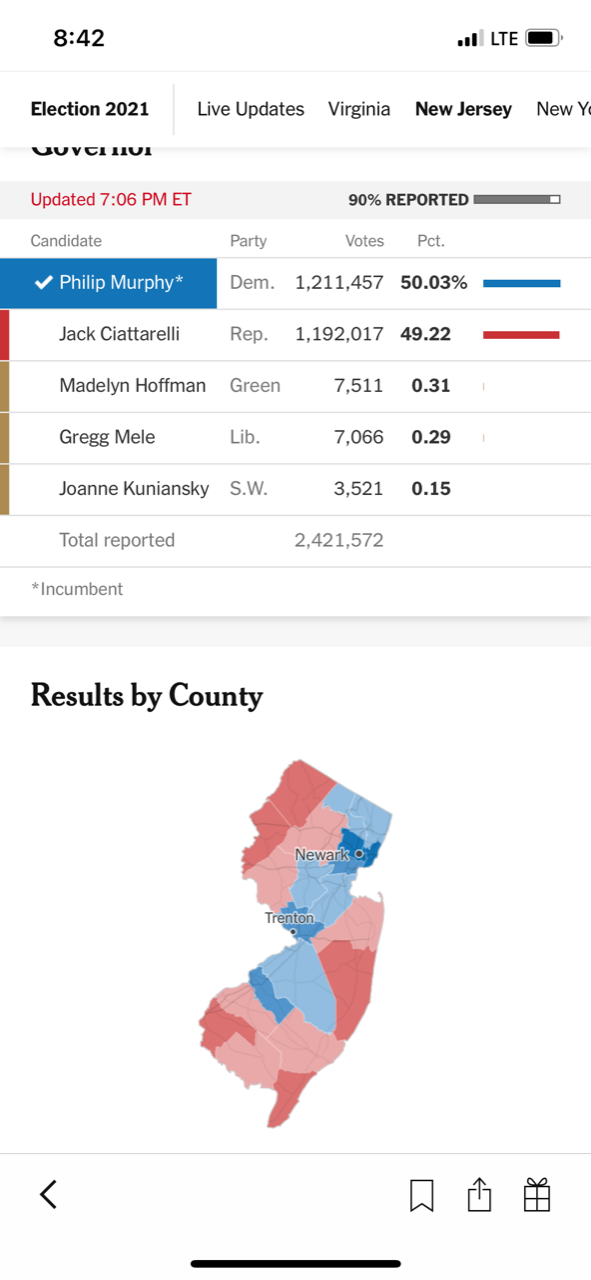
Conventional wisdom has it that voting is a waste of time, and third-party voting, even worse. Voting is a waste of time because a single vote can’t change the outcome of an election, and third-party voting is worse because third parties have no chance of winning elections in the US.

Well. From The New York Times, Wednesday, November 3rd around 8:40 pm.

results.2021

Continue reading

A Vote for Curtis Sliwa

Here’s an article from The New York Times on the mixed bag that is Curtis Sliwa.

It’s hard for me to be impartial because we’re friends (distant friends, but still friends). I freely confess to being prone to dismissing his wrongdoing as venial shenanigans and dumb, regrettable shit of the kind everybody does. He just did a lot of it, over and over again, in the public eye. But hey. Nobody’s perfect. Continue reading

the right sort of intrinsic desire to avoid doing morally wrong things

One can do what is morally right without the action having moral worth, as with Kant’s (merely) prudent shopkeeper (not overcharging a naive customer when she easily could). The reason that the shopkeeper’s right action lacks moral worth is, roughly, that she does not have the right sort — the moral sort — of aim or motivation in doing the right (honest) thing.

In recent literature, folks distinguish two different sorts of motivational contents (motivating reasons) that might go into having the correct sort of motivation for a right action to have moral worth. First, there is content that concerns right-making features (RMF-type content), content like that overcharging this customer would fail to treat each customer equally. Second, there is content that concerns rightness (or wrongness) itself (RI-type content), content like that it would be wrong to charge this customer more than I charge the others. Some, like Nomy Arpaly and Julia Markovitz, have argued that only RMF-type motivational content is necessary. One intuitive point that works in favor of this approach is this: absent any knowledge of what makes a right action right, the insistence on doing the right thing can begin to look like a kind of empty fetish. Also, in the Huckleberry Finn case, Huck doesn’t turn Jim (the slave) in partly because he sees Jim as concretely human in various aspects (something that would make turning Jim in wrong, so an RMF-content) even though he thinks doing this is wrong (an RI-content that motivates toward turning Jim in).

More recently, others (e.g., Zoe Johnson King, Paulina Sliwa, Kashev Singh) have argued that RI-content is necessary as well (and sometimes that RI-content is primary, as Johnson King and Sliwa argue). Among other things, these authors (and others) produce reasonably convincing arguments against drawing the conclusions that Arpaly and Markovitz draw from cases of doing what is right simply because it is right (with no particular understanding of what makes right actions right operative, hence the charge of fetishism) and from the Huck Finn case (responding, by doing what is right, to the things that make the right action right, while holding explicit judgments that the right action is wrong).

Continue reading

The “Other Side” of the Holocaust

My response to a (perfectly legitimate) critique of the Texas directive demanding that teachers teach “both sides” of every issue, including the Holocaust:

Irfan Khawaja October 16, 2021 at 11:08 am

This is a fundamentally idiotic directive with a fundamentally idiotic motivation. But if they’re really duty-bound to abide by it, why not teach the history of the Palestinian nakba of 1947-49? The Palestinians were (and are) the victims of the victims of the Holocaust, the people whose story is rarely told in American discourse. If you want “the other side” of the Holocaust, that’s it. You don’t have to tell the Holocaust from the perspective of David Irving or the SS. Tell it from the perspective of those who were collateral damage of the attempt to compensate the victims.