We’re reading Hayek’s famous paper, “The Use of Knowledge in Society,” in our monthly reading group tomorrow. I’ve never been convinced by Hayek’s argument, and get less convinced every time I re-read the paper. I don’t have time to work out a full response to the paper, so here, for whatever it’s worth, is a quick laundry list of objections to be developed at some later date. Continue reading
Author Archives: Irfan Khawaja
Stirring the POT (1)
February 2025
Here’s a bunch of announcements I’ve been meaning to post for awhile. Going forward, I’m going to try to post a collection of these each month, ideally toward the beginning of the month. Yet another New Year’s Resolution for 2025–let’s see how long it lasts. I’ve already missed January! Continue reading
Academic Hiring and Genocide
“In the literature of complaint and reform, and in the endless reports from distinguished groups identifying a crisis in some element or all of higher education in America, a key defect is often the absence of practical solutions.”
–John V. Lombardi, How Universities Work, p. 31.
In an essay I posted here a few weeks ago, I argued that genocidaires seeking lower-level electoral office should be denied such offices at the ballot box. The argument was framed as a response to Jason Brennan’s account of the ethics of voting, which he describes as “the ethics of voting in political contexts.”(1) Though he doesn’t quite define “political contexts,” it’s obvious enough that he means voting in democratic elections for governmental office, e.g., for U.S. President, for legislative offices, and in some cases for judicial offices, taking U.S. electoral politics as the paradigm. Continue reading
No More Tears
The Selena Gomez controversy may not be your idea of a top story right now, but I think it has a certain interest to it. As you may know, Gomez took to social media to post a video of herself sobbing about the recent ICE deportations. No sooner did she do so, but she was assailed for it. She tried to explain herself, only to invite further derision, then ended up deleting both the original post and one of her later explanations.
Of particular interest to me is this riposte to Gomez from Thomas Homan, acting director of ICE during Trump’s first term, and now the White House “border czar.”
We’ve got a quarter of a million Americans dead from fentanyl coming across an open border. Where’s the tears for them?
The border isn’t “open,” and the “quarter of a million” figure is phony. But I have a pretty direct answer to Homan’s question, and have special standing to answer it: If you want tears, look elsewhere. Continue reading
Learn the Language
A friend of mine was unceremoniously fired from Felician University in 2023–one of sixteen people fired on a single day–after 23 unrelenting years as an English comp instructor to students with an average SAT verbal score well below 500. I described her in a letter of recommendation, without exaggeration, as “the most dedicated college instructor I had ever encountered” in two+ decades in the profession. Her office was across the hall from mine, and every now and then I’d eavesdrop on her efforts. I couldn’t imagine putting even half the effort into teaching that she did. Continue reading
Advice for the Democrats
Been dazed and confused for so long, it’s not true…
Wanted a president, never bargained for you
–Led Zeppelin, “Dazed and Confused” (more or less)
Oh, the poor Democrats. Here’s The New York Times lamenting their fate.

Come on Dems, you can do this. Just pretend that Donald Trump is a Palestinian ER physician, and that the White House is a pediatric trauma center in Gaza. How hard could it be?
Nowhere to Hide
About a month ago, I described an unwelcome encounter I’d had at work with the Department of Homeland Security (ICE). Today I had one with the Israeli authorities–while sitting at a desk in Iselin, New Jersey.
A friend of mine, along with his wife and several small children, is literally going hungry in the West Bank, has had nothing to eat for days. They’ve been fully locked down since 2023: no work, no money, nowhere to go. The army is in their village every day, smashes into their house every now and then. The world a mile outside of their village is a shooting gallery where violent death lurks around every corner. The IDF told them flat out to leave now or die later. They’ve opted for “die later.” Continue reading
The “Ceasefire” Fraud
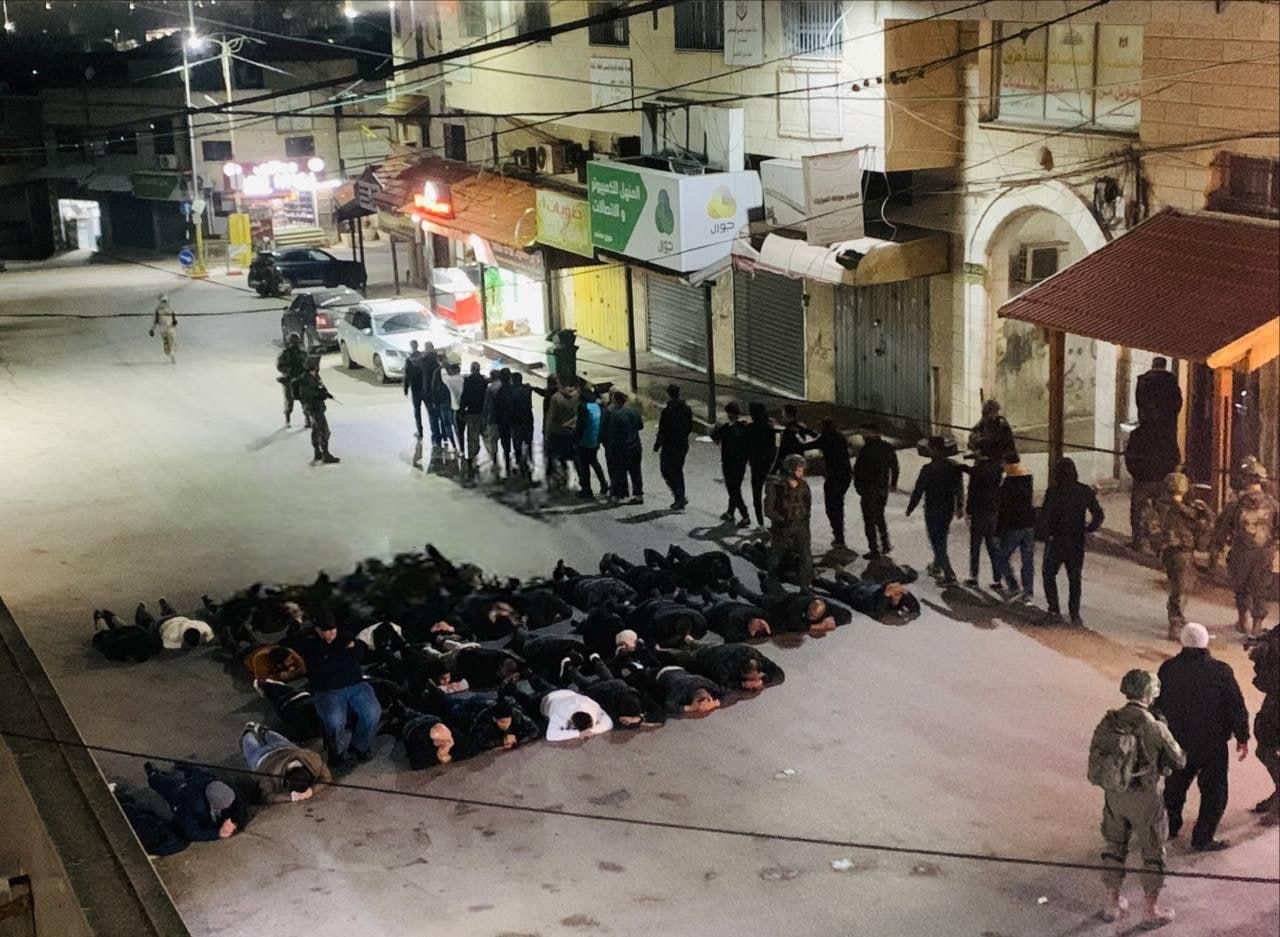
This is what the vaunted “ceasefire” actually looks like in the West Bank: disarm the population, box them in, round them up, incarcerate them en masse. The occupation has quietly swept dozens into jail, and settlers have set fire to the village of Sinjil. Not a shot fired, though.
Continue readingCharacter-Based Voting and Genocide
It’s been a while since I’ve beaten up on Jason Brennan’s “argument” against character-based voting, but I’m feeling the urge again, so here I am, hot to go.(1) The crux of Brennan’s argument is that it’s wrong to vote for political candidates on the basis of their traits of character, except when character is a predictive proxy for the policies they can be expected to enact once in office. In a formula (Brennan’s formula, made in discussion here on PoT): “policy > character.” Taken literally, the argument proscribes voting against any candidate, no matter how evil, if the evil he exemplifies is policy-irrelevant. My aim here is to add yet another counter-example to my ever-growing list of counter-examples to Brennan’s thesis, partly for the understanding it affords, and partly for the fun of it. Continue reading
Engels on Social Murder
“Social murder” is a form of homicide that takes place through relatively invisible social processes involving collective rather than individual responsibility. The concept is controversial because it attributes murder to “society” while relying on an unconventional conception of murder: society intends murder, and society kills, where society is identified with a ruling class that controls the political system. What’s controversial here is that social murder kills mostly by omission rather than commission, and is perpetrated by a class rather than by individuals. Both assumptions flout the conventional understanding of the intentionality and causality of murder. Continue reading
 Policy of Truth