One contested question is the extent to which Mikie Sherrill would be willing to accept complicity in someone else’s wrongdoing in the name of, say, misplaced loyalty to someone or something. Would she knowingly cover up someone else’s wrongdoing? Would she tolerate someone’s dishonesty in a morally consequential matter? Would she play dumb if she thought that doing so was somehow justified? Would she, on being called on it, double down?
The answer to all of these questions is yes, and has been documented and litigated (and now also forgotten) in detail. During the 2025 New Jersey gubernatorial campaign, it was revealed that Mikie Sherrill didn’t walk in her graduation from the Naval Academy because she failed to report cheating on an exam. There’s no need to get side-tracked on whether it was the explicit policy of the Naval Academy to demand reporting (I’m inclined to think it was implied by their explicit policies). If there is widespread cheating on an exam that you are taking, and you know that there is, you have an obligation to say something to the relevant authorities about it. Even if you merely suspect there is, you have an obligation to relay your suspicion. If you don’t, it’s ipso facto the case that you tolerate dishonesty, and are partly complicit in it. You are knowingly, willingly, part of the process by which the fraud takes place. One estimate holds that 400 of the 663 candidates for the exam had seen it before taking it.
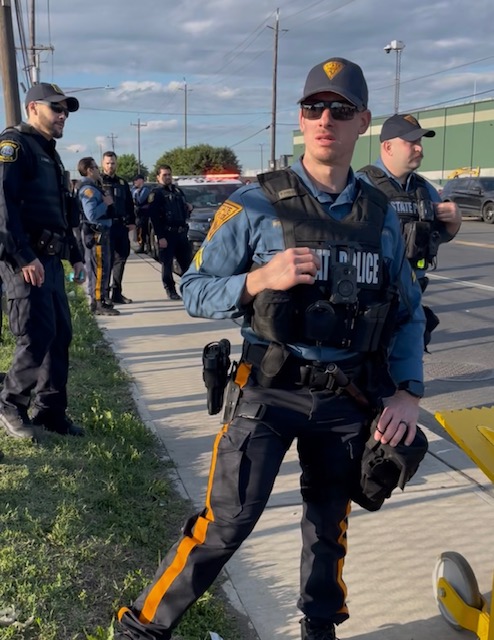
New Jersey State Trooper, Doremus Ave, Newark, June 1, 2026 (photo: Irfan Khawaja)
Sherrill’s critics raised a fair set of questions: how do we square Sherrill’s silence with respect to the exam with her devotion to the Navy? Why would a person committed to the Navy fail to report malfeasance of this nature, malfeasance that could only serve to weaken the organization? How can a person brag about the greatness of the Navy in the knowledge that cheating of this kind not only took place at the Naval Academy, but according to Sherrill ought to have been tolerated when it happened? If Sherrill is right, the very ethos of the Navy rewards toleration of and complicity in the dishonesty of others. If, as she brags, she internalized that ethos, could she not have internalized it with respect the New Jersey State Police?
Maybe she just had no idea that anything was happening. Yet she was disciplined, and she herself has admitted to telling investigators what she knew. “I knew people who were implicated,” she has said, “but I didn’t come forward with that information.” That admission seems hard to get around.
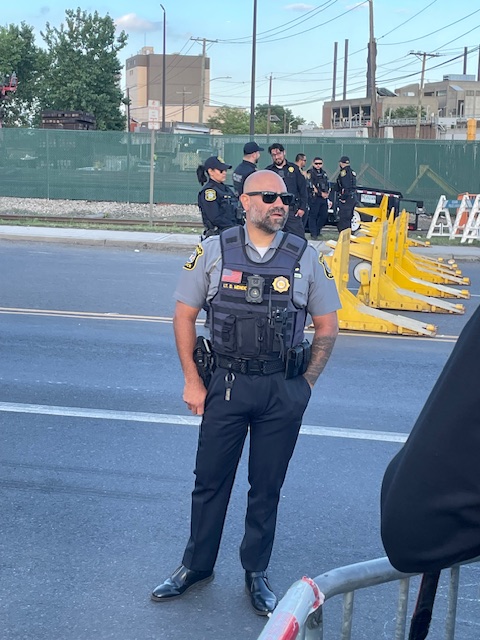
Newark Police Officer, Doremus Ave, Newark, New Jersey, June 1, 2026 (photo: Irfan Khawaja)
If she somehow knew nothing, or knew something but did nothing wrong, she might have authorized the opening of her disciplinary records to prove her version of events. But she refused. It’s worth noting that the same Mikie Sherrill who claims that ICE must have something to hide because it refuses to allow her to inspect Delaney Hall herself refused to authorize public disclosure of her disciplinary records from the Naval Academy. But you can’t have it both ways. Either refusal to disclose implies concealment of wrongdoing, or it doesn’t. Sherrill can’t consistently claim that ICE has to open its facility to her scrutiny but that she need not open her disciplinary records to ours, not after the time and energy she’s spent hyping her years in the Navy.
If she really did nothing wrong, the fact remains that the Navy punished her. In that case, they did something wrong. Yet she has nothing but praise for the Navy (to put it mildly), and couldn’t stop invoking it throughout her campaign in order to burnish her own credentials. But again, you can’t have it both ways: you can’t say that you were innocent without saying that the organization that found you guilty was wrong. “In the Navy,” she’s said, “I learned to find a way or make one.” The problem is that that claim blurs easily into the belief that when you can’t find a way, you make shit up.
And yes, Sherrill spent the entirety of her gubernatorial campaign bragging about her experience in the Navy. Her Republican rival made an irrefutably correct point about it:
“Today’s admission by Congresswoman Sherrill that she was implicated in, and punished for, her involvement in the largest cheating and honor code scandal in the history of the United States Navy is both stunning and deeply disturbing,” Arpert stated. “For eight years, Mikie Sherrill has built her entire political brand around her time at the Naval Academy and in the Navy, all the while concealing her involvement in the scandal and her punishment. The people of New Jersey deserve complete and total transparency.”
Aircraft carrier, Norfolk, Virginia (taken from the Hilton Norfolk, photo: Irfan Khawaja)
I discussed Sherrill’s cheating scandal in a post I wrote here last September, “Karma Comes for Mikie Sherrill.” The first half of the post discusses an unrelated aspect of the scandal, but the second half discusses what I regard as Sherrill’s culpability in the cheating scandal itself. It was precisely Sherrill’s inability to answer the charge of culpability in the scandal–and inability to dispose of the issue–that led her to confabulate the charges against Jack Ciatterelli that I described in a previous post.
Just to be clear: because she couldn’t answer a perfectly reasonable charge of complicity, Sherrill confabulated a charge of murder. Get clear on the pattern there. The underlying principle is: when I’m in a jam that involves my complicity in wrongdoing, I get out of it by accusing others of wrongdoing.
I haven’t yet argued this is what she did with respect to ICE and the New Jersey State Police in the Delaney Hall crisis. I’ve simply argued that having done it once, we can reasonably come to the present controversy with the belief that she might very well do it again. In other words, in thinking about the present controversy, there is nothing problematically “conspiratorial” about thinking that Sherrill might, say, have falsely accused protesters of wrongdoing to avoid charges of complicity in the wrongdoing of law enforcement–the law enforcement she ostensibly sent out to “protect” them. That’s a perfectly legitimate hypothesis, underwritten by prior events. Nor, considering her valorization of the Navy–a Navy where cheating was rampant, and cheaters were tolerated–is it conspiratorial to think that she might overlook some of the malfeasances of the New Jersey State Police, assuming it had any. That, too, is a perfectly legitimate hypothesis given prior events.
The “conspiratorial” hypotheses are legitimately in play because they have confirmation in prior events. Making a false accusation to avoid a charge of complicity is precisely what she did on the prior occasion. So is making excuses for a transparently problematic but much-hyped organizationwhose fortunes are central to your own. It remains to be seen whether she repeated the pattern here. More on that in a forthcoming post.