The Politics of Affordable Housing in New Jersey
As you read the feel-good love-fest linked to this post (whose warm fuzzies I don’t begrudge anyone, least of all myself), bear in mind that over the last few weeks, twenty people have died of exposure in New York City, and twenty in New Jersey. Though it’s difficult to count, there are by some estimates 13,748 people experiencing homelessness in New Jersey right now, an increase of some 57% since 2022. The homeless have become a recognizable presence not just in larger cities, like New Brunswick, where they’re mostly taken for granted, but in affluent towns like Princeton, where many ride mass transit all day to keep out of the cold.
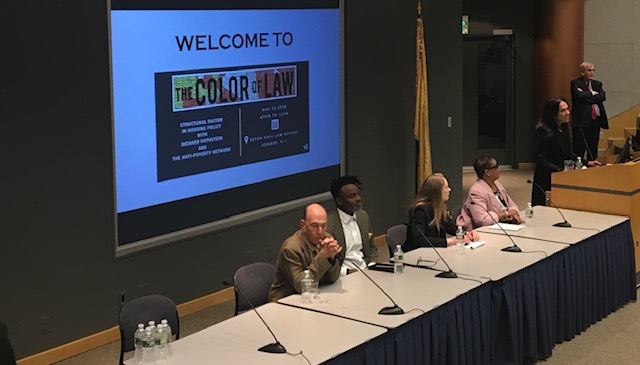
Richard Rothstein, at a symposium on his book The Color of Law, Seton Hall University Law School, Newark, New Jersey (May 2018)
Despite this, virtually every small-town municipal council in New Jersey–Princeton, Montgomery, West Windsor, West Orange, Millburn, Montvale, West Amwell, Warren, etc.–is committed both in theory and in practice to resisting affordable housing mandates. Every council meeting I’ve visited over the last year focuses with righteous indignation on how to evade the state’s affordable housing laws, and/or on the prospects of the latest litigation against them. These are towns willing to spend money hand-over-fist on plaintiff’s attorneys, but too chintzy to put up with affordable housing.
They’re likewise towns willing to accept whatever federal immigration law demands of them, but unwilling to accept what state affordable housing law demands of them. Unlike ICE, the state’s DCA–its Department of Community Affairs–is something they’re willing to fight to the death, meaning, of course, the deaths of those without shelter. In this inverted moral universe, affordable housing is our enemy, but ICE is our friend.
In a depressing but predictable development, almost thirty New Jersey municipalities currently have a case pending before the US Supreme Court, seeking to overturn Southern Burlington County NAACP vs. Mt. Laurel Twp. (1975), New Jersey’s landmark inclusionary zoning decision. What this amounts to is an unapologetic statewide desire to return to the days of exclusionary zoning, which is to say, to the days of both suburbanized Jim Crow and even higher housing prices than we currently have (on which, see this and this). It’s a bipartisan effort, led as much by Democrats as by Republicans. If it’s to be opposed, it has to be opposed by people as willing to take on Democrats as Republicans. Doing so is one of my New Year’s Resolutions for 2026, so as I get to it, I’ll be posting about it here. But the starting point is to get clear on what’s going on here, and to call it by its proper name: it’s Jim Crow for the 21st Century, and it has to be dealt with accordingly.
 Policy of Truth