The local papers around Princeton are gushing over an event that took place in town this morning:
In 1776, the New Jersey Legislature convened for the first time in Nassau Hall, the ivy-covered building that is now the centerpiece of Princeton University’s campus.
It was wartime, but the new legislators kept busy: within months, they had adopted the state’s first constitution, elected the state’s first governor, and kick-started preparations to help the Continental Army fight British redcoats. The British eventually seized the building, before being kicked out again by George Washington’s army in the Battle of Princeton, but by then the legislators had moved on.
Two-hundred-fifty years later, as the United States prepares to celebrate the 250th anniversary of its independence, the New Jersey Assembly returned to Nassau Hall to celebrate its role in New Jersey’s revolutionary history.
“Today isn’t simply a change in venue for us,” Assembly Speaker Craig Coughlin said. “It’s a return home, a return to our beginnings, to the place where our Legislature first met in 1776 at the dawn of a new and uncertain democracy.”
The Assembly approved a series of ceremonial resolutions honoring New Jersey’s role in the American Revolution, Princeton University’s 280th anniversary, the New Jersey National Guard, and battleships named for New Jersey, among others.
The celebrants included Lt. Gov. Dale Caldwell, Princeton University President Christopher Eisgruber, and British Consul General to New York Oliver Christian.
No one happened to mention that Cannon Green, the lawn just behind Nassau Hall and traditionally reserved for political protests, has been closed to “organized” political activity by the same President Eisgruber since 2024 (watch this video to see how the University has decided to re-brand it). The closure marks a first for the University since…well, the British Army’s occupation of Princeton. And even that was more of a closure-by-default, not a formal closure. No one before Christopher Eisgruber had ever formally closed Cannon Green by putting up little signs saying so, and deploying The Department of Public Safety (“P-Safe”) to enforce the edict. There’s a first time for everything.
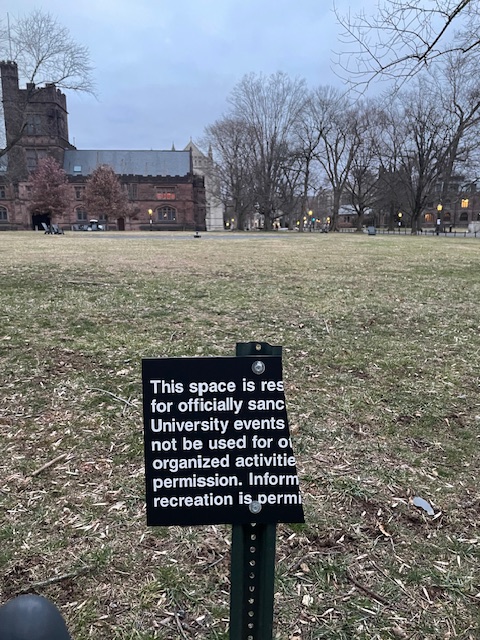
The vandal’s dissent (taken January 8, 2026)
His Majesty’s troops occupied Princeton, including the University, for about two days in early 1777. The recent closure is currently a few months shy of the two year mark: it began around May 15, 2024 and continues to this day, making it by far the longest in the University’s history. The University, by the way, was founded in 1746, some thirty years before the Republic itself. So it’s fair to call the closure both historically unprecedented and historically significant. And yet I don’t think anyone’s about to issue a Proclamation celebrating the University’s retrogression to the days of absolute monarchy. That said, if anyone could have written one, Coughlin, Eisgruber & Co. would surely qualify.
The closure of Cannon Green was a panic-stricken response to Princeton’s Gaza Solidarity Encampment, which began in mid-April 2024, moved to Cannon Green on May 1, and was shut down by the University around May 14. Clearly, the trauma of the event continues to reverberate in the fragile psyches of the Board and Administration of the University, which is probably the best argument there is for repeating some version of the experience in the near future.
“Antiquarian history,” Nietzsche writes, “degenerates the moment that the fresh life of the present no longer animates and inspires it” (Nietzsche, On the Advantage and Disadvantage of History for Life, §3, p. 21). That’s essentially where Eisgruber and his administration (and much of the state legislature and some of his faculty) are, lost in a comforting and confabulated past designed to avoid engagement with the present. The Revolutionary Army at least had the virtue of marching forward into battle. Leave it to the leadership of the Ivy League to march backwards into the world well lost. If only they’d march there and stay there. Too bad they’ve invented a form of marching that keeps them stationary while giving the illusion of progress. It’s the only kind of revolution they know–the kind where you turn circles but go nowhere.
 Policy of Truth