The migrant defense group that I work with, Resistencia en Acción, held a rummage sale the other day, raising $3,700 for migrants detained in a recent set of raids here in Princeton. That, by any measure, is a success. Think about what was involved in making it happen.
Someone had to conceive the idea, then convey it to others willing to help make it happen. Tasks had to be divided up, and people had to be held to keeping whatever promises of assistance they made. The organizers had to find a space within which to hold the event. They had to acquire several roomfuls of items to sell, then go to the space they’d acquired and arrange the items there. The space in question was a set of rooms in a church, not presently set up for a rummage sale. So that had to be set up. “That had to be set up” is elliptical for hours of work too tedious to describe: the space in question was the size of small house; anyone who’s moved homes, even from one apartment to another, knows what’s involved.
Once everything was there, the organizers had to set the event up for electronic sales–Venmo, etc. (It’s an axiom that if you set an event up for Venmo, someone will complain that you haven’t set it up for their preferred method of payment, e.g., Velle, PayPal, credit card swipe or tap, etc. That had to be dealt with, too.). Someone had to dot any number of legal i’s and cross any t’s, including issues of liability. What happens if someone slips and falls? What if a product proves defective? What if someone leaves a door open, lets a murder hornet in, and someone is stung by it? As it happens, someone did leave a door open, and did let a murder hornet in, but I guess it was a pro-migrant hornet, so it didn’t sting anyone.
The organizers then had to advertise the event, hoping that a sufficient number of people would attend. Since the event was likely to be long enough to span at least one meal time, they had to set up a potluck to feed the dozens of people involved. They ran a raffle in tandem with the rummage sale, so they had to arrange that, including a microphone, amplifier, etc. Then they had to run the sale itself for a couple hours, greeting people, making sales pitches, answering questions, making sales, collecting money, etc. I’m skimping on the details, because they’re simply too boring to list, even for purposes of valorization. But boring or not, they had to be done.
Once the event was over, the organizers had to arrange to donate any unsold items, and there were plenty of them. Then they had to clean up. And then, finally, they had to disburse the funds to the detainees, or their families. That presupposes, of course, that they’d done enough research to know who the families were, what their needs were, and how funds could be disbursed to them. Which of course they had. As a postscript, Resistencia and allied groups described the event on social media in an overtly celebratory spirit. Or as academic experts like Justin Tosi and Brandon Warmke might have put it, they engaged in the “abuse of moral talk” known as “grandstanding.”
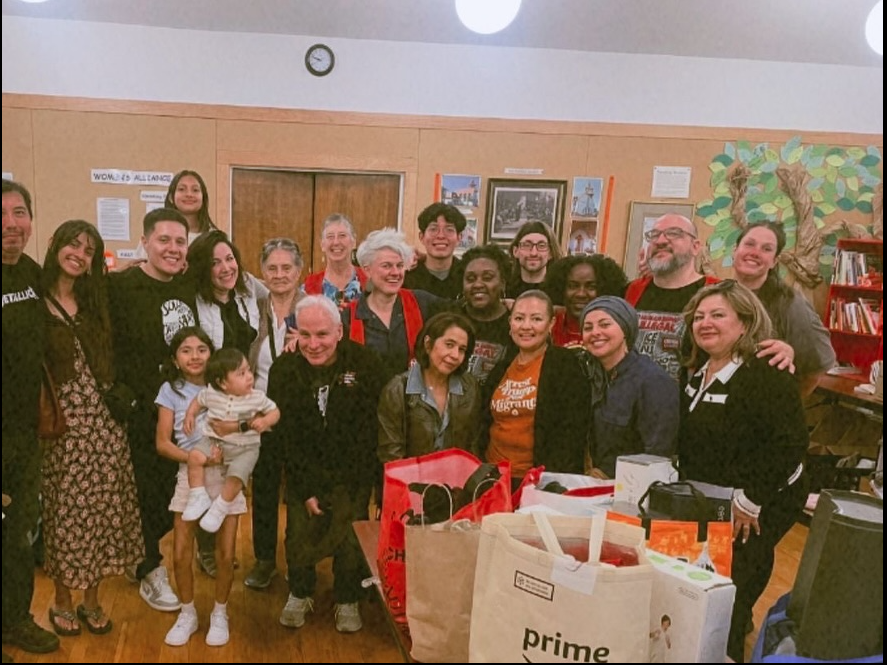
“Moral grandstanding as a threat to free expression” (photo credit: Resistencia en Acción)
This is a very simple instance of activism involving that stereotypical bourgeois-capitalist activity, the sale of consumer goods. The relation between means and end is straightforward, and needs no elaborate explanation. The point and value of the end is itself straightforward: detainees need money, but lack any means of acquiring it; the money they got from the rummage sale spares the detainees some measure of needless suffering and privation.
Most of the work involved is unglamorous scut work of one sort or another; much of it (cooking, cleaning, organizing, arranging) is stereotypical “women’s work.” It took hours even for a couple dozen people to get it all done, but it obviously had to get done if the event was going to take place. You had to be there to know that the whole enterprise took place bilingually, in English and in Spanish. You’d have to have been involved for a while to know that the bilingual aspect of the event presupposed some long-term, off-stage effort: Spanish-speakers had to work to acquire English-language skills, and vice versa. If you knew that much, you might also know that there’s pressure on to make these events tri-lingual so as to accommodate Creole speakers of Haitian background. In a world where the schools don’t make us multi-lingual, someone has to.
The Resistencia rummage sale might look to some like mere “volunteerism” or “charity work,” but without contesting those descriptions, I would insist: it’s activism. Like it or not, recognize it or not, believe it or not, this is what activism looks like. When you see “performative” demonstrations of people chanting slogans in the street, that’s activism, too, but it’s activism in the way that an advertisement “is” capitalist exchange. An advertisement is an invitation to capitalist exchange, not the exchange itself. Likewise, a street demonstration is an invitation to activism, not the activity itself.
As in capitalist exchange, so in activism, there’s always a danger that the marketing campaign will overtake the supply line or overshadow front-line production. But as with both activities, the advertising campaign serves the productive process, not the other way around. In activism, unlike most capitalist exchange, the product is justice, sometimes in the form of what Alasdair MacIntyre calls “just generosity,” that is, the charitable giving that is in some complex sense owed to its recipient. And in activism, unlike most capitalist exchange, the product is not entirely distinct from the act involved in producing it: justice is both part of the process and a final product; justice can only be produced justly. But the relevant point is that there is a product, and there is such a thing as success or failure at producing it.
Contrary to popular belief, then, activism properly conceived is not a matter of mindless or performative “grandstanding” in the sense now prevalent. It’s a structured, disciplined activity that aims to get something done. In migrant defense work, the aim is obvious: to defend migrants against the range of attacks that target them; to strengthen their capacity to deal with the hostile environment in which they find themselves (e.g., ESL classes, know-your-rights trainings, interventions into employer-employee disputes); and to build a network that helps integrate them into a community that regards its activities, self-consciously, as aimed at a common good. If anyone besides activists is doing this, I have yet to see it. And if you don’t think it needs doing, I infer that you’re either indifferent or hostile to the interests of migrants, or don’t know what you’re talking about.
With all that in mind, consider some classic criticisms of activism, reproduced below. In selecting them, I had to choose between reproducing a generic AI meta-summary of classic criticisms, or dwelling on specific criticisms from particular individuals. There are pros and cons either way–the standard ones involving trade-offs between generality and specificity–but I went with the former in this case.

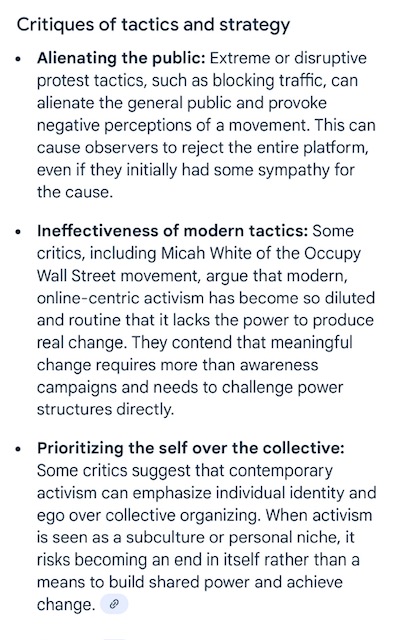
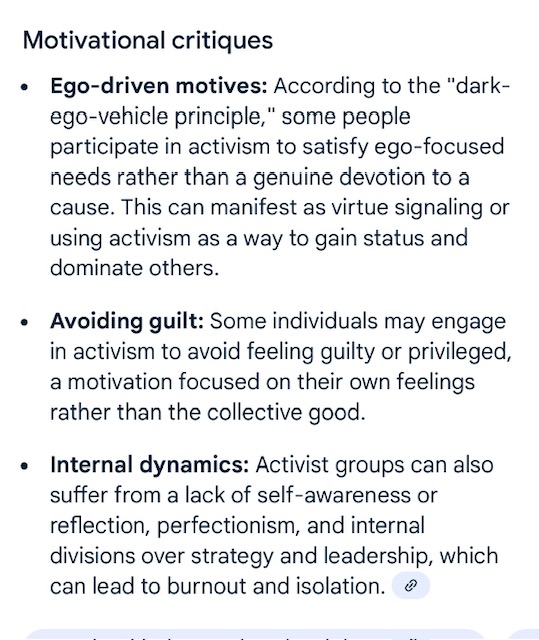
These criticisms are clueless. To state the obvious, none of them is distinctive to activism, so that none of them, even cumulatively, adds up to a criticism of activism as such. Activism can be performative, but so can a lot of things, like a business meeting. Activism can revert to low-effort modes of behavior, but so can other things, like a marriage. Activism can take place in an echo chamber, but so can a lot of things, like a profession, a website, a publication, a media corporation, or the public life of a whole country. Activism can alienate the public, but so can performative apathy or carping criticisms; and if activism can alienate the public, it can also capture the public’s imagination, and elevate it to new heights. If activism is ineffective, so, surely are voting or writing your elected representative. And so surely is inertial inaction. Nothing is fully effective but omnipotence.
Activism can be self-seeking, but so can the pursuit of career or apolitical hedonism. Some people participate in activism to allay a sense of guilt, but some don’t, and maybe others feel guilt for a good reason, and expiate it for an equally good one. Activist groups suffer from problematic group dynamics, but so do religious groups, trade groups, governments, corporations, hospitals, gyms, and fraternities. Problematic group dynamics are endemic to groups as such–human as well as non-human–not particular to activist groups. And while problematic group dynamics are by definition problematic, the only foolproof way of eliminating the problems involved would be full-scale planetary biocide. That seems drastic to me, and out of a sense of interpretive charity, I attribute the same reaction to these critics.
These criticisms represent the perspective of spectators looking in at an activity from the outside while in the grips of a disdainful but fundamentally ignorant incomprehension. None betrays any sense of the diversity of activities that qualify as activist, or the diversity of locales in which activism finds expression. Each relies on a series of stereotypes gotten from half-remembered protests observed from some distant, lofty vantage. Each dredges up some objection or accusation based on that memory. Each uses that reaction as the basis for a set of armchair speculations that stand in for knowledge. But none really strikes me as knowledge.
None of these criticisms applies to my rummage sale example or to any of the myriad activities–outreach, education, lobbying, litigation, networking, fundraising, negotiation–that constitute the bread-and-butter of a real-life activist campaign. The critics see what strikes them as the off-putting spectacle of people chanting protest slogans, marinate in the disdain they feel, and take it from there.
These critics remind me of my father’s attitude toward my mother’s cooking. My mother was widely acknowledged to be a great cook. My father took the lion’s share of the credit for her cooking on the grounds that at the beginning of their marriage, she couldn’t cook, but after a couple of decades, she’d become a veritable chef. How? Well, largely through attention to his sage criticisms of her cooking. She cooked; he ate; he criticized. The criticisms found their mark, and by an unspoken process, improved her cooking. It all kind of made sense, at least to him: his eating was after all the end for the sake of which her cooking served as means. Since the end determines the means, he was the one who made the improvements, leaving her labor–aka, the cooking–a kind of accidental byproduct of his criticisms.
The story is both funny and not-funny. Funny because of how preposterous it is. (To be fair, it may have been intended tongue-in-cheek. With my father, you never knew.) But taken literally, neither as humor nor tongue-in-cheek, it expresses an offensive, ignorant hauteur that needs to be brushed back. Imagine spending a lifetime cooking the family’s meals, and achieving proficiency at it, only to be told that those who had made zero contribution except by way of consumption deserved the credit for that labor, and were entitled to sit on the sidelines and issue Caesar-like verdicts on the quality of the effort.
When it comes to Moms and cooking, the point seems obvious enough. But when it comes to activists and activism, the very same point somehow becomes a labyrinth of inscrutability. People who have done nothing or less than nothing in the way of resistance to tyranny or injustice sincerely believe that their inactivity or brave talk entitles them to all manner of hand-waving criticisms. I don’t mean that no non-activist can ever criticize any activist or form of activism, or that no non-practitioner of activity X can criticize some practitioner of X. Non-criminals can criticize crime. Non-soldiers can criticize the military. Non-physicians can initiate malpractice suits. What I mean is that the blanket criticisms commonly made of activism as an activity, made by people with little or no acquaintance with the activity, are indistinguishable from my father’s claims about my mother’s cooking. They are exercises in grandstanding, the vice so often attributed to activists. Worse yet, they’re ignorant exercises in grandstanding, made by critics who really have no idea what they’re talking about.
That has to stop, and if it doesn’t, the critics have to be put in their place–nicely at first, less nicely as time goes by, not nicely if niceness proves insufficient, as it so often does. Subtract activism from human history and what you get is moral stagnation or worse. If people want stagnation, they should say so, but mostly they don’t. They’re content to attack the sources of moral progress, while taking credit for the outcome. The credit is not theirs to take. Activists should insist on that point, and fight for it, until it finally prevails.
Thanks to Radio Jornalera NJ for cross-posting. Thanks also to Hilary Persky for helpful feedback.
 Policy of Truth